Showing posts with label Kush. Show all posts

Saturday, 2 November 2019

Some African History from 750-500BC

Statue of Taharqa offering wine to a god
This is a quick overview of African history from the year 750BC to the year 500BC. Due to the nature of the sources it will be rather focused on Egypt. This is unfortunate, but somewhat inevitable, as Egypt is the one of the best documented places in the world at this time. However, during this time other sources begin to appear in the historical record, which brings joy to all those who love history.

Outside of Egypt there was a complex and powerful civilisation in the kingdom of Kush, which lay along the Nile to the south of Egypt. This land is also sometimes referred to as Nubia. The land of Punt, which had been the destination of Egyptian trading expeditions during the New Kingdom disappears from the records and while it may still have existed, we have no knowledge of it.

Nok culture terracotta artefact
The lower edge of the Sahara had seen the development of agriculture, although there is no record of extensive bronze metalworking from this period. This is to be expected as tin was very scarce in the ancient world and there were no easy trade routes past the Sahara at this time. While bronze-working was not evident in that region, iron-working does seem to have become known to the civilisations in the Sahel and further south around this time.

Further south of the equator humans still lived as hunter-gatherers, as their distant ancestors had done for millennia. This was more to do with the sophistication of their hunting techniques than anything else. Unlike other parts of the world they had not had the need to develop agriculture and their culture was perfectly adapted to its surroundings. However, if farming groups were to arrive in the area from outside, this would change the balance of the environment and tip the scales in favour of the agricultural groups.

The Nok culture was thriving at this time, in what is now the country of Nigeria. Meanwhile the speakers of Bantu languages had already begun the process of expansion that would see their languages spread over most of sub-Saharan Africa. The Bantu speakers had already reached the rainforests of the Congo Basin and the Ugandan highlands around this time, but it is hard to know the exact spread of this language family at this time.

By the year 740BC King Piye of Kush had enforced a loose hegemony over the Egyptian rulers of Upper and Lower Egypt and probably had tributary arrangements as far north as the Nile Delta. However, the rulers of the city of Sais probably felt threatened by this.

Burial ground at El-Kurru in Kush
In the year 732BC Tefnakht of Sais declared himself to be the Pharaoh of Egypt and the founder of the 24th Dynasty of Egypt. This was while both the 22nd and the 23rd Dynasties were still technically ruling Egypt as well. Tefnakht began to form the Libyan princes who ruled the cities of Egypt into an anti-Kushite alliance.

In the year 728BC Piye of Kush responded. He sent his troops to break the siege of Heracleopolis and then pushed northwards in the following year 727BC, receiving the surrender of forts and cities along his route. Those who surrendered were not killed however and it seems that Piye even captured another of the sons of Tefnakht and did not put him to death. The victorious march continued until the king had reached the city of Memphis, which was strengthened by Tefnakht with 8000 troops who marched in secretly during the night, however Tefnakht himself left the city on horseback, leaving the garrison to fend for itself while he organised resistance among the cities of the Delta. Memphis was surrounded by high walls and arms of the river encompassed it on the eastern side. Some of his generals advocated a long siege however Piye decided on the element of speed and surprise, commandeering all boats available, plus his own fleet, and rushing against the river walls. The city was taken by siege and put to the sword. By the second day the looting and killing had stopped and Piye had taken full control of the city.

Stele of Piye
Then he sent forth his fleet and his army to assault the harbor of Memphis; they brought to him every ferry-boat, every cargo-boat, every transport, and the ships, as many as there were, which had moored in the harbor of Memphis, with the bow-rope fastened among its houses.
Piye Stela

The bloody siege of Memphis and the incredible speed it had been taken left the northern princes, chiefs and little kings no choice but to surrender. Osorkon of Tanis, probably the second strongest of the kings of the Delta after Tefnakht, surrendered in Heliopolis and gave tribute. The other kings followed suit shortly in the city of Athribis. While Piye organised his armies, a city in the western delta, called Mesed rose up against the Kushites, but was crushed by the Kushite armies and the forces of Pediese, a Libyan king who had submitted to Piye. After this final defeat Tefnakht finally surrendered but refused to come to meet Piye and bow down before him. Tefnakht had fled, perhaps to Crete or Cyprus, and refused to risk his life or humble his pride. The last remaining chieftains submitted to Piye, where they were humiliated by not being allowed inside the palace due to their ritual uncleanliness. Instead they had to kiss the ground at the feet of Piye outside the palace and were left outside once the surrender was complete.

Then came those kings and princes of the Northland, all the chiefs who wore the feather (meaning Libyans rather than Egyptians), every vizier, all chiefs, and every king's confidant, from the west, from the east, and from the islands in the midst, to see the beauty of his majesty.
Piye Stela

Pyramid of Piye at El-Kurru
Piye had the stela written glorifying his exploits in the style of the great Egyptian warrior kings of old, like Tuthmosis III or Ramesses II. He stressed his reliance on the Egyptian gods and his ritual purity, the innovative tactics he had used, the mercy he showed to those who surrendered and the retribution he gave to those who did not, although his methods of waging war were humane by the standards of the day and almost humanitarian compared to the Assyrian methods. But most of all he stressed that this was not merely a civil war, nor an invasion from the south but that he, a true Egyptian, was finally ridding Egypt of the sway of unclean Libyan foreigners. His account has sometimes been compared to a religious crusade although that is probably overstating matters. Piye's capital however was in Napata, in present day Sudan, so after having set the Delta in order and reconfirmed the now loyal sub-kings, he returned to Napata with all the spoils of victory. The sub-kings would not rise again against the Kushites.

This war also ended the 23rd Dynasty, although a descendant of Tefnakht would rule at Sais for another few years as the second and last king of the short lived 24th Dynasty. Osorkon IV, the last king of the 22nd Dynasty continued to hold his throne in Tanis, but as a vassal of the Kushite Pharaohs. Piye was declared the Pharaoh of Egypt and the first ruler 25th Dynasty of Egypt.

Piye died in 714BC and was buried in a large pyramid in the Kushite royal cemetery of El-Kurru. He was succeeded by his son Shebitku, who may have been followed by Piye's brother Shabaka. Their reigns saw the crushing of the 24th Dynasty at Sais and the ending of the 23rd Dynasty at Tanis. The north-eastern border of Egypt was threatened by the Assyrians who were expanding their empire in the Levant. The Kushite general Taharqa attempted to save the Kingdom of Judah from the Assyrians, but was defeated at Eltekeh.

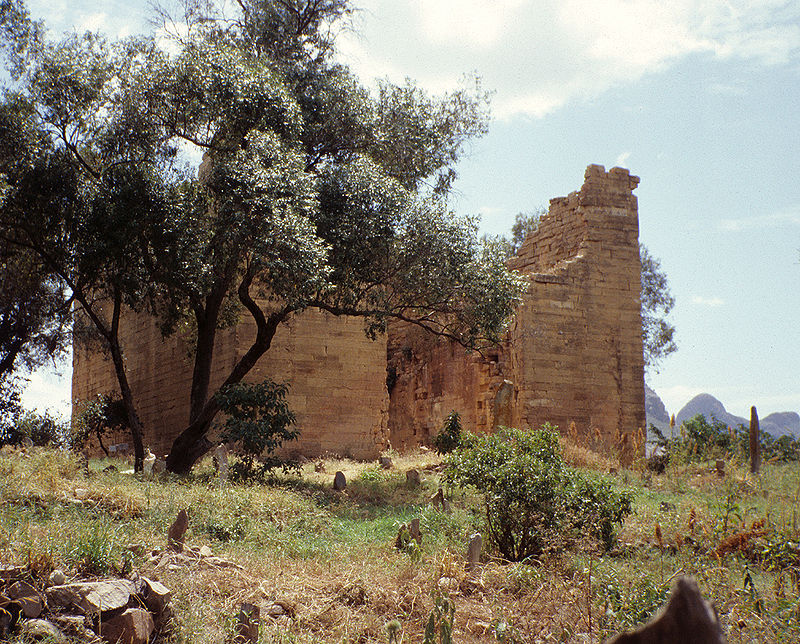
Temple of the Moon God at D'mt
During this time the kingdom of D'mt was reaching the zenith of its power and glory. Their kingdom was centred on their capital at Yeha, in what is now northern Ethiopia. They built a great temple at Yeha, part of which still stands today. It was probably dedicated to the Moon God, but this is unclear.

Inscriptions in the Sabaean script have been found from this region and most amazingly, they record the names of kings and queens for this obscure kingdom. They use Sabaean titles for their rulers, as well as the Sabaean script, so it is very clear that the kingdom was culturally influenced by the Sabaeans, but it does not seem as if they names of their kings and queens were Sabaean.

The kingdom of D'mt did not merely centre on Yeha, but had a number of other cities, mostly in the region of what is now the country of Eritrea. These included Hawulti, Matara and Qohaito, all of which may yield more information on the history of this land when excavated more fully in the future.

Sabaean inspired writing from the kingdom of D'mt
In Egypt and Kush, Taharqa acceded to the throne in 690BC. He appears to have been a strong and capable Pharaoh, but he faced a very serious threat. The Assyrian Empire was at the height of its power and, under their king Esarhaddon, invaded Egypt in 671BC. The Assyrians captured Memphis after a fierce struggle and while Taharqa escaped, other members of the Kushite royal family, including the crown prince Ushanahuru, were captured by the ruthless Assyrians.

Esarhaddon was faced with rebellion in his own kingdom and withdrew shortly after the capture of Memphis. But even so, this was the most terrible invasion that Egypt had seen in many centuries. The Libyans and the Kushites had both seen themselves as in certain sense Egyptian. The Assyrians were simply foreign conquerors. We have a prayer from Taharqa at this time.

Oh Amun, … my wives, let my children live. Keep death away from them, for me. 
Prayer of Taharqa, written around 670

The Egyptians rebelled against the Assyrians in 670BC and Taharqa came back to the attack. Esarhaddon died as he was returning to Egypt to crush the Kushite counterattack. His son Ashurbanipal took over the conquest. In 667BC Ashurbanipal returned to Egypt and defeated Taharqa once more. One of the Egyptian princes of Sais had been placed as an Assyrian governor of Lower Egypt and even though he had rebelled against the Assyrians, Necho I was returned to Egypt as a client ruler of the Delta in the name of the Assyrians.

Pyramid of Taharqa at Nuri in Kush
Taharqa died around 664BC and was buried in a grand pyramid at a new royal cemetery at Nuri. It was succeeded by Tanutamon, also known as Tantamani. Tantamani attacked the Assyrians, killing their vassal king Necho I, and the Assyrians counterattacked, pushing southwards to Thebes in Upper Egypt. Here they attacked until they had captured it and sacked it, causing great destruction in one of the greatest cities on earth. This destruction of Thebes effectively pushed the Kushite rulers back into Kush. The end of Kushite rule is generally held as the end of the Third Intermediate Period of Egyptian history and the beginning of what is known as the Late Period.

In 656 Psammetichus I, son of Necho I, recaptured Thebes, ending Kushite rule in Egypt. This was at least partly because the Divine Adoratrice of Amun (High Priestess) was a sacred figure and had been left alone by the Assyrians and Egyptians. This person had joint control over the city of Thebes and control of the vast estates of the temple of Amun. The current Adoratrice was Shepenupet II, a Kushite and a long-lived daughter of Piye, the first Kushite Pharaoh of Egypt. Shepenupet was old and had adopted a daughter, Amenirdis, the daughter of Taharqa, to succeed her.

Relief of Nitocris and Psamtik I
The estates of Amun were too powerful to be left in the hands of the relatives of a rival Pharaoh, so Psammetichus (or Psamtik I depending on what naming convention is used), decided to force Shepenupet to adopt his daughter, Nitocris, instead, so that on Shepenupet's death, Nitocris would become the next Adoratrice. This forced adoption took place in 656 and is commemorated by a stela of Psammetichus. This time period sees Psammetichus gradually increasing his power to the point where he would be able to defy the Assyrians and expel them from his land. Assyrian forces may have begun to withdraw from Egypt from around 654 onwards. Psammetichus I now ruled as a Pharaoh of the 26th Dynasty of Egypt.

In the year 9, second month of the first season, day 14, they arrived at the city of the gods, Thebes. As she advanced, she found all Thebes, men and women alike, standing, rejoicing at her approach, surrounding her with great offerings, a multitude in number. Then they said: "The daughter of the King of Upper Egypt, Nitocris, comes to the house of Amun; that he may receive her and be satisfied with her. The daughter of the King of Lower Egypt, Shepnupet, comes to Karnak, that the gods therein may honour her."
Adoption Stela of Nitocris

Relief showing Shepenupet
Psammetichus was also famed in literature for conducting possibly the first scientific experiment ever, or at least the first psychological experiment. The Egyptians had always claimed that they were the oldest civilisation in the world. Psammetichus sought to prove this by having some children raised without listening to the speech of others and trying to figure out which language the children would spontaneously speak, assuming that they would speak the original language of mankind and thus, find the oldest civilisation. This experiment supposedly showed that the Phrygians were the oldest civilisation, which is interesting, as that can hardly have been the expected outcome. This was determined by the fact that the children kept saying the word "bekos" when pointing at bread, which roughly matched the Phrygian word for bread, but not the Egyptian. However, this story is nowhere recorded among the Egyptians and is only taken from the much later Greek texts of Herodotus.

Stela of Tefnakht
While we cannot prove if the language experiment was real or not, we can be certain that a new form of writing was pioneered in Egypt around this time, called the Demotic script (capitalised to avoid confusion with Greek "demotic" script). This was a short-hand script that could be used to transcribe hieroglyphs quickly and in some ways replaced an earlier short-hand known as hieratic. It was not an alphabet but it could be used to speed up writing and was widely adopted. It was part of the much later Rosetta Stone that was later used to decipher the Egyptian hieroglyphs.

According to legend the Greek colony of Cyrene was founded in Libya with Greek colonists and native Libyans in the year 631BC. It had good relations with the native peoples and it was unusual for Greek colonies, in that the main city was founded slightly inland, rather than directly on the sea, as was more usual. The colony would become famed for its export of silphium, a rare plant that only grew near this region and was believed to be not only the finest of delicacies, but also a herb with powerful healing properties. Silphium became the main export of Cyrene under the reigns of the Battiad kings, who ruled the colony for some centuries after its foundation.

In the year 609BC Necho II of Egypt led an expedition as far as the Euphrates River to try and save the remnants of the Assyrian Empire, which was on the verge of destruction by the Babylonians and the Medes. On the way there he defeated King Josiah of Judah in battle at Megiddo. After some initial successes, the Egyptian force was dealt a serious defeat in 605BC and was pushed back to the borders of Egypt by the Babylonians. The Egyptians defeated the Babylonians on the frontier in 601BC, but the Babylonians were still an active threat in the region.

Nok culture terracotta artifact
Around the year 600BC the people of the Nok culture had definitely developed iron-smelting techniques. It is unclear if they developed these independently or if they had received external knowledge. I suspect that the knowledge of iron-working was brought from artefacts traded across Africa, but that the techniques of iron-working were developed independently. The sophistication of their smelting furnaces was quite impressive and the quality of their iron was some of the best in the world at the time. An important smelting site was located at the present-day town of Taruga, near the Nigerian capital city of Abuja.

Around 595BC Pharaoh Necho II died and was succeeded by Psamtik II. He was one of the most fascinating individuals of this time period and seems to have had many excellent ideas. Perhaps he was too ahead of his time though, as most of his ideas seem to have failed in their execution.

Necho II is supposed to have attempted to link the Red Sea to the Nile in the earliest version of the Suez Canal to have been attempted. This was a gigantic work and was truly a work of vision but there were problems with it, namely that there is a considerable difference in water levels between the two bodies of water. There are no Egyptian inscriptions for this but we know the story from Herodotus, who says that Necho II stopped construction after receiving an unfavourable oracle.

Depiction of Necho II
Necho II then appears to have commissioned an even more intriguing expedition. He hired Phoenician sailors, the greatest sailors of the ancient world, to set sail from the Red Sea and to attempt to circumnavigate Africa. According to Herodotus, who again, is our sole source for the story, the sailors did not return for a long time but did eventually arrive back in Egypt having sailed around the continent and coming back through the Straits of Gibraltar. This was an unprecedented feat and one that was not to be repeated to our knowledge until the Age of Exploration. The sailors told tales of the sun being in the wrong position, which led the Greeks, and perhaps the Egyptians, to discount the story. This however makes it much more plausible, as it suggests that the Phoenicians did in fact reach the southern hemisphere.

For Libya shows clearly that it is bounded by the sea, except where it borders on Asia. Necos king of Egypt first discovered this and made it known. When he had finished digging the canal which leads from the Nile to the Arabian Gulf, he sent Phoenicians in ships, instructing them to sail on their return voyage past the Pillars of Heracles until they came into the northern sea and so to Egypt. So the Phoenicians set out from the Red Sea and sailed the southern sea; whenever autumn came they would put in and plant the land in whatever part of Libya they had reached, and there await the harvest; then, having gathered the crop, they sailed on, so that after two years had passed, it was in the third that they rounded the pillars of Heracles and came to Egypt. There they said (what some may believe, though I do not) that in sailing around Libya they had the sun on their right hand.
Herodotus, Histories: 4:42

Statue of Anhknesneferibre
When Psamtik II took the throne he instated his daughter Ankhnesneferibre as Divine Adoratrice of Amun in Thebes. This was in the year 595 or 594 depending on what is counted as the first year. This was an important position, in certain ways perhaps the second most important position in Egypt after the Pharaoh himself, so it was important to ensure that this post was held by someone loyal to the dynasty. Nitocris I adopted the princess to ensure that she would become God's Wife on the death of Nitocris. Thus the Saite Dynasty (the 26th Dynasty) further strengthened its hold on the southern part of Egypt.

Year 1, third month of the third season, day 29, under the majesty of Horus: Favourite of the Two Goddesses: Mighty of Arm; Golden Horus: Beautifying the Two Lands; King of Upper and Lower Egypt: Psamtik II, given life. On this day the king's-daughter, Ankhnesneferibre, arrived at Thebes. Her mother, the Divine Consort, Nitocris, who liveth, came forth to behold her beauty, and they went together to the House of Amon. 
Stela of Ankhnesneferibre, written circa 594BC

Around 590BC the Kushite capital appears to have moved south from Napata, which was vulnerable to raids from the reinvigorated Egyptian kingdom, to Meroe, which was further south along the Nile. Napata was still held by the Kushites however and their kings continued to be buried in the royal cemetery of Nuri during this time.

In the year 589BC Apries of Egypt, known as Hophra in the Biblical record, succeeded to the throne. He was unable to prevent the rise of Babylonian power in the region, and it is possible that there was a Babylonian invasion during his reign, but this is unclear. He was overthrown by the usurper Amasis II in 570BC after a failed invasion of Cyrene.

Relief from Jebel Barka in Kush
I am not sure of when this story took place, but I have presumed it to occur at some point around the year 550BC, if it happened at all. The cities of Carthage and Cyrene both existed along the North African coast: Two trading cities, one Phoenician, one Greek. Neither side had great interest in the desert interior and were both more interested in trading with the rest of the Mediterranean. Thus they decided to draw a border between them. It was decided that two runners would set out from each city and run as fast as they could along the coast until they met the runners from the other city. Supposedly the Carthaginian runners made incredible speed and met the runners from Cyrene well over halfway away from Carthage. The runners from Cyrene understandably were annoyed and accused the Carthaginians, two brothers known as the Philaeni Brother, of cheating. Cheating may in fact have taken place. The Greeks wanted to rerun the race while the Carthaginians wanted the result to stand.

AD1872 painting of the Battle of Pelusium by Lenoir
Eventually the Greeks agreed to a compromise. They would accept the result, if the Philaeni Brothers were to be slain. If the Philaeni Brothers wanted to live they would rerun the race. The Philaeni chose to die so that their homeland could enjoy the advantage that they had won for it. Solemn sacrifices were made and until the time of late Antiquity the boundary between the two regions was fixed at the Altar of the Philaeni. Later the Roman Empire would be split into east and west at the point where the Philaeni Brothers died. I'm not sure when this story happened and I'm not at all sure if the story is true. It probably is not. But there are no records of Cyrene and Carthage going to war at least.

In 525BC the Babylonian Empire had fallen and the Persian Empire now dominated the Middle East. Led by their ruler Cambyses II, the son of Cyrus the Great, the Persians invaded Egypt, which was now ruled by the son of Amasis, Psammetichus III. There was a great battle fought at Pelusium, which the Persians won. There are some strange legends about the Battle of Pelusium that lead it to be known as the Battle of the Cats. This comes from a much later Greek book however and should not be taken too seriously. Egypt was now part of the huge Persian Empire. This ended the 26th Dynasty of Egypt. The Persian kings are sometimes referred to as the 27th Dynasty of Egypt.

Wall paintings from the tomb of Tanutamani
Around the year 500BC the Magonid kings began their rule of the city of Carthage. They were from a family that bore the name of Mago, e.g. Hamilcar Mago or Hannibal Mago. Very little is known of the constitution of Carthage around this time and even though it was ruled by kings during this period, there probably was some form of Senate, or Council, to moderate the decisions of the kings.

Around this time the ancestors of the Khoikhoi group probably began to inhabit the region to Twyfelfontein in what is now present-day Namibia. The region is known for its rock art in the caves and cliff faces. These rock carvings and paintings are preserved due to the aridity of the region, which receives very little rainfall. It was probably a sacred site or a gathering place for the hunter-gatherers of the region, but sadly little can be said about it.

During all this time the speakers of the Bantu languages were gradually moving southwards into the rainforests of central Africa. Over the next millennium they would gradually extend their languages across much of the central and southern reaches of the continent.

Wall paintings from the tomb of Tanutamani
And thus the period draws to a close. Egypt had seen the end of the New Kingdom, followed by the Libyan and Kushite rule of the Third Intermediate Period, followed by the Persian conquest after the 26th Dynasty. Even after the Kushite defeats, Kush was still one of the strongest states in the world at the time. The period also saw the growth of the Phoenician city of Carthage on the northern coast of Tunisia, and the foundation of the Greek colony of Carthage on what is now the northern region of Libya. The Iron Age sub-Saharan Africa began in earnest with the adoption and refinement of iron-working by the Nok Culture. In the east of Africa the little-known kingdom of D'mt was flourishing.

Sphinx of Amasis
Primary Sources:
Piye Stela, written circa 720BC
Prayer of Taharqa, written around 670BC
Adoption Stela of Nitocris, written circa 656BC
Herodotus, Histories: 4:42, written circa 440BC
Stela of Ankhnesneferibre, written circa 594BC

Related Blog Posts:
Some African History from 4000-3000BC
Some African History from 3000-2000BC
Some African History from 2000-1500BC
Some African History from 1500-1000BC
Some African History from 1000-750BC
Some African History from 750-500BC

Friday, 1 November 2019

Some African History from 1000-750BC

Temple of Amun from Kush
This is a quick overview of African history from the year 1000BC to the year 750BC. Due to the nature of the sources it will be rather focused on Egypt. This is unfortunate, but somewhat inevitable, as Egypt is the one of the best documented places in the world at this time.

Outside of Egypt there were sophisticated cultures in Nubia/Kush and Punt, although Nubia had been subjugated by the Egyptian state during much of the New Kingdom period in Egypt and Punt seems to have faded into obscurity. The lower edge of the Sahara had seen the development of agriculture, although there is no record of extensive bronze metalworking from this period. This is to be expected as tin was very scarce in the ancient world and there were no easy trade routes past the Sahara at this time.

Further south of the equator humans still lived as hunter-gatherers, as their distant ancestors had done for millennia. This was more to do with the sophistication of their hunting techniques than anything else. Unlike other parts of the world they had not had the need to develop agriculture and their culture was perfectly adapted to its surroundings. However, if farming groups were to arrive in the area from outside, this would change the balance of the environment and tip the scales in favour of the agricultural groups.

Nok culture terracotta sculpture
The Nok culture was beginning to thrive around this time, in what is now the country of Nigeria. Meanwhile the speakers of Bantu languages had already begun the process of expansion that would see their languages spread over most of sub-Saharan Africa. The Bantu speakers had already reached the rainforests of the Congo Basin and the Ugandan highlands around this time, but it is hard to know the exact spread of this language family at this time.

Around the year 1000BC the kingdom of Kush had once again broken free of Egypt. We know very little of their rulers or politics at this time, but they seem to have been free once more as Egypt became weaker. In Libya, with the power of the Egyptians waning, the local tribes seem to have become independent and to have taken control of the oases, as well as having more and more influence in the Delta region of Lower Egypt. These tribes are sometimes spoken of as ancestors of the later Garamantes people, but the name for the ethnic group that the Egyptians used was “Meshwesh”.

Further south in Africa, it seems likely that speakers of the eastern Bantu languages had reached what is now Uganda by around this time. These dates should be treated as extremely approximate, as they are based on linguistic reconstructions.

Far to the west, the Canary Islands were possibly settled by this time. Perhaps this settlement was by a group of people known as the Guanches, who were later known in classical antiquity. Perhaps the settlement was by an entirely different group of people who were wiped out by later groups arriving on the islands.

Bubastite Portal of Shoshenq I
Around the year 943BC, Shoshenq, a Libyan chieftain of the Meshwesh tribe took control of Lower Egypt and declared himself to be the new Pharaoh. This was not as the result of a foreign invasion, but was more akin to a palace coup. Shoshenq was already the lead adviser and chief general of the armies of Egypt. When the king died, it made sense for the person who actually held the reins of power to take on the reigning of the state.

Shoshenq I declared a new Dynasty, the 22nd Dynasty of Egypt, and his accession to the throne is generally seen as the ending of the New Kingdom Period in Egypt, and the beginning of the Third Intermediate Period. Shoshenq I built great monuments in Egypt and led an expedition into the lands of Canaan, which was the first such expedition in many long years. Shoshenq is usually said to be the same person as the Biblical Shishak and thus

However, this projection of power into the Levant appears to have been brief. Shoshenq’s successors do not seem to have maintained more than a trading presence in Canaan and the Levant and the New Kingdom Empire in the region was not restored.

Make to triumph, Shoshenq, triumphant, the great chief of Ma, chief of chiefs, the great … and all who are before thee …, all the troops …."
Said to him, Amon-Re, king of gods: "… I will do … for thee, thou shalt attain old age, abiding on earth; thy heir shall be upon thy throne forever."
Endowment Stela of Shoshenq I, written circa 930BC

Remains of Temple of Amun in Kush
Around the year 900 the Nok Culture in what is now the region of Central Nigeria seems to have become much wealthier. It is possible that the Nok craftsmen had mastered iron-working at this time, but this is not confirmed. The Nok now began creating high-quality terracotta figurines, which are still highly sought after by museums around the world. Sadly, conflict in the area currently has led to many of these figurines being looted and removed from their archaeological context.

Also around this time, the kingdom of D’mt was founded in what is now the Eritrean/Ethiopian region. It seems to have close connections with the Sabaean kingdoms in southern Arabia and there was much trade across the Red Sea between the coasts of present-day Yemen and Eritrea.

Despite the Arabian influence, it does seem that the kingdom of D’mt was a truly African state. Their iconography and writing systems derive from the Arabian Peninsula, but were interpreted in different ways in the African context. The capital of this kingdom was probably at the city of Yeha in present-day northern Ethiopia.

Around the year 837 the 23rd Dynasty of Egypt was founded by the Libyan Meshwesh princes. It ruled concurrently with the 22nd Dynasty that ruled from Tanis. The 23rd Dynasty was a much more unstable dynasty and was almost perpetually engaged in civil wars. They ruled from the cities of Thebes and Herakleopolis in Upper Egypt where they also had power struggles with the powerful priests of Amun in the city of Thebes.

Turner painting of Carthage
Around the year 800, the cities of Utica and Carthage were founded by Phoenician colonists on the coast of what is now present-day Tunisia. It is probable that Utica was the older of the two colonies, perhaps by as much as a century. There are a number of traditions about the foundation of Carthage, but these stem from much later and are from the Greeks and Romans rather than the Carthaginians themselves.

It is said that Carthage was founded by Dido who was fleeing from her brother, King Pygmalion of Tyre. There are many legendary accounts of her falling in love with the Trojan hero Aeneas, but these are from the much, much later Aeneid of Virgil and do not match any chronologies. Carthage would go on to be the preeminent Phoenician settlement in the western Mediterranean. In times to come it would far surpass the wealth and power of Tyre and Sidon themselves.

Statue of Osorkon I
Also around the year 800 the Kingdom of Kush, which lay along the Nile to the south of the lands of Egypt grew in power. Their king was said to be Alara, who was succeeded by Kashta. By the time of Kashta, perhaps around 770, the factions and petty rulers of Upper Egypt were beginning to be subjugated by the Kushites and brought under their hegemony. The Kushite rulers saw themselves as the guardians of true Egyptian traditions and opposed to the Libyan customs of the Meshwesh rulers of Egypt. They built a large temple of Amun at Jebel Barkal in present-day Sudan and their capital was probably at the city of Napata nearby. Their royalty were buried in tumuli in the cemetery of El-Kurru near to the city of Napata.

And thus the period ends, with Kingdom of Kush encroaching on the southern regions of a divided Egypt, Phoenician cities being founded on the northern coastlands of Tunisia, a Sabaean influenced kingdom growing in east Africa and terracotta production in the lands of the Nok culture on the Niger River. Only in Egypt do we have written records for this time period, even the Kushite records do not seem to say much of this time period and kings such as Alara and Kashta must be inferred from the records of their successors. The kingdom of D’mt does not seem to have been using writing at this point, although it did later. The records of Carthage come from later times and are generally from Greek and Roman sources. Nevertheless it is clear that much was happening on the continent of Africa during this quarter millennium.

Bubastite Portal at Karnak
Primary Sources:
Endowment Stela of Shoshenq I, written circa 930BC

Related Blog Posts:
Some African History from 4000-3000BC
Some African History from 3000-2000BC
Some African History from 2000-1500BC
Some African History from 1500-1000BC
Some African History from 1000-750BC
Some African History from 750-500BC

Thursday, 3 October 2019

419-400BC in the Near East

Achaemenid gold roundel
This blog will try and look at the Near East for the years 419-400BC, which during this period was mainly included in the Persian Empire. From the Persian period onwards, the historical sources become quite scant and we are quite heavily reliant on the writings of the Greeks, such as Thucydides, Plutarch and Diodorus Siculus.

Occasional snippets of information may come from the Hebrew biblical writings, or sacred traditions, but these will generally only concern affairs in Judea or those pertaining specifically to Jewish history. It is not that there is nothing to say for this period, but the history is now mainly written by the Greeks. So if most of what I have to say concerns the Greeks, we should remember it is because they are writing the history, not because nothing else was happening in the Persian Empire. For any events that deal with the Greeks, I will only write of them briefly as they are dealt with in greater detail in previous blogs, which will be listed at the end.

I had previously included the affairs of Carthage in these blogs, insofar as these are known. However, these are now dealt with in greater detail in the Greek blogs covering this time period.

At the start of this period Darius II was ruling as Great King of Persia. Relative peace existed between the Persians and the Greeks, as the Greek cities were embroiled in the Peloponnesian War. Persia was still the largest empire in the world, stretching from the Indus River in the east, to the lands of Cyrene in the west and containing the ancient lands of Babylonia and Egypt. It was incredibly wealthy and could put larger armies in the field than any other kingdom. However, the increasing professionalism of armies in Greece, China and India meant that these vast armies may not have been the most effective in the world at that time. Still, Persia was the single most important empire in the world at this time.

One of the Elephantine Papyri
In the year 419BC the Passover Papyrus was written. This was an instruction concerning the observance of Passover for the Jewish community in the southern Egyptian fortress of Elephantine. The Jews who lived here were part of a Persian garrison that helped to keep the lands of Egypt loyal to the Persians. They may have been descended from those Jews who fled to Egypt during and after the Fall of Jerusalem and the destruction of the Temple. This particular papyrus is quite fascinating, as it suggests that perhaps the Jewish garrison had no knowledge of Passover. Considering that Passover was celebrated intermittently, if at all, during the monarchy, this is not overly surprising. However, the actual content of the letter suggests that the Persian King is ordering the Passover to be celebrated. This would fit in with some of the decrees preserved in the Biblical book of Ezra where the Persian kings would give pronouncements on religious matters, such as temple rebuilding.

To my brethren Yedoniah and his colleagues the Jewish garrison, your brother Hananiah. The welfare of my brothers may God seek at all times. Now, this year, the fifth year of King Darius, word was sent from the king to Arsames saying, "Authorise a festival of unleavened bread for the Jewish garrison". So do you count fourteen days of the month of Nisan and observe the passover, and from the 15th to the 21st day of Nisan observe the festival of unleavened bread. Be ritually clean and take heed. Do no work on the 15th or the 21st day, nor drink beer, nor eat anything in which there is leaven from the 14th at sundown until the 21st of Nisan. For seven days it shall not be seen among you. Do not bring it into your dwellings but seal it up between these dates. By order of King Darius. To my brethren Yedoniah and the Jewish garrison, your brother Hananiah.
Passover Papyrus from the Elephantine Papyri, written 419BC

Not much can be said, to my knowledge, for the years 418 and 417. Presumably things happened, but sadly I am not aware of them.

Around the year 416 Pissuthnes, the satrap of Lydia, was in revolt against King Darius II of Persia. The revolt may have been ongoing for some years, but I suspect that it was only a recent thing. I suspect that a major revolt left unchecked for years would have been noted by the Greek historians, as Lydia was very close to the Greek world. .

In the year 415 Pissuthnes died, but his rebellion was continued by his son Amorges. Amorges seems to have received some support, secretive or otherwise, from the Athenians. This would have led the Persians to consider open war against the Athenians.

Coin of the Persian satrap Tissaphernes
In the year 414 the King of Persian dispatched the able general Tissaphernes to Ionia to help quell the revolt of Amorges. He took over the satrapy of Lydia.

In the year 413 the strategic situation in the Aegean had changed greatly. The Athenians, who had dominated the Aegean Sea with their navy, had suffered a terrible defeat far to the west in Sicily. Sparta now rekindled the war against Athens and pressed their advantage hard. Athenian subject states attempted to rise up against Athens. Tissaphernes noted that now was the time to break Athenian power and he made a treaty with the Spartans.

In the year 412 Tissaphernes and the other satraps along the coast, including the wealthy and capable Pharnabazus who ruled Hellespontine Phrygia to the north of Lydia, began to collect tribute from Greek cities on the coast. For decades these cities had been under the Athenian empire and the Persians had been kept away from the coast. The Athenian defeat in Sicily had changed all this. In return for the Spartans allowing the Persians a free hand against former Athenian subject cities, the Persians would pay for the upkeep of the Spartan navy.

Multiple states now rose up against the Athenians, including Chios and Clazonmenae. The Athenians responded and continued to fight in a way that none expected them to. The city of Clazomenae was retaken by the Athenians.

It was around this time that the wayward Athenian general Alcibiades defected from the Spartans to the Persians. He was an enemy of one of the Spartan kings, most likely because Alcibiades was said to be the lover of the Spartan king's wife. Fearing for his safety Alcibiades went over to Tissaphernes, who found him useful, but does not seem to have been fooled by the silver-fork-tongued Alcibiades. The rebel Amorges was captured by the Spartan navy and was handed over to Tissaphernes, who executed him.

In the year 411 it seems that a small rebellion broke out in the Nile Delta region against Persian rule. It was said to be led by Amyrtaeus of Sais, a descendant of a previous rebel king in that region. However, this date may be a confusion of the sources and the rebellion may have happened later. Alternatively, there may have been riots and the potential for rebellion, but no actual rebellion. The sources are unclear.

Remains of the temple of Khnum at Elephantine
In the year 410 it seems that there were disturbances and riots in Egypt. The Temple of YHWH that was used by the Jewish soldiers at the Temple of Elephantine was burned down. It seemed to have been burned by parts of the Egyptian community who were resentful of the presence of the Jewish garrison. The Jewish temple at Elephantine was beside a temple to the Egyptian god Khnum. Previously the Egyptians and Jews had coexisted relatively peacefully, but perhaps with the possibility of a rebellion against Persian rule, the Jewish community was seen as infiltrators from the Persian overlords.

Around this time, although it is impossible to give an exact date, the region of the Indus Valley seems to have slipped out of direct Achaemenid control. It was not that other empires in the region had taken it from the Persians, at least not to our knowledge. But the local dynasts of the region seem to have ruled from Taksashila, or Taxila, as it was known to the Greeks. Soldiers from the region still appear in Persian reliefs, but these may well be mercenaries, or simply copying earlier reliefs from when the empire had greater control of the hinterlands.

One of the Elephantine
Papyri
The Rabbinic tradition in Judaism speaks of a group that are sometimes referred to as the Great Assembly. These are said to be 80 or 120 wise men who lived between the time of the last exile and the beginning of the Rabbinic tradition proper. They are sometimes referred to as if they sat together as a single council, at other times it seems more as if they are a generation of sages. They are said to have approved the addition of Esther and other later books to the canon. Ezra, Zechariah and Haggai were said to be among their number. I am unsure as to whether to take the tradition seriously.

The chronology of the Mishnah appears to be quite erroneous for this period, suggesting that the entire Persian empire lasted for little more than a generation, rather than the over two centuries that it in fact lasted. Chronologically speaking, the people mentioned as being part of the Great Assembly were not likely to be contemporaries. But some continuity of respected elders who passed down traditions and gave their opinions on the tradition is quite plausible, so there may well have been a Great Assembly in that sense.

In the year 409 the Greek historian Xenophon records that the Medes revolted against King Darius II of Persia. However, the revolt seems to have not lasted long or to have seriously threatened the king, as Xenophon records that they submitted to the royal authority again shortly afterwards.

In the year 408, perhaps because of frustration with the slow progress of the war, King Darius II sent his son, the ambitious prince Cyrus, also known as Cyrus the Younger, to the western provinces to take over the conduct of the war. The loyal satrap Tissaphernes was marginalised, while Cyrus was given a large treasury and presumably instructions to bring the war in the west to a close. Tissaphernes had sought to weaken the Greek cities by giving money to both sides. Cyrus now unilaterally favoured the Spartans and gave them large amounts of money, particularly to an equally ambitious Spartan commander named Lysander.

Elephantine Temple reconstruction request
In the year 407 the Jewish community at Elephantine sent a petition to Bagoas, a Persian governor of the province of Yehud, asking for funds to rebuild the temple of YHWH at Elephantine. The Jews in Elephantine had also written to Sanballat. It is unclear if this is the same Sanballat who had been an opponent of Nehemiah. It is chronologically possible, but it is also possible that one of his descendants or relatives bore the same name and held the same position as governor of Samaria.

The High Priest at Jerusalem had not answered the requests of the Elephantine Jews. This may be because the Jews at Elephantine followed the customs of the pre-exilic Kingdom of Judah, and included the worship of idols along with the worship of YHWH. At least some of the priests in Jerusalem were determined to worship YHWH alone. The Samaritan community led by Sanballat may have acted as a middle ground between the communities of Jerusalem and Elephantine. At least some members of the priesthood in Jerusalem had family ties to the Samaritan community.

Not much can be said, to my knowledge, for the year 406. Presumably things happened, but sadly I am not aware of them.

Tomb of King Darius II at Naqsh-i-Rustam
Around the year 405 King Amanineteyerike of Kush died and was buried in a pyramid at the royal cemetery of Nuri. He was succeeded by Baskakeren, who was probably his younger brother. Little is known of either of these kings.

In the year 404 King Darius II of Persia died and was succeeded by his son Artaxerxes II. Artaxerxes was known as Artaxerxes Mnemon (Mnemon meaning "Good memory") to the Greeks. Darius II was buried in a rock-hewn tomb carved from the cliff face of Naqsh-i-Rustam like many of the Persian kings before him. The tomb is not named, but his tomb can be identified with some certainty. Like the tombs of the other kings, it shows a rock-cut relief of the king standing before Ahura Mazda, on a platform upheld by soldiers from all the corners of the empire.

Upon the accession of King Artaxerxes II to the Persian throne, the satrap Tissaphernes accused Prince Cyrus of wishing to usurp the throne. It is likely that Tissaphernes was telling the truth. Artaxerxes believed him and nearly executed his brother. However, their mother Parysatis intervened on behalf of Cyrus the Younger and his brother was merciful and spared him.

While there was the uncertainty of the royal succession and a new king on the throne, Amyrtaeus of Sais took advantage of this confusion to launch a rebellion in Egypt. Artaxerxes II ordered a large army to be assembled in Phoenicia to crush the rebellion. This army was to be led by Abrocomas, the bastard brother of Artaxerxes, but the assembly of the army took time. Many of the best Persian troops were probably dispatched to this army. It did however take quite a long time to assemble.

Stela of King Harsiotef of Kush
Around this time King Baskakeren of Kush died and was buried in a small pyramid at the royal cemetery of Nuri. The pyramid was probably small due to the short reign of the king. He was succeeded by Harsiotef who was probably his younger brother. Little is known of either of these kings, but we do know that Harsiotef led campaigns against a town called Habasa, which may be the first attestation of the word that is the root word for the region known in English as Abyssinia. Harsiotef also took full Egyptian titles as a Pharaoh of old.

In this year Sparta defeated Athens at the end of the Great Peloponnesian War. The Spartans mostly took over the Athenian empire and established themselves as the hegemonic power of the Greek world; on both land and sea.

Not much can be said, to my knowledge, for the year 403. Presumably things happened, but sadly I am not aware of them.

Around the year 402 the Elephantine Papyri, those documents that give a tantalising peephole into the lives of the Jewish community in Upper Egypt, seem to come to an end. It is possible that the rebellion of Amyrtaeus destroyed the community, or at least disrupted its record keeping. It is astonishing that we have such an archive at all. To be clear, there are more recent papyrus documents found at Elephantine, but none to my knowledge that pertain directly to the Jewish community there. The rebuilt temple of YHWH there was eventually destroyed and the land used to expand the nearby temple of Khnum.

Royal Kushite cemetery at Nuri near Napata
Cyrus had helped the Spartans, particularly Lysander, win their war against Athens and decided to use his influence with them to ask for the services of their fleet. Cyrus still held a large satrapy in western Asia and he made war on Tissaphernes, gathering Greek mercenaries while doing so. The Spartans hated Tissaphernes and were happy with this. The king was not displeased with his satraps fighting, as it meant that neither one would become too powerful. The end of the Peloponnesian War had led to many idle professional soldiers around the Aegean and they now gathered around Cyrus the Younger, drawn by the pay and the possibility of loot.

Cyrus the Younger had gathered a force of over 10,000 Greek mercenaries and had perhaps 40,000 other troops at his command. He set out to invade Pisidia, which he deemed to be in rebellion against himself. But Tissaphernes was too cunning to be fooled by the ruse. He correctly guessed that Cyrus was going to make a play for the empire itself.

The army passed through Cilicia, where the local dynasts made a clever strategy. Not knowing if Cyrus the Younger would win or lose, the local queen helped him, while her husband made an effort to block his path, without causing any real damage to Cyrus the Younger. This way, whether Cyrus the Younger won or lost, they could still stay in favour with Persia.

It was after the army had reached Tarsus that the Greeks realised that they had been tricked and that their expedition was in fact a civil war. Their commander, the Spartan general Clearchus, urged them onwards, telling them of the fantastic rewards that would be theirs should they follow. However, it now became clear that Cyrus the Younger did not have full control of his army. The Greeks would follow Clearchus and the other generals, but would not take orders directly from Cyrus the Younger. The Greeks wasted twenty days in Tarsus, deciding whether or not to continue, during which time Artaxerxes was gathering an army to meet the forces of Cyrus the Younger.

Soldiers of the Persian Empire shown on the tomb of
Darius II at Naqsh-i-Rustam
Cyrus the Younger passed the Cilician Gates and it was only here in Syria that he revealed that he was in fact marching against his brother the king. The Greeks were unhappy, but continued with the march. The tale is told in the writings of Xenophon's Anabasis. He was a soldier in the army and he wrote an account of it some years later, although he pretended that it was written by a person called Themistogenes the Syracusan, presumably as some form of pen-name.

Abrocomas, the bastard brother of the king and commander of the forces that had been gathered in Syria for the planned invasion of Egypt, had marched ahead of Cyrus the Younger and was presumably hoping to block the Royal Road into Assyria. It can only be surmised that Abrocomas, in command of large numbers of some of the best troops in Persia, engaged in scorched earth tactics. But it was all in vain.

After the delays in Tarsus, Cyrus did the last thing that he could do to gain surprise and turned south, racing along the Euphrates River, far from the paved roads of the heartlands. This must have surprised both Artaxerxes II and Abrocomas and even though Abrocomas had initially had a head start on Cyrus the Younger, Cyrus was now in between the armies of the king and Abracomas. Artaxerxes was now forced to give battle without his most experienced troops to defend the city of Babylon.

At a place near Cunaxa on the bank of the Euphrates, Artaxerxes gave battle. He had mustered a much larger army than that of his brother, but it had no Greek phalanx. The Greeks were deployed at the right of Cyrus' forces, but when Cyrus asked the Greeks to be moved to the centre, Clearchus refused, fearing to be outflanked by the army of the king. Cyrus the Younger held the centre with his bodyguard, while Arieus and the non-Greek troops of Cyrus held the left flank.

The two armies joined in battle on the dusty plain. The Greeks pushed through the troops deployed in front of them. However, the battle on the left flank of Cyrus' forces was a much messier affair, as here the army of Cyrus the Younger was much outnumbered. The left flank must have slowly been turned. Meanwhile the Greeks kept pushing in front of them. With the scale of the battle it seems that the dust rose and obscured the battlefield. The Greeks advanced into empty space while the battle raged behind them.

Sensing that the Greek victory on the right flank had disrupted the army of the king, but that he must act fast before the left flank crumbled, Cyrus the Younger led his bodyguard in a headlong charge against the bodyguard of his brother the king. The bodyguards of Artaxerxes II and Cyrus the Younger clashed in fierce hand to hand combat and it is recorded that the king himself was wounded. The Greek doctor Ctesias is recorded to have afterwards treated the wound. But Cyrus the Younger was struck down and his head hewn off and with that blow the Battle of Cunaxa was over.

Painting of the Battle of Cunaxa by Adrien Guignet
Then the king cast his lance at his brother, but missed him, though he both hit and slew Satiphernes, a noble man and a faithful friend to Cyrus. Then Cyrus directed his lance against the king, and pierced his breast with it quite through his armour, two inches deep, so that he fell from his horse with the stroke. At which those that attended him being put to flight and disorder, he, rising with a few, among whom was Ctesias, and making his way to a little hill not far off, rested himself. But Cyrus, who was in the thick of the enemy, was carried off a great way by the wildness of his horse, the darkness which was now coming on making it hard for them to know him, and for his followers to find him. However, being made elate with victory, and full of confidence and force, he passed through them, crying out, and that more than once, in the Persian language, "Clear the way, villains, clear the way;" which they indeed did, throwing themselves down at his feet. But his tiara dropped off his head, and a young Persian, by name Mithridates, running by, struck a dart into one of his temples near his eye, not knowing who he was, out of which wound much blood gushed, so that Cyrus, swooning and senseless, fell off his horse.
Plutarch, Life of Artaxerxes, written circa AD100

The Greeks had had so little to do with the battle that they were three miles away when the fate of the battle was decided. After some confused skirmishing they slept on the battlefield and only found out the next day that Cyrus the Younger was dead and that they had lost the battle.

It was unclear what to do next. The Greeks tried to make Arieus king, but Arieus refused the offer. He was not of royal blood and had no claim whatsoever to the throne. Even if he could gain a victory of sorts at Cunaxa he could never hold the empire. Arieus surrendered and went over to the side of Artaxerxes II. Tissaphernes then negotiated with the Greeks.

The Greek mercenaries were a formidable force. The Persians had no heavy infantry that could meet them head on and the arrows of the Persians had little effect on their heavy armour. Having lost many men at Cunaxa, it was not thought clever to attack these desperate men. It was hard to know what should be done with them. Tissaphernes eventually got them to march northwards with him, hoping to escort them out of the domains of the king. The Greeks marched but kept their weapons with them.

Tissaphernes was in close contact with the Greek generals, who also were worried about Tissaphernes and the Persian army that he was in command of. Tissaphernes had a reputation for treachery. On the other hand, Meno, one of the Greek generals, was telling Tissaphernes that Clearchus was planning to have Tissaphernes murdered, which may well have been the case. Regardless of who betrayed whom first, Tissaphernes summoned Clearchus and the other generals to the Persian camp, before they were arrested and sent to the King, where they were subsequently executed.

Map showing the march of the Ten Thousand. Note that the
Persian Empire in the year 401 was smaller than the empire
shown on this map (this shows the 490BC borders)
This led to panic in the Greek camp and a fear that they would soon be attacked by the Persian army. However, they elected new generals, including the young Athenian nobleman named Xenophon, and fought off the Persian skirmishing attacks that followed. Despite what one might think from reading Xenophon, Xenophon was not in overall command of the mercenaries at this point, as there was a more senior Spartan officer there who was in overall command.

The Greeks marched northwards, being harassed by the armies of Tissaphernes until they reached the mountainous regions near Kurdistan. These lands were wild lands with mountain tribes. The Persians tended not to bother with these tribes and did not exact tribute from them, so Tissaphernes gave up his pursuit shortly after the Greeks reached the mountains, hoping that they would die in the mountains from exposure, starvation or guerrilla attacks. Either way, it was guessed that the mercenaries, often referred to as the Ten Thousand, would never make it home.

Tissaphernes was an astute politician, but he guessed wrong in this matter. The Greeks made a terrible march across the mountains of Kurdistan and Armenia, fighting tribes, fording rivers, storming fortresses to gain food and dealing with their own internal bickering and feuding without killing each other. The mercenaries are not likeable characters, but the March of the Ten Thousand is one of the more remarkable campaigns in the ancient world, and the fact that we have a first person account of it in Xenophon's Anabasis makes it all the more remarkable.

In the year 400 Tissaphernes returned to the coast of Asia Minor where he took over the command of the satrapies left vacant by the death of Cyrus the Younger. He pressured the Ionian cities into paying tribute to Persia.

Coin of the Persian satrap Pharnabazus
The Ten Thousand mercenaries showed up unexpectedly in the region of Hellespontine Phrygia where they raided the lands. The satrap of the region, Pharnabazus, fought back and eventually bribed the Spartans to transport the mercenaries across the Bosphorus. The Spartans were not happy with the mercenaries either and threatened war upon them. Eventually the mercenaries took service briefly with Seuthes II, a Thracian ruler on the northern coast of the Aegean.

The Ionian states feared Tissaphernes and appealed to the Spartans to protect them. The Spartans made the decision in autumn to go to war with Persia and the new governors who were sent into the region hired the Ten Thousand mercenaries to fight against Persia once more.

In Egypt, the rebel Amyrtaeus, who had declared himself Pharaoh and declared the beginning of the 28th Dynasty, was consolidating his reign. Upper Egypt had held out against the Egyptians of Amyrtaeus, but Amyrtaeus probably established control of Upper Egypt in this year. He was not a popular king however and some of his generals appear to have wanted to control the land themselves.

The Egyptians benefited from turmoil elsewhere in the Persian Empire. The armies of Abrocomas had had to retreat to the interior to face the army of Cyrus the Younger, rather than attacking Egypt as planned. Within a year Persia was embroiled in another conflict in the west, facing the fearsome Spartan soldiers and their generals, honed by years of war with the Athenians. It is probable that the Persians did not attempt to retake Egypt properly until the Spartan threat was dealt with. Amyrtaeus may also have captured several Greek deserters from the army of Cyrus the Younger and handed them over to Artaxerxes II, perhaps as a way of establishing a temporary truce.

Persian lion
The Greek prisoners who had been taken by Tissaphernes were probably executed around this time. The Queen Mother, Parysatis, had appealed on their behalf, as they had fought for her beloved son Cyrus, but at the instigation of Queen Stateira the Greeks were put to death as rebels against the king. Shortly after this, but for probably unrelated reasons, Parysatis contrived to have Stateira poisoned. Artaxerxes II suspected that his mother was at fault and ordered her confidant tortured and executed, but he did not dare harm the person of his mother. Artaxerxes seems to have been a mild character by the standards of the times. The women in his life appear very strong-willed in the Greek tales told about them. These tales are from Greek authors and may of course be confused.

Around this time the Murashu Archive was being slowly compiled. This is the named given by current scholars to the preserved cuneiform records of the Murashu family, who were businessmen from Nippur in southern Babylonia during this period. Their records span four generations and cover their business dealings. The Murashu family would lease land and then sublet it while also lending money. The family filled an important economic niche, as the Persians would generally not accept payment in kind, but instead demanded payment in coins, which were of precious metals. By facilitating this the Murashu businessmen stood as a link between the landowners of Babylonia and the treasury of the Persian kings.

And thus the period draws to a close. It seems strange to have so little to write about the largest empire in the world for a span of two decades. Aside from the deaths and wars of kings and states on their borders, or tombs of their subject kings, or the affairs of the tiny province of Yehud, there is almost nothing to report, save occasional rebellions and the name of the kings. It is sad that there are such gaps in our knowledge, but this is the state of affairs.

Achaemenid gold jewellery
Primary Sources
Elephantine Papyri, written between circa 459-402BC
Book of Malachi, written perhaps circa 433BC
Book of Esther, written possibly as early as 420BC
Ezra, probably written no earlier than 420BC
Nehemiah, probably written no earlier than 420BC
Passover Papyrus from the Elephantine Papyri, written 419BC
Thucydides, History of the Peloponnesian War, written circa 400BC
Ctesias, Persica, written circa 398BC
Ctesias, Indica, written circa 400BC
Xenophon, Anabasis, written circa 370BC
Xenophon, Hellenica, written circa 355BC
The Parian Chronicle, written circa 216BC
Apocrypha 1 Esdras (2 Esdras in Slavonic, 3 Esdras in Appendix to Vulgate), written circa 170BC
2 Esdras (3 Esdras in Slavonic, 4 Esdras in Appendix to Vulgate: Composite work comprising 5 Ezra chs 1-2], 4 Ezra 3-14], 6 Ezra chs 15-16]). All three works were composed by circa AD250, but may only have been combined as late as AD800
Diodorus Siculus, Library of History, written circa 40BC
Josephus, Antiquities of the Jews, written circa AD93
Plutarch, Life of Artaxerxes, written circa AD100
Sukkah, written perhaps circa AD230

Secondary sources
Clarification page on books called Ezra/Esdras

Related Blogs
439-420BC in the Near East
419-410BC in Greece
409-410BC in Greece
419-400BC in Rome
The Last Blog Post