This is a quick overview of African history from the year 750BC to the year 500BC. Due to the nature of the sources it will be rather focused on Egypt. This is unfortunate, but somewhat inevitable, as Egypt is the one of the best documented places in the world at this time. However, during this time other sources begin to appear in the historical record, which brings joy to all those who love history.
Outside of Egypt there was a complex and powerful civilisation in the kingdom of Kush, which lay along the Nile to the south of Egypt. This land is also sometimes referred to as Nubia. The land of Punt, which had been the destination of Egyptian trading expeditions during the New Kingdom disappears from the records and while it may still have existed, we have no knowledge of it.
Nok culture terracotta artefact
The lower edge of the Sahara had seen the development of agriculture, although there is no record of extensive bronze metalworking from this period. This is to be expected as tin was very scarce in the ancient world and there were no easy trade routes past the Sahara at this time. While bronze-working was not evident in that region, iron-working does seem to have become known to the civilisations in the Sahel and further south around this time.
Further south of the equator humans still lived as hunter-gatherers, as their distant ancestors had done for millennia. This was more to do with the sophistication of their hunting techniques than anything else. Unlike other parts of the world they had not had the need to develop agriculture and their culture was perfectly adapted to its surroundings. However, if farming groups were to arrive in the area from outside, this would change the balance of the environment and tip the scales in favour of the agricultural groups.
The Nok culture was thriving at this time, in what is now the country of Nigeria. Meanwhile the speakers of Bantu languages had already begun the process of expansion that would see their languages spread over most of sub-Saharan Africa. The Bantu speakers had already reached the rainforests of the Congo Basin and the Ugandan highlands around this time, but it is hard to know the exact spread of this language family at this time.
By the year 740BC King Piye of Kush had enforced a loose hegemony over the Egyptian rulers of Upper and Lower Egypt and probably had tributary arrangements as far north as the Nile Delta. However, the rulers of the city of Sais probably felt threatened by this.
Burial ground at El-Kurru in Kush
In the year 732BC Tefnakht of Sais declared himself to be the Pharaoh of Egypt and the founder of the 24th Dynasty of Egypt. This was while both the 22nd and the 23rd Dynasties were still technically ruling Egypt as well. Tefnakht began to form the Libyan princes who ruled the cities of Egypt into an anti-Kushite alliance.
In the year 728BC Piye of Kush responded. He sent his troops to break the siege of Heracleopolis and then pushed northwards in the following year 727BC, receiving the surrender of forts and cities along his route. Those who surrendered were not killed however and it seems that Piye even captured another of the sons of Tefnakht and did not put him to death. The victorious march continued until the king had reached the city of Memphis, which was strengthened by Tefnakht with 8000 troops who marched in secretly during the night, however Tefnakht himself left the city on horseback, leaving the garrison to fend for itself while he organised resistance among the cities of the Delta. Memphis was surrounded by high walls and arms of the river encompassed it on the eastern side. Some of his generals advocated a long siege however Piye decided on the element of speed and surprise, commandeering all boats available, plus his own fleet, and rushing against the river walls. The city was taken by siege and put to the sword. By the second day the looting and killing had stopped and Piye had taken full control of the city.
Stele of Piye
Then he sent forth his fleet and his army to assault the harbor of Memphis; they brought to him every ferry-boat, every cargo-boat, every transport, and the ships, as many as there were, which had moored in the harbor of Memphis, with the bow-rope fastened among its houses. Piye Stela
The bloody siege of Memphis and the incredible speed it had been taken left the northern princes, chiefs and little kings no choice but to surrender. Osorkon of Tanis, probably the second strongest of the kings of the Delta after Tefnakht, surrendered in Heliopolis and gave tribute. The other kings followed suit shortly in the city of Athribis. While Piye organised his armies, a city in the western delta, called Mesed rose up against the Kushites, but was crushed by the Kushite armies and the forces of Pediese, a Libyan king who had submitted to Piye. After this final defeat Tefnakht finally surrendered but refused to come to meet Piye and bow down before him. Tefnakht had fled, perhaps to Crete or Cyprus, and refused to risk his life or humble his pride. The last remaining chieftains submitted to Piye, where they were humiliated by not being allowed inside the palace due to their ritual uncleanliness. Instead they had to kiss the ground at the feet of Piye outside the palace and were left outside once the surrender was complete.
Then came those kings and princes of the Northland, all the chiefs who wore the feather (meaning Libyans rather than Egyptians), every vizier, all chiefs, and every king's confidant, from the west, from the east, and from the islands in the midst, to see the beauty of his majesty. Piye Stela
Pyramid of Piye at El-Kurru
Piye had the stela written glorifying his exploits in the style of the great Egyptian warrior kings of old, like Tuthmosis III or Ramesses II. He stressed his reliance on the Egyptian gods and his ritual purity, the innovative tactics he had used, the mercy he showed to those who surrendered and the retribution he gave to those who did not, although his methods of waging war were humane by the standards of the day and almost humanitarian compared to the Assyrian methods. But most of all he stressed that this was not merely a civil war, nor an invasion from the south but that he, a true Egyptian, was finally ridding Egypt of the sway of unclean Libyan foreigners. His account has sometimes been compared to a religious crusade although that is probably overstating matters. Piye's capital however was in Napata, in present day Sudan, so after having set the Delta in order and reconfirmed the now loyal sub-kings, he returned to Napata with all the spoils of victory. The sub-kings would not rise again against the Kushites.
This war also ended the 23rd Dynasty, although a descendant of Tefnakht would rule at Sais for another few years as the second and last king of the short lived 24th Dynasty. Osorkon IV, the last king of the 22nd Dynasty continued to hold his throne in Tanis, but as a vassal of the Kushite Pharaohs. Piye was declared the Pharaoh of Egypt and the first ruler 25th Dynasty of Egypt.
Piye died in 714BC and was buried in a large pyramid in the Kushite royal cemetery of El-Kurru. He was succeeded by his son Shebitku, who may have been followed by Piye's brother Shabaka. Their reigns saw the crushing of the 24th Dynasty at Sais and the ending of the 23rd Dynasty at Tanis. The north-eastern border of Egypt was threatened by the Assyrians who were expanding their empire in the Levant. The Kushite general Taharqa attempted to save the Kingdom of Judah from the Assyrians, but was defeated at Eltekeh.
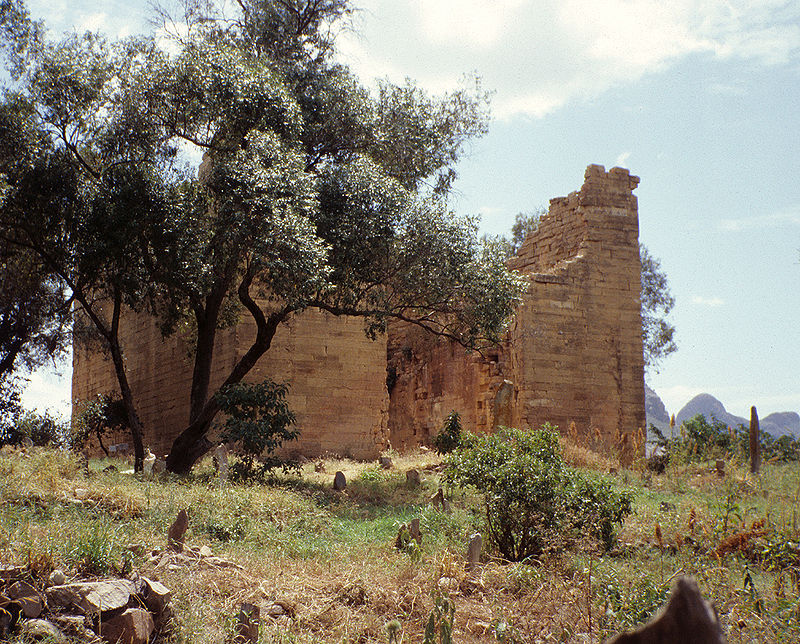
Temple of the Moon God at D'mt
During this time the kingdom of D'mt was reaching the zenith of its power and glory. Their kingdom was centred on their capital at Yeha, in what is now northern Ethiopia. They built a great temple at Yeha, part of which still stands today. It was probably dedicated to the Moon God, but this is unclear.
Inscriptions in the Sabaean script have been found from this region and most amazingly, they record the names of kings and queens for this obscure kingdom. They use Sabaean titles for their rulers, as well as the Sabaean script, so it is very clear that the kingdom was culturally influenced by the Sabaeans, but it does not seem as if they names of their kings and queens were Sabaean.
The kingdom of D'mt did not merely centre on Yeha, but had a number of other cities, mostly in the region of what is now the country of Eritrea. These included Hawulti, Matara and Qohaito, all of which may yield more information on the history of this land when excavated more fully in the future.
Sabaean inspired writing from the kingdom of D'mt
In Egypt and Kush, Taharqa acceded to the throne in 690BC. He appears to have been a strong and capable Pharaoh, but he faced a very serious threat. The Assyrian Empire was at the height of its power and, under their king Esarhaddon, invaded Egypt in 671BC. The Assyrians captured Memphis after a fierce struggle and while Taharqa escaped, other members of the Kushite royal family, including the crown prince Ushanahuru, were captured by the ruthless Assyrians.
Esarhaddon was faced with rebellion in his own kingdom and withdrew shortly after the capture of Memphis. But even so, this was the most terrible invasion that Egypt had seen in many centuries. The Libyans and the Kushites had both seen themselves as in certain sense Egyptian. The Assyrians were simply foreign conquerors. We have a prayer from Taharqa at this time.
The Egyptians rebelled against the Assyrians in 670BC and Taharqa came back to the attack. Esarhaddon died as he was returning to Egypt to crush the Kushite counterattack. His son Ashurbanipal took over the conquest. In 667BC Ashurbanipal returned to Egypt and defeated Taharqa once more. One of the Egyptian princes of Sais had been placed as an Assyrian governor of Lower Egypt and even though he had rebelled against the Assyrians, Necho I was returned to Egypt as a client ruler of the Delta in the name of the Assyrians.
Pyramid of Taharqa at Nuri in Kush
Taharqa died around 664BC and was buried in a grand pyramid at a new royal cemetery at Nuri. It was succeeded by Tanutamon, also known as Tantamani. Tantamani attacked the Assyrians, killing their vassal king Necho I, and the Assyrians counterattacked, pushing southwards to Thebes in Upper Egypt. Here they attacked until they had captured it and sacked it, causing great destruction in one of the greatest cities on earth. This destruction of Thebes effectively pushed the Kushite rulers back into Kush. The end of Kushite rule is generally held as the end of the Third Intermediate Period of Egyptian history and the beginning of what is known as the Late Period.
In 656 Psammetichus I, son of Necho I, recaptured Thebes, ending Kushite rule in Egypt. This was at least partly because the Divine Adoratrice of Amun (High Priestess) was a sacred figure and had been left alone by the Assyrians and Egyptians. This person had joint control over the city of Thebes and control of the vast estates of the temple of Amun. The current Adoratrice was Shepenupet II, a Kushite and a long-lived daughter of Piye, the first Kushite Pharaoh of Egypt. Shepenupet was old and had adopted a daughter, Amenirdis, the daughter of Taharqa, to succeed her.
Relief of Nitocris and Psamtik I
The estates of Amun were too powerful to be left in the hands of the relatives of a rival Pharaoh, so Psammetichus (or Psamtik I depending on what naming convention is used), decided to force Shepenupet to adopt his daughter, Nitocris, instead, so that on Shepenupet's death, Nitocris would become the next Adoratrice. This forced adoption took place in 656 and is commemorated by a stela of Psammetichus. This time period sees Psammetichus gradually increasing his power to the point where he would be able to defy the Assyrians and expel them from his land. Assyrian forces may have begun to withdraw from Egypt from around 654 onwards. Psammetichus I now ruled as a Pharaoh of the 26th Dynasty of Egypt.
In the year 9, second month of the first season, day 14, they arrived at the city of the gods, Thebes. As she advanced, she found all Thebes, men and women alike, standing, rejoicing at her approach, surrounding her with great offerings, a multitude in number. Then they said: "The daughter of the King of Upper Egypt, Nitocris, comes to the house of Amun; that he may receive her and be satisfied with her. The daughter of the King of Lower Egypt, Shepnupet, comes to Karnak, that the gods therein may honour her." Adoption Stela of Nitocris
Relief showing Shepenupet
Psammetichus was also famed in literature for conducting possibly the first scientific experiment ever, or at least the first psychological experiment. The Egyptians had always claimed that they were the oldest civilisation in the world. Psammetichus sought to prove this by having some children raised without listening to the speech of others and trying to figure out which language the children would spontaneously speak, assuming that they would speak the original language of mankind and thus, find the oldest civilisation. This experiment supposedly showed that the Phrygians were the oldest civilisation, which is interesting, as that can hardly have been the expected outcome. This was determined by the fact that the children kept saying the word "bekos" when pointing at bread, which roughly matched the Phrygian word for bread, but not the Egyptian. However, this story is nowhere recorded among the Egyptians and is only taken from the much later Greek texts of Herodotus.
Stela of Tefnakht
While we cannot prove if the language experiment was real or not, we can be certain that a new form of writing was pioneered in Egypt around this time, called the Demotic script (capitalised to avoid confusion with Greek "demotic" script). This was a short-hand script that could be used to transcribe hieroglyphs quickly and in some ways replaced an earlier short-hand known as hieratic. It was not an alphabet but it could be used to speed up writing and was widely adopted. It was part of the much later Rosetta Stone that was later used to decipher the Egyptian hieroglyphs.
According to legend the Greek colony of Cyrene was founded in Libya with Greek colonists and native Libyans in the year 631BC. It had good relations with the native peoples and it was unusual for Greek colonies, in that the main city was founded slightly inland, rather than directly on the sea, as was more usual. The colony would become famed for its export of silphium, a rare plant that only grew near this region and was believed to be not only the finest of delicacies, but also a herb with powerful healing properties. Silphium became the main export of Cyrene under the reigns of the Battiad kings, who ruled the colony for some centuries after its foundation.
In the year 609BC Necho II of Egypt led an expedition as far as the Euphrates River to try and save the remnants of the Assyrian Empire, which was on the verge of destruction by the Babylonians and the Medes. On the way there he defeated King Josiah of Judah in battle at Megiddo. After some initial successes, the Egyptian force was dealt a serious defeat in 605BC and was pushed back to the borders of Egypt by the Babylonians. The Egyptians defeated the Babylonians on the frontier in 601BC, but the Babylonians were still an active threat in the region.
Nok culture terracotta artifact
Around the year 600BC the people of the Nok culture had definitely developed iron-smelting techniques. It is unclear if they developed these independently or if they had received external knowledge. I suspect that the knowledge of iron-working was brought from artefacts traded across Africa, but that the techniques of iron-working were developed independently. The sophistication of their smelting furnaces was quite impressive and the quality of their iron was some of the best in the world at the time. An important smelting site was located at the present-day town of Taruga, near the Nigerian capital city of Abuja.
Around 595BC Pharaoh Necho II died and was succeeded by Psamtik II. He was one of the most fascinating individuals of this time period and seems to have had many excellent ideas. Perhaps he was too ahead of his time though, as most of his ideas seem to have failed in their execution.
Necho II is supposed to have attempted to link the Red Sea to the Nile in the earliest version of the Suez Canal to have been attempted. This was a gigantic work and was truly a work of vision but there were problems with it, namely that there is a considerable difference in water levels between the two bodies of water. There are no Egyptian inscriptions for this but we know the story from Herodotus, who says that Necho II stopped construction after receiving an unfavourable oracle.
Depiction of Necho II
Necho II then appears to have commissioned an even more intriguing expedition. He hired Phoenician sailors, the greatest sailors of the ancient world, to set sail from the Red Sea and to attempt to circumnavigate Africa. According to Herodotus, who again, is our sole source for the story, the sailors did not return for a long time but did eventually arrive back in Egypt having sailed around the continent and coming back through the Straits of Gibraltar. This was an unprecedented feat and one that was not to be repeated to our knowledge until the Age of Exploration. The sailors told tales of the sun being in the wrong position, which led the Greeks, and perhaps the Egyptians, to discount the story. This however makes it much more plausible, as it suggests that the Phoenicians did in fact reach the southern hemisphere.
For Libya shows clearly that it is bounded by the sea, except where it borders on Asia. Necos king of Egypt first discovered this and made it known. When he had finished digging the canal which leads from the Nile to the Arabian Gulf, he sent Phoenicians in ships, instructing them to sail on their return voyage past the Pillars of Heracles until they came into the northern sea and so to Egypt. So the Phoenicians set out from the Red Sea and sailed the southern sea; whenever autumn came they would put in and plant the land in whatever part of Libya they had reached, and there await the harvest; then, having gathered the crop, they sailed on, so that after two years had passed, it was in the third that they rounded the pillars of Heracles and came to Egypt. There they said (what some may believe, though I do not) that in sailing around Libya they had the sun on their right hand. Herodotus, Histories: 4:42
Statue of Anhknesneferibre
When Psamtik II took the throne he instated his daughter Ankhnesneferibre as Divine Adoratrice of Amun in Thebes. This was in the year 595 or 594 depending on what is counted as the first year. This was an important position, in certain ways perhaps the second most important position in Egypt after the Pharaoh himself, so it was important to ensure that this post was held by someone loyal to the dynasty. Nitocris I adopted the princess to ensure that she would become God's Wife on the death of Nitocris. Thus the Saite Dynasty (the 26th Dynasty) further strengthened its hold on the southern part of Egypt.
Year 1, third month of the third season, day 29, under the majesty of Horus: Favourite of the Two Goddesses: Mighty of Arm; Golden Horus: Beautifying the Two Lands; King of Upper and Lower Egypt: Psamtik II, given life. On this day the king's-daughter, Ankhnesneferibre, arrived at Thebes. Her mother, the Divine Consort, Nitocris, who liveth, came forth to behold her beauty, and they went together to the House of Amon. Stela of Ankhnesneferibre, written circa 594BC
Around 590BC the Kushite capital appears to have moved south from Napata, which was vulnerable to raids from the reinvigorated Egyptian kingdom, to Meroe, which was further south along the Nile. Napata was still held by the Kushites however and their kings continued to be buried in the royal cemetery of Nuri during this time.
In the year 589BC Apries of Egypt, known as Hophra in the Biblical record, succeeded to the throne. He was unable to prevent the rise of Babylonian power in the region, and it is possible that there was a Babylonian invasion during his reign, but this is unclear. He was overthrown by the usurper Amasis II in 570BC after a failed invasion of Cyrene.
Relief from Jebel Barka in Kush
I am not sure of when this story took place, but I have presumed it to occur at some point around the year 550BC, if it happened at all. The cities of Carthage and Cyrene both existed along the North African coast: Two trading cities, one Phoenician, one Greek. Neither side had great interest in the desert interior and were both more interested in trading with the rest of the Mediterranean. Thus they decided to draw a border between them. It was decided that two runners would set out from each city and run as fast as they could along the coast until they met the runners from the other city. Supposedly the Carthaginian runners made incredible speed and met the runners from Cyrene well over halfway away from Carthage. The runners from Cyrene understandably were annoyed and accused the Carthaginians, two brothers known as the Philaeni Brother, of cheating. Cheating may in fact have taken place. The Greeks wanted to rerun the race while the Carthaginians wanted the result to stand.
AD1872 painting of the Battle of Pelusium by Lenoir
Eventually the Greeks agreed to a compromise. They would accept the result, if the Philaeni Brothers were to be slain. If the Philaeni Brothers wanted to live they would rerun the race. The Philaeni chose to die so that their homeland could enjoy the advantage that they had won for it. Solemn sacrifices were made and until the time of late Antiquity the boundary between the two regions was fixed at the Altar of the Philaeni. Later the Roman Empire would be split into east and west at the point where the Philaeni Brothers died. I'm not sure when this story happened and I'm not at all sure if the story is true. It probably is not. But there are no records of Cyrene and Carthage going to war at least.
In 525BC the Babylonian Empire had fallen and the Persian Empire now dominated the Middle East. Led by their ruler Cambyses II, the son of Cyrus the Great, the Persians invaded Egypt, which was now ruled by the son of Amasis, Psammetichus III. There was a great battle fought at Pelusium, which the Persians won. There are some strange legends about the Battle of Pelusium that lead it to be known as the Battle of the Cats. This comes from a much later Greek book however and should not be taken too seriously. Egypt was now part of the huge Persian Empire. This ended the 26th Dynasty of Egypt. The Persian kings are sometimes referred to as the 27th Dynasty of Egypt.
Wall paintings from the tomb of Tanutamani
Around the year 500BC the Magonid kings began their rule of the city of Carthage. They were from a family that bore the name of Mago, e.g. Hamilcar Mago or Hannibal Mago. Very little is known of the constitution of Carthage around this time and even though it was ruled by kings during this period, there probably was some form of Senate, or Council, to moderate the decisions of the kings.
Around this time the ancestors of the Khoikhoi group probably began to inhabit the region to Twyfelfontein in what is now present-day Namibia. The region is known for its rock art in the caves and cliff faces. These rock carvings and paintings are preserved due to the aridity of the region, which receives very little rainfall. It was probably a sacred site or a gathering place for the hunter-gatherers of the region, but sadly little can be said about it.
During all this time the speakers of the Bantu languages were gradually moving southwards into the rainforests of central Africa. Over the next millennium they would gradually extend their languages across much of the central and southern reaches of the continent.
Wall paintings from the tomb of Tanutamani
And thus the period draws to a close. Egypt had seen the end of the New Kingdom, followed by the Libyan and Kushite rule of the Third Intermediate Period, followed by the Persian conquest after the 26th Dynasty. Even after the Kushite defeats, Kush was still one of the strongest states in the world at the time. The period also saw the growth of the Phoenician city of Carthage on the northern coast of Tunisia, and the foundation of the Greek colony of Carthage on what is now the northern region of Libya. The Iron Age sub-Saharan Africa began in earnest with the adoption and refinement of iron-working by the Nok Culture. In the east of Africa the little-known kingdom of D'mt was flourishing.
This is a quick overview of African history from the year 1000BC to the year 750BC. Due to the nature of the sources it will be rather focused on Egypt. This is unfortunate, but somewhat inevitable, as Egypt is the one of the best documented places in the world at this time.
Outside of Egypt there were sophisticated cultures in Nubia/Kush and Punt, although Nubia had been subjugated by the Egyptian state during much of the New Kingdom period in Egypt and Punt seems to have faded into obscurity. The lower edge of the Sahara had seen the development of agriculture, although there is no record of extensive bronze metalworking from this period. This is to be expected as tin was very scarce in the ancient world and there were no easy trade routes past the Sahara at this time.
Further south of the equator humans still lived as hunter-gatherers, as their distant ancestors had done for millennia. This was more to do with the sophistication of their hunting techniques than anything else. Unlike other parts of the world they had not had the need to develop agriculture and their culture was perfectly adapted to its surroundings. However, if farming groups were to arrive in the area from outside, this would change the balance of the environment and tip the scales in favour of the agricultural groups.
Nok culture terracotta sculpture
The Nok culture was beginning to thrive around this time, in what is now the country of Nigeria. Meanwhile the speakers of Bantu languages had already begun the process of expansion that would see their languages spread over most of sub-Saharan Africa. The Bantu speakers had already reached the rainforests of the Congo Basin and the Ugandan highlands around this time, but it is hard to know the exact spread of this language family at this time.
Around the year 1000BC the kingdom of Kush had once again broken free of Egypt. We know very little of their rulers or politics at this time, but they seem to have been free once more as Egypt became weaker. In Libya, with the power of the Egyptians waning, the local tribes seem to have become independent and to have taken control of the oases, as well as having more and more influence in the Delta region of Lower Egypt. These tribes are sometimes spoken of as ancestors of the later Garamantes people, but the name for the ethnic group that the Egyptians used was “Meshwesh”.
Further south in Africa, it seems likely that speakers of the eastern Bantu languages had reached what is now Uganda by around this time. These dates should be treated as extremely approximate, as they are based on linguistic reconstructions.
Far to the west, the Canary Islands were possibly settled by this time. Perhaps this settlement was by a group of people known as the Guanches, who were later known in classical antiquity. Perhaps the settlement was by an entirely different group of people who were wiped out by later groups arriving on the islands.
Bubastite Portal of Shoshenq I
Around the year 943BC, Shoshenq, a Libyan chieftain of the Meshwesh tribe took control of Lower Egypt and declared himself to be the new Pharaoh. This was not as the result of a foreign invasion, but was more akin to a palace coup. Shoshenq was already the lead adviser and chief general of the armies of Egypt. When the king died, it made sense for the person who actually held the reins of power to take on the reigning of the state.
Shoshenq I declared a new Dynasty, the 22nd Dynasty of Egypt, and his accession to the throne is generally seen as the ending of the New Kingdom Period in Egypt, and the beginning of the Third Intermediate Period. Shoshenq I built great monuments in Egypt and led an expedition into the lands of Canaan, which was the first such expedition in many long years. Shoshenq is usually said to be the same person as the Biblical Shishak and thus
However, this projection of power into the Levant appears to have been brief. Shoshenq’s successors do not seem to have maintained more than a trading presence in Canaan and the Levant and the New Kingdom Empire in the region was not restored.
Make to triumph, Shoshenq, triumphant, the great chief of Ma, chief of chiefs, the great … and all who are before thee …, all the troops …." Said to him, Amon-Re, king of gods: "… I will do … for thee, thou shalt attain old age, abiding on earth; thy heir shall be upon thy throne forever." Endowment Stela of Shoshenq I, written circa 930BC
Remains of Temple of Amun in Kush
Around the year 900 the Nok Culture in what is now the region of Central Nigeria seems to have become much wealthier. It is possible that the Nok craftsmen had mastered iron-working at this time, but this is not confirmed. The Nok now began creating high-quality terracotta figurines, which are still highly sought after by museums around the world. Sadly, conflict in the area currently has led to many of these figurines being looted and removed from their archaeological context.
Also around this time, the kingdom of D’mt was founded in what is now the Eritrean/Ethiopian region. It seems to have close connections with the Sabaean kingdoms in southern Arabia and there was much trade across the Red Sea between the coasts of present-day Yemen and Eritrea.
Despite the Arabian influence, it does seem that the kingdom of D’mt was a truly African state. Their iconography and writing systems derive from the Arabian Peninsula, but were interpreted in different ways in the African context. The capital of this kingdom was probably at the city of Yeha in present-day northern Ethiopia.
Around the year 837 the 23rd Dynasty of Egypt was founded by the Libyan Meshwesh princes. It ruled concurrently with the 22nd Dynasty that ruled from Tanis. The 23rd Dynasty was a much more unstable dynasty and was almost perpetually engaged in civil wars. They ruled from the cities of Thebes and Herakleopolis in Upper Egypt where they also had power struggles with the powerful priests of Amun in the city of Thebes.
Turner painting of Carthage
Around the year 800, the cities of Utica and Carthage were founded by Phoenician colonists on the coast of what is now present-day Tunisia. It is probable that Utica was the older of the two colonies, perhaps by as much as a century. There are a number of traditions about the foundation of Carthage, but these stem from much later and are from the Greeks and Romans rather than the Carthaginians themselves.
It is said that Carthage was founded by Dido who was fleeing from her brother, King Pygmalion of Tyre. There are many legendary accounts of her falling in love with the Trojan hero Aeneas, but these are from the much, much later Aeneid of Virgil and do not match any chronologies. Carthage would go on to be the preeminent Phoenician settlement in the western Mediterranean. In times to come it would far surpass the wealth and power of Tyre and Sidon themselves.
Statue of Osorkon I
Also around the year 800 the Kingdom of Kush, which lay along the Nile to the south of the lands of Egypt grew in power. Their king was said to be Alara, who was succeeded by Kashta. By the time of Kashta, perhaps around 770, the factions and petty rulers of Upper Egypt were beginning to be subjugated by the Kushites and brought under their hegemony. The Kushite rulers saw themselves as the guardians of true Egyptian traditions and opposed to the Libyan customs of the Meshwesh rulers of Egypt. They built a large temple of Amun at Jebel Barkal in present-day Sudan and their capital was probably at the city of Napata nearby. Their royalty were buried in tumuli in the cemetery of El-Kurru near to the city of Napata.
And thus the period ends, with Kingdom of Kush encroaching on the southern regions of a divided Egypt, Phoenician cities being founded on the northern coastlands of Tunisia, a Sabaean influenced kingdom growing in east Africa and terracotta production in the lands of the Nok culture on the Niger River. Only in Egypt do we have written records for this time period, even the Kushite records do not seem to say much of this time period and kings such as Alara and Kashta must be inferred from the records of their successors. The kingdom of D’mt does not seem to have been using writing at this point, although it did later. The records of Carthage come from later times and are generally from Greek and Roman sources. Nevertheless it is clear that much was happening on the continent of Africa during this quarter millennium.
This post will look at Greece and the wider Greek world from the years 409BC to 400BC. Firstly, a word about our sources. Archaeology can shed some light on this period, but we are primarily reliant on written sources, such as the writings of Xenophon, Diodorus Siculus, Plutarch, and Pausanias. A more complete list of sources is given at the end of the blog.
In the year 409BC Alcibiades and the Athenian soldiers with him reconquered Byzantium on the Bosphorus. A number of prisoners were taken, including the Theban general Coeratadas. This safeguarded the passage to the Black Sea and allowed grain ships to pass unhindered to Athens once more. An Athenian fortress was established at Chrsyopolis near the Bosphorus and a tax imposed on vessels sailing past it. This was to try and get a regular source of income for the impoverished Athenians, who were struggling to pay their soldiers even a small wage.
The Persian satrap Pharnabazus seems to have come to some understanding with Alcibiades and gave the Athenians some money. This was partly as a bribe to not attack the nearby cities, but perhaps Pharnabazus was persuaded to the same school of thought as Tissaphernes, that it would be useful to support both Athens and Sparta and let them kill each other.
The Athenian general Thrasyllus sailed to Ionia and attacked Colophon and Ephesus. Colophon was taken by the Athenians, but the Persian satrap Tissaphernes sent a force to reinforce the Ephesians and the Athenians were defeated, with up to 300 killed in the battle. Thrasyllus won a small victory over some Syracusan ships that were caught by his fleet as he sailed northwards towards the main army.
Coin of Syracuse
The remainder of the Syracusan navy seems to have sailed westwards to Sicily after this setback. The Syracusans who were captured were sent to Athens to be imprisoned in stone quarries. This was in retribution for the terrible conditions that Athenian prisoners had been held in while captive at Syracuse. These Syracusans later used the tools they were forced to labour with to dig a path to freedom and to escape.
The Spartans had suffered a great defeat at sea, at the Battle of Cyzicus the previous year. This had been so severe that they had even offered peace terms, before these were turned down by the Athenians. The Spartans now took the opportunity of assaulting the Athenian fortress of Pylos on the western edge of the Peloponnese. This was held by freed helots who would raid the lands of Messenia and encourage more helots to revolt.
The Spartans besieged it and the Athenians dispatched their general Anytus with a small fleet to bring relief. Anytus turned back because of storms at Cape Malea; to the fury of the populace in Athens when he returned. The helots fought bravely, expecting the ships of the Athenians to bring supplies and reinforcements. But the ships never came.
Eventually the helots and the Spartans had fought themselves to a standstill and the helots surrendered the fortress under a truce. The unbeaten helots allowed the freedom to leave the Peloponnese. Anytus, who had failed to bring aid to Pylos, was put on trial for his life, but was said to have bribed the jury and so escaped.
King Agis II of Sparta still seems to have held the fortress of Decelea in Attica, but perhaps his attention was elsewhere, as it seems that a battle was fought between the Megarians and Athenians, with the Athenians slaying great numbers of Megarians. But this detail may be chronologically misplaced.
Pleistonax, the Agiad king of Sparta who had been exiled, but returned on the orders of the Oracle, died this year. He was succeeded by his son Pausanias. This event may however have happened in the year following.
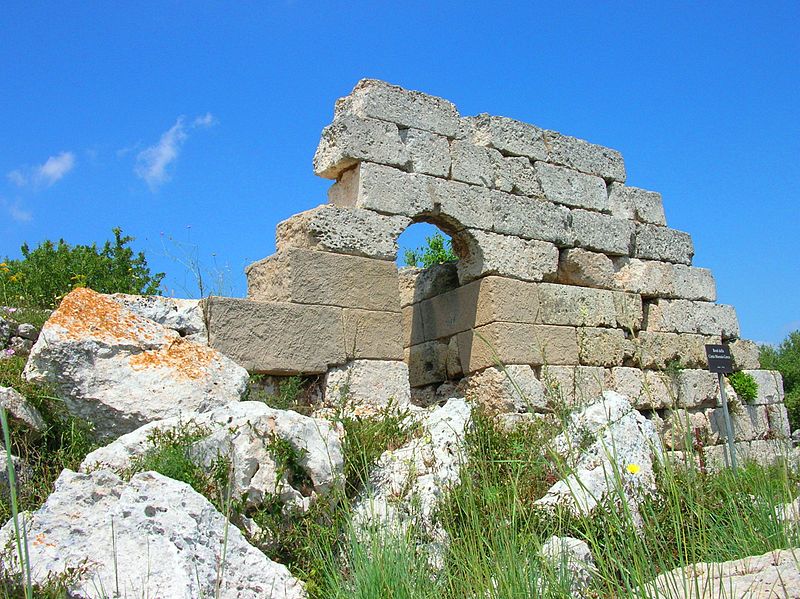
The ruins of Temple G in Selinus
Meanwhile in Sicily, Hannibal Mago had crossed the sea from Africa with a great army. The Greek sources measure it as at least 100,000 strong, but it is more likely that it was perhaps around 30-40,000 strong and that perhaps it later received reinforcements from native Sicel or Sicanian peoples and the city of Segesta in Sicily. Hannibal Mago's target was the city of Selinus, a city in the southwest of the island. Selinus had appealed to Syracuse for aid, but the Syracusans were tardy in dispatching their troops.
The Selinuntines were soon besieged by this huge mercenary force. It is unusual to hear, but the Carthaginians and their mercenaries began to batter down the walls. It is odd to hear how the Greeks at this period so seldom engaged in direct assaults on fortified cities, but that the Carthaginians were so seemingly adept at it. In what unknown wars were these skills honed?
Six high siege towers drove the defenders from the walls of Selinus while six siege rams battered down the walls beneath the covering fire of the towers. The Selinuntines fought back with the best of their ability, but breaches were soon made in the walls. The Carthaginians sent their troops in rotas to maintain a constant assault for hours. The defenders were driven from the breaches to the alleyways, where a continued battle raged for hours. Finally the city was taken and the inhabitants of the city murdered, raped and enslaved. The Syracusan reinforcements had only reached as far as Acragas by the time Selinus fell.
The sack of the city meant that the huge Temple G, which would have been one of the largest temples in the Greek world, was never fully finished. The Selinuntines had been working on it for over a century. The nearly finished temple eventually fell into disrepair and now only the jumbled ruins of the columns remain.
Map showing the Carthaginian campaign of Hannibal Mago
against Selinus and Himera
Hannibal Mago then marched northwards towards Himera, the site of the famous defeat of the Carthaginians. It was here that the tyrants of Syracuse and Acragas had defeated and killed Hamilcar, the grandfather of Hannibal Mago. The Carthaginians and their mercenaries invested the city of Himera, which had been reinforced previously by 5000 Syracusan troops under the leadership of Diocles. Hearing of what had befallen Selinus and desperate to avoid such a fate, the Himerans sallied forth unexpectedly and met the mercenaries before their walls, driving them back in disorder and flight. Hannibal Mago had troops on the nearby hills however and was able to drive the Himerans back to their city.
It was at this time that the Syracusan triremes that had sailed away from the war in the Aegean had returned to Sicily. These triremes had been dispatched to aid the city of Himera and arrived now, stopping the Carthaginians from pressing their victory in the field. Even with Syracusan reinforcements the defence of Himera was a hopeless task and there were rumours that the fleet of Hannibal Mago was sailing for the now undefended city of Syracuse. The Himerans reluctantly evacuated as many as could be loaded onto the Syracusan vessels, allowing perhaps half the city to escape.
Coin of Himera
Those who remained behind were attacked the next day by the full weight of the Carthaginian army. They were able to hold out for a day, expecting the return of the Syracusan ships to take them to safety. But the ships returned the next day instead, as the city was falling. The walls were taken and a massacre followed. Finally, the Carthaginians and their mercenaries stopped killing and took prisoners, but it perhaps it was as well to die fighting as be taken prisoner. Diodorus Siculus recounts that Hannibal Mago offered a sacrifice of 3,000 Greek prisoners in memory of the death of his grandfather Hamilcar. This was an atrocious act, although perhaps not that different from the death the Syracusans had meted out to the Athenian prisoners less than a decade earlier. After this, Hannibal Mago returned with great spoils to Carthage, where he was welcomed back in triumph.
Vase painting by the Jena Painter
It was around this time that Sophocles won the first prize for tragedy at the Great Dionysia festival with his play Philoctetes. This was a play about a Greek warrior from the time of the Trojan War who had been granted the bow of Heracles. Due to suffering a snake bite and suffering an enduring and suppurating wound (that smelled badly) the Greeks had exiled him for ten years on a deserted island. A prophecy foretold that the Greeks must recall Philoctetes if they are ever to take Troy. The play focuses on the fact that the attempt of the Greeks to persuade Philoctetes to help those who had done him such harm.
In 408 the Syracusan exile Hermocrates took the money given him by the Persian satrap Pharnabazus and returned secretly to Sicily, hiring ships and soldiers at Sicilian Messene (later Messana) and seizing the now barely inhabited city of Selinus. He used this as a base to attack the Carthaginians who had remained in Sicily and to rally the disaffected Greeks to his cause, hoping to be recalled to Syracuse after his exile by Diocles.
Diocles himself appears to have been exiled around this time. At any rate he disappears from the historical record. There is a legend that he absent-mindedly wandered into the agora wearing a blade, and that his enemies raised a hue and cry against him, saying that he had violated his own laws against bringing weapons into the public space. Diocles, in his anger and shame at his unintentional hypocrisy, proclaimed that he himself would enforce his own law, and slew himself with his own blade. This is almost certainly fictional and there are similar legends about other lawgivers. The less poetic but more plausible tale is that he was exiled after his failure to defend Himera against the Carthaginians in the previous year.
A modern drawing of the return of Alcibiades
While Diocles was in disfavour in Syracuse, Alcibiades was greatly in favour back in Athens. He sailed to the port of Piraeus in triumph, having won many victories and restoring much of the previous naval dominance of Athens. He was received by a cheering, ecstatic crowd. Afterwards he even led a great procession to Eleusis, as a way of showing that he was innocent of the Profanation of the Mysteries.
So when the fleet came to land the multitude turned to the ship of Alcibiades, and as he stepped from it all gave their welcome to the man, congratulating him on both his successes and his return from exile. He in turn, after greeting the crowds kindly, called a meeting of the Assembly, and offering a long defence of his conduct he brought the masses into such a state of goodwill to him that all agreed that the city had been to blame for the decrees issued against him. Consequently they not only returned to him his property, which they had confiscated, but went farther and cast into the sea the stelae on which were written his sentence and all the other acts passed against him; and they also voted that the Eumolpidae should revoke the curse they had pronounced against him at the time when men believed he had profaned the Mysteries. And to cap all they appointed him general with supreme power both on land and on sea and put in his hands all their armaments. They also chose as generals others whom he wished, namely, Adeimantus and Thrasybulus. Diodorus Siculus, Library of History, Book 13, written circa 40BC
This appeared very promising to the Athenians. Alcibiades was, for all his other faults, a genuinely talented commander and someone who seemed to have a strange relationship with destiny. He was elected as general and the affairs of the state were laid at his feet. The Athenian democracy had been fully restored at this point.
Papyrus fragment of part of Euripides' play Orestes
But there were troubling developments for the Athenians. The Spartans had chosen a new navarch, or commander of their naval forces. His name was Lysander and he sailed across the Aegean to meet up with the remnants of the Peloponnesian forces, which had taken refuge at Ephesus.
The Spartans had not just a new general, but a new sponsor. Cyrus the Younger, a son of the Persian King Darius II, had been sent to the western provinces to take control of the situation there. Pharnabazus and Tissaphernes were side-lined and Cyrus fully supported the Spartan cause. The Spartan fleet at Ephesus was supported with large sums of money. Lysander and Cyrus became fast friends and the two men became interested, not just in winning the war against Athens, but in helping each other with their own ambitions after the victory.
On hearing of the voyage of Lysander and the build-up of the Spartan fleet at Ephesus, Alcibiades sailed back across the Aegean to the Athenian naval base at Samos. Alcibiades tried to lure Lysander out to battle, perhaps intending to use the same stratagem as at the Battle of Cyzicus, but Lysander was too wily to engage before his forces were ready. He had time and money on his side and intended to use them.
Around this time, the various cities on the island of Rhodes united into a single city. This was a sensible way of making their lands more defensible, reducing the possibility of wars and of making their state one that would be of consequence in later times.
Orestes pursued by the Furies,
by William Adolphe Bouguereau, AD1862
Around this time Euripides is said to have written the plays Orestes and Phoenician Women around this time. The Phoenician Women is set in a similar dramatic setting to the much earlier play of Aeschylus called Seven Against Thebes. Here the chorus of Phoenician Women beholds the trauma of the city of Thebes under siege. In the play Orestes, which has much the same setting as Aeschylus' play The Libation Bearers. This play sees the revenge of Orestes against his mother Clytemnestra, but also the moral dilemmas that are invoked by avenging the slaying of a parent, who must be avenged, by slaying a parent, who must be avenged. The plays were not well received and did not win prizes. Despite the high reputation of Euripides in the rest of the Greek world, he was not particularly successful in Athens. It is said that he left Athens to go to the court of Archelaus I of Macedon around this time.
The play Orestes is highly unusual in that it is the only play for which music survives. We know that the Greek tragedies were set to tunes and the lines were in many cases sung. For this play, a small fragment of music has in fact survived. This is known as the Katolophyromai, called so from the opening words in the fragment. The fragment itself is of a much later date and may be of a later interpretation of the music, but if it is original, then it is the oldest piece of Greek music yet known and by extension, the oldest European music known to us. It is not however the oldest piece of music known to us, as some music from the Near East is considerably older. I have included a video of someone interpreting the fragment.
Musical interpretation of Katolophyromai melody from Euripides' Orestes
In Athens, the Theban general Coeratadas was being taken ashore from the Piraeus. He had been taken prisoner at Byzantium and as a general of the hated city of Thebes, must have expected harsh treatment or possibly death at the hands of the Athenians. Instead he pulled off a daring escape, managing to orchestrate a disturbance and then mingle into the crowd. Taken to Athens to meet his fate, he simply walked out of the city with his head held high and slipped away to his native Thebes unharmed. It is not the first escape known to us, nor particularly elaborate, but it takes a certain courage and sang-froid to pull off such a feat.
The Olympic Games were held that year. Eubotas of Cyrene won the stadion race. Polydamas of Skotoussa won the pancration competition. Evagoras of Elis won the synoris chariot race, or more accurately, owned the team of horses that won the race. The normal chariot racing in the Olympics was the tethrippon, the four horse race. The Synoris was added in this Olympiad and was a two-horse chariot race. The winning horses of the tethrippon chariot race were owned by the ambitious and cultured King Archelaus of Macedon.
These games saw Polydamas of Skotoussa win the pancration. He was internationally famous for his feats of strength, like Milo of Croton in the previous century. He was said to have been summoned to the court of Darius II of Persia to show his prowess. He was said to have slain a lion on Mount Olympus in unarmed combat and to have been strong enough to bring a speeding chariot to a dead halt. According to tales he later died while attempting to hold up a cave that was collapsing on himself and his friends. His friends escaped, but he could not hold the weight indefinitely and so he died. Many of these tales are doubtless legends, but interesting stories nonetheless.
Lais of Corinth painted by Hans Holbein
the Younger
Another tale of these times is that there was a beautiful hetaira, or courtesan, named Lais of Corinth who was the lover of Eubotas of Cyrene, the victor of the stadion race. Their relationship may have been some years later, nevertheless Lais was referred to as the most beautiful woman in Greece at the time.
In the year 407 the Athenian general Thrasybulus was active in Thrace and the northern Aegean, recapturing Abdera and Thasos. After this he went to besiege the promontory of Phocaea.
Alcibiades, who had the Athenian fleet moored at Notium, went to assist Thrasybulus, leaving his helmsman Antiochus in charge of the Athenian fleet. Antiochus was charged not to attack under any circumstances, but in fact tried to lure the Spartans out of their harbour with a small decoy force. This failed badly, and Antiochus' ship was sunk. The Athenians straggled out to help the decoy force, which was now in trouble, and the Spartans inflicted a defeat on the Athenians. This was known as the Battle of Notium or alternatively, the Battle of Ephesus. It was not a very serious defeat, but it was a boost to Lysander's reputation.
Statue of an athlete in Athens
Antiochus was dead, so the blame for the defeat fell on the absent Alcibiades, who had left his steersman in charge of the bulk of the Athenian navy. Alcibiades attempted to make up for it by sailing to the city of Cyme, hoping to provoke it into rebellion and sack it to then gain extra money for his underpaid troops. The people of Cyme did not take the bait and instead reported his behaviour to the Athenians. The Athenians, who had welcomed Alcibiades back with open arms and made him commander-in-chief only the year before, now believed him to be contemplating switching sides once more.
The Athenians deprived Alcibiades of command, and word reached Alcibiades of a series of lawsuits that were being lodged against him. One of the more serious lawsuits to Alcibiades, although rather amusing to an outside observer, was of a man who claimed that Alcibiades had borrowed his best horses and won an Olympic victory in the tethrippon chariot race without crediting the owner and pretending that he himself was the victor. This is all very amusing, but Alcibiades had neither funds to pay damages, nor the intention of answering his accusers. He took his leave of the navy and sailed to the region of the Hellespont, where he had some land, and lived in a small fortress there for the next years.
Around this time, either in this year or the preceding one, Hermocrates had conspired to return to Syracuse. A number of his aristocratic supporters attempted to sneak him back into the city at night, but the plot, which bore all the hallmarks of a coup even if it wasn't one, was discovered and fighting broke out. In the confusion Hermocrates was slain. He had done much to protect Syracuse against the Athenians, but its citizens had exiled him nonetheless and now they had killed him.
Statue of Euripides
It was around this time that the playwright Euripides wrote the plays Bacchae and Iphigenia at Aulis. Euripides was Athenian, but he had left the city and wrote them at the court Archelaus I of Macedon. Both plays survive and were later directed by Euripides' son or nephew in Athens some years later. The Bacchae is a play about one of the darker sides of Greek mythology, describing an episode where the women of Thebes tear apart and destroy the sacrilegious king of Thebes under the maddening influence of the god Dionysus.
Iphigenia at Aulis is an even darker play in some ways. The dramatic setting is Aulis, in Boeotia, where the Greek navy is about to embark on the Trojan War. Agamemnon commands the navy, but the winds are against him. Finally the seers tell him that to sail, he must sacrifice his daughter Iphigenia. The plot revolves on the horror of a father willingly deciding that his goal is so dear that he will murder his child to achieve it. The ending of the play that we have is probably a later interpolation and it is not clear how Euripides ended this story.
Finally, around this time, although we can in no way be sure of the exact date or year, a young man of Athens, possibly called Aristocles, but more usually referred to as Platon or Plato, became a follower of the controversial Socrates. Socrates was an unusual man, famed equally for his cleverness and his ugliness, who delighted in asking questions of the great men of Athens until they became frustrated. Many young people in Athens and further afield became almost disciples of Socrates, but he wrote no books that we know of, nor preached any specific doctrines. He questioned, and others put their own interpretation onto his words. Numerous philosophical doctrines would be inspired by the life and questions of Socrates, but perhaps none has been more influential for the world than the philosophy of Plato.
Bust of Socrates
Perhaps it was around this time that Xenophon of Athens began to spend time with Socrates as well. Xenophon was not a philosopher of anything like the calibre of Plato, but he wrote many historical works later in his life and is useful to our understanding of this period.
In the year 406 the Carthaginians, angered by the raids of Hermocrates on their settlements in Sicily, decided to counterattack and perhaps conquer the entire island. Hannibal Mago was chosen as the commander of the forces and a large army of Carthaginians, allies and mercenaries was assembled. Hannibal Mago's cousin, Himilco, was also sent as one of the commanders of the fleet and army. The Greeks of Sicily, now believing their entire way of life to be under threat, made preparations to meet the threat.
The Carthaginians landed in Sicily and moved against Acragas, a wealthy and powerful Greek city, famed in both culture and war, and a powerful ally of Syracuse. The Syracusans and other Greek states marched to the aid of Acragas. A Spartan general named Dexippus was also directing the defence of the city from the inside.
The Carthaginians fell victim to a plague while they were besieging Acragas. Many Carthaginians died and their commander, Hannibal Mago, also succumbed to the disease. Himilco assumed command and continued the siege, building great siege ramps to attack the city while ordering great sacrifices to the gods in an attempt to stop the plague.
The Syracusans marched against the weakened Carthaginians, bringing allies from the Greeks in Italy and reinforcements from the Greek cities of Gela and Camarina. The Carthaginians sallied out of their camps against them, but were defeated by the Greeks. The Greeks however were unable to take the Carthaginian camps and the two sides settled into a near stalemate. The Carthaginians could not take Acragas, while the Syracusans could not storm the Carthaginian camps.
Temple at Acragas
Himilco, realising that without prompt action from himself, the Carthaginians would eventually be destroyed, used his ships to ambush and destroy the grain convoys that were supplying the city of Acragas with food. This action terrified the people of Acragas, who had assumed that they could be easily supplied by sea and had not stockpiled their food. Facing starvation after a siege of around eight months, the people of Acragas abandoned the city in winter, leaving behind practically all their copious wealth. The aged and the sick and any who feared the breakout attempt were left in the city to fend for themselves.
Himilco's army took the city the next day, thoroughly sacking it and slaying most of those left behind. One of the dead was said to be Tellias, a wealthy philanthropist famed for his generosity. The loot captured was immense, as Acragas had been the second most powerful city on the island of Sicily. Himilco then wintered in the city.
Meanwhile, in this same year, the Spartans had sent out Callicratidas, a traditionalist Spartan commander, to take control of their fleet. Because of the dangers of commanding abroad for too long, the Spartans were keen that their generals and admirals (the exact title in this case was "navarch") only command for a single year. Lysander was vain and ambitious and was feared by many Spartans at home. Callicratidas was not popular with Sparta's allies and quarrelled with the Persian prince Cyrus, who was financing the Spartan fleet. Lysander had made Callicratidas' position more difficult by returning funds to Cyrus before the new navarch arrived, thus forcing Callicratidas to either ask Cyrus for more money, or risk not paying his crews. An old-school Spartan who disapproved of the Persian alliance, Callicratidas was thus set on a collision course with the Persians.
Temple at Acragas
The Athenian fleet was commanded by Conon, who had been sent out to command the fleet after the flight of Alcibiades. He had fewer ships than the Spartans and could barely afford to pay his soldiers and sailors. He also had strategic disadvantages. The Spartans could choose to attack at various points, but Conon needed to defend the Hellespont at all costs, in order that the grain ships could continue to reach Athens from the Black Sea.
The Spartans attacked and took Methymna, on the island of Lesbos. Lesbos was a large island and close to the Hellespont, so Conon was forced to defend it. He sailed against the Spartans, but was outnumbered (perhaps 70 ships versus 170 Spartan ships. The Athenian fleet was no longer experienced and battle-hardened, being filled with many newer recruits. In an engagement near Mytilene Conon was defeated and lost 30 ships. His remaining 40 ships were blockaded in the harbour of Mytilene and the Spartan land forces besieged the city from the landward side. However, Conon managed to dispatch a ship bearing news of the desperate situation to Athens.
Athenian grave marker
The Athenians realised the danger. The 40 ships under Conon were some of the last remnants of their once invincible navy. If these were defeated, as they surely would be, the Spartans would close the Hellespont and then sail to Athens to besiege the city from land and sea. Another fleet must be raised without delay. Athens was at the end of its resources and so enrolled even slaves and foreigners to for the fleet. These were to be given Athenian citizenship and, in the case of the slaves, their freedom. The last remaining wealth of the city was expended and every ship pressed into service. The fleet then sailed to Samos, summoning every allied ship available to join them there.
The Spartan navarch Callicratidas, upon hearing of the Athenian relief force approaching, left a force of around 50 triremes to guard Mytilene while taking the remainder of his fleet, around 120 triremes to meet the Athenians at a place called Arginusae. He came upon the Athenians at nightfall and was tempted to attack, but was prevented from doing so by bad weather.
The next day the Athenians, whose new and inexperienced crews were not used to naval warfare, took to the seas. They outnumbered the Spartans and their allies, but dared not do any complex manoeuvres. Instead they formed up in a double-line, so that if any Peloponnesian ships attempted to row through the line and then turn suddenly to ram amidships, that that ship would then immediately be rammed by a ship in the second line. It was a very defensive formation and one that the Athenian admirals at the beginning of the war would have laughed at.
Frieze from the Temple of Apollo at Bassae
However, Callicratidas did not know how to break the Athenian formation and ordered a simple all-out attack. His outnumbered ships were unable to use their superior seamanship and suffered a heavy defeat. The Athenians lost 25 ships at the Battle of Arginusae, while the Peloponnesians lost 69 ships. Callicratidas died in the attack and the leaderless Spartan fleet fled, mostly towards Chios.
The Athenians attempted to sail straightaway to the relief of Conon, fearing that the Spartans might launch a pre-emptive attack on Mytilene. Theramenes and Thrasybulus were ordered to pick up the survivors from the 25 sunken ships, while the others sailed on to Lesbos. However a great storm arose and the Athenians were unable to either reach Mytilene or to pick up their survivors. 25 ships might have had perhaps 200 men each aboard. Thus, the Battle of Arginusae, while a great Athenian victory, came at a price that Athens could ill afford.
Word reached Eteonicus, who was the commander of the Spartan fleet bottling up the Athenians at Mytilene. He pretended that Sparta had won a great victory, to lull the suspicions of the Athenians in the harbour, before retreating to Chios under the cover of darkness.
When news of the victory reached Athens there was much rejoicing. This soon turned to sorrow when it was heard that so many had perished, and there was a public debate as to why the sailors from the sunken ships had not been rescued. The eight generals (not counting Conon) who had been victorious at Arginusae heard that there was anger in the city and, assuming that it had been stirred against them by those who had been asked to rescue the drowning sailors, seem to have accused others of failing to pick up survivors. Theramenes in particular was probably blamed. Theramenes may in fact have been stirring up resentment against the generals and when six of the generals returned to Athens (two had already fled), they were formally charged with the deaths of the dead sailors.
Theramenes took charge of the prosecution against the generals, despite the fact that they had asked him to pick up the sailors. Thrasybulus, who had also been in charge of the rescue attempt, seems to have stayed out of the debate. The generals made the defence that no one was to blame really and that the storm was the only real culprit; a tragic, but understandable circumstance. This would have the added benefit of allowing Theramenes, who was the unofficial leader of those who supported moderate oligarchy, to cease persecuting them, as he would not be liable for prosecution either. The strategy seems to have been working.
Unfortunately the timing of the trial now gave the trial a life of its own. The Apaturia festival took place the next day. This was a time for Athenian families to meet with each other and the empty places left by the dead sailors of Arginusae whipped the resentment of the people into a roaring fury.
Bust of Socrates
A politician named Callixeinus proposed that there should be an immediate trial of the generals, not through the normal legal means, but held in the Assembly. The generals would also be tried as a group, rather than as individuals. This was against Athenian law. Euryptolemus, who was a cousin of the disgraced Alcibiades, stood against the motion, but stood down once it became clear that the enemies of the generals would execute those who sought to defend them. However, the president of the Assembly, a randomly selected councilman who would hold office for a day, happened to be Socrates. Socrates ignored the open threats of Callixeinus and his allies and refused to allow the motion to be voted on. Euryptolemus recovered his courage once more, but on the next meeting of the Assembly Socrates was no longer president and the motion to try and execute the generals as a group passed.
This obstinate dissentient was Socrates, the son of Sophroniscus, who insisted that he would do nothing except in accordance with the law. After this Euryptolemus rose and spoke in behalf of the generals. Xenophon, Hellenica, written circa 355BC
Among the men executed were Thrasyllus, who had been an Athenian general in previous years, and Pericles the Younger, the son of Pericles and Aspasia, who had been granted citizenship as a last favour to Pericles. Shortly after the execution of the generals, the Athenians realised what a terrible mistake it had been and passed a sentence against Callixeinus. Callixeinus fled Athens and his property was confiscated by the state.
While Athens was tearing itself apart in the madness of the trial of the generals, the Spartans were facing their own dilemmas. They had once again been defeated at sea, by an Athens that seemed to refuse to accept defeat. Many must have felt that the war could not be won, others must have feared that if the war continued that the ambitious navarch Lysander must become more powerful. Thus the Spartans proposed a peace treaty. The Spartans would hand over Decelea to the Athenians while the status quo in the Aegean would be maintained (i.e. Athens could not attempt to reconquer Methymna, Chios and other states that had revolted against Athens).
This was a rather reasonable proposition by the Spartans, but the Athenians, urged on by a popular speaker named Cleophon, turned it down. They felt that they could perhaps win another great victory and maybe restore their empire, perhaps to not the extent that it had been, but at least with undisputed control of the Aegean. Athenian daring had always carried the day for them before: Perhaps it could win them one last throw of the die.
Coin of Archelaus I of Macedon
In this year it is said that both Sophocles and Euripides died. Sophocles died respected in Athens while Euripides is said to have died in the northern kingdom of Macedonia at the court of King Archelaus. Both of these playwrights would be remembered as some of the finest playwrights to have ever lived and their works are performed to this day.
In this year, the temple of the Erechtheion was completed on the Acropolis in Athens. This was a temple encompassing a number of different shrines to various heroes and deities, including a sacred snake that was said to live nearby. It had been under construction for many years previously, but was finished around this time.
In 405 the Carthaginian commander Himilco demolished the city of Acragas, leaving only the remains of the temples and moved on to attack the city of Gela. Gela was also on the southern coast of Sicily and was another stepping stone towards Syracuse itself.
Temple of the Erechtheion
In Syracuse, a citizen Dionysus, a Syracusan general who may have been the son of Hermocrates, accused the generals of cowardice and possible treachery. He was granted sole overall command of the war effort and was given a bodyguard to protect against his enemies. He hired large numbers of mercenaries, while gathering allies from the Greek cities of Italy and Sicily.
The Carthaginians pressed the siege of Gela while the citizens of the city defended fiercely. The Carthaginians heavily fortified their camp, fully expecting the great army of Dionysus to attack them at any moment. This attack eventually came and a hard-fought battle on land and sea ensued, with the Carthaginians eventually carrying the day. Dionysus urged that the city of Gela be abandoned and that the people of Gela retreat to Syracuse.
No sooner had Gela been abandoned than the retreating Syracusans urged the abandonment of Camarina, which was also on the southern coast of Sicily. The Carthaginian army looted Gela and must have marched on Camarina on hearing of its abandonment.
Temple of the Erechtheion
Now however the Syracusans began to feel that Dionysus was not really wanting to fight the Carthaginians, but had instead a plan to make himself the tyrant of Syracuse. Thus a large number of Syracusan cavalrymen galloped onwards to Syracuse and looted his house and abused his wife while barring the gates against Dionysus. Dionysus realised what they intended and swiftly marched after them taking the city by surprise and winning a pitched battle in the streets with his mercenaries. His opponents fled to Leontini and Etna and Dionysus now became the tyrant Dionysus I of Syracuse.
Shortly after this Dionysus and Himilco contracted a treaty between them. The Carthaginians would subject Selinus, Acragas, Himera, Gela and Camarina to tribute, as well as the peoples of the interior. Syracuse would be independent and ruled by Dionysus, but Dionysus should not molest the cities of Leontini and Messene. The prisoners were to be exchanged. It must be wondered why Himilco did not press his advantage and attack further? The answer seems to be simply that his army was being destroyed once more by the plague. Diodorus Siculus implies that half Himilco's army was slain by plague and that when the Carthaginians returned to Africa that they brought the plague with them. Himilco had won many victories, but the death toll of the plague prevented Carthage from profiting from these victories.
Coin of the city of Gela in Sicily
Consequently Himilco, acting under the stress of circumstances, dispatched a herald to Syracuse urging the vanquished to make up their differences. Dionysius was glad to comply and they concluded peace on the following terms: To the Carthaginians shall belong, together with their original colonists, the Elymi and Sicani; the inhabitants of Selinus, Acragas, and Himera as well as those of Gela and Camarina may dwell in their cities, which shall be unfortified, but shall pay tribute to the Carthaginians; the inhabitants of Leontini and Messene and the Siceli shall all live under laws of their own making, and the Syracusans shall be subject to Dionysius; and whatever captives and ships are held shall be returned to those who lost them. As soon as this treaty had been concluded, the Carthaginians sailed off to Libya, having lost more than half their soldiers from the plague; but the pestilence continued to rage no less in Libya also and great numbers both of the Carthaginians themselves and of their allies were struck down. Diodorus Siculus, Library of History, Book 13, written circa 40BC
Around this time Seuthes II, a high-ranking Thracian general, probably from the royal family, revolted against King Amadocus I of the Odrysian kingdom. Little is known of the revolt save that Seuthes II effectively created a rival Thracian kingdom along the Aegean coastline.
Coin of Syracuse
In Sparta, Lysander was once again appointed as the navarch of the Spartan fleet and was dispatched to Ephesus. Here he made contact with the Persian prince Cyrus and was given a large sum of money. Cyrus counselled to wait for the opportune moment before facing the Athenians again. Money was plentiful and easily replaced, but men were not. Lysander rebuilt his fleet and strengthened the morale of his troops.
The Athenian fleet was based at Samos and was now raiding Persian territory in Asia Minor. Lysander waited until summer when his forces were sufficiently ready to challenge the Athenians once more. He then bypassed the Athenian fleet at Samos and moved to the Hellespont, where the grain ships bearing the harvest were soon to be passing. The Athenian navy now had to follow.
Lysander and the Peloponnesians attacked Lampsacus, a city on the Asian side of the Hellespont and now used this as a base from which they could attack shipping. The Persians could now supply the Spartans directly from the land as well. Fearing the damage that Lysander could do, the Athenians made a base across the straits at a place called Aegospotami.
Alcibiades, who had a fortified dwelling nearby, came to see the Athenian generals and advised them to move to Sestos, as their base at Aegospotami was too exposed. The generals advised Alcibiades to mind his own business. Aegospotami was too exposed. Everyone knew it. But to move to Sestos was to allow Lysander to capture the grain ships. Thus Alcibiades' advice was problematic. For Athens to survive, Lysander had to be brought to battle and defeated in the straits.
Vase painting by the Sisyphus Painter
What happened next is unclear. The Athenians tried for some successive days to lure Lysander out to battle, but to no avail. Lysander waited and waited, while the Athenians grew more incautious. There is also the possibility that Lysander was in contact with certain Athenian generals. Finally, when the Athenians had either made a feint attack, or had returned to their base, Lysander swiftly manned his vessels, crossed the straits and captured nearly the entire Athenian fleet on the beach. The Battle of Aegospotami, the final battle of the Great Peloponnesian War, was an anti-climax. Most of the Athenian sailors were captured without fighting.
Conon, the Athenian general, had managed to put to sea with 9 or 10 ships. These few ships managed to escape the Spartan surprise attack and sail away unscathed. Of these ships, two of them were the Athenian elite ships, the Paralus and the Salaminia. The Paralus took the news of the disaster to Athens, while Conon and the other 8 ships sailed southwards to Cyprus, where they took up service with King Evagoras of Salamis. Conon must have feared that the Athenians would execute him, but he never fled to the King of Persia or surrendered to the Spartans.
Lysander was not merciful with the Athenians. The Athenian allies were let free, but 3000 Athenian captives were slain, as well as all their generals except Adeimantus, who fell under suspicion of having betrayed the fleet.
Of the triremes only ten escaped. Conon the general, who had one of them, gave up any thought of returning to Athens, fearing the wrath of the people, but sought safety with Evagoras, who was in control of Cyprus and with whom he had relations of friendship; and of the soldiers the majority fled by land to Sestos and found safety there. The rest of the ships Lysander captured, and taking prisoner Philocles the general, he took him to Lampsacus and had him executed. Diodorus Siculus, Library of History, Book 13, written circa 40BC
Stela in Athens recording the friendship between Samos and
Athens
Once news of the Spartan victory spread throughout the Greek world, nearly all of the Athenian allies defected from the Athenian empire. The only ones to stand strong were the Samians, who had recently installed a democratic government and were considered the last reliable friends of Athens. Lysander left a besieging force to take Samos and sailed against Athens. The Athenians voted that all Samians should be granted Athenian citizenship and left a memorial to the friendship and loyalty of the Samians during Athens' darkest hour.
Now Pausanias and Agis, the two kings of Sparta, besieged the walls of Athens from the land, while Lysander blockaded the Piraeus with 200 triremes. Inside Athens there was a panic, but fearing what the Spartans would do and urged on by the popular leader Cleophon, the Athenians fought on; without ships, without food, without hope.
Attempts were made to negotiate with the Spartan kings besieging them, but the kings advised the Athenians to go to Sparta, where the Spartans may have been summoning a conference of all their allies, old and new, to determine the fate of the Athenians. Theramenes was dispatched to Sparta where he was kept for three months while the Spartans deliberated.
While some Spartan allies, namely Corinth and Thebes, were in favour of destroying Athens entirely, Sparta was inclined to leave the city intact. The one thing that the Spartans insisted on was the destruction of the famed Long Walls that stretched from Athens to Piraeus and meant that Athens, as long as she had a fleet, could withstand a siege by land.
The terms were brought back to Athens, where they were seen as extremely harsh. Athens was prepared to fight on to keep her Long Walls. The demagogue Cleophon was the main influence behind the rejection of these terms, despite the urging of Theramenes to accept them. However, as the hunger bit ever deeper into the Athenians, the words of Cleophon rang ever hollower.
Earlier in this year Euripides' plays, the Bacchae, Iphigenia in Aulis and Alcmaeon in Corinth were performed posthumously. Euripides had always been more popular outside Athens and had seldom won prizes at the Great Dionysia, winning only four prizes during his life. Now that he was dead, the Athenians finally realised the genius of their playwright and Dionysus won his fifth prize posthumously. More plays of Euripides survive than of any other Greek tragedian.
This legacy of Euripides is parodied and explored by Aristophanes' play The Frogs, which has the god Dionysus and his slave Xanthias descend to the underworld to meet Aeschylus and Euripides. As with all Old Comedy, there are pointed political overtones. The play is not explicitly political, but it does excoriate Cleophon and some scholars suggest that it may have included a coded reference to Alcibiades, hinting that the return of Alcibiades might save Athens at the final hour, like a god from a machine in one of the tragedies of Euripides.
A later depiction of a manticore
Around this time the historian Ctesias flourished. He was a court physician to the King of Persia and wrote a number of books, including the Indica, which was a view of India as it was known to the Persians. He also wrote a history of Persia known as the Persica. Both of these books are very badly preserved and only really come down to us in excerpted form. From what does survive, we can assume that either everyone who read Ctesias misquoted him, or that he was a terrible historian. Almost none of his writings are verifiable. I suspect that he may not have spoken Persian or Aramaic well and may have misunderstood his hosts when they told him stories. For example his description of the Manticore in the Indica is likely to just be a Persian description of a tiger.
The painter Parrhasius, famed as one of the greatest Greek painters, flourished around this time. It is said that the older Zeuxis competed against Parrhasius in a painting contest. Zeuxis is said to have painted grapes so realistically that his painting was damaged by birds trying to eat the grapes. Parrhasius was impressed, but asked Zeuxis to unveil his own painting. Zeuxis tried to pull aside the curtain covering the painting only to realise that the painting was in fact of the curtain. Zeuxis is said to have graciously accepted defeat, saying that "Zeuxis has fooled the birds, but Parrhasius has fooled Zeuxis". This is almost certainly a later anecdote from later times.
Around this time the Apulian red-figure vase painter known as the Sisyphus Painter flourished. His works show that other high prestige vase-painting workshops were now becoming significant throughout the Greek world. The strain of the Peloponnesian War had probably damaged the Athenian pottery export trade, as it had damaged everything else in the city.
It was also around this time that the magnificent friezes in the little-known Arcadian temple at Bassae, dedicated to Apollo Epicurius, were completed. This temple was quite remote. Arcadia was famed as a rural region even in Classical times. The elaborate temple may have been created as a thank offering to Apollo for alleviating a plague some decades previously. The remoteness of the region preserved the temple and its artwork until the modern era. Many of the artworks were taken to the British Museum, although even now they are remote, only being open to the public at very limited times.
Frieze from the Temple of Apollo at Bassae
In the year 404 Athenian victory was not found. By this time the Athenians were literally starving in the streets. There was no food and no hope of food. The Spartans had surrounded the city by land and sea and there was no hope of relief. Their only remaining ally, Samos, was also under siege. The city had been persuaded to keep fighting by Cleophon, but he was now deeply unpopular among the aristocratic class of the city. Using some legal dodges, Cleophon was put on trial for his life on a charge of neglecting his duty and executed.
Once Cleophon was dead, the popular opposition to peace terms evaporated, perhaps partly out of fear of the aristocrats. The Athenians made terms with the Spartans. They agreed to tear down their Long Walls, tear down the walls of the Piraeus and hand over all but 12 triremes of any ships that they might yet have. The terms were not as harsh as they might have been and the Spartans did not massacre the Athenians or sell them into slavery, as many had believed that they might. It is possible that the Spartans feared the ambition of the Thebans and wished to have keep some power in Athens to resist the Thebans to the north.
When this was done, the Athenians came into dire want of everything, but especially of food, because this had always come to them by sea. Since the suffering increased day by day, the city was filled with dead, and the survivors sent ambassadors and concluded peace with the Lacedaemonians on the terms that they should tear down the two long walls and those of the Piraeus, keep no more than ten ships of war, withdraw from all the cities, and recognize the hegemony of the Lacedaemonians. And so the Peloponnesian War, the most protracted of any of which we have knowledge, having run for twenty-seven years, came to the end we have described. Diodorus Siculus, Library of History, Book 13, written circa 40BC
The city of Samos held out for longer than the Athenians, but eventually on hearing of the Athenian surrender they came to terms, which allowed the defenders to leave the island, but without taking away any of their possessions with them. After finishing off the war, Lysander sailed to the Peloponnese in triumph bringing the vast wealth and trophies of the war. He was justly famed as perhaps the most influential man in the Greek world at this time; the navarch who had defeated the Athenian empire. The Great Peloponnesian War, which had lasted for 27 years had now finally drawn to a close.
The Athenian empire was no more, but the Spartan hegemony had begun. Spartan officials were put in place across the cities of the Greek world. These officials were known as harmosts and they were quickly hated. The Spartans began to ask for tribute for themselves and the harmosts became known as corrupt, greedy incompetents. The Spartans also disliked democracies and either set up oligarchic governments in the newly freed cities or allowed the aristocrats to overthrow the democracies themselves.
Frieze from the Temple of Apollo at Bassae
Athens herself was not immune. Under Spartan pressure, the democratic constitution of the Athenians was suspended and thirty aristocrats were established as an interim government that would draw up new laws. The thirty were led by Critias and Theramenes. Critias was a talented sophist who passionately hated democracy and who wanted the government to be controlled by a tiny minority of citizens. Theramenes was a moderate oligarch, who favoured a government controlled by several thousand of the richer citizens. We might refer to Theramenes as a democrat who believed in a highly restricted franchise. Critias made sure to include Theramenes and his supporters in the Thirty, as they would otherwise form a powerful and credible opposition. But Critias and his supporters took care to maintain a majority within the Thirty.
Critias asked for and received a Spartan garrison from Lysander. With this backup Critias and Theramenes began condemning the informers under the democratic regime to death. These people had informed on those who were felt to be enemies of the democracy and after the failed oligarchic coup seven years previously they had probably been responsible for the death of many aristocrats. The aristocrats now took their revenge.
Critias now began to go further, murdering any opponents of the regime without any semblance of a trial. The reasons became increasingly specious, until even Theramenes began to object to the terror. The Thirty became known in later writings as the Thirty Tyrants and it is said that around 1500 people were murdered in the terror they unleashed. Many Athenians now fled to nearby cities or overseas rather than risk murder because they had offended the inflexible Critias.
The ground being thus cleared, as it were, and feeling that they had it in their power to do what they pleased, they embarked on a course of wholesale butchery, to which many were sacrificed to the merest hatred, many to the accident of possessing riches. Presently the question rose, 'How they were to get money to pay their guards?' And to meet this difficulty a resolution was passed empowering each of the committee to seize on one of the resident aliens apiece, to put his victim to death, and to confiscate his property. Xenophon, Hellenica, written circa 355BC
Poison hemlock, which was probably the plant used by the
Athenians to execute political prisoners
Theramenes now began to openly oppose Critias. Critias accused Theramenes of treason in the Council chamber. Theramenes defended himself with a speech, but Critias had already prepared the armed guards of the Thirty to seize Theramenes. Theramenes leapt to an altar of Hestia, crying out that he did not believe it would save his life, but that it would show the impiety of Critias and his thugs. The guards dragged Theramenes from the altar, through the Agora and into the jail, where he was forced to drink hemlock. Xenophon hated Theramenes, but he records that Theramenes died well, contemptuously making a joke at Critias' expense with the dregs of the hemlock.
With Theramenes dead, the Thirty Tyrants began to kill even more of the populace. Many now fled to the nearby cities of Thebes and Megara. The Spartans issued orders to say that no city of Greece should shelter the Athenian refugees, but the Thebans in particular flouted the order and it damaged the reputation of Sparta that they were prepared to defend such a cruel regime as the Thirty Tyrants.
Vase painting by the Jena Painter
One of those killed was Leon of Salamis. He was probably a general who had served with Conon in the fleet after the final defection and had perhaps been one of the blockade runners who had brought word of Conon's encirclement at Mytilene. Either way, he lived on the island of Salamis and was hated by the Thirty. Five men were sent to bring him to Athens so he could be put to death. One of these men was Socrates, who was known for his eccentric views, but also his strict moral code. Socrates listened gravely to the order to bring Leon for death and then simply went home instead. This action was seen as an act of resistance to the Thirty, as indeed it was, but it did not save Leon, who was taken to his death by the other four. For all of Socrates' courageous non-violent resistance to the tyranny, it was not forgotten that Critias, the architect of the bloodshed, had once been a student of Socrates.
One who did not die was Lysias. Lysias was a foreign orator and a very wealthy man. He was probably originally from Syracuse, but had spent time in Thurii, before being exiled from there to Athens. The Thirty Tyrants conceived a hatred against foreigners, particularly rich foreigners. Lysias' brother Polemarchus was arrested and executed by being forced to drink hemlock. Lysias managed to pay a bribe and escaped, before fleeing to nearby Megara. It seems that Lysias used what remained of his wealth to aid those Athenians who had fled from the tyrants.
The Death of Alcibiades, by Philippe Chéry, AD1791
It was during this time that Alcibiades moved his residence to a fortified house in Hellespontine Phrygia, the domain of the Persian satrap Pharnabazus. It seems that either the Spartans could not allow Alcibiades to live, or that he had made local enemies. Either way, his house was attacked in the night while he was sleeping with his mistress Timandra. He made his way out through the flames before being shot down with arrows and javelins by his foes. Thus died Alcibiades, believed by the Athenians to be the prodigy of the age.
How great his abilities actually were is debateable, but he was certainly a remarkable person. He was a man who had served and betrayed Athens, Sparta and Persia. He had brought victory wherever he went, yet his ideas were often folly and the Sicilian Expedition has to be seen as one of the reasons for the defeat of Athens. Some see him as a psychopath, others see the fault to lie primarily in the Athenians who were willing to believe that Alcibiades was genuinely brilliant when in fact he was merely passably lucky. Ultimately he will be a mystery forever.
The Olympic Games were held this year. Krokinas of Larissa won the stadion race. Symmachos of Elis won the wrestling competition. Lasthenes of Thebes won the dolichos race. Promachos of Pellene won the pancration. Eukles of Rhodes won the boxing competition. He was the grandson of the famed Diagoras of Rhodes, who had won Olympic boxing victories earlier in the century and whose sons had also won fame in the boxing and pancration contests.
Frieze from the temple of Apollo at Bassae
However, the greatest drama of the games is said to have ensued from the victory of Peisirrhodos of Thourioi in the boy's boxing competition. Pausanias recounts that the trainer of Peisirrhodos leapt into the ring to congratulate the victor. The spectators became aware that the trainer of Peisirrhodos was no man. In fact, the trainer, Kallipateira, was Peisirrhodos' mother.
She was taken before the Olympic judges, charged with impiety, for which the penalty in this instance was death. However she proudly stood before the judges and declaimed that she was the daughter of Diagoras of Rhodes. She spoke of her father's Olympic victories, of the Olympic crowns won by her three brothers, and now the Olympic victory of her son, thanks to her training. Even Eukles of Rhodes, who had just won the crown for boxing in this Olympic Games was her nephew. If any woman could ever enter the sacred area of Olympia, it was she.
The judges are said to have been in awe of the courage of Kallipateira and of the heroic prowess of her family, who had dominated the Olympics for three generations. She was not executed, but Pausanias notes that after this event trainers as well athletes were required to be in the nude, to prevent a repeat of this performance.
Statue of an athlete in Athens
In early 403, with Theban encouragement, Thrasybulus, an Athenian exile, seized the fortress of Phyle near the border of Boeotia and Attica. Thrasybulus had been an Athenian politician and general, involved in the oligarchic coup of 411, but also known as a friend of democracy. His leadership had been vital in the Athenian victory at Cyzicus in 410 and had been one of the trierarchs who had failed to pick up survivors at the Battle of Arginusae, although unlike Theramenes, he does not seem to have been involved in the trial of the generals afterwards. After the Thirty Tyrants came to power Thrasybulus was one of the first to oppose the tyrants and fled to Thebes, where he had been welcomed by Ismenias, an anti-Spartan Theban politician. Thebes and Athens were traditional enemies, but the plight of the Athenian democrats must have brought sympathy into even the hearts of enemies.
The Thirty Tyrants marched against Phyle. Thrasybulus only had 70 men with him and their forces were far stronger. However an unseasonal snowfall forced the soldiers of the tyrants back to Athens and the few men of Thrasybulus were able to kill many of the camp followers in the confusion of the snowstorm.
After this victory, the people of Attica flocked to Thrasybulus. Before the battle he had had 70 men. A few days later he had 700. Mounting a surprise attack in the early morning light Thrasybulus ambushed another army of the tyrants and killed many of the Spartan garrison. Hundreds more rushed to join the resistance of Thrasybulus.
Frieze from the Temple of Apollo at Bassae
Thrasybulus marched to the Piraeus with a force of around 1000 men. They occupied a hill known as Munychia (or Munichia). The Thirty Tyrants and their followers, as well as the Spartan garrison, came out to meet them. Thrasybulus and his men were outnumbered by at least 3:1. Critias himself led the oligarchic army and the forces of the tyrants advanced up the hill in what would be known as the Battle of Munychia.
Thrasybulus did not wait for the onset of the oligarchs and Spartans, but instead ordered a charge down the hill. This enthusiasm, combined with the weight of the charge, broke the morale of the oligarchic army. In the confusion, some turned to flee. Others may have switched sides. Critias was killed in the confusion, as were others of the Thirty Tyrants. The oligarchs and their Spartan allies fled back in disorder to Athens. The Athenian dead were not despoiled and were given back to their families under a truce.
The next day, the remaining members of the Thirty Tyrants were unable to control their supporters within Athens. The Thirty were deposed and a semi-democratic assembly known as the Three Thousand was put in its place. This was still quite an aristocratic assembly, but certainly more democratic than the Thirty had been. The remaining Thirty Tyrants fled to nearby Eleusis.
Coin of Thebes
So now there was a three-sided civil war, with the Thirty in Eleusis, the Three Thousand in Athens and Thrasybulus in Piraeus. The Thirty and the Three Thousand appealed to Sparta for help. The Spartans answered, sending an army under the command of King Pausanias and the general Lysander. Corinth and Thebes refused to help Sparta, saying that the Athenians had not violated the treaty. Lysander was intending to reinstate the Thirty Tyrants, or at least to wipe out the democrats in Piraeus. Pausanias seems to have wanted peace, if only to spite Lysander.
The Spartan army was a large one, battle-hardened, and with veteran commanders. Thrasybulus' men engaged them before Piraeus in a hard-fought battle. Thrasybulus and his men fought with courage and honour before being pushed back by the weight of numbers and eventually breaking. King Pausanias erected a trophy to the victory. Thrasybulus and his men manned the walls of Piraeus and awaited the siege.
But Pausanias did not besiege them. He had needed a Spartan victory to restore Spartan honour (Thrasybulus had previously defeated the Spartan garrison at Athens: too easily). Now that Pausanias had been victorious he opened negotiations. All parties in the civil war appealed to Sparta and a very creditable compromise was worked out in the end.
The democracy in Athens would be restored. The Spartans would withdraw their army in peace from Attica. Those who wished to leave Athens might go to the nearby city of Eleusis. No one who remained in Athens was to be prosecuted for anything done during the reign of the Thirty Tyrants. The only people who would be prosecuted were the Thirty themselves, the Eleven (the leaders of their secret police and executioners) and the Ten (those who had enforced the will of the tyrants on Piraeus). As most of these people had already fled, the end result was that the Athenians were to live at peace once more.
Vase painting by the Sisyphus Painter
Later, some of the remaining Thirty in Eleusis attempted to hire mercenaries to restart the civil war. Thrasybulus and the Athenians marched out against the remnant and executed the leaders of the conspiracy. Thrasybulus then made a peace between the democrats and the oligarchs. Athens had suffered so much that when Thrasybulus brought together the two parties in a lasting unity, he was spoken of as a greater statesman than Pericles. Pausanias, who wrote much later, speaks of Thrasybulus as the greatest Athenian who ever lived. He lacked a good biographer however, and his name is not well-known even among students of classics.
The oath they bound themselves by consisted of a simple assertion: "We will remember past offences no more;" and to this day the two parties live amicably together as good citizens, and the democracy is steadfast to its oaths. Xenophon, Hellenica, composed circa 355BC
Thrasybulus did not work alone. The orator Lysias also helped in the reconciliation, although he prosecuted one of the surviving Thirty Tyrants, Eratosthenes, for his involvement in the murder of Lysias' brother. Under the new regime, even one of the tyrants was eligible for a trial and it is unclear if Eratosthenes of Athens was found guilty or not.
In recognition of Lysias' aid to the exiles, Thrasybulus proposed an extension of Athenian citizenship to many of the resident foreigners. This was a wise and fore-sighted move; one that would have brought in many new citizens to a city recently hit with war, famine and plague. But Thrasybulus' motion was defeated in the Assembly.
Coin of Syracuse
Archinus and Eucleides, archons of Athens, blocked Thrasybulus' motion to extend the franchise, but they helped in restoring the civic pay to that of Periclean times. They were also instrumental in helping Thrasybulus bring in the amnesty for deeds of the civil war and for recalling the exiles. This amnesty allowed the return of the rather contemptible orator Andocides, who had been implicated in the desecration of the herms prior to the Sicilian Expedition.
Eucleides also championed a spelling reform, which added the eta and omega symbols to the Ionic alphabet that was used in Athens, abandoning the older Attic alphabet. This new alphabet is known to scholars as the Euclidean Alphabet in honour of the archon. It allowed all the vowel sounds to be represented, whereas previously some of these had been silent (in the Phoenician alphabet no vowels had been represented). The Euclidean Alphabet would eventually be generally adopted throughout the Greek world and would be the ancestor of the current Greek alphabet.
In 402 Lycophron of Pherae made himself the ruler of a part of Thessaly. This must have aggravated the ruling Aleuadae family, who held the traditional title of "Tagus", signifying their control of Thessaly. It is unclear exactly how much power Lycophron of Pherae actually had, but he was certainly known to have been important in Thessaly at the time.
Remains of the walls of Syracuse that were built up
during this period
During this time the tyrant Dionysus I of Syracuse was extending the city of Syracuse onto the hill of the Epipolae and building up the walls. By the end of the year Syracuse was one of the best fortified cities in the Greek world and was growing stronger.
In this year the comic poet Cephisodorus won a comedy prize in Athens, possibly at the Lenaea festival of the Athenians. Little else is known of Cephisodorus unfortunately.
In the year 401 King Agis II, the Spartan king from the Eurypontid line, died. He was not immediately replaced, as there appears to have been a controversy on who should replace him. His son Leotychides was the obvious choice. But there was some doubt raised against his legitimacy. The general Lysander was powerful in Sparta and favoured his own ex-lover Agesilaus. Agesilaus was the lame brother of Agis II and, despite his physical infirmity, was a trained Spartan warrior. It seems that while this doubt lingered, the Spartans hesitated to appoint either man as king.
Three years previously, Darius II of Persia had died and been succeeded by his son Artaxerxes II. This was not liked by his brother, Cyrus, who had hoped to succeed to the throne himself. The Persian satrap Tissaphernes had previously suggested that Cyrus was disloyal, and Cyrus had narrowly escaped execution only through the influence of his mother Parysatis who loved him dearly and interceded on his behalf.
Artaxerxes II of Persia
Cyrus, hitherto referred to as Cyrus the Younger to avoid confusion, had helped the Spartans, particularly Lysander, win their war against Athens and decided to use his influence with them to ask for the services of their fleet. Cyrus still held a large satrapy in western Asia and he made war on Tissaphernes, gathering Greek mercenaries while doing so. The Spartans hated Tissaphernes and were happy with this. The king was not displeased with his satraps fighting, as it meant that neither one would become too powerful. The end of the Peloponnesian War had led to many idle professional soldiers around the Aegean and they now gathered around Cyrus the Younger, drawn by the pay and the possibility of loot.
Cyrus the Younger had gathered a force of over 10,000 Greek mercenaries and had perhaps 40,000 other troops at his command. He set out to invade Pisidia, which he deemed to be in rebellion against himself. But Tissaphernes was too cunning to be fooled by the ruse. He correctly guessed that Cyrus was going to make a play for the empire itself.
The army passed through Cilicia, where the local dynasts made a clever strategy. Not knowing if Cyrus the Younger would win or lose, the local queen helped him, while her husband made an effort to block his path, without causing any real damage to Cyrus the Younger. This way, whether Cyrus the Younger won or lost, they could still stay in favour with Persia.
It was after the army had reached Tarsus that the Greeks realised that they had been tricked and that their expedition was in fact a civil war. Their commander, the Spartan general Clearchus, urged them onwards, telling them of the fantastic rewards that would be theirs should they follow. However, it now became clear that Cyrus the Younger did not have full control of his army. The Greeks would follow Clearchus and the other generals, but would not take orders directly from Cyrus the Younger. The Greeks wasted twenty days in Tarsus, deciding whether or not to continue, during which time Artaxerxes was gathering an army to meet the forces of Cyrus the Younger.
Bust of Xenophon
Cyrus the Younger passed the Cilician Gates and it was only here in Syria that he revealed that he was in fact marching against his brother the king. The Greeks were unhappy, but continued with the march. The tale is told in the writings of Xenophon's Anabasis. He was a soldier in the army and he wrote an account of it some years later, although he pretended that it was written by a person called Themistogenes the Syracusan, presumably as some form of pen-name.
Abrocomas, the bastard brother of the king and commander of the forces that had been gathered in Syria for the planned invasion of Egypt, had marched ahead of Cyrus the Younger and was presumably hoping to block the Royal Road into Assyria. It can only be surmised that Abrocomas, in command of large numbers of some of the best troops in Persia, engaged in scorched earth tactics. But it was all in vain.
After the delays in Tarsus, Cyrus did the last thing that he could do to gain surprise. He turned south, racing along the Euphrates River, far from the paved roads of the heartlands. This must have surprised both Artaxerxes II and Abrocomas and even though Abrocomas had initially had a head start on Cyrus the Younger, Cyrus was now in between the armies of the king and Abracomas. Artaxerxes was now forced to give battle without his most experienced troops to defend the city of Babylon.
At a place near Cunaxa on the bank of the Euphrates, Artaxerxes gave battle. He had mustered a much larger army than that of his brother, but it had no Greek phalanx. The Greeks were deployed at the right of Cyrus' forces, but when Cyrus asked the Greeks to be moved to the centre, Clearchus refused, fearing to be outflanked by the army of the king. Cyrus the Younger held the centre with his bodyguard, while Arieus and the non-Greek troops of Cyrus held the left flank.
Painting of the Battle of Cunaxa by Adrian Guignet
The two armies joined in battle on the dusty plain. The Greeks pushed through the troops deployed in front of them. However, the battle on the left flank of Cyrus' forces was a much messier affair, as here the army of Cyrus the Younger was much outnumbered. The left flank must have slowly been turned. Meanwhile the Greeks kept pushing in front of them. With the scale of the battle it seems that the dust rose and obscured the battlefield. The Greeks advanced into empty space while the battle raged behind them.
Sensing that the Greek victory on the right flank had disrupted the army of the king, but that he must act fast before the left flank crumbled, Cyrus the Younger led his bodyguard in a headlong charge against the bodyguard of his brother the king. The bodyguards of Artaxerxes II and Cyrus the Younger clashed in fierce hand to hand combat and it is recorded that the king himself was wounded. The Greek doctor Ctesias is recorded to have afterwards treated the wound. But Cyrus the Younger was struck down and his head hewn off and with that blow the Battle of Cunaxa was over.
The Greeks had had so little to do with the battle that they were three miles away when the fate of the battle was decided. After some confused skirmishing they slept on the battlefield and only found out the next day that Cyrus the Younger was dead and that they had lost the battle.
Coin bearing the head of Tissaphernes
It was unclear what to do next. The Greeks tried to make Arieus king, but Arieus refused the offer. He was not of royal blood and had no claim whatsoever to the throne. Even if he could gain a victory of sorts at Cunaxa he could never hold the empire. Arieus surrendered and went over to the side of Artaxerxes II. Tissaphernes then negotiated with the Greeks.
The Greek mercenaries were a formidable force. The Persians had no heavy infantry that could meet them head on and the arrows of the Persians had little effect on their heavy armour. Having lost many men at Cunaxa, it was not thought clever to attack these desperate men. It was hard to know what should be done with them. Tissaphernes eventually got them to march northwards with him, hoping to escort them out of the domains of the king. The Greeks marched but kept their weapons with them.
Tissaphernes was in close contact with the Greek generals, who also were worried about Tissaphernes and the Persian army that he was in command of. Tissaphernes had a reputation for treachery. On the other hand, Meno, one of the Greek generals, was telling Tissaphernes that Clearchus was planning to have Tissaphernes murdered, which may well have been the case. Regardless of who betrayed whom first, Tissaphernes summoned Clearchus and the other generals to the Persian camp, before they were arrested and sent to the King, where they were subsequently executed.
A map of the Persian Empire showing the march of
the Ten Thousand (note that the Persian empire was smaller
in the year 401 than is depicted on this map)
This led to panic in the Greek camp and a fear that they would soon be attacked by the Persian army. However, they elected new generals, including the young Athenian nobleman named Xenophon, and fought off the Persian skirmishing attacks that followed. Despite what one might think from reading Xenophon, Xenophon was not in overall command of the mercenaries at this point, as there was a more senior Spartan officer there who was in overall command.
The Greeks marched northwards, being harassed by the armies of Tissaphernes until they reached the mountainous regions near Kurdistan. These lands were wild lands with mountain tribes. The Persians tended not to bother with these tribes and did not exact tribute from them, so Tissaphernes gave up his pursuit shortly after the Greeks reached the mountains, hoping that they would die in the mountains from exposure, starvation or guerrilla attacks. Either way, it was guessed that the mercenaries, often referred to as the Ten Thousand, would never make it home.
Tissaphernes was an astute politician, but he guessed wrong in this matter. The Greeks made a terrible march across the mountains of Kurdistan and Armenia, fighting tribes, fording rivers, storming fortresses to gain food and dealing with their own internal bickering and feuding without killing each other. The mercenaries are not likeable characters, but the March of the Ten Thousand is one of the more remarkable campaigns in the ancient world, and the fact that we have a first person account of it in Xenophon's Anabasis makes it all the more remarkable.
Modern drawing of the Ten Thousand coming in sight of
the sea
Finally the Ten Thousand, after crossing innumerable mountain ridges heard their advance scouts shouting in the distance, thinking that they must be being attacked yet again. But instead they heard the welcome sound, "Thalatta! Thalatta!" meaning "The Sea! The Sea!" A Greek was never too far from home if he could see the sea.
But as the shout became louder and nearer, and those who from time to time came up, began racing at the top of their speed towards the shouters, and the shouting continually recommenced with yet greater volume as the numbers increased, Xenophon settled in his mind that something extraordinary must have happened, so he mounted his horse, and taking with him Lycius and the cavalry, he galloped to the rescue. Presently they could hear the soldiers shouting and passing on the joyful word, "The sea! the sea!" Xenophon, Anabasis, written circa 370BC
In this year Sophocles won the tragedy prize at the Great Dionysia Festival in Athens for a trilogy including the play Oedipus at Colonus. Because Sophocles head died five years earlier it was a posthumous prize, but a great honour nonetheless for a great tragedian.
In the year 400BC Tissaphernes returned to Asia Minor, taking over the satrapies that had previously been held by Cyrus the Younger. Tissaphernes' enemy, Pharnabazus still held his ancestral satrapy in Hellespontine Phrygia, but for now Tissaphernes refrained from open war with his fellow satrap, but instead set about threatening the Spartans and the Ionian Greek cities for their support of Cyrus the Younger's rebellion. To keep the Persian alliance, the Spartan attitude became very conciliatory to the Persians.
Later painting of Oedipus at Colonus
The army of the Ten Thousand, probably much less than 10,000 at this point, had managed to make their way to the southern coast of the Black Sea. From here they marched and sailed to the mouth of the Bosphorus. Pharnabazus was highly displeased at this large army of mercenaries showing up in his territory. They were highly experienced and had nothing to lose. Most Greek cities could only field a few thousand heavy hoplites, so this mercenary force was similar to seeing a medium-sized aggressive city appear at the strategic passage from the Black Sea to the Aegean. At one point they had even considered founding a new city near the mouth of the Bosphorus.
After much diplomatic manoeuvring, the Ten Thousand were transferred across the Bosphorus to the European side by the local Spartan governor. Here they fell afoul of the Spartans and were threatened with being treated as outlaws by the Spartans. The mercenaries were faced with a dilemma. Some of them could probably go home, but many of these men were exiled from their cities. Without pay from a successful campaign, they were dangerous. Tissaphernes and the Persians had not known what to do with them. Now the Spartans didn't know what to do either.
Coeratadas of Thebes, who had pulled off a daring escape from Athens during the previous war, came to the camp of the Ten Thousand and said that he would be their general. The men were amenable, although no one really knew what Coeratadas intended to do. As it turned out, Coeratadas had no actual money or supplies or any clear idea what he was talking about and so his command of the Ten Thousand lasted for perhaps a day, during which nothing was achieved.
Coin of the satrap Pharnabazus
The Ten Thousand received a much more substantial offer from Seuthes II, a Thracian king who had taken control of the coastal regions of the Odrysian kingdom and was locked in a war with his previous overlord, Amadocus I. The Odrysians were rich and even though the Greeks viewed them as barbarians, there were many cultural similarities between the Thracians and the Greeks. The Ten Thousand accepted the offer and took service with Seuthes II under the command of Xenophon. This happened around autumn of the year and some battles were fought, but no decisive engagements. Not long after this Seuthes and the mercenaries began to disagree over pay and relations soured between them.
The fortunes of the Ten Thousand changed at the onset of winter, when new governors were sent out by the Spartans. The Spartans had decided to go to war against Tissaphernes and the Persian Empire as a whole. The mercenaries were told that they could enlist under Spartan command and would be attacking the lands of Pharnabazus and Tissaphernes. Thus a new phase of war began in the lands around the Aegean Sea.
During this year the Spartans had been at war with the city of Elis. A supporter of Sparta, an oligarch named Xenias of Elis attempted to stage a coup in Elis by murdering the leader of the party of the common people, named Thrasydaeus. Xenias and his supporters did manage to kill Thrasydaeus, or so they thought, until it turned out that they had killed someone who merely resembled Thrasydaeus.
Thrasydaeus was in fact sleeping off a heavy night of drinking, but when he awoke he rallied the people and foiled the coup. This is a minor story in Greek history, but I can't help but admire how well Thrasydaeus coped with what must have been a grim morning: A hangover and a coup to deal with.
Carthaginian glass object
Around this time Carthage occupied the strategic island of Malta in the Mediterranean to the south of Sicily. I suspect that they must have had a presence on the island previously however.
Around this time the Syracusan tyrant, Dionysus I, reissued the currency of his country, keeping the weight of the gold coins the same, but doubling the nominal value. The result led to a predictable inflation, but probably boosted the wealth of the tyrant, who was able to make purchases before the inflation became widespread.
In Athens, the disreputable orator Andocides had returned to Athens under the general amnesty promised three years earlier when the democracy was restored. He had immediately gone back to his old tricks of launching lawsuits and had ingratiated himself into the sympathies of the people. A case was brought against him by the wealthy wastrel Callias (known as Callias III to distinguish him from previous members of his family) and others. Andocides was accused of violating the Eleusinian Mysteries, both in the past and in a present instance. Andocides defended himself in a speech that survives to this day, known as On the Mysteries. He was acquitted of the charge and continued to live in Athens.
Around this time, the little-known poet Antimachus of Colophon flourished. He wrote commentaries on Homeric works, wrote elegiac poems and wrote an epic poem called Thebais about the tale in the play Seven Against Thebes. Only fragments of his works survive.
Around this time Aspasia, the brilliant courtesan, lover of Pericles and mother of Pericles' executed son, died. She leaves no writings of her own, but all later writings agree that her wit and intelligence were able to match those of philosophers and statesmen.
Plaster copy of bust of Thucydides
The great historian Thucydides also died around this time, leaving his work The Peloponnesian War unfinished. It is unclear if he did not finish the work because he died, or because he was unhappy with it. The final section of the book shows signs of being a first draft and the text is abandoned in mid-sentence. We will never really know what exactly stopped the finishing of the text. We can only be glad that other historians are able to fill in some of the gaps.
In sculpture, the Mature Classical Period is said to end around this time and the Late Classical Period to begin. This is a modern classification of course.
The Jena Painter flourished around this time. They were an Attic red-figure vase painter whose pottery has survived and exists in museums around the world. In this case many of the paintings are stored in Jena University.
Around this time musicians in Thebes invented a more sophisticated form of reed instrument, adding keys and rings made of silver and bronze to the Greek aulos. This allowed much more flexibility and durability to their playing and were the forerunners to modern instruments such as the clarinet.
The Olympic Games were also held in this year. Minos of Athens won the stadion race. Demarchos of Parrhasia won the boxing competition, while Xenodikos of Kos won the boy's boxing competition. Euthymenes of Mainalos won the boy's wrestling. Baukis of Troezen won the wrestling and Antiochus of Lepreon won the pancration competition. Timon of Elis owned the team of horses that won the tethrippon chariot race.
And thus the period draws to a close. The long Peloponnesian War has ended, with a decisive Athenian defeat. Sparta is now the hegemon of Greece. Alcibiades is dead, as are many of the major players of the Peloponnesian War. Carthage had nearly taken over Sicily, but was beaten back by a tyrant and a plague. We have seen the March of the Ten Thousand and the fall of the Thirty Tyrants. The civil war in Athens was ended gracefully thanks to the statesmanship of Thrasybulus. Kallipateira defied gender roles in the Olympics. Thrasydaeus beat off both hangovers and murder attempts. It is a strange decade, but one worth studying.