Showing posts with label Africa. Show all posts

Saturday, 2 November 2019

Some African History from 750-500BC

Statue of Taharqa offering wine to a god
This is a quick overview of African history from the year 750BC to the year 500BC. Due to the nature of the sources it will be rather focused on Egypt. This is unfortunate, but somewhat inevitable, as Egypt is the one of the best documented places in the world at this time. However, during this time other sources begin to appear in the historical record, which brings joy to all those who love history.

Outside of Egypt there was a complex and powerful civilisation in the kingdom of Kush, which lay along the Nile to the south of Egypt. This land is also sometimes referred to as Nubia. The land of Punt, which had been the destination of Egyptian trading expeditions during the New Kingdom disappears from the records and while it may still have existed, we have no knowledge of it.

Nok culture terracotta artefact
The lower edge of the Sahara had seen the development of agriculture, although there is no record of extensive bronze metalworking from this period. This is to be expected as tin was very scarce in the ancient world and there were no easy trade routes past the Sahara at this time. While bronze-working was not evident in that region, iron-working does seem to have become known to the civilisations in the Sahel and further south around this time.

Further south of the equator humans still lived as hunter-gatherers, as their distant ancestors had done for millennia. This was more to do with the sophistication of their hunting techniques than anything else. Unlike other parts of the world they had not had the need to develop agriculture and their culture was perfectly adapted to its surroundings. However, if farming groups were to arrive in the area from outside, this would change the balance of the environment and tip the scales in favour of the agricultural groups.

The Nok culture was thriving at this time, in what is now the country of Nigeria. Meanwhile the speakers of Bantu languages had already begun the process of expansion that would see their languages spread over most of sub-Saharan Africa. The Bantu speakers had already reached the rainforests of the Congo Basin and the Ugandan highlands around this time, but it is hard to know the exact spread of this language family at this time.

By the year 740BC King Piye of Kush had enforced a loose hegemony over the Egyptian rulers of Upper and Lower Egypt and probably had tributary arrangements as far north as the Nile Delta. However, the rulers of the city of Sais probably felt threatened by this.

Burial ground at El-Kurru in Kush
In the year 732BC Tefnakht of Sais declared himself to be the Pharaoh of Egypt and the founder of the 24th Dynasty of Egypt. This was while both the 22nd and the 23rd Dynasties were still technically ruling Egypt as well. Tefnakht began to form the Libyan princes who ruled the cities of Egypt into an anti-Kushite alliance.

In the year 728BC Piye of Kush responded. He sent his troops to break the siege of Heracleopolis and then pushed northwards in the following year 727BC, receiving the surrender of forts and cities along his route. Those who surrendered were not killed however and it seems that Piye even captured another of the sons of Tefnakht and did not put him to death. The victorious march continued until the king had reached the city of Memphis, which was strengthened by Tefnakht with 8000 troops who marched in secretly during the night, however Tefnakht himself left the city on horseback, leaving the garrison to fend for itself while he organised resistance among the cities of the Delta. Memphis was surrounded by high walls and arms of the river encompassed it on the eastern side. Some of his generals advocated a long siege however Piye decided on the element of speed and surprise, commandeering all boats available, plus his own fleet, and rushing against the river walls. The city was taken by siege and put to the sword. By the second day the looting and killing had stopped and Piye had taken full control of the city.

Stele of Piye
Then he sent forth his fleet and his army to assault the harbor of Memphis; they brought to him every ferry-boat, every cargo-boat, every transport, and the ships, as many as there were, which had moored in the harbor of Memphis, with the bow-rope fastened among its houses.
Piye Stela

The bloody siege of Memphis and the incredible speed it had been taken left the northern princes, chiefs and little kings no choice but to surrender. Osorkon of Tanis, probably the second strongest of the kings of the Delta after Tefnakht, surrendered in Heliopolis and gave tribute. The other kings followed suit shortly in the city of Athribis. While Piye organised his armies, a city in the western delta, called Mesed rose up against the Kushites, but was crushed by the Kushite armies and the forces of Pediese, a Libyan king who had submitted to Piye. After this final defeat Tefnakht finally surrendered but refused to come to meet Piye and bow down before him. Tefnakht had fled, perhaps to Crete or Cyprus, and refused to risk his life or humble his pride. The last remaining chieftains submitted to Piye, where they were humiliated by not being allowed inside the palace due to their ritual uncleanliness. Instead they had to kiss the ground at the feet of Piye outside the palace and were left outside once the surrender was complete.

Then came those kings and princes of the Northland, all the chiefs who wore the feather (meaning Libyans rather than Egyptians), every vizier, all chiefs, and every king's confidant, from the west, from the east, and from the islands in the midst, to see the beauty of his majesty.
Piye Stela

Pyramid of Piye at El-Kurru
Piye had the stela written glorifying his exploits in the style of the great Egyptian warrior kings of old, like Tuthmosis III or Ramesses II. He stressed his reliance on the Egyptian gods and his ritual purity, the innovative tactics he had used, the mercy he showed to those who surrendered and the retribution he gave to those who did not, although his methods of waging war were humane by the standards of the day and almost humanitarian compared to the Assyrian methods. But most of all he stressed that this was not merely a civil war, nor an invasion from the south but that he, a true Egyptian, was finally ridding Egypt of the sway of unclean Libyan foreigners. His account has sometimes been compared to a religious crusade although that is probably overstating matters. Piye's capital however was in Napata, in present day Sudan, so after having set the Delta in order and reconfirmed the now loyal sub-kings, he returned to Napata with all the spoils of victory. The sub-kings would not rise again against the Kushites.

This war also ended the 23rd Dynasty, although a descendant of Tefnakht would rule at Sais for another few years as the second and last king of the short lived 24th Dynasty. Osorkon IV, the last king of the 22nd Dynasty continued to hold his throne in Tanis, but as a vassal of the Kushite Pharaohs. Piye was declared the Pharaoh of Egypt and the first ruler 25th Dynasty of Egypt.

Piye died in 714BC and was buried in a large pyramid in the Kushite royal cemetery of El-Kurru. He was succeeded by his son Shebitku, who may have been followed by Piye's brother Shabaka. Their reigns saw the crushing of the 24th Dynasty at Sais and the ending of the 23rd Dynasty at Tanis. The north-eastern border of Egypt was threatened by the Assyrians who were expanding their empire in the Levant. The Kushite general Taharqa attempted to save the Kingdom of Judah from the Assyrians, but was defeated at Eltekeh.
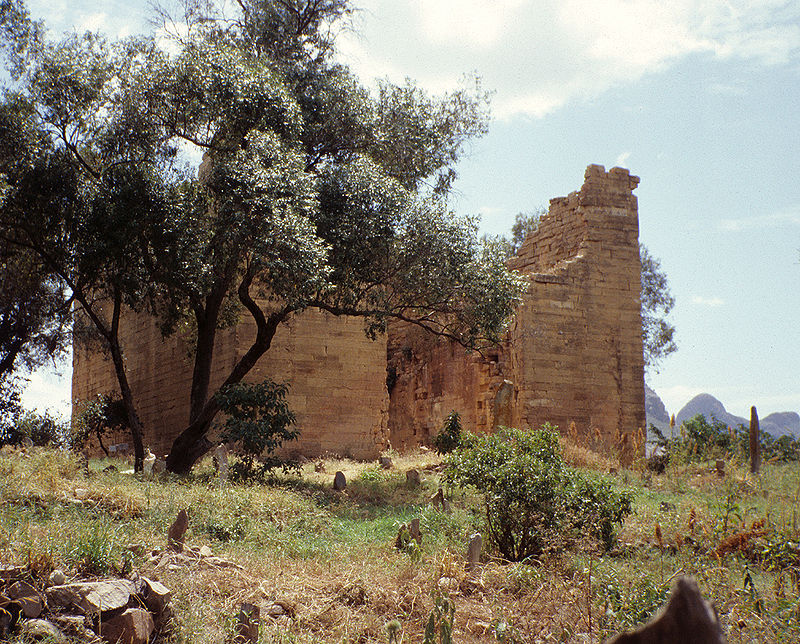
Temple of the Moon God at D'mt
During this time the kingdom of D'mt was reaching the zenith of its power and glory. Their kingdom was centred on their capital at Yeha, in what is now northern Ethiopia. They built a great temple at Yeha, part of which still stands today. It was probably dedicated to the Moon God, but this is unclear.

Inscriptions in the Sabaean script have been found from this region and most amazingly, they record the names of kings and queens for this obscure kingdom. They use Sabaean titles for their rulers, as well as the Sabaean script, so it is very clear that the kingdom was culturally influenced by the Sabaeans, but it does not seem as if they names of their kings and queens were Sabaean.

The kingdom of D'mt did not merely centre on Yeha, but had a number of other cities, mostly in the region of what is now the country of Eritrea. These included Hawulti, Matara and Qohaito, all of which may yield more information on the history of this land when excavated more fully in the future.

Sabaean inspired writing from the kingdom of D'mt
In Egypt and Kush, Taharqa acceded to the throne in 690BC. He appears to have been a strong and capable Pharaoh, but he faced a very serious threat. The Assyrian Empire was at the height of its power and, under their king Esarhaddon, invaded Egypt in 671BC. The Assyrians captured Memphis after a fierce struggle and while Taharqa escaped, other members of the Kushite royal family, including the crown prince Ushanahuru, were captured by the ruthless Assyrians.

Esarhaddon was faced with rebellion in his own kingdom and withdrew shortly after the capture of Memphis. But even so, this was the most terrible invasion that Egypt had seen in many centuries. The Libyans and the Kushites had both seen themselves as in certain sense Egyptian. The Assyrians were simply foreign conquerors. We have a prayer from Taharqa at this time.

Oh Amun, … my wives, let my children live. Keep death away from them, for me. 
Prayer of Taharqa, written around 670

The Egyptians rebelled against the Assyrians in 670BC and Taharqa came back to the attack. Esarhaddon died as he was returning to Egypt to crush the Kushite counterattack. His son Ashurbanipal took over the conquest. In 667BC Ashurbanipal returned to Egypt and defeated Taharqa once more. One of the Egyptian princes of Sais had been placed as an Assyrian governor of Lower Egypt and even though he had rebelled against the Assyrians, Necho I was returned to Egypt as a client ruler of the Delta in the name of the Assyrians.

Pyramid of Taharqa at Nuri in Kush
Taharqa died around 664BC and was buried in a grand pyramid at a new royal cemetery at Nuri. It was succeeded by Tanutamon, also known as Tantamani. Tantamani attacked the Assyrians, killing their vassal king Necho I, and the Assyrians counterattacked, pushing southwards to Thebes in Upper Egypt. Here they attacked until they had captured it and sacked it, causing great destruction in one of the greatest cities on earth. This destruction of Thebes effectively pushed the Kushite rulers back into Kush. The end of Kushite rule is generally held as the end of the Third Intermediate Period of Egyptian history and the beginning of what is known as the Late Period.

In 656 Psammetichus I, son of Necho I, recaptured Thebes, ending Kushite rule in Egypt. This was at least partly because the Divine Adoratrice of Amun (High Priestess) was a sacred figure and had been left alone by the Assyrians and Egyptians. This person had joint control over the city of Thebes and control of the vast estates of the temple of Amun. The current Adoratrice was Shepenupet II, a Kushite and a long-lived daughter of Piye, the first Kushite Pharaoh of Egypt. Shepenupet was old and had adopted a daughter, Amenirdis, the daughter of Taharqa, to succeed her.

Relief of Nitocris and Psamtik I
The estates of Amun were too powerful to be left in the hands of the relatives of a rival Pharaoh, so Psammetichus (or Psamtik I depending on what naming convention is used), decided to force Shepenupet to adopt his daughter, Nitocris, instead, so that on Shepenupet's death, Nitocris would become the next Adoratrice. This forced adoption took place in 656 and is commemorated by a stela of Psammetichus. This time period sees Psammetichus gradually increasing his power to the point where he would be able to defy the Assyrians and expel them from his land. Assyrian forces may have begun to withdraw from Egypt from around 654 onwards. Psammetichus I now ruled as a Pharaoh of the 26th Dynasty of Egypt.

In the year 9, second month of the first season, day 14, they arrived at the city of the gods, Thebes. As she advanced, she found all Thebes, men and women alike, standing, rejoicing at her approach, surrounding her with great offerings, a multitude in number. Then they said: "The daughter of the King of Upper Egypt, Nitocris, comes to the house of Amun; that he may receive her and be satisfied with her. The daughter of the King of Lower Egypt, Shepnupet, comes to Karnak, that the gods therein may honour her."
Adoption Stela of Nitocris

Relief showing Shepenupet
Psammetichus was also famed in literature for conducting possibly the first scientific experiment ever, or at least the first psychological experiment. The Egyptians had always claimed that they were the oldest civilisation in the world. Psammetichus sought to prove this by having some children raised without listening to the speech of others and trying to figure out which language the children would spontaneously speak, assuming that they would speak the original language of mankind and thus, find the oldest civilisation. This experiment supposedly showed that the Phrygians were the oldest civilisation, which is interesting, as that can hardly have been the expected outcome. This was determined by the fact that the children kept saying the word "bekos" when pointing at bread, which roughly matched the Phrygian word for bread, but not the Egyptian. However, this story is nowhere recorded among the Egyptians and is only taken from the much later Greek texts of Herodotus.

Stela of Tefnakht
While we cannot prove if the language experiment was real or not, we can be certain that a new form of writing was pioneered in Egypt around this time, called the Demotic script (capitalised to avoid confusion with Greek "demotic" script). This was a short-hand script that could be used to transcribe hieroglyphs quickly and in some ways replaced an earlier short-hand known as hieratic. It was not an alphabet but it could be used to speed up writing and was widely adopted. It was part of the much later Rosetta Stone that was later used to decipher the Egyptian hieroglyphs.

According to legend the Greek colony of Cyrene was founded in Libya with Greek colonists and native Libyans in the year 631BC. It had good relations with the native peoples and it was unusual for Greek colonies, in that the main city was founded slightly inland, rather than directly on the sea, as was more usual. The colony would become famed for its export of silphium, a rare plant that only grew near this region and was believed to be not only the finest of delicacies, but also a herb with powerful healing properties. Silphium became the main export of Cyrene under the reigns of the Battiad kings, who ruled the colony for some centuries after its foundation.

In the year 609BC Necho II of Egypt led an expedition as far as the Euphrates River to try and save the remnants of the Assyrian Empire, which was on the verge of destruction by the Babylonians and the Medes. On the way there he defeated King Josiah of Judah in battle at Megiddo. After some initial successes, the Egyptian force was dealt a serious defeat in 605BC and was pushed back to the borders of Egypt by the Babylonians. The Egyptians defeated the Babylonians on the frontier in 601BC, but the Babylonians were still an active threat in the region.

Nok culture terracotta artifact
Around the year 600BC the people of the Nok culture had definitely developed iron-smelting techniques. It is unclear if they developed these independently or if they had received external knowledge. I suspect that the knowledge of iron-working was brought from artefacts traded across Africa, but that the techniques of iron-working were developed independently. The sophistication of their smelting furnaces was quite impressive and the quality of their iron was some of the best in the world at the time. An important smelting site was located at the present-day town of Taruga, near the Nigerian capital city of Abuja.

Around 595BC Pharaoh Necho II died and was succeeded by Psamtik II. He was one of the most fascinating individuals of this time period and seems to have had many excellent ideas. Perhaps he was too ahead of his time though, as most of his ideas seem to have failed in their execution.

Necho II is supposed to have attempted to link the Red Sea to the Nile in the earliest version of the Suez Canal to have been attempted. This was a gigantic work and was truly a work of vision but there were problems with it, namely that there is a considerable difference in water levels between the two bodies of water. There are no Egyptian inscriptions for this but we know the story from Herodotus, who says that Necho II stopped construction after receiving an unfavourable oracle.

Depiction of Necho II
Necho II then appears to have commissioned an even more intriguing expedition. He hired Phoenician sailors, the greatest sailors of the ancient world, to set sail from the Red Sea and to attempt to circumnavigate Africa. According to Herodotus, who again, is our sole source for the story, the sailors did not return for a long time but did eventually arrive back in Egypt having sailed around the continent and coming back through the Straits of Gibraltar. This was an unprecedented feat and one that was not to be repeated to our knowledge until the Age of Exploration. The sailors told tales of the sun being in the wrong position, which led the Greeks, and perhaps the Egyptians, to discount the story. This however makes it much more plausible, as it suggests that the Phoenicians did in fact reach the southern hemisphere.

For Libya shows clearly that it is bounded by the sea, except where it borders on Asia. Necos king of Egypt first discovered this and made it known. When he had finished digging the canal which leads from the Nile to the Arabian Gulf, he sent Phoenicians in ships, instructing them to sail on their return voyage past the Pillars of Heracles until they came into the northern sea and so to Egypt. So the Phoenicians set out from the Red Sea and sailed the southern sea; whenever autumn came they would put in and plant the land in whatever part of Libya they had reached, and there await the harvest; then, having gathered the crop, they sailed on, so that after two years had passed, it was in the third that they rounded the pillars of Heracles and came to Egypt. There they said (what some may believe, though I do not) that in sailing around Libya they had the sun on their right hand.
Herodotus, Histories: 4:42

Statue of Anhknesneferibre
When Psamtik II took the throne he instated his daughter Ankhnesneferibre as Divine Adoratrice of Amun in Thebes. This was in the year 595 or 594 depending on what is counted as the first year. This was an important position, in certain ways perhaps the second most important position in Egypt after the Pharaoh himself, so it was important to ensure that this post was held by someone loyal to the dynasty. Nitocris I adopted the princess to ensure that she would become God's Wife on the death of Nitocris. Thus the Saite Dynasty (the 26th Dynasty) further strengthened its hold on the southern part of Egypt.

Year 1, third month of the third season, day 29, under the majesty of Horus: Favourite of the Two Goddesses: Mighty of Arm; Golden Horus: Beautifying the Two Lands; King of Upper and Lower Egypt: Psamtik II, given life. On this day the king's-daughter, Ankhnesneferibre, arrived at Thebes. Her mother, the Divine Consort, Nitocris, who liveth, came forth to behold her beauty, and they went together to the House of Amon. 
Stela of Ankhnesneferibre, written circa 594BC

Around 590BC the Kushite capital appears to have moved south from Napata, which was vulnerable to raids from the reinvigorated Egyptian kingdom, to Meroe, which was further south along the Nile. Napata was still held by the Kushites however and their kings continued to be buried in the royal cemetery of Nuri during this time.

In the year 589BC Apries of Egypt, known as Hophra in the Biblical record, succeeded to the throne. He was unable to prevent the rise of Babylonian power in the region, and it is possible that there was a Babylonian invasion during his reign, but this is unclear. He was overthrown by the usurper Amasis II in 570BC after a failed invasion of Cyrene.

Relief from Jebel Barka in Kush
I am not sure of when this story took place, but I have presumed it to occur at some point around the year 550BC, if it happened at all. The cities of Carthage and Cyrene both existed along the North African coast: Two trading cities, one Phoenician, one Greek. Neither side had great interest in the desert interior and were both more interested in trading with the rest of the Mediterranean. Thus they decided to draw a border between them. It was decided that two runners would set out from each city and run as fast as they could along the coast until they met the runners from the other city. Supposedly the Carthaginian runners made incredible speed and met the runners from Cyrene well over halfway away from Carthage. The runners from Cyrene understandably were annoyed and accused the Carthaginians, two brothers known as the Philaeni Brother, of cheating. Cheating may in fact have taken place. The Greeks wanted to rerun the race while the Carthaginians wanted the result to stand.

AD1872 painting of the Battle of Pelusium by Lenoir
Eventually the Greeks agreed to a compromise. They would accept the result, if the Philaeni Brothers were to be slain. If the Philaeni Brothers wanted to live they would rerun the race. The Philaeni chose to die so that their homeland could enjoy the advantage that they had won for it. Solemn sacrifices were made and until the time of late Antiquity the boundary between the two regions was fixed at the Altar of the Philaeni. Later the Roman Empire would be split into east and west at the point where the Philaeni Brothers died. I'm not sure when this story happened and I'm not at all sure if the story is true. It probably is not. But there are no records of Cyrene and Carthage going to war at least.

In 525BC the Babylonian Empire had fallen and the Persian Empire now dominated the Middle East. Led by their ruler Cambyses II, the son of Cyrus the Great, the Persians invaded Egypt, which was now ruled by the son of Amasis, Psammetichus III. There was a great battle fought at Pelusium, which the Persians won. There are some strange legends about the Battle of Pelusium that lead it to be known as the Battle of the Cats. This comes from a much later Greek book however and should not be taken too seriously. Egypt was now part of the huge Persian Empire. This ended the 26th Dynasty of Egypt. The Persian kings are sometimes referred to as the 27th Dynasty of Egypt.

Wall paintings from the tomb of Tanutamani
Around the year 500BC the Magonid kings began their rule of the city of Carthage. They were from a family that bore the name of Mago, e.g. Hamilcar Mago or Hannibal Mago. Very little is known of the constitution of Carthage around this time and even though it was ruled by kings during this period, there probably was some form of Senate, or Council, to moderate the decisions of the kings.

Around this time the ancestors of the Khoikhoi group probably began to inhabit the region to Twyfelfontein in what is now present-day Namibia. The region is known for its rock art in the caves and cliff faces. These rock carvings and paintings are preserved due to the aridity of the region, which receives very little rainfall. It was probably a sacred site or a gathering place for the hunter-gatherers of the region, but sadly little can be said about it.

During all this time the speakers of the Bantu languages were gradually moving southwards into the rainforests of central Africa. Over the next millennium they would gradually extend their languages across much of the central and southern reaches of the continent.

Wall paintings from the tomb of Tanutamani
And thus the period draws to a close. Egypt had seen the end of the New Kingdom, followed by the Libyan and Kushite rule of the Third Intermediate Period, followed by the Persian conquest after the 26th Dynasty. Even after the Kushite defeats, Kush was still one of the strongest states in the world at the time. The period also saw the growth of the Phoenician city of Carthage on the northern coast of Tunisia, and the foundation of the Greek colony of Carthage on what is now the northern region of Libya. The Iron Age sub-Saharan Africa began in earnest with the adoption and refinement of iron-working by the Nok Culture. In the east of Africa the little-known kingdom of D'mt was flourishing.

Sphinx of Amasis
Primary Sources:
Piye Stela, written circa 720BC
Prayer of Taharqa, written around 670BC
Adoption Stela of Nitocris, written circa 656BC
Herodotus, Histories: 4:42, written circa 440BC
Stela of Ankhnesneferibre, written circa 594BC

Related Blog Posts:
Some African History from 4000-3000BC
Some African History from 3000-2000BC
Some African History from 2000-1500BC
Some African History from 1500-1000BC
Some African History from 1000-750BC
Some African History from 750-500BC

Monday, 18 February 2019

Some African History from 1500-1000BC

Bust of Nefertiti
This is a quick overview of African history from the year 1500BC to the year 1000BC. Due to the nature of the sources it will be rather focused on Egypt. This is unfortunate, but somewhat inevitable, as Egypt is the one of the best documented places in the world at this time.

Outside of Egypt there were sophisticated cultures in Nubia and Punt, although Nubia had been subjugated by the Egyptian state by the year 1500BC. The lower edge of the Sahara had seen the development of agriculture, although there is no record of extensive bronze metalworking from this period. This is to be expected as tin was very scarce in the ancient world and there were no easy trade routes past the Sahara at this time.

Further south of the equator humans still lived as hunter-gatherers, as their distant ancestors had done for millennia. This was more to do with the sophistication of their hunting techniques than anything else. Unlike other parts of the world they had not had the need to develop agriculture and their culture was perfectly adapted to its surroundings. However, if farming groups were to arrive in the area from outside, this would change the balance of the environment and tip the scales in favour of the agricultural groups. The Nok culture was beginning to thrive around this time, in what is now the country of Nigeria. Meanwhile the speakers of Bantu languages had already begun the process of expansion that would see their languages spread over most of sub-Saharan Africa.

Statue of Hatshepsut
In the century of the 1400’s BC the 18th Dynasty ruled Egypt. After overthrowing the foreign Hyksos and subduing the neighbouring regions, such as the region of Nubia and the oases of the western desert, the Pharaohs expanded their control into Palestine and made expeditions as far north as Syria. Egypt was now probably the wealthiest state on earth. It was secure against foreign invasions, was cohesively organised and had a tradition of literacy and administration stretching back for over a millennium and a half. This helped make Egypt one of the militarily strongest states on earth and also allowed them to create their most spectacular works of art, architecture and sculpture.

Hatshepsut became Pharaoh around the year 1478BC. It was not unheard of for there to be a woman ruling Egypt, but it was unusual. She ruled as regent for her nephew Thutmose III. She preserved the power of Egypt, commissioned impressive building projects, went on military campaigns and also sent expeditions to Punt, which was probably located in what is now northern Somalia. At one of her temples she left detailed descriptions of the expedition that she commissioned and these have been the most descriptive accounts of that fabled land that have come down to us. Her preserved body has since been discovered by modern archaeologists and it appears that she died of cancer caused by a skin lotion that the queen used. After Hatshepsut’s death, her monuments were defaced during the reign of her successor and her name was attempted to be removed from history. Fortunately this attempt did not succeed, but it is not clear why Thutmose III or others would want to remove Hatshepsut from the record.

Thutmose III, the strongest military leader of Egypt
When Thutmose III came to the throne he began the most ambitious series of campaigns ever undertaken by an Egyptian ruler. This involved crushing a rebellion in Nubia and a northern expedition that crossed the Euphrates River in Syria. The expedition across the Euphrates was an attempt to defeat the Mitanni, a Hurrian state ruled by an Indo-Iranian aristocracy famed for their prowess in chariotry. Thutmose III achieved great successes, but could not destroy the Mitanni. His most well-known achievement was in fighting the combined armies of the Canaanite princes at the Battle of Megiddo.  This probably took place around 1457BC and is the earliest battle for which there exists a near-contemporary description. It was a great victory for the Egyptians and the land of Canaan was incorporated into the Egyptian Empire. The reign of Thutmose III was the apex of Egyptian military power.

Then his majesty prevailed against them at the head of his army, and when they saw his majesty prevailing against them they fled headlong to Megiddo in fear, abandoning their horses and their chariots of gold and silver. The people hauled them up, pulling them by their clothing, into this city; the people of this city having closed it against them and lowered clothing to pull them up into this city.
Account of the Battle of Megiddo

The 18th Dynasty continued its rule into the century of the 1300’s BC. Egypt grew in power and strength but was never as militarily dominant as during the reign of Thutmose III. Other competitors arose who were able to contend with them. The Mitanni were beginning to decline, but the rising Hittite Empire proved a potent threat to the Egyptian domination of Syria. The Kassites ruled rich Babylonia and their Assyrian vassals in the north of Mesopotamia would later emerge as a great power. Each of these powerful states became engaged in a system of diplomacy that would come to characterise the late Bronze Age. The powers would correspond as equals, referring to each other as brothers and solving diplomatic disputes peacefully if they could. The subordinate rulers of minor cities would be referred to as sons and orders would be sent to them from the main rulers.

Akhenaten, the Heretic Pharaoh
Around the year 1351BC Amenhotep IV came to power. He was an anomalous character who changed his name to Akhenaten, moved the capital to the city now known as Amarna and tried to reform the Egyptian art and religion. He is known sometimes as the Heretic Pharaoh. His main reforms were the replacement of Amun, who was the patron god of Thebes, with Aten, who was portrayed as the sun-disk. This may have been because the priests of Amun were too powerful, but some have thought of Akhenaten as the first monotheist. This is possible, but probably projects too many of our modern concepts onto Akhenaten.

He also changed Egyptian art. With the exception of the much earlier Senusret III and his son, Egyptian art followed very rigid conventions. The art of Amarna showed the royal family in an almost realistic fashion. The king was shown with a prominent paunch and strange facial features. However, this unusual style also allowed great beauty and the most famous Egyptian bust, the famed bust of Nefertiti, was from around this time.

While the new revolution was ambitious, it was also a failure and its failure doomed the 18th Dynasty. When Akhenaten died there was no clear ruler and a number of short-lived rulers took power, possibly including Nefertiti herself. The capital of Amarna was abandoned and its abandonment was a boon for later archaeologists as the palace archives, with the correspondence of the Bronze Age rulers was left intact. This archive is known as the Amarna Letters.

Art from the Amarna Period
Rib-addi (King of Byblos) spoke to his lord, the King of Lands (Akhenaten, Pharaoh of Egypt): May the Mistress of Gubla (Byblos) grant power to my lord. At the feet of my lord, my sun, I fall down seven times and seven times. Let the king, my lord, know that Gubla, your handmaid from ancient times, is well.
Letter from Rib-Addi, king of Byblos, to his overlord Akhenaten, imploring him for help against his foes: From the Amarna Letters:

One of the later rulers was the rather weak and pathetic boy-king Tutankhamun, who seems to have been persuaded to reverse all the changes of his father. Tutankhamun would not have been remembered by history but his sheer unimportance guaranteed the survival of his fame in modern times. His tomb was overlooked by grave robbers (who seem to have been disturbed in the robbery of it) and was neglected until it was excavated by Howard Carter in 1915. It was the most spectacular tomb ever discovered in Egypt, or possibly anywhere in the world. The riches found within are some of the greatest treasures known to man and give an idea of the power and riches of the 18th Dynasty. Even the most minor king of their dynasty was buried with unimaginable quantities of wealth.

Horemheb, a commoner who became
Pharaoh and erased the memory
of Akhenaten
Now when his majesty appeared as king, the temples of the gods and goddesses from Elephantine down to the marshes of the Delta [had... and] or fallen into neglect. Their shrines had become desolate, had become mounds overgrown with weeds. Their sanctuaries were as if they had never been. Their halls were a footpath. The land was topsy-turvy and the gods turned their backs upon this land.
Edict of Restoration (of the temples of Amun) by Tutankhamun, reversing the policies of Akhenaten

After Tutankhamun’s death, a highly-ranked noble called Ay took the throne before being deposed by a general named Horemheb. Under Horemheb’s rule the memories of the rule of Akhenaten were erased and the Heretic Pharaoh would only be dimly remembered by later Egyptian scribes. Horemheb died without heir, so another general took the throne, ruling Egypt as Ramesses I and founding the 19th Dynasty in 1292.

In 1279 the third Pharaoh of the 19th Dynasty came to power. He was Ramesses II and was the greatest builder of all the Pharaohs. He had a tendency to appropriate the works of others to himself ,but even so he was a great builder. He built a new capital at Pi-Ramesses on one of the branches of the Nile Delta. He commissioned gigantic statues and temples. While the New Kingdom Pharaohs no longer built pyramids, the works of Ramesses were smaller but more ornate. One of the colossal statues of the king weighed 83 tonnes.

Colossal statue of Ramesses II
Ramesses II fought many wars to re-establish the Egyptian Empire, which was threatened by Hittite expansion in Syria. The two sides fought a number of battles, including a stalemate at Kadesh. The Hittites ambushed the Egyptian forces with a neat piece of trickery, but the arrival of Egyptian reinforcements forced the victorious Hittites to withdraw. After a number of years of fighting the Hittites and the Egyptians made peace with each other, which is recorded by what is the oldest peace treaty yet discovered. Eventually Ramesses II died around the year 1213BC, old and full of years, having lived until his nineties.

There shall be no hostilities between them, forever. The great chief of Kheta (King of the Hittites) shall not pass over into the land of Egypt, forever, to take anything therefrom. Ramses-Meriamon (Ramesses III), the great ruler of Egypt, shall not pass over into the land of Kheta (Hittite territory), to take anything therefrom, forever.
Part of the treaty (Egyptian version) between the Hittites and Egyptians after the Battle of Kadesh

Treaty of Kadesh (Hittite Version)
While the Egyptian medicine of the time was unable to save Ramesses II from his death, which was probably from an abscess in the jaw, it was nevertheless advanced. The Brugsch Papyrus dates from around this time and contains a synopsis of much of Egyptian medicine. A lot of what is written is wrong, but most medicine up until the 1800’s AD was based on bad guesswork. The interesting thing is that the Egyptians tried to have a systematic view of medicine and the Greeks would later be enthusiastic learners from the Egyptians.

Elsewhere in Africa, the site of Luxmanda, in what is now the country of Tanzania, was occupied. This was a settlement by the Savanna Pastoral Neolithic culture, which was probably a Cushitic-speaking culture that had used cattle and stone tools from the upper Nile regions to expand southwards.

Similarly the Elmenteitan culture flourished around this time in what is now the country of Kenya. This was another stone tool using agricultural group that had moved south to displace and absorb the hunter-gatherers who had been in the region before them.

Temple of Ramesses II at Abu Simbel
This was later moved to protect it from the rising
waters of the Aswan Dam
After the long reign of Ramesses II a number of short lived monarchs ruled Egypt until finally Twosret took the throne around the year 1191BC. She was ruler for only a few years before a civil war occurred, either against her or after her death, and Setnakhte took the throne, founding the 20th Dynasty in Egypt. By this time there were serious problems in the Bronze Age world of the Near East. The Mycenaean kingdoms were facing threats, the Hittites in Anatolia were being wiped out by the famine and external attacks and the whole eastern seaboard of the Mediterranean had to deal with attacks by pirate groups known as the Sea Peoples.

This collapse was faced head on by Ramesses III who defeated the Sea Peoples in two battles, one in Canaan and another on the Nile, which is known as the Battle of the Delta. These battles are said to have saved Egypt from invasion, but it seems as if Egypt only barely held on. The empire in Syria and Palestine was lost. The kingdoms with whom Egypt traded, such as the Hittites and the Mycenaeans had been swept away by the turmoil of the age. Ramesses III continued campaigning, but in many ways he was the last of the great rulers of the New Kingdom.

Medinet Habu Temple of Ramesses III
showing him defeating the enemies of Egypt
I have the river-mouths prepared like a strong wall, with warships, galleys and coasters fully equipped, for they were manned completely from bow to stern with valiant warriors carrying their weapons. The troops consisted of every picked man of Egypt.
Ramesses III inscription at the temple of Medinet Habu, describing the Battle of the Delta

Ramesses III was assassinated by one of his sons, Pentawer, acting upon the advice of his mother Tiye, around the year 1155BC. There are court documents dealing with the assassins and archaeologists have found the mummy of Ramesses III, showing a deep throat wound that would have been fatal. The mummy does not seem to match the descriptions given in the court, but there may be a modern misunderstanding of what exactly happened.

The great criminal, Pebekkamen, formerly chief of the chamber. He was brought in because of his collusion with Tiy and the women of the harem. He made common cause with them, and began bringing out their words to their mothers and their brothers who were there, saying: "Stir up the people! Incite enemies to hostility against their lord." He was placed before the great nobles of the court of examination; they examined his crimes; they found that he had committed them. His crimes seized him; the nobles who examined him brought his judgment upon him.
Section of the Turin Papyrus describing the trials of the assassins of Ramesses III

Each of the Pharaohs of the 20th Dynasty who followed Ramesses III would also take the name Ramesses. There would be a Ramesses IV, V, VI, VII, VIII, IX, X and XI; none of whom managed to restore Egypt to greatness.

Relief showing Ramesses II slaying enemies at Kadesh
Around this time a piece of literature called the Story of Wenamun was written. It was set in the time of the later rulers of the 20th Dynasty, but is probably not a straightforward account of a real journey. It tells the tale of a priest named Wenamun who travels to Byblos in Lebanon to ask for cedar wood from the king of Byblos. Wenamun requests the wood for free, as had been the custom in earlier times, but the king of Byblos refuses and the Egyptian has to send back to Egypt for payment. The text is incomplete as it breaks off at the point of the text when Wenamun reaches Cyprus. It does serve as a literary reminder of the diminishing power of Egypt at this time, as Byblos had once been part of their empire, but was no longer. This is especially poignant considering that the king of Byblos had been one of the most subservient vassals recorded in the Amarna Letters correspondence two centuries earlier.

He said to me: "If the ruler of Egypt were the owner of my property, and I were also his servant, he would not send silver and gold, saying: 'Do the command of Amon.' It was not the payment of (tribute?) which they exacted of my father. As for me, I am myself neither thy servant nor am I the servant of him that sent thee.
Extract from the Tale of Wenamun where the king of Byblos refuses to give cedar logs for free to the Egyptians

Relief showing a house in Punt, from a temple inscription
commemorating the expedition Hatshepsut sent to Punt. 
Around the year 1077BC a new Pharaoh named Smendes came to the throne and founded the 21st Dynasty. This is referred to by modern scholars as the end of the New Kingdom and the beginning of the Third Intermediate Period. The rulers of the 21st Dynasty reigned from Tanis and some spectacular grave goods survive from this period. But this is not because they were wealthy. It was because the Pharaohs themselves were sponsoring the robbing of the graves of their predecessors.

Around the year 1000 the kingdom of Kush had once again broken free of Egypt. We know very little of their rulers or politics at this time but they seem to have been free once more as Egypt became weaker. In Libya, with the power of the Egyptians waning, the local tribes seem to have become independent and to have taken control of the oases, as well as having more and more influence in the Delta region of Lower Egypt.

Further south in Africa, it seems likely that speakers of the eastern Bantu languages had reached what is now Uganda by around this time. These dates should be treated as extremely approximate, as they are based on linguistic reconstructions.

And finally, the far to the west, the Canary Islands were probably settled by this time. Perhaps this settlement was by a group of people known as the Guanches, who were later known in classical antiquity. Perhaps the settlement was by an entirely different group of people who were wiped out by later groups arriving on the islands.

Funerary mask of Tutankhamun
Thus the period draws to a close. This time saw the expansion of agriculture in Africa, both from the Bantu speakers but also the Savanna Pastoral Neolithic culture in eastern Africa. Punt saw the last of the great Egyptian expeditions and the land of Punt fades from view after this time. Nubia had been subjugated at the beginning of the period but had broken free by the end of it. Egypt had seen some of its greatest rulers and most iconic individuals from this time, Hatshepsut, Thutmose III, Akhenaten, Tutankhamun, Ramesses II and Ramesses III. After this great flourishing of their land, Egypt settled into a period of decline.

Related Blog Posts:
Some African History from 4000-3000BC
Some African History from 3000-2000BC
Some African History from 2000-1500BC
Some African History from 1500-1000BC
Some African History from 1000-750BC
Some African History from 750-500BC

Some African History from 2000-1500BC

Statue of Thutmose I
This is a quick overview of African history from the year 2000BC to the year 1500BC. Due to the nature of the sources it will be rather focused on Egypt. This is unfortunate, but somewhat inevitable, as Egypt is the one of the best documented places in the world at this time.

Outside of Egypt there were sophisticated cultures in Nubia and Punt. The lower edge of the Sahara had seen the development of agriculture, although there is no record of extensive bronze metalworking from this period. This is to be expected as tin was very scarce in the ancient world and there were no easy trade routes past the Sahara at this time.

Further south of the equator humans still lived as hunter-gatherers, as their distant ancestors had done for millennia. This was more to do with the sophistication of their hunting techniques than anything else. Unlike other parts of the world they had not had the need to develop agriculture and their culture was perfectly adapted to its surroundings. However, if farming groups were to arrive in the area from outside, this would change the balance of the environment and tip the scales in favour of the agricultural groups. Near the Niger Delta agriculture was being developed by speakers of what are now known as Proto-Bantu languages. This group would eventually expand and change the linguistic makeup of the continent when it began to expand.

Ruins of the city of Kerma, in present-day Sudan
In Egypt the 11th Dynasty was founded by Mentuhotep II. This is held to be the beginning of the Middle Kingdom of Egypt, after the relative chaos of the First Intermediate Period. The 11th Dynasty was centred on the southern city of Thebes. The new dynasty brought stability and prosperity to Egypt. Mentuhotep II led armies south into the lands that they now referred to as Kush. He also sent trading missions to the Land of Punt, probably in what is now northern Somalia. These missions would continue intermittently for the next two hundred years.

The “Kushite” kingdom was probably the large polity to the south of Egypt. This was centred on the city of Kerma. The culture of the region at this time is also referred to as the Kerma culture, but their rulers are barely known in comparison to the Pharaohs to the north.

Further to the south, a Neolithic culture referred to as the Savannah Pastoral Neolithic Culture flourished in Kenya and Tanzania. They may have been influenced by settlers from the Nile Valley further to the north. It is suspected that these peoples may have spoken Cushitic languages and that their economy was focused on pastoral cattle farming.

Cave paintings from the Brandberg Mountain region
in Namibia
Far to the south, in the lands that are now Namibia, a series of cave paintings were created by the local hunter-gatherers. The dating of these is extremely hard to identify precisely and the paintings were created over a period of millennia anyway. But it seemed important to mention them and this date is probably approximately correct for them.

It was after supper, when night had fallen, and I had spent an hour of happiness. I was asleep upon my bed, having become weary, and my heart had begun to follow sleep. When weapons of my counsel were wielded, I had become like a snake of the necropolis. As I came to, I awoke to fighting, and found that it was an attack of the bodyguard. If I had quickly taken weapons in my hand, I would have made the wretches retreat with a charge! But there is none mighty in the night, none who can fight alone;
Instructions of Amenemhat

Ruined pyramid of Amenemhat
During the 1900’s BC the 11th Dynasty ended in Egypt and the 12th Dynasty began, probably with a palace coup. During this century Egyptian culture and technology blossomed. Literary works such as the Instructions of Amenemhat were written around this time. The Instructions of Amenemhat was written as if the dead Pharaoh Amenemhat was counselling his son in a dream. Amenemhat had been murdered in a conspiracy and wanted to prevent his son from the same fate.

Also around this time in Egypt, glass was invented. This was coloured glass, used for decorations, but the clear glass that we normally associate with glass was not invented until later. It was still a major technological leap for humanity.

In the 1800’s BC the literary trends of Egypt continued, with texts such as the Eloquent Peasant, the Admonitions of Ipuwer, and the Berlin Papyrus 6619 all dating from around this period.

Would that there were an end of men, without conception, without birth! Then would the land be quiet from noise and tumult be no more.
Admonitions of Ipuwer, c1800’s BC

The Eloquent Peasant was a light-hearted tale of a scheming official who deprived a peasant of his property using a trick. The peasant appealed for justice and eventually receives it, but only after being made to wait, while the court enjoy listening to his pleas. The Admonitions of Ipuwer is a darker piece of royal propaganda. It gives a terrifying description of a world descending into chaos while the righteous suffer. We are missing the end of the poem, but it is likely that the coming of a king to end the suffering would have been prophesied, thus glorifying the Pharaoh who commissioned it. The Berlin Papyrus 6619 was a mathematical treatise that demonstrated knowledge of the Pythagorean Theorem.

Papyrus fragment showing
Tale of Sinuhe
But the glory of Egyptian literature is the Tale of Sinuhe. This is the story of Sinuhe, an Egyptian courtier who, upon hearing a dangerous conversation, flees Egypt. He finds his way to Canaan where he builds a new life and becomes a great man in the local lands. But his heart misses Egypt and finally a decree arrives from the Pharaoh, allowing Sinuhe to return home. His newfound greatness cannot overcome his longing for Egypt and he returns to be welcomed back to his native land, where a tomb was prepared for him so that he could face the afterlife with his head held high.

And I was clad in soft linen, and anointed with fine oil; by night I lay upon a bed. I gave up the sand to them that dwell therein, and oil of wood to him who smears himself with it.
The Tale of Sinuhe, written c1800’s BC

During this time, the powerful ruler Senusret III ruled Egypt. He expanded the Middle Kingdom to the height of its power and engaged in campaigns in Libya and against the Kushites to the south. He also became involved in the politics of Canaan. His campaigns would go on to become legendary and his name would live on as the legendary Sesostris, who was said to have been a great Egyptian conqueror who subjugated lands near and far.

The unusual face of Senusret III
Senusret III completed huge building projects, including a canal that allowed passage of the First Cataract of the Nile. He also began work to create the Great Canal that would allow the Faiyum Depression to act as a storage area for the waters of the Nile. This gigantic project was eventually finished by his son. Strangely, the statues of Sesostris III seem to show the face of a ruler who is saddened, lonely and bitter, which is most unusual for the statues of a Pharaoh.

Eventually, late in the century, the last ruler of the 12th Dynasty, Queen Sobekneferu, passed away, possibly in a coup and the 13th Dynasty came to power. The chronology of this dynasty is not well known at all and even the names of the rulers and the order in which they ruled are uncertain. Egypt appears to have begun to decline at this point.

In the century of the 1700’s BC the 13th Dynasty reigned in Thebes, in Upper Egypt. In the later years of the century the 14th Dynasty began to rule concurrently at Avaris, in Lower Egypt. These Pharaohs may have had connections with the kingdom of Kush and with the city-states of Canaan and Syria. With two competing dynasties Egypt was disunited and weak.

Statue of an Asiatic man from Avaris
While Egypt was weak, the Kingdom of Kerma, as Nubia/Kush is known at this point, was strong. This time seems to have been the zenith of the power of the rulers of Kerma.

In the century of the 1600’s BC foreign invaders from Syria, known as the Hyksos, took Avaris and founded the 15th Dynasty of Egypt. The Hyksos may have been responsible for the introduction of horses into the continent of Africa, and their horse drawn chariots may have been the secret to their success. Another dynasty, known as the 16th Dynasty, ruled in Thebes, but was subordinate to the Hyksos in Avaris. A third, even smaller, dynasty ruled a tiny buffer state between Avaris and Thebes and are known as the Abydos Dynasty. The Kingdom of Kerma took advantage of this to attack the southern frontiers of Egypt.

Far to the south and west of Egypt, in the region now known as Nigeria, the Nok Culture arose. At this point they were a Neolithic culture and their great cultural flourishing would not occur for many centuries but they were nevertheless laying the foundations for their later prosperity at around this time.

Mummified body of Ahmose
Founder of the 18th Dynasty and the
New Kingdom
In the century of the 1500’s BC the 17th Dynasty of Egypt, based at Thebes, finally cast out the Hyksos, who had invaded Egypt in the previous century and founded what we refer to as the New Kingdom. This ended the Second Intermediate Period and would bring Egypt to its greatest period of strength. Ahmose I, who had finally expelled the Hyksos, founded a new dynasty, known as the 18th Dynasty. Ahmose was to construct the last pyramid built by native Egyptian rulers. Under the son and grandson of Ahmose I (Amenhotep I and Thutmose I) the Kingdom of Kerma was conquered by Egypt and Egyptian power now stretched far south along the Nile, far to the west across the oases of the Sahara and as far north as the Euphrates River, to which the Egyptian Pharaohs would occasionally campaign.

In a very different type of expansion, the speakers of Bantu languages seem to have begun to spread outwards. These speakers had probably been close to the mouth of Niger River. Perhaps the technologies and organisation of the Nok Culture aided this expansion. But we know from analysing linguistic drift that around this time the language speakers split into two groupings; East and West. The western Bantu speakers went along the Atlantic coast, towards the Congo Valley, while the eastern Bantu speakers went inland to the south-east towards central Africa and the lakes.

Some have speculated that the Nok culture had discovered iron-smelting at this point and that this fuelled both the rise of the Nok culture and the Bantu expansion. This is perhaps plausible, but it is not likely, as this would probably have led to a much faster expansion at this stage. Only Egypt and Kerma were known to be using bronze at this stage of African history, so iron weapons and tools would have been a great advantage indeed against the stone tool users elsewhere.

Pottery from Kerma
Thus the period draws to a close, with the chaos of the Egyptian Second Intermediate Period at an end and the beginnings of the New Kingdom. The Kingdom of Kerma was destroyed around this time by the resurgent Egyptians. Meanwhile in western Africa, the Nok culture was beginning to grow and the Bantu speakers were beginning to spread east and west, along the coasts, towards the lakes and into the equatorial forests.

This is of course only the barest of outlines, a mere historical sketch. There is so much more that could be said but I have tried to give a map that others can use to search for further detail and discover more of the history of Egypt, of Sudan, of Nigeria and of Africa as a whole.

Related Blog Posts:
Some African History from 4000-3000BC
Some African History from 3000-2000BC
Some African History from 2000-1500BC
Some African History from 1500-1000BC
Some African History from 1000-750BC
Some African History from 750-500BC