Showing posts with label Sea Peoples. Show all posts

Monday, 18 February 2019

Some African History from 1500-1000BC

Bust of Nefertiti
This is a quick overview of African history from the year 1500BC to the year 1000BC. Due to the nature of the sources it will be rather focused on Egypt. This is unfortunate, but somewhat inevitable, as Egypt is the one of the best documented places in the world at this time.

Outside of Egypt there were sophisticated cultures in Nubia and Punt, although Nubia had been subjugated by the Egyptian state by the year 1500BC. The lower edge of the Sahara had seen the development of agriculture, although there is no record of extensive bronze metalworking from this period. This is to be expected as tin was very scarce in the ancient world and there were no easy trade routes past the Sahara at this time.

Further south of the equator humans still lived as hunter-gatherers, as their distant ancestors had done for millennia. This was more to do with the sophistication of their hunting techniques than anything else. Unlike other parts of the world they had not had the need to develop agriculture and their culture was perfectly adapted to its surroundings. However, if farming groups were to arrive in the area from outside, this would change the balance of the environment and tip the scales in favour of the agricultural groups. The Nok culture was beginning to thrive around this time, in what is now the country of Nigeria. Meanwhile the speakers of Bantu languages had already begun the process of expansion that would see their languages spread over most of sub-Saharan Africa.

Statue of Hatshepsut
In the century of the 1400’s BC the 18th Dynasty ruled Egypt. After overthrowing the foreign Hyksos and subduing the neighbouring regions, such as the region of Nubia and the oases of the western desert, the Pharaohs expanded their control into Palestine and made expeditions as far north as Syria. Egypt was now probably the wealthiest state on earth. It was secure against foreign invasions, was cohesively organised and had a tradition of literacy and administration stretching back for over a millennium and a half. This helped make Egypt one of the militarily strongest states on earth and also allowed them to create their most spectacular works of art, architecture and sculpture.

Hatshepsut became Pharaoh around the year 1478BC. It was not unheard of for there to be a woman ruling Egypt, but it was unusual. She ruled as regent for her nephew Thutmose III. She preserved the power of Egypt, commissioned impressive building projects, went on military campaigns and also sent expeditions to Punt, which was probably located in what is now northern Somalia. At one of her temples she left detailed descriptions of the expedition that she commissioned and these have been the most descriptive accounts of that fabled land that have come down to us. Her preserved body has since been discovered by modern archaeologists and it appears that she died of cancer caused by a skin lotion that the queen used. After Hatshepsut’s death, her monuments were defaced during the reign of her successor and her name was attempted to be removed from history. Fortunately this attempt did not succeed, but it is not clear why Thutmose III or others would want to remove Hatshepsut from the record.

Thutmose III, the strongest military leader of Egypt
When Thutmose III came to the throne he began the most ambitious series of campaigns ever undertaken by an Egyptian ruler. This involved crushing a rebellion in Nubia and a northern expedition that crossed the Euphrates River in Syria. The expedition across the Euphrates was an attempt to defeat the Mitanni, a Hurrian state ruled by an Indo-Iranian aristocracy famed for their prowess in chariotry. Thutmose III achieved great successes, but could not destroy the Mitanni. His most well-known achievement was in fighting the combined armies of the Canaanite princes at the Battle of Megiddo.  This probably took place around 1457BC and is the earliest battle for which there exists a near-contemporary description. It was a great victory for the Egyptians and the land of Canaan was incorporated into the Egyptian Empire. The reign of Thutmose III was the apex of Egyptian military power.

Then his majesty prevailed against them at the head of his army, and when they saw his majesty prevailing against them they fled headlong to Megiddo in fear, abandoning their horses and their chariots of gold and silver. The people hauled them up, pulling them by their clothing, into this city; the people of this city having closed it against them and lowered clothing to pull them up into this city.
Account of the Battle of Megiddo

The 18th Dynasty continued its rule into the century of the 1300’s BC. Egypt grew in power and strength but was never as militarily dominant as during the reign of Thutmose III. Other competitors arose who were able to contend with them. The Mitanni were beginning to decline, but the rising Hittite Empire proved a potent threat to the Egyptian domination of Syria. The Kassites ruled rich Babylonia and their Assyrian vassals in the north of Mesopotamia would later emerge as a great power. Each of these powerful states became engaged in a system of diplomacy that would come to characterise the late Bronze Age. The powers would correspond as equals, referring to each other as brothers and solving diplomatic disputes peacefully if they could. The subordinate rulers of minor cities would be referred to as sons and orders would be sent to them from the main rulers.

Akhenaten, the Heretic Pharaoh
Around the year 1351BC Amenhotep IV came to power. He was an anomalous character who changed his name to Akhenaten, moved the capital to the city now known as Amarna and tried to reform the Egyptian art and religion. He is known sometimes as the Heretic Pharaoh. His main reforms were the replacement of Amun, who was the patron god of Thebes, with Aten, who was portrayed as the sun-disk. This may have been because the priests of Amun were too powerful, but some have thought of Akhenaten as the first monotheist. This is possible, but probably projects too many of our modern concepts onto Akhenaten.

He also changed Egyptian art. With the exception of the much earlier Senusret III and his son, Egyptian art followed very rigid conventions. The art of Amarna showed the royal family in an almost realistic fashion. The king was shown with a prominent paunch and strange facial features. However, this unusual style also allowed great beauty and the most famous Egyptian bust, the famed bust of Nefertiti, was from around this time.

While the new revolution was ambitious, it was also a failure and its failure doomed the 18th Dynasty. When Akhenaten died there was no clear ruler and a number of short-lived rulers took power, possibly including Nefertiti herself. The capital of Amarna was abandoned and its abandonment was a boon for later archaeologists as the palace archives, with the correspondence of the Bronze Age rulers was left intact. This archive is known as the Amarna Letters.

Art from the Amarna Period
Rib-addi (King of Byblos) spoke to his lord, the King of Lands (Akhenaten, Pharaoh of Egypt): May the Mistress of Gubla (Byblos) grant power to my lord. At the feet of my lord, my sun, I fall down seven times and seven times. Let the king, my lord, know that Gubla, your handmaid from ancient times, is well.
Letter from Rib-Addi, king of Byblos, to his overlord Akhenaten, imploring him for help against his foes: From the Amarna Letters:

One of the later rulers was the rather weak and pathetic boy-king Tutankhamun, who seems to have been persuaded to reverse all the changes of his father. Tutankhamun would not have been remembered by history but his sheer unimportance guaranteed the survival of his fame in modern times. His tomb was overlooked by grave robbers (who seem to have been disturbed in the robbery of it) and was neglected until it was excavated by Howard Carter in 1915. It was the most spectacular tomb ever discovered in Egypt, or possibly anywhere in the world. The riches found within are some of the greatest treasures known to man and give an idea of the power and riches of the 18th Dynasty. Even the most minor king of their dynasty was buried with unimaginable quantities of wealth.

Horemheb, a commoner who became
Pharaoh and erased the memory
of Akhenaten
Now when his majesty appeared as king, the temples of the gods and goddesses from Elephantine down to the marshes of the Delta [had... and] or fallen into neglect. Their shrines had become desolate, had become mounds overgrown with weeds. Their sanctuaries were as if they had never been. Their halls were a footpath. The land was topsy-turvy and the gods turned their backs upon this land.
Edict of Restoration (of the temples of Amun) by Tutankhamun, reversing the policies of Akhenaten

After Tutankhamun’s death, a highly-ranked noble called Ay took the throne before being deposed by a general named Horemheb. Under Horemheb’s rule the memories of the rule of Akhenaten were erased and the Heretic Pharaoh would only be dimly remembered by later Egyptian scribes. Horemheb died without heir, so another general took the throne, ruling Egypt as Ramesses I and founding the 19th Dynasty in 1292.

In 1279 the third Pharaoh of the 19th Dynasty came to power. He was Ramesses II and was the greatest builder of all the Pharaohs. He had a tendency to appropriate the works of others to himself ,but even so he was a great builder. He built a new capital at Pi-Ramesses on one of the branches of the Nile Delta. He commissioned gigantic statues and temples. While the New Kingdom Pharaohs no longer built pyramids, the works of Ramesses were smaller but more ornate. One of the colossal statues of the king weighed 83 tonnes.

Colossal statue of Ramesses II
Ramesses II fought many wars to re-establish the Egyptian Empire, which was threatened by Hittite expansion in Syria. The two sides fought a number of battles, including a stalemate at Kadesh. The Hittites ambushed the Egyptian forces with a neat piece of trickery, but the arrival of Egyptian reinforcements forced the victorious Hittites to withdraw. After a number of years of fighting the Hittites and the Egyptians made peace with each other, which is recorded by what is the oldest peace treaty yet discovered. Eventually Ramesses II died around the year 1213BC, old and full of years, having lived until his nineties.

There shall be no hostilities between them, forever. The great chief of Kheta (King of the Hittites) shall not pass over into the land of Egypt, forever, to take anything therefrom. Ramses-Meriamon (Ramesses III), the great ruler of Egypt, shall not pass over into the land of Kheta (Hittite territory), to take anything therefrom, forever.
Part of the treaty (Egyptian version) between the Hittites and Egyptians after the Battle of Kadesh

Treaty of Kadesh (Hittite Version)
While the Egyptian medicine of the time was unable to save Ramesses II from his death, which was probably from an abscess in the jaw, it was nevertheless advanced. The Brugsch Papyrus dates from around this time and contains a synopsis of much of Egyptian medicine. A lot of what is written is wrong, but most medicine up until the 1800’s AD was based on bad guesswork. The interesting thing is that the Egyptians tried to have a systematic view of medicine and the Greeks would later be enthusiastic learners from the Egyptians.

Elsewhere in Africa, the site of Luxmanda, in what is now the country of Tanzania, was occupied. This was a settlement by the Savanna Pastoral Neolithic culture, which was probably a Cushitic-speaking culture that had used cattle and stone tools from the upper Nile regions to expand southwards.

Similarly the Elmenteitan culture flourished around this time in what is now the country of Kenya. This was another stone tool using agricultural group that had moved south to displace and absorb the hunter-gatherers who had been in the region before them.

Temple of Ramesses II at Abu Simbel
This was later moved to protect it from the rising
waters of the Aswan Dam
After the long reign of Ramesses II a number of short lived monarchs ruled Egypt until finally Twosret took the throne around the year 1191BC. She was ruler for only a few years before a civil war occurred, either against her or after her death, and Setnakhte took the throne, founding the 20th Dynasty in Egypt. By this time there were serious problems in the Bronze Age world of the Near East. The Mycenaean kingdoms were facing threats, the Hittites in Anatolia were being wiped out by the famine and external attacks and the whole eastern seaboard of the Mediterranean had to deal with attacks by pirate groups known as the Sea Peoples.

This collapse was faced head on by Ramesses III who defeated the Sea Peoples in two battles, one in Canaan and another on the Nile, which is known as the Battle of the Delta. These battles are said to have saved Egypt from invasion, but it seems as if Egypt only barely held on. The empire in Syria and Palestine was lost. The kingdoms with whom Egypt traded, such as the Hittites and the Mycenaeans had been swept away by the turmoil of the age. Ramesses III continued campaigning, but in many ways he was the last of the great rulers of the New Kingdom.

Medinet Habu Temple of Ramesses III
showing him defeating the enemies of Egypt
I have the river-mouths prepared like a strong wall, with warships, galleys and coasters fully equipped, for they were manned completely from bow to stern with valiant warriors carrying their weapons. The troops consisted of every picked man of Egypt.
Ramesses III inscription at the temple of Medinet Habu, describing the Battle of the Delta

Ramesses III was assassinated by one of his sons, Pentawer, acting upon the advice of his mother Tiye, around the year 1155BC. There are court documents dealing with the assassins and archaeologists have found the mummy of Ramesses III, showing a deep throat wound that would have been fatal. The mummy does not seem to match the descriptions given in the court, but there may be a modern misunderstanding of what exactly happened.

The great criminal, Pebekkamen, formerly chief of the chamber. He was brought in because of his collusion with Tiy and the women of the harem. He made common cause with them, and began bringing out their words to their mothers and their brothers who were there, saying: "Stir up the people! Incite enemies to hostility against their lord." He was placed before the great nobles of the court of examination; they examined his crimes; they found that he had committed them. His crimes seized him; the nobles who examined him brought his judgment upon him.
Section of the Turin Papyrus describing the trials of the assassins of Ramesses III

Each of the Pharaohs of the 20th Dynasty who followed Ramesses III would also take the name Ramesses. There would be a Ramesses IV, V, VI, VII, VIII, IX, X and XI; none of whom managed to restore Egypt to greatness.

Relief showing Ramesses II slaying enemies at Kadesh
Around this time a piece of literature called the Story of Wenamun was written. It was set in the time of the later rulers of the 20th Dynasty, but is probably not a straightforward account of a real journey. It tells the tale of a priest named Wenamun who travels to Byblos in Lebanon to ask for cedar wood from the king of Byblos. Wenamun requests the wood for free, as had been the custom in earlier times, but the king of Byblos refuses and the Egyptian has to send back to Egypt for payment. The text is incomplete as it breaks off at the point of the text when Wenamun reaches Cyprus. It does serve as a literary reminder of the diminishing power of Egypt at this time, as Byblos had once been part of their empire, but was no longer. This is especially poignant considering that the king of Byblos had been one of the most subservient vassals recorded in the Amarna Letters correspondence two centuries earlier.

He said to me: "If the ruler of Egypt were the owner of my property, and I were also his servant, he would not send silver and gold, saying: 'Do the command of Amon.' It was not the payment of (tribute?) which they exacted of my father. As for me, I am myself neither thy servant nor am I the servant of him that sent thee.
Extract from the Tale of Wenamun where the king of Byblos refuses to give cedar logs for free to the Egyptians

Relief showing a house in Punt, from a temple inscription
commemorating the expedition Hatshepsut sent to Punt. 
Around the year 1077BC a new Pharaoh named Smendes came to the throne and founded the 21st Dynasty. This is referred to by modern scholars as the end of the New Kingdom and the beginning of the Third Intermediate Period. The rulers of the 21st Dynasty reigned from Tanis and some spectacular grave goods survive from this period. But this is not because they were wealthy. It was because the Pharaohs themselves were sponsoring the robbing of the graves of their predecessors.

Around the year 1000 the kingdom of Kush had once again broken free of Egypt. We know very little of their rulers or politics at this time but they seem to have been free once more as Egypt became weaker. In Libya, with the power of the Egyptians waning, the local tribes seem to have become independent and to have taken control of the oases, as well as having more and more influence in the Delta region of Lower Egypt.

Further south in Africa, it seems likely that speakers of the eastern Bantu languages had reached what is now Uganda by around this time. These dates should be treated as extremely approximate, as they are based on linguistic reconstructions.

And finally, the far to the west, the Canary Islands were probably settled by this time. Perhaps this settlement was by a group of people known as the Guanches, who were later known in classical antiquity. Perhaps the settlement was by an entirely different group of people who were wiped out by later groups arriving on the islands.

Funerary mask of Tutankhamun
Thus the period draws to a close. This time saw the expansion of agriculture in Africa, both from the Bantu speakers but also the Savanna Pastoral Neolithic culture in eastern Africa. Punt saw the last of the great Egyptian expeditions and the land of Punt fades from view after this time. Nubia had been subjugated at the beginning of the period but had broken free by the end of it. Egypt had seen some of its greatest rulers and most iconic individuals from this time, Hatshepsut, Thutmose III, Akhenaten, Tutankhamun, Ramesses II and Ramesses III. After this great flourishing of their land, Egypt settled into a period of decline.

Related Blog Posts:
Some African History from 4000-3000BC
Some African History from 3000-2000BC
Some African History from 2000-1500BC
Some African History from 1500-1000BC
Some African History from 1000-750BC
Some African History from 750-500BC

Monday, 7 May 2012

The Collapse of the Bronze Age: Part III

Tiglath-Pileser III
In the east, the troubles appear to have less to do with famines and earthquakes and more to do with human frailties. The difficult times may have prompted the assassination of the powerful Assyrian king, Tukulti-Ninurta I, but assassination was not uncommon. The wars that followed between Assyria and Babylon were pointless and persistent and the collapse of the Kassite Dynasty in Babylon was the perfectly natural result of being under attack from Assyria and Elam. But the fall of the Egyptian and Hittite empires had put events in motion. Free from imperial control the newly independent peoples in Syria and Palestine may have provided inspiration to others, or possibly the migrations of the Sea Peoples, despite probably being small in numbers, may have pushed other tribes further inland.

"…The people ate one another's flesh to save their lives. Like a flood's ravaging water the Aramean rulers became strong, plundered the crops of Assyria, conquered and took many fortified cities of Assyria." 
Inscription by Tigleth-Pileser I describing the attacks of the Arameans. 

When Assyria next has a strong military commander (Tiglath-Pileser I in the year 1114BC) the Babylonian threat has passed but a new people, the Arameans, inhabit Syria. Tiglath-Pileser reported that he devastated them in retaliation for their attacks on Assyria but the Arameans were to be a threat for several hundred years and it was not until around 732BC during the reign of Tiglath-Pileser III that the Arameans were finally crushed by Assyria.

After the chaos surrounding the end of the Bronze Age, the old empires had either fallen, gone into terminal decline or been locked in perpetual conflict. This allowed the areas at the edges of civilisation to gain their independence and for new ideas, cultures and peoples to thrive. While the stability of the Bronze Age was sometimes viewed as golden the new cultures of the Iron Age would go on to irrevocably shape the world as we know it. In the temporary absence of the great empires political entities such as the Greek city states or the Israelite kingdoms were able to flourish and create cultural legacies that last to this day.

Temple at Delphi: a centre of later Greek civilisation 
Hundreds of years later, as Greece emerged from the "Dark Ages" after the Bronze Age Collapse, the poet Hesiod immortalised the traditions surrounding the events of times past by describing two ages that had preceded his own. I believe that these two ages reflect a cultural memory of the old Mycenaean empire and the overall structure of the Bronze Age and Hesiod’s writing sums up the fear and the splendour that was associated with this memory in later times, as well as the wish that such splendour would have a form of immortality and never truly pass away. I conclude the post by quoting Hesiod in full and leaving the reader with a speculative timeline for the events mentioned above.

"Great was their strength and unconquerable the arms which grew from their shoulders on their strong limbs.  Their armour was of bronze, and their houses of bronze, and of bronze were their implements: there was no black iron.  These were destroyed by their own hands and passed to the dank house of chill Hades, and left no name: terrible though they were, black Death seized them, and they left the bright light of the sun.

But when earth had covered this generation also, Zeus, the son of Cronos, made yet another, the fourth, upon the fruitful earth, which was nobler and more righteous, a god-like race of heroes who are called demi-gods, the race before our own, throughout the boundless earth.  Grim war and dread battle destroyed a part of them, some in the land of Cadmus at seven-gated Thebes when they fought for the flocks of Oedipus, and some, when it had brought them in ships over the great sea gulf to Troy for rich-haired Helen's sake: there death's end enshrouded a part of them.  But to the others father Zeus, the son of Cronos, gave a living and an abode apart from men, and made them dwell at the ends of earth.  And they live untouched by sorrow in the islands of the blessed along the shore of deep swirling ocean, happy heroes for whom the grain-giving earth bears honey-sweet fruit flourishing thrice a year, far from the deathless gods, and Cronos rules over them for the father of men and gods released him from his bonds.  And these last equally have honour and glory.

And again far-seeing Zeus made yet another generation, the fifth, of men who are upon the bounteous earth. Thereafter, would that I were not among the men of the fifth generation, but either had died before or been born afterwards.  For now truly is a race of iron, and men never rest from labour and sorrow by day, and from perishing by night; and the gods shall lay sore trouble upon them." 

Hesiod, Works and Days


Relief of Sea Peoples at Medinet Habu
Speculative timeline of events

1208BC: Simultaneous attack on Egypt by Nubians and Libyans with Sea Peoples allies

1207BC: Assassination of Assyrian king Tukulti-Ninurta I

c.1200BC: Destruction of Mycenaean citadels at Tiryns, Mycenae and Pylos

c.1200BC: Destruction of Hittite capital of Hattusa

c.1200BC: Destruction of citadel at Troy

c.1192BC: Destruction of Ugarit

c.1178BC: Battle of the Delta: Ramesses III defeats Sea Peoples invasion of Egypt

c.1158BC: Sack of Babylon by Elamite king Shutruk-Nakhunte and end of Kassite Dynasty


Related Blog Posts:
Collapse of the Bronze Age: Part I
Collapse of the Bronze Age: Part II
Collapse of the Bronze Age: Part III
The Late Bronze Age in the Middle East
The Early Iron Age and the Death of Kings: I

The Collapse of the Bronze Age: Part II

Hittite Deities
"They spent their time going about the land, fighting, to fill their bodies daily. They came to the land of Egypt, to seek the necessities of their mouths." 
Inscription by the Pharaoh Merneptah on the Libyan invasion, translation from The Collapse of the Bronze Age by Manuel Robbins

Firstly, I believe that there around 1200BC there was a major food shortage in what is now Greece and Turkey. This was not unprecedented and the empires (the Mycenaeans and Hittites) responded as they always did, by coercing the peripheral states to send food to the impoverished heartlands. The food shortage may or may not have been accompanied by a plague of some type. The evidence for plague is almost non-existent, however, famine and plague have often been closely associated in other historical periods. The four horsemen of the Apocalypse ride close together. The central states were weakened but not fatally so by any means. There appears to have been a food shortage in Libya at the time as well so it is unclear whether or not the famine stretched across the Middle East.


Later Greek vase with a scene of the Trojan War
"He sat himself down away from the ships with a face as dark as night, and his silver bow rang death as he shot his arrows in the midst of them. First he smote their mules and their hounds, but presently he aimed his shafts at the people themselves, and all day long the pyres of the dead were burning." 
Iliad I.7, describing Apollo in his role of god of plague attacking the Greek army at Troy.

Faced with these demands and having endured years of meddling in their affairs by the two empires, the peoples of the western seacoast of Turkey began to forsake their towns and take to the sea as pirates. History knows these pirates as the Sea Peoples (mainly because this is what the Egyptians called them). The Mycenaeans and Hittites had fleets but the west coast of Turkey was at the edge of their striking range and they struggled to contain the rebellion. The rebellion meant that no food was sent to Hattusa from the west, further weakening the Hittites and the pirates began to seize food shipments for Hattusa en route from Syria and Egypt.

Hittite Relief
An Assyrian army had defeated the Hittites earlier and the Hittite king had proved unable to respond. The Hittites had had a civil war several generations previously and, with the signs of weakness in the royal house, this conflict appears to have flared up again. To make matters worse, some of the raiders joined forces with the Libyans against the Pharaoh Merneptah, who fought off the invasion but then seemed to blame the Hittites for allowing their subjects to attack Egypt, subsequently cutting off grain shipments. The northern tribes of Kaska appear to have attacked as well, doubtless feeling the strain of the famine and hoping to raid Hittite food supplies. A new king took the name of Suppiluliuma II (the previous king of that name had saved the Hittites at a time of crisis) and attempted to fend off the attacks.

Mycenaean Dagger
The Mycenaeans, who were probably never a unified people except in war, (the number of fortified citadels suggest a highly independent nobility at the very least) struggled to contain the threat. In times of crisis neighbours often attack each other and only a common enemy can force people to work together. The Mycenaean leaders may have attempted to solve their problems by going to war against a far off foe. Around this time Troy, on the north western coast of Turkey, was burnt to the ground. It is unknown if this was done by the Greeks, the Sea Peoples or others but the strength of the legend of the Trojan War suggests that the Mycenaeans attacked the western coast of Turkey around that date. If this was intended to stave off the crisis, it failed. Greek legend speaks of the absolute chaos that ensued after returning from the war. The legends of Aegisthus and Orestes may recall power struggles and civil wars at that time. The countryside was rapidly depopulating and without the food provided by these farmers, the nobility probably turned on each other.

A fragment from the citadel of Pylos speaks of posting guards to warn of sea raiders from the south (from a direction that speaks of attackers from Crete or other Greek islands) and the citadel is burned shortly afterwards. The palaces show signs of a faltering recovery but are subsequently abandoned for a final time. Legends speak of a Greek speaking barbarian tribe from the north (the Dorians) that subsequently inhabited the Mycenaean heartlands. These new immigrants were unfamiliar with the Bronze Age order of things and the remains of citadels such as the ones at Tiryns were left alone and believed to be the work of Cyclops and giants. Settlement evidence indicates major abandonment of settlements and it is possible that many Mycenaeans left Greece for more distant shores.

"Thus the watchers are guarding the coasts : command of Maleus at Owitono... 50 men of Owitono to go to Oikhalia, command of Nedwatas.... 20 men of Kyparssia at Aruwote, 10 Kyparissia men at Aithalewes..." 
Tablet from Pylos describing guards on the southern coast

It should also be noted that some of the cities destroyed at this time show signs of earthquake damage. The eastern Mediterranean is a seismically active area and a major series of earthquakes could damage city walls enough to allow small groups of raiders (or pirates) to sack cities that were caught unprepared. The activities of the empires probably helped in this, as the empires would concentrate their forces at a single point, allowing small groups of raiders to strike undefended peripheral cities with impunity.

Ruins of the city of Ugarit in Syria
"The city and the king (of Ugarit) have been annihilated by fire, half of it has been burned, and the other half is no longer there." 
Abi-Milku of Tyre describing an earlier earthquake in Ugarit, , translation from The Collapse of the Bronze Age by Manuel Robbins

Egypt and Mesopotamia, with their high population densities and irrigation networks were probably less affected by food shortages and less susceptible to earthquakes but the chaos in the Mediterranean would have affected their trade networks. The effects of this would only be felt gradually but it would have eventually affected their economies. To remedy their deficits they, like the Hittites and Mycenaeans, would have attempted to go to war. Numerous wars between the Assyrians and Kassites occurred and Assyria might well have capitalised on the situation, were it not for the assassination of their king. As it was however, the assassination forced Assyria into civil war and the armies of Babylon, previously defeated by the Assyrians, were no match for the invading Elamites. As the empires each came under threat (each in their own way) they would have ceased correspondence with each other and the intricate diplomacy of the Bronze Age disappeared. An empire under attack could only send the most minimal aid to its allies and each empire faced their threats on their own.

Suppiluliuma II
"I mobilised and I Suppiluliuma, the Great King, immediately crossed the sea. The ships of Alashia (Cyprus) met me in the sea three times for battle, and I smote them; and I seized the ships and set fire to them in the sea. But when I arrived on dry land, the enemy from Alashia came in multitude against me for battles…" 
Last known inscription by Suppiluliuma II of the Hittites, translation from The Collapse of the Bronze Age by Manuel Robbins

As the central empires weakened, the previously weak sea raiders became comparatively stronger. Their acts of piracy had temporarily saved them from starvation and the earthquakes would only have aided their attacks. They appear to have switched from simple raiding and attempted to migrate en masse to new lands. But now they faced a backlash. The last known inscription of the last Hittite king speaks of a great sea victory near Cyprus and Suppiluliuma II may have attempted to capitalise on the victory (if it happened) by attacking the bases of the pirates on the south-western coasts.

"… My cities were burned and evil things were done in my country. Does my father (respectful title for a king) know that my troops are stationed in Hittite land and my ships in Lukka (western coast of Turkey) country? Thus, the country is abandoned to itself. May my father know this. Seven ships of the enemy have come here and did us much damage. Be on the lookout for other enemy ships and send me warning." 
Message from Ugarit to a king in Cyprus, translation from The Collapse of the Bronze Age by Manuel Robbins

If this is what happened, the venture failed. Around the year 1192BC the armies and navies of Hittite allies are sent westwards and do not return. Possibly there was a great battle that destroyed the Hittite force or, more likely, the raiders had already abandoned their bases and slipped past the Hittite fleets but the result of the expedition was that the coastal cities of Cyprus and Syria were attacked and burned. The final messages found in the ruins of Ugarit reveal the danger that the cities had been left in and one extraordinary message has a neighbouring king pleading for Ugarit to launch one hundred and fifty ships against the threat (bear in mind that the grain ships of Ugarit appear to have been able to transport 250 tons of grain so presumably their warships were of a reasonable size). But there were no ships.

"Twenty enemy ships slipped away into the mountain region and we don’t know where they have gone…" 
Message from king of Ugarit to ally in Cyprus, translation from The Collapse of the Bronze Age by Manuel Robbins

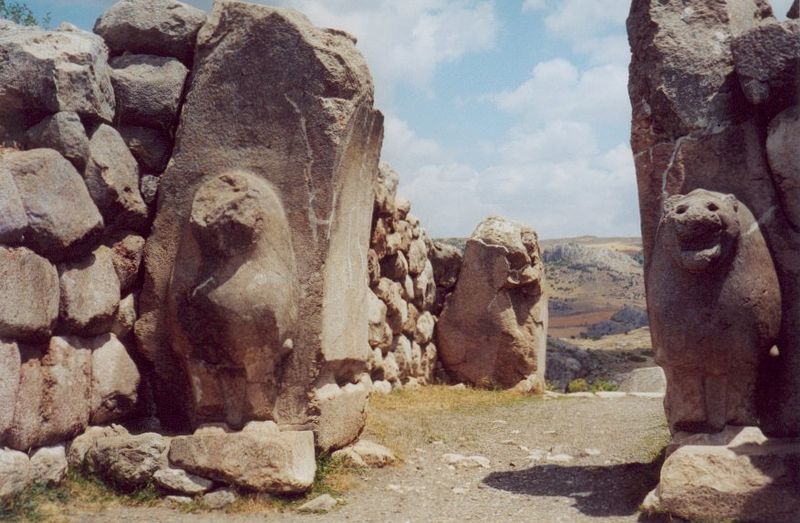
Gates of Hattusa, the Hittite Capital
The loss of the west and the famine in the north meant that the Hittites had abandoned their ancient capital Hattusa and the formidable walls were undefended. The Kaska tribes probably swept south to attack their ancestral foes and the empty cities were totally destroyed but it is clear that the invaders simply torched the city and made no attempt to settle. The famine stricken land of the Hittites, with their farms abandoned and granaries emptied, was now a death trap.

"Since there is famine in your house we will starve to death… The living soul of your country is no more..." 
Letter from a diplomat of Ugarit to a Hittite diplomat, translation from The Collapse of the Bronze Age by Manuel Robbins

The fate of the last king of the Hittites, Suppiluliama II, is unknown but with the capital burned, the people starving and the empire lost, it is doubtful that the remaining subjects, who looked to the king to placate the gods, treated him kindly. Small Hittite kingdoms in Tarhuntassa and Carchemish (tributary states to the south that were formerly subordinate to the Great King in Hattusa) survived but the empire never revived.

Hittite Chariots
The Mycenaeans appear to have weathered the initial destruction, as some of their citadels show signs of rebuilding, but the population that had supported the old order was no longer there and the citadels were abandoned. The skilled craftsmen fled to islands less affected by the wars. The nobility now faced a new threat, a flaw in their system of ruling that the changing times had exposed.

The Bronze Age empires had all depended on chariot elites to form the core of their armies. These armies were equipped with bronze weapons and depended on the trade routes to give them copper from Cyprus and tin from the west to form the alloy. The collapse of the trade routes (and the sudden exodus of skilled Hittite craftsmen from Anatolia) allowed iron-working to begin across the Near East, lessening the dependence on central organisation for weapons manufacturing.

More significantly, the desperation of peripheral peoples allowed them to fight back against the major armies of the day. Bronze Age warfare had seen swift chariot battles on the plains followed by long sieges of fortresses or mountain strongholds that resisted. The major armies would still have been able to win chariot battles but the weakened empires could no longer afford to allow their armies to waste years besieging fortresses. In other words, at a time of crisis, if a barbarian tribe could hold mountainous ground it could be difficult to defeat them without losing other areas of the empire for years and the subject kings would have been unwilling to allow their troops to be away for so long. For embattled empires like the Hittites or Mycenaeans (whose terrains were littered with mountain ranges) the weakness of over-reliance on chariots would have been fatal.

"A camp was set up in one place in Amurru (southern Syria). They (the Sea Peoples) desolated its peoples and its land was like that which had never come into being." 
Inscription of Ramesses III at Medinet Habu, translation from The Collapse of the Bronze Age by Manuel Robbins

"As for the countries who came from the land in isles in the midst of the sea, as they were coming forward toward Egypt, their hearts relying on their hands, a net was prepared for them." 
Inscription of Ramesses III at Medinet Habu, translation from The Collapse of the Bronze Age by Manuel Robbins

Drawing of the relief showing Battle of the Delta
After the fall of Ugarit and the collapse of the Hittites the Sea Peoples moved down the coast of Syria. The cities of Tyre and Sidon were spared assault and may in fact have joined forces with the invaders. Around 1178BC the Pharaoh Ramesses III faced a Sea Peoples invasion of Egypt itself. There had previously been a battle somewhere in Syria and the Egyptians depict loaded carts with women and children, suggesting that the invaders were searching for new lands. Ramesses claimed the battle in Syria as a victory but if so it was a hollow one as the enemy was now at the mouth of the Nile, threatening Egypt itself. The Sea Peoples were using new weapons, a long slashing sword based on a design from the Balkans, that had a longer reach that the Egyptian scimitar. Ramesses’ generals cunningly surprised the invaders in the marshes of the Nile Delta and used the firepower of their archers to destroy the invading armies in what is known as the Battle of the Delta. The invasion of Egypt had been halted but the Egyptian empire in Syria was no more and a group of Sea Peoples were to settle permanently along the coast in southern Syria. The name of one of their tribes, the Philistines, is the origin of our word Palestine.

Sea Peoples depicted as prisoners
"I caused the Nile mouth to be prepared like a strong wall with warships, galleys and coasters equipped, for they were manned completely from bow to stern with valiant warriors with their weapons." 
Inscription of Ramesses III at Medinet Habu, translation from The Collapse of the Bronze Age by Manuel Robbins

Ramesses III had saved Egypt but it was a hollow victory. The loss of its empire and its isolation from other empires led Egypt to a decline. A further eight pharaohs were to claim the name Ramesses in an attempt to rekindle the glories of their predecessors but when Ramesses XI died Egypt split into two kingdoms before being temporarily taken over by Libyans.

Related Blog Posts:
Collapse of the Bronze Age: Part I
Collapse of the Bronze Age: Part II
Collapse of the Bronze Age: Part III
The Late Bronze Age in the Middle East
The Early Iron Age and the Death of Kings: I
The Early Iron Age and the Death of Kings: II

Sunday, 6 May 2012

The Collapse of the Bronze Age: Part I

Lion Gate of Mycenae
"…You say that you have seen the boats of the enemy at sea…. Be strong! Move your chariots and troops within the walls of the city…. The enemy is very strong. …."
Fragments from a response to a plea for help from the king of Ugarit from around the year 1190BC, translation from The Collapse of the Bronze Age by Manuel Robbins

I previously spoke of the complexity of the late Bronze Age, of the palaces and cities, art and literature, warfare and diplomacy that comprise our knowledge of this civilised period. In this post I will speak of how it came to an end. Around the year 1200BC many cities of the Bronze Age are burned, empires fall and entire swathes of land are abandoned for hundreds of years. Some of the more stable civilisations survive but in a reduced form, cowering behind city walls; others disappear forever. Sources for the period are very poor and civilisation declined to the point that some states lost the ability to write their own languages while in other areas place-names are forgotten, suggesting long term abandonment. But these tumultuous events seem to have left behind echoes and some believe that works such as the Iliad and the Odyssey might be distant recollections of these chaotic times.

A much later statue of Homer
Around the year 1208 BC Egypt was attacked by a hitherto unknown coalition that the Egyptians called the "Sea Peoples", in alliance with Egypt’s ancient tribal foes from Libya. A simultaneous revolt of the southern region of Nubia placed Egypt under strain and the Pharaoh Merneptah (son of the builder Ramesses II) was only barely able to contain the attack. In later years a much more concerted series of attacks by the Sea Peoples were repulsed by Ramesses III, but Egypt’s empire in Syria was lost and never properly recovered and one group of Sea Peoples, the Philistines settled along the coast of what were previously Egyptian possessions.

Merneptah blamed the Hittites for allowing the attack suggesting that the Sea Peoples may have been from Anatolia and from the area supposedly controlled by the Hittites. But the Hittite Empire was in serious trouble as well. A civil war had divided loyalties in the population and elites and their northern capital was abandoned for a safer location further south. Texts seem to signify a great famine in the land as well. The weakened empire lost control of western Anatolia and the northern city of Wilusha (probably the city now referred to as Troy) was burnt. Around 1190 BC the old capital of Hattusa suffered a complete destruction. In Mycenaean Greece the great palaces in Mycenae and Tiryns suffer heavy damage and burning. Surviving Linear B fragments from the palace of Pylos point to invaders from the sea, although there may have been land invaders as well. The opulent trading city of Ugarit, in modern day Syria, was burned to the ground around a similar date, while their trading partners in Cyprus see their cities burned. While the Cypriot cities are quickly reoccupied, the destruction in Ugarit was so intense that the fires turned limestone building blocks to lime and the city was never rebuilt.

Assyrian Stele
The inland empires of Assyria, Babylonia and Elam are less affected. Assyria, under the strong leadership of Tukulti-Ninurta I, was expanding at Babylon’s expense around 1200BC before his assassination. After the assassination of Tukulti-Ninurta Assyria went into rapid decline, having kings with short and uncertain reigns and inconclusive wars with Babylon. These wars weakened Babylon to the point where a strong Elamite king was able to raid the city and end the Kassite Dynasty. When Assyria recovered from the dynastic strife it was forced to fight a nearly continuous series of wars against new tribes that had occupied the neighbouring territories.

By around 1150BC the Babylonian, Assyrian and Egyptian empires had been seriously weakened while the Hittite and Mycenaean civilisations had fallen entirely, never to rise again. The population dropped across the Near East and when records become plentiful hundreds of years later, there are new states, peoples, cities and gods. What event or series of events was able to trigger this catastrophic change?

Relief of Hittite Chariots
Firstly I should attempt to exonerate some of the usual suspects. While contemporary sources and later myths suggest mass barbarian invasions, I doubt that barbarian invaders alone could topple the advanced Bronze Age empires. The sheer organisation of these empires meant that they could field large armies and they had fended off external attacks before. Secondly, climate change is unlikely, in and of itself, to have caused the catastrophe. The world population was quite low, arguing against large scale anthropogenic climate change. Also, the civilisations were all affected differently suggesting more local factors were at work. There is no agreement on the order of many of the events described here and even less consensus on causal factors, but I shall tell the story as I understand it, giving primary quotations to back up my arguments where possible. The reader should be aware that very different interpretations are possible.

Fresco of Mycenaean Woman
I have used the book, the Collapse of the Bronze Age by Manuel Robbins quite extensively, and while, not all of the ideas stated here are drawn upon his research, it was the single most valuable secondary source used in researching this piece. I would quite recommend the book.

Related Blog Posts:
Collapse of the Bronze Age: Part I
Collapse of the Bronze Age: Part II
Collapse of the Bronze Age: Part III
The Late Bronze Age in the Middle East
The Early Iron Age and the Death of Kings: I
The Early Iron Age and the Death of Kings: II