|
| Mycenaean mural of a woman |
This post will look at European history for the period from around 1500-1000BC. Due to the lack of sources we will have few written records to rely upon. As well as the lack of sources, the time period is too distant for ancient legends to be of much use, although there may be flickers of truth remembered in places. This means that to look at history for this place and time we have to rely primarily on the archaeological record. This is fine and useful, but like all methods of looking at history it has its flaws and caution must be used. The dates in particular must be treated with caution. Some of the issues with dating have been dealt with in the previous post on European history.
In the previous post, looking at European history for the period 2000-1500BC. Cultures that seem to be associated with Indo-European languages had been spreading westwards from the lands north of the Black Sea. By 1500BC these had probably reached nearly every part of Europe, although some areas, such as Crete, Sardinia and parts of the Iberian Peninsula may not have spoken Indo-European languages. The Bronze Age had now spread across practically the entire continent. In central Europe the Tumulus culture had succeeded the Unetice culture as the dominant culture. Meanwhile in Crete and mainland Greece the Minoan and the Mycenaean cultures were flourishing.
 |
| Reconstructed Mycenaean mural of a woman |
In the century of the 1500’s BC the Tarxien Cemetery Phase came to an end on Malta. This was the final phase of megalithic temple building in Maltese prehistory. Even with this, it was typified more by dolmens and other types of smaller graves rather than the magnificent temples that had been built earlier in the Neolithic period.
Much farther to the north, the Kiukainen culture, the last Stone Age culture in what is now Finland, came to an end. This culture merged into the Bronze Age. It is important to remember that the eastern Mediterranean and Near East were quite heavily urbanised compared to the majority of Europe. New cultural patterns and technologies would often come from there and would take time to reach distant parts of the continent such as Ireland or Finland.
The El Argar culture in what is now south-eastern Spain came to an end around this time. It had been an early Bronze Age culture that had occupied much of the same territory as the Los Millares culture. The El Argar culture was probably an evolution of sorts from the Los Millares but with Bronze technology. Very little is known about this culture but it is important to remember that the Iberian Peninsula was experiencing urbanisation as well as the eastern Mediterranean, just at a slightly slower rate.
 |
| The "Death Mask of Agamemnon", in actuality from about 1500BC |
The Mycenaean culture began to flourish, with the citadels now becoming ever more fortified and the burials even more elaborate. One of the most iconic symbols of the Mycenaeans was created around this time. One of their kings was buried in a shaft-grave. This grave was later excavated by the controversial archaeologist Heinrich Schliemann in the year AD1876. When Schliemann saw the golden death mask that had been buried with the king he is said to have written “I have gazed upon the face of Agamemnon”. This was dramatic indeed. There was, and is, some suspicion that the artefact is forged, as nothing quite like it was ever found again in Mycenaean graves. But it is quite likely that it is genuine, although it has nothing to do with Agamemnon. It is an extraordinary object and is currently on display in the National Archaeological Museum in Athens.
It is not clear on the exact date, but at some point between 1630-1500BC the volcano of Thera erupted in one of the largest volcanic eruptions in human history. The eruption vaporised the centre of the island of Santorini and ejected it into the atmosphere. The city of Akrotiri was completely buried by ash in an early stage of the eruption and this shielded it from the full explosive power of the volcano when it erupted later with its full force. No human remains have been found at Akrotiri, suggesting that the people tried to evacuate. They may have been loaded on to ships or they may have tried to seek shelter in a different part of the island. I don’t know if they fully got away, but I hope that they did.
 |
| The excavated remains of the buried city of Akrotiri |
The violent eruption caused major localised earthquakes and landslides. The landslides subsequently triggered megatsunamis that would have swept through the eastern Mediterranean. The northern coast of Crete would have been particularly badly hit, including the port of Knossos. If any Minoan ships were beached there they would likely have been destroyed. Normal tsunamis have relatively small wave heights while at sea, so ships can pass unaffected over most tsunamis, providing they are in deep water. In the case of megatsunamis the wave height is high, as triggered by material falling into the ocean and thus acts like a ripple in a pool. Thus any ship caught by the wave was likely to have been sunk. It is likely that this event saw the destruction of the majority of the Minoan navy and trading fleet. Other seafarers would have been affected but none worse than the Minoans.
 |
| Mycenaean bull's head sculpture |
The eruption at Thera was also close enough that the palaces and cities of Crete would have been affected with falling ash and earthquakes. At one point it was thought that this acted as the death knell of the Minoan civilisation but it probably did not. The palaces themselves were functioning again almost immediately and the effect of the ash should not have destroyed the agriculture of the island. But the loss of their ships must have been devastating for a culture that was so closely tied to the sea. Perhaps this sudden loss of sea power was interpreted as a sign that the gods had turned against them. Perhaps it led to the nearby Mycenaean culture deciding to contest the mastery of the seas with the Minoans.
The eruption of Thera is complicated to date. The archaeological evidence points to a date around 1500BC, while the carbon dating evidence seems to suggest an earlier date, perhaps around 1620BC. Hopefully new studies will resolve some of these complications.
 |
| Linear B tablet |
In the 15th century BC, meaning the 1400’s BC, the civilisation on Crete had seemingly recovered from the ill effects of the eruption of Thera, although the city of Akrotiri was definitely and utterly destroyed. However, around 1450BC the palaces on Crete were burned and rebuilt. However, new artefacts were found that tie the rebuilt palaces to the Mycenaean culture on the mainland. It seems likely that the rulers of the Mycenaeans had managed to invade and control the island of Crete. The Cretan palaces were mostly unfortified, so without a navy, they would have been vulnerable to attack. If the Mycenaeans controlled Crete they almost certainly also controlled the Cyclades Islands and would have had influence across the entire Aegean Sea.
One group of archaeological finds are a new type of script. It was modelled on the Minoan script called Linear A, but was adapted to fit a different language. This script is known as Linear B and it was deciphered by Michael Ventris in 1952. Ventris discovered that the language written in the script was a type of archaic Greek and thus gave us the oldest readable texts in Europe. There are certainly older scripts, but none readable, so it is from the 1400’s that European history, as opposed to prehistory, can be said to truly begin.
 |
| Nuraghe in Sardinia |
In Sardinia around this time, large tower structures began to be built by the culture there. Many of them remain standing to this day and are somewhat mysterious. They have an unusual shape and are simultaneously tower/fortress/house/village/temple. They are known as nuraghe and the culture on Sardinia at this time was named Nuragic, after the most striking of their monuments. We should not think of a few nuraghes either. Over six thousand survive to this day dotted over the lands of Sardinia and there must have been many more originally. They were probably like ring-forts in other parts of Europe and were fortified homesteads, but just carried to a much greater extreme that was usually done in Europe at this time.
The nuraghe were not unique to Sardinia however. Similar structures, called torri, were built in Corsica in or around this time as well. The torri are clustered around the southern edge of Corsica, close to the island of Sardinia.
 |
| The Golden Hat of Schifferstadt |
Around this time the first of an unusual type of cultural artefact was found: The Golden Hat of Schifferstadt. This was an ornate golden hat, beaten out of thin sheet gold and covered with intricate spirals, similar in construction to the Mold Cape from Britain. The metallurgy needed to create such a perfect work from such a tiny amount of gold showed that the tribes of northern Europe had master goldsmiths. The golden hat would have been worn atop a hat of other materials and was probably worn for religious purposes. The symbols on the hat were probably astronomical in nature and may have represented the astronomical knowledge of the wise men of these tribes. The hat was deliberately buried with earth inside it to preserve its shape. Three bronze axes were placed beside it, but nothing else. The shape of the hat is tall, with a broad brim. I wonder if there was some cultural memory of old wise people wearing tall hats that transferred to a later wizard stereotype. It probably is a mere coincidence but I cannot look at any of the golden hats (there are four) without considering the possibility of a Bronze Age Gandalf.
 |
| Trundholm Sun Chariot, showing the gilded face |
The Trundholm Sun Chariot may be related to the Golden Hats. This was a religious object that shows a horse, fastened to a chariot, which pulls a disk, gilded on one side, representing the sun. It was found buried in a bog in Denmark in a relatively intact state. Like the buried golden hats, there were no graves nearby, so this was a deliberate burial of the item itself, rather than placing it as a grave good. Exactly what the object means is unknown, but it may represent a belief that the sun had a light side and a dark side and that the dark side went around the earth at night. This is unclear but the circle and spiral designs on the chariot may be alluding to astronomical cycles. The spoked wheels of the chariot are also surprising. Spoked wheels were believed to be invented in the Middle East around 1600BC but this find might suggest that a different theory, that the spoked wheels were invented independently in the Pontic Steppe some time earlier. The second theory would allow spoked wheel technology to have reached the Denmark region by that time.
 |
| Inscribed stones from the King's Grave in Scania |
While the Bronze Age was not noted for large graves, the King’s Grave in the province of Scania, in Sweden, is an exception. This was a large tomb that has unfortunately been looted. The looters did not damage the etchings on the stones, which show scenes from the Nordic Bronze Age. Here we see hooded figures, an altar, a spoked-wheel chariot, what seem to be musical instruments or drinking cups and possible scenes of sacrifice. The King’s Grave was a noted example of the Nordic Bronze Age.
During the century of the 1300’s BC the Mycenaeans became even more powerful. They began to interfere in the cities and states of the Luwian peoples on the western coast of Anatolia. The Hittites noted this and referred to a great power to the west, known as Akkhiyawa, which may have been the Hittite way of saying “Achaean”. The wealth of the Mycenaeans came from olive oil, which they created in large quantities and shipped around the Mediterranean. Mycenaean society was ruled by a king, known as a “Wanax”. The leader of his army was the “Lawagetas” and his officials were known as “Telestas” (“Telestai” in the plural). A chariot-riding aristocracy known as “Equeta” served as warriors for the king, while local leaders were known as “Qasireu”. This was a non-Greek word and was the etymology for the later Greek word “Basileos”.
 |
| The Lion Gate of Mycenae |
While the king may have had central authority it is hard to imagine that his rule was absolute and the Mycenaean world may have resembled a confederation more than a unified empire. The reason I believe this is that the cities were so heavily fortified that any citadel could withstand a siege for years, perhaps decades. The stones of the walls were so large that later Greeks referred to them as Cyclopean, meaning that they had been built by one-eyed giants of long ago.
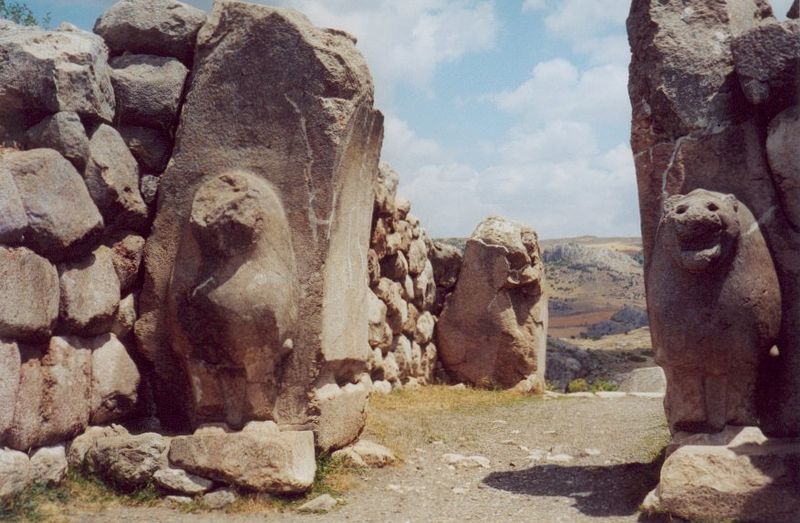
There is no better example of this than the Lion Gate of Mycenae, where the visitor to the citadel would enter a narrow road flanked on both sides by high walls. As they approached the gate they would see two regular blocks of stone, capped by a heavy capstone that made up the entire gate. Above this was another huge stone set into the wall, carved with two rearing lions, symbolising the majesty of the city and the palace within. The heads of the lions (or lionesses) were carved separately and attached to the sculpture. It was a mighty entrance and one that rivalled the great gate at the Hittite capital of Hattusa. But this was built a little later, around 1250BC.
 |
| Entrance to the Treasury of Atreus tomb in Mycenae |
During the 1200’s BC the Mycenaean world went from strength to strength. The citadel walls were built higher as their cities expanded to incorporate land around their walls, including older grave sites. New graves were dug and constructed for the rulers of Mycenae. No longer would the rulers be buried in shaft graves. The dead kings would be laid to rest in huge chambers of cut stone. Two in particular stand out: The Treasury of Atreus and the Tomb of Clytemnestra. Both of these were domed structures with long entrances. The Treasury of Atreus was the largest domed building in the world for over a thousand years.
However, midway through the century the citadels of Orchomenos and Thebes were burned. The glorious walls of the Mycenaeans may have been built as a response to an external threat. However, there are later legends of great wars and struggles that saw Thebes being attacked by armies of the Greeks themselves. The cities razed at this time are quite likely to have been destroyed in an internal conflict or civil war. Certainly the Mycenaean culture continued to flourish still.
 |
| Cyclopean walls of Mycenae |
Further north, in central Europe, the Tumulus Culture was replaced by the Urnfield Culture. The tumulus culture had buried their dead in large mounds. The Tumulus Culture had succeeded the Unetice culture that had gone before them and were succeeded by the Urnfield culture in their turn. The Urnfield peoples cremated their dead and placed them in urns which were then buried in fields, hence the name “Urnfield”. It is probable that the terms Tumulus Culture and Urnfield culture would have meant almost nothing to the people of those times. But they are useful from an archaeological standpoint. This culture spanned most of central Europe, encompassing much of Hungary, Slovakia, Poland, the Czech Republic, Germany, Switzerland, Austria and Italy. There were subcultures of this in various parts of central Europe, such as the Proto-Villanovan culture in Italy.
The Urnfield peoples used chariots with spoked wheels, much as the armies of the Near East did, but their swords were much larger than those of the older civilisations and could be used for slashing. While the change in burial practices may have indicated a change in religion it is likely that some elements did not change, as the use of Golden Hats appears to continue, and may have been shared with the peoples of the Nordic Bronze Age. The peoples who inhabited central Europe at this time may have spoken some form of proto-Celtic languages.
 |
| Reconstructed remains of Tollense battlefield in Neues Museum Berlin |
A great battle was fought in what is now northern Germany around this time, perhaps as a result of the cultural changes heralding the shift from Tumulus to Urnfield cultures. A small river, known as the Tollense, was crossed by a causeway of stone and earth that acted as a bridge and road along which trade flowed. It seems that two groups of warriors met and fought along this causeway. From the skeletons that have been found so far, it seems that there may have been over a thousand deaths. Extrapolating from this it is probable that there were at least four thousand men taking part in this battle. The dead were stripped of their weapons and then thrown into the river, which scattered their bodies across the plain. It is the first known battle site in Europe, but not the last.
It is around this time that the temples of Ramesses II record the arrival of pirates, who he refers to as Sherden. These pirates were defeated by the Egyptians, but as they were obviously formidable fighters, Ramesses incorporated them into his bodyguards. They appear on the walls of his temples, carrying long straight bronze swords, far longer than the Egyptian swords of the time. They wear helmets with a ball at the top and horns protruding from the sides. The name Sherden has prompted some later historians to speculate that they may have come from Sardinia. This is actually a plausible theory, as the people of Sardinia at this time made a number of bronze sculptures, some of which show warriors with horned helmets.
 |
| On the left, Sherden as depicted by Ramesses II, On the right, a Sardinian bronze sculpture of a warrior |
In the early years of century of the 1100’s BC, perhaps around 1190BC, the Mycenaean cities were destroyed. The legends of the later Greeks talk about a long war, where the kings of Mycenae went abroad for ten years to fight against a city in Asia: The Trojan War sung of by Homer. When the kings made the dangerous crossing back to their many of them were assassinated or how to face civil wars. After the chaos of the murders, within two generations, the old royal families had been destroyed by a group who referred to themselves as the descendants of Heracles (Heraclidae), who invaded the Peloponnese but who did not attack Athens.
 |
| Mycenaean weapons |
The picture painted by ancient myths is not entirely inaccurate. I will give a picture that I believe is a plausible account of what happened. The city of Troy was burned around this time period, although it is far from clear who actually burned it. Hittite sources begin to disappear around this time period as their empire began to founder. I believe it probable that there was a major famine in western and central Anatolia and that the Luwian peoples of the coast turned to piracy. As the complicated palace-controlled trade networks of the Mycenaeans began to break down, the nobles turned on each other and fought civil wars, perhaps while the “wanax”, meaning high king, was dead. Eventually one group of nobles, upon being exiled, made an alliance with semi-barbarous Greek tribes to the north. The weakness of the Mycenaeans and Hittites made the region vulnerable to pirates from all over the Mediterranean; who joined the starving Luwian peoples of Anatolia and disaffected coastal peoples of Syria. This loose coalition of raiders became the fierce Sea Peoples.
 |
| Dendera panoply: Mycenaen armour, possibly ceremonial |
The Sea Peoples now threatened the coast, all trade routes were now cut and the people would have felt that the gods had turned against them. Linear B tablets record that there are soldiers dispatched to watch the coastlines, guarding against pirates. As the palace organisation fell into chaos, the people of the countryside would have begun to hoard their food or flee the land. The cities would then have been abandoned before being burned, either by raiders of the Sea Peoples, or by the returning nobles who had been exiled, or by the tribes of the northern Greeks, who were later referred to as Dorians. It is likely that while the Dorians were involved in the collapse, that they did not cause it by a simple invasion. It seems that the palaces were abandoned before they were burned or reoccupied. As an interesting confirmation of the myth that Athens assisted the Heraclidae (descendants of Heracles), Athens is the only one of the Mycenaean citadels that is not burned at this time.
The destruction was immense. The historians and the archaeologists of the 20th century referred to it as the Bronze Age Collapse. The palaces were burned on both mainland Greece and in Crete and they were not rebuilt. Even more devastating for the culture of Europe, the ability to write was forgotten. The collapse of the palace organisations had seen the destruction of the scribal class and writing was forgotten among the Greeks for nearly five centuries. The wars of the 1200’s and 1100’s would survive as a flickering memory preserved by bards and storytellers until, with the skilful retelling by poets such as the semi-legendary Homer or Hesiod, it became the foundation of much of Greek mythology.
 |
| Remains of houses at Cladh Hallan |
The next thing mentioned is a completely separate development, in some ways insignificant compared to the Bronze Age Collapse. At the site now known as Cladh Hallan, on South Uist, a Hebridean island off the north of Scotland, an unusual ceremony took place around 1120BC. Many bodies are preserved across northern Europe in peat bogs, but in Cladh Hallan, where a small Bronze Age community lived, the inhabitants dug up two bodies that had died hundreds of years before and reburied them inside a dwelling. It’s not clear why their ancestors had buried these people in the bog centuries previously, nor why the people of Cladh Hallan dug them up. It is a strange thought that perhaps there was some prophecy that the bodies were to be dug up at a later time. I have no real clue as to why this happened, but I thought it worth mentioning.
In the century of the 1000’s BC the last remnants of civilisation on Crete appear to disappear. This had been known as the Sub-Minoan Age and was perhaps the last place where the palace organisations survived. But eventually this too was abandoned. It seems that Crete had a non-Greek speaking population until the 3rd century BC. This language, known as Eteocretan, was very likely to be a descendent language of the language spoken by the Minoans. Very few inscriptions remain; enough to be tantalising, but not enough to translate satisfactorily, and some of those few were destroyed in World War II. Enough remains however to show that it has no clear relationship with Indo-European languages or any other known language family.
 |
| Håga Mound at Uppsala |
Far to the north of Europe, it is around this time that the speakers of Uralic languages began to inhabit the northern reaches of Scandinavia. The languages spoken by these people would eventually evolve into Sami, Finnish and Estonian.
Also in Scandinavia, at the site of Uppsala in Sweden, a great mound was made around this time called the Håga Mound. It is one of the largest Bronze Age burials in Europe and was larger even than the King’s Mound in Scania. Uppsala, where this tomb lay, would be an important cultural and religious centre in Scandinavia. It was the largest pre-Christian temple of the pagans and even today is the home of an old cathedral that was built at the site after the Christianisation of Sweden. The Håga Mound itself was excavated in 1902 by, among others, a young Swedish prince with a love for archaeology who later became King Gustaf IV Adolf of Sweden.
 |
| Talaiot on the Balearic islands |
On the Balearic Islands of Minorca and Mallorca a new culture, known as the Talaiotic Culture, arose around this time. Like the torri of Corsica or the nuraghes of Sardinia, the talaiots of the Balearic Islands were tower-like structures that appeared all over the islands. They do however appear to be somewhat later than the nuraghes and it is unclear if the two phenomenon are related.
This period also saw the burial of a huge cache of gold known as the Treasure of Villena. This was the largest Bronze Age treasure from all of Europe. The hoard was discovered in Spain and contained gold, silver, iron and amber. Despite the fact that the prehistory of the Iberian Peninsula is poorly known outside the region and often is not talked about, the sheer volume of treasure found at this one site, outweighed the golden goods of the Mycenaean graves.
 |
| The Treasure of Villena |
One of the major shifts that was happening quietly around this time was that the use of iron was beginning to spread throughout Europe. The Treasure of Villena contained iron, but it seemed to be a valuable metal that was used more for a decoration. The Iron Age refers to a time when iron was so cheap and economical to use that people used it more than bronze or stone for their tools and weapons. It is the ubiquity of the material that makes the age. Slowly but steadily iron-working technology was spreading westward and northwards across Europe and bronze would be gradually used less. Thus the Iron Age came by slow degrees to Europe.
Finally, to bring the period to a close, two more of the enigmatic Golden Hats were created around this time. The Golden Cone of Ezelsdorf-Buch and the Avanton Gold Cone date from around this period. Little is known of these.
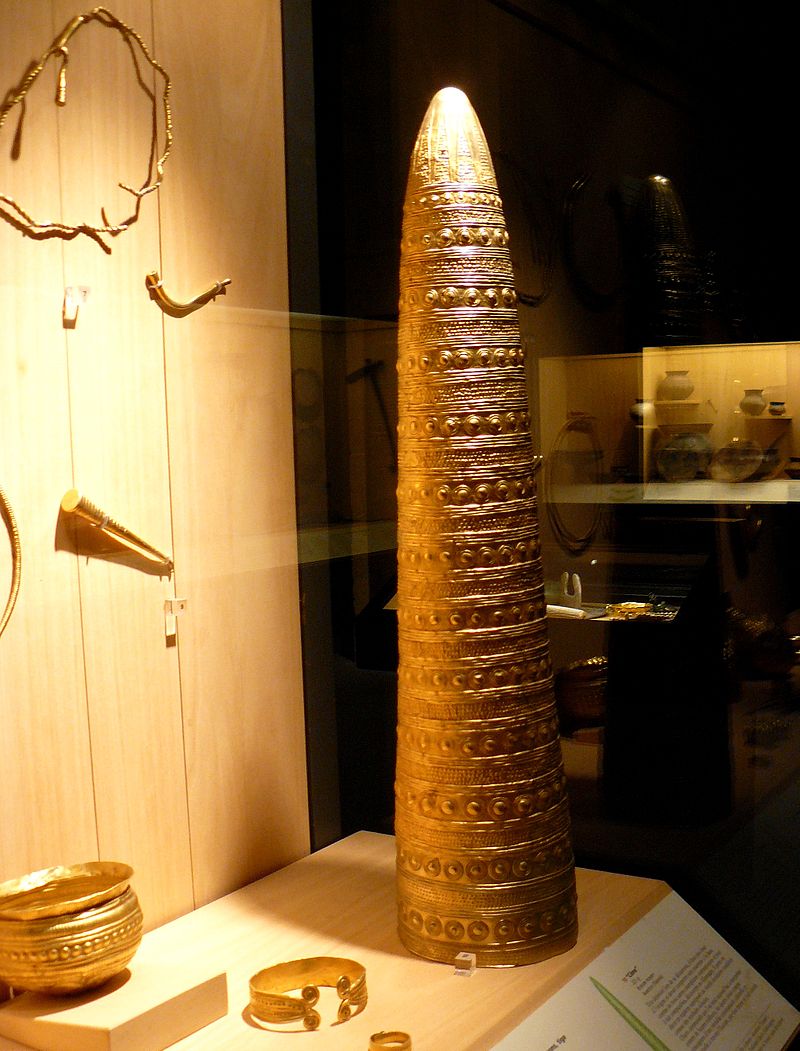 |
| Avanton Gold Cone |
So the blog must end. The period began in the aftermath of the eruption at Thera, saw the rise of the Mycenaeans, the first readable writing in Europe, large tombs in Scandinavia, strange reburials in the Hebrides, the Bronze Age Collapse, the forgetting of writing in Europe, the mysterious towers of Sardinia, the equally mysterious golden hats of Central Europe and the beginning of the Iron Age. We will continue the story in subsequent blogs.
Related Blog Posts:
Some European history from 4000-3000BC
Some European history from 3000-2000BC
Some European History from 2000-1500BC
Some European History from 1500-1000BC
Some European History from 1000-750BC
Some European History from 750-500BC
Related Blog Posts:
Some European history from 4000-3000BC
Some European history from 3000-2000BC
Some European History from 2000-1500BC
Some European History from 1500-1000BC
Some European History from 1000-750BC
Some European History from 750-500BC