Showing posts with label Ramesses III. Show all posts

Tuesday, 4 August 2015

The Early Iron Age and the Death of Kings: Part I


This blog post is about the aftermath of the Bronze Age Collapse. I have written fairly extensively about the Late Bronze Age in the Middle East, with articles on the period as a whole, on the Mitanni and the Pharaoh Akhenaten in particular. At some point I may write some dedicated articles on Hittite history, the Kassites, the Battle of Kadesh and other interesting topics, as there is a wealth of material on this period. But in case the reader is tired of hearing of the Late Bronze Age I’m going to try to advance the narrative in the meantime and move on to the early Iron Age, in my very slow, very haphazard, piecemeal history of the world. I will not give absolute dates, as dating in this era is not entirely agreed upon and many of the kings mentioned have multiple names. I will use the most common English names for the kings and/or call out where my usage differs.

Many of the quotations given here are taken from the very interesting reshafim.org site which can be found here. A lot of enjoyable reads have been posted on this site.

In the Bronze Age Collapse, the civilisations collapsed at a different rate and to a different extent. The collapse was the worst in the west, with Mycenaean Greece falling utterly. Its settlements were abandoned and its writing system forgotten. The Hittites were destroyed but a small remnant survived in Syria. Egypt, Assyria and Babylon survived but were weakened. Elam appears to have actually grown stronger. I will try to give the history of roughly 1200-1000BC, moving from west to east (in a geographically confused fashion).

A later Greek depiction of Heracles
Around 1200BC the Mycenaean cities and palaces were burned. Some time may have elapsed between the burnings but textual evidence is non-existent and carbon dating is unable to provide great precision. Eventually some of the citadels were reoccupied and may have even flourished briefly before the final abandonment. The relatively unimportant citadel of Athens appears to not have been destroyed. Possibly it was overlooked, but it is more likely that they collaborated in the destruction. There is a legend that the sons of Heracles (Hercules) were expelled from the Peloponnese (where Mycenaean power was strongest) and stayed at Athens before returning generations later to attack the king of Mycenae.

If there is any truth to this legend it would suggest that the invaders may have been part of a civil war and that the inhabitants of Attica were on good terms with the invaders. However, this is to read a great deal into myth. Myth is fascinating, but we do have to be cautious. There are so many (quite wonderful) Greek myths, that it is possible to make all sorts of theories and selectively use myth to create elaborate justifications for them.

Building from the Iron Age in Lefkandi
For whatever reason, Attica was spared the general destruction, as were the islands. There was a migration from the Peloponnese to the islands of Euboea and elsewhere in the Aegean. Greek speakers began to colonise the western coast of Asia Minor over the next few hundred years, ringing the Aegean with Greek speaking settlements. Many of these settlements spoke an Ionic dialect, which they shared with Attica, but few other places on the mainland. The Peloponnese spoke a Doric dialect of Greek with the notable exception of the highlands of Arcadia to the north. Again, people have made a great deal of this, treating the Ionic speakers as fugitives from the old Mycenaean kingdom and the Doric speakers as the descendants of the invaders, but the situation is almost certainly more complicated. In history, things are always complicated.

Almost nothing of note would be created in Greece for the two hundred years under discussion. However, pottery styles changed from the Mycenaean styles to a variety of localised styles and iron weapons became widespread throughout the region. On the island of Euboea, a town now known as Lefkandi has some buildings dating from slightly after this period, with the main structure of the small settlement being a large ritual building with a major burial there. There were later burials in the vicinity and it is speculated that this was a “heroon”, meaning the tomb of a hero. Perhaps this was a community’s way of commemorating a great warrior leader who was reverenced by his community after his passing and whose remains were the focus of his community. The size of the structure compared to the settlement suggests that the towns of this time were quite isolated and were controlled by single rulers. Apart from this, there is not much that can really be said for Greece at this period. The fall had been total, but the subsequent rise in centuries to come was to be dazzling.

And all of the cities of the land of Carchemish, Murmurik, Shipri, Mazuwati and Ĺ urun – these fortified cities– I gave to my son (Piyassili).
Detail from the Suppililiuma-Shattiwazza treaty telling of the creation of the Hittite viceroy in Carchemish

Hittite relief from Carchemish
The Hittite collapse was vicious also but not quite as complete as in Mycenae. After Suppiluliuma I had captured Carchemish (a major city on the Euphrates in Syria) from the Mitanni, there had been a powerful viceroy set up in the city to rule as a deputy and representative of the royal house. The deputy was Piyassili, a son of the king Suppiluliuma and he was treated as a de facto minor king in his own right, with his descendants succeeding to his throne. When the last king of the Hittites (Suppiluliuma II) disappears from history, Talmi-Teshub was ruling in Carchemish. His son, Kuzi-Teshub, proclaimed himself as a Great King upon his succession. The main Hittite Empire was no more but many refugees must have fled to the southern cities and for a time the empire survived in a truncated form in Carchemish. Another important state, Milid, survived. Initially it was dependent on Carchemish but soon it, like other cities, became independent and became a flourishing centre in its own right. The site is known today as Arslantepe.

Hittite reliefs from Carchemish
How Hittite these kingdoms really were is subject to interpretation. The main Hittite dialect was almost extinct and nearly all the inscriptions are in Luwian, a related Indo-European language. The native inhabitants of the region spoke Semitic tongues, particularly Aramaic; the language of the new tribesmen that had moved into the region. Carchemish had no ability to hold an empire together so a group of states that are referred to as Neo-Hittite formed a loose confederation in the north of Syria. These survived and kept the Hittite legacy alive until they were crushed by the Neo-Assyrian Empire in the eighth and ninth centuries.

Ramesses III had stemmed the worst of the assault on Egypt. The Sea Peoples had been defeated in the Battle of the Delta and even though Egyptian influence was now minimal in its old Syro-Palestinian empire, the Egyptians still controlled Sinai. However, despite Ramesses III’s claims to have saved Egypt and his magnificent temple building, unrest seems to have grown in the later years of his reign. There are records of food shortages, workers strikes and increases in the price of bread.

The stresses of this turbulent period may have fostered dissent. Possibly the dissent had nothing to do with external pressures and was simply the result of palace intrigue but for whatever reason, a conspiracy against the Pharaoh was hatched. Tiye, a wife of the Pharaoh, appears to have wanted her son Pentawer to inherit the throne. A host of accomplices who used black magic to subvert the guards’ defences attacked the king at night while he was in Thebes in Upper Egypt to celebrate the Heb Sed ritual. According to some documents the Pharaoh may have initially survived an attack by poison before expiring later. Modern analysis of the embalmed body of the Pharaoh tells a different story. Hidden under thick bandages, analysis showed that a deep cut had been made to the throat of the king; a cut that could not have been survived for more than minutes. Perhaps it was a mercy killing, perhaps a second conspiracy or perhaps our readings of the documents were simply wrong.

He arrived at the side of the harem, this other large, deep place. He began to make people of wax, inscribed, in order that they might be taken in by the inspector, Errem, [hindering] one troop and bewitching the others, that a few words might be taken in, and others brought out. Now, when he was examined concerning them, truth was found in every crime and in every evil (deed), which his heart had devised to do. There was truth therein, he had done them all, together with the other great criminals, the abomination of every god and every goddess all together. The great punishments of death were executed upon him, of which the gods have said: "Execute them upon him.
Lee Papyrus, describing the magic rituals used by the conspirators to assist in their assassination attempt

The mummy of Ramesses III
with heavy bandaging on the neck
 The conspirators were caught by the favoured heir, Ramesses IV, who allowed judges to examine and pass judgement upon the conspirators. The high ranked Prince Pentawer, who was to have become Pharaoh, was allowed to kill himself, allowing him to enter the afterlife in disgrace. The lower ranked conspirators were probably burned alive, thus denying them entry to the afterlife in any form; a terrible punishment designed to destroy in both this life and the next. The fate of Queen Tiye, the instigator of the conspiracy, is unknown.

Ramesses IV succeeded to the throne in 1155 and reigned over a diminishing kingdom. Ramesses IV was perhaps the last Pharaoh of this dynasty to have led expeditions into the Sinai Desert (Ramesses VI may have been to Megiddo but the evidence is unclear). Beyond the Sinai Egyptian power was minimal. Monuments were built on an epic scale but the priesthood of Amun (the god of Thebes who was given prominence during the New Kingdom, when many of the dynasties were based in Thebes) was becoming a force that would rival the monarchy. The priesthood controlled large tracts of land and had considerable incomes. When the monarchy was focused on the north, on Lower Egypt, then the priesthood could act autonomously in the south. During the reign of Ramesses V there were attacks by Libyan raiders and increasing fortifications were made for the temples of Thebes, showing that the state was becoming increasingly unstable. Ramesses V may have been overthrown by his brother, who reigned as Ramesses VI. Ramesses VII and Ramesses VIII are not well known but grain prices increased during their reigns.

Ramesses IV
These are the tombs and sepulchres in which the nobles, the […], the Theban women, and the people of the land rest, on the west of the city; it was found that the thieves had broken into them all, that they had pulled out their occupants from their coverings and coffins, they (the occupants) being thrown upon the ground; and that they had stolen their articles of house-furniture, which had been given them, together with the gold, the silver, and the ornaments which were in their coverings.
The Abbot Papyrus giving an investigation into the tomb robberies in the time of Ramesses IX

During the reign of Ramesses IX it was found that there had been a spate of tomb robberies in the Valley of the Kings, with many of even the royal tombs opened and plundered. The mayor of Thebes was implicated but not convicted. It was a sign that royal authority and the rule of law itself was becoming weak. The graves were supposedly protected by curses and spells and the desperation that would lead the thieves to risk disturbing the royal dead cannot have augured well for the dynasty.

Then the High Priest of Amun, Menkheperre, triumphant, went to the great god, saying: "As for any person, of whom they shall report before thee, saying, `A slayer of living people … (is he); thou shalt destroy him, thou shalt slay him." Then the great god nodded exceedingly, exceedingly.
The Banishment Stele, telling of the High Priest of Thebes punishing rebels who had attacked the temple. In ancient Egypt statues were sometimes moved by priests to show the god assenting to the verdict.

The threat of Libyan raiders was still present during the reign of Ramesses X, with workers on the royal tombs neglecting their work for fear of attack. During the reign of Ramesses XI, the last king of the Twentieth Dynasty, the effective power seems to have been in the hands of Piankh, the High Priest of Amun. The Pharaoh died leaving no successor and was buried by Smendes, who claimed the title of Pharaoh. Smendes only really ruled Lower Egypt, with his capital being based at Tanis. However, the Pharaoh made no attempt to try and wrest back control of Upper Egypt from the priests, probably recognising that his own power base was weak.

Magnificent death mask of Psusennes I
Smendes was succeeded by Amenenmisu, who is almost invisible to history before being succeeded by Psusennes I. Psusennes reigned for over thirty years and married the daughter of the High Priest of Thebes, uniting the two ruling families of Egypt. His burial goods have been discovered and are truly spectacular despite the weak state of Egypt at the time. It has been discovered how the Pharaohs of the Twenty-First Dynasty were able to bury themselves in such splendour. Previously the robbery of tombs had been done by corrupt officials and desperate guards and workmen; now it was being carried out by kings; papering over the poverty of their state by stealing from those who had reigned before them.

This blog post is rather long so I will split the narrative here and speak of the Assyrian, Babylonian and Elamite civilisations in a following post.

Related Blog Posts:
The Bronze Age Collapse: I (c. 1200BC)
The Bronze Age Collapse: II (c. 1200BC)
The Bronze Age Collapse: III (c. 1200BC)
The Early Iron Age and the Death of Kings: I (c.1200-1000BC)
The Early Iron Age and the Death of Kings: II (c.1200-1000BC)
The 10th Century BC (c.1000-900BC)

Monday, 7 May 2012

The Collapse of the Bronze Age: Part II

Hittite Deities
"They spent their time going about the land, fighting, to fill their bodies daily. They came to the land of Egypt, to seek the necessities of their mouths." 
Inscription by the Pharaoh Merneptah on the Libyan invasion, translation from The Collapse of the Bronze Age by Manuel Robbins

Firstly, I believe that there around 1200BC there was a major food shortage in what is now Greece and Turkey. This was not unprecedented and the empires (the Mycenaeans and Hittites) responded as they always did, by coercing the peripheral states to send food to the impoverished heartlands. The food shortage may or may not have been accompanied by a plague of some type. The evidence for plague is almost non-existent, however, famine and plague have often been closely associated in other historical periods. The four horsemen of the Apocalypse ride close together. The central states were weakened but not fatally so by any means. There appears to have been a food shortage in Libya at the time as well so it is unclear whether or not the famine stretched across the Middle East.


Later Greek vase with a scene of the Trojan War
"He sat himself down away from the ships with a face as dark as night, and his silver bow rang death as he shot his arrows in the midst of them. First he smote their mules and their hounds, but presently he aimed his shafts at the people themselves, and all day long the pyres of the dead were burning." 
Iliad I.7, describing Apollo in his role of god of plague attacking the Greek army at Troy.

Faced with these demands and having endured years of meddling in their affairs by the two empires, the peoples of the western seacoast of Turkey began to forsake their towns and take to the sea as pirates. History knows these pirates as the Sea Peoples (mainly because this is what the Egyptians called them). The Mycenaeans and Hittites had fleets but the west coast of Turkey was at the edge of their striking range and they struggled to contain the rebellion. The rebellion meant that no food was sent to Hattusa from the west, further weakening the Hittites and the pirates began to seize food shipments for Hattusa en route from Syria and Egypt.

Hittite Relief
An Assyrian army had defeated the Hittites earlier and the Hittite king had proved unable to respond. The Hittites had had a civil war several generations previously and, with the signs of weakness in the royal house, this conflict appears to have flared up again. To make matters worse, some of the raiders joined forces with the Libyans against the Pharaoh Merneptah, who fought off the invasion but then seemed to blame the Hittites for allowing their subjects to attack Egypt, subsequently cutting off grain shipments. The northern tribes of Kaska appear to have attacked as well, doubtless feeling the strain of the famine and hoping to raid Hittite food supplies. A new king took the name of Suppiluliuma II (the previous king of that name had saved the Hittites at a time of crisis) and attempted to fend off the attacks.

Mycenaean Dagger
The Mycenaeans, who were probably never a unified people except in war, (the number of fortified citadels suggest a highly independent nobility at the very least) struggled to contain the threat. In times of crisis neighbours often attack each other and only a common enemy can force people to work together. The Mycenaean leaders may have attempted to solve their problems by going to war against a far off foe. Around this time Troy, on the north western coast of Turkey, was burnt to the ground. It is unknown if this was done by the Greeks, the Sea Peoples or others but the strength of the legend of the Trojan War suggests that the Mycenaeans attacked the western coast of Turkey around that date. If this was intended to stave off the crisis, it failed. Greek legend speaks of the absolute chaos that ensued after returning from the war. The legends of Aegisthus and Orestes may recall power struggles and civil wars at that time. The countryside was rapidly depopulating and without the food provided by these farmers, the nobility probably turned on each other.

A fragment from the citadel of Pylos speaks of posting guards to warn of sea raiders from the south (from a direction that speaks of attackers from Crete or other Greek islands) and the citadel is burned shortly afterwards. The palaces show signs of a faltering recovery but are subsequently abandoned for a final time. Legends speak of a Greek speaking barbarian tribe from the north (the Dorians) that subsequently inhabited the Mycenaean heartlands. These new immigrants were unfamiliar with the Bronze Age order of things and the remains of citadels such as the ones at Tiryns were left alone and believed to be the work of Cyclops and giants. Settlement evidence indicates major abandonment of settlements and it is possible that many Mycenaeans left Greece for more distant shores.

"Thus the watchers are guarding the coasts : command of Maleus at Owitono... 50 men of Owitono to go to Oikhalia, command of Nedwatas.... 20 men of Kyparssia at Aruwote, 10 Kyparissia men at Aithalewes..." 
Tablet from Pylos describing guards on the southern coast

It should also be noted that some of the cities destroyed at this time show signs of earthquake damage. The eastern Mediterranean is a seismically active area and a major series of earthquakes could damage city walls enough to allow small groups of raiders (or pirates) to sack cities that were caught unprepared. The activities of the empires probably helped in this, as the empires would concentrate their forces at a single point, allowing small groups of raiders to strike undefended peripheral cities with impunity.

Ruins of the city of Ugarit in Syria
"The city and the king (of Ugarit) have been annihilated by fire, half of it has been burned, and the other half is no longer there." 
Abi-Milku of Tyre describing an earlier earthquake in Ugarit, , translation from The Collapse of the Bronze Age by Manuel Robbins

Egypt and Mesopotamia, with their high population densities and irrigation networks were probably less affected by food shortages and less susceptible to earthquakes but the chaos in the Mediterranean would have affected their trade networks. The effects of this would only be felt gradually but it would have eventually affected their economies. To remedy their deficits they, like the Hittites and Mycenaeans, would have attempted to go to war. Numerous wars between the Assyrians and Kassites occurred and Assyria might well have capitalised on the situation, were it not for the assassination of their king. As it was however, the assassination forced Assyria into civil war and the armies of Babylon, previously defeated by the Assyrians, were no match for the invading Elamites. As the empires each came under threat (each in their own way) they would have ceased correspondence with each other and the intricate diplomacy of the Bronze Age disappeared. An empire under attack could only send the most minimal aid to its allies and each empire faced their threats on their own.

Suppiluliuma II
"I mobilised and I Suppiluliuma, the Great King, immediately crossed the sea. The ships of Alashia (Cyprus) met me in the sea three times for battle, and I smote them; and I seized the ships and set fire to them in the sea. But when I arrived on dry land, the enemy from Alashia came in multitude against me for battles…" 
Last known inscription by Suppiluliuma II of the Hittites, translation from The Collapse of the Bronze Age by Manuel Robbins

As the central empires weakened, the previously weak sea raiders became comparatively stronger. Their acts of piracy had temporarily saved them from starvation and the earthquakes would only have aided their attacks. They appear to have switched from simple raiding and attempted to migrate en masse to new lands. But now they faced a backlash. The last known inscription of the last Hittite king speaks of a great sea victory near Cyprus and Suppiluliuma II may have attempted to capitalise on the victory (if it happened) by attacking the bases of the pirates on the south-western coasts.

"… My cities were burned and evil things were done in my country. Does my father (respectful title for a king) know that my troops are stationed in Hittite land and my ships in Lukka (western coast of Turkey) country? Thus, the country is abandoned to itself. May my father know this. Seven ships of the enemy have come here and did us much damage. Be on the lookout for other enemy ships and send me warning." 
Message from Ugarit to a king in Cyprus, translation from The Collapse of the Bronze Age by Manuel Robbins

If this is what happened, the venture failed. Around the year 1192BC the armies and navies of Hittite allies are sent westwards and do not return. Possibly there was a great battle that destroyed the Hittite force or, more likely, the raiders had already abandoned their bases and slipped past the Hittite fleets but the result of the expedition was that the coastal cities of Cyprus and Syria were attacked and burned. The final messages found in the ruins of Ugarit reveal the danger that the cities had been left in and one extraordinary message has a neighbouring king pleading for Ugarit to launch one hundred and fifty ships against the threat (bear in mind that the grain ships of Ugarit appear to have been able to transport 250 tons of grain so presumably their warships were of a reasonable size). But there were no ships.

"Twenty enemy ships slipped away into the mountain region and we don’t know where they have gone…" 
Message from king of Ugarit to ally in Cyprus, translation from The Collapse of the Bronze Age by Manuel Robbins

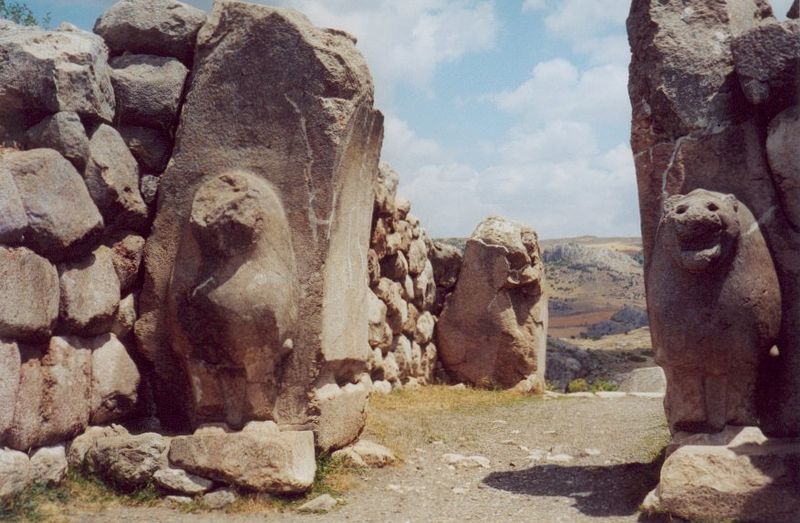
Gates of Hattusa, the Hittite Capital
The loss of the west and the famine in the north meant that the Hittites had abandoned their ancient capital Hattusa and the formidable walls were undefended. The Kaska tribes probably swept south to attack their ancestral foes and the empty cities were totally destroyed but it is clear that the invaders simply torched the city and made no attempt to settle. The famine stricken land of the Hittites, with their farms abandoned and granaries emptied, was now a death trap.

"Since there is famine in your house we will starve to death… The living soul of your country is no more..." 
Letter from a diplomat of Ugarit to a Hittite diplomat, translation from The Collapse of the Bronze Age by Manuel Robbins

The fate of the last king of the Hittites, Suppiluliama II, is unknown but with the capital burned, the people starving and the empire lost, it is doubtful that the remaining subjects, who looked to the king to placate the gods, treated him kindly. Small Hittite kingdoms in Tarhuntassa and Carchemish (tributary states to the south that were formerly subordinate to the Great King in Hattusa) survived but the empire never revived.

Hittite Chariots
The Mycenaeans appear to have weathered the initial destruction, as some of their citadels show signs of rebuilding, but the population that had supported the old order was no longer there and the citadels were abandoned. The skilled craftsmen fled to islands less affected by the wars. The nobility now faced a new threat, a flaw in their system of ruling that the changing times had exposed.

The Bronze Age empires had all depended on chariot elites to form the core of their armies. These armies were equipped with bronze weapons and depended on the trade routes to give them copper from Cyprus and tin from the west to form the alloy. The collapse of the trade routes (and the sudden exodus of skilled Hittite craftsmen from Anatolia) allowed iron-working to begin across the Near East, lessening the dependence on central organisation for weapons manufacturing.

More significantly, the desperation of peripheral peoples allowed them to fight back against the major armies of the day. Bronze Age warfare had seen swift chariot battles on the plains followed by long sieges of fortresses or mountain strongholds that resisted. The major armies would still have been able to win chariot battles but the weakened empires could no longer afford to allow their armies to waste years besieging fortresses. In other words, at a time of crisis, if a barbarian tribe could hold mountainous ground it could be difficult to defeat them without losing other areas of the empire for years and the subject kings would have been unwilling to allow their troops to be away for so long. For embattled empires like the Hittites or Mycenaeans (whose terrains were littered with mountain ranges) the weakness of over-reliance on chariots would have been fatal.

"A camp was set up in one place in Amurru (southern Syria). They (the Sea Peoples) desolated its peoples and its land was like that which had never come into being." 
Inscription of Ramesses III at Medinet Habu, translation from The Collapse of the Bronze Age by Manuel Robbins

"As for the countries who came from the land in isles in the midst of the sea, as they were coming forward toward Egypt, their hearts relying on their hands, a net was prepared for them." 
Inscription of Ramesses III at Medinet Habu, translation from The Collapse of the Bronze Age by Manuel Robbins

Drawing of the relief showing Battle of the Delta
After the fall of Ugarit and the collapse of the Hittites the Sea Peoples moved down the coast of Syria. The cities of Tyre and Sidon were spared assault and may in fact have joined forces with the invaders. Around 1178BC the Pharaoh Ramesses III faced a Sea Peoples invasion of Egypt itself. There had previously been a battle somewhere in Syria and the Egyptians depict loaded carts with women and children, suggesting that the invaders were searching for new lands. Ramesses claimed the battle in Syria as a victory but if so it was a hollow one as the enemy was now at the mouth of the Nile, threatening Egypt itself. The Sea Peoples were using new weapons, a long slashing sword based on a design from the Balkans, that had a longer reach that the Egyptian scimitar. Ramesses’ generals cunningly surprised the invaders in the marshes of the Nile Delta and used the firepower of their archers to destroy the invading armies in what is known as the Battle of the Delta. The invasion of Egypt had been halted but the Egyptian empire in Syria was no more and a group of Sea Peoples were to settle permanently along the coast in southern Syria. The name of one of their tribes, the Philistines, is the origin of our word Palestine.

Sea Peoples depicted as prisoners
"I caused the Nile mouth to be prepared like a strong wall with warships, galleys and coasters equipped, for they were manned completely from bow to stern with valiant warriors with their weapons." 
Inscription of Ramesses III at Medinet Habu, translation from The Collapse of the Bronze Age by Manuel Robbins

Ramesses III had saved Egypt but it was a hollow victory. The loss of its empire and its isolation from other empires led Egypt to a decline. A further eight pharaohs were to claim the name Ramesses in an attempt to rekindle the glories of their predecessors but when Ramesses XI died Egypt split into two kingdoms before being temporarily taken over by Libyans.

Related Blog Posts:
Collapse of the Bronze Age: Part I
Collapse of the Bronze Age: Part II
Collapse of the Bronze Age: Part III
The Late Bronze Age in the Middle East
The Early Iron Age and the Death of Kings: I
The Early Iron Age and the Death of Kings: II

Sunday, 6 May 2012

The Collapse of the Bronze Age: Part I

Lion Gate of Mycenae
"…You say that you have seen the boats of the enemy at sea…. Be strong! Move your chariots and troops within the walls of the city…. The enemy is very strong. …."
Fragments from a response to a plea for help from the king of Ugarit from around the year 1190BC, translation from The Collapse of the Bronze Age by Manuel Robbins

I previously spoke of the complexity of the late Bronze Age, of the palaces and cities, art and literature, warfare and diplomacy that comprise our knowledge of this civilised period. In this post I will speak of how it came to an end. Around the year 1200BC many cities of the Bronze Age are burned, empires fall and entire swathes of land are abandoned for hundreds of years. Some of the more stable civilisations survive but in a reduced form, cowering behind city walls; others disappear forever. Sources for the period are very poor and civilisation declined to the point that some states lost the ability to write their own languages while in other areas place-names are forgotten, suggesting long term abandonment. But these tumultuous events seem to have left behind echoes and some believe that works such as the Iliad and the Odyssey might be distant recollections of these chaotic times.

A much later statue of Homer
Around the year 1208 BC Egypt was attacked by a hitherto unknown coalition that the Egyptians called the "Sea Peoples", in alliance with Egypt’s ancient tribal foes from Libya. A simultaneous revolt of the southern region of Nubia placed Egypt under strain and the Pharaoh Merneptah (son of the builder Ramesses II) was only barely able to contain the attack. In later years a much more concerted series of attacks by the Sea Peoples were repulsed by Ramesses III, but Egypt’s empire in Syria was lost and never properly recovered and one group of Sea Peoples, the Philistines settled along the coast of what were previously Egyptian possessions.

Merneptah blamed the Hittites for allowing the attack suggesting that the Sea Peoples may have been from Anatolia and from the area supposedly controlled by the Hittites. But the Hittite Empire was in serious trouble as well. A civil war had divided loyalties in the population and elites and their northern capital was abandoned for a safer location further south. Texts seem to signify a great famine in the land as well. The weakened empire lost control of western Anatolia and the northern city of Wilusha (probably the city now referred to as Troy) was burnt. Around 1190 BC the old capital of Hattusa suffered a complete destruction. In Mycenaean Greece the great palaces in Mycenae and Tiryns suffer heavy damage and burning. Surviving Linear B fragments from the palace of Pylos point to invaders from the sea, although there may have been land invaders as well. The opulent trading city of Ugarit, in modern day Syria, was burned to the ground around a similar date, while their trading partners in Cyprus see their cities burned. While the Cypriot cities are quickly reoccupied, the destruction in Ugarit was so intense that the fires turned limestone building blocks to lime and the city was never rebuilt.

Assyrian Stele
The inland empires of Assyria, Babylonia and Elam are less affected. Assyria, under the strong leadership of Tukulti-Ninurta I, was expanding at Babylon’s expense around 1200BC before his assassination. After the assassination of Tukulti-Ninurta Assyria went into rapid decline, having kings with short and uncertain reigns and inconclusive wars with Babylon. These wars weakened Babylon to the point where a strong Elamite king was able to raid the city and end the Kassite Dynasty. When Assyria recovered from the dynastic strife it was forced to fight a nearly continuous series of wars against new tribes that had occupied the neighbouring territories.

By around 1150BC the Babylonian, Assyrian and Egyptian empires had been seriously weakened while the Hittite and Mycenaean civilisations had fallen entirely, never to rise again. The population dropped across the Near East and when records become plentiful hundreds of years later, there are new states, peoples, cities and gods. What event or series of events was able to trigger this catastrophic change?

Relief of Hittite Chariots
Firstly I should attempt to exonerate some of the usual suspects. While contemporary sources and later myths suggest mass barbarian invasions, I doubt that barbarian invaders alone could topple the advanced Bronze Age empires. The sheer organisation of these empires meant that they could field large armies and they had fended off external attacks before. Secondly, climate change is unlikely, in and of itself, to have caused the catastrophe. The world population was quite low, arguing against large scale anthropogenic climate change. Also, the civilisations were all affected differently suggesting more local factors were at work. There is no agreement on the order of many of the events described here and even less consensus on causal factors, but I shall tell the story as I understand it, giving primary quotations to back up my arguments where possible. The reader should be aware that very different interpretations are possible.

Fresco of Mycenaean Woman
I have used the book, the Collapse of the Bronze Age by Manuel Robbins quite extensively, and while, not all of the ideas stated here are drawn upon his research, it was the single most valuable secondary source used in researching this piece. I would quite recommend the book.

Related Blog Posts:
Collapse of the Bronze Age: Part I
Collapse of the Bronze Age: Part II
Collapse of the Bronze Age: Part III
The Late Bronze Age in the Middle East
The Early Iron Age and the Death of Kings: I
The Early Iron Age and the Death of Kings: II