Showing posts with label Homer. Show all posts

Tuesday, 13 June 2017

Greece from 750-700

Dipylon Inscription
This blog will be looking at the latter half of the 8th Century BC (or BCE if you prefer), from the years 750-700 for Greece and the greater Greek region. This post was originally intended to be about the greater Near East for this period, but there was so much happening in Greece that I decided to make an entire blog post just about this.

Whoever of all these dancers now plays most delicately, to him this ...
Dipylon Inscription
(I am) Nestor’s cup, good to drink from.
Whoever drinks from this cup, him straightaway
the desire of beautiful-crowned Aphrodite will seize.
Nestor’s Cup

Nestor's Cup
The two texts quoted above are the oldest known Greek inscriptions, both dating from around 740. Both are texts painted onto pottery and it is possible that older inscriptions again will yet be found.  This is the beginning of one of the world’s greatest literary traditions and both inscriptions point to a culture where ritual social interactions involving drinking and dancing abounded. One of the texts also hints at the great epics of Homer, which according to tradition, were composed around this time. While myth and history do not always correlate, it seems that the late 700’s is a plausible time for the Iliad and the Odyssey to be written. If they were not written at this time they were written shortly thereafter.

Rage-Goddess, sing the rage of Peleus’ son Achilles,
Murderous, doomed, that cost the Achaeans countless losses,
Hurling down to the House of Death so many sturdy souls,
Great fighters’ souls, but made their bodies carrion,
Feasts for the dogs and birds,
And the will of Zeus was moving towards its end.
Begin, Muse, when the two first broke and clashed,
Agamemnon lord of men and brilliant Achilles.
Iliad 1:1 Fagles

These poems were descriptions of an ancient war in an age of heroes, where the gods dealt more directly with men, who were themselves closer to gods. The first poem, the Iliad, speaks of an incident during a war across the sea, when the greatest of the Greeks quarrelled whilst besieging windswept Troy on the far side of the Aegean. The second poem, the Odyssey, speaks of the quest of one of victorious Greek warriors braving perils to return to his home across the wine-dark sea. The two books are the earliest truly European literature and can still stand among the finest works of art ever produced by European civilisation.

Later depiction of Homer
It is not entirely clear if Homer actually wrote both poems and because so much of his life is legendary, he may not in fact have existed. However, both poems could conceivably have been written by one artist, and, as we shall never have full clarity, Homer is as good a name as any. While the current form of the texts was likely finalised around this time, the poems show clear features of having been recited in various forms by bards and singers. Homer, if he existed, was a skilful weaver of the multiple strands of song into completed epics, rather than a creator of tales himself. One of the characters of his stories may in fact be referenced on one of the earliest inscriptions (Nestor) so it is safe to assume that the broader tales were well known around the Greek speaking world.

Once they'd put aside desire for food and drink, old Nestor the noble charioteer began, at last: "Now's the time, now they've enjoyed their meal, to probe our guests and find out who they are. Strangers — friends, who are you? Where did you sail from, over the running sea-lanes? Out on a trading spree or roving the waves like pirates, sea-wolves raiding at will, who risk their lives to plunder other men?"
Odyssey: Book 3

Despite being so vital for European cultural history, they may not in fact have even been written in Europe. The language of the poems is a mixture of Aeolic and Ionic (two dialects of Greek), suggesting that the poems may have been written in present day Turkey, or on the islands in the Aegean rather than the mainland. This underpins the fact that the Greeks cities were becoming crowded and that, seeking a better life, or more land, or to trade, to engage in piracy, for simple love of adventure, or all of the above reasons, Greeks were leaving mainland Greece and colonising the adjacent lands. The western coast of Asia Minor was full of Greek cities by this point and around the year 733, a group of Corinthian settlers founded the city of Syracuse in Sicily, which would go on to become of pivotal importance in later centuries (and still a major city today).

Later vase depiction of a scene from the Trojan War
There was a major war in Greece during this time that may have sparked a renewed interests in the wars of antiquity. This was the First Messenian War between Sparta and Messene. Sparta had supposedly undergone military and social reforms under Lycurgus in the previous century, but it did not seem to have fully transformed the Spartan state. The Messenians were a powerful state to the west of the Peloponnese who had close relations with the Eleans (who organised the Olympic Games). Many of the early Olympic winners were from Messene.

…the mutual hatred of the Lacedaemonians and Messenians was aroused, and the Lacedaemonians began war, obtaining a pretext which was not only sufficient for them, eager for a quarrel as they were and resolved on war at all costs,
Pausanias: Description of Greece 4.4.4

The Messenians were Achaean Greeks (named for their dialect) while the Spartans were Dorian Greeks, who saw themselves as conquerors of the earlier Achaeans. There were tensions between the two states and sometime around 740 the two states went to war. Both sides would only have been able to field around 5000 soldiers (usually a lot less than that) and both sides would struggle to field armies throughout the year, as neither side was fully militarised. Hoplite warfare had not developed fully so the armies would have fought in irregular infantry formations, but many elements of the later Greek warfare were already present. Some sources suggest that the Spartans may have developed the beginnings of the phalanx in this war, but these sources are later and there is no evidence that this was actually the case.

When the leaders on either side gave the signal, the Messenians charged the Lacedaemonians recklessly like men eager for death in their wrath, each one of them eager to be the first to join battle. The Lacedaemonians also advanced to meet them eagerly, but were careful not to break their ranks.
Pausanias: Description of Greece 4.8.1

The war stretched on for nearly two decades of irregular warfare, with Sparta gaining the upper hand. Both sides appealed to the Oracle of Delphi and both sides were granted relatively ambiguous advice, but neither side was fully promised victory. The Messenians fortified Mt Ithome in their territory and when this finally fell to the Spartans around 720 it marked the end of the Messenian state.

Mt Ithome: Fortified by the Messenians at the end of the war
Even then the Messenians were not inferior in courage and brave deeds, but all their generals were killed and their most notable men. After this they held out for some five months, but as the year was coming to an end deserted Ithome, the war having lasted twenty years in all, as is stated in the poems of Tyrtaeus: But in the twentieth year they left their rich tilled lands, and fled from out the lofty mountains of Ithome.
Pausanias: Description of Greece 4.13.6

This was a very unusual war for the Greeks. The Spartans had spent decades fighting the war and never wanted to repeat it. So, after the war, they enslaved and permanently conquered the city of Messene, destroying the city and reducing the population to a perpetual underclass of slaves, who were known as helots, although it is clear that the Spartans already had an underclass of helots and thus not all helots were Messenian.

This was the true beginning of Sparta as we know it. The warrior class was maintained by the grudging labour of the helots. In turn, because the memory of Messenia never faded, the helots were always a danger to the state. A slave rebellion was always imminent so the Spartan warrior class had to remain ever vigilant. This paranoid military arrangement forced the Spartan state to maintain a permanent warrior class and the fact that their city actually had the land of two large city-states at their disposal meant that the Spartans were the most powerful of the city states. However, because of their continual need to prevent rebellion at home, the Spartans used this power lightly, never sending their armies on campaign for long periods.

Greek pottery from the period
The Messenians themselves were treated in this way: First they exacted an oath that they would never rebel or attempt any kind of revolution. Secondly, though no fixed tribute was imposed on them, they used to bring the half of all the produce of their fields to Sparta. It was also ordained that for the funerals of the kings and other magistrates men should come from Messene with their wives in black garments, and a penalty was laid on those who disobeyed.
As to the wanton punishments which they inflicted on the Messenians, this is what is said in Tyrtaeus' poems:–
Like asses worn by their great burdens, bringing of dire necessity to their masters the half of all the fruits the corn-land bears.
Pausanias: Description of Greece 4.14.4-5

On a rather different note, with the Spartan army on campaign for long periods during the war, a number of illegitimate children were supposedly born to the Spartan women and were viewed as being outside of society. These fatherless men were sent to colonise southern Italy and founded the colony of Taras around 710. This city, afterwards known as Tarentum/Tarento would become famous in its own right in years to come.

Not many bows will be drawn,
nor will slingshots be common,
whenever battle will be joined in the plain;
instead the much-sighing work will belong to the swords,
for the warlike lords of Euboea are experienced in that manner of war.
Archilochus

Greek pottery from the period
The Messenian War was long and decisive, but another war was beginning at this time. The Lelantine War was fought between Chalcis and Eretria. Both of these cities were wealthy cities on the long island of Euboea. They were barely twenty kilometres apart but these two cities, which had previously been allies, as well as some of the wealthiest cities in Greece, went to war over the plain between their cities. The war is supposed to have had gentleman’s agreements over the forbidding of cavalry and archers, to have involved cities from all over the Greek world and to have lasted for sixty years. It is strange to imagine that in this archaic period that Greece could have sustained conflict for over six decades in such a tiny field of battle. The truth may have been that that there were intermittent conflicts (that evolved into almost ritualised infantry encounters) that periodically flared up between the two states. As the states traded extensively, foreign cities would choose a side and occasionally send small contingents. As the war drags on into the next century we will discuss it in depth there, but it certainly starts in the 8th Century.

Muses of Pieria who give glory through song, come hither, tell of Zeus your father and chant his praise. Through him mortal men are famed or un-famed, sung or unsung alike, as great Zeus wills. For easily he makes strong, and easily he brings the strong man low; easily he humbles the proud and raises the obscure, and easily he straightens the crooked and blasts the proud,--Zeus who thunders aloft and has his dwelling most high.
Beginning of Works and Days by Hesiod

Mt Helikon, where Hesiod was inspired by the Muses
Around the late 700’s a Greek poet by the name of Hesiod began to write. His genuine poems that come down to us are Theogony and Works and Days. Theogony is a short description of the nature of the gods of Greece and provides a rough version of a Greek creation story. Works and Days is similar to a farmer’s almanac, containing vignettes of life as the owner of a small farm in Boeotia. These short poems are not nearly as famous as the Iliad or Odyssey, but they give us the first concept of the Muses, the myth of the Titans, Prometheus, Pandora’s box and the concept of four successive ages (gold, silver, bronze and iron).

For never yet have I sailed by ship over the wide sea, but only to Euboea from Aulis where the Achaeans once stayed through much storm when they had gathered a great host from divine Hellas for Troy, the land of fair women.  Then I crossed over to Chalcis, to the games of wise Amphidamas where the sons of the great-hearted hero proclaimed and appointed prizes.  And there I boast that I gained the victory with a song and carried off a handled tripod which I dedicated to the Muses of Helicon, in the place where they first set me in the way of clear song.
Hesiod: Works and Days

Unlike Homer, Hesiod was almost certainly a real person, and he describes his life in a number of passages in his work. There is a later myth that Homer and Hesiod were in fact contemporaries and that they competed in poetry competitions against each other (supposedly the prize went to Hesiod, whose poem promoted peace rather than war). The venue of the competition was supposedly the city of Chalcis, at the funeral celebrations of Amphidamas, a noble who had fallen in the Lelantine War. Hesiod himself mentions the competition but the tradition that his opponent was Homer is a much later and probably false invention.

A gift of HDR for our lord Hazael, from the plain of Basan, a brow-band for our respectful lord
Inscription from a votive offering found in Samos

Lastly, there is some evidence that the Greeks of this era were involved as mercenaries and traders in the larger empires of the Near East. In 733/732 Damascus was taken by the Assyrians and looted. Certain items that had been looted by Hazael and dedicated in the temples of his god Hadad were taken as loot from the sack of Damascus. Some of these items were dedicated in temples in Eretria and Samos and may have been the parts of the spoil allocated to Greek mercenaries serving in the Assyrian army. It is a tempting supposition, but it is of course possible that the items were looted several more times and were dedicated at the Greek temples at a later date. Either way, it is an interesting case study in the movement of people and artefacts during the Greek Archaic Period.

Item with inscription mentioning Hazael
A gift of Hadad for our lord Hazael, the year that our lord crossed the river
Inscription from the Hazael Blinkers found in Eretria

Related Blog Posts:
The 8th Century BC in the Near East: I
750-725BC in the Near East
725-701BC in the Near East
Greece from 700-675BC

Monday, 7 May 2012

The Collapse of the Bronze Age: Part II

Hittite Deities
"They spent their time going about the land, fighting, to fill their bodies daily. They came to the land of Egypt, to seek the necessities of their mouths." 
Inscription by the Pharaoh Merneptah on the Libyan invasion, translation from The Collapse of the Bronze Age by Manuel Robbins

Firstly, I believe that there around 1200BC there was a major food shortage in what is now Greece and Turkey. This was not unprecedented and the empires (the Mycenaeans and Hittites) responded as they always did, by coercing the peripheral states to send food to the impoverished heartlands. The food shortage may or may not have been accompanied by a plague of some type. The evidence for plague is almost non-existent, however, famine and plague have often been closely associated in other historical periods. The four horsemen of the Apocalypse ride close together. The central states were weakened but not fatally so by any means. There appears to have been a food shortage in Libya at the time as well so it is unclear whether or not the famine stretched across the Middle East.


Later Greek vase with a scene of the Trojan War
"He sat himself down away from the ships with a face as dark as night, and his silver bow rang death as he shot his arrows in the midst of them. First he smote their mules and their hounds, but presently he aimed his shafts at the people themselves, and all day long the pyres of the dead were burning." 
Iliad I.7, describing Apollo in his role of god of plague attacking the Greek army at Troy.

Faced with these demands and having endured years of meddling in their affairs by the two empires, the peoples of the western seacoast of Turkey began to forsake their towns and take to the sea as pirates. History knows these pirates as the Sea Peoples (mainly because this is what the Egyptians called them). The Mycenaeans and Hittites had fleets but the west coast of Turkey was at the edge of their striking range and they struggled to contain the rebellion. The rebellion meant that no food was sent to Hattusa from the west, further weakening the Hittites and the pirates began to seize food shipments for Hattusa en route from Syria and Egypt.

Hittite Relief
An Assyrian army had defeated the Hittites earlier and the Hittite king had proved unable to respond. The Hittites had had a civil war several generations previously and, with the signs of weakness in the royal house, this conflict appears to have flared up again. To make matters worse, some of the raiders joined forces with the Libyans against the Pharaoh Merneptah, who fought off the invasion but then seemed to blame the Hittites for allowing their subjects to attack Egypt, subsequently cutting off grain shipments. The northern tribes of Kaska appear to have attacked as well, doubtless feeling the strain of the famine and hoping to raid Hittite food supplies. A new king took the name of Suppiluliuma II (the previous king of that name had saved the Hittites at a time of crisis) and attempted to fend off the attacks.

Mycenaean Dagger
The Mycenaeans, who were probably never a unified people except in war, (the number of fortified citadels suggest a highly independent nobility at the very least) struggled to contain the threat. In times of crisis neighbours often attack each other and only a common enemy can force people to work together. The Mycenaean leaders may have attempted to solve their problems by going to war against a far off foe. Around this time Troy, on the north western coast of Turkey, was burnt to the ground. It is unknown if this was done by the Greeks, the Sea Peoples or others but the strength of the legend of the Trojan War suggests that the Mycenaeans attacked the western coast of Turkey around that date. If this was intended to stave off the crisis, it failed. Greek legend speaks of the absolute chaos that ensued after returning from the war. The legends of Aegisthus and Orestes may recall power struggles and civil wars at that time. The countryside was rapidly depopulating and without the food provided by these farmers, the nobility probably turned on each other.

A fragment from the citadel of Pylos speaks of posting guards to warn of sea raiders from the south (from a direction that speaks of attackers from Crete or other Greek islands) and the citadel is burned shortly afterwards. The palaces show signs of a faltering recovery but are subsequently abandoned for a final time. Legends speak of a Greek speaking barbarian tribe from the north (the Dorians) that subsequently inhabited the Mycenaean heartlands. These new immigrants were unfamiliar with the Bronze Age order of things and the remains of citadels such as the ones at Tiryns were left alone and believed to be the work of Cyclops and giants. Settlement evidence indicates major abandonment of settlements and it is possible that many Mycenaeans left Greece for more distant shores.

"Thus the watchers are guarding the coasts : command of Maleus at Owitono... 50 men of Owitono to go to Oikhalia, command of Nedwatas.... 20 men of Kyparssia at Aruwote, 10 Kyparissia men at Aithalewes..." 
Tablet from Pylos describing guards on the southern coast

It should also be noted that some of the cities destroyed at this time show signs of earthquake damage. The eastern Mediterranean is a seismically active area and a major series of earthquakes could damage city walls enough to allow small groups of raiders (or pirates) to sack cities that were caught unprepared. The activities of the empires probably helped in this, as the empires would concentrate their forces at a single point, allowing small groups of raiders to strike undefended peripheral cities with impunity.

Ruins of the city of Ugarit in Syria
"The city and the king (of Ugarit) have been annihilated by fire, half of it has been burned, and the other half is no longer there." 
Abi-Milku of Tyre describing an earlier earthquake in Ugarit, , translation from The Collapse of the Bronze Age by Manuel Robbins

Egypt and Mesopotamia, with their high population densities and irrigation networks were probably less affected by food shortages and less susceptible to earthquakes but the chaos in the Mediterranean would have affected their trade networks. The effects of this would only be felt gradually but it would have eventually affected their economies. To remedy their deficits they, like the Hittites and Mycenaeans, would have attempted to go to war. Numerous wars between the Assyrians and Kassites occurred and Assyria might well have capitalised on the situation, were it not for the assassination of their king. As it was however, the assassination forced Assyria into civil war and the armies of Babylon, previously defeated by the Assyrians, were no match for the invading Elamites. As the empires each came under threat (each in their own way) they would have ceased correspondence with each other and the intricate diplomacy of the Bronze Age disappeared. An empire under attack could only send the most minimal aid to its allies and each empire faced their threats on their own.

Suppiluliuma II
"I mobilised and I Suppiluliuma, the Great King, immediately crossed the sea. The ships of Alashia (Cyprus) met me in the sea three times for battle, and I smote them; and I seized the ships and set fire to them in the sea. But when I arrived on dry land, the enemy from Alashia came in multitude against me for battles…" 
Last known inscription by Suppiluliuma II of the Hittites, translation from The Collapse of the Bronze Age by Manuel Robbins

As the central empires weakened, the previously weak sea raiders became comparatively stronger. Their acts of piracy had temporarily saved them from starvation and the earthquakes would only have aided their attacks. They appear to have switched from simple raiding and attempted to migrate en masse to new lands. But now they faced a backlash. The last known inscription of the last Hittite king speaks of a great sea victory near Cyprus and Suppiluliuma II may have attempted to capitalise on the victory (if it happened) by attacking the bases of the pirates on the south-western coasts.

"… My cities were burned and evil things were done in my country. Does my father (respectful title for a king) know that my troops are stationed in Hittite land and my ships in Lukka (western coast of Turkey) country? Thus, the country is abandoned to itself. May my father know this. Seven ships of the enemy have come here and did us much damage. Be on the lookout for other enemy ships and send me warning." 
Message from Ugarit to a king in Cyprus, translation from The Collapse of the Bronze Age by Manuel Robbins

If this is what happened, the venture failed. Around the year 1192BC the armies and navies of Hittite allies are sent westwards and do not return. Possibly there was a great battle that destroyed the Hittite force or, more likely, the raiders had already abandoned their bases and slipped past the Hittite fleets but the result of the expedition was that the coastal cities of Cyprus and Syria were attacked and burned. The final messages found in the ruins of Ugarit reveal the danger that the cities had been left in and one extraordinary message has a neighbouring king pleading for Ugarit to launch one hundred and fifty ships against the threat (bear in mind that the grain ships of Ugarit appear to have been able to transport 250 tons of grain so presumably their warships were of a reasonable size). But there were no ships.

"Twenty enemy ships slipped away into the mountain region and we don’t know where they have gone…" 
Message from king of Ugarit to ally in Cyprus, translation from The Collapse of the Bronze Age by Manuel Robbins

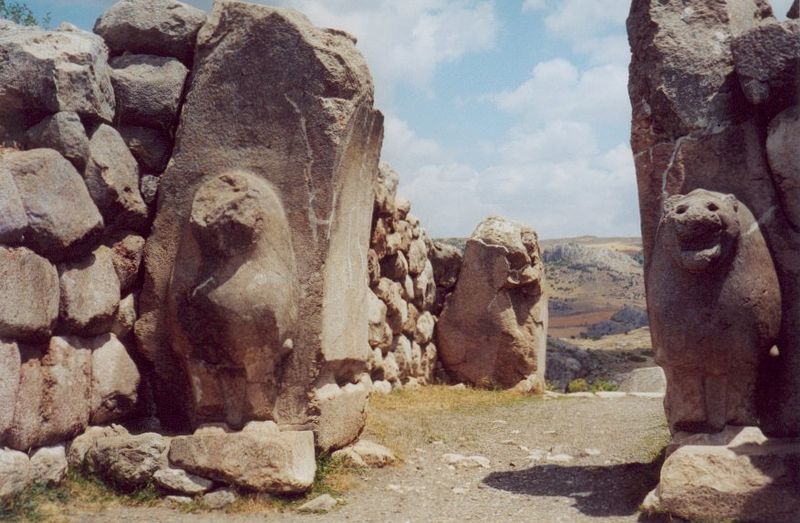
Gates of Hattusa, the Hittite Capital
The loss of the west and the famine in the north meant that the Hittites had abandoned their ancient capital Hattusa and the formidable walls were undefended. The Kaska tribes probably swept south to attack their ancestral foes and the empty cities were totally destroyed but it is clear that the invaders simply torched the city and made no attempt to settle. The famine stricken land of the Hittites, with their farms abandoned and granaries emptied, was now a death trap.

"Since there is famine in your house we will starve to death… The living soul of your country is no more..." 
Letter from a diplomat of Ugarit to a Hittite diplomat, translation from The Collapse of the Bronze Age by Manuel Robbins

The fate of the last king of the Hittites, Suppiluliama II, is unknown but with the capital burned, the people starving and the empire lost, it is doubtful that the remaining subjects, who looked to the king to placate the gods, treated him kindly. Small Hittite kingdoms in Tarhuntassa and Carchemish (tributary states to the south that were formerly subordinate to the Great King in Hattusa) survived but the empire never revived.

Hittite Chariots
The Mycenaeans appear to have weathered the initial destruction, as some of their citadels show signs of rebuilding, but the population that had supported the old order was no longer there and the citadels were abandoned. The skilled craftsmen fled to islands less affected by the wars. The nobility now faced a new threat, a flaw in their system of ruling that the changing times had exposed.

The Bronze Age empires had all depended on chariot elites to form the core of their armies. These armies were equipped with bronze weapons and depended on the trade routes to give them copper from Cyprus and tin from the west to form the alloy. The collapse of the trade routes (and the sudden exodus of skilled Hittite craftsmen from Anatolia) allowed iron-working to begin across the Near East, lessening the dependence on central organisation for weapons manufacturing.

More significantly, the desperation of peripheral peoples allowed them to fight back against the major armies of the day. Bronze Age warfare had seen swift chariot battles on the plains followed by long sieges of fortresses or mountain strongholds that resisted. The major armies would still have been able to win chariot battles but the weakened empires could no longer afford to allow their armies to waste years besieging fortresses. In other words, at a time of crisis, if a barbarian tribe could hold mountainous ground it could be difficult to defeat them without losing other areas of the empire for years and the subject kings would have been unwilling to allow their troops to be away for so long. For embattled empires like the Hittites or Mycenaeans (whose terrains were littered with mountain ranges) the weakness of over-reliance on chariots would have been fatal.

"A camp was set up in one place in Amurru (southern Syria). They (the Sea Peoples) desolated its peoples and its land was like that which had never come into being." 
Inscription of Ramesses III at Medinet Habu, translation from The Collapse of the Bronze Age by Manuel Robbins

"As for the countries who came from the land in isles in the midst of the sea, as they were coming forward toward Egypt, their hearts relying on their hands, a net was prepared for them." 
Inscription of Ramesses III at Medinet Habu, translation from The Collapse of the Bronze Age by Manuel Robbins

Drawing of the relief showing Battle of the Delta
After the fall of Ugarit and the collapse of the Hittites the Sea Peoples moved down the coast of Syria. The cities of Tyre and Sidon were spared assault and may in fact have joined forces with the invaders. Around 1178BC the Pharaoh Ramesses III faced a Sea Peoples invasion of Egypt itself. There had previously been a battle somewhere in Syria and the Egyptians depict loaded carts with women and children, suggesting that the invaders were searching for new lands. Ramesses claimed the battle in Syria as a victory but if so it was a hollow one as the enemy was now at the mouth of the Nile, threatening Egypt itself. The Sea Peoples were using new weapons, a long slashing sword based on a design from the Balkans, that had a longer reach that the Egyptian scimitar. Ramesses’ generals cunningly surprised the invaders in the marshes of the Nile Delta and used the firepower of their archers to destroy the invading armies in what is known as the Battle of the Delta. The invasion of Egypt had been halted but the Egyptian empire in Syria was no more and a group of Sea Peoples were to settle permanently along the coast in southern Syria. The name of one of their tribes, the Philistines, is the origin of our word Palestine.

Sea Peoples depicted as prisoners
"I caused the Nile mouth to be prepared like a strong wall with warships, galleys and coasters equipped, for they were manned completely from bow to stern with valiant warriors with their weapons." 
Inscription of Ramesses III at Medinet Habu, translation from The Collapse of the Bronze Age by Manuel Robbins

Ramesses III had saved Egypt but it was a hollow victory. The loss of its empire and its isolation from other empires led Egypt to a decline. A further eight pharaohs were to claim the name Ramesses in an attempt to rekindle the glories of their predecessors but when Ramesses XI died Egypt split into two kingdoms before being temporarily taken over by Libyans.

Related Blog Posts:
Collapse of the Bronze Age: Part I
Collapse of the Bronze Age: Part II
Collapse of the Bronze Age: Part III
The Late Bronze Age in the Middle East
The Early Iron Age and the Death of Kings: I
The Early Iron Age and the Death of Kings: II

Tuesday, 20 March 2012

The Late Bronze Age in the Middle East

Statues of Ramesses II built around 1255BC
In earlier posts, about Sumer, Egypt and Minoan Crete, I sketched a brief account of early civilisations in the region now known as the Middle East. By 1600 BC the greater Middle Eastern region had seen civilisation spread from the early cultural centres and complex trade routes linked states and empires from Iran to the edges of Greece and from the southern borders of Russia to northern Sudan. The trade routes may well have extended further for certain important commodities but, at the very least, the greater Middle Eastern region had reached a level of development that allowed communication across a wide area. I will skip over some of the events around 2500-1600BC for the moment, although hopefully I will be able to get back to them at some point, and focus on the later Bronze Age period in all its glory. I will describe the states that formed the region and then end by describing the relations that existed between them.

Map of the Bronze Age c.1400BC (not showing Elam or Mycenae)
At the eastern edge of the region lay Elam, a kingdom centred around what is now south-western Iran. This kingdom had two major urban centres at Susa and Anshan. The inhabitants spoke an isolated language that can nevertheless be translated because of their use of cuneiform however sources are quite scarce for this period. The Elamite kingdom at that time based its legitimacy on the earlier Elamite kingdoms, whose history went back almost to the dawn of civilisation, but the dynasties had changed throughout the centuries. Unfortunately there is not a great deal that can be said about the Elamite kingdom of this era (at least by me) so the reader must be content with knowing that there was a strong kingdom in south-western Iran whose rulers frequently clashed with the Babylonian Kassite rulers of southern Iraq and whose power generally waxed if the power of the Kassites waned.

Illustration from a Kassite kudurru
The southern region of Iraq was ruled by a people known as Kassites from the early 1500’s BC until the early 1100’s. After Babylon was destroyed by invading Hittite armies and the last member of Hammurabi’s dynasty deposed, the Kassites took over. They spoke a language that was difficult to understand but which may have been related to Hurrian. Very few of texts in their language survive, however substantial correspondence exists between them and other rulers, using tablets inscribed with the older Akkadian language.

The Kassites were not native to the region and built a new capital, Dur-Kurigalzu, from which to rule, but the city of Babylon had such a reputation that it nevertheless retained its importance. After a time the Kassites appear to have been absorbed into the greater Babylonian population. Sadly, very little has survived from this period but the Kassites left as their legacies kudurrus, which were similar to legal grants of lands and privileges. Although this was unintended, the astronomical data recorded in writing the dates on the kudurrus has greatly assisted archaeologists in dating events in Near Eastern history.

Letter from Tushratta, King of Mitanni, to Egypt
From around 1500 to 1300 BC the area roughly comprising what is now northern Iraq, eastern Turkey and Syria was ruled by a state called Mitanni. A number of different names were used for this state, including Hurri, Khanigalbat/Hanigalbat or Maryannu. Some of these may have been names of peoples within the state that were subsequently confused with the state itself. Seldom have we known so little about a state but some scholars have hypothesised that a group of Indo-Aryan speakers formed a small ruling class in the Mitanni state and that the Mitanni state may have developed the light chariot and introduced the art of training horses to a high physical peak. A manual for training horses written by a certain "Kikkuli the Mitanni" was found in the Hittite capital and dated to around 1400BC.

Whether or not the Mitanni invented the light spoked chariot wheel, by around 1500BC the light chariot had become pivotal to the armies of the Middle East and the armies of the day were formed around elite chariot corps. The Mitanni state was powerful and at the height of its power was more than a match for Egypt, but it had no natural defences and proved unable to control its own territory. The Hittite state in present day Turkey eroded its Syrian empire while the rising Assyrian state (near present day Mosul in northern Iraq) sapped its interior strength. Eventually the Mitanni state ceased to be a great power and became tributary to the Hittites and Assyrians before finally becoming absorbed into the Assyrian empire. For an empire that lasted over two hundred years and may have pioneered innovative military tactics we know so little about it that the location of its capital Washukanni is a mystery to this day.

Middle Assyrian Stele
The Assyrians were based very close to the centre of Mitanni power in the north of Iraq and so were unable to achieve any degree of independence for a time. Their main city of Asshur had been the capital city of a substantial, but short-lived, empire hundreds of years earlier so the kings of that city dreamed of re-establishing the greatness of earlier times. However, the measures needed to fend off the Kassites to the south while also shaking off the yoke of Mitanni rule appear to have forced the Assyrians to begin to use drastic (extremely brutal) tactics to achieve success. Eventually the Assyrians were able to crush the Mitanni and claim their perceived rights as great powers. At first the neighbouring powers, the Kassites and Hittites, were angry that a regional power would dare to dispute with them at their own level but they adjusted pragmatically once it was seen that Assyria was there to stay. One Hittite king contemptuously asks Adad-Nirari I (one of the first Assyrian kings to claim great power status) "So you’ve become a Great King have you?" But the next Hittite king adopts a more conciliatory tone when writing about a troublesome border town between their empires, "If Turira is yours, smash it! If Turira is not yours, write to me so that I may smash it!" Assyria had risen to the challenge of politics in the Bronze Age and the Mitanni state passed into obscurity.

Hittite Carving
The Hittite state was based in central Turkey with their capital Khattusha lying near the current town of Bogazkale. The Hittite kingdom had existed since around 1800BC and had burst onto the international scene when they had sacked Babylon around 1530BC, however, internal power struggles forced them to pull back. Around 1400BC the revived empire began pushing forward once more and they clashed with the Mitanni and Egypt over control of Syria and Lebanon. They spoke an Indo-European language but used Akkadian (the language of Babylonia) to communicate with most of their neighbours. Their cities and fortresses were impressively built from stone and they produced some vibrant artwork and carvings. They appear to have had a navy (as they seem to have included Cyprus in their empire). But their most impressive technological feat was the production of iron. They were unable to produce much of it and they were certainly unable to equip armies with it, but they were able to produce small luxury iron items like knives that were traded among kings. This invention paved the way for the later mass production that enabled the Iron Age. It is unclear though if the Hittites were the only ones who knew this secret and it is likely that other late Bronze Age kingdoms had at least some knowledge of this.

Hittite Depiction of Chariots
While their population was far below that of Egypt the Hittites were capable of meeting the Egyptian armies in battle. At the battle of Kadesh the forces of the Hittite king, Muwatalli II, outwitted and inflicted serious casualties on the Egyptian armies of Ramesses II. Although Ramesses’ forces recovered, the Hittites forced the Egyptians to recognise a draw and significantly, it was the Egyptians who had to withdraw after the battle. Despite successes such as these, the Hittites were unable to seriously threaten Egypt. Their population was much smaller and the neighbouring states of Kaska, Arzawa and Wilusha were continuously threatening to revolt or invade should the Hittite king ever leave them alone for any period of time.

Bust of Nefertiti
The Egyptian Empire reached its apogee in the Late Bronze Age. After having expelled the foreign Hyskos Dynasty (and having learned from them all the secrets of chariotry) the Pharaohs used the resources of Egypt to dramatically expand their borders controlling large sections of present day Libya, Sudan, Israel, Palestine, Lebanon and Syria. Around 1350 BC Egypt suffered a setback in international affairs when the Pharaoh decided to change Egyptian religion (this event is definitely worth a blog post of its own) and the ensuing turmoil appears to have loosened the Egyptian hold on their empire. But after this setback the Egyptians did recover some of their control of the region.

Egypt was the strongest of the great powers because none of the other powers could strike it directly (they had to cross the sea, deserts or pass through the Egyptian controlled areas of Syro-Palestine). The regularity of the Nile and advanced Egyptian agriculture enabled the Pharaohs to control (and feed) large populations who could be mobilised for war if necessary. Also Egyptian mines produced seemingly inexhaustible amounts of gold allowing Egypt to exercise far greater spending power than its rivals. While these factors meant that Egypt was the most stable and pre-eminent power, it was no guarantee that its armies would be victorious once they left the safety of Egypt (as Ramesses II found out at Kadesh).

Main Entrance to Mycenae
The last of the great powers was only really acknowledged by the Hittites. This power was referred to by the Hittites as Ahhiyawa. It was located somewhere to the west of the Hittite kingdom but, even with the Hittite naval forces, it appeared that the Hittites were unable to strike at the homeland of this people. This people interfered with the kingdoms on the western coast of Turkey and were powerful enough for the kings of the mighty Hittite Empire to be forced to address them as equals. While the link is unproved and still somewhat contentious, I believe that it is fair to assume that the "Ahhiyawa" referred to in Hittite records actually refers to Mycenaean Greece.

Mycenaean Fresco of a Lady
The Mycenaean culture was centred in the south of Greece. Like the Hittites they built massive stone citadels (and tombs that mirrored the splendour of Egyptian tombs). They may not have been an empire in the traditional sense but it is likely from Hittite records that there may have been a number of powerful regional overlords who all deferred to a single overall leader. If the later writings of Homer are indication of Bronze Age culture, the portrayal of Agamemnon would back this up. The Mycenaean culture left some writings behind but these are nearly all extremely boring documents describing the daily accounts of the palaces (interesting in their own way I suppose but of very little help in getting a sense of the politics of the time). It is almost definite that they could not speak Akkadian so they were unable to communicate in the deliberations of the great powers but the distance between their realm and any empire save the Hittite one made such communication unnecessary.

Depiction of Ramesses II at the Battle of Kadesh
For those of you who have struggled through the blog post this far, it has doubtless been a fairly boring read and I apologise for this. Sadly, the amount of detail and time that must be covered makes it difficult to really make things interesting and no amount of pretty pictures will compensate. But I do think that this post is worth spending time on. There are some really significant things to take from this piece of history. Firstly, that each kingdom mentioned here shared broad cultural similarities, they each had kings, worshipped similar gods and used similar weapons and strategies to wage war. Each kingdom appears to have been centred to a greater or lesser extent around a bronze-wielding, chariot-driving elite.

But the most extraordinary thing is the way that they talk. I have alluded throughout the piece to concepts such as "Great Power" status. What this meant was that each of these kings viewed the others as effectively their equal and used diplomacy to maintain this. No one empire or kingdom was strong enough to conquer the others (over the entire time period only the Mitanni kingdom falls and that takes the concerted efforts of Egypt, the Hittites and Assyria over a period of several hundred years) so by and large they simply don’t try.

Vase showing Mycenaean Soldiers
This fine balance may be disrupted by warfare but after the wars the kings would draw up elaborate peace treaties using a common language of diplomacy (Akkadian) that could be as scrupulously honoured (possibly more so) than treaties today. I’m not trying to imply that there was a proto United Nations at work but I do find the intricate balance of power, diplomacy and peacemaking in the late Bronze Age to be one of the most interesting political scenarios to have ever existed. It is impossible to tell how the modern world might be different had these kingdoms survived longer but it is interesting that many cultures in later times appear to have looked back to this era as a golden age.

To give a flavour of the correspondence between the Great Kings I shall finish by showing the beginning of a translated letter sent from Assur-Uballit I of Assyria (when Assyria was just trying to establish itself as a great power) to Akhenaten of Egypt. The translation is taken from the book the Amarna Letters, which was edited and translated by William L. Moran.

Lamassu from Assyrian Palace
Say to the Great King, king of Egypt, my brother: Thus Assur-Uballit, king of Assyria, Great King, your brother,
For you, your household and your country, may all go well.
When I saw your messengers I was very happy. Certainly your messengers shall reside with me as objects of great solicitude.
I send you as your greeting gift a beautiful royal chariot outfitted for me and two white horses also outfitted for me, one chariot not outfitted and one seal of genuine lapis lazuli. 
Is such a present that of a Great King? Gold in your country is as dirt. One simply gathers it up. Why are you so sparing of it? I am engaged in building a new palace. Send me as much gold as is needed for its adornment.
When Assur-nadin-ahhe, my ancestor, wrote to Egypt twenty talents of gold were sent to him.
When the king of Khanigalbat (Mitanni) wrote to your father in Egypt he sent twenty talents of gold to him.
Now I am the equal of the king of Khanigalbat (Mitanni) but you have sent (x) amount of gold and it is not even enough for the pay of my messengers on the journey to and back….

Related Blog Posts:
Sumerian History: 3500-1940BC
The Time of the Amorites: Part I
The Time of the Amorites: Part II
The Heretic Pharaoh
The Mitanni