Showing posts with label Helot. Show all posts

Sunday, 7 July 2019

459-450BC in Greece

Statue A from the Riace Bronze
Sculptures, found undersea
near Calabria
This post will look at Greece and the wider Greek world from the years 459BC to 450BC. Firstly, a word about our sources. Archaeology can shed some light on this period, but we are primarily reliant on written sources, such as the writings of Aeschylus, Thucydides, Diodorus Siculus, Plutarch, and Pausanias.

In the year 459 the Athenians and Spartans were at war in what would become known as the First Peloponnesian War. The Spartans were probably still fighting a helot uprising and the Athenians were fighting a major campaign against the Persians in Egypt, having committed perhaps 200 ships and their crews to that war. Thus, even though the war had begun the previous year, it is not clear that either side had really engaged each other. However the dates are somewhat unclear from this time, so some of what I mention in this year may in fact have occurred the year previously.

Some scholars place the alliance between Athens and Megara in this year, but I think it more likely that this occurred the year previously, as it was likely a cause for the war. However, I would certainly not be dogmatic about it.

The Athenians fought the Corinthians and the Corinthian allies from Epidaurus at a place called Halieis. Both Athens and Corinth were naval powers, but this battle was fought on land. The Athenians suffered a defeat, but probably not a very serious one. The Athenian navy was more successful than their land army, and won a victory over the Corinthians in a naval battle fought near the tiny island of Cecryphaleia, which was near to Aegina. Aegina was a traditional foe of Athens and the presence of their enemies in force must have frightened the Aeginetans.

Roman copy of a bust of Pericles
The Aeginetans joined the war on the Spartan side (this may possibly have happened early in the following year), adding their navy to the navy of the Corinthians and other Peloponnesian allies. Even with the huge naval force already engaged in Egypt, the Athenian navy was still the terror of the seas. The remainder of the Athenian fleet engaged the full fleet of the Aeginetans and whatever allies were available to help them. The Athenians were victorious, winning a huge victory, capturing 70 ships and entirely crippling the navy of Aegina.

A large Athenian force then landed on the island of Aegina and began to besiege the city. The Spartans had sent a force of three hundred soldiers to aid the Aeginetans, but it was nowhere near enough to sally forth and rout the Athenians. The siege dragged on, as siege warfare was not advanced in this time period among the Greeks. The Spartans meanwhile were decidedly inactive, which leads me to suspect that they were still fighting the helot uprising at this time.

Around this time, in Asia Minor, Archeptolis, son of the Themistocles, became governor of Magnesia. He governed the region as a vassal of the Persian kings and followed his father's example in minting coins in his own name, which may also include a portrait of his face upon the obverse of the coins.

In Sicily, the leader of the native people (the Sicels) took over the settlement of Morgantina. This town was probably taken from one of the Greek cities, Catana or Camerina.

Coin of Archeptolis, son of Themistocles, ruler of Magnesia
In the year 458 the Spartans remained inactive, perhaps still engaged in quelling the helot uprising. The Corinthians were not inactive however, and they decided, as the foremost of Sparta's allies, to take the initiative. They had previously defeated the Athenians in a land engagement and the Athenian land forces were acting as marines in Egypt or Aegina, fighting two simultaneous major wars. The Corinthians recognised that this would leave them vulnerable to a land invasion. The Corinthians sent their land forces to attack the city of Megara, a recent Athenian ally and one that lay on the route from Corinth to Athens.

The Corinthians had reasoned correctly and the Athenians had no proper land forces ready to counter the Corinthian attack. The cemetery of Kerameikos in Athens has a number of funerary monuments that give casualty lists for various years. The casualty lists for these years are, by any standards, high. There was a statue, excavated from the Acropolis Hill and created around this time that shows Athena exhausted and mourning, presumably for the Athenians who were paying such a heavy cost for their many battles and many wars.

Contemplative Athena
But the Athenians did not lack initiative themselves. They responded to the Corinthian attack. They armed the young and the old, calling every man who could hold a spear and sent this motley bunch of misfits to hold Megara at all costs, under the command of a general called Myronides.

The Megarians had their own troops of course, although they were outnumbered by the Corinthians. The Athenians joined forces with the Megarians and an inconclusive battle was fought between the two sides, quite near to the city of Megara itself. Neither side had much advantage, but the Corinthians, not wanting to stay so close to the hostile city of their foes, simply went home after the battle, thinking they had won, or at least, not lost.

Now it was tradition in ancient Greek warfare for the victor to erect a trophy to show all the world that they had been victorious. The Athenians believed that they had won the battle and thus put up a trophy after the Corinthians had gone home. The Corinthians were galled by the insult and went back to Megara to put up their own trophy. The Athenians and Megarians saw a small Corinthian detachment putting up their own trophy and they sallied out to punish this impudence.

The Corinthian detachment was put to flight and the Athenians pursued this group until it re-joined the main Corinthian army. Being disoriented by their own fleeing troops and the rapidity of the Athenian attack, the main Corinthian army was routed. Many Corinthians simply ran all the way back to Corinth, which was not very far away. A detachment of Corinthians got caught in a fenced enclosure on a farm and the Athenians surrounded them and killed them, which was a major blow to the Corinthian land army.

Bust of Pericles in
Vatican Museum
Around this time, the Athenians began constructing their own Long Walls, to connect the city of Athens (which is some kilometres inland), with their ports of Piraeus and Phalerum. These were rather longer than the Long Walls of Megara, which the Athenians were also constructing for their allies. The Athenians knew that, even if their land armies were not inferior to their enemies, their troops would often be away on distant engagements. The walls were to enable the city to withstand sieges and still continue to be supplied from the sea. Even if they lost control of their farmland outside their walls, the Athenians never envisaged themselves losing control of the sea. These walls were not close to each other and encompassed all the land between Piraeus and Phalerum.

In Sparta, Pleistarchus, the son of the famed Leonidas and Gorgo, died. He was succeeded by Pleistonax, who was the son of the disgraced regent Pausanias, as the Agiad King of Sparta. Nicomedes, son of Cleombrotus, acted as a regent however, as the king was still a young man.

The playwright Aeschylus won the tragedy prize at the Great Dionysia Festival that year. The trilogy of plays that he presented that year was the Oresteia. This is the first full trilogy of plays that survives to us from the classical era. It is also arguably one of the finest works of tragedy ever written.

Theatre of Dionyus in Athens. The seating and stage
date from the later Roman era
The first play is "Agamemnon", where the Mycenaean king and his prisoner Cassandra return after ten years of war at Troy, only to be murdered by his wife Clytemnestra and treacherous relative Aegisthus, in vengeance for murders and human sacrifices committed earlier.

The next play is "The Libation Bearers", where Orestes, son of Agamemnon and his wife Clytemnestra, returns unknown from exile to avenge his father, eventually trapping and killing Aegisthus and then his own mother. On the one hand he has fulfilled the will of the gods and of justice by slaying his father's murderer. On the other hand Orestes has committed the heinous crime of matricide and thus he is pursued by the Erinyes, or as their name translates, the Furies.

In the third play, "Eumenides", the haunted Orestes wanders the earth only to arrive in Athens. Here he pleads to Athena, goddess of wisdom. She answers his prayer by allowing Orestes to stand trial, where he is eventually found innocent. The nature of vengeance then changes. The primordial cycle of revenge gives way to the laws of the state and of reason. The Furies become the embodiment of the fury of the law and the place of the trial, the Areopagus, became a permanent law court for Athens. It is a majestic trilogy spanning heights and lows and is one of the greatest works of Greek literature.

Aeschylus also wrote a satyr play, called Proteus, to accompany the dark and gloomy majesty of the Oresteia, but the play is lost to us. Sophocles received the second prize for his plays that year, but these are (to my knowledge) unknown. Euphonius received the prize in the Comedy competition.

A kylix showing the murder of Cassandra by Clytemnestra
Chorus: What is it, Cassandra? What terror turns your head? 
Cassandra: Terror! Terror, terror indeed! 
Chorus: What terror, Cassandra? Is there some terror in your heart? 
Cassandra: Do you smell that? In there. Do you smell that? The palace is clogged thick with the stench of slaughter! 
Chorus: What are you saying? It is the smell of animals sacrificed on the altar! 
Cassandra: It is like the stench that emanates from a tomb. 
Aeschylus, Agamemnon, 1305-1312, written circa 458BC

Around this time a painter named Agatharchus flourished in Athens. He was reputed to have been a great painter and is said by a later Roman writer to have painted the backdrops to one of Aeschylus' plays and to have used a form of perspective and vanishing points.

In the first place Agatharchus, in Athens, when Aeschylus was bringing out a tragedy, painted a scene, and left a commentary about it. This led Democritus and Anaxagoras to write on the same subject, showing how, given a centre in a definite place, the lines should naturally correspond with due regard to the point of sight and the divergence of the visual rays, so that by this deception a faithful representation of the appearance of buildings might be given in painted scenery, and so that, though all is drawn on a vertical flat facade, some parts may seem to be withdrawing into the background, and others to be standing out in front.
Vitruvius, De Architectura, Preface to Book 7, written circa 20BC

Vase by the Persephone Painter
In this year Pericles made the archonship a paid position and allowed the poorer citizens to attain to this office. This was part of Pericles' policy of expanding the democracy. Even though Pericles came from a very aristocratic background himself, his policies generally strengthened the overall body politic at the expense of the aristocratic faction in Athens.

In the year 457 the Phocians attacked the region of Doris near Boeotia. This region was the reputed homeland of the Spartans and it was felt that this insult to Spartan power could not be ignored. The Spartans must have felt that they were no longer threatened by the helot uprising, or possibly the rising had been finished at this time. In any case, they were able to raise a large army and slip across the Gulf of Corinth, eluding the Athenian navy. The Spartans, under the command of Nicomedes, fought with the Phocians and compelled them to cease attacking Doris.

The Spartans had won a victory, but were now in a tricky situation. The Athenians were aware that a large Spartan force had left the Peloponnese and their navies now watched the seas. The land route led them by the city of Megara along the narrow isthmus and the Athenian land armies were mustering now to stop the Spartans from passing this way.

Pediment detail from the Temple of Zeus at
Olympia
The Spartans waited in Boeotia for the Athenians to come to them. The Athenians slightly outnumbered the Spartans. Presumably some marines had been brought from the siege at Aegina to strengthen the Athenian numbers. The two sides met at Tanagra and a protracted struggle ensued. The fighting was intense and there were heavy losses for both armies. Eventually the Athenians were forced off the field, but this was no great Spartan victory. The Spartans were unable to do anything with this victory except retreat back to Sparta using the land route past Megara, where they cut down some fruit trees of the Megarians, but accomplished little else.

The reason for the Spartan retreat may have been more than just their heavy losses. Athens had previously concluded an alliance with Argos, and the Spartans may have feared leaving their lands exposed for too long to attack from an enemy so near to them. The Athenian navy meanwhile could still roam unchecked and attack anywhere on the coasts of the Peloponnese at will.

The Athenians were in no way dismayed however and immediately gathered more troops from their allies and subjects. Two months later they marched northwards again, commanded by their general Myronides who had led them to victory over the Corinthians, knowing that the Spartans had abandoned the region. The Thebans and other Boeotians were defeated by the Athenians at the Battle of Oenophyta. The Athenians then converted this into a tangible and lasting success for their empire and forced all of Boeotia (except Thebes) and Phocis to join the Delian League. This is sometimes referred to as the Athenian Land Empire. The walls of Tanagra were destroyed, to make sure it couldn't stand against Athens again and the regions of Locri and Phocis were also ravaged by the Athenian troops before peace was made. The Athenians then gave the administration of Delphi, a very important role, to their Phocian allies.

Pediment detail from the Temple of Zeus at
Olympia
During this year, the city of Aegina fell to the Athenian forces besieging it. The Athenians had finally defeated their old enemy and the terms of peace were not lenient. Aegina was forced to join the Delian League, tear down her walls, abandon her navy, and pay heavy tribute to Athens.

Athens was going from strength to strength. The Long Walls of Athens, that enclosed the ports of Piraeus and Phalerum, were also finished around this time, making Athens practically invulnerable to land invasion by Corinth, Thebes or even Sparta.

The battle was fought at Tanagra in Boeotia. After heavy loss on both sides, victory declared for the Lacedaemonians and their allies. After entering the Megarid and cutting down the fruit trees, the Lacedaemonians returned home across Geraneia and the isthmus. Sixty-two days after the battle the Athenians marched into Boeotia under the command of Myronides, defeated the Boeotians in battle at Oenophyta, and became masters of Boeotia and Phocis. They dismantled the walls of the Tanagraeans, took a hundred of the richest men of the Opuntian Locrians as hostages, and finished their own long walls. This was followed by the surrender of the Aeginetans to Athens on conditions; they pulled down their walls, gave up their ships, and agreed to pay tribute in future.
Thucydides, History of the Peloponnesian War, Book I, written circa 400BC

Athens had had success in nearly every venture that they had attempted. They had been defeated by Sparta to be sure, but only barely defeated, and they had recovered from that defeat to take over much of central Greece. Their sea power was unassailable by any Greek state and with their alliance with Megara, they nearly had the entire Peloponnese in a stranglehold. The only cloud on the horizon was that their armies in Egypt had still not managed to win the war against the Persians and Egyptians besieged in a fortress in Memphis.

Ruins of the Temple of Zeus at Olympia
In this year it seems that the Temple of Zeus at Olympia was completed. This was a large temple, built at the site of earlier temples, at the site of the oldest of the Panhellenic Games. It was a temple built in the Doric style. The sculptor Phidias was brought to create the statue that would be placed inside the temple, but this was done at a later date. The actual pediments of the temple itself were decorated by an unknown sculptor known as the Olympia Master. Many of the pediment decorations survive and some are in the Louvre, where they serve as an example of the early Classical style of statuary. Some refer to this style as Severe style, in that it shows a high technical ability, but like the earlier archaic statues, shows no variety of emotion. However their expressions are unlike the enigmatic smiles of the Archaic statues. The Severe statues show a firm unsmiling dignity and are serious above all else.

Around the year 456 the Athenians, revelling in their successes of the previous years, seem to have decided to launch a punitive expedition against the Spartans. They had control of the seas with their many triremes and the Peloponnese was nearly an island. They would attack all around the shores and coastlines of the Peloponnese, harassing Sparta from every side and weakening her allies. The expedition was probably mustered in this year, but may not have set sail until the following year.

Later Roman bust of Aeschylus
copied from a Greek original
As a sign of the military strength of the Athenians, the statue of Athena Promachos, meaning Athena Front-Fighter, was finished on the Acropolis hill. This statue was created by Phidias, probably the greatest of the Greek sculptors at the time and stood over 9 metres tall. It is said that the flashing of the metal could be seen by ships rounding Cape Sunium far to the south of Athens.

Around this time the Athenian playwright Aeschylus died while abroad in Sicily. He was the first of the three tragic playwrights who would be become famed in antiquity. His works comprise the oldest surviving plays from anywhere in the world. There are later legends that he was killed by an eagle mistaking his bald head for a rock and dropping a tortoise on it to shatter the tortoise. This is rather obviously a later legend, but too wonderful not to relate. His plays were so beloved by the people that they were sometimes re-staged at festivals. This is commonplace now, but at this time, plays were generally staged once in a competition and then not staged again.

But of all the praises that were given to Aeschylus before and after his death, the one that he was most proud of was that he had fought in the Battle of Marathon, and not been found wanting. This was engraved upon his tombstone in Athens.

Beneath this stone lies Aeschylus, son of Euphorion, the Athenian,
who perished in the wheat-bearing land of Gela;
of his noble prowess the grove of Marathon can speak,
and the long-haired Persian knows it well.
Funerary Inscription of Aeschylus

Vase by the Altamura Painter
In this year the Olympic Games were held, where all of the Greek cities held a truce and competed against each other for glory. Phrynichus of Athens won the boys wrestling competition. Ikadion of Crete won the boys stadion. Alkainetos of Lepreon won the boys boxing. Psaumios of Camarina won the mule-cart race. Polymnastos of Cyrene won the stadion race. Diactorides won the tethrippon chariot race, or, more accurately, owned the horses that won the race. Leontiskos of Sicilian Messene won the wrestling competition. Timanthes of Kleonai won the pancration. Mnaseas of Cyrene won the hoplitodromos race.

In the year 455 the Athenian fleet sailed around the coast of the Peloponnese. They attacked and burned the port of Gythion in the southern Peloponnese. This was where the Spartans and their allies in that region had been storing supplies and building a navy in a meagre bid to challenge the naval dominance of the Athenians. It was probably the best port in the region and would later become important for the Spartans of later generations. The Athenian burning of the port by the admiral Tolmides and his navy would have set back any hopes of the Spartans to even contest the seas or give any naval aid at all to their allies.

Vase by the Achilles Painter
The fleet continued to sail its course around the Peloponnese. They had attacked the island of Cythera, which could have been strategic as a future base, and attacked the region of Messenia, perhaps in the hope of sparking fresh hope into the helot revolt. But the Spartans had quashed all remnants of hope among the bondmen there.
Sailing around the Peloponnese, Tolmides attacked and took Chalcis and Naupactus on the northern coast of the Gulf of Corinth. He then sailed further into the Gulf of Corinth and attacked the city of Sicyon, near Corinth itself. Tolmides won a battle here but was unable to take the city of Sicyon itself. Some Achaean cities along the northern coast of the Peloponnese seem to have switched to Athenian allegiances however.

All was not going to plan for the Athenians however. The long siege in Egypt had been broken. The Athenians and rebel Egyptians under Inaros and Amyrtaeus, had been besieging the Persians and loyalist Egyptians in a fortified area of Memphis known as White Castle. The siege had apparently dragged on for years, and the Athenians had probably been unable to fully capture the Nile waterway and stop the resupply of the Persian garrison. While the siege had dragged on, the Persians had been mustering a counterattack.

Obverse of Athenian Tetradrachm showing head of
Athena with test cut
The Persian general Megabyzus had been put in charge of the campaign by Artaxerxes I. He had spent time retraining his army and preparing it for the campaign. He attacked the Egyptians and Greeks and raised the siege of Memphis. The Egyptians were defeated and possibly their armies were broken at this point. The Athenians retreated in good order to the island of Prosopitis in the Nile where their ships were moored. However they were unable or unwilling to abandon the campaign and reach the sea. Megabyzus then began to besiege the island and began drainage works to drain that section of the Nile itself.

The Athenians must have known that something had gone terribly wrong in Egypt and prepared a counter-stroke. An additional 50 ships were prepared to sail to the relief and rescue of the Egyptian expedition.

The Athenians may also have finally realised that they had overstretched themselves. There seems to be a general cessation of hostilities around this point and what I suspect happened is as follows. The Athenians approached the Spartans with an offer of a temporary truce. The Spartans, who now saw Athenian garrisons within the Peloponnese itself, must have been glad to accept. They in turn gave terms to the helots who were still holding out against the Spartans on Mt Ithome. The rebel helots were allowed to leave on the condition that they would never return. The rebels left the Peloponnese under a promise of safe conduct and went to Athens. The Athenians then settled these refugee rebels in the captured city of Naupactus, which was very close to the Peloponnese and a threat to naval traffic in the Gulf of Corinth. Thus the Third Messenian War drew to a close.

Statue A from the Riace Bronze
Sculptures, found undersea
near Calabria
Now, the dates here are rather confused and some people believe that the Third Messenian War actually ended before the First Peloponnesian War, five years earlier. This is, I believe, wrong, because the Athenians would not have been able to give the helots the city of Naupactus until after Tolmides had captured it,  which certainly happened in the midst of the Peloponnesian War. The safe-conduct to the Athenians is most likely to have happened under a temporary truce and the setbacks in Egypt would likely have had to have happened before Athens would grant a truce, as up until that point they had had nearly constant successes.

The settlement of the helots at Naupactus led to tension between Athens and Sparta, but I would argue that this tension occurred during a temporary truce, rather than being a cause of the war. If the Spartans were not facing an internal threat of some sort it is difficult to explain their almost complete inaction in the early parts of the war.

In this year Euripides produced his first known tragedy, called Peliades. It did not win a prize and the play itself has not survived from antiquity.

Around this time a bronze statue was made known as Statue A of the Riace bronzes. Unlike most Greek bronze sculptures from this period, the statue has survived, perhaps being thrown overboard in a storm near the coast of Calabria in Italy, along with a slightly later statue. When statues were discovered by a diver, it was thought that it might actually be a recent drowning victim, so lifelike was the statue at first glance. Both this statue and the later statue have been recovered and restored. Their creators and the purposes for which they were made remain unknown, although some have suspected that they may have represented two of the figures known as "Seven Against Thebes", from a play by Aeschylus.

Coin of Alexander I of Macedon
In the year 454 Alexander I of Macedon died and was succeeded by Alcetas II. He had been a vassal of the king of Persia during the earlier part of his long reign, but after the defeat of Xerxes' invasion he had once again become an independent king. The Macedonians were viewed as perhaps not fully Greek by the more southerly Greek speakers. Their names and customs were seen as strange and they were a much larger, though still small, political unit compared to the average Greek city state. However Alexander I had petitioned to take part in the Olympic Games and had drawn up a genealogy that suggested his ancestors were Greeks from the time of the Trojan War. This was seen as sufficient and the Macedonians were afterwards treated as Greeks, but perhaps with certain reservations. Alexander had also been a patron of Bacchylides and Pindar and now minted coins like other Greek states. Alcetas II was less successful as a king and seems to have drank heavily.

It seems that there was a war of sorts between the two cities of Segesta and Selinunte in the region of eastern Sicily. But this is merely based on an anachronistic statement of Diodorus Siculus and we do not know if it was merely written in error or if there was indeed a war.

Roman bust of Panyassis from
the buried city of Herculaneum
In Halicarnassus, the poet Panyassis was executed for treason against the ruling tyrant Lygdamis II, who ruled the Carian city in the name of Persia. Panyassis was a famed poet in antiquity, but none of his works survive. It is guessed that his more famous nephew, Herodotus, was exiled around this time. Herodotus took this opportunity to travel around the world of the eastern Mediterranean, gathering stories and tales and eventually weaving these into what would become known to us as the "Histories". Lygdamis II probably died not long after this however, perhaps as the result of Athenian intervention, and shortly thereafter Halicarnassus became part of the Delian League (or the Athenian Empire depending on what term you want to use). Perhaps the dates here are wrong however and the death of Panyassis occurred earlier. This is probably the latest possible date for the execution of Panyassis and the beginnings of the travels of Herodotus.

Around this time unrest grew in southern Italy against the still considerable influence of the Pythagoreans. This quasi-mathematical, quasi-religious cult is generally seen today as a harmless yet slightly strange society of philosophers. In antiquity however they do seem to have had connections to political power, generally allying themselves with aristocrats against the common people and justifying this by saying that only the wise should rule. This led to a lot of unrest against them, and as democracies became more popular in the western Greek cities, in Sicily and Italy, the Pythagoreans became ever more hated.

This hatred came to a head, possibly in this year, and the meeting places of the Pythagoreans were burned. The Pythagoreans fled, with many of them leaving the western regions and travelling to mainland Greece. Here they set up new centres of teaching, at Phlius and Thebes. They influenced later thinkers but they never again attained political prominence. They did however carry nostalgic memories of a time when philosophers ruled cities.

Coin of Segesta in Sicily
One of those who fled was the philosopher Philolaus, who seems to have been the first thinker we know of to have conceived of a universe where the earth was not the centre. This should not be confused with helio-centrism.

Philolaus believed that everything rotated around a central flame that was far off, high up and invisible. The central fire could not be seen, as it was blocked by the disk of the sky, but presumably this was what gave light to the stars. There was also a counter-earth added to the system to make the number of heavenly bodies 10, rather than 9. Bare fragments of his work survive and the witnesses to Philolaus' work are generally later philosophers who are at least partly hostile to his thinking. We know that Philolaus was also interested in music and in the types of mathematical relationships in harmonies.

But Philolaus the Pythagorean says that it revolves round the fire in an oblique circle, in like manner as the Sun and Moon.
Eusebius, Preparation for the Gospel, 15.LVIII, written circa AD320

Remains of a temple in Memphis in Egypt
In Egypt, the Athenian forces had been under siege on an island in the Nile. They had been defeated by the Persians in the previous year and their Egyptian allies were scattered. However, secure on their island, the Athenians were able to fend off the attacking Persians. However, the Persian commander Megabyzus had ordered the Nile to be diverted away from that area. Once the river drained away, the Persians could march over and attack the Greek forces by land. Also, the two hundred ships of the Athenians were now useless. Some Athenians tried to escape and some made it out, eventually marching along the coast and making it to Cyrene. Most did not. The Persians inflicted a terrible defeat on the Athenians, capturing or destroying the entire expeditionary navy and killing or capturing nearly all of the rowers and marines.

To further compound the disaster, the relief force that the Athenians had sent approached Egypt, unaware of the disaster. This comprised 50 ships; a sizeable force, but not a huge one. The Persian navy caught the Athenian reinforcements and utterly defeated them. The Athenians and their Greek allies had grown used to easily defeating the Persians and their overconfidence made them pay a terrible price. The defeat of the Egyptian expedition was nearly complete. The Athenians and their allies lost 250 ships and perhaps 50,000 men. It was a defeat so heavy that it should have ended most empires.
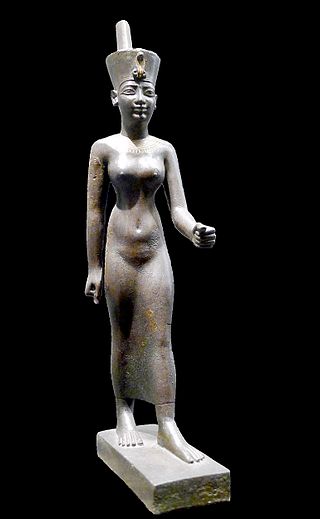
Statue of the goddess Neith
from Sais, one of the centres of
the Egyptian rebellion
The Egyptians were similarly hurt. Their rebellion against Persia was nearly ended by the defeat. The Libyan chieftain, Inaros II, who had been the main leader of the revolt, was captured by the Persians, having fled to a place called Byblos (presumably a place near Memphis rather than the more famous Byblos in Phoenicia). He was afterwards crucified or impaled on the orders of Artaxerxes I. Another leader of the rebellion, Amyrtaeus of Sais, who was an Egyptian, seems to have had more success and carried out a low-level guerrilla war against the triumphant Persians. Amyrtaeus and his remaining troops escaped the Persian retaliations by hiding in the marshes of the Nile Delta.

Arriving by land he defeated the Egyptians and their allies in a battle, and drove the Hellenes out of Memphis, and at length shut them up in the island of Prosopitis, where he besieged them for a year and six months. At last, draining the canal of its waters, which he diverted into another channel, he left their ships high and dry and joined most of the island to the mainland, and then marched over on foot and captured it. Thus the enterprise of the Hellenes came to ruin after six years of war. Of all that large host a few travelling through Libya reached Cyrene in safety, but most of them perished. And thus Egypt returned to its subjection to the King, except Amyrtaeus, the king in the marshes, whom they were unable to capture from the extent of the marsh;
Thucydides, History of the Peloponnesian War, Book I, written circa 400BC

Vase by the Hasselmann Painter
The Athenians panicked when they heard of the scale of the disaster. Their naval supremacy was now threatened and there was a real fear that the Persians would attack Greece in strength once more. Once news of the losses became known, the Athenians decided to move the treasury of the Delian League from the island of Delos in the midst of the Aegean, to Athens itself. This would protect it from any threat of the revived Persian navy, but it also meant that Athens could help itself to that money with greater ease.

It might be wondered how Athens could survive such a defeat at all. After all, Athens probably only had around 200,000 inhabitants? The exact numbers of Athenians is debateable, but I think the answer is that the soldiers and sailors who died in Egypt were from all the cities of the Delian League. Thus the actual loss of Athenian citizens was perhaps closer to 10,000 with the rest spread across the other maritime cities who made up the League. The loss in Egypt was still a heavy loss, but the loss of life from their allies and subject states perhaps explains why there were no immediate rebellions against Athenian rule.

The Athenians, under the leadership of Pericles, responded with characteristic vigour. The truce between Athens and Sparta, if it existed in the first place, was surely broken by the Spartans once they heard of the defeat that the Athenians had suffered on the Nile. There seems to have been an uprising in Thessaly against Orestes, a leader of the Thessalians and an ally of Athens. The Athenians marched northwards to restore him, but Pericles was unable to force the Thessalians to take back their exiled ruler.

Athenian funerary stele
showing a woman and a slave
With Thessaly now hostile, Pericles took the initiative and led an expedition across the Corinthian Gulf to attack the city of Sicyon. The Athenians won a victory here, but once more, seem not to have actually taken the city of Sicyon. Embarking on their ships once more, the Athenians took their Achaean allies from the north of the Peloponnese and attacked Oeniadae, on the northern shore of the Gulf of Corinth. This was a city of the Acarnanians and neighbours of the recently settled helots at Naupactus. The helots and the Acarnanians were at war, and the helots had recently taken Oeniadae, before the Acarnanians had forced them out again and retaken their city. Pericles must have hoped to aid the helots in their war, but his siege was unsuccessful.

In this year, Pericles made the position of juryman a paid position. This meant that poorer people who were too old to serve in the navy could still earn money by serving the state. It was a measure designed to strengthen the poorer classes and bolster the democracy of Athens. It was opposed by the aristocratic faction in Athens, but these had little influence. Pericles was to all intents and purposes the absolute ruler of Athens, despite it being a democracy. Pericles was an astute politician, but seems to have not been an excellent general. He was not terrible, but his campaigns led to no great victories for Athens.

Coin of Catana in Sicily
In the year 452 no great battles, sieges or campaigns took place in the First Peloponnesian War. However in Sicily, Ducetius, the leader of the Sicels, who were some of the original inhabitants of Sicily before the Greek and Phoenician colonisation, founded a city called Palice, near the sanctuary of two Sicilian gods, called the Palici. Their temple was near a lake system that emitted sulphurous fumes and held sacred significance for the Sicels. This new city was to be the capital of the Sicels and the runaway slaves from the Greek and Carthaginian cities could flee to it and be protected by Ducetius. By now the Greek cities on the coast were becoming concerned about the growth of Ducetius' power.

On the southern coast of Italy, some exiles from the defeated city of Sybaris attempted to refound the city. However, the nearby city of Croton, who had originally defeated and exiled the Sybarites, expelled them once more. It is perhaps ironic that sybarite and sybaritic, are almost synonyms for hedonist and hedonistic, yet the actual history of the city of Sybaris seems to show mostly hardship.

The Olympic Games were held this year. Lachon of Chios won the boy's stadion race. Cleodorus won the boy's wrestling. Lykos of Larissa won the stadion race, as well as winning the hoplitodromos. Euboulos won the diaulos. Hippobotus won the dolichos. Ariston of Epidaurus won the boxing. Leontiskos of Sicilian Messene won the wrestling, for the second Olympic Games in a row. Damagetos of Rhodes won the pancration. Damagetos was the son of Diagoras, a famous boxer who had won two victories at the Olympic Games, four in the Isthmian, two in the Nemean and at least one in the Pythian Games. Psaumios of Camerina owned the team of horses that won the tethrippon chariot race, while Python was the owner of the horse that won the horse race.

Ostraca showing the name of Cimon, son of Miltiades
In the year 451 Cimon of Athens returned from the ten year exile imposed by his ostracism. He seems to have made his peace with the new order within Athens and there is no record of Pericles and himself quarrelling.

The power of Pericles was undiminished and he passed a new citizenship law, restricting Athenian citizenship to those whose parents were both Athenian. This was again popular with many of the common people, who may have been concerned with wealthy foreigners arriving and becoming citizens, but there must have been some opposition to the law. There is no record of Cimon using his influence to oppose it however. Cimon must have been quite an old man at this time however.

Some believe that there was an alliance of sorts forged between Cimon and Pericles. Pericles would lead the political development of Athens, while Cimon would use his military skill to lead the Athenian armies in the field. Cimon would also use his pro-Spartan connections to foster a truce and perhaps even forge a peace with Sparta. If such an alliance truly existed it was to the benefit of the Athenians.

Coin of Acragas from around this time
Cimon brokered some sort of truce with the Spartans. The terms of this truce involved the Athenians breaking their alliance with Argos (which was of minimal use to the Athenians anyway, as Argos had not sent many soldiers to aid Athens). There was too great hostility between Argos and Sparta for there to ever be lasting peace between them. But the Argives were weak enough that they were prepared to agree to a thirty year truce between Argos and Sparta, which was close enough to a lasting peace in the tumultuous Greek world. Meanwhile Athens took advantage in the lull in hostilities to prepare their fleets to face the Persians once more, under the leadership of Cimon, their greatest general.

In Sicily, Ducetius led his army of Sicels and attacked Motyon, which was held by the Greek city of Acragas and is possibly the archaeological site currently known as Vassallaggi. This was considered to be too threatening by the Syracusans and despite having previously supported Ducetius, they now supported Acragas against the Sicels. Ducetius was undeterred however and took Motyon in despite of the Syracusans.

Athenian funerary stele of a young
girl and two doves
In the year 450 a great many things are said to have occurred. Of these many are simply placed by historians to have happened in or around this time, because it is the midpoint of the century. I shall first deal with the things that certainly happened in this year, before dealing with the things that happened around this time.

In Sicily, Ducetius, the leader of the Sicels, fought a battle with the Greek cities of Syracuse and Acragas, which were probably the two strongest Greek settlements on the island. He was defeated at a place called Nomae and his army was scattered. Fearing the wrath both of the people of Acragas and his own people, Ducetius fled to his enemies, the Syracusans, and made himself their suppliant. The Syracusans took pity on their defeated foe, who had once been their ally, and instead of killing him, sent him into exile overseas to Corinth, not to return without the permission of the Syracusans. The people of Acragas were angry that their enemy had been released unilaterally by the Syracusans, but the Syracusans refused to answer to Acragas and gave some measure of the protection to the defeated Sicels left behind.

Meanwhile in Athens, Cimon had not been idle and had raised a great fleet of 200 triremes to send against the Persians. He attacked Cyprus with his main force, but split off a fleet of 60 triremes to sail southwards to Egypt to support the faltering revolt of Amyrtaeus. The Athenians and their allies laid siege to Kition, but were unable to take the city, as siege warfare was not well developed in those days. The Persians were mustering a response to Cimon's attack and were preparing their own navy and land army.

A modern bust of Cimon in Cyprus
While the siege dragged on, Cimon died, either of a wound or sickness, or just old age, as he cannot have been a young man. A large Persian army and navy arrived on Cyprus and the Greeks abandoned the siege of Kition, retreating towards Salamis. This was not the more famous Salamis where Persia had been defeated under Xerxes, but a city named Salamis-in-Cyprus.

The Athenians were not informed of Cimon's death and were told that he was still in command and drawing up the plans of battle. The Athenian general Anaxicrates was actually in command however. The Athenians defeated the Persians on land and sea at Salamis-in-Cyprus, giving Cimon the honour of being one of the few generals to win a posthumous victory. However, the victory was a hollow one, as the Athenians had not enough men or ships to exploit their victory. Taking the body of Cimon, the expeditionary force returned to Athens, joined by the ships that had been sent to Egypt, which had also achieved very little.

Cimon was buried in Athens, but was remembered by shrines in Cyprus where he had died. In more recent times statues have been placed to honour his memory there. More than any other person he had ensured the military greatness of Athens, particularly in her wars with Persia in the aftermath of the invasion of Xerxes. He was probably the single greatest military commander that Athens ever had. His death left a void in Athenian politics and his role as leader of the aristocratic party was filled by Thucydides of Alopece, who, just to clarify, was not the more famous historian Thucydides, who would come to prominence later.

Vase by the Altamura Painter
Cimon's half-sister, and reputed lover, Elpinice, survived him by many years. She was the lover of the painter Polygnotus, but was a sharp-witted woman who used her status to continue to oppose Pericles in her own right.

This year Crates won the Comedy prize for his plays at the Great Dionysia Festival. Very little survives of his works, but there are a few fragments of his work that remain. No single play remains intact however.

Many events took place around the mid-fifth century BC and, as there is no convenient year that these can be confidently ascribed to, I shall mention them here. In the realm of the theatre, it is possible that Sophocles wrote his early play "Women of Trachis" around this time, but this is unclear. The work survives to us, but is not accounted as one of the best works of Sophocles. Some scholars place it here, others assign it to a later date.

Around this time, the Achilles Painter, the Altamura Painter (who was the brother of the Niobid Painter), the Hasselmann Painter and the Persephone Painter all flourished. These were Attic painters who painted their creations in workshops just outside the city of Athens, near the cemetery and whose art was highly valued in antiquity and which survives today in many museums around the world.

Vase by the Persephone Painter
It was around this time that the perhaps legendary lawyers and masters of rhetoric, named Corax and Tisias are said to have lived in Syracuse. Corax undertook to teach Tisias how to argue before the law. He took no fee for his instruction on the understanding that Tisias would pay him from the winnings of his first court case. Tisias was fully trained in the art of speaking and debating and Corax fully expected that he would soon become an active figure in the courts. But Tisias ended up doing nothing really and Corax was furious with him.

Corax then took him to court to get him to pay his fee, however Tisias pleaded his own case. He made the rather innovative argument that if Corax won his case then, Tisias would not pay the fee, as the teaching of Corax would be shown to be useless (as Tisias could not win his case). On the other hand if Tisias won the case, then Tisias wouldn't pay the fee (as the non-payment of the fee was what Tisias was wanting).

The story is a fun one and could lead to many imaginary debates. Corax and Tisias probably existed but nothing of their work survives and this particular story is probably false. Tisias may have been the teacher of the later orator Isocrates.

Around this time the doctor Herodicus of Selymbria flourished. He is said to have favoured exercise therapy, sometimes recommending that his patients walk the 30km to Megara from Athens. His prescriptions for healthy living were probably of minimal use to anyone who had a genuinely life-threatening ailment, but would have been of interest to the populace in general and athletes in particular. It was said that he was one of the teachers of Hippocrates, who would later become the most famous doctor of the ancient world.

Relief of Zeus and Hera from
Selinunte Temple E
The mathematician and astronomer Oenopides of Chios seems to have flourished around this time. He made some astronomical observations, primarily regarding the zodiac and the Great Year, where relative apparent orbits of the sun and the moon would repeat the same patterns after a given length of time. His calculations here were useful, but imprecise. His works in geometry seem to have been more theoretical and he was apparently the first geometer to explicitly rule out more brute-force methods of solving puzzles. Only a compass and a straight-edge could be used to truly solve a problem. Thus geometry became a more theoretical discipline, whereas it had previously been an extremely practical one. He also had certain beliefs about the nature of the universe, and was a philosopher, but little of his thought remains to us.

Another astronomer who flourished around this time was the astronomer Harpalus. Little is known about him, save that he improved on certain calculations of Cleostratus, an astronomer from two generations previous who may have been influenced by the Babylonian astronomical records.

Around this time the philosopher Melissus of Samos flourished. He came from the island of Samos but had been taught in the Magna Graecia region of Italy under the tutelage of Parmenides. He is usually treated as being part of the Eleatic school of philosophy. His philosophy is quite similar to that of Parmenides, arguing for a timeless, changeless state of Being. Like the other Eleatics, Melissus was concerned to show that the concept of change was an illusory one. He restated many of the points of Parmenides, but also spoke on how there could be no true vacuum. Thus, if there was no true vacuum, there was no empty space for Being to move to. It is an odd argument, like all of the arguments of the Eleatics, but worth considering, if only as a way of testing the mind.

Zeno's Paradox of Achilles and the Tortoise:
Even though Achilles is ten times faster, he will never
catch the tortoise
The best-remembered of the Eleatics also flourished around this time. Zeno of Elea was another of the pupils of Parmenides. As a way of protecting the very unusual doctrines of his teacher from ridicule, Zeno set out to show that our normal ways of considering change and being were equally worthy of ridicule. He created nine paradoxes, including the paradox of the moving arrow, which is in motion, but if examined at any given second appears to rest still and motionless in the air. Another of the most famous paradoxes was that of Achilles and the Tortoise. Achilles runs ten times faster than the tortoise, but the tortoise starts 10 paces ahead of Achilles. By the time Achilles has run 10 paces, the tortoise has moved 1 pace. By the time Achilles has run 1 pace, the tortoise has move 0.1 pace, etc. Thus Achilles will never catch the tortoise.

These puzzling paradoxes seem to have captivated the imagination of various philosophers and many spent time trying to disprove them. A later work by Plato suggests that these paradoxes may never have been intended for publication, but that once they were known, they could not be recalled. Zeno's Paradoxes seem obviously wrong, but without a knowledge of physics and logic it can be hard to say exactly why. In this unprovable error and puzzlement lay their enduring appeal.

In the realm of architecture around this time, the Corinthian order was invented. This was a type of column that had an elaborate capital, adorned with decorations and acanthus leaves and other decorations. This became known as the third Classical Order, along with Doric and Ionic. However it did not immediately become popular and the Doric and Ionic orders were primarily used in this period. It would become very popular some centuries later.

Site of the water clock in the Athenian Agora
In Athens, a new council house was built in the Agora. The new hero temple of Theseus, whose supposed bones had been brought back to Athens by Cimon, was also completed around this time. A water clock, known as a clepsydra, was also placed in the Agora of Athens. Water clocks had been invented centuries earlier in other cultures and were well known in the ancient world, but the Greeks were beginning to make significant improvements on the ones known in Mesopotamia and Egypt. Finally, the sacred area of Eleusis, where the Athenians held the Eleusinian Mysteries, was also rebuilt after its destruction in the Persian Wars.

In Sicily, the Temple of the Dioscuri was built in Acragas around this time. In Selinunte, the Temple E was built. Scholars are unclear as to whether this was a temple to Hera or to Aphrodite. The temple contains a number of surviving reliefs that are preserved in a museum in Palermo. The temple itself stands impressively today, but was reconstructed using the fallen material in the 1950's.

Temple of the Dioscuri in Acragas
Writing around this time, the poet Praxilla of Sicyon wrote lyric poetry. Little of her work survives, but we have some references to her work in other sources. Her work was well regarded in antiquity despite its eventual loss. She wrote about mythological subject matter, but also wrote drinking songs for symposia (drinking parties). Some have suspected that the reason she was allowed to these traditionally male-dominated events was that she was a hetaira, or a prostitute, but this is not proven at all.

Around this time the early logographers wrote. These were people who were interested in the stories of times past and who wrote down lists of times, people and places. They were concerned with genealogies and festivals, being almost like a cross between a Mesopotamian chronicler and a later Greek historian. By and large they showed no critical faculty in discerning between the mythical and the historical. They also were not overly concerned with cause and effect. But their compiled lists and tales were often used by later classical historians. They were not the first historians. They were not really historians at all. But they are an important symptom of the birth of historiography in Greece.

Hellanicus of Lesbos was one such of these. He wrote lists of the priestesses of Hera, lists of the winners of the Carnea festival, a genealogy of a mythical Peloponnesian king named Phoronis, as well as some of the earliest writings about Rome, and histories of Troy, Persia and Attica. Thucydides later notes that Hellanicus' work was not particularly good, but he seems to have been used as a source by later historians.

Selinunte Temple E
Pherecydes of Leros was another such systematiser. He wrote a history of the island of Leros and long genealogies, which sometimes contained historical information.

The logographers were not even all Greek. One such writer was Xanthus of Lydia, who wrote a history of his native Lydia, which was a lost work known as the Lydica. He also is said to have written a work about Persian religion, known as Magica, after the Persian Magi.

Ultimately almost none of what the logographers wrote has survived to the present day. But I thought that it was worth mentioning their work. Even the word logographer has fallen out of our vocabulary. Their entire enterprise has been subsumed by the discipline of history. In one sense of the word, logographers are prehistoric, the last remnants of a less critical age.

In the realm of sculpture, the Severe style, or Early Classical, can be said to end, and the Mature Classical, can be said to begin. Around this time the sculptor Polycleitus formulated the Kanon, or Canon of statuary. This defined perfection in sculpting the human body as a matter of perfect proportions and symmetry. Polyclitus defined the exact proportions that he believed best exemplified these principles.

Roman marble copy of the
Doryphoros of Polycleitus
The principles were shown in Polycleitus' work Doryphoros, meaning Spear Bearer. This was a statue that showed a relaxed male nude, standing emotionless and carrying a spear over his left shoulder. The statue was made originally in bronze and has been lost to us. But there are numerous Roman copies through which its likeness survives in marble, including one found in the buried city of Pompeii.

Another important sculpture made around this time is the Discobolus, created by the sculptor Myron. This showed an athlete in the moment of spinning with a disc in hand, instants before releasing the disc. There is motion and power in the statue, but the figure is still perfectly calm. Again, this statue did not survive antiquity, but it survives in numerous Roman marble copies.

And thus the period draws to a close, with advances being made in history, mathematics and astronomy. New poets, painters, sculptors and architects were creating art of the highest quality. Philosophy and physics were under consideration. The playwrights wrote tragedies, comedies and satyr plays, with the art of theatre reaching a recognisable form.

In the political world, Athens and Sparta had spent much of the decade at war with each other. The Athenians had generally been victorious in their wars, but Sparta had concluded the helot revolt, while Athens had suffered a grievous defeat against Persia with the failure of the Egyptian expedition. Athens was led by Pericles, who continued the trend of strengthening the democracy, and had seen the loss of Cimon, their greatest general. The Persian Wars themselves were drawing to a close, as both the Persians and the Athenians were becoming tired of the decades-long struggle. Elsewhere in the Greek world, the Syracusans had exiled Ducetius, who had threatened their hegemony with his failed attempt to create a Sicel state. It is not an often studied period of history, but there is enough here to make it worth the time to take a second glance.

Roman copy of the Discobolus of Myron
Primary Sources:
Pindar, Odes, written circa 475BC
Aeschylus, Agamemnon, written circa 458BC
Aeschylus, Libation Bearers, written circa 458BC
Aeschylus, Eumenides, written circa 458BC
Thucydides, History of the Peloponnesian War, written circa 400BC
The Parian Chronicle, written circa 216BC
Diodorus Siculus, Library of History, written circa 40BC
Vitruvius, De Architectura, Preface to Book 7, written circa 20BC
Plutarch, Life of Themistocles, written circa AD100
Plutarch, Life of Cimon, written circa AD100
Plutarch, Life of Pericles, written circa AD100
Pausanias, Description of Greece, written circa AD150
Eusebius, Preparation for the Gospel, written circa AD320

Secondary Sources:
Historical eruptions on Mount Etna
Agamemnon by Aeschylus, Part I
Agamemnon by Aeschylus, Part II

Related Blog Posts:
Greece 469-460BC
459-440BC in the Near East
459-440BC in Rome
449-440BC in Greece


Monday, 24 June 2019

469-460BC in Greece

The Bronze of Artemision
Statue of either Zeus or Poseidon
found in a shipwreck north of Euboea
This post will look at Greece and the wider Greek world from the years 469BC to 460BC. Firstly, a word about our sources. Archaeology can shed some light on this period but we are primarily reliant on written sources, such as the writings of Aeschylus, Thucydides, Diodorus Siculus, Plutarch, and Pausanias.

In the year 469BC the exiled Eurypontid Spartan king Leotychidas, who had been exiled some years previously after he had been bribed by Thessalian nobles, died in exile. Sparta was rather unusual in the ancient world for having two lines of kings, the Agiad and Eurypontid. It was actually a rather good system, as it meant that if one king was too young or too old to lead armies, then the other king could still act as a general in the field.

Meanwhile in the Aegean, the island of Naxos had had enough of the continued war against Persia. They wanted to leave the Delian League and take no more part in the war. The other members of the Delian League, particularly the Athenians, would not allow this. If a state continued to enjoy peace and freedom from invasion, then it was only fair that they should help to shoulder the cost of protection.

The navy of the Athenians and their allies sailed to Naxos to force the Naxians back into the League. The Naxians resisted but resistance was futile in the face of the combined navies of the Aegean. The Naxians were disarmed and their ships were taken from them. They were forced to remain in the League, but from now on they would only contribute tribute rather than ships.

Meanwhile to the north of Greece, the disgraced Athenian general Themistocles was still hiding at the court of Admetus, King of the Molossians. The Spartans heard that Themistocles was there and sent word to Admetus that if Themistocles was not handed over that they would march against him with the combined land armies of Greece. Admetus was furious that he would be threatened like this, but could not hope to stand against the Spartans and their allies, so he gave a large quantity of money and some guides to Themistocles and told him to disappear.

Themistocles escaped into the night, travelling only under cover of darkness across land and sea. Reputedly he was travelling in disguise on a ship that took him perilously close to the Athenian navy He seems to have stayed hidden in Persian territory for a number of years, possibly trying to gain access to funds that had been left at Argos when he fled.

According to some historians the Battle of the Eurymedon was fought this year, but the chronology here is not exact. It is possible that it was fought this year, but also possible that this happened a number of years later. I have chosen to write of it three years later, but wanted to mention it here.

The ancient Lion Gate of Mycenae
In the year 468 war seems to have broken out between the Argives and some of their tributary cities. The very ancient citadel of Mycenae lay not far from Argos. Argos claimed a position of great importance in Greece, due to her ancient fame from Homeric times, which was out of all proportion to the actual power of Argos. But in Homeric times, the citadel of Mycenae had been more important still. There was tension between the two groups because of this ancient rivalry, and this was exacerbated by the fact that the people of Mycenae had sided with the Spartans during the Persian Wars.

Argos felt that this was too dangerous to be allowed to continue and invaded the tiny state of Mycenae, besieging it, deporting its people and razing the fortifications. Thus ended the city of Mycenae, which would be only barely remembered by the end of antiquity and which would then be lost entirely until the excavation by Schliemann in the 19th century. I have recorded this event in this year, but there are certain indications that might suggest that this happened some years later. The chronology of Greece at this time is not perfectly exact unfortunately.

Around this time Aristides the Just died. He had been a dutiful servant of the Athenian people. He had served at Marathon and guarded the battlefield after the main army marched back to defend Athens from the Persian fleet. He had been ostracised for his opposition to Themistocles, but had returned to his country in its hour of need. He had commanded a detachment at the Battle of Salamis and fought valiantly there. He had commanded the Athenian forces at the Battle of Plataea, again winning renown. Finally, his justice and fair dealings had been one of the prime reasons the Greek cities preferred Athenian leadership to Spartan leadership in the continued war with Persia. Despite being trusted with the assessment of the various dues and contributions of all the states in the Aegean, he did not take bribes. It is said that his estates had been badly destroyed by the Persian invasion and that he died penniless; having to be buried at the expense of the state he had served.

Lekythos of the Oreithyia Painter
Around this time the Parian Chronicle, a chronicle composed on marble columns on the island of Paros, records that Simonides of Ceos died. Simonides had lived a long and eventful life. Very few instances of his poetry have come down to us from him, but he was very famous during his lifetime. He had spent time with the cultured tyrants of Athens before their deposition, but this didn’t affect his popularity with the Athenians. He had been asked to write the epitaphs for the Athenian war dead at Marathon and for the Three Hundred Spartans at Thermopylae.

"Oh stranger, tell the Lacedaemonians that here we lie, obedient to their laws."
Epitaph of the Three Hundred Spartans, composed by Simonides of Ceos and recorded by Herodotus

Simonides of Ceos was said to have developed a system of mnemonics. The story goes that he composed a poem in praise of a boxer in Thessaly. He embellished the poem with many references to Castor and Pollux, the heroic twin-gods of Greek mythology. The Thessalian was at a banquet and told the poet to collect half his fee from the hero-twins, as clearly the poem was half theirs as well. After receiving this insult Simonides was called outside as two people wished to speak to him. As soon as Simonides left the building, the building collapsed; the Hero-Twins had saved the poet from the catastrophe. The bodies of those inside were so mangled that Simonides was only able to identify people by where they had been sitting at the banquet table.

This is almost certainly a fictional story, but Simonides was credited with the invention of the mnemonic device known as the method of loci, or the palace of memory and it is still used to this day by those who are concerned with extending their powers of memory. Simonides was also credited with other inventions, such as improving the Greek alphabet and improving the lyre. Both of these were almost certainly not done by him, but it shows that he was remembered as an innovator. He also was concerned with ethics and was quoted by later philosophers such as Plato. Considering that he seems to have been such an interesting character, it is a shame that we have not more of his work.

A view from the seats of the Theatre of Dionyisus in Athens
The seats that remain are mostly from the Roman era however
In this year Sophocles won a prize at the Great Dionysia for a play called Triptolemos. The play was probably a tragedy, but may have been a satyr play. Sadly, it is lost to us and we are not even entirely sure of the plot.

The Olympic Games were held this year. Parmenides of Poseidonia won the stadion race. Menalkes of Opous won the boxing. Epharmostos of Opous won the wrestling competition. Agesias of Sicily won the mule-cart race. Lycophron of Athens won the boys stadion race. Epitimadas of Argos won the pancration. Hiero I of Syracuse owned the team of horses that won the tethrippon chariot race, in a victory that was celebrated by an ode of the poet Bacchylides.

In the year 467 Hiero I, the tyrant of Syracuse, died. He had ruled the city of Syracuse and the surrounding territories for eleven years. He was succeeded by his brother Thrasybulus.

Before Hiero died, he had encouraged the sons of Anaxilas of Rhegion to come to his court in Syracuse. Here they grew to adulthood while Micythus was the tyrant of Rhegion. Hiero had told the sons of Anaxilas to return to Rhegion and claim back their father’s throne from the regent. Presumably Hiero was hoping to cause a war.

The sons of Anaxilas returned and pressed their claim to the throne. Anyone who has any familiarity with the period would expect a civil war to break out, but instead Micythus promptly stepped down and handed over the treasury intact and with a full accounting of what he had spent. Unlike what Hiero had told the children, the former slave Micythus had in fact been loyal. Thus Micythus retired with wealth and honour to Tegea in the Peloponnese and Leophron the son of Anaxilas became tyrant of Rhegion and Zancle.

Some historians put the revolt of Naxos in this year, but I think that it probably happened some years previously. As I have mentioned, the chronology of the Greek world is somewhat confused around this time. We have a fair idea what happened and the decades that they happened in, but cannot always be precise in terms of years.

In Athens, Aeschylus won the Great Dionysia tragedy competition with the play Seven against Thebes. This play is set in Thebes, telling the tale of the siege of Thebes in ancient times, where two sons/brothers of Oedipus, products of his incestuous union with his mother, are fighting for the throne of Thebes, one as usurper, the other as invader of his homeland. Each brother has the aid of six champions and they fight at the mythical seven gates of Thebes. The play survives to this day, but it was probably edited in later years to make it tie in to a later play written by Sophocles. An unknown playwright named Aristias took second place.

Halley's Comet
In or around this time, plus or minus a year due to some uncertainty in the dating, a great stone fell from the heavens at Aegospotami, near the Hellespont. This fall of the stone was recorded by later Greek writers as an interesting celestial phenomenon, with some noting that a comet was seen around the time the stone fell. This may be a coincidence, or recorded wrongly, but it is also the potentially the first recorded sighting of Halley’s Comet.

In the year 466 the Persians began belatedly preparing to reconquer the Ionian cities. It is not clear why it took the Persians so long to respond to their subjects breaking free. Also remember that some scholars place this battle as occurring three years earlier. Perhaps Xerxes had been preoccupied with crushing unrest in Babylon and other parts of the empire? Perhaps he was now focused primarily on building projects and had lost all taste for war? Perhaps the Persians had lost so many troops on the Greek campaigns that they were extremely cautious about fighting again unless they were certain of victory. Persian morale must have been quite low in the western satrapies at this time.

Eventually the Persians collected a fleet and a land army at Aspendus, near the mouth of the Eurymedon River. The army was relatively strong, though nowhere near as strong as Persian armies in the past. The Persian fleet probably numbered about 200 ships.

Cimon of Athens realised that the fleet and army could have only been assembled for the re-conquest of Ionia. The fleet was probably intended to sail along the coast, closely following the army. The army would then attack each city while the navy blockaded the ports. In this way the Persians could reduce each city without facing a major naval engagement. The navy of the Delian League was now considerably stronger and more experienced that the navies of the Persians, so the land army was probably expected to do most of the work.

A modern bust of Cimon in Cyprus
To stymie the Persian advance, Cimon took 200 ships and sailed to Phaselis, which was the city closest to the western flank of the Persians. Here he besieged the city to "convince" them to become an ally of the Athenians. Eventually Phaselis surrendered to Cimon, giving the Athenians and their allies a base from which to threaten the Persians.

The Persians appear to have been waiting for reinforcements. Cimon took advantage of this to launch an attack on their base at the mouth of the River Eurymedon. The Persian fleet did not initially give battle when the Greeks appeared but eventually put out to sea to face the Greeks. This was a mistake. The Persian fleet was outmatched, presumably because their hastily organised battle order was no match for the prepared formations of the Athenian triremes. After suffering some losses the Persians tried to retreat back to the shore.

This would have been the perfect time disengage, having inflicted hurt upon the enemy. But instead of treating this as a prelude to a later engagement, Cimon made the decision to carry on the attack, following the Persians to the shore. The Persian sailors abandoned their beached ships to the Greeks and fled back towards their land forces. The Persian land forces had not been expecting to fight and were hampered by their own sailors fleeing through their lines. On the other hand they could no longer afford to wait, as the Greeks were threatening to torch the entire Persian navy as it lay beached on the shore.

The Persian land army was hastily committed and defeated by the battle-hardened Greek marines, who may have been able to use the beached triremes as bastions. The Greeks pushed forward and the Persian morale must have crumbled. Eventually the Persian land army was defeated and turned to flight. The Athenians and their allies now burned the entire Persian navy that had been beached before the battle. Some sources suggest that Cimon then searched out and sank the Phoenician reinforcements that had been en route before the battle. The victory was complete, Ionian freedom from Persia was secured, and the Greeks, in particular the Athenians, were the undisputed masters of the Aegean.

The Eurymedon Vase. The caption in Greek reads:
"I am Eurymedon. I stand bent over"
There is a vase that survives called the Eurymedon vase, where a defeated Persian solder is shown bent over, while on the other side of the vase a naked Greek soldier appears ready to forcibly have sex with the Persian archer. Exactly what the vase and its inscription mean is not precisely clear and various scholars have various opinions, but the most likely explanation is that it means the Persians were now seen as effeminate and weak. In previous decades the Persians were feared as the potential destroyers of Greece. After the Battle of the Eurymedon River, the Greeks seem to have begun to despise the Persians. In warfare it is always a dangerous thing to underestimate the enemy.

Next we come to the actions by land and by sea at the river Eurymedon, between the Athenians with their allies, and the Medes, when the Athenians won both battles on the same day under the conduct of Cimon, son of Miltiades, and captured and destroyed the whole Phoenician fleet, consisting of two hundred vessels.
Thucydides, History of the Peloponnesian War, written circa 400BC

In the city of Syracuse the tyrant Thrasybulus was struggling to maintain control. He had taken over the city when his brother Hiero I had died the previous year. However, his rule had been cruel and the citizens would put up with it no longer. Furthermore he had alienated the members of his own clan, the Deinomenids, who were unhappy that Hiero’s son had not been allowed to take the throne. Thrasybulus fled the city and gathered some mercenaries and colonists in other cities who were willing to help him. The citizens of Syracuse fought a battle with him and after facing defeat in this, Thrasybulus negotiated a surrender. The ex-tyrant would leave and live out the rest of his life in the city of Locri, while the mercenaries were allowed to leave the lands held by Syracuse. Thus democracy was re-established in Syracuse, where it lasted for some time. However, the mercenaries did not leave quietly and there were a number of battles fought between the citizens and soldiers for some time.

Vase painted by the Tarquinia Painter
The city of Taras, in southern Italy, continued its long war with the Iapygian speaking tribes (the Messapians, Apulians and Peucetians). They had suffered a heavy defeat nine years earlier. It is not clear what sparked this particular war however. The Greek colonists of Taras were heavily defeated again. They suffered such heavy casualties among their leaders that the city of Taras changed its government from an aristocratic oligarchy to a democracy. It is possible that the Pythagoreans were associated with the aristocracy, as they seem to have been expelled from the city of Taras at this time also.

Sparta may have viewed these events with some concern. The seeming invincibility of the Athenians in their continued wars with the Persians and the growth of their influence on other city states would have been concerning. The trend towards democracies was also concerning. The Spartans were no fans of the Sicilian tyrants, but they also preferred dealing with stable oligarchies instead of the participatory democracies of which Athens was the greatest example.

In the year 465 Battus IV of Cyrene died. His reign had been long and peaceful, having been on the throne for around fifty years. Not much is known of the reign save that it was peaceful and under Persian hegemony. He was succeeded by Arcesilaus IV as King of Cyrene.

Another, far more influential king passed away this year. Xerxes I of Persia, whose invasion had been so thoroughly defeated fifteen years previously, was murdered in Persia. After some internal power struggles his son Artaxerxes I took the throne of the Persian Empire later that year.

A coin of Thasos from around this time period
In the Aegean, the northern island of Thasos, famed for its gold mines, revolted from the Delian League and refused to take part any more in the ceaseless wars against Persian organised by the Athenians. The Thasians had their own navy and put to sea to defend their isle from the forces of the Athenians and their allies. Cimon led an attack on the island and inflicted a major defeat on their navy. With the navy defeated the city on the island was besieged by Cimon.

The Athenians decided that the region was a problematic one and dispatched ten thousand settlers to found a new city at Amphipolis, which lay north of Thasos on the Thracian coast. Sadly for the settlers they were not sufficiently protected by the Athenian military and they were slaughtered by the Thracians in the region.

Around this time, the exact year is unknown, some helots were fleeing from the Spartans and had come to a sanctuary, a temple of Poseidon at Taenarus, far from Sparta. The Spartans were furious with their runaway slaves and dragged them out of the temple, presumably to face torture and execution. The desecration of a temple would have put the Spartan state into a state of ritual pollution, as far as the Greek religion was concerned.

Around this time the Corinthians began to rebuild the Temple of Poseidon at Isthmia, which had burned down about five years previously. It had been one of the most ancient temples in the Greek world and it was an important temple for the Isthmian Games, one of the four Pan-Hellenic Games of Greece. So the Corinthians were clearly planning on rebuilding it spectacularly.

A later re-imagining of what the Acropolis must have looked
like. The statue of Athena Promachos is visible to the left.
The other temples of the Acropolis and the Propylaea
would not yet have been built however 
In Athens, the sculptor Phidias (or Pheidias) was planning on building a gigantic statue. This statue was known as Athena Promachos (roughly translating as "Athena the Front Fighter"). This statue was to be built on the Acropolis, standing 10 metres tall. It was probably intended as a thanksgiving to the gods after the defeat of the Persians at Eurymedon. The statue was made of bronze, took around nine years to build and was said to be so tall that ships rounding the Cape of Sounion could see it from a great distance. The statue seems to have lasted through antiquity, before being brought to Constantinople where it was eventually destroyed after the Fourth Crusade. It was almost certainly the largest statue in Athens in antiquity.

Around this time various vase painters flourished, including Hermonax, the Oreithyia Painter, the Tarquinia Painter, the Pan Painter and the Beldam Painter. While in many cases we know very little about these people, their works are some of the most vivid artistic works that survive from antiquity.

In the year 464 Cimon of Athens attacked the Chersonese (what is now the region around Gallipoli). He did not attack the Macedonians, who were suspected of aiding the Thasians in their rebellion. The siege of Thasos continued apace.

Vase painted by the Pan Painter
Meanwhile in Sparta a major earthquake happened and levelled a great part of the city of Sparta to the ground. The city of Sparta was mostly unwalled and the buildings were generally small and one-story buildings, so the damage was certainly less than it could have been. However, a considerable number of people still died.

The helots and the Messenian slaves who had been in the vicinity of Sparta seem to have seen this as a perfect opportunity to attack a weakened Sparta. Perhaps this earthquake was also seen as a punishment from Poseidon the Earth shaker for the crime of having dragged helot suppliants from his alter at Taenarus. While Archidamus II, the Eurypontid king of Sparta, was able to fight off a first assault from the helots and led his army out into the field, he was unable to quell the rebellion.

The Messenians threw off their shackles and fled to their traditional stronghold on Mount Ithome. The Spartans, disoriented by the damage to their city from the earthquake, were in no fit state to crush the rebellion and the rebellion spread. Sparta tried to fight on their own for a time but were simply unable to defeat the slave uprising without external aid. This sustained uprising became known as the Third Messenian War.

During this year a great and incredible catastrophe befell the Lacedaemonians; for great earthquakes occurred in Sparta, and as a result the houses collapsed from their foundations and more than twenty thousand Lacedaemonians perished. And since the tumbling down of the city and the falling in of the houses continued uninterruptedly over a long period, many persons were caught and crushed in the collapse of the walls and no little household property was ruined by the quake. And although they suffered this disaster because some god, as it were, was wreaking his anger upon them, it so happened that other dangers befell them at the hands of men for the following reasons. The Helots and Messenians, although enemies of the Lacedaemonians, had remained quiet up to this time, since they stood in fear of the eminent position and power of Sparta; but when they observed that the larger part of them had perished because of the earthquake, they held in contempt the survivors, who were few. Consequently they came to an agreement with each other and joined together in the war against the Lacedaemonians.
Diodorus Siculus, Library of History, Book 11, written circa 40BC

Another uprising took place this year in Egypt. An Egyptian named Inaros attempted to break free of the Persian Empire and launched a rebellion that would continue for a number of years. It is possible that this uprising was actually launched some years later. The dates, as always for this period, are a little complicated.

In this year Metrodorus of Lampsacus died. He was a philosopher from the Hellespont region of Greece. Very few of his works survived but he was said to have been a friend of the philosopher Anaxagoras and was mentioned by Plato in later years. His main contribution to thought appears to have been the reinterpretation of Homeric myths as allegories.

Jar of Three Amazons by the
Beldam Painter
The Olympic Games were held this year. Xenophon of Corinth won the stadion and also the pentathlon race. Pherias of Aegina won the boys wrestling, while Pythagoras of Mantineia won the boys stadion and Protolaus of Mantineia won the boys boxing. Diagoras of Rhodes won the boxing. Ergoteles of Himera won the dolichos. Echecratidas of Thessaly won the horse race (owned the horses). Ephotion of Mainalos won the pancration. Cratisthenes of Cyrene won the tethrippon chariot race (or more specifically, owned the team of horses that won).

In 463 the citizens of Thasos were forced to surrender to the Athenians after a two-year siege. They were forced back into the League. Presumably after this rebellion they were disarmed and forced to make their contributions in money only. The fact that the Athenians were shouldering so much of the burden of the wars and that other states generally preferred to give money instead, meant that when a state rebelled against Athens, that they had no experienced navy to fall back upon, whereas the Athenians only became more practiced in war. The Delian League is a modern term. In ancient times people would probably have used the phrase, "Athens and its allies". But modern historians also begin to refer to it as the "Athenian Empire" around this time. There was no longer any real threat from Persia and yet Athens kept the fleets and contributions of their allies to more and more serve the needs of Athens.

This year Cimon faced an ostracism attempt. Cimon was an aristocrat and favoured the aristocrats, as well as favouring a peace with Sparta. He was opposed by Ephialtes, a politician who favoured the causes of the poorer classes of society and who seems to have wanted war with Sparta. Just to clarify, Ephialtes had no relation to the Ephialtes of Trachis, who is said to have aided the Persians at Thermopylae. Aiding Ephialtes was his young protégé, Pericles.

The exact charge brought against Cimon was that he had taken bribes not to attack the Macedonians during the siege of Thasos, as the Macedonians were held to have covertly aided the Thasian rebellion. Cimon survived the ostracism attempt however.

A coin of Themistocles. The picture is potentially a portrait
Around this time Themistocles made his way to the court of Artaxerxes I, the new king of Persia. He was received well and treated almost as a celebrity. Artaxerxes would not try and restore him to Athens, but he did make Themistocles the ruler of the province of Magnesia. Themistocles went to his assigned province and ruled Magnesia, minting coins and founding a dynasty of Greek rulers serving Persian kings. Themistocles’ coins show various portraits on them and it is possible that these are some of the first coins to show a portrait of the ruler. This is speculative, but possible. Meanwhile it must have been deeply ironic to see the victor of Salamis becoming a provincial governor for Persia.

In the year 462 Sparta was still struggling with the helot revolt that had its heart at the rebel base on Mount Ithome. Sparta appealed to all her allies to bring sufficient troops to help crush this dangerous rebellion. Many of the Spartan allies, such as Corinth, sent troops. The Athenians also sent a large contingent of 4,000 hoplites. This was not a giant force, but was probably a substantial percentage of the trained hoplites in the city. They were led by Cimon, who was not only the greatest general in Athens at the time, but also a general who knew, feared, and admired Spartan strength in war. Ephialtes had not wanted to send any help at all, but Cimon knew that Athens and Sparta were still nominally allies and felt it would not be right to abandon an ally in need.

However, once the Athenians had actually arrived in Messenia, the Spartans became worried that this Athenian force had come with ill intentions and that the Athenians would wait for the opportune moment before joining forces with the Messenian helot rebels on the mountain to attack Sparta. Fearing betrayal, the Spartans dismissed the Athenian forces as untrustworthy. The Athenian forces returned to Athens where an uproar ensued. Cimon lost all popularity; being seen as a mere lapdog of the Spartans.

The Spartans accordingly dismissed the Athenians alone of the allies, without declaring their suspicions, but merely saying that they had now no need of them. But the Athenians, aware that their dismissal did not proceed from the more honourable reason of the two, but from suspicions which had been conceived, went away deeply offended, and conscious of having done nothing to merit such treatment from the Lacedaemonians; and the instant that they returned home they broke off the alliance which had been made against the Mede, and allied themselves with Sparta's enemy Argos; each of the contracting parties taking the same oaths and making the same alliance with the Thessalians.
Thucydides, History of the Peloponnesian War, written circa 400BC

There were rumours that Sparta had considered aiding Thasos in their rebellion previously. Athenians believed that Spartans were trying to undermine them in all things and many spoke of war against Sparta, particularly from within the party of Ephialtes.

View from the hill of the Areopagus looking
northwards towards the Agora and Athens
Ephialtes took advantage of this decline in the popularity of Cimon to prosecute members of the Areopagus, which was a type of aristocratic court that sat on a hill near the Acropolis, for corruption. The powers of this bastion of the aristocracy were severely reduced.

Around this time the philosopher Anaxagoras, who was interested in investigating the physical nature of the world, came to Athens. Athens at this time was like a candle and the philosophers, poets and thinkers of the world were like moths gathering towards the flame. While in Athens, Anaxagoras made a friendship with Pericles, the young up and coming protégé of Ephialtes.

In the year 461 it seems that Athens and Persia finally began to consider making peace. Callias II, the Athenian nobleman who was said to have stolen a load of Persian gold at the Battle of Marathon, was sent by the Athenians to Susa to act as an ambassador to the Persian king Artaxerxes I. However no treaty came of it and it is possible that his mission there was not explicitly to make peace.

Athens did however make an alliance with Argos. There were other alliances with the Thessalian cities, which gave the Athenians access to the best cavalry troops in Greece. The Thessalian alliance also allowed the Athenians to threaten their enemy Thebes from the northern flank if the two cities ever went to war.

In southern Italy, the tyrant Leophron, who had taken back the cities of Rhegion and Messana from Micythus, found that the citizens were rebelling against him. Both he and his brother were expelled from the region and the cities became democracies. It is unknown where Leophron and his brother went next. Tyrants do seem to have become most unpopular in Italy and Sicily during this time.

Ostraca with the name of Cimon, son of Miltiades, inscribed
upon it
In Athens, Cimon was ostracised following the debacle of his attempt to aid Sparta in her war against the helots. Cimon had won victory after victory for Athens, but as we have seen, this was never a sufficient guarantee of safety.

Ephialtes and Pericles had been prosecuting the members of the Areopagus for corruption. Now they reformed it entirely, with nearly all of the power now resting with the Ekklesia (the Assembly) and the law courts. An alliance was made with the Argives, who were the traditional enemies of Sparta. Ephialtes was at the height of his career and was almost unopposed in Athens when suddenly he was murdered. His killers did not even bother to hide the body.

His murderer was never found. As with any political murder, conspiracies arose. The obvious blame lay with his enemies. The aristocratic faction had just lost Cimon to the machinations of Ephialtes, who had ostracised their leader. They doubtless hated Ephialtes and wished him dead. Revenge formed a clear motive for the aristocrats to murder Ephialtes. But things are not always so simple.

Ephialtes was not always a popular politician, even with his own party. Perhaps others felt that Ephialtes was dangerous or that a better politician could be found to lead the party. It is certain that Pericles stepped forward to lead Athens, in an almost uncontested fashion, after the murder of Ephialtes. But this does not necessarily mean that Pericles ordered the murder either.

Ostraca with the name of Cimon, son of Miltiades, inscribed 
upon it
Later writers suggest that the murderer (or one of them) was a man known as Aristodikos of Tanagra. Presuming this is true, it does not solve the mystery. Aristodikos seems to have some involvement with the aristocratic party, but was also an ally of Pericles. Perhaps Ephialtes was slain for some entirely unrelated reason? We will probably never fully know. It must be said that murders such as this one very seldom happened in Athenian politics. Politics was a brutal game, but compared to the murders and assassinations of other republics and democracies, Athenian democracy preserved a general civility; usually.

The year 460 was a very busy year and many things happened. In Egypt, the revolt of Inaros II, a Libyan chieftain who ruled some portion of the Nile Delta region, was still ongoing. Achaemenes, who was the Persian satrap of Egypt and a brother of Xerxes I, had gathered a large army to fight it. The Athenians sent a large force of 200 ships to aid the rebellion. The Athenians made contact with the Egyptians and together they set out to confront the Persian garrison. The two armies clashed in what is known as the Battle of Pampremis and, after a sharp struggle, the Persians were routed. Achaemenes was slain in the rout.

However the victory was not fully complete. A section of the Persian garrison fled to a fortified section of Memphis called the White Castle and they could not be removed from this position. They had ample supplies and enough troops to disrupt the whole region of Lower Egypt. So the Athenians and their Egyptian allies settled down for a siege of this fortress.

Amphora by the Niobid Painter
showing a musical scene
Meanwhile Inaros, son of Psammetichus, a Libyan king of the Libyans on the Egyptian border, having his headquarters at Marea, the town above Pharos, caused a revolt of almost the whole of Egypt from King Artaxerxes and, placing himself at its head, invited the Athenians to his assistance. Abandoning a Cyprian expedition upon which they happened to be engaged with two hundred ships of their own and their allies, they arrived in Egypt and sailed from the sea into the Nile, and making themselves masters of the river and two-thirds of Memphis, addressed themselves to the attack of the remaining third, which is called White Castle. Within it were Persians and Medes who had taken refuge there, and Egyptians who had not joined the rebellion.
Thucydides, History of the Peloponnesian War, written circa 400BC

It was around this time that King Teres I organised the Thracian tribes into something resembling a single state. This was known as the Kingdom of Odrysia and would be a significant power in the region for around a century to come.

In Sicily, the Greeks had to deal with native resistance in a manner that they had not faced in many decades. Sicily was named after the Sicel people who inhabited the interior, however, the Greeks and Carthaginians had set up so many cities along the coast and into the interior that the lands of the Sicels were being encroached on and the Sicels were in fact in danger of being absorbed. A native leader arose called Ducetius who seems to have been familiar with Greek methods of fighting and Greek customs.

Syracuse and Catana were at war. Catana had taken some land from the Sicel people so Ducetius organised an army of the Sicels and joined the war on the side of Syracuse. Catana was defeated and Ducetius was given thanks by the people of Syracuse. Ducetius then founded a city on the land that the city of Catana had taken (modern Mineo) and occupied other land in the vicinity. The Syracusans became worried that Ducetius might turn the Sicel army against themselves and the friendship between the two groups became strained.

Crater by the Niobid Painter showing a battle
with the centaurs
In Magnesia, in Asia Minor, Themistocles died. He was now the Persian governor of Magnesia and lived a comfortable lifestyle there. It is not clear if he ever led troops against the Athenians and the Delian League on his borders, or if they ever ventured inland to attack him. Some authors record that Themistocles was ordered by Artaxerxes to lead a third invasion of Greece and that Themistocles killed himself by drinking bull’s blood to prevent this. This is merely a tale. There is a rather more plausible tale told that in later days his ashes were brought back to Athens and he was interred on Athenian soil. This I could believe. His son Archeptolis seems to have travelled to Susa to be granted the lands granted to his father. In later years he too ruled Magnesia.

Megara had a border dispute with Corinth and after coming off the worse with their larger neighbour, the Megarians appealed to Sparta. Sparta was however concerned about alienating the Corinthians and stayed out of the war. Furious with the Spartan refusal to help, the Megarians went to nearby Athens and appealed to them to aid them against the Corinthians. The Corinthians and Athenians had previously got on quite well (Corinth had aided Athens in previous wars with Aegina) so the Corinthians were horrified when the Athenians made an alliance with Megara.

Megara lay on the Isthmus, to the east of Corinth, and the Athenians sent troops and citizens to build Long Walls, that stretched down and connected the city of Megara to its port. This meant that Megara could hold out against a siege and that the Athenian navy could sail to the port and reinforce the city at leisure. They also began to build a wall across the Isthmus, which would fence in the Corinthians, and the Spartans, in the Peloponnese. This development was viewed with great alarm in Sparta and Corinth had become an implacable enemy of Athens.

The Artemision Bronze
Statue of either Zeus or Poseidon
found in a shipwreck north of Euboea
The most significant event this year however was the outbreak of war between Athens and Sparta. This war is sometimes called the First Peloponnesian War. Both sides started the war with very serious handicaps. The Spartans were locked in a struggle with the helots that was far from over. They had confined the resistance to Mount Ithome, but were unable to drive the helots from the heights. Meanwhile the Athenians had committed two hundred ships and thousands of soldiers to their war in Egypt, assisting in the revolt of Inaros. As a result of the two sides being heavily committed, both were slow to actually go to war with each other and no battles were fought this year.

The Argives and the Athenians did possibly inflict a small defeat on the Spartans at a place called Oenoe, but no details of the battle survive. It is possible that no battle in fact took place and that later sources are confused.

The comic writer Epicharmus of Kos died around this time. He lived in Syracuse and composed comic plays, which is a sure sign that the dramatic tradition existed outside of Athens at this time. A few fragments of his works survive, but no complete plays. He also wrote on philosophical themes and on morality. In this he may have had an influence on later thinkers such as Plato, but this is not certain.

Around this time a physician by the name of Aegimus lived and practiced his art in the Greek city states of Italy. We know very little about him, but we do know that he wrote a treatise on the beating of the heart, although we do not know what exactly he said.

In architecture, the second Temple of Hera was built at Paestum, in what is now Campania (right beside an earlier Temple of Hera). This is one of the best preserved temples from antiquity and its outer sections still stand today (although the roof has long since collapsed). It is sometimes referred to as the Temple of Neptune/Poseidon, but this is not in fact the case. The lines of the temple are curved, so as to make the proportions more harmonious to a viewer on the ground.

The Temple of Hera Lacinia in Acragas
The Temple of Hera Lacinia in Acragas was also built around this time. It was later damaged in a fire and although it was restored, it has not survived intact to the present day. It is part of what is now known as Valle dei Templi in Agrigento (Valley of the Temples).

In this year, the playwright Aristias won the tragedy prize in Athens. The Olympics were also held this year. Alcmedon of Aegina won the boys wrestling. Sostratos of Pellene won the boys stadion. Kyniskos of Mantineia won the boys boxing. Ladas of Argos won the dolichos. Timodemos of Athens won the pancration competition. Amesinas of Barca won the wrestling. King Arcesilaus IV of Cyrene owned the team of horses that won the tethrippon. The poet Pindar celebrated this win in an ode where he urged the king to be reconciled to his enemies. It does not seem that the king listened to him.

Even the dead have their share when paid them with due rites, and the grace of kinsmen's honour the dust does not conceal. From Hermes' daughter Fame shall Iphion hear and tell to Kallimachos this lustre of Olympic glory, which Zeus hath granted to this house. Honour upon honour may he vouchsafe unto it, and shield it from sore disease. I pray that for the share of glory fallen to them he raise against them no contrary discontent, but granting them a life unharmed may glorify them and their commonwealth.
Olympian Ode of Pindar, celebrating the win of Alcmedon of Aegina in the boy’s wrestling competition. 

The Niobid Krater, by the Niobid Painter
In the visual arts, the Niobid Painter and Penthesilea Painter flourished. The Niobid Painter is famed for painting a beautiful vase with Niobe weeping for her slain children on one side of the vase, and soldiers preparing for battle while standing at a shrine of Heracles on the other. It is thought that the soldiers may be depictions of Athenians preparing for the Battle of Marathon. The vase is currently held in the Louvre.

Around this time the painters Polygnotus, Micon and Panaenus were engaged in painting the Stoa Poikile in the Agora of Athens. Micon painted the Amazonomachy (presumably Theseus fighting the Amazons), Polygnotus painted the Fall of Troy and Panaenus painted the Battle of Marathon. A later Greek writer describes this painting in great detail and it can be reconstructed to a certain extent. Another painting may have been added later, showing the Athenian victory over the Spartans at Oenoe, but this is conjectural.

Finally, one of the most spectacular bronze works of the Classical world was created around this time: The Artemision Bronze. This was a statue of either Poseidon or Zeus (probably Zeus). The god is about to either cast the thunderbolt or stab with a trident. The statue was recovered from a shipwreck. The object in its hand is missing, as are the eyes of the statue, which must have originally been inland. Like the works of its era, the statue is perfectly created from a technical perspective, but also is perfectly calm, as if one can hurl the lightning unperturbed. It resides today in the National Archaeological Museum in Athens.

Thus the period draws to a close. It is not often studied, because the chronology is not perfect. But this period saw the city states of Athens and Sparta move from friendly allies who fought the Persians to enemies who viewed each other as existential threats. The period also saw the continued flowering of Greek painting, architecture, sculpture, drama and a host of other cultural achievements.


The second Temple of Hera at Paestum
Primary Sources:
Pindar, Odes, written circa 475BC
Thucydides, History of the Peloponnesian War, written circa 400BC
The Parian Chronicle, written circa 216BC
Diodorus Siculus, Library of History, written circa 40BC
Plutarch, Life of Aristides, written circa AD100
Plutarch, Themistocles, written circa AD100
Pausanias, Description of Greece, written circa AD150

Secondary Sources:
Historical eruptions on Mount Etna
A scholarly article on whether or not the Battle of Oenoe took place

Related Blog Posts:
479-470BC in Greece
479-460BC in the Near East
479-460BC in Rome
459-450BC in Greece

Reconstructed painting from the Stoa Poikile showing the Battle of Marathon
Reconstructed using the writings of Pausanias