|
| Panathenaic Vase painted by the Eucharides Painter |
This post will look at Greece and the wider Greek world from the years 489BC to 480BC. Firstly a word about our sources. Archaeology can shed some light on this period, but for this time in particular we are indebted to Herodotus' "Histories", the earliest book of history to have come down to us. Other sources, such as Aeschylus, Thucydides, Plutarch, Pausanias and others will be of interest, but the main story told here is taken from Herodotus and the other writers that we mention will generally follow the story told by Herodotus.
Near the site of the Battle of Marathon lies the Attic deme of Rhamnous. This was most famous in antiquity for the Temple of Nemesis that stood there. Nemesis was an avenging Greek deity who would pursue those whose fortune or hubris propelled them to untold heights. "
Hubris" was when human arrogance grew too great and when man forgot that they were but mortal. "
Nemesis" was to restore the balance of the world and cast down any who, like Icarus, flew too high. She was given the name "
Adrasteia", meaning The Inescapable One.
 |
| Ruins at the deme of Rhamnous |
When the Persian camp was captured the Athenians were said to have found a large piece of marble that was intended for a Persian victory column after their destruction of Athens. This stone was dedicated to the goddess Nemesis and would later be carved into a renowned statue of the goddess, which was ironic. The goddess Nemesis seems to have had her eye on Miltiades.
In the beginning of 489BC Miltiades was the most fortunate man in Athens. He was the general most responsible for the most famous victory that Athens had yet won. He had led an army against the largest and most powerful empire in the world and triumphed. The people of Athens urged him to lead them onwards. Miltiades took the relatively small Athenian navy and army and led an attack on the island of Paros. This was seen as a continuation of the war against the Persians, as the Parians had submitted to Persian rule when Datis and Artaphrenes had sailed through the Aegean in the previous year. However, it soon became common knowledge that Miltiades had a personal grudge against the citizens of Paros and seemed to be wasting the lives of the Athenians to satisfy a purely personal feud.
 |
| A later Roman bust of Miltiades |
What happened next is unclear and Herodotus tells an elaborate tale, but makes it clear that there were several versions of what happened. The result of the expedition was that the Athenian siege of Paros achieved nothing and that the Athenians sailed home. Miltiades had received a serious leg injury and was possibly fatally wounded. It is not recorded how many other casualties there were, if any.
The Athenian populace changed from adoration to fury and put Miltiades on trial for his life. Miltiades was in such pain that although he was present at the court, he was unable to give his defence speech and had to rely on his friends to defend him. He was found guilty of treason and sentenced to death. The death sentence was then changed to a fine of fifty talents, about 1,290 kilograms of silver.
Miltiades was thrown into prison until his fine could be paid. Here he died from an infection in his wounded leg. His son, Cimon, would later pay his fine to Athens. Miltiades had won a stunning victory for Athens, one that will be remembered for as long as humans study history, but he died a year later in prison. Nemesis was not kind to Miltiades, nor was Athens kind to those who gave her victories.
 |
| The Funeral of Miltiades, a later painting by Peyron, AD1782 |
The Athenians had much to say about Miltiades on his return from Paros, especially Xanthippus son of Ariphron, who prosecuted Miltiades before the people for deceiving the Athenians and called for the death penalty. Miltiades was present but could not speak in his own defence, since his thigh was festering; he was laid before the court on a couch, and his friends spoke for him, often mentioning the fight at Marathon and the conquest of Lemnos: how Miltiades had punished the Pelasgians and taken Lemnos, delivering it to the Athenians. The people took his side as far as not condemning him to death, but they fined him fifty talents for his wrongdoing. Miltiades later died of gangrene and rot in his thigh, and the fifty talents were paid by his son Cimon.
Herodotus' Histories, 6.136, written circa 440BC
In the year 488 Theron became tyrant of the city of Acragas in Sicily (also known as Agrigentum, or in modern times, Agrigento). According to Polyaenus he was given public money for a building project, which he promptly spent on hiring bodyguards and took over the city. He quickly became an ally of Gelo, who was the tyrant of Gela. These two ambitious men, in charge of two important cities, made it unlikely that Sicily would have peace in the coming years.
In this year the Olympic Games were held. Astylos of Croton won both the stadion and the diaulos races. Diognetos of Crete won the prize for boxing. Euthykes of Locroi won the pentathlon. Hippokleas of Pelinna won an unspecified track event. Asopichos of Orchomenos won the boys' stadion race, while Agiadas of Elis won the boys' boxing. Gelo, the tyrant of Gela in Sicily, owned the horses that won the tethrippon (chariot race).
 |
| Temple of Aphaia at Aegina |
Around the year 487 war broke out once more between Athens and Aegina. Herodotus describes a conflict that occurred perhaps three years earlier, but it is possible that this war had been happening for some time and that Herodotus merely records it there. Herodotus mostly records an Athenian version of the wars of this time period, and later generations of Athens did not have any interest in describing this particular war. But Athens was fighting a wealthy state with a large navy and the war did not go well for Athens in the initial stages.
During this time as well the constitution of Athens underwent some minor changes. It of course remained a democracy, but the power of some of the Archons were reduced. There were three archons, the Eponymous Archon, the Polemarch and the Archon Basileus. The Eponymous Archon had the year named after him, for example, Anchises was the Eponymous Archon for the year 487 (although not precisely, as the Greek year did not exactly overlap our own). The Polemarch had been the chief general, but this office was reduced in function and a class of rank, known as generals or strategoi, were instituted. This was perhaps because of the requirements of the war with Aegina or to prevent a repeat of the problems with Miltiades. The Archon Basileus was a religious functionary who no longer had any real power. The Eponymous Archons were now chosen by lot from among the citizenry, but the strategoi were elected, as commanding in war was too important to leave to chance.
 |
| Ostraca with the names of those voted for exile |
Also in this, and possibly connected with the constitutional reforms, was the ostracism of Hipparchus. Ostracism was a mechanism where the state could defend itself against those who were too powerful or dangerous, even if they had not actually committed a crime. The citizens would be asked if they wished for an ostracism to take place. If the citizens answered "
Yes" in the Assembly on Pnyx Hill, then the ostracism would take place two months later (the delay was to stop citizens exiling people in a fit of anger at recent events). After the two months the citizens would gather and each citizen, if they wanted to exile someone, would write a name on a potsherd (as paper or papyrus was not easily available). The Greek word for shard of pottery is "
ostraca", hence the word ostracism. Ostracism could only be used once per year and many years it was not used at all.
 |
| Ostraca with the name of Xanthippus upon it |
Sources differ on how many votes were needed to ostracise someone. Perhaps it took 6000 potsherds with a single name on it to exile someone, perhaps it merely took 6000 potsherds to be cast in total and then the name with the most counts on it would be exiled. I think the latter possibility is more likely. Candidates would canvass the people, trying to appeal to the people to vote for someone else, and the major political figures and groups tried to manipulate the votes in various ways, perhaps banding together to ensure that their favoured enemy was voted out, rather than having their supporters voting for multiple opponents and splitting their vote. After the vote, the ostracised had ten days to leave the city and faced death if they returned. However their property was untouched and they could return with no penalty once the ten years of ostracism had passed.
In this year Hipparchus was ostracised. It is not entirely clear why, and we know very little about this person. He seems to have been related to the family of the former tyrants, the Peisistratids, and this was probably enough to secure his exile. Perhaps it was thought that he was involved in the signalling of the Persian fleet at Marathon, but this is pure speculation on my part.
In 486 Chionides probably won the prize for Comedy at the Great Dionysia festival in Athens. Sadly we know very little about this playwright and only small fragments of this author survive, quoted in other later works.
 |
| Xerxes I of Persia |
Also in this year Darius I of Persia died. He had been gathering an army to avenge the defeat at Marathon, but these plans were interrupted by his death and by rebellions elsewhere in the empire. His son Xerxes I succeeded him.
In the year 485 some Syracusan aristocrats who had been expelled from the city of Syracuse appealed to Gela, the tyrant of Gelo, for aid in their restoration. Gela accepted their request, mustered his army and marched to Syracuse with the exiles. He took the city and reinstated the exile, but then took up the opportunity to install himself as tyrant of Syracuse. He left his brother Hiero in charge of the city of Gela, but moved a large number of citizens around between the two cities, to break up existing bonds of loyalty. Gelo was now also an ally of Theron of Acragas and the three tyrants, Gelo, Theron and Hiero now formed a power bloc in Sicily.
Around this time the lyric poet Anacreon died. He had lived to a great age and had seen the Persian conquest of Ionia and the flight of his native city from Ionia to Thrace, where they had been subjugated once more by the Persians. He had been a friend of Polycrates, the liberal tyrant of Samos, and a friend of Hipparchus, the cultured tyrant's brother who had been assassinated by Harmodius and Aristogeiton. After the death of Polycrates and the assassination of Hipparchus, Anacreon had returned to his native Teos in his old age and died there.
Also around this time, the Antiphon Painter, Eucharides Painter, Kleophrades Painter and Makron were active. These were all vase painters, who painted in the red-figure style and whose works have survived down to the present day and can still be seen in museums around the world.
 |
| Later bust of Anacreon |
Around the year 484 the comic playwright Epicharmus flourished. It is unclear exactly where he was from, but it was probably in Sicily. He spent time at the court of Gelo in Syracuse and wrote a great number of comedies, none of which survive to this day in anything other than sparse fragments. We know that he took the Homeric gods and heroes and made fun of them, showing them as flawed braggarts or other comic stereotypes. His plays have not survived, but as well as his comic plays he is said to have written many quasi-philosophical pieces, which were later held in high esteem. Like Hecataeus, Epicharmus is perhaps part of the emerging trend of rationalism in Greek thought.
In Athens, Xanthippus was ostracised. Xanthippus was a wealthy politician and had married into the Alcmaeonid clan. He was a political rival of the ambitious Themistocles. This rivalry was apparently sufficient for the supporters of Themistocles to band together and determine on his banishment through ostracism.
In this year Aeschylus is said to have won first prize in the Tragedy competition at the Great Dioynsia festival in Athens. The play that he won with has sadly not survived.
The Olympics were also held this year. Astylos of Croton won both the stadion and diaulos races for the second time. Mnaseas of Cyrene won the hoplitodromos race. Euthymos of Locri won the boxing. Theopompus of Heraia won the pentathlon. Dromeus of Stymphalia won the dolichos (long-distance race). Telemachus of Pharsalus won the wrestling. Agias of Pharsalus won the Pancration. Epikradius of Mantineia won the boys' boxing. Polypeithes of Sparta owned the team of horses that won the tethrippon, or chariot race.
 |
One of the endings of the Xerxes Canal through the isthmus
at Mount Athos |
In the year 483 King Xerxes of Persia continued his father's preparations for a war with Greece. However, revolts in Babylonia and Egypt had occupied much of the Persian military for the previous years so the preparations were still far from complete. Because the Persians had suffered a naval disaster rounding the cape near Mount Athos, the Persians decided to cut a channel through the isthmus there, thus allowing their ships to bypass the cape. It is hard not to think that this was for superstitious reasons, as the cape was not necessarily any worse for shipwrecks than any other rocky promontory in the Aegean. Phoenician and Egyptian engineers and work crews were dispatched to the peninsula to cut through, with Bubares and Artachaies as Persian overseers of the labour force. Bubares was married to the sister of Alexander I, king of Macedon, and so was familiar with the territory. He also seems to have been a competent overseer.
The canal was known as the Xerxes Canal and it took around three years to complete. It was wide enough for two triremes to sail abreast and Herodotus records that the Phoenicians had the most success in building their section of the canal. When the fleet of Xerxes arrived in the region they would be able to bypass Mt Athos, although it seems a huge amount of overkill for such a small safety measure. The remains of the Canal still exist today, but it has long ago silted up and it is no longer clear from the ground level where the canal was. If it was a useful canal it would have been maintained by later generations, but the fact that it silted up almost immediately meant that it probably had no intrinsic use and was mainly a vanity project or undertaken for religious reasons.
 |
Ancient mine-workings at the mines
of Laurion |
Preparations such as the digging of a new canal could not be hidden. The Greeks, particularly the Athenians, must have known that war with Persia was coming. Themistocles was now one of the most prominent political figures in Athens and he believed that the destiny of Athens lay in naval dominance. Athens still seems to have been in conflict with neighbouring Aegina, although little is known of the war. Faced with the nearby conflict with Aegina and the looming war with Persia, Themistocles was keen to build up the fleet. In this year a large bonanza was gained from the discovery of a new vein of silver in the mines at Laurion, to the south of Athens near Cape Sunium.
These mines were owned by the city of Athens, but the contract for working these mines would be sold off to the highest bidders. Thus the wealthy aristocrats would bid for the right to work the mines, giving the state a certain percentage of the profit. Most of the slave workforce of Athens was at work in these mines and the underground mining was the most dangerous work undertaken by slaves. The new underground vein was extremely rich and the city found itself around 100 talents richer than it had thought. Many wanted to distribute the money out among the citizens, but Themistocles persuaded them to instead invest the money into building 200 triremes. This would give Athens the largest fleet in Greece and make them a force to be reckoned with against the Persian navy in future wars. More immediately it would almost guarantee victory against Aegina in their current war with that island city-state. The Athenians agreed and the triremes began to be laid down and the crews trained.
 |
| Coin of Himera dating from circa 490BC |
Far to the west in Sicily, Gelo, tyrant of Syracuse, conquered Megara Hyblaea, sold the majority of the citizens into slavery and settled the rest at Syracuse. As Megara Hyblaea had been near to Syracuse the conquest of this city ended a regional rivalry and helped make Syracuse the most important of all the Sicilian cities. Because the island of Sicily had been settled by Dorians and Ionians, there seems to have been an Ionian/Dorian rivalry on the island that was more pronounced than elsewhere in Greece. The Dorians prided themselves on being the most martial of all the Greek tribes, and looked down on the Ionians as being the weakest. The rivalry between Ionians and Dorians was perhaps most prominent in Sicily and the cities of Gela, Acragas and Syracuse were all Dorian cities. Other cities on Sicily or in the south of Italy were Ionian, or from other non-Dorian tribes, such as Rhegion, Messana, Leontini or Himera.
Partly because of this rivalry and partly just from a desire for expansion, Theron of Acragas launched an attack on Terillus, the tyrant of Himera. Himera was on the northern coast of Sicily and very near Carthaginian allied cities in the west of the island. Terillus had thus been allied to Anaxilus of Rhegion, at the toe of Italy, but also to the Carthaginians. The expulsion of Terillus and the alliance of Theron, Hiero and Gelo was seen as too much of a threat to the Carthaginians.
 |
| Coin of Acragas, dating from circa 480BC |
The Carthaginians began preparations for an invasion of Sicily to regain Himera, but did not yet attack. As the Carthaginian armies were mostly mercenaries it may have taken them some time to gather the funds and then to gather their soldiers. As they would have been aware that a Persian invasion of Greece was likely, it is also possible that they were waiting for this invasion to begin, to prevent reinforcements from Greek states, such as Corinth, reaching the tyrants of Syracuse, Gela and Acragas.
In the year 482 Aristides the Just was ostracised in Athens. He was an aristocratic general and politician who was renowned for his utter trustworthiness and incorruptible nature. He had been a general at Marathon and been placed in charge of guarding the battlefield while Miltiades had led the rest of the troops back to Athens. He was an opponent of the more populist politician Themistocles. He did not believe in the new naval ideas of Themistocles and favoured the old aristocratic land-warfare policy. Naval warfare was more popular with the more extreme democrats, as all citizens could serve as rowers, whereas a certain amount of wealth was needed to be able to afford hoplite armour. Because of Themistocles' insistence on the importance of the new navy and Aristides resistance to it, Aristides was ostracised.
 |
Ostraca with the name of Aristides upon it, perhaps
even written by himself |
It is reported that an illiterate clownish fellow, giving Aristides his potsherd, supposing him a common citizen, begged him to write "Aristides" upon it; and he being surprised and asking if Aristides had ever done him any injury, "None at all," said he, "neither know I the man; but I am tired of hearing him everywhere called the Just." Aristides, hearing this, is said to have made no reply, but returned the sherd with his own name inscribed. At his departure from the city, lifting up his hands to heaven, he made a prayer, (the reverse, it would seem, of that of Achilles,) that the Athenians might never have any occasion which should constrain them to remember Aristides.
Plutarch, Life of Aristides, written circa AD100
 |
| Kylix painted by the Antiphon Painter |
Around the year 481 Douris, the Foundry Painter, the Triptolemus Painter and the Theseus Painter were active. These were vase painters who were doubtless active for many years before and after this date, but if one was to pick a mid-date for their careers it would be around this year. The Theseus Painter was one of the last vase painters to continue the now old-fashioned black-figure painting style, while the other vase painters were creating in the red-figure tradition.
Around this time the sceptical philosopher Xenophanes of Colophon died. The date is not exact, but it is likely to have been around this time period. I have mentioned his scepticism about the nature of gods in a previous post.
 |
| Kylix painted by the Foundry Painter |
Alcmaeon of Croton was active around this time. He was not a doctor in the modern sense, but is one of the first anatomists. He is said to have dissected bodies and discovered important parts of the human anatomy, but it is not clear if the dissected bodies were in fact human bodies or animals. He is associated with the Pythagoreans, but may not have been one in any sense. Croton was an important city in southern Italy and culturally significant, producing thinkers, generals and athletes.
In one unfortunate turn of events, Alcmaeon is said to have been the first physician in the West to come up with the idea of health being a balance of the humours. This pernicious idea would ruin much of western medicine up until the modern age. Alcmaeon was wrong in this of course, but he showed an open and enquiring mind in coming up with the theory. The fault lay with later practitioners of the art for not correcting him.
 |
| Kritios Boy sculpture |
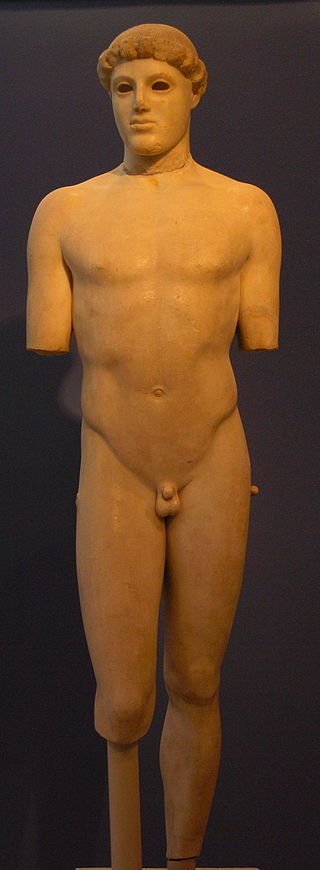
In art, the Archaic Period in statuary is said to end at around this time and the Early Classical Period, sometimes known as the Severe Style, begins. This saw the move away from stiff, smiling figures to idealised figures in natural poses. A good example of the early development of the new style is the statue known as the Kritios Boy, created around this time. This statue, which had originally been on the Acropolis and may have been created by the famous Athenian artist Kritios (or Critias/Critios depending on how people spell it).
By this time it was obvious that a Persian invasion of Greece was imminent. Xerxes was at Sardis and a vast army was assembling. Greek spies said that it was the largest army that the world had ever seen and this is actually possible, although the size of the army is disputed. The canal at the isthmus of Mount Athos was nearing completion and ships were assembled, both for the navy and to make pontoon bridges across the Hellespont. Emissaries from Persia asking for earth and water, symbols of submission to Persia, arrived at many Greek cities, with the conspicuous omission of Athens and Sparta, who had previously murdered Persian emissaries a decade previously.
Faced with this threat the Greek cities sent representatives to assemble for a congress at the Isthmus at Corinth. Here the Spartans assumed leadership of the resistance to the Persians. The Athenians supported them, but claimed a leadership position in commanding the navy. They ultimately accepted a Spartan overall commander for the fleet, named Eurybiades, but with the Athenian generals advising the nominal leader.
 |
Kritios Boy
sculpture |
The allies considered asking the tyrant Gelo of Syracuse for aid, as he was the ruler of the most powerful city in Sicily. A delegation was sent and Gelo replied that he would lead over twenty thousand soldiers and two hundred ships to aid the Greeks, but only if he was given command of either land or sea operations. The Spartans and Athenians would not give up their positions of leadership, so no aid would come from Sicily. It's probable that Gelo merely asked for the leadership positions as an excuse. Knowing full well that Sparta and Athens would never give up their leadership, this allowed Gelo an excuse to refuse. In truth, rumours spoke of a large Carthaginian fleet preparing for an invasion of Sicily and Gelo must have known he would need his troops at home.
"My Athenian friend," Gelo answered, "it would seem that you have many who lead, but none who will follow. Since, then, you will give up nothing but must have everything, it is high time that you hasten home and tell your Greece that her year has lost its spring."
Herodotus' Histories, 7.162, written circa 440BC
The city of Argos, which had been an enemy of Sparta for so long and had such a crushing defeat at Sepeia in the previous decades, refused to send aid unless they were given leadership of half the land forces. The Spartans refused to give up this position and the Argives could not provide many troops anyway. An oracular pronouncement from Delphi confirmed this position and the Argives took no part in the war. A similar prophecy from the Oracle dissuaded the Cretans from joining the war. I cannot help but feel that the Oracle of Delphi may have been bribed by the Persians, or at least felt that Persian victory was inevitable, because nearly every oracular prophecy seemed to predict that the Greek resistance was futile.
The island of Corcyra (modern Corfu) was asked to provide ships. They agreed and manned a squadron of sixty ships, but it is possible that the ships were ordered to wait at anchor near the Peloponnese until it was obvious which way the war was to go. Gelo of Syracuse is said to have sent ships to the Gulf of Corinth to see which way the war went and to submit to Persia if necessary. The cities of Thessaly were likely to defect unless they were protected, as likewise was the city of Thebes. No one wished to take on the might of Persia on their own, leaving the anti-Persian alliance as Sparta, Athens, Corinth and a number of smaller cities near to Sparta and Athens.
The Greek city-states were not used to cooperating in any way. There were hundreds of cities stretching from the Black Sea to present-day France. They all spoke the same language, had the same gods, consulted the Oracle at Delphi and competed in the Olympic Games and other festivals. But that was pretty much all that they had in common. Greece was not a nation, which made a unified resistance difficult. Many of the cities hated each other and at least some of them, particularly the naval powers of Athens and Aegina, were actually at war with each other when the Persian invasion loomed.
 |
| River flowing through the Vale of Tempe |
Early in the year 480, the Greek alliance sent an army northwards to the Vale of Tempe, to guard a mountain pass between Mount Olympus and Mount Ossa. They believed that the Persian army would have to come this way and this would enable them to protect the wavering communities of Thessaly and Boeotia that were considering joining the Persians.
Xerxes' army began to cross the Hellespont, after being delayed by a storm that broke the first set of pontoon bridges. Alexander I of Macedon, who was a Persian vassal but nevertheless had sympathy with the Greek cause, is said to have sent a warning to the Greeks. He told them that the Vale of Tempe could be bypassed and that the army of Xerxes was large enough to keep them engaged at Tempe, while still sending a force to bypass them by another route. The Greeks subsequently abandoned their position Tempe and put no army in the field for a time.
Faced with this seemingly invincible invasion force the Spartans and Athenians consulted the Oracle of Delphi. The Oracle held out little or no hope for them. According to Herodotus, the Oracle gave this message to the Spartans.
 |
Ruins of a temple at Delphi, where the Oracle
gave her prophecies to Athens and Sparta |
"For you, inhabitants of wide-wayed Sparta,
Either your great and glorious city must be wasted by Persian men,
Or if not that, then the bound of Lacedaemon must mourn a dead king, from Heracles' line.
The might of bulls or lions will not restrain him with opposing strength; for he has the might of Zeus.
I declare that he will not be restrained until he utterly tears apart one of these."
This prophecy suggested that either Sparta would fall or one of the kings of Sparta would die. The prophecy given to Athens was even grimmer.
"Fools, why do you linger here? Rather flee from your houses and city,
Flee to the ends of the earth from the circle embattled of Athens!
The head will not remain in its place, nor in the body,
Nor the feet beneath, nor the hands, nor the parts between;
But all is ruined, for fire and the headlong god of war speeding in a Syrian chariot will bring you low.
Many a fortress too, not yours alone, will he shatter;
Many a shrine of the gods will he give to the flame for devouring;
Sweating for fear they stand, and quaking for dread of the enemy,
Running with gore are their roofs, foreseeing the stress of their sorrow;
Therefore I bid you depart from the sanctuary.
Have courage to lighten your evil."
 |
| Vase painted by the Theseus Painter |
The Athenians were aghast at this and begged the Pythia for another word from Apollo. Eventually the Oracle relented and the Athenians received this second prophecy, which was still dire, but had a word of hope.
"Vainly does Pallas (Athena) strive to appease great Zeus of Olympus;
Words of entreaty are vain, and so too cunning counsels of wisdom.
Nevertheless I will speak to you again of strength adamantine.
All will be taken and lost that the sacred border of Cecrops
Holds in keeping today, and the dales divine of Cithaeron;
Yet a wood-built wall will by Zeus all-seeing be granted
To the Trito-born, a stronghold for you and your children.
Await not the host of horse and foot coming from Asia,
Nor be still, but turn your back and withdraw from the foe.
Truly a day will come when you will meet him face to face.
Divine Salamis, you will bring death to women's sons,
When the corn is scattered, or the harvest gathered in."
These prophecies were taken back to the two cities leading the resistance to the Persians. The leaders and citizens pondered these and guessed at what they might mean and how they might be used.
Xerxes was moving quite slowly. His army was cumbersome and apparently had difficulties with supply lines. Because of the size of the army it probably could not move away from the coast, as it is easiest to carry supplies by sea. The invading army moved very slowly along the coast of Thrace, passing by and through the canal that had been dug at such expense to bypass Mount Athos. Herodotus recounts stories of entire rivers being drank dry by the invasion force as they passed, which sounds implausible to me, but I know little of the rivers in the region.
The Spartans and their allies had earlier left a force in the Vale of Tempe, but this position had been abandoned. The Persians were now able to enter Thessaly without a battle. The Thessalian city-states, who had the finest cavalry in Greece, now went over to the Persian side, as they feared to face the Persians on their own without support. The Persian army moved slowly onwards.
 |
The pass at Thermopylae: The land has changed over
the millennia. The coastline was close to where the
modern road is in the photograph, possibly even closer to the
mountains in places. |
With Thessaly lost, the remaining Greek city-states had few places left to make their stand. It was decided that Leonidas, the Agiad king of Sparta, would lead a force to hold the pass of Thermopylae. Xerxes' army had thus far hugged the coast, as the navy and the army were trying not to get separated. I suspect that most of the supplies of the army were being carried in transport ships, as this would make transport far easier. Thermopylae was a narrow pass between the mountains and the sea. It was a nearly perfect place to hold, as the pass was narrow, but nearby were narrow straits of the sea, where the sea was forced into a narrow channel between the mainland and the island of Euboea. Here the navy of the Greek alliance could hold off the Persian navy while the land forces were held at bay by Leonidas and his army.
Leonidas took a small force. The Olympic Games were about to start and the Dorian festival of the Carnea (where no Dorian, including Spartans, could fight for religious reasons). The emergency was held to be serious enough that Leonidas was permitted by the ephors of Sparta to lead an army, but only a small one. Leonidas took three hundred of the elite Spartiates, the full Spartan citizens and perhaps a thousand helots and perioci; the enslaved serfs and the dwellers round about Sparta who had not full citizenship. It is possible that Leonidas took in mind the prophecy of the Delphic Oracle, that Sparta would fall or a Spartan king would die. It is said that he made sure that all the Spartiates on this mission had sons to carry on their name. It seems as if Leonidas possibly thought it a suicide mission.
 |
| Decoration from the Temple of Aphaia at Aegina |
On the way through the Peloponnese, other allies offered around four thousand additional troops. When nearing Thermopylae, the Thespians, Malians, Thebans, Phocians and Opuntian Locrians sent perhaps another two thousand hoplites and lighter armed troops. Particularly useful were the Phocians, whose territory bordered Thermopylae and who knew the area. The Theban contingent was not fully trusted, as it seems their city was plotting to join the Persians if Leonidas failed to hold them. But the Thebans may have been volunteers from the anti-Persian party in the city.
The Phocians had previously used Thermopylae as a fortress themselves and they knew its weaknesses. Leonidas' troops began to repair an old wall that the Phocians had once built across the pass, but had now fallen into disrepair. The Phocian contingent, a thousand strong, was sent to hold a small mountain path that allowed an attacker to bypass Thermopylae. The Greek navy sailed northwards to take up a position not far from the Greek land forces, although they may not all have been in place until after the Olympics.
It is a sign of just how seriously the ancient Greeks took sports that they actually held the Olympic Games that summer. The games were held around July, as the army of Xerxes was about to move into Thessaly. They were eventful games.
 |
| Coin of Leontini circa 480BC |
The tyrant Anaxilus of Rhegion owned the team that won the mule-cart race. He was very proud of this and minted coins to show the fact. He may or may not have actually been at the games however, as he was allied to the Carthaginians and their expedition to restore Terillus to Himera would soon be underway.
Xenopithes of Chios won the boys' stadion, while an unknown boy from Heraia won the boys' boxing. Theagenes of Thasos, whose island city-state had been subdued by Mardonius in the previous Persian invasion, won the boxing. Theopompus of Heraia won the pentathlon for the second time. Dromeus of Mantineia won the pancration. Dromeus of Stymphalia won the dolichos.
The city-state of Argos, which was abstaining from the coming war, won the horse race. Two Theban nobles, Daitondas and Arsilochus, owned the winning team for the tethrippon. The Theban nobility was suspected of having pro-Persian sympathies.
In an extraordinary feat of athleticism Astylos of Croton (or Syracuse) won the stadion, diaulos and hoplitodromos races. This was in fact his third time winning both the stadion and diaulos races. This was the first time since Chionis of Sparta (who won his last victory in 656) that anyone had managed such a feat and he had also won the hoplitodromos race on top of this. The Spartans were so concerned for the fame of their ancestor that they put up an explanation on the monument of Chionis to clarify that the hoplitodromos had not existed at the time of Chionis. However, the crowning glory for Astylos was to be a sad one. He was from the city of Croton, but had in fact chosen to compete as a citizen of Syracuse instead, for the honour of the tyrant Gelo. The citizens of Croton were so disgusted with him that they exiled him and turned his house into a prison. Even his own parents disowned him.
 |
Earlier representation of a hoplite
at Dodona |
This conversations at the Games must have included debates as to what would happen with the Persian and Carthaginian invasions; talk of alliances, secret whispers of betrayal or offers of conditional aid. The Olympic Games may seem frivolous, but these Games and institutions like them were crucial in providing even the barest semblance of unity to the divided Greek world.
As a postscript to these games it is said that some enemy of the Theagenes of Thasos (who had won the boxing) decided to attack his statue with a whip. The statue subsequently fell on the man and killed him. The citizens of Thasos then put the statue of Theagenes on trial for murder, found it guilty, presumably because it refused to speak in its own defence, and exiled it by throwing it into the sea. The Oracle of Delphi later told the Thasians that they had to restore the statue. The vindicated statue was hauled up from the seabed and venerated with a hero-cult. But all of this happened later.
It must have been around this time that the Carthaginian forces, which had been prepared by Hamilcar, King of Carthage, set sail for Sicily. This was said to be the largest army that the Carthaginians had ever assembled and was said to have been around three hundred thousand strong. This is almost certainly an exaggeration and the actual Carthaginian forces were probably around sixty to eighty thousand strong, but this was still a huge army. The army was led by Hamilcar himself. Hamilcar was descended from King Mago, his grandfather, who had established Carthaginian power in the western Mediterranean. Supposedly the fleet included 200 warships and 3000 transport ships, but again, these numbers are probably too large. 200 warships is quite plausible though.
As the expedition was undertaken on the behalf of the Terillus, the exiled Ionian tyrant of Himera, the Carthaginian fleet rounded the western tip of Sicily and sailed along the north coast, before disembarking their troops at Panormus (modern Palermo). The sea crossing was a rough one and the Carthaginian fleet was beset with storms. Many ships were lost, including the main troop transports for the cavalry.
 |
| An ancient representation of a a Greek trireme |
After reorganising his army at Panormus, Hamilcar marched towards Himera and began to besiege the city. Theron of Acragas had led his armies to Himera, but he had not tried to contest the crossing, possibly because of the stormy seas. Upon the arrival of Hamilcar at the city some small engagements were fought, but Carthaginians had greater success and the forces of Theron were trapped inside the city. Messages were sent, by Theron to his ally Gelo of Syracuse begging for aid.
As the Olympics were ongoing, the small Greek land army, under the command of King Leonidas of Sparta, was repairing the Phocian Wall at the pass of Thermopylae, while the Greek fleet took up positions near the Cape of Artemisium, sending three scout ships to the island of Sciathos to light beacons once the Persian fleet arrived. Once the Persian advance ships were sighted the beacon was lit and the three ships raced to re-join their comrades, but were captured by the Persians. The Greek fleet retreated towards Chalcis, allowing them to contest the straits if need be, but also moving far enough south that they would not risk encirclement if the main Persian fleet sailed around Euboea.
The Persian fleet had only begun to arrive at Artemisium and the beacons may have been lit too early. The Greek fleet had overreacted in caution, but this overreaction may have accidentally won the war for Greece.
The Persian land army was still marching through Thessaly, but probably not exactly along the coast. They reached the Greek forces at Thermopylae around mid-August, although the dates are not exactly clear. The Carnea and the Olympics were both ongoing around this time, hence the very small Spartan contingent, but this still leads to problems with dating. Xerxes expected the Greek forces facing him to run away once the sheer scale of his army became obvious. However the Greeks did not in fact run away. Xerxes's scouts are said to have reported the Greeks seeming indifference to the Persian army, although this was doubtless a posture.
 |
A statue of a hoplite at Sparta,
possibly meant to represent Leonidas |
According to Plutarch, a message was sent from Xerxes to Leonidas, asking his army to lay down their arms. Leonidas is said to have said "
Molon labe", which is usually translated as "Come and get them", although the more literal translation is "
Having come (here), take (them)". Herodotus does not mention this phrase, meaning that it is probably a later invention. Herodotus does mention a story of Dianeces. Dianeces was a Spartiate soldier who was told by a man from Trachis that the Persians had so many archers that their arrows would darken the sky. Dianeces replied that they would have the pleasure of fighting in the shade. Plutarch later attributes this saying to Leonidas.
Xerxes waited for his army to rest and reorganise before attempting to force the pass. But he may have had another reason for waiting. The weather turned bad and a fierce storm swept down from the north-east. The Persian fleet had been caught out in the open and were driven onto the coast near Mount Pelion. Perhaps a third of the Persian fleet was wrecked. It was a terrible disaster, and while some ships were doubtless repaired and some sailors would have floated ashore, it must have seriously compromised the fleet and any supplies for the land army that the fleet was carrying. The storm raged for two days, during which the Persian land army made no move and the Persian fleet suffered losses.
To make matter worse, according to Pausanias, two Greek divers, Hydna and her father Scyllis, swam out to sea and diving down beneath the waves they were able to cut the anchors that held many of the Persian ships in place. This may be a later story. Herodotus tells of a great diver called Scyllias who was asked by the Persians to dive down and rescue valuable material from the sea bed from their wrecked ships. Scyllias later defected to the Greeks with valuable information, but while on the sea bed beneath the waves, the two divers may have also been cutting anchor ropes. This is very sketchy, but it is possibly the earliest recorded example of underwater warfare in history, so I thought it worth mentioning in passing.
The Greek navy, anchored on the western shore of Euboea, was shielded from the worst of the storm's fury. After the worst of the storm had passed on the third day, the Greek fleet, under the command of Eurybiades the Spartan, moved back into position at Artemisium. That night Scyllias defected to the Greeks, swimming across the channel. He had grim news for them. The Persians were planning to send a fleet of two hundred triremes around the island of Euboea. This would encircle the Greek navy and cut off their retreat. It did however present an opportunity, in that it would divide the already storm-battered Persian fleet. The Greek fleet had over three hundred triremes, so to catch this encirclement force on its own would in fact hand a great victory to the Greeks. But the timing had to be right.
The Greeks were divided in their plans and fearful. Some commanders wanted to retreat, while the experienced Themistocles wanted to stay and fight, but pretended to want to retreat to extract bribes from the Euboean islanders, to try and then bribe the Spartan commander Eurybiades to stay. Suffice it to say that the Greek command structure and morale was not ideal. It was however decided to try and fight, with at least a portion of their force.
 |
A modern reconstruction of
a hoplite panoply |
On land, Xerxes was weary of waiting for the Spartans and their allies to surrender. So he ordered an attack. After an initial barrage of arrows, a contingent of Medes and Cissians was ordered to begin the attack. They tried to force their way through, but the pass was so narrow that they could not bring their numbers to bear. The Phocian Wall and the heavy armour of the Greeks had rendered the arrows of the Persians almost useless. The fighting continued all day, but to no avail. The Greeks had thousands of hoplites who could be cycled in and out of the position. So, despite their vastly superior numbers, the Persian army could make no progress. They probably did not suffer heavy losses though. Because the pass was so narrow, the Greek spears were unable to kill many at a time. The Greeks would have taken very few casualties however. It is likely as well that the Spartans were forcing their helots to do much of the actual frontline fighting, so as to save the Spartiates for the coming days.
Xerxes sent his elite forces, the Immortals, against the Greek position at Thermopylae. These were a body of troops that is not well known. Herodotus describes them, but the phrase "
Immortals" is not known from any Persian sources. They were probably the bodyguard of the king and a standing army that was mostly stationed around the area of Persia and Elam. Herodotus certainly regarded them as the elite of the Persian army and they are probably the soldiers depicted in reliefs at Susa and Persepolis. They attacked, but with no greater success than the Medes or other units. The Greek forces, particularly the Spartan contingent, are said to have done fake retreats to lure in the Persians and slaughter them when turning suddenly. But I'm sceptical of this. The pass was too narrow to do this often without giving up too much ground and the tactic could only be used a few times before their opponents realised the trick.
At sea, the Greeks had set sail that morning to give battle to the Persians. They had drawn up into a circular or semi-circular formation, possibly with only a part of their fleet, before waiting for the Persians to draw in closely to them. The use of this formation stopped their ships from being rammed (as they were too close together) and allowed their more heavily armoured marines to grapple in hand-to-hand combat with the Persian sailors. The battle was long and indecisive, but the Greeks seem to have fared the better of it, with both sides breaking off the battle at nightfall.
 |
| The "Hollows" of Euboea |
That night the Greeks had planned to sail in ambush against the encircling fleet, but were unable to, as there was yet another storm. This forced the Greek ships to stay at anchor near shore, but it devastated the Persian contingent that were trying to encircle Euboea. They were caught at sea against the eastern shore and driven into the bays known as "
The Hollows", where most of their ships were wrecked. The encircling fleet was no more a force to be feared, although the Greeks did not yet know this.
The following day Xerxes ordered his troops to attack once more but similarly failed to make headway. I doubt that either side suffered many casualties. The Persians would have taken some casualties trying to force through a phalanx, but these would have numbered in the hundreds rather than thousands. The Greeks were fighting in a strong defensive position and didn't need to cause many casualties. The idea was that they would hold the Persians in place until the Carnea (and possibly the Olympics) were finished, at which point reinforcements could join from Sparta and other states. It is not clear what the overall Greek plan was though. Were they intending to hold Thermopylae indefinitely?
 |
The Cape of Artemisium, looking across the Straits,
towards Magnesia |
Having suffered from the storm of the night before, the Persians attempted to make their fleet seaworthy once more and did not put out to sea for battle. The Greeks received reinforcements of fifty-three more triremes from Athens. The reinforcements, and the fact that the enemy was declining battle, raised the morale of the Greeks and later that day they attacked a small detachment of Cilician ships and destroyed them. The disaster on the eastern shore of Euboea became known to both sides as well, and the Greeks rejoiced that the winds and the waves had done their work for them.
Later that afternoon however, Xerxes received word from a Greek traitor, Ephialtes of Trachis, who told him of another way; more difficult to find and more secret. This was a mountain path that led up through the oak forests to a pass, where Leonidas had stationed the Phocian hoplites. Hydarnes, son of one of the co-conspirators of Darius, was given command of the Immortals and some other troops and sent over the mountains, guided by the traitor Ephialtes.
The Phocians had not been expecting an attack and so had not properly readied themselves. When the Persian forces emerged from the forests both groups were surprised. The Phocians assumed that the Persians were coming to attack them and retreated up the mountain to a defensive position. Hydarnes led his troops straight past the Phocians without giving battle and down the path towards the rear of the Greek force.
Around this time the Greeks under Leonidas became aware of what was happening. Deserters came from the Persian side to inform them that there was an encirclement happening and runners from the Phocian position reached them to let them know that the Immortals had bypassed their defence. The Greek position at Thermopylae had been almost impregnable, but it could not withstand attack from both sides at once. If the Persians came around behind them, the army was lost.
Leonidas held a council of war in the hours before daybreak. His army was small, less than ten thousand strong, but this was still a large army by Greek standards and a high percentage of the armies of Greece. Of the few city states that had sent troops, some had sent nearly every man they had. Leonidas decided to dismiss the majority of these troops, probably asking that they would retreat south to join the Spartans in defending the Peloponnese.
 |
A modern memorial to
Leonidas, with the words
Molon Labe inscribed |
Some troops stayed. The Thebans were kept with Leonidas, possibly as a type of hostage, as the loyalty of Thebes was doubted, but it is possible that they stayed voluntarily, as they may have been from an anti-Persian faction in Thebes. It is hard to know. The Thespians stayed voluntarily. Seven hundred of their hoplites were with Leonidas. The three hundred Spartiates stayed, and the helots may have been forced to stay also.
It is unclear what Leonidas had in mind, but a glorious and inspiring death now loomed before him. Perhaps he intended to hold out for a little time as a rear-guard to the troops he had dismissed. The Persians had cavalry and the Greek hoplites were all infantry. If they were all to retreat at once the Persians would break through the narrow pass and hunt them down like animals on the plains. He may have had the prophecy of the oracle in mind, that Sparta would either be destroyed or lose a king. Perhaps he thought that by sacrificing himself he might perhaps save his city.
At daybreak Xerxes offered sacrifices and then ordered the attack on the Greek position, with perhaps twenty thousand troops. The remaining Greek forces charged forward from their defensive position to attack. The Immortals had not yet arrived in their rear and if they fought before they were encircled they could do much greater damage to the Persians. Leonidas was killed almost immediately and a bloody struggle began over his body, with the remaining Greeks outnumbered twenty to one and selling their lives dearly.
Finally the Immortals arrived on the battlefield, thus completing the encirclement. Herodotus records that at least some of the Thebans surrendered at this point. Those Greeks left alive fought their way to a little mound known as Kolonos Hill. Here they made their last stand, fighting to the end, until the Persians, who had no desire to face men who had nothing left to lose, showered the hill with a hail of arrows until the defenders were all dead.
 |
Hill (or mound) of Kolonos, where the Spartans and
other Greeks made their final stand at Thermopylae |
Xerxes made libations at sunrise and waiting till about mid-morning, made his assault. Ephialtes had advised this, for the descent from the mountain is more direct, and the way is much shorter than the circuit and ascent. Xerxes and his barbarians attacked, but Leonidas and his Hellenes, knowing they were going to their deaths, advanced now much farther than before into the wider part of the pass. In all the previous days they had sallied out into the narrow way and fought there, guarding the defensive wall. Now, however, they joined battle outside the narrows and many of the barbarians fell, for the leaders of the companies beat everyone with whips from behind, urging them ever forward. Many of them were pushed into the sea and drowned; far more were trampled alive by each other, with no regard for who perished. Since the Hellenes knew that they must die at the hands of those who had come around the mountain, they displayed the greatest strength they had against the barbarians, fighting recklessly and desperately. By this time most of them had had their spears broken and were killing the Persians with swords. Leonidas, proving himself extremely valiant, fell in that struggle and with him other famous Spartans, whose names I have learned by inquiry since they were worthy men. … Two brothers of Xerxes accordingly fought and fell there. There was a great struggle between the Persians and Lacedaemonians over Leonidas' body, until the Hellenes by their courageous prowess dragged it away and routed their enemies four times. The battle went on until the men with Ephialtes arrived. When the Hellenes saw that they had come, the contest turned, for they retired to the narrow part of the way, passed behind the wall, and took their position crowded together on the hill, all except the Thebans. This hill is at the mouth of the pass, where the stone lion in honour of Leonidas now stands. In that place they defended themselves with swords, if they still had them, and with hands and teeth. The barbarians buried them with missiles, some attacking from the front and throwing down the defensive wall, others surrounding them on all sides.
Herodotus, Histories, 7.223-225, written circa 440BC
 |
Spears and arrow heads found at Kolonos at Thermopylae
Here the last stand was made |
At Artemisium the Greek fleet was still fighting. That morning both navies had put forth to sea and fought a hard-fought engagement. Neither side was victorious. Herodotus records that the Greeks inflicted much more damage on the Persians, but also that half of the Athenian ships were damaged at the end of the day. Faced with these mounting losses the Greeks must have been unsure how long they could continue to hold.
That evening a message came from Thermopylae to tell them that the Persians had forced the pass, that the main army had retreated and that Leonidas was dead. Upon hearing this the fleet commanders agreed upon a retreat. Themistocles is said to have ordered messages in Greek cut into the rock near any available fresh water springs, urging the Ionian Greeks in Xerxes' navy to betray the Persians. It was a clever strategy if he did it. Either it would induce the Ionians to betray the Persians or it would cause the Persians to distrust the Ionians, or both.
The Battle of Thermopylae is one of the most well-known battles in world history. Even those who know nothing of history can tell of the Three Hundred Spartans. I have tried to show that there were certainly more than three hundred and that not all were Spartans. The sacrifice of the Thespians is at least as notable as that of the Spartans. But it was a heroic last stand; perhaps the most famous in the world. Later Spartan propaganda would lionise Leonidas and those who fought with him, giving rise to the belief that Spartans would never surrender and strengthening their martial reputation. What Leonidas and his soldiers achieved was doubtless extremely brave, but phrases like "
We will fight in the shade" and
Molon Labe must be treated as a type of propaganda. Their sacrifice certainly helped to inspire the Greeks later in the wars.
The Greeks later came to view the sacrifice at Thermopylae as the supreme example of heroism. Monuments were left in ancient times, one for all of the Greeks and one for the Three Hundred. The contemporary Greeks of today have also erected a monument to the Thespians and to King Leonidas. Whenever a last stand is made, it will be compared to Thermopylae.
 |
| Leonidas at Thermopylae, painted by David in AD1814 |
There is an inscription written over these men, who were buried where they fell, and over those who died before the others went away, dismissed by Leonidas. It reads as follows: "Here four thousand from the Peloponnese once fought three million. That inscription is for them all, but the Spartans have their own: "Foreigner, go tell the Spartans that we lie here obedient to their commands."
Herodotus, Histories, 7.228, written circa 440BC
Viewed as anything other than an inspiration though, the Battle of Thermopylae was an unmitigated disaster for the Greeks. What had made Thermopylae special was its position; a narrow pass that could be held by a few men against thousands. It was a place that could negate every advantage that the Persians had. Once this defensive position was left for any reason, the Spartans and other Greeks could easily be encircled and cut down, as of course happened at the end of the battle.
Once Thermopylae was lost there was no similar chokepoint anywhere in Greece. The closest thing to this chokepoint was the Corinthian Isthmus, which the Peloponnesians would soon begin to fortify in preparation for the coming invasion. But retreating to the Isthmus meant abandoning all of Boeotia and Attica, losing the cities of Athens, Thebes, Megara and others, as well as losing all of the island of Euboea.
 |
A later seal showing an Achaemenid king slaying a
Greek hoplite |
Even worse than this, Thermopylae had been near the straits of Artemisium, where the Greek navy could hold off the Persian fleet from simply bypassing and landing troops in the rear of the Greek land armies. The Corinthian Isthmus had no such strait, meaning that it didn't matter if the Greeks could hold out on land. The Persians could simply bypass the position by sea. Thus, once Thermopylae was lost, all hope of defeating the Persians seemed to be lost and all of the plans of the Greek coalition were thrown off balance.
We sometimes see Thermopylae as a Pyrrhic victory for the Persians, but I have tried to show that casualties could not have been that high for the Persians. Most casualties in ancient battles happened on the retreat and the Persians did not have to retreat, merely move back out of range of the spears. The Greeks had lost perhaps two or three thousand soldiers and the Persians had lost perhaps two or three times that number, but that was hardly a dent in their vast land army.
Often overlooked, but perhaps more significant, was the simultaneous Battle of Artemisium. Here the Greek navy had held its own against the much larger Persian navy. The fighting had been done in narrow straits, but all things considered, the Greek navy had performed better than the Greek land forces. Also, by forcing a battle in Artemisium, the Greeks had inadvertently exposed the Persians to two storms, which had heavily damaged their fleet. It is almost a certainty that far more died at sea in the storms than died at Thermopylae. The Persian land army was untouched, but the Persian fleet was now perhaps down to half-strength, with their surviving ships damaged. The navy of Xerxes was still extremely strong, but perhaps it would prove his Achilles Heel?
 |
| A modern reenactment of hoplite armour |
After the Persian victory at Thermopylae the Persian army moved through the pass and into Phocian territory. The Thessalians, who had switched to the Persian side before the battle, were enemies of the Phocians and used the Persian invasion as an excuse to ravage the lands of their ancestral foes. The ravages of the Thessalians and Persians in this region were particularly brutal and Herodotus, who normally doesn't tell much of the terrors of war, mentions some women who were caught while fleeing to the mountains and gang-raped to death.
After devastating the Phocian lands, the main army moved into Boeotian territory. Thebes and the majority of the Boeotian cities surrendered to the Persians and sent troops to join the Persian army. Thespiae and Plataea, the only two cities in Boeotia that did not submit, were captured and destroyed, although their inhabitants had mostly already fled southwards. Herodotus mentions that a contingent of the Persian army came to plunder the temples at Delphi and were turned away by supernatural omens and thundering. I do not believe this in the slightest, as the Persians, as a general rule, did not attack the temples unless provoked. As Delphi had not aggravated them, and had in fact prophesied disaster for the Greeks, it is unlikely that Delphi would have been a target. It is most likely that this is a later story invented by the priests at Delphi to clear them of any suspicion of collaboration with the invaders.
With the death of Leonidas I, Pleistarchus was now the Agiad king of Sparta, but was too young to command. Leonidas' brother, Cleombrotus, took control of the Spartan forces and acted as regent. Leotychidas, the Eurypontid king of Sparta, was apparently with the fleet, but was not the overall commander, as the fleet was under the command of the less objectionable Eurybiades. The sizeable fleet of Aegina would almost certainly have refused to serve under Leotychidas, who had taken their citizens hostage a decade earlier.
 |
| Later Roman bust of Themistocles |
With Boeotia now under Persian control, the Persians moved south into Attica. The confusion in the Greek war plan was now evident, as the Athenians had expected the Spartans and their allies to defend Attica. In fact the Spartans had no such intention, but were now fortifying the Corinthian Isthmus, frantically building a wall from sea to sea to try and block the Persian advance. The Athenians took council, and on the advice of Themistocles, decided to abandon the city.
The Oracle of Delphi had spoken of a wooden wall that would grant safety to the Athenians and the island of Salamis was also mentioned, "
Divine Salamis, you will bring death to women's sons". Themistocles is said to have argued that this portended a Greek victory there, as if it had been a defeat, the oracle would have said "
Cruel Salamis". The wooden wall was interpreted as a reference to the fleet. The oracle so closely fitted Themistocles' purposes in certain respects that I wonder if he had bribed the interpreters of the prophecy to insert these lines.
A final prophecy seemed to confirm the abandonment of the city. A sacred snake was said to live near what is now the Temple of the Erechtheum and was fed by the priests. These priests now reported that the food was left untouched and that the gods had abandoned the Acropolis of Athens. Faced with this portent, the people mostly left. The women and children were sent to the coastal city of Troezen in the Peloponnese, while others were sent to Megara (foolishly close to the fighting) or the nearby island of Aegina, with whom the Athenians were recently at war. Those men who could fight were transferred to the nearby island of Salamis to act as support to the navy. The Greek fleet was now anchored off the small island of Salamis, within sight of Athens. The Athenians had more ships than anyone else and they insisted that the fleet would stay near Attica, for the time being at least.
 |
| Ostraca with the name of Aristides upon it |
The Athenians had also issued a decree allowing all of those ostracised to return to the city without fear. This was perhaps done because Aristides the Just had been exiled. He had a substantial following in the city and it was feared that he would defect to the Persians and cause his supporters to abandon their resistance.
A small group of people had opted to interpret the oracle differently. There had once been a small wooden wall around the Acropolis and they chose to fortify the Acropolis and try to hold out against the Persians. The Acropolis is certainly a steep hill and not easily taken, but those who remained were probably not in sufficient numbers to hold it well.
 |
| Decoration of the temple of Aphaia at Aegina |
The Persians moved into Attica, burning as they went. Athens was the main target of the expedition and it was now in sight. The few defenders on the Acropolis put up a resistance, but as soon as the Persians realised that the hill was held against them, they went to the nearby knoll of the Areopagus and fired flaming arrows into the hasty wooden barricades that the remnants had left there. Meanwhile some Persian troops climbed up a steep part of the hill that had been left unguarded and appeared behind the defenders. The defenders either committed suicide or hid in the temples, known today as the Older Parthenon and the Old Temple of Athena. These were burned down by the Persians, either as an accident as part of the fighting or, more likely, as a revenge for the burning of the temples of Sardis during the Ionian Revolt. The burning of Athens was almost certainly visible to the Greek sailors anchored at Salamis.
The Persian navy had probably moved up towards Athens and was probably drawn up around the wide bay of Phalerum to support the army. After the destruction of Athens, the army and the fleet began to move westwards towards the Peloponnese.
 |
| Ruins at the site of the city of Himera |
Meanwhile in Sicily, the tyrant Gelo had brought up reinforcements to the besieged city of Himera. The later Greek tradition suggests that the Carthaginians had vast numbers of troops and that the Greeks were far outnumbered, but in reality the addition of Gelo's troops from the cities of Syracuse and Gela probably nearly equalised the two sides. The Greeks probably had less troops overall, but seem to have had an advantage in cavalry. The cavalry advantage meant that the Carthaginians could no longer forage safely from their encampment. The Carthaginians must have been awaiting support from their Ionian allies and perhaps from Sardinian and Etruscan reinforcements, but these never seemed to arrive.
Gelo had set up camp on the eastern side of the River Himera, near to the city and had ordered the defenders of the city to unblock the gates that had been bricked up. This signified that the Greeks were anticipating a move to the offensive.
 |
| 5th century BC coin of Syracuse |
Diodorus Siculus, a much later Sicilian Greek writer, tells a detailed story of the battle. According to his account, Hamilcar had requested allied Greek cavalry to join his army from their allies in Selinus. This letter was intercepted by Gelo, who sent in his own cavalry troops to pose as Selinuntines. When they were safely in the Carthaginian camp Gelo launched a diversionary attack on the Carthaginian land camp to the west of the city of Himera, forcing the Carthaginians to commit their army to battle to defend the camp.
When the Carthaginians were engaged in battle, the Greek cavalry forces, who had been pretending to be allies of Hamilcar, slew Hamilcar as he was preparing a sacrifice in the sea camp. They then raced to the shore to begin to set the triremes alight. The Carthaginians were now without their commander and their hope of rescue was being cut off. In the confusion the Carthaginians retreated, and the Greeks took time to loot the abandoned camp. However the Iberian mercenaries hired by Hamilcar reorganised and attacked the Greeks in their moment of triumph. The battle hung in the balance until Theron sallied out from Himera and broke the Carthaginian resistance. Those left alive in the Carthaginian army retreated to a small nearby hill until they were forced to surrender later, due to lack of water.
 |
| Earlier vase showing hoplites fighting |
The tale told by Diodorus Siculus is a neat one, with stratagems and tactics. The tale told by Herodotus is simpler and probably closer to the truth, although there are some similarities. According to Herodotus the Greeks and Carthaginian forces joined battle and fought throughout the day in a vicious struggle. Hamilcar was offering sacrifices to try and obtain favourable omens from the gods. The omens grew more and more unfavourable until the Carthaginian forces broke and fled and Hamilcar disappeared. His body was never found. It was speculated that as a final sacrifice Hamilcar had sacrificed himself.
When the armies met and he was defeated in the battle, it is said that Hamilcar vanished from sight, for Gelo looked for him everywhere but was not able to find him anywhere on earth, dead or alive. The story told by the Carthaginians themselves seems to have some element of truth. They say that the barbarians fought with the Greeks in Sicily from dawn until late evening (so long, it is said, the battle was drawn out), during which time Hamilcar stayed in his camp offering sacrifice and striving to obtain favourable omens by burning whole bodies on a great pyre. When he saw his army routed, he cast himself into the fire where he was pouring libations on the sacrifice; he was consumed by this and was not seen any more.
Herodotus' Histories, 7.166-167, written circa 440BC
I am inclined to believe the story of Herodotus more, as the tradition of human sacrifice and suicide was known in Carthage, and also because Herodotus is writing much closer to the time of the events. But it would pay to be sceptical in both cases. Diodorus Siculus records that this battle took place at the same time as Thermopylae. Herodotus records that it took place at the same time as Salamis. The Greeks had many different calendars and it would have been quite difficult even for a Greek at the time to be sure of the dates. The Sicilians may have been ashamed of not participating in the Persian Wars and thus wanted to show that they too had been defending Greece from a foreign invader who wanted to destroy the Greeks.
But Hamilcar was probably only intending to restore Terillus as tyrant of Himera, and made no effort to attack any of the other Greek states. If Hamilcar had wanted to attack the Greeks it would have probably have made more sense to attack Acragas on the southern coast. It almost certainly was not a coordinated attempt with the Persians to destroy Greeks, but perhaps it may have seemed so to the people at the time.
 |
Later painting showing Gelo granting peace to the
Carthaginians |
Gelo and Theron took immense numbers of prisoners in the aftermath of the battle and amassed a huge amount of plunder. The captives were sent into slavery and put onto building projects in Sicily, while the plunder helped to finance spectacular building programs by the tyrants. In Carthage, Hamilcar was remembered as the last strong king. He was succeeded by someone named Hanno, but the power of the kings would be greatly reduced in the coming decades, as Carthage moved towards a constitution more akin to a republic.
On the island of Salamis, the commanders of the Greek navy were in turmoil. The Corinthians and most of the Peloponnesians were in favour of withdrawing to the Peloponnese, to defend the Corinthian Isthmus. The Athenians under Themistocles were in favour of making a stand at Salamis, where the narrow straits would favour their fleet against the larger Persian fleet.
The Persian commanders were unsure of the next step as well. Their fleet was still moored at Phaleron, but the Persian land army was marching towards the Isthmus, leaving the Greek fleet interposed between the Persian land and sea forces. If the ships were needed to supply the army then it was imperative for the Persians to push past the Greeks. To do so, they could sail around the southern edge of Salamis, or force a battle with the Greeks in the straits between the mainland and the island. Winter was coming and with winter, more storms would come. If the campaign was to be finished before the onset of winter, it was imperative for the Persians to bypass the wall at the Corinthian Isthmus and land troops in the Peloponnese. If this could be done some cities might try and fight to the death, but most would surrender and Greece would be conquered. But to do this the Persian navy had to move into the Saronic Gulf, on the far side of Salamis.
Herodotus claims that the Greeks had around 370 ships, but other sources give a lower number of around 310. Probably the discrepancies occur because some sources may have only counted triremes, while some may have counted the smaller penteconters. Also, Aegina was said to have contributed 30 ships to the fleet, but it was said that they had other ships stationed at their nearby home island. They may have had up to 100 extra ships that were close enough that they could join the main fleet in around a day, so perhaps this is the source of the confusion.
 |
A contemporary wooden small scale model of a
Greek trireme |
The Persian numbers are much harder to quantify. Herodotus speaks of there being around 1200 ships in the Persian fleet, but it's unclear how many of these are smaller penteconters, or possibly even transport ships. Also, Herodotus speaks of major Persian losses due to storms and enemy action at Artemisium, so if the initial figure was right, the Persians should have only had perhaps about 600 ships left, still a clear advantage, but far from a total one. Herodotus states that the losses had been fully recovered with reinforcements, but this is almost impossible.
Presumably the Persians received some reinforcements from the Greek states that were conquered, but these would only have been a few triremes. Thebes and the cities of the territories conquered since Artemisium had either minimal navies or none at all, and there is no record of the Persians receiving reinforcements. Herodotus is probably just wrong on this point. Some ships may have been damaged at Artemisium and repaired, but it's likely that the Persians only had around 600 ships. This meant that the Greeks were outnumbered around 2:1 or 3:2, depending on exactly how many ships could have been repaired at short notice. However, the Greeks certainly believed that they were heavily outnumbered by around 3:1 or 4:1.
On the evening of 27th of September 480BC (probably), the Persians sent a feint into the straits before retreating. Their fleet was now riding at anchor near the straits and clearly in a position to attack or bypass Salamis.
Themistocles is said to have sent a messenger to Xerxes, warning him that the Greeks were divided and that they were planning to flee soon. If Xerxes wanted a quick victory he should attack the disunited fleet and capture it. Once the Greek fleet was destroyed, the Persian land forces could bypass the Isthmus at their leisure. The message was a brilliant one (if Themistocles truly sent it), as he was technically telling the truth. The Greeks were divided and many wanted to retreat to the Isthmus. If Xerxes won a victory, Themistocles would be honoured by the Persians. But if the Persians attacked the next day, the Greeks would be forced to fight and the conditions of battle would favour them. This was pretty much the last area of narrow water between Attica and the Isthmus, so this was one of the few places that the Greeks could make a stand.
 |
| View from the Temple of Aphaia at Aegina |
The Corinthian commanders are said to have been in favour of a withdrawal, although with the Persian fleet apparently anchored outside the strait, it was not clear if this was even possible any more. At this crucial juncture Aristides the Just, the ostracised Athenian politician, returned to the Athenians. He had boarded a ship at Aegina and made his way to Salamis under cover of darkness. He greeted his old rival Themistocles, who had caused him to be exiled from Athens for ten years, and immediately tried to persuade the Spartan commanders that Themistocles' plan of battle in the straits was the correct one. Aristides was known to (understandably) dislike Themistocles and had argued against ever investing in a navy. For Aristides to so firmly support his rival was a strong reason to believe him. Aristides was a politician to be sure, but he was an Athenian first.
According to Aeschylus, who fought in the battle and wrote a play about it, the Persians stayed up all night patrolling the mouth of the straits to prevent the Greeks from escaping. It is not clear that this actually happened, but it shows what Aeschylus and the Athenian populace probably thought happened. As his play was performed in front of a lot of people who had also fought in the battle, Aeschylus probably did not have leeway to stray too far from the truth.
 |
| A possible reconstruction of the Battle of Salamis |
In the morning of the 28th of September 480BC (probable date) battle was joined. The narratives of Salamis are quite confused. It's possible to give a general idea of what happened, but the stories all sound like sailors' tales, as everyone gives an incomplete picture. Even Xerxes, who sat on a throne on the mainland overlooking the battle, seems not to have fully understood what was happening.
The Greeks put to sea, singing their battle hymns, only to be met by the Persian navy advancing into the straits. The Greek ships advanced and then began to back water before the Persians, beginning to lure them in. The Persian ships came on, until their ships were too tightly clustered to use any of their manoeuvring abilities. If the lines were tight, then ships could only ram head first or try and board the enemy ships. The Greek triremes had less experienced crews and so could not move as swiftly as the nimble Phoenician ships, but their ships were heavier and had more heavily armed marines. The Corinthian contingent possibly seems to have moved away from the Greek navy towards the north and west, perhaps as if to flee, but the Greeks did not panic. If this happened, it was probably a planned tactic rather than Corinthian cowardice, as later alleged by the Athenians.
 |
A possible interpretation of the Battle of Salamis,
showing the positions overlaid on a modern aerial
photo of the straits |
The wind changed and the Greek ships now moved to the attack, as the swell began to force the Persians back onto the shore of the mainland. The heavier Athenian ships slammed into the lighter Phoenician ships. Early on in the battle the Persian admiral Ariabignes was slain and the Phoenician contingent seems to have been leaderless. The Egyptian contingent was heavier armed than the Phoenicians and might have fared better, but they may have been sent around the island to try and cut off the Greek escape route from the other channel. However, if this was the case, they do not seem to have made it. Again, the details are unclear.
The Phoenician ships tried to turn and withdraw, but the advancing second and third lines of Persian ships made this impossible. The ships fouled their lines and oars became entangled. The battle became a confused mess, but with the Greeks consistently ramming forwards and fighting in close quarters. Herodotus records an instance of a Persian ship, manned by Queen Artemisia of Halicarnassus, ramming another Persian ship, just to try and clear a path for her to escape. The Corinthian squadron returned to the fight pressing in on the western edge of the Persian fleet. The Athenians pressed forward in the centre, with their ships doing the majority of the fighting.
Meanwhile the Aeginetans are said by Herodotus to have closed the straits behind the Persian fleet and to have rammed the Persian ships as they attempted to flee back to Phalerum. This seems to be an inconsistency, as the Aeginetans were said to have only contributed 30 ships (and it doesn't answer how the Aeginetans had come to be behind the Persian fleet). What perhaps happened is that the main fleet of Aegina had been released from guarding the home island and attacked the rear of the Persian fleet. The Spartans certainly thought that they had been crucial in the battle and afterwards awarded them the prize for victory. Athens and Aegina were longstanding enemies and Herodotus mainly tells the Athenian story. But it is likely that Aegina was crucial in this battle, if only because, as Herodotus notes, the Athenians and Aeginetans had such a rivalry with each other that they competed in sinking Persian ships.
Aristides proved his worth once more by organising some hoplites to be ferried over to the island of Psyttilleia. Here the Persians had stationed some troops to kill any Greeks who might try to land there. Now with their fleet defeated around them, these Persians were slaughtered.
The confusion of the battle was intense and none of the sources exactly agree on what happened. The earliest source that has come down to us is the account of Aeschylus, from his play The Persians. It is a dramatized account, put in the words of a messenger returning to the Persian court at Susa and reporting the battle to Queen Atossa. It was first performed around 472, so it is not quite contemporary, but it is very close to contemporary.
 |
Painting by Wilhelm von Kaulbach of the
Sea Battle at Salamis, painted in AD1868 |
Then Day arrived on her chariot, pulled by her white steeds, and she flooded the whole earth with her bright beauty; and at that very moment a shrieking war cry rang out from the Greeks! A song that echoed all about us from every rock and crag on the island. A song of terror that engulfed us all. Fear shook all of the non-Greeks. Their hopes of victory was proven false. This was no solemn song the Greeks were singing. This was no song of grief and of defeat. This was a song sprung from deep their war-clogged hearts. They were charging into the battle with fearless zeal and, right through their whole line, the trumpet's voice fired them up into brave action. And suddenly, their flat oars obeyed some command and they sliced the salty waters of the deep. Almost immediately after that, they were there, in front of us! First came their right wing: orderly, calmly and then, close behind it, came the rest of their fleet. They rushed hard at us with a great shout: "Charge! Greek men, set your country free! Save your children, your wives, the holy temples of your fathers' gods, the sacred tombs of your ancestors! Now is the time to fight for all these things!" The Persians answered that shout with a frightened murmur… but there was no time to do anything. Ship crashed her bronze beak upon a ship, the first being a Greek one that sheared off the figure head of a Phoenician ship. Captains from both sides drove their ships against each other. At first, all was well with the Persian fleet. Their enormous mass held strong against the Greek onslaught. But then they all entered the narrow straights. Hundreds of them! Pressed hard up against each other! Our own ships crashed against our own ships, none of them able to assist the other! Our own ships smashed our own oars! Our own prows smashed our own figureheads! Then the Greeks seized that moment and, all together and with great precision, surrounded us and rushed at us from all angles and tipped our ships over. You could not see the water from all the wreckage and the slaughtered men! You could not see the shores and the crags from all the bodies of our men! The rest of the barbarian ships took to the oars and sped away in disarray. But the Greeks followed us and even with broken oars and with floating wreckage, kept at us, beating us hard, like fishermen beat tunnies or some sort of other netted fish. Groans and wails spread all across the wide sea right up until the black darkness of the night came and covered it from sight. But the disasters we suffered, my Lady! The disasters are so many that if you were to ask me to tell them all I would not reach their end for ten whole days my Lady, because, my Lady, be certain of this: no other single day saw the deaths of so many men.
Aeschylus, The Persians, 380-440, written circa 472BC
 |
| A modern reconstruction of a Greek trireme |
Xerxes was horrified to see the destruction of his fleet. He had lost between 200-300 ships at least. He still had a navy of sorts left to him, but there was now no chance of forcing the straits of Salamis and no chance of using it to bypass the Isthmus. This single engagement saved the Greek cause and doomed Xerxes' invasion.
As Xerxes was not a particularly good general, he gave some fairly useless responses. Firstly, he tried to build a bridge of boats out to Salamis, which predictably failed, as the Greek warships were now in full control of the straits. He also ordered the execution of certain high-ranking Phoenician commanders for cowardice. This perhaps (again the sources are unclear) to have led to the desertion of the remainder of the Phoenician fleet that night. As the Phoenicians were the largest contingent of the Persian navy, this would have meant that the Persian navy was now a mere shadow of its former strength. Also, as many of the remaining ships were manned by Ionian Greeks, kinsmen to the Athenians who had just won a stunning victory, it was not clear if they would be loyal to Persia in future.
 |
| A modern reconstruction of a Greek trireme |
The initiative was now completely on the side of the Greeks. The Spartan commander at the Isthmus, Cleombrotus, was considering actually leading his men out to attack the Persian land armies. But an eclipse of the sun on the 2nd of October 480BC (definite date) convinced him that this was a bad idea (it was a bad idea).
Xerxes began to fear for his own safety. With complete naval dominance the Greeks could cut off his retreat across the Hellespont. Without the fleet to protect the transport ships, the transport ships could not accompany the land army. Even though his land army was undefeated in the field, he chose to withdraw from Greece, taking most of the army with him. Babylon had been restless in previous years and word may have reached Xerxes of another potential rebellion there, although this is not certain. It is certain that after the defeat at Salamis, Xerxes chose to withdraw from Greece and withdraw swiftly.
Xerxes' uncle Mardonius, who had led the invasion twelve years earlier that had been thwarted by the storm near Mount Athos, requested to stay in Greece with a portion of the land army. He would attempt to defeat the Greeks again in the spring. Herodotus estimates this force at around three hundred thousand plus Greek allies, but the real number is probably closer to one hundred thousand including the Greek allies.
Without their carefully planned supply lines and grain ships, many in the Persian army died of starvation on this march back through Greece and Thrace. The remains of the Persian fleet sailed straight across the Aegean to try and protect the pontoon bridges.
 |
| Vase painted by the Kleophrades Painter |
Upon reaching the pontoon bridges at the Hellespont, it was found that these bridges had been wrecked by storms, however the ships of the remainder of the Persian fleet acted as ferries to bring the Persian army back to the Asia Minor. Xerxes went first to Sardis and from there all the way back to Susa.
Meanwhile the Greeks had considered sailing to the Hellespont to trap Xerxes in Europe, but many, including Eurybiades and Themistocles, were of the opinion that this would only make the Persians desperate and much more dangerous. If the Persians were allowed to escape from Greece this would be best for both sides. Herodotus speculates that Themistocles publicly supported this plan as a way of possibly gaining favour with the Persian king in future, and sent a warning to the Persian king telling him to escape Greece. The Persian Wars are a strange time, as even in their moments of victory, the Greek leaders were (possibly) quite often contemplating defecting to the other side.
Mardonius remained in Thessaly with his large army and prepared to winter there. Meanwhile the Greek fleet, now having full command of the Aegean, began to pressure the islands that had collaborated with the Persians. Andros was attacked by the fleet and Carystus and Paros were forced into paying large sums of money, although this may have been in the form of bribes to the allied Greek leaders rather than compensation for collaboration. The Greeks then sailed their navy back to the Isthmus where all the commanders decided to award a prize for who had contributed the most to the war. True to form, the squabbling commanders all voted for themselves. Themistocles won the prize, but only on the second round of voting.
 |
| A modern reconstruction of a Greek trireme |
Thus the ten year period draws to a close. The Battle of Salamis is, in my view, the most crucial battle of the Persian Wars and one of the most crucial battles in the history of the world. Before this battle the Greeks had yet to win a decisive engagement against Xerxes and the conquest of Greece appeared merely a matter of time. After Salamis, the balance of power had so shifted that Xerxes had to retreat from Greece. The remaining army of Mardonius was still a grave threat. But this was a far smaller force and one that the Greeks could contemplate facing in open battle. A Greek defeat at Salamis would probably have led to the Persian conquest of Greece, and even though the actual Greek victory did not immediately end the war, it made the war winnable.
Would a Greek victory at Salamis would have even been possible if the Persian fleet had not been so badly weakened by the storms at Artemisium? Would the Greeks have been able to fight if their navy had been wrecked similarly by the storms? Did the chance lighting of the beacons too early and the consequent panicked retreat to Chalcis inadvertently save the Greek fleet from being caught at sea by the storms? I've been sceptical about the Delphic Oracle and still am, but of all the oracles that Herodotus records, the one that I think is most akin to a real prophecy is the one given to the Delphians themselves. The Delphians feared what would happen to themselves and to Greece and asked what they should do. They were told, "
Pray to the winds."
 |
| Vase painted by the Triptolemus Painter |
The Aegean Sea, and the Mediterranean Sea as a whole, certainly is no stranger to storms, but it seems as if there were an unusual number of storms that year. These storms that occasionally damaged the Greek cause, but did a disproportionate amount of damage to the Persians and Carthaginians. There was a storm that broke their pontoon bridges when first crossing into Europe. There was a storm that damaged Hamilcar's fleet en route from Carthage to Sicily. The Corcyrans claimed that their 60 ships were unable to round the Peloponnese due to high winds that prevented them passing Cape Malea. This was viewed as an excuse, but if the year was unusually stormy the story may have had some truth to it.
Crucially, there was the storm that damaged the Persian fleet approaching Artemisium and the storm a few days later that wrecked their encircling force at the Hollows of Euboea. Finally, their pontoon bridges were destroyed by storms when they tried to return to Asia Minor, although these may have been destroyed in earlier storms.
The Greeks must have felt that the wind and the waves, and the gods themselves, were fighting against the Persians, while the Persians must have felt discouraged that their carefully laid plans seemed to fail again and again due to bad weather. Perhaps the Persians attributed it to the gods, perhaps they attributed it to mere misfortune? Perhaps some of the Ionian Greeks among the Persian host looked at the vast Persian host and the pride of their kings and wondered if the goddess Nemesis was punishing the hubris of Xerxes?
So with all speed the Greeks went their several ways to meet the enemy. In the meantime, the Delphians, who were afraid for themselves and for Hellas, consulted the god. They were advised to pray to the winds, for these would be potent allies for Hellas.
Herodotus, Histories, 7.178, written circa 440BC
 |
| Modern memorial for the Battle of Salamis |
Primary Sources:
Aeschylus, The Persians, written circa 472BC
Herodotus, Histories, written circa 440BC
Thucydides, History of the Peloponnesian War, written circa 400BC
Plutarch, On the Glory of Athens, written circa AD100
Plutarch, Life of Aristides, written circa AD100
Plutarch, Themistocles, written circa AD100
Pausanias, Description of Greece, written circa AD150
Related Blog Posts:
499-490BC in Greece
499-480BC in the Near East
499-480BC in Rome
479-470BC in Greece