Monday, 4 November 2019

Some European History from 750-500BC

Etruscan Sarcophagus of the Spouses
This post will look at European history for the period from around 750-500BC. While most of the European continent is without written sources for this time period, the Greeks had a written tradition that is readable today and their inscriptions from this time period, as well as the much more voluminous Greek traditions from later time periods, allows us to talk more confidently about this period. The Greek sources also mention some of their European neighbours, for example the Thracians, but these records are less reliable than the ones regarding the Greeks themselves. Much of Europe is not documented at all and for areas such as Ireland, or Scandinavia, it is correct to view them as still being part of prehistory.

By the year 750BC Indo-European languages were spoken in the majority of Europe, with the exception of certain areas such as upper Scandinavia, perhaps parts of Ireland, Crete, Sardinia and parts of the Iberian Peninsula. Knowledge of iron-working was widespread at this point, but certain peripheral areas, such as Ireland and Scandinavia seem to have mostly used bronze at this point. For other points about the mid-700’s BC, these are dealt with in greater detail in the previous blog.

Reconstructed fortress at Biskupin
Around the year 700BC the fortified town of Biskupin was built in the region now known as Poland. This was a large island fortress that nevertheless had large wooden fortifications for defence. The builders were part of the Lusation culture, which was a Bronze/Iron Age culture that was related to the Urnfield and subsequent Hallstatt cultures further south in Europe. The fortified town was partially reconstructed by the Poles in the early 20th century, before it was intentionally destroyed by the retreating Nazis in WWII and subsequently rebuilt again after the war. It is one of the more impressive site reconstructions from the time period. I’m a fan of reconstructing history, as long as it can be done in a sensitive manner and without destroying what it purports to represent. We are visual and tactile beings and seeing a reconstruction may help us understand more history than we might otherwise get from a textbook alone.

On the Iberian Peninsula the treasure of El Carambolo dates from around this time. This is an exquisite hoard of golden treasure from the region generally referred to as Tartessos, to the southwest of the Iberian Peninsula. The golden hoard may be more closely associated with the Phoenicians however, as statues of their deities have been found nearby. It is an impressive hoard of gold regardless of whether its owners were Phoenician colonists or native Tartessians trading with the Phoenicians.

Hochdorf Chieftain's Grave
On the northern regions of the Italian Peninsula, the Villanovan culture gave way to the Etruscan culture around this time. The Etruscans are sometimes viewed as being external migrants to the region and there may be some truth to this. But if certain parts of Etruscan culture were imported from the outside, much of their culture was an evolution of the existing Villanovan culture.

Grave practices did seem to evolve and the tombs became quite elaborate. Cremation was still common, but rather than simply being interred in urns, elaborate sarcophagi and/or tombs were constructed for the nobles. Games for the dead may have formed the foundation for later gladiatorial games in Rome. Roman customs such as celebrating a triumph are also probably of Etruscan origin.

The Etruscan vision of the afterlife influenced later Roman conceptions of Hades and may have ultimately influenced medieval writers such as Dante. Later Roman writers viewed the Etruscans as being continually concerned with divination, augury and religious matters, to the point where they were viewed as almost superstitious.

The Etruscans ultimately formed into a confederation that was referred to as the Twelve Towns. These held an annual council at the shrine of the goddess Voltumna and decided matters between themselves. The League was a very loose one and in practice each city acted nearly independently. However these observations are taken from later sources and may not have been present at the beginning of the Etruscan civilisation.

Dipylon Inscription
In Greece, the earliest writings date from around this time. The two objects generally held to be have the oldest writing are the Dipylon Inscription and the Nestor Cup, both of which are small inscribed pottery pieces. Pottery and terracotta tend to survive the ages well. Even broken, they can be put back together. They cannot be melted down by looters like bronze or gold and once in the ground they can last for a very long time. Hence, why, even if nothing else survives of a culture, the archaeologists may still find the pottery.

It is around this time that Homer is said to have written the Iliad and the Odyssey. It is unclear if the Odyssey and the Iliad were written by the same person, if that person was Homer, or even if Homer existed. But rather than calling the person Anonymous, we may as well call them Homer. These two epics were drawn together from the existing oral tradition of epic poetry. If Homer existed, he was more of a master compiler and editor than an author in the modern sense. We know that the Greek epic tradition was well known in the centuries that immediately followed Homer, but we cannot say for sure that the organisation of the epics was exactly the same as we have them today. The versions of the poems that survive to us are the earliest pieces of European literature extant today. They also have a justified claim to being some of the greatest literary works ever written, but this is subjective.

Artifacts from the Hochdorf Chieftain's Grave
Around the year 650BC the climate in Scandinavia appears to have grown colder. In a probably unrelated development, the Novocherkassk culture of the Pontic steppe, in the lands north of the Black Sea, appears to have disappeared around this time. This is likely because they were subsumed into the Scythian culture that was becoming prominent.

Around this time the Etruscans seem to have developed their own script to write their language in. This was an alphabetic script and was based on the Phoenician and Greek alphabets, both of whom would have traded with the Etruscans. The Etruscans left a large number of inscriptions, but their language appears to be a language isolate and is quite difficult to understand. Thus very little of it can be fully understood.

By around the year 600BC the Scythians seem to have become dominant in the Pontic steppes. They were a nomadic tribe of horse-riders. The Greeks feared them as barbarians and saw them as “other”. Like other steppe peoples before them, they buried their dead in Kurgans and carried their wealth in horses, cattle and gold. Their religion is not well known, but their artwork seems to have motifs of deer, birds and leopards in a ceaseless struggle against each other. This may be an artistic trope rather than a religious belief however. The Scythians were said to practice human sacrifice as well.

Strettweg Cult Wagon
The Strettweg Cult Wagon appears to date from around this time as well. This was a bronze grave offering found in the tomb of a Hallstatt culture Celtic chieftain in what is now the region of Austria. The wagon is an elaborate four-wheeled creation with figures of warriors, worshippers, horsemen and deer surrounding a larger female figure bearing something upon her head, usually displayed as a bronze bowl although this is now disputed. It is a striking artwork and one that is usually used as a depiction of the Hallstatt Celts. It is still not entirely clear what the Cult Wagon is actually depicting. While it is probably a religious ceremony of some sort, it is hard to say more than this.

An even more mysterious memory from this time is the Girl of the Uchter Moor. The body of a girl was found in a bog in what is now Germany. She was dated to have lived around this time. However, she had not been cremated, nor were there grave goods found with her body. The girl was well-preserved and 17-19 years old. She had been malnourished and had clearly had a hard life, with her skeleton showing signs of lifting very heavy loads. She was clearly not a high-status woman and the fact that she was naked when buried in the bog suggests that this was not a burial, but an ancient crime scene.

Reconstruction of the Girl of the Uchter Moor
Maiden Castle was first built in Britain around this time. This would go on to later become one of the most spectacular ancient fortifications in the British Isles, but the initial fort was much more modest.

In the Iberian Peninsula, the Southwest Paleohispanic script, sometimes known as the Tartessian script, was developed. This was probably the third oldest European alphabetic script, after the Greek and the Etruscan, although the Latin alphabet may predate it. The Tartessian alphabet was actually a semi-syllabary and thus contained a number of redundant signs. It was almost developed after contact with the Phoenician script, but is not a direct copy, as the Phoenicians had no need for syllabic signs. The sounds can be guessed at by the connections to the Phoenician alphabet, but the language itself is not understood. It may be a non-Indo-European language.

Around the year 550 a Celtic chieftain was buried with great splendour in what is now the small village of Hochdorf in Germany. The mound was a large one, but had gradually sunk into the ground and had been lost to history. This obscurity saved it from looting and the golden objects survive to this day. The man buried here was doubtless of great importance, almost certainly a chieftain or a king. He was middle-aged, perhaps around 40 years old. The tomb held a wagon that was covered in iron and which carried grave goods to be wheeled into the next world. A great cauldron was filled with mead for feasting and the chieftain himself wore gold and amber. It was a magnificent burial and a sign of the grandeur of the Celtic world.

In the Italian Peninsula, an Etruscan couple were buried in the necropolis at Caere (now known as Cervetari). Their sarcophagus for their ashes was decorated with a scene of the couple reclining lovingly in each other’s arms as for a feast. It is a perhaps the most iconic piece of Etruscan sculpture. It was made in terracotta and was once painted, although this has faded. It is displayed in the Etruscan Museum in Rome. This artistic motif of a banqueting couple may once have been a common one, as a similar sarcophagus is preserved in the Louvre.

Duenos Inscription
Further south, in Rome, the first inscriptions in Latin begin to appear around this time. The probable oldest writing in Rome is on the Lapis Niger, in the Roman Forum. However another candidate for the oldest Latin inscription is the Duenos Inscription, which is on a small pottery piece held in the Altes Museum in Berlin. Another candidate for oldest Latin inscription is the Praenestine fibula, but there is still some doubt over the exact dating of this artefact.

In Greece, the main period of colonisation, of the sending out of spare citizens to explore and make new cities in new lands, came to an end around this period. Occasionally new colonies were sent out, but for various reasons, including needing increased manpower for hoplite warfare and increased participation of the hoplite class in government, the Greek cities generally ceased to send colonies.

The Greeks had mostly stopped sending colonists to conquer new territory, but around this time Thales, an Ionian Greek from the city of Miletus in Asia Minor, became the first philosopher in the Greek tradition. He also has some claim to the title of first scientist as well. Thales believed that water was the primordial entity and that all things came from water. This is of course wrong, but Thales is perhaps the first person known to us who attempted to rationally explain the world without reference to the gods. Much of what later became philosophy and science and all the sub-disciplines and related disciplines of these two endeavours, stems from this moment.

Sarcophagus of the Spouses
Around the time of 500BC the Iron Age arrived in Ireland, as well as into the Scandinavian region. The Celts probably also arrived in Ireland around this time, although it is not clear if there was a large migration from Europe or Britain into Ireland, or if it was a small migration that gradually spread the culture and language. The latter option is perhaps more likely.

The Celtic world on the mainland was also changing. The Hallstatt art style was beginning to be superseded by a newer style of Celtic art, known as La Tene. This was named after a village in Switzerland where a huge variety of objects had been dropped as votive offerings in an Alpine lake. The art style gives its name to the culture, which is said to supersede Hallstatt culture, although the change was primarily a stylistic one. The art style is one that most people would identify as Celtic, including the spirals and curving lines so associated with Celtic art. But the art style was probably also taken up by speakers of non-Celtic languages as well.

Around this time the actual Celtic settlement of Hallstatt seems to have been abandoned and looted. This would almost certainly have nothing to do with the change in art style, but was more likely to be tied to a nearby salt mine becoming unproductive. As the settlement shifted away to a new source of income, the abandoned town was looted by those who were leaving or by surrounding peoples.

The Lepontic and South Picene alphabets may date from this time. These are poorly attested alphabets from the Italian Peninsula. The Lepontic script (also known as the Lugano Alphabet) is from the Alpine region and probably was used by the Celtic inhabitants of the region, who would have been visited by Greek and Etruscan traders.

The South Picene alphabet is from the east of the peninsula. The people on the other side of the Apennine Mountains from the Etruscans developed their own script. Only around 20 inscriptions remain and it appears to be heavily influenced by the Etruscan alphabet. However because the language is Indo-European the inscriptions are (generally) readable.

Pyrgi Tablets
The Pyrgi Tablets, perhaps the most important Rosetta Stone like object for the Etruscan alphabet, dates from around this time. These are a collection of three golden sheets inscribed with Etruscan and Phoenician inscriptions. The tablets have aided a great deal in the better understanding of Etruscan, but the inscriptions do not seem to match exactly and the fact that Etruscan is itself an unknown language makes further advances with Etruscan inscriptions difficult.

An Etruscan artist in the city of Veii created the Apollo of Veii, a terracotta statue of the god Apollo disputing with the hero Heracles. This was as part of a scene to decorate a temple. The artwork is quite advanced and nearly on a par with the Greek Archaic statuary that was current in Greece at the time.

In the year 513BC King Darius I of Persia, ruler of the largest empire in the world at the time, launched an expedition across the Bosphorus into Europe. This was aimed at conquering the Thracians, Macedonians and Scythians. The Thracians and the Macedonians were quickly brought into the Persian Empire, but Herodotus records that the Persians had to cross the Danube to face the Scythians. The Persians marched fast but the Scythians retreated faster and even though Darius was said to have crossed both the Dnieper and the Don and advanced all the way to the edges of the Caucasus, he was unable to bring the steppe warriors to battle as he had wished. The Persians retreated to the Danube and returned to Asia.

In the year 509BC it is said that the Romans overthrew their last king, Tarquinius Superbus, a man of Etruscan descent, and established the Roman Republic. The foundation of the Republic has many legends associated with it and the date in particular is not fixed. However, this is the traditional date and I have mentioned it here.

Gold dress fasteners from Bronze Age Ireland
In the year 508BC, we can say with more certainty that the Athenians, having finally got rid of their tyrants two years previously, began to move towards a participatory democracy. I have spoken at length of Greek history elsewhere and the reader can check the associated blogs, but I feel it useful to give context as to what is happening in Europe.

Thus the period draws to a close, with La Tene Celtic culture becoming the dominant culture in central Europe and iron-working technology spreading entirely across Europe. In the Iberian Peninsula Phoenician influence is growing in importance, while in the Italian Peninsula Greek cities have been established in the south, the Etruscan civilisation is flourishing in the north, and between these lies the small and hitherto insignificant city of Rome. The period sees Europe move more fully into the historical period, with the beginnings of Greek philosophy and science and from this point onwards, much more can be said.

Related Blog Posts:
Some European history from 4000-3000BC
Some European history from 3000-2000BC
Some European History from 2000-1500BC
Some European History from 1500-1000BC
Some European History from 1000-750BC
Some European History from 750-500BC

Sunday, 3 November 2019

Some European History from 1000-750BC

Golden Hat of Berlin

This post will look at European history for the period from around 1000-750BC. Due to the lack of sources we will have no real written records to rely on. This means that to look at history for this place and time we have to rely primarily on the archaeological record. This is fine and useful, but like all methods of looking at history it has its flaws and caution must be used. The dates in particular must be treated with caution. Some of the issues with dating have been dealt with in the previous post on European history. 

By the year 1000BC, Indo-European languages had probably reached nearly every part of Europe, although some areas, such as upper Scandinavia, perhaps parts of Ireland, Crete, Sardinia and parts of the Iberian Peninsula may not have spoken Indo-European languages. The Bronze Age had now spread across practically the entire continent, but was slowly being replaced by the new iron-working knowledge from the Middle East. While there were few trade routes as such, the Amber Road, which brought the prized amber from the Baltic, through the Moravian Gate and into central and southern Europe. 

Iron Age houses
In the century of the 1000’s BC the last remnants of civilisation on Crete appear to disappear. This had been known as the Sub-Minoan Age and was perhaps the last place where the palace organisations survived. But eventually this too was abandoned. It seems that Crete had a non-Greek speaking population until the 3rd century BC. This language, known as Eteocretan, was very likely to be a descendant language of the language spoken by the Minoans. Very few inscriptions remain; enough to be tantalising but not enough to translate satisfactorily, and some of those few were destroyed in World War II. Enough remains however to show that it has no clear relationship with Indo-European languages or any other known language family. 

Far to the north of Europe, it is around this time that the speakers of Uralic languages began to inhabit the northern reaches of Scandinavia. The languages spoken by these people would eventually evolve into Sami, Finnish and Estonian. 

Artifact from Hallstatt
Also in Scandinavia, at the site of Uppsala in Sweden, a great mound was made around this time called the Håga Mound. It is one of the largest Bronze Age burials in Europe and was larger even than the King’s Mound in Scania. Uppsala, where this tomb lay, would be an important cultural and religious centre in Scandinavia. It was the largest pre-Christian temple of the pagans and even today is the home of an old cathedral that was built at the site after the Christianisation of Sweden. The Håga Mound itself was excavated in 1902 by, among others, a young Swedish prince with a love for archaeology who later became King Gustaf IV Adolf of Sweden. 

On the Balearic Islands of Minorca and Mallorca a new culture, known as the Talaiotic Culture, arose around this time. Like the torri of Corsica or the nuraghes of Sardinia, the taliots of the Balearic Islands were tower-like structures that appeared all over the islands. They do however appear to be somewhat later than the nuraghes and it is unclear if the two phenomenon are related. 

This period also saw the burial of a huge cache of gold known as the Treasure of Villena. This was the largest Bronze Age treasure from all of Europe. The hoard was discovered in Spain and contained gold, silver, iron and amber. Despite the fact that the prehistory of the Iberian Peninsula is poorly known outside the region and often is not talked about, the sheer volume of treasure found at this one site, outweighed the golden goods of the Mycenaean graves. 

One of the major shifts that was happening quietly around this time was that the use of iron was beginning to spread throughout Europe. The Treasure of Villena contained iron, but it seemed to be a valuable metal that was used more for a decoration. The Iron Age refers to a time when iron was so cheap and economical to use that people used it more than bronze or stone for their tools and weapons. It is the ubiquity of the material that makes the age. Slowly but steadily iron-working technology was spreading westward and northwards across Europe and bronze would be gradually used less. Thus the Iron Age came by slow degrees to Europe. 

Urns of the Urnfield culture
Culturally, much of continental Europe was dominated by the Urnfield culture, where the dead were generally buried in urns. Cremation was common. Bronze was the main metal of choice, even as the use of iron began to spread through the tribal lands. Warrior elites fought from chariots with spoked wheels. Large fortified settlements were built atop hills, while in the lakes of the Alpine regions, houses were built on piles driven into the lakes to protect the dwellers from those who roamed the shores. In central Europe, though not necessarily outside it, the Urnfield culture may have corresponded loosely to the speakers of proto-Celtic, though we must be careful of confusing material cultures with linguistic ones. 

Two more of the enigmatic Golden Hats were created around this time. The Golden Cone of Ezelsdorf-Buch and the Avanton Gold Cone date from around this period. The astronomical features of these golden hats and other earlier artefacts such as the Trundholm Sun chariot might suggest that the Urnfield culture peoples, and the peoples of the Nordic Bronze Age cultures, might have primarily worshipped the sun. But this is speculation. 

The Golden Hat of Berlin
Around the year 950 the Golden Hat of Berlin was made. Like the Golden Hat of Schifferstadt, the Golden Cone of Ezelsdorf-Buch and the Avanton Gold Cone, this was an ornate golden hat, beaten out of thin sheet gold and covered with intricate spirals, similar in construction to the Mold Cape from Britain. The metallurgy needed to create such a perfect work from such a tiny amount of gold showed that the tribes of northern Europe had master goldsmiths. The golden hat would have been worn atop a hat of other materials and was probably worn for religious purposes. The symbols on the hat were probably astronomical in nature and may have represented the astronomical knowledge of the wise men of these tribes. 

The hat was deliberately buried with earth inside it to preserve its shape. The shape of the hat is tall, with a broad brim. The Berlin Hat is, in my opinion, the finest of the late Bronze Age Golden Hats and is well worth a visit to the Neues Museum in Berlin. 

I wonder if there was some cultural memory of old wise people wearing tall hats that transferred to a later wizard stereotype. It probably is a mere coincidence but I cannot look at any of the golden hats (there are four that are known to us) without considering the possibility of a Bronze Age Gandalf.

Around the year 900BC the Proto-Villanovan culture ended in Italy and was replaced by the Villanovan culture. This was more of a gradual evolution rather than a violent replacement. The Proto-Villanovan and Villanovan were both derived from or influenced by the Urnfield culture that was dominant in central Europe in previous centuries. 

Villanovan burial urn
The Villanovan culture roughly coincided with the spread of iron working to the Italian Peninsula. Their warriors wore elaborately crested helms and they had a warrior culture similar to the other regions of Europe. Not much more can be said of this culture, although those who came afterwards would be famed. 

Around this time the Phoenicians, who lived on the Levantine coast, began to send colonies throughout the Mediterranean. These were mostly in the eastern Mediterranean or in Africa to begin with, but not long afterwards Phoenician colonies would be settled in the Iberian Peninsula, on the island of Sicily and along the southern coasts of what is now France. There is the possibility that Phoenician colonisation began some centuries earlier, but this is debateable. 

Around the year 850 the Eberswalde Hoard was buried in the region that is now Germany. This was a hoard of the late Bronze Age, although the Iron Age was coming to that region of the world. There over 80 gold objects, mostly gold spirals and bangles, but including some beautifully decorated gold bowls. The treasure was stored in Germany and disappeared to Russia in the aftermath of WWII. A reproduction can now be viewed in Germany. 

Around the year 800BC the Urnfield Culture is generally viewed as coming to an end and the Hallstatt Culture is said to have evolved out of the parent Urnfield Culture. The Hallstatt Culture was named after a burial site at a village called Hallstatt in Austria. Over 1,300 burials were found, spanning a period of centuries. The distinctive artwork found in certain of these graves has given rise to the name of the culture. The Hallstatt culture, in the areas west of Hallstatt, are generally associated with the culture later known as Celtic. 

Around this time the Iron Age seems to have reached the island of Britain. Strangely enough the technology does not seem to have crossed over to Ireland, perhaps because there were large quantities of copper on Ireland that made bronze cheaper to produce than in other areas. 

Giant of Mont’e Prama
Around this time the people of the Nuraghic culture, on the island of Sardinia, built a huge tomb, possibly an entire necropolis. This tomb, near Mont’e Prama, was flanked (probably) with large statues carved as outsized warriors. The artwork might appear crude to us, but the site was subject to extensive looting after its discovery and many of the most impressive sculptures are probably missing. The dating of this tomb and these statues is problematic. They could date anywhere between 1000-300BC. I have written about them during this time period, but this is merely one interpretation. It is worth remembering that there were little known civilisations who nevertheless produced artworks. Without writing it is of course difficult to say more. 

On the Pontic steppe, in the areas now referred to as Ukraine and southern Russia, the Novocherkassk culture began. These were a steppe people who buried their dead in kurgans. Like other steppe peoples they appear to have been very concerned with horses and cattle, but not much more can be said of them. 

In the year 776BC the first Olympic Games in Greece are said to be held and the Greeks dated their Olympiads from this date. There is no contemporary evidence of this event and I would be wary of taking the date overly seriously. But there is no real reason to discount it automatically either. 

Spread of Celtic culture across Europe
In the year 753BC Rome was said to have been founded by Romulus. As with the Olympic dating in the previous decades, there is no contemporary evidence of this and there is a strong chance that it is legendary. However, it is likely that there were some village settlements on the hills of Rome during this time and that they may have begun to amalgamate themselves in or around this time period. Possibly they did this under the guidance of a charismatic tribal leader: Possibly his name was Romulus. But while not impossible we cannot leave it unquestioned either. 

The Oracle of Delphi was probably established by around the mid-700’s BC. This was a prophetess cult in Central Greece. Volcanic vapours wafted into a cavern over which a temple was later built. A woman specially chosen for the purpose would be sent into the cave for some time, before emerging in a euphoric trance speaking prophecies, which might or might not be intelligible. Those who came to the Pythia, for so she was called, would have these replies cast into a definite form by the priests and this guidance led most of the Greek world. Whenever a Greek individual or city wished to do anything of importance they would first consult the Oracle and thus it became the main focal point of the Greek world. 

Reconstruction of the Eberswalde Hoard
It was around this time that the Greeks were beginning to emerge from their Dark Ages. Greek cities, while still small and relatively poor compared to the cities of Egypt or the Near East, were now suffering from overpopulation. To solve the problems of overpopulation and discontent, Greek cities would send away colonies, groups of perhaps a thousand or more people to found a new city in faraway lands. There would be generally good ties between the parent city and the child colony, but many of the colonies became major cities in their own right. The prospective colonists would consult the Oracle who would give advice on where and how to settle the new lands. After this the Greeks would sail out into the frightening waters, for navigation was still an uncertain art for the Greeks. They would come into conflict with the Carthaginians who were already colonising and trading in the Mediterranean. 

Treasure of Aliseda
One of the most important markets for both the Carthaginians and the Greeks was the semi-mythical city of Tartessos. This was probably located in the region of southern Spain/Portugal, past the Pillars of Heracles, but south of the Tagus. Archaeology has shown that there was a rich culture in the region, but it is unclear exactly where the city of Tartessos itself existed, if it did exist. 

The Greek accounts are contradictory as to where exactly it lay and there is the possibility that Tartessos was not an exact place. The Phoenicians of Tyre, Sidon and Carthage were the main commercial contacts of Tartessos and jealously guarded their secrets. The confusion over Tartessos may be as the result of contradictory tales put about by the Phoenicians to protect their trade secrets. 

Tartessos may even be mentioned in the Bible a number of times, as the Biblical writers mention a trading port named Tarshish across the sea to the west. But they give few further details of this strange place. 

Villanovan Helmet
Possibly the most important change that occurred around the mid-700’s BC was the creation of the Greek alphabet, adopted from the Phoenician alphabet. This is the ancestor of the current Greek alphabet, as well as the ancestor of many of the alphabets in use in the world today. While no texts survive from this exact time period, the script must have been invented around this time, as many inscriptions appear shortly afterwards. This means that after several centuries of near total silence, at least one European civilisation could transmit their writings to later generations. 

And thus the period draws to a close, with the Iron Age technology spreading westwards across the continent, but with the fringe regions still primarily using bronze. The proto-Celtic Urnfield Culture had evolved into the primarily Celtic Hallstatt culture. Great advances were being made in Greece, which was once again linked by trading ties to the Near East and the Greek region is about to re-enter the field of history rather than prehistory.

Related Blog Posts:
Some European history from 4000-3000BC
Some European history from 3000-2000BC
Some European History from 2000-1500BC
Some European History from 1500-1000BC
Some European History from 1000-750BC
Some European History from 750-500BC

Saturday, 2 November 2019

Some African History from 750-500BC

Statue of Taharqa offering wine to a god
This is a quick overview of African history from the year 750BC to the year 500BC. Due to the nature of the sources it will be rather focused on Egypt. This is unfortunate, but somewhat inevitable, as Egypt is the one of the best documented places in the world at this time. However, during this time other sources begin to appear in the historical record, which brings joy to all those who love history.

Outside of Egypt there was a complex and powerful civilisation in the kingdom of Kush, which lay along the Nile to the south of Egypt. This land is also sometimes referred to as Nubia. The land of Punt, which had been the destination of Egyptian trading expeditions during the New Kingdom disappears from the records and while it may still have existed, we have no knowledge of it.

Nok culture terracotta artefact
The lower edge of the Sahara had seen the development of agriculture, although there is no record of extensive bronze metalworking from this period. This is to be expected as tin was very scarce in the ancient world and there were no easy trade routes past the Sahara at this time. While bronze-working was not evident in that region, iron-working does seem to have become known to the civilisations in the Sahel and further south around this time.

Further south of the equator humans still lived as hunter-gatherers, as their distant ancestors had done for millennia. This was more to do with the sophistication of their hunting techniques than anything else. Unlike other parts of the world they had not had the need to develop agriculture and their culture was perfectly adapted to its surroundings. However, if farming groups were to arrive in the area from outside, this would change the balance of the environment and tip the scales in favour of the agricultural groups.

The Nok culture was thriving at this time, in what is now the country of Nigeria. Meanwhile the speakers of Bantu languages had already begun the process of expansion that would see their languages spread over most of sub-Saharan Africa. The Bantu speakers had already reached the rainforests of the Congo Basin and the Ugandan highlands around this time, but it is hard to know the exact spread of this language family at this time.

By the year 740BC King Piye of Kush had enforced a loose hegemony over the Egyptian rulers of Upper and Lower Egypt and probably had tributary arrangements as far north as the Nile Delta. However, the rulers of the city of Sais probably felt threatened by this.

Burial ground at El-Kurru in Kush
In the year 732BC Tefnakht of Sais declared himself to be the Pharaoh of Egypt and the founder of the 24th Dynasty of Egypt. This was while both the 22nd and the 23rd Dynasties were still technically ruling Egypt as well. Tefnakht began to form the Libyan princes who ruled the cities of Egypt into an anti-Kushite alliance.

In the year 728BC Piye of Kush responded. He sent his troops to break the siege of Heracleopolis and then pushed northwards in the following year 727BC, receiving the surrender of forts and cities along his route. Those who surrendered were not killed however and it seems that Piye even captured another of the sons of Tefnakht and did not put him to death. The victorious march continued until the king had reached the city of Memphis, which was strengthened by Tefnakht with 8000 troops who marched in secretly during the night, however Tefnakht himself left the city on horseback, leaving the garrison to fend for itself while he organised resistance among the cities of the Delta. Memphis was surrounded by high walls and arms of the river encompassed it on the eastern side. Some of his generals advocated a long siege however Piye decided on the element of speed and surprise, commandeering all boats available, plus his own fleet, and rushing against the river walls. The city was taken by siege and put to the sword. By the second day the looting and killing had stopped and Piye had taken full control of the city.

Stele of Piye
Then he sent forth his fleet and his army to assault the harbor of Memphis; they brought to him every ferry-boat, every cargo-boat, every transport, and the ships, as many as there were, which had moored in the harbor of Memphis, with the bow-rope fastened among its houses.
Piye Stela

The bloody siege of Memphis and the incredible speed it had been taken left the northern princes, chiefs and little kings no choice but to surrender. Osorkon of Tanis, probably the second strongest of the kings of the Delta after Tefnakht, surrendered in Heliopolis and gave tribute. The other kings followed suit shortly in the city of Athribis. While Piye organised his armies, a city in the western delta, called Mesed rose up against the Kushites, but was crushed by the Kushite armies and the forces of Pediese, a Libyan king who had submitted to Piye. After this final defeat Tefnakht finally surrendered but refused to come to meet Piye and bow down before him. Tefnakht had fled, perhaps to Crete or Cyprus, and refused to risk his life or humble his pride. The last remaining chieftains submitted to Piye, where they were humiliated by not being allowed inside the palace due to their ritual uncleanliness. Instead they had to kiss the ground at the feet of Piye outside the palace and were left outside once the surrender was complete.

Then came those kings and princes of the Northland, all the chiefs who wore the feather (meaning Libyans rather than Egyptians), every vizier, all chiefs, and every king's confidant, from the west, from the east, and from the islands in the midst, to see the beauty of his majesty.
Piye Stela

Pyramid of Piye at El-Kurru
Piye had the stela written glorifying his exploits in the style of the great Egyptian warrior kings of old, like Tuthmosis III or Ramesses II. He stressed his reliance on the Egyptian gods and his ritual purity, the innovative tactics he had used, the mercy he showed to those who surrendered and the retribution he gave to those who did not, although his methods of waging war were humane by the standards of the day and almost humanitarian compared to the Assyrian methods. But most of all he stressed that this was not merely a civil war, nor an invasion from the south but that he, a true Egyptian, was finally ridding Egypt of the sway of unclean Libyan foreigners. His account has sometimes been compared to a religious crusade although that is probably overstating matters. Piye's capital however was in Napata, in present day Sudan, so after having set the Delta in order and reconfirmed the now loyal sub-kings, he returned to Napata with all the spoils of victory. The sub-kings would not rise again against the Kushites.

This war also ended the 23rd Dynasty, although a descendant of Tefnakht would rule at Sais for another few years as the second and last king of the short lived 24th Dynasty. Osorkon IV, the last king of the 22nd Dynasty continued to hold his throne in Tanis, but as a vassal of the Kushite Pharaohs. Piye was declared the Pharaoh of Egypt and the first ruler 25th Dynasty of Egypt.

Piye died in 714BC and was buried in a large pyramid in the Kushite royal cemetery of El-Kurru. He was succeeded by his son Shebitku, who may have been followed by Piye's brother Shabaka. Their reigns saw the crushing of the 24th Dynasty at Sais and the ending of the 23rd Dynasty at Tanis. The north-eastern border of Egypt was threatened by the Assyrians who were expanding their empire in the Levant. The Kushite general Taharqa attempted to save the Kingdom of Judah from the Assyrians, but was defeated at Eltekeh.

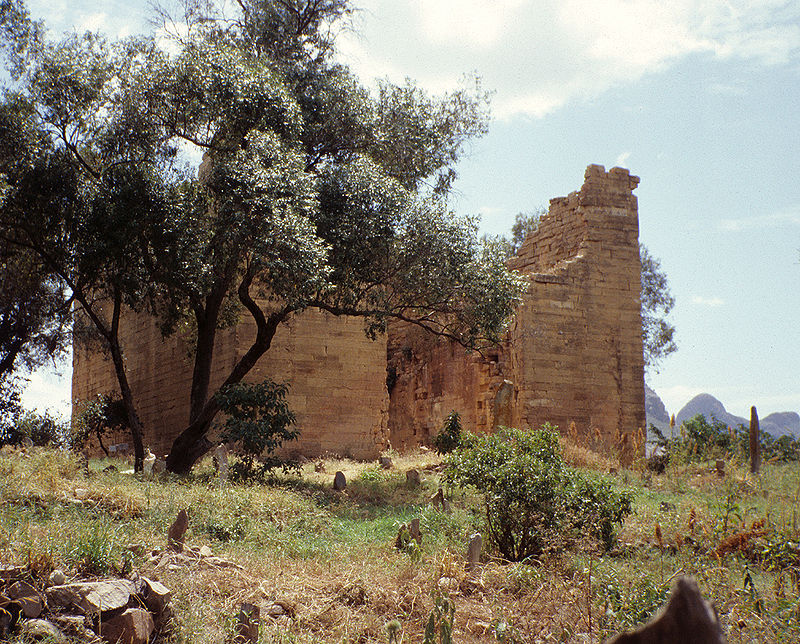
Temple of the Moon God at D'mt
During this time the kingdom of D'mt was reaching the zenith of its power and glory. Their kingdom was centred on their capital at Yeha, in what is now northern Ethiopia. They built a great temple at Yeha, part of which still stands today. It was probably dedicated to the Moon God, but this is unclear.

Inscriptions in the Sabaean script have been found from this region and most amazingly, they record the names of kings and queens for this obscure kingdom. They use Sabaean titles for their rulers, as well as the Sabaean script, so it is very clear that the kingdom was culturally influenced by the Sabaeans, but it does not seem as if they names of their kings and queens were Sabaean.

The kingdom of D'mt did not merely centre on Yeha, but had a number of other cities, mostly in the region of what is now the country of Eritrea. These included Hawulti, Matara and Qohaito, all of which may yield more information on the history of this land when excavated more fully in the future.

Sabaean inspired writing from the kingdom of D'mt
In Egypt and Kush, Taharqa acceded to the throne in 690BC. He appears to have been a strong and capable Pharaoh, but he faced a very serious threat. The Assyrian Empire was at the height of its power and, under their king Esarhaddon, invaded Egypt in 671BC. The Assyrians captured Memphis after a fierce struggle and while Taharqa escaped, other members of the Kushite royal family, including the crown prince Ushanahuru, were captured by the ruthless Assyrians.

Esarhaddon was faced with rebellion in his own kingdom and withdrew shortly after the capture of Memphis. But even so, this was the most terrible invasion that Egypt had seen in many centuries. The Libyans and the Kushites had both seen themselves as in certain sense Egyptian. The Assyrians were simply foreign conquerors. We have a prayer from Taharqa at this time.

Oh Amun, … my wives, let my children live. Keep death away from them, for me. 
Prayer of Taharqa, written around 670

The Egyptians rebelled against the Assyrians in 670BC and Taharqa came back to the attack. Esarhaddon died as he was returning to Egypt to crush the Kushite counterattack. His son Ashurbanipal took over the conquest. In 667BC Ashurbanipal returned to Egypt and defeated Taharqa once more. One of the Egyptian princes of Sais had been placed as an Assyrian governor of Lower Egypt and even though he had rebelled against the Assyrians, Necho I was returned to Egypt as a client ruler of the Delta in the name of the Assyrians.

Pyramid of Taharqa at Nuri in Kush
Taharqa died around 664BC and was buried in a grand pyramid at a new royal cemetery at Nuri. It was succeeded by Tanutamon, also known as Tantamani. Tantamani attacked the Assyrians, killing their vassal king Necho I, and the Assyrians counterattacked, pushing southwards to Thebes in Upper Egypt. Here they attacked until they had captured it and sacked it, causing great destruction in one of the greatest cities on earth. This destruction of Thebes effectively pushed the Kushite rulers back into Kush. The end of Kushite rule is generally held as the end of the Third Intermediate Period of Egyptian history and the beginning of what is known as the Late Period.

In 656 Psammetichus I, son of Necho I, recaptured Thebes, ending Kushite rule in Egypt. This was at least partly because the Divine Adoratrice of Amun (High Priestess) was a sacred figure and had been left alone by the Assyrians and Egyptians. This person had joint control over the city of Thebes and control of the vast estates of the temple of Amun. The current Adoratrice was Shepenupet II, a Kushite and a long-lived daughter of Piye, the first Kushite Pharaoh of Egypt. Shepenupet was old and had adopted a daughter, Amenirdis, the daughter of Taharqa, to succeed her.

Relief of Nitocris and Psamtik I
The estates of Amun were too powerful to be left in the hands of the relatives of a rival Pharaoh, so Psammetichus (or Psamtik I depending on what naming convention is used), decided to force Shepenupet to adopt his daughter, Nitocris, instead, so that on Shepenupet's death, Nitocris would become the next Adoratrice. This forced adoption took place in 656 and is commemorated by a stela of Psammetichus. This time period sees Psammetichus gradually increasing his power to the point where he would be able to defy the Assyrians and expel them from his land. Assyrian forces may have begun to withdraw from Egypt from around 654 onwards. Psammetichus I now ruled as a Pharaoh of the 26th Dynasty of Egypt.

In the year 9, second month of the first season, day 14, they arrived at the city of the gods, Thebes. As she advanced, she found all Thebes, men and women alike, standing, rejoicing at her approach, surrounding her with great offerings, a multitude in number. Then they said: "The daughter of the King of Upper Egypt, Nitocris, comes to the house of Amun; that he may receive her and be satisfied with her. The daughter of the King of Lower Egypt, Shepnupet, comes to Karnak, that the gods therein may honour her."
Adoption Stela of Nitocris

Relief showing Shepenupet
Psammetichus was also famed in literature for conducting possibly the first scientific experiment ever, or at least the first psychological experiment. The Egyptians had always claimed that they were the oldest civilisation in the world. Psammetichus sought to prove this by having some children raised without listening to the speech of others and trying to figure out which language the children would spontaneously speak, assuming that they would speak the original language of mankind and thus, find the oldest civilisation. This experiment supposedly showed that the Phrygians were the oldest civilisation, which is interesting, as that can hardly have been the expected outcome. This was determined by the fact that the children kept saying the word "bekos" when pointing at bread, which roughly matched the Phrygian word for bread, but not the Egyptian. However, this story is nowhere recorded among the Egyptians and is only taken from the much later Greek texts of Herodotus.

Stela of Tefnakht
While we cannot prove if the language experiment was real or not, we can be certain that a new form of writing was pioneered in Egypt around this time, called the Demotic script (capitalised to avoid confusion with Greek "demotic" script). This was a short-hand script that could be used to transcribe hieroglyphs quickly and in some ways replaced an earlier short-hand known as hieratic. It was not an alphabet but it could be used to speed up writing and was widely adopted. It was part of the much later Rosetta Stone that was later used to decipher the Egyptian hieroglyphs.

According to legend the Greek colony of Cyrene was founded in Libya with Greek colonists and native Libyans in the year 631BC. It had good relations with the native peoples and it was unusual for Greek colonies, in that the main city was founded slightly inland, rather than directly on the sea, as was more usual. The colony would become famed for its export of silphium, a rare plant that only grew near this region and was believed to be not only the finest of delicacies, but also a herb with powerful healing properties. Silphium became the main export of Cyrene under the reigns of the Battiad kings, who ruled the colony for some centuries after its foundation.

In the year 609BC Necho II of Egypt led an expedition as far as the Euphrates River to try and save the remnants of the Assyrian Empire, which was on the verge of destruction by the Babylonians and the Medes. On the way there he defeated King Josiah of Judah in battle at Megiddo. After some initial successes, the Egyptian force was dealt a serious defeat in 605BC and was pushed back to the borders of Egypt by the Babylonians. The Egyptians defeated the Babylonians on the frontier in 601BC, but the Babylonians were still an active threat in the region.

Nok culture terracotta artifact
Around the year 600BC the people of the Nok culture had definitely developed iron-smelting techniques. It is unclear if they developed these independently or if they had received external knowledge. I suspect that the knowledge of iron-working was brought from artefacts traded across Africa, but that the techniques of iron-working were developed independently. The sophistication of their smelting furnaces was quite impressive and the quality of their iron was some of the best in the world at the time. An important smelting site was located at the present-day town of Taruga, near the Nigerian capital city of Abuja.

Around 595BC Pharaoh Necho II died and was succeeded by Psamtik II. He was one of the most fascinating individuals of this time period and seems to have had many excellent ideas. Perhaps he was too ahead of his time though, as most of his ideas seem to have failed in their execution.

Necho II is supposed to have attempted to link the Red Sea to the Nile in the earliest version of the Suez Canal to have been attempted. This was a gigantic work and was truly a work of vision but there were problems with it, namely that there is a considerable difference in water levels between the two bodies of water. There are no Egyptian inscriptions for this but we know the story from Herodotus, who says that Necho II stopped construction after receiving an unfavourable oracle.

Depiction of Necho II
Necho II then appears to have commissioned an even more intriguing expedition. He hired Phoenician sailors, the greatest sailors of the ancient world, to set sail from the Red Sea and to attempt to circumnavigate Africa. According to Herodotus, who again, is our sole source for the story, the sailors did not return for a long time but did eventually arrive back in Egypt having sailed around the continent and coming back through the Straits of Gibraltar. This was an unprecedented feat and one that was not to be repeated to our knowledge until the Age of Exploration. The sailors told tales of the sun being in the wrong position, which led the Greeks, and perhaps the Egyptians, to discount the story. This however makes it much more plausible, as it suggests that the Phoenicians did in fact reach the southern hemisphere.

For Libya shows clearly that it is bounded by the sea, except where it borders on Asia. Necos king of Egypt first discovered this and made it known. When he had finished digging the canal which leads from the Nile to the Arabian Gulf, he sent Phoenicians in ships, instructing them to sail on their return voyage past the Pillars of Heracles until they came into the northern sea and so to Egypt. So the Phoenicians set out from the Red Sea and sailed the southern sea; whenever autumn came they would put in and plant the land in whatever part of Libya they had reached, and there await the harvest; then, having gathered the crop, they sailed on, so that after two years had passed, it was in the third that they rounded the pillars of Heracles and came to Egypt. There they said (what some may believe, though I do not) that in sailing around Libya they had the sun on their right hand.
Herodotus, Histories: 4:42

Statue of Anhknesneferibre
When Psamtik II took the throne he instated his daughter Ankhnesneferibre as Divine Adoratrice of Amun in Thebes. This was in the year 595 or 594 depending on what is counted as the first year. This was an important position, in certain ways perhaps the second most important position in Egypt after the Pharaoh himself, so it was important to ensure that this post was held by someone loyal to the dynasty. Nitocris I adopted the princess to ensure that she would become God's Wife on the death of Nitocris. Thus the Saite Dynasty (the 26th Dynasty) further strengthened its hold on the southern part of Egypt.

Year 1, third month of the third season, day 29, under the majesty of Horus: Favourite of the Two Goddesses: Mighty of Arm; Golden Horus: Beautifying the Two Lands; King of Upper and Lower Egypt: Psamtik II, given life. On this day the king's-daughter, Ankhnesneferibre, arrived at Thebes. Her mother, the Divine Consort, Nitocris, who liveth, came forth to behold her beauty, and they went together to the House of Amon. 
Stela of Ankhnesneferibre, written circa 594BC

Around 590BC the Kushite capital appears to have moved south from Napata, which was vulnerable to raids from the reinvigorated Egyptian kingdom, to Meroe, which was further south along the Nile. Napata was still held by the Kushites however and their kings continued to be buried in the royal cemetery of Nuri during this time.

In the year 589BC Apries of Egypt, known as Hophra in the Biblical record, succeeded to the throne. He was unable to prevent the rise of Babylonian power in the region, and it is possible that there was a Babylonian invasion during his reign, but this is unclear. He was overthrown by the usurper Amasis II in 570BC after a failed invasion of Cyrene.

Relief from Jebel Barka in Kush
I am not sure of when this story took place, but I have presumed it to occur at some point around the year 550BC, if it happened at all. The cities of Carthage and Cyrene both existed along the North African coast: Two trading cities, one Phoenician, one Greek. Neither side had great interest in the desert interior and were both more interested in trading with the rest of the Mediterranean. Thus they decided to draw a border between them. It was decided that two runners would set out from each city and run as fast as they could along the coast until they met the runners from the other city. Supposedly the Carthaginian runners made incredible speed and met the runners from Cyrene well over halfway away from Carthage. The runners from Cyrene understandably were annoyed and accused the Carthaginians, two brothers known as the Philaeni Brother, of cheating. Cheating may in fact have taken place. The Greeks wanted to rerun the race while the Carthaginians wanted the result to stand.

AD1872 painting of the Battle of Pelusium by Lenoir
Eventually the Greeks agreed to a compromise. They would accept the result, if the Philaeni Brothers were to be slain. If the Philaeni Brothers wanted to live they would rerun the race. The Philaeni chose to die so that their homeland could enjoy the advantage that they had won for it. Solemn sacrifices were made and until the time of late Antiquity the boundary between the two regions was fixed at the Altar of the Philaeni. Later the Roman Empire would be split into east and west at the point where the Philaeni Brothers died. I'm not sure when this story happened and I'm not at all sure if the story is true. It probably is not. But there are no records of Cyrene and Carthage going to war at least.

In 525BC the Babylonian Empire had fallen and the Persian Empire now dominated the Middle East. Led by their ruler Cambyses II, the son of Cyrus the Great, the Persians invaded Egypt, which was now ruled by the son of Amasis, Psammetichus III. There was a great battle fought at Pelusium, which the Persians won. There are some strange legends about the Battle of Pelusium that lead it to be known as the Battle of the Cats. This comes from a much later Greek book however and should not be taken too seriously. Egypt was now part of the huge Persian Empire. This ended the 26th Dynasty of Egypt. The Persian kings are sometimes referred to as the 27th Dynasty of Egypt.

Wall paintings from the tomb of Tanutamani
Around the year 500BC the Magonid kings began their rule of the city of Carthage. They were from a family that bore the name of Mago, e.g. Hamilcar Mago or Hannibal Mago. Very little is known of the constitution of Carthage around this time and even though it was ruled by kings during this period, there probably was some form of Senate, or Council, to moderate the decisions of the kings.

Around this time the ancestors of the Khoikhoi group probably began to inhabit the region to Twyfelfontein in what is now present-day Namibia. The region is known for its rock art in the caves and cliff faces. These rock carvings and paintings are preserved due to the aridity of the region, which receives very little rainfall. It was probably a sacred site or a gathering place for the hunter-gatherers of the region, but sadly little can be said about it.

During all this time the speakers of the Bantu languages were gradually moving southwards into the rainforests of central Africa. Over the next millennium they would gradually extend their languages across much of the central and southern reaches of the continent.

Wall paintings from the tomb of Tanutamani
And thus the period draws to a close. Egypt had seen the end of the New Kingdom, followed by the Libyan and Kushite rule of the Third Intermediate Period, followed by the Persian conquest after the 26th Dynasty. Even after the Kushite defeats, Kush was still one of the strongest states in the world at the time. The period also saw the growth of the Phoenician city of Carthage on the northern coast of Tunisia, and the foundation of the Greek colony of Carthage on what is now the northern region of Libya. The Iron Age sub-Saharan Africa began in earnest with the adoption and refinement of iron-working by the Nok Culture. In the east of Africa the little-known kingdom of D'mt was flourishing.

Sphinx of Amasis
Primary Sources:
Piye Stela, written circa 720BC
Prayer of Taharqa, written around 670BC
Adoption Stela of Nitocris, written circa 656BC
Herodotus, Histories: 4:42, written circa 440BC
Stela of Ankhnesneferibre, written circa 594BC

Related Blog Posts:
Some African History from 4000-3000BC
Some African History from 3000-2000BC
Some African History from 2000-1500BC
Some African History from 1500-1000BC
Some African History from 1000-750BC
Some African History from 750-500BC