Showing posts with label Europe. Show all posts

Monday, 4 November 2019

Some European History from 750-500BC

Etruscan Sarcophagus of the Spouses
This post will look at European history for the period from around 750-500BC. While most of the European continent is without written sources for this time period, the Greeks had a written tradition that is readable today and their inscriptions from this time period, as well as the much more voluminous Greek traditions from later time periods, allows us to talk more confidently about this period. The Greek sources also mention some of their European neighbours, for example the Thracians, but these records are less reliable than the ones regarding the Greeks themselves. Much of Europe is not documented at all and for areas such as Ireland, or Scandinavia, it is correct to view them as still being part of prehistory.

By the year 750BC Indo-European languages were spoken in the majority of Europe, with the exception of certain areas such as upper Scandinavia, perhaps parts of Ireland, Crete, Sardinia and parts of the Iberian Peninsula. Knowledge of iron-working was widespread at this point, but certain peripheral areas, such as Ireland and Scandinavia seem to have mostly used bronze at this point. For other points about the mid-700’s BC, these are dealt with in greater detail in the previous blog.

Reconstructed fortress at Biskupin
Around the year 700BC the fortified town of Biskupin was built in the region now known as Poland. This was a large island fortress that nevertheless had large wooden fortifications for defence. The builders were part of the Lusation culture, which was a Bronze/Iron Age culture that was related to the Urnfield and subsequent Hallstatt cultures further south in Europe. The fortified town was partially reconstructed by the Poles in the early 20th century, before it was intentionally destroyed by the retreating Nazis in WWII and subsequently rebuilt again after the war. It is one of the more impressive site reconstructions from the time period. I’m a fan of reconstructing history, as long as it can be done in a sensitive manner and without destroying what it purports to represent. We are visual and tactile beings and seeing a reconstruction may help us understand more history than we might otherwise get from a textbook alone.

On the Iberian Peninsula the treasure of El Carambolo dates from around this time. This is an exquisite hoard of golden treasure from the region generally referred to as Tartessos, to the southwest of the Iberian Peninsula. The golden hoard may be more closely associated with the Phoenicians however, as statues of their deities have been found nearby. It is an impressive hoard of gold regardless of whether its owners were Phoenician colonists or native Tartessians trading with the Phoenicians.

Hochdorf Chieftain's Grave
On the northern regions of the Italian Peninsula, the Villanovan culture gave way to the Etruscan culture around this time. The Etruscans are sometimes viewed as being external migrants to the region and there may be some truth to this. But if certain parts of Etruscan culture were imported from the outside, much of their culture was an evolution of the existing Villanovan culture.

Grave practices did seem to evolve and the tombs became quite elaborate. Cremation was still common, but rather than simply being interred in urns, elaborate sarcophagi and/or tombs were constructed for the nobles. Games for the dead may have formed the foundation for later gladiatorial games in Rome. Roman customs such as celebrating a triumph are also probably of Etruscan origin.

The Etruscan vision of the afterlife influenced later Roman conceptions of Hades and may have ultimately influenced medieval writers such as Dante. Later Roman writers viewed the Etruscans as being continually concerned with divination, augury and religious matters, to the point where they were viewed as almost superstitious.

The Etruscans ultimately formed into a confederation that was referred to as the Twelve Towns. These held an annual council at the shrine of the goddess Voltumna and decided matters between themselves. The League was a very loose one and in practice each city acted nearly independently. However these observations are taken from later sources and may not have been present at the beginning of the Etruscan civilisation.

Dipylon Inscription
In Greece, the earliest writings date from around this time. The two objects generally held to be have the oldest writing are the Dipylon Inscription and the Nestor Cup, both of which are small inscribed pottery pieces. Pottery and terracotta tend to survive the ages well. Even broken, they can be put back together. They cannot be melted down by looters like bronze or gold and once in the ground they can last for a very long time. Hence, why, even if nothing else survives of a culture, the archaeologists may still find the pottery.

It is around this time that Homer is said to have written the Iliad and the Odyssey. It is unclear if the Odyssey and the Iliad were written by the same person, if that person was Homer, or even if Homer existed. But rather than calling the person Anonymous, we may as well call them Homer. These two epics were drawn together from the existing oral tradition of epic poetry. If Homer existed, he was more of a master compiler and editor than an author in the modern sense. We know that the Greek epic tradition was well known in the centuries that immediately followed Homer, but we cannot say for sure that the organisation of the epics was exactly the same as we have them today. The versions of the poems that survive to us are the earliest pieces of European literature extant today. They also have a justified claim to being some of the greatest literary works ever written, but this is subjective.

Artifacts from the Hochdorf Chieftain's Grave
Around the year 650BC the climate in Scandinavia appears to have grown colder. In a probably unrelated development, the Novocherkassk culture of the Pontic steppe, in the lands north of the Black Sea, appears to have disappeared around this time. This is likely because they were subsumed into the Scythian culture that was becoming prominent.

Around this time the Etruscans seem to have developed their own script to write their language in. This was an alphabetic script and was based on the Phoenician and Greek alphabets, both of whom would have traded with the Etruscans. The Etruscans left a large number of inscriptions, but their language appears to be a language isolate and is quite difficult to understand. Thus very little of it can be fully understood.

By around the year 600BC the Scythians seem to have become dominant in the Pontic steppes. They were a nomadic tribe of horse-riders. The Greeks feared them as barbarians and saw them as “other”. Like other steppe peoples before them, they buried their dead in Kurgans and carried their wealth in horses, cattle and gold. Their religion is not well known, but their artwork seems to have motifs of deer, birds and leopards in a ceaseless struggle against each other. This may be an artistic trope rather than a religious belief however. The Scythians were said to practice human sacrifice as well.

Strettweg Cult Wagon
The Strettweg Cult Wagon appears to date from around this time as well. This was a bronze grave offering found in the tomb of a Hallstatt culture Celtic chieftain in what is now the region of Austria. The wagon is an elaborate four-wheeled creation with figures of warriors, worshippers, horsemen and deer surrounding a larger female figure bearing something upon her head, usually displayed as a bronze bowl although this is now disputed. It is a striking artwork and one that is usually used as a depiction of the Hallstatt Celts. It is still not entirely clear what the Cult Wagon is actually depicting. While it is probably a religious ceremony of some sort, it is hard to say more than this.

An even more mysterious memory from this time is the Girl of the Uchter Moor. The body of a girl was found in a bog in what is now Germany. She was dated to have lived around this time. However, she had not been cremated, nor were there grave goods found with her body. The girl was well-preserved and 17-19 years old. She had been malnourished and had clearly had a hard life, with her skeleton showing signs of lifting very heavy loads. She was clearly not a high-status woman and the fact that she was naked when buried in the bog suggests that this was not a burial, but an ancient crime scene.

Reconstruction of the Girl of the Uchter Moor
Maiden Castle was first built in Britain around this time. This would go on to later become one of the most spectacular ancient fortifications in the British Isles, but the initial fort was much more modest.

In the Iberian Peninsula, the Southwest Paleohispanic script, sometimes known as the Tartessian script, was developed. This was probably the third oldest European alphabetic script, after the Greek and the Etruscan, although the Latin alphabet may predate it. The Tartessian alphabet was actually a semi-syllabary and thus contained a number of redundant signs. It was almost developed after contact with the Phoenician script, but is not a direct copy, as the Phoenicians had no need for syllabic signs. The sounds can be guessed at by the connections to the Phoenician alphabet, but the language itself is not understood. It may be a non-Indo-European language.

Around the year 550 a Celtic chieftain was buried with great splendour in what is now the small village of Hochdorf in Germany. The mound was a large one, but had gradually sunk into the ground and had been lost to history. This obscurity saved it from looting and the golden objects survive to this day. The man buried here was doubtless of great importance, almost certainly a chieftain or a king. He was middle-aged, perhaps around 40 years old. The tomb held a wagon that was covered in iron and which carried grave goods to be wheeled into the next world. A great cauldron was filled with mead for feasting and the chieftain himself wore gold and amber. It was a magnificent burial and a sign of the grandeur of the Celtic world.

In the Italian Peninsula, an Etruscan couple were buried in the necropolis at Caere (now known as Cervetari). Their sarcophagus for their ashes was decorated with a scene of the couple reclining lovingly in each other’s arms as for a feast. It is a perhaps the most iconic piece of Etruscan sculpture. It was made in terracotta and was once painted, although this has faded. It is displayed in the Etruscan Museum in Rome. This artistic motif of a banqueting couple may once have been a common one, as a similar sarcophagus is preserved in the Louvre.

Duenos Inscription
Further south, in Rome, the first inscriptions in Latin begin to appear around this time. The probable oldest writing in Rome is on the Lapis Niger, in the Roman Forum. However another candidate for the oldest Latin inscription is the Duenos Inscription, which is on a small pottery piece held in the Altes Museum in Berlin. Another candidate for oldest Latin inscription is the Praenestine fibula, but there is still some doubt over the exact dating of this artefact.

In Greece, the main period of colonisation, of the sending out of spare citizens to explore and make new cities in new lands, came to an end around this period. Occasionally new colonies were sent out, but for various reasons, including needing increased manpower for hoplite warfare and increased participation of the hoplite class in government, the Greek cities generally ceased to send colonies.

The Greeks had mostly stopped sending colonists to conquer new territory, but around this time Thales, an Ionian Greek from the city of Miletus in Asia Minor, became the first philosopher in the Greek tradition. He also has some claim to the title of first scientist as well. Thales believed that water was the primordial entity and that all things came from water. This is of course wrong, but Thales is perhaps the first person known to us who attempted to rationally explain the world without reference to the gods. Much of what later became philosophy and science and all the sub-disciplines and related disciplines of these two endeavours, stems from this moment.

Sarcophagus of the Spouses
Around the time of 500BC the Iron Age arrived in Ireland, as well as into the Scandinavian region. The Celts probably also arrived in Ireland around this time, although it is not clear if there was a large migration from Europe or Britain into Ireland, or if it was a small migration that gradually spread the culture and language. The latter option is perhaps more likely.

The Celtic world on the mainland was also changing. The Hallstatt art style was beginning to be superseded by a newer style of Celtic art, known as La Tene. This was named after a village in Switzerland where a huge variety of objects had been dropped as votive offerings in an Alpine lake. The art style gives its name to the culture, which is said to supersede Hallstatt culture, although the change was primarily a stylistic one. The art style is one that most people would identify as Celtic, including the spirals and curving lines so associated with Celtic art. But the art style was probably also taken up by speakers of non-Celtic languages as well.

Around this time the actual Celtic settlement of Hallstatt seems to have been abandoned and looted. This would almost certainly have nothing to do with the change in art style, but was more likely to be tied to a nearby salt mine becoming unproductive. As the settlement shifted away to a new source of income, the abandoned town was looted by those who were leaving or by surrounding peoples.

The Lepontic and South Picene alphabets may date from this time. These are poorly attested alphabets from the Italian Peninsula. The Lepontic script (also known as the Lugano Alphabet) is from the Alpine region and probably was used by the Celtic inhabitants of the region, who would have been visited by Greek and Etruscan traders.

The South Picene alphabet is from the east of the peninsula. The people on the other side of the Apennine Mountains from the Etruscans developed their own script. Only around 20 inscriptions remain and it appears to be heavily influenced by the Etruscan alphabet. However because the language is Indo-European the inscriptions are (generally) readable.

Pyrgi Tablets
The Pyrgi Tablets, perhaps the most important Rosetta Stone like object for the Etruscan alphabet, dates from around this time. These are a collection of three golden sheets inscribed with Etruscan and Phoenician inscriptions. The tablets have aided a great deal in the better understanding of Etruscan, but the inscriptions do not seem to match exactly and the fact that Etruscan is itself an unknown language makes further advances with Etruscan inscriptions difficult.

An Etruscan artist in the city of Veii created the Apollo of Veii, a terracotta statue of the god Apollo disputing with the hero Heracles. This was as part of a scene to decorate a temple. The artwork is quite advanced and nearly on a par with the Greek Archaic statuary that was current in Greece at the time.

In the year 513BC King Darius I of Persia, ruler of the largest empire in the world at the time, launched an expedition across the Bosphorus into Europe. This was aimed at conquering the Thracians, Macedonians and Scythians. The Thracians and the Macedonians were quickly brought into the Persian Empire, but Herodotus records that the Persians had to cross the Danube to face the Scythians. The Persians marched fast but the Scythians retreated faster and even though Darius was said to have crossed both the Dnieper and the Don and advanced all the way to the edges of the Caucasus, he was unable to bring the steppe warriors to battle as he had wished. The Persians retreated to the Danube and returned to Asia.

In the year 509BC it is said that the Romans overthrew their last king, Tarquinius Superbus, a man of Etruscan descent, and established the Roman Republic. The foundation of the Republic has many legends associated with it and the date in particular is not fixed. However, this is the traditional date and I have mentioned it here.

Gold dress fasteners from Bronze Age Ireland
In the year 508BC, we can say with more certainty that the Athenians, having finally got rid of their tyrants two years previously, began to move towards a participatory democracy. I have spoken at length of Greek history elsewhere and the reader can check the associated blogs, but I feel it useful to give context as to what is happening in Europe.

Thus the period draws to a close, with La Tene Celtic culture becoming the dominant culture in central Europe and iron-working technology spreading entirely across Europe. In the Iberian Peninsula Phoenician influence is growing in importance, while in the Italian Peninsula Greek cities have been established in the south, the Etruscan civilisation is flourishing in the north, and between these lies the small and hitherto insignificant city of Rome. The period sees Europe move more fully into the historical period, with the beginnings of Greek philosophy and science and from this point onwards, much more can be said.

Related Blog Posts:
Some European history from 4000-3000BC
Some European history from 3000-2000BC
Some European History from 2000-1500BC
Some European History from 1500-1000BC
Some European History from 1000-750BC
Some European History from 750-500BC

Sunday, 3 November 2019

Some European History from 1000-750BC

Golden Hat of Berlin

This post will look at European history for the period from around 1000-750BC. Due to the lack of sources we will have no real written records to rely on. This means that to look at history for this place and time we have to rely primarily on the archaeological record. This is fine and useful, but like all methods of looking at history it has its flaws and caution must be used. The dates in particular must be treated with caution. Some of the issues with dating have been dealt with in the previous post on European history. 

By the year 1000BC, Indo-European languages had probably reached nearly every part of Europe, although some areas, such as upper Scandinavia, perhaps parts of Ireland, Crete, Sardinia and parts of the Iberian Peninsula may not have spoken Indo-European languages. The Bronze Age had now spread across practically the entire continent, but was slowly being replaced by the new iron-working knowledge from the Middle East. While there were few trade routes as such, the Amber Road, which brought the prized amber from the Baltic, through the Moravian Gate and into central and southern Europe. 

Iron Age houses
In the century of the 1000’s BC the last remnants of civilisation on Crete appear to disappear. This had been known as the Sub-Minoan Age and was perhaps the last place where the palace organisations survived. But eventually this too was abandoned. It seems that Crete had a non-Greek speaking population until the 3rd century BC. This language, known as Eteocretan, was very likely to be a descendant language of the language spoken by the Minoans. Very few inscriptions remain; enough to be tantalising but not enough to translate satisfactorily, and some of those few were destroyed in World War II. Enough remains however to show that it has no clear relationship with Indo-European languages or any other known language family. 

Far to the north of Europe, it is around this time that the speakers of Uralic languages began to inhabit the northern reaches of Scandinavia. The languages spoken by these people would eventually evolve into Sami, Finnish and Estonian. 

Artifact from Hallstatt
Also in Scandinavia, at the site of Uppsala in Sweden, a great mound was made around this time called the Håga Mound. It is one of the largest Bronze Age burials in Europe and was larger even than the King’s Mound in Scania. Uppsala, where this tomb lay, would be an important cultural and religious centre in Scandinavia. It was the largest pre-Christian temple of the pagans and even today is the home of an old cathedral that was built at the site after the Christianisation of Sweden. The Håga Mound itself was excavated in 1902 by, among others, a young Swedish prince with a love for archaeology who later became King Gustaf IV Adolf of Sweden. 

On the Balearic Islands of Minorca and Mallorca a new culture, known as the Talaiotic Culture, arose around this time. Like the torri of Corsica or the nuraghes of Sardinia, the taliots of the Balearic Islands were tower-like structures that appeared all over the islands. They do however appear to be somewhat later than the nuraghes and it is unclear if the two phenomenon are related. 

This period also saw the burial of a huge cache of gold known as the Treasure of Villena. This was the largest Bronze Age treasure from all of Europe. The hoard was discovered in Spain and contained gold, silver, iron and amber. Despite the fact that the prehistory of the Iberian Peninsula is poorly known outside the region and often is not talked about, the sheer volume of treasure found at this one site, outweighed the golden goods of the Mycenaean graves. 

One of the major shifts that was happening quietly around this time was that the use of iron was beginning to spread throughout Europe. The Treasure of Villena contained iron, but it seemed to be a valuable metal that was used more for a decoration. The Iron Age refers to a time when iron was so cheap and economical to use that people used it more than bronze or stone for their tools and weapons. It is the ubiquity of the material that makes the age. Slowly but steadily iron-working technology was spreading westward and northwards across Europe and bronze would be gradually used less. Thus the Iron Age came by slow degrees to Europe. 

Urns of the Urnfield culture
Culturally, much of continental Europe was dominated by the Urnfield culture, where the dead were generally buried in urns. Cremation was common. Bronze was the main metal of choice, even as the use of iron began to spread through the tribal lands. Warrior elites fought from chariots with spoked wheels. Large fortified settlements were built atop hills, while in the lakes of the Alpine regions, houses were built on piles driven into the lakes to protect the dwellers from those who roamed the shores. In central Europe, though not necessarily outside it, the Urnfield culture may have corresponded loosely to the speakers of proto-Celtic, though we must be careful of confusing material cultures with linguistic ones. 

Two more of the enigmatic Golden Hats were created around this time. The Golden Cone of Ezelsdorf-Buch and the Avanton Gold Cone date from around this period. The astronomical features of these golden hats and other earlier artefacts such as the Trundholm Sun chariot might suggest that the Urnfield culture peoples, and the peoples of the Nordic Bronze Age cultures, might have primarily worshipped the sun. But this is speculation. 

The Golden Hat of Berlin
Around the year 950 the Golden Hat of Berlin was made. Like the Golden Hat of Schifferstadt, the Golden Cone of Ezelsdorf-Buch and the Avanton Gold Cone, this was an ornate golden hat, beaten out of thin sheet gold and covered with intricate spirals, similar in construction to the Mold Cape from Britain. The metallurgy needed to create such a perfect work from such a tiny amount of gold showed that the tribes of northern Europe had master goldsmiths. The golden hat would have been worn atop a hat of other materials and was probably worn for religious purposes. The symbols on the hat were probably astronomical in nature and may have represented the astronomical knowledge of the wise men of these tribes. 

The hat was deliberately buried with earth inside it to preserve its shape. The shape of the hat is tall, with a broad brim. The Berlin Hat is, in my opinion, the finest of the late Bronze Age Golden Hats and is well worth a visit to the Neues Museum in Berlin. 

I wonder if there was some cultural memory of old wise people wearing tall hats that transferred to a later wizard stereotype. It probably is a mere coincidence but I cannot look at any of the golden hats (there are four that are known to us) without considering the possibility of a Bronze Age Gandalf.

Around the year 900BC the Proto-Villanovan culture ended in Italy and was replaced by the Villanovan culture. This was more of a gradual evolution rather than a violent replacement. The Proto-Villanovan and Villanovan were both derived from or influenced by the Urnfield culture that was dominant in central Europe in previous centuries. 

Villanovan burial urn
The Villanovan culture roughly coincided with the spread of iron working to the Italian Peninsula. Their warriors wore elaborately crested helms and they had a warrior culture similar to the other regions of Europe. Not much more can be said of this culture, although those who came afterwards would be famed. 

Around this time the Phoenicians, who lived on the Levantine coast, began to send colonies throughout the Mediterranean. These were mostly in the eastern Mediterranean or in Africa to begin with, but not long afterwards Phoenician colonies would be settled in the Iberian Peninsula, on the island of Sicily and along the southern coasts of what is now France. There is the possibility that Phoenician colonisation began some centuries earlier, but this is debateable. 

Around the year 850 the Eberswalde Hoard was buried in the region that is now Germany. This was a hoard of the late Bronze Age, although the Iron Age was coming to that region of the world. There over 80 gold objects, mostly gold spirals and bangles, but including some beautifully decorated gold bowls. The treasure was stored in Germany and disappeared to Russia in the aftermath of WWII. A reproduction can now be viewed in Germany. 

Around the year 800BC the Urnfield Culture is generally viewed as coming to an end and the Hallstatt Culture is said to have evolved out of the parent Urnfield Culture. The Hallstatt Culture was named after a burial site at a village called Hallstatt in Austria. Over 1,300 burials were found, spanning a period of centuries. The distinctive artwork found in certain of these graves has given rise to the name of the culture. The Hallstatt culture, in the areas west of Hallstatt, are generally associated with the culture later known as Celtic. 

Around this time the Iron Age seems to have reached the island of Britain. Strangely enough the technology does not seem to have crossed over to Ireland, perhaps because there were large quantities of copper on Ireland that made bronze cheaper to produce than in other areas. 

Giant of Mont’e Prama
Around this time the people of the Nuraghic culture, on the island of Sardinia, built a huge tomb, possibly an entire necropolis. This tomb, near Mont’e Prama, was flanked (probably) with large statues carved as outsized warriors. The artwork might appear crude to us, but the site was subject to extensive looting after its discovery and many of the most impressive sculptures are probably missing. The dating of this tomb and these statues is problematic. They could date anywhere between 1000-300BC. I have written about them during this time period, but this is merely one interpretation. It is worth remembering that there were little known civilisations who nevertheless produced artworks. Without writing it is of course difficult to say more. 

On the Pontic steppe, in the areas now referred to as Ukraine and southern Russia, the Novocherkassk culture began. These were a steppe people who buried their dead in kurgans. Like other steppe peoples they appear to have been very concerned with horses and cattle, but not much more can be said of them. 

In the year 776BC the first Olympic Games in Greece are said to be held and the Greeks dated their Olympiads from this date. There is no contemporary evidence of this event and I would be wary of taking the date overly seriously. But there is no real reason to discount it automatically either. 

Spread of Celtic culture across Europe
In the year 753BC Rome was said to have been founded by Romulus. As with the Olympic dating in the previous decades, there is no contemporary evidence of this and there is a strong chance that it is legendary. However, it is likely that there were some village settlements on the hills of Rome during this time and that they may have begun to amalgamate themselves in or around this time period. Possibly they did this under the guidance of a charismatic tribal leader: Possibly his name was Romulus. But while not impossible we cannot leave it unquestioned either. 

The Oracle of Delphi was probably established by around the mid-700’s BC. This was a prophetess cult in Central Greece. Volcanic vapours wafted into a cavern over which a temple was later built. A woman specially chosen for the purpose would be sent into the cave for some time, before emerging in a euphoric trance speaking prophecies, which might or might not be intelligible. Those who came to the Pythia, for so she was called, would have these replies cast into a definite form by the priests and this guidance led most of the Greek world. Whenever a Greek individual or city wished to do anything of importance they would first consult the Oracle and thus it became the main focal point of the Greek world. 

Reconstruction of the Eberswalde Hoard
It was around this time that the Greeks were beginning to emerge from their Dark Ages. Greek cities, while still small and relatively poor compared to the cities of Egypt or the Near East, were now suffering from overpopulation. To solve the problems of overpopulation and discontent, Greek cities would send away colonies, groups of perhaps a thousand or more people to found a new city in faraway lands. There would be generally good ties between the parent city and the child colony, but many of the colonies became major cities in their own right. The prospective colonists would consult the Oracle who would give advice on where and how to settle the new lands. After this the Greeks would sail out into the frightening waters, for navigation was still an uncertain art for the Greeks. They would come into conflict with the Carthaginians who were already colonising and trading in the Mediterranean. 

Treasure of Aliseda
One of the most important markets for both the Carthaginians and the Greeks was the semi-mythical city of Tartessos. This was probably located in the region of southern Spain/Portugal, past the Pillars of Heracles, but south of the Tagus. Archaeology has shown that there was a rich culture in the region, but it is unclear exactly where the city of Tartessos itself existed, if it did exist. 

The Greek accounts are contradictory as to where exactly it lay and there is the possibility that Tartessos was not an exact place. The Phoenicians of Tyre, Sidon and Carthage were the main commercial contacts of Tartessos and jealously guarded their secrets. The confusion over Tartessos may be as the result of contradictory tales put about by the Phoenicians to protect their trade secrets. 

Tartessos may even be mentioned in the Bible a number of times, as the Biblical writers mention a trading port named Tarshish across the sea to the west. But they give few further details of this strange place. 

Villanovan Helmet
Possibly the most important change that occurred around the mid-700’s BC was the creation of the Greek alphabet, adopted from the Phoenician alphabet. This is the ancestor of the current Greek alphabet, as well as the ancestor of many of the alphabets in use in the world today. While no texts survive from this exact time period, the script must have been invented around this time, as many inscriptions appear shortly afterwards. This means that after several centuries of near total silence, at least one European civilisation could transmit their writings to later generations. 

And thus the period draws to a close, with the Iron Age technology spreading westwards across the continent, but with the fringe regions still primarily using bronze. The proto-Celtic Urnfield Culture had evolved into the primarily Celtic Hallstatt culture. Great advances were being made in Greece, which was once again linked by trading ties to the Near East and the Greek region is about to re-enter the field of history rather than prehistory.

Related Blog Posts:
Some European history from 4000-3000BC
Some European history from 3000-2000BC
Some European History from 2000-1500BC
Some European History from 1500-1000BC
Some European History from 1000-750BC
Some European History from 750-500BC

Monday, 25 February 2019

Some European History from 2000-1500BC

Fresco of the "Saffron Gatherer" from
Akrotiri
This post will look at European history for the period from around 2000-1500BC. Due to the lack of sources we will have almost no written records to rely upon; none that we can read at least. As well as the lack of sources, the time period is too distant for ancient legends to be of much use, although there may be flickers of truth remembered in places. This means that to look at history for this place and time we have to rely primarily on the archaeological record. This is fine and useful, but like all methods of looking at history it has its flaws and caution must be used. The dates in particular must be treated with caution. Some of the issues with dating have been dealt with in the previous post on European history.

In the previous post, looking at European history for the period 3000-2000BC, we saw that megalithic architecture in Western Europe was gradually becoming less prevalent. Cultures that seem to be associated with Indo-European languages were spreading westwards from the lands north of the Black Sea. The Bronze Age spread across nearly the entire continent, except for the isolated northern fringes, with nearly all cultures having some familiarity with bronze-working.

Minoan snake goddess
In the century of 2000BC Newgrange, which is now the most famous megalithic site in Ireland, was abandoned. The nearby site of Knowth would see ritual use by other later cultures, but this is by and large the end of the era of great megalithic tombs in Ireland. Around this time the Bronze Age had come to Ireland and perhaps those who had brought the new technology had also brought new beliefs? Many stone circles now begin to appear in Ireland, and may be related to the shifts in belief, or the physical manifestations of these beliefs.

Further to the south in Ireland, in what is now the county of Laois, a ritual killing took place. A man was taken to a peat bog, where he was struck down with a sharp object, breaking his arm as he tried to parry the blow. After his death his back was broken in two with the sword and the man was buried in the bog. It would seem that he was a king who had failed to bring good harvests.

The role of kingship in Ireland was seen as a contract between the king and the gods, where the king would rule, but also bring the favour of the gods, in the form of good weather and harvests. Any king who failed this task would be sacrificed and a new king placed in his stead. This fusing of kingship, duty and sacrifice was held by a number of cultures in northern Europe. In this case, the body of the sacrificed man was preserved by the bog and was discovered in 2011. Many bodies are preserved across northern Europe in the bogs, but Cashel Man, as this man was known, is the oldest one whose flesh was preserved. His remains are a reminder of the sometimes brutal nature of our ancestors. I would hate to be responsible for plentiful harvests and good weather, in Ireland of all places.

Partially reconstructed palace of Knossos in Crete
In Finland large megalithic monuments known as Giant’s churches were built. The largest of these was built at Kastelli, measuring around 60x35 metres. Unlike the megalithic monuments of Atlantic coast of Europe, these appear to have been built by hunter-gatherers rather than Neolithic farmers.

In Greece, the Phylakopi culture came to an end on the Cycladic islands and the Middle Helladic began on mainland Greece. On the island of Crete, the first phases of the palace of Knossos began to be built, which would be the focal point of the first indisputable civilisation in Europe.

Around the century of the 1900’s BC new inhabitants may have arrived in the small island of Malta. Here their wooden wheeled carts began to erode ruts in the soft earth, and beneath it, the soft stone. One area of Malta is so rutted with these tracks that it is referred to as Clapham Junction, because the overlapping ruts look like a busy railway junction. The correct name for it in the Maltese language is Misraħ Għar il-Kbir and is near Siġġiewi.

Reconstruction of the tumulus at
Leubingen
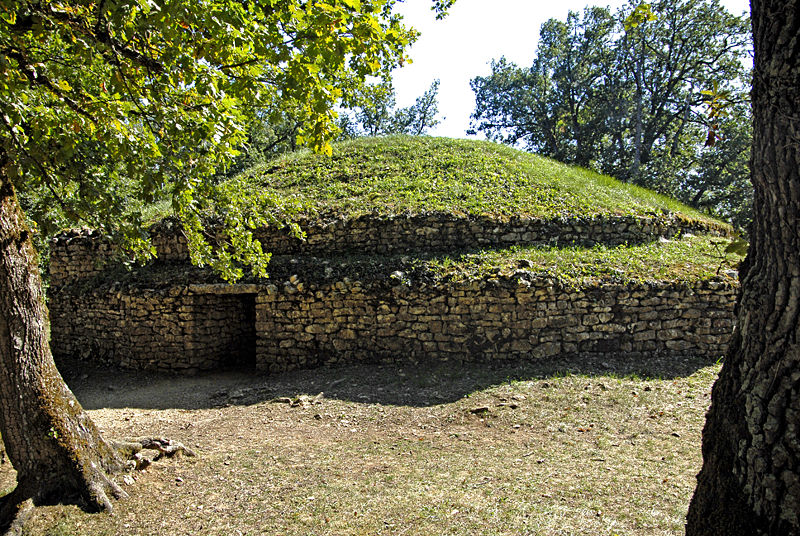
Around the year 1942BC, in Leubingen in what is now Germany, a tumulus was built for a powerful member of the Unetice culture. We can be relatively certain of the year because an oaken beam in the tomb was tested using dendrochronology. The grave goods were impressive, with gold, bronze and stone items placed in the tomb. But the most impressive thing about the tomb was the size. The tumulus was roughly circular with a height of 8.5m and diameter of 34m, no small feat for the burial of one person. We know nothing of the person save that they must have been important. They may have been a tribal chieftain or king of unusual importance.

Around the century of the 1800’s BC, the Neolithic settlement of the Monte d’Accoddi in Sardinia, as new peoples and cultures began to inhabit the island and older beliefs were abandoned. It is unclear if there was a population transfer or if the islanders merely adopted the cultures of the mainland. It does not seem that the islanders began to speak Indo-European languages so it was probably more of a cultural shift.

Linear A writing from Crete
It was around this time that the Minoans began to develop the writing system known to us as Linear A. This was in addition to their previous writing system, known as Cretan Hieroglyphs. Neither of these has yet been translated satisfactorily and very few examples of the scripts survive. It probably does not represent a Greek language and it is likely that the language of the Minoans (or at least the Minoan scribes or elites) was not a Greek language. A number of the symbols are shared with a later script (Linear B) so, if we presume that Linear B copied Linear A and reused certain symbols for the same sounds we can make some educated guesses as to what it sounds like but so far the language has not been identified. Perhaps one day it will be translated, but so little remains that it may be an unsolvable problem.

Around the century of the 1700’s the Minoan culture in Crete was the most sophisticated in Europe. It was here that there were palaces and cities for the first time in Europe, discounting the anomalous and far earlier Cuceteni-Tripolye culture. Trade networks stretched across the eastern Mediterranean, connecting the Cycladic Islands and Greece to Crete and Crete to Egypt, Anatolia and the Levant. During this century however, a huge earthquake destroyed most of the palaces. The Minoans merely rebuilt on a scale even grander than before and this was the beginning of the golden age of the Minoans.

Tomb of Oscar and Agda Montelius
in a replica dolmen grave in Sweden
This time period marks the beginnings of the Nordic Bronze Age, which is an archaeological term for the period 1700-500BC when bronze was the primary metal in use in Scandinavia. It’s rather a catch all term, but it is interesting in that the person who devised this categorisation (Oscar Montelius) was the first person to split up history into the classic Stone Age, Bronze Age, Iron Age types. It is such a fundamental concept to our understanding of history that we sometimes overlook it. Oscar and his wife Agda are buried under a dolmen, reflecting their love of ancient history, in Norra begravningsplatsen in Sweden. Their tale lies outside this time period, but they helped shape our understanding of it and they deserved to be remembered.

The Nuragic culture in Sardinia began around this time. This would see large tower-like structures being created that would serve as dwellings and fortresses for the peoples who lived here. I will discuss them in greater detail in the next blog.

Around this time, the Beaker culture in Britain and Ireland finally changed into other cultural phases. In central Europe the Beaker culture had evolved into the Unetice culture about five centuries earlier. We must remember that these cultures are created by archaeologists to help systemise the artefacts that are discovered. The term Beaker culture would have been meaningless to any person who belonged to it. Doubtless they would have been shocked to realise that they were being categorised on the basis of their pots rather than tribal groupings. Those tribal groupings are practically invisible to archaeologists today, but the pots still remain.

Mold Cape
One of the greatest treasures of the Bronze in Britain dates from this time and is known as the Mold Cape, after the town of Mold in Wales where it was discovered. It is a ceremonial golden object that was probably meant to be worn over the shoulders by priests or kings. It is a very beautiful and surprisingly well-preserved object. The exact dating is a matter of conjecture, as gold is very hard to date, but it is probably around this time period, with a couple of centuries as a margin of error.

Around the century of the 1600’s BC the Neopalatial Period of the Minoan culture began. The Cretan palaces and cities had suffered from a large earthquake in the previous century, but they had rebuilt and thrived. The palaces may or may not have housed kings and queens but may have functioned as distribution centres. So the people of Crete would bring the produce of land and trade to the palaces where functionaries would redistribute it. As many of the palaces were not fortified and contained large storage areas it seems likely that they had some redistribution function. There is one room in the palace of Knossos, the largest of the palaces, which may have been a throne room. But it may have had a religious function either.

Phaistos Disc
The Minoans were trading with the whole eastern Mediterranean. Their buildings were multi-storey, covered in decorative frescoes and sustained by pillars that held up the large ceilings. They had developed two types of writing, Cretan hieroglyphs and Linear A, which are the two earliest proven writing systems in Europe, although neither is translated. The Phaistos Disc is the best known example of the Cretan hieroglyph writing and dates from around this time. As the name suggests, it is disc shaped, with the hieroglyphs on both sides, arranged in a spiral pattern. Despite the beauty of this object it does not seem to have been very practical and it is probable that literacy was extremely limited in Minoan society.

Minoan religion seems to have involved worship of a mother goddess, perhaps similar to later Phrygian religion, but there were other gods as well. The most famous statuette of Minoan religion is one showing a bare-breasted goddess or priestess, with a flounced dress and snakes in both hands. The association of snakes and goddesses/priestesses would be carried over into later Greek religion, where the oracle at Delphi and the goddess Athena were both associated with snakes.

Fresco of bull-leaping
One ritual that is featured in their art was that of bull-leaping, where young men would vault across angry bulls while young women waited to catch them. This must have been a dangerous ritual and it is possible that the actual leapers of the bulls were slaves or foreign prisoners/hostages. If this was the case then this may be some foundation for the later myth of Theseus and the Minotaur. The roofs of some Minoan buildings may have been decorated with bull horn decorations.

Another ritual item that the Minoans seem to have been interested in is the double-headed axe. This was seen as a type of good luck charm, a symbol that would protect the bearer. The walls of the palaces are decorated with them and a number of these were created as votive offerings.

Frescoes from Akrotiri
The Minoans do not seem to have been particularly warlike, in that few weapons have survived, and no artistic depictions of war. But there may be a good reason for this. Later Greek myths spoke of a powerful Cretan king, called Minos, after whom the later archaeologists named the civilisation. They believed that Minos was the first to establish control of the sea, which would mean that the Minoans may not have needed to focus on fortresses and armour, when they could sink the fleets of any invaders long before they reached the shores of Crete. Perhaps there were roaming fleets based at every island of the Cyclades. The Egyptians were not noted seafarers and the other powers of the eastern Mediterranean were their trade partners, so perhaps they felt no need for land-based armies?

The art of the Minoans was beautiful. They created large stone vessels to store liquids, which were elaborately decorated. They also created delicate murals on their walls, frescoes on the plaster surfaces. These would show boxers, bull vaulters, scenes of trade and sea-faring and a host of other pleasant images. Their architecture was most evident in their palaces, which were sprawling complexes. They had none of the elegant symmetry of later Greek architecture, but instead were impressive through their sheer scale. The palace of Knossos had a large road that stretched down to the nearby seaport and this was one of the first paved roads in Europe. The palace of Knossos also had a drainage system and plumbing, meaning that it rivalled the palaces of Egypt and Mesopotamia for comfort.

Fresco showing ships from Akrotiri
The palace and adjoining city complex of Knossos was estimated to have around 100,000 inhabitants during this century. This is merely an estimate, but it is likely that Crete was one of the most densely inhabited parts of the world at this time and that Knossos was one of the largest cities.

The advances were not merely confined to the island of Crete alone. The city of Akrotiri, on the island of Santorini, was another prominent city that was associated with Minoan culture. It may have been a Minoan city, an ally, subject or merely a trading partner, but its culture was very similar to the Minoan culture. Like Knossos it was adorned with frescoes, but did not seem to have a central palace.

On mainland Greece a warrior culture emerged that would begin to challenge the Minoans. It seems to have emerged in southern Greece, particularly in the Peloponnese. They were known to later archaeologists as the Mycenaeans. They probably had trade contacts with the Minoans at this point, but because of Minoan dominance of the seas, all of the Mycenaean settlements were at least partially inland. The main centre was around the Argolid region, where a cluster of fortified settlements were created on high hills: Mycenae, Argos and Tiryns. The burials were in shaft-graves and the grave goods included weapons and golden death-masks that were meant to show the individuals. The previous pottery styles used in mainland Greece have been referred to as Minyan Ware; suggesting that they were the pottery used by the Middle Helladic culture. This pottery style evolved into the Mycenaean pottery styles and the Mycenaean period is sometimes referred to as Late Helladic.

Nebra Sky Disk
Also from around this time period but in a very different part of Europe, was the Nebra Sky Disk. This is a small disk in bronze and gold that represents the night sky. It is one of the earliest representations of the night sky anywhere in the world, although astronomical observations were clearly known to other ancient peoples. It was found in a tumulus in Germany, near the town of Nebra, in the region of Saxony-Anhalt. Some have speculated that it was used for astronomical observations, but I’m not sure that this would have worked, unless there was some other apparatus connected with it that has not been found. It was probably connected with the Unetice culture, which had also created the Leubingen tumulus. Around this time the Unetice culture was coming to an end and was replaced by the Tumulus Culture.

In the century of the 1500’s BC the Tarxien Cemetery Phase came to an end on Malta. This was the final phase of megalithic temple building in Maltese prehistory. Even with this, it was typified more by dolmens and other types of smaller graves rather than the magnificent temples that had been built earlier in the Neolithic period.

Another death mask from
Mycenae
Much farther to the north, the Kiukainen culture, the last Stone Age culture in what is now Finland, came to an end. This culture merged into the Bronze Age. It is important to remember that the eastern Mediterranean and Near East were quite heavily urbanised compared to the majority of Europe. New cultural patterns and technologies would often come from there and would take time to reach distant parts of the continent such as Ireland or Finland.

The El Argar culture in what is now south-eastern Spain came to an end around this time. It had been an early Bronze Age culture that had occupied much of the same territory as the Los Millares culture. The El Argar culture was probably an evolution of sorts from the Los Millares but with Bronze technology. Very little is known about this culture, but it is important to remember that the Iberian Peninsula was experiencing urbanisation as well as the eastern Mediterranean, just at a slightly slower rate.

So-called Mask of Agamemnon
The Mycenaean culture began to flourish, with the citadels now becoming ever more fortified and the burials even more elaborate. One of the most iconic symbols of the Mycenaeans was created around this time. One of their kings was buried in a shaft-grave. This grave was later excavated by the controversial archaeologist Heinrich Schliemann in the year AD1876. When Schliemann saw the golden death mask that had been buried with the king he is said to have written "I have gazed upon the face of Agamemnon". This was dramatic indeed. There was, and is, some suspicion that the artefact is forged, as nothing quite like it was ever found again in Mycenaean graves. But it is quite likely that it is genuine, although it has nothing to do with Agamemnon. It is an extraordinary object and is currently on display in the National Archaeological Museum in Athens.

It is not clear on the exact date, but at some point between 1630-1500BC the volcano of Thera erupted in one of the largest volcanic eruptions in human history. The eruption vaporised the centre of the island of Santorini and ejected it into the atmosphere. The city of Akrotiri was completely buried by ash in an early stage of the eruption and this shielded it from the full explosive power of the volcano when it erupted later with its full force. No human remains have been found at Akrotiri, suggesting that the people tried to evacuate. They may have been loaded on to ships or they may have tried to seek shelter in a different part of the island. I don’t know if they fully got away, but I hope that they did.

Boars' Tusk helmet from
Mycenaean culture
The violent eruption caused major localised earthquakes and landslides. The landslides subsequently triggered megatsunamis that would have swept through the eastern Mediterranean. The northern coast of Crete would have been particularly badly hit, including the port of Knossos. If any Minoan ships were beached there they would likely have been destroyed. Normal tsunamis have relatively small wave heights while at sea, so ships can pass unaffected over most tsunamis, providing they are in deep water. In the case of megatsunamis the wave height is high, as triggered by material falling into the ocean and thus acts like a ripple in a pool. Thus any ship caught by the wave was likely to have been sunk. It is likely that this event saw the destruction of the majority of the Minoan navy and trading fleet. Other seafarers would have been affected, but none worse than the Minoans.

The eruption at Thera was also close enough that the palaces and cities of Crete would have been affected with falling ash and earthquakes. At one point it was thought that this acted as the death knell of the Minoan civilisation, but it probably did not. The palaces themselves were functioning again almost immediately and the effect of the ash should not have destroyed the agriculture of the island. But the loss of their ships must have been devastating for a culture that was so closely tied to the sea. Perhaps this sudden loss of sea power was interpreted as a sign that the gods had turned against them. Perhaps it led to the nearby Mycenaean culture deciding to contest the mastery of the seas with the Minoans.

Excavated remains of the buried city of Akrotiri
The eruption of Thera and the destruction of Minoan cities there (there may have been other settlements other than Akrotiri that may have been more thoroughly destroyed or as yet undiscovered) may have been remembered by the Greeks. The Greeks have a number of different flood myths and it is possible that perhaps one of these, such as the myth of Dardanus, has some recollection of the tsunami. The most compelling parallel is the tale of Atlantis told by Plato in the Timaeus and the Critias dialogues. There are a number of similarities between the two cultures: the shape of the island, the preoccupation with bulls being two examples. While I find it very compelling to believe that Santorini is in fact Atlantis, I also remember that Plato was a man with a brilliant imagination. It is quite possible that the two islands are purely unrelated and that Plato invented the entire story.

So, this is where I will leave the reader. At the beginning of the period, there were parts of the continent that were only just entering the Bronze Age and there was no culture that could truly be said to be a civilisation (although the Minoans were certainly a proto-civilisation). At the end of the period, the knowledge of bronze-working had permeated every corner of the continent. Europe now had two fully-fledged civilisations in the Minoans and Mycenaeans. I will continue the story in the next blog.
Panorama of one edge of the crater of the volcano of Santorini, showing the full scale of the eruption size


Related Blog Posts:
Some European history from 4000-3000BC
Some European history from 3000-2000BC
Some European History from 2000-1500BC
Some European History from 1500-1000BC
Some European History from 1000-750BC
Some European History from 750-500BC

Sunday, 8 July 2018

Some European history from 4000-3000BC

Cromlech of Almendres
This is a post about European history, or more strictly prehistory, from the years 4000-3000BC. The time period is a little arbitrary, but a millennia will certainly give enough to talk about. I am no expert on this time period and everything I say should be treated critically and examined. This is as much for my own learning and discovery as it is for the readers.

Naturally we are in a prehistoric era. This period in Europe sees no writing and the beginning of the period sees no readable writing on Earth. Also, the time period is so long ago that stories, legends and oral traditions are of little use to us.

There are real difficulties in dating. Most of what remains is stone, either in the form of monuments or tools, but stone itself cannot be generally be dated, thus all dates must be inferred by some form of carbon dating, thermo-luminescence or dendrochronology on organic remains near the stones. Carbon dating can have significant inaccuracies and dendrochronology is seldom available to the archaeologist. There are other issues in dating. Because many ancient sites were discovered by early archaeologists in different European countries, there was almost a spirit of national rivalry over who had the earliest artefacts. This happens all over the world, but it is particularly awkward in Europe. Nearly every major Neolithic site in Europe uses the phrase “older than Stonehenge” to market itself. This is because Stonehenge was a very well-known ancient monument and the temptation to say that your site was older than the prototype seems to be compelling.

General map of pottery cultures in Europe c. 4500BC
Europe was also where archaeology and the study of the Stone Age was first developed. This, along with the fact that many areas of Europe had cultural traditions that preserved Stone Age sites, meant that there has been a great deal of study into the Neolithic period in Europe. I suspect that other parts of the world will become better known as human knowledge advances.

There is another difficulty in dating as well. Many sites are occupied for centuries. This means that a site could be occupied in 4000, have a ceremonial centre in 3800, expand the ceremonial centre in 3500 to its current form and finally abandon it in 3200. Is the site, 6000, 5800, 5500 or 5200 years old? There’s no neat answer. So whenever someone talks about the exact age of a site, it’s useful to check whether they are talking about its first occupation or the building of a notable structure on the site. Again, this is common to all prehistory, but I found this issue particularly prevalent while researching the European Stone Age. I think it should be taken as a given that exact dates in this context are very rare and caution should be used with nearly all the dates given here.

Cairn of Barnenez
Yet another issue of trying to understand Neolithic Europe is that often archaeologists will attach a culture name to a group of pottery. For example books will often speak of the Beaker People, referring to the Beaker type pottery and the graves where these pots were buried. But much in the same way as vastly different people groups will wear similar clothing or write with a similar script, it should not be taken to mean that there were homogenous people groups. The naming conventions are attached as a way of covering our own ignorance and should be treated as such.

There are also the conceptions that European culture at this time was less advanced than others. And this is to a certain extent true. The people of the river valleys of the Nile, Euphrates, Tigris and Indus were all making steps towards building cities and developing writing during this time. On certain levels Europe was behind and this should be acknowledged, but we should be wary to being too derogatory about Neolithic Europe. The temptation to do reverse-colonial history is a temptation we must resist. Any culture that was able to create Newgrange should probably be viewed as a proto-civilisation. The question of exactly what constitutes civilisation is a loaded one with little agreement, but we must remember that these societies were well-organised and complex.

Tumulus of Bougon
To give a prelude we must understand what came before this period. The retreating of the glaciers from the last glacial maximum was nearly complete at this point. Most of Europe was inhabited by humans, with the exception of some far off islands such as Iceland. In the previous millennia farming had spread by a process of either migration or cultural diffusion from the Middle East and by this period had reached all of Europe. This period, where agriculture is the main source of food but before the advent of writing or widespread working of non-precious metals, is known as the Neolithic and it lasts in Europe for about the next two millennia. The transition from hunter-gathering to farming (Mesolithic to Neolithic) was gradual but had nearly universally happened across Europe by 4000BC.

The Neolithic farmers not only farmed grains, but also had access to domesticated animals such as dogs, sheep, goats, oxen and others. Cats and horses were probably not domesticated as yet by humans but were known to them in their wild forms. Much of the land would still have been the primeval forests that had grown across Europe after the last Ice Age, but the Neolithic peoples were engaged in clearing this with axes and fire to make farmland. They also had access to boats that were able to navigate rivers and short distances at sea.

Varna Necropolis Treasure
Previously, while the glaciers had covered much of the land, there had been land bridges across many short straits, such as across the English Channel.  But with the rising sea levels these had been flooded. The rising sea levels also covered over many pre-existing Mesolithic settlements that would have been along the coast lands of Europe. It has been hypothesised that there was a population crash in Europe around 4500BC, but I am somewhat sceptical about how significant this was, despite the fact that the overall methodology seems sound. Fascinatingly there seems to have been a culture in the far north of Europe, called the Pit-comb culture that has similarities with the cultures across all of northern Eurasia. If so this would suggest some very early migrations in either direction across the Siberian taiga but it’s possible that the similarities are illusory. Perhaps comb patterned pottery is just an easy design to make and thus emerges, almost like convergent evolution?

With the rise of agriculture and Neolithic culture Europe seems to have developed relatively complex societies quite quickly. Their sites are less ancient than Jericho or Catal Huyuk, but there are signs of quasi-urbanisation in the Transylvanian region from about the mid-5000’s to the mid 4000’s. This is known as the Vinca culture. They had some small villages that could be classed as towns or proto-cities, as well as some of the earliest usage of copper. Most mysteriously they also created small amulets covered in symbols that look suspiciously like writing. There is no evidence that they are anything more than shamanic symbols, but there is the possibility that these were the first attempts at writing. They probably weren’t, but it does remain a possibility. For those who wish to know more about these, check out the Vinca Symbols and Tartaria Tablets for further details.

Broken Menhir of Er Grah
Slightly further south from the mid-4000’s to the late 4000’s were the Varna culture, who buried their dead in elaborate tombs. They were possibly the first people to work with gold and their chieftains must have been rich indeed. The south-eastern Europeans also were familiar with the working of copper and this knowledge spread slowly across the continent during this millennium. But copper should not be viewed as a primary working material. It was too soft to be of much use in day to day life and the primary material was still stone. Trade networks facilitated the spread of high-status items like jadeite axes, which were imported from the Alps as far as Ireland. But these would only have been for very valuable items and trade was presumably still quite limited.

Further north and west in Europe the religion of the inhabitants seems to have at least partially focused on sun-worship and the creation of large arrangements of giant stones. These giant stone arrangements are known to us today as megaliths, from the Greek words for “large stone”. While the main building of megaliths would be later, apparently there were early examples of it from the early 4000’s. The Iberian Peninsula saw the building of the Almendres Cromlech in what is now Portugal. Western France in particular saw much activity at this early stage with the Cairn of Barnanez, Tumulus of Bougon and the Menhir of Er Grah dating from this period. The Menhir of Er Grah is particularly astounding as it is the largest stone known to have been moved by Neolithic man, weighing over 300 tons and originally standing over 20m tall before it toppled. I am somewhat sceptical about these dates, as it would be unusual for the most difficult type of construction to be completed first, but if it is correct it points to advanced engineering capabilities in the Neolithic.

Computer reconstruction of Talianki,
a massive temporary settlement of the
Cucuteni-Trypillia culture
Finally it is worth pointing out that the languages of Europe were different. There is considerable debate about the origins of Proto-Indo-European, but practically all scholars are in agreement that Proto-Indo-European (or PIE) was not spoken in Europe at the time and that the European languages were of a different and probably unknown language family. It has been speculated that the Basque language is a tiny linguistic remnant from this time, but this is unproven. The Proto-Indo-European speakers were probably living north of the Black Sea at this point in time.

Around 4000BC the great Menhir of Er Grah in Brittany was broken, probably by an earthquake. As mentioned previously, I am wary of the dates for this item, but this is the conventional dating. On Sardinia, Monte d’Accoddi was begun to be occupied around this time by the Ozieri culture. This was a small step pyramid but the site was extended over the next millennium so it is hard to tell what the original structure was like.

Around this time the Cuceteni-Trypillia culture (or Cucuteni-Tripolye culture) was flourishing in the area roughly around in Romania, Moldova and Ukraine. Their settlements were very large, but perhaps not cities as we would think of them. They seem to be composed of about twenty thousand inhabitants (which would be extremely large for the time) living in a temporary fortified encampments. These encampments were burned and abandoned after about two generations and the process would start afresh, with the population either rebuilding or moving to another area. The settlements were always burned, but perhaps not accidentally or in warfare. Like other cultures living in the region before them the peoples of these cities/proto-cities, seem to have deliberately covered their houses with flammable material to create a gigantic pyre that would vitrify the mud walls of the houses, leaving them cracked and destroyed.

Reconstruction of the Sweet Track
Around 3900BC there was the 5.9 Kiloyear Event. I dislike this naming convention, as it will be out of date and very misleading in around fifty years. However, it caused cooling over Europe at the same time as it contributed to desertification in the Sahara. It may have caused some migration into the Iberian Peninsula from Africa, but apart from this it is likely that it simply made Europe a harsher and more difficult place to live in than it had previously been.

Around this time, the Ertebølle culture in Denmark, which was quasi-Mesolithic, seems to have come to an end, as better agricultural practices moved northwards. Up until this point, this culture appears to have known about farming but to have primarily used sea-fishing as its main source of food.

Around 3800 work began on the Windmill Hill complex structure around Avebury in what is now England. Malta was re-inhabited around this time as well. The previous population had over-farmed the land and had apparently abandoned the island, although this is an unproven hypothesis.

Tomb from Carrowmore
Also around this time we can give what to my knowledge is one of the first fixed dates in human history. Normally we can say that something happened in a particular millennium or century. But in exactly 3838BC some Neolithic farmers in Somerset England decided to build a wooden causeway across some marshy ground. This is known as the Post Track. In 3807BC the posts were reused and incorporated into an expanded causeway known as the Sweet Track. The remains of this event were covered up by peat bogs and only consisted of a single plank walkway at the top. But thanks to the wonders of dendrochronology, it is more securely dated than any of the early deeds of the great monarchs of Egypt or Mesopotamia.

Around 3700BC the Carrowmore complex was begun in the west of Ireland. This marked the first of the passage grave complexes in Ireland.

In the Caucasus area the Maykop culture began to flourish. This group used large mounds to bury their dead, which are sometimes referred to as kurgans. Some have identified these people are early Indo-European language speakers but this is speculative.The Maykop culture does seem to have been related to the steppe cultures further north however.

Ggantija Temple in Malta
Around 3600BC Malta entered a phase of megalithic temple building known as the Ggantija Phase. This was typified by the building of large stone buildings, presumably for religious purposes. These stone buildings are some of the oldest enclosed structures in the world, but what exactly counts as a structure is debateable (e.g. should Carrowmore be treated as an enclosed structure?). Shortly after this the Ħaġar Qim complex on Malta was also built, presumably by the same culture and for similar reasons.

Around this time the Baden culture in central Europe arose and has been treated by some as being an Indo-European culture. But this is speculative and I am unsure as to whether the members of this culture were primarily Proto-Indo-European speakers.

Ceide Fields in Ireland
Circa 3500 the wheel seems to have been invented, possibly independently by the Sumerians in the Near East, by the Maykop culture of the Caucasus and by the Cucuteni-Trypillia culture in what is present-day Romania or the Funnel-Beaker culture of what is now Poland. This would have far-reaching consequences for humanity, but it would take time for wheels to attain their full utility. The earliest known representation of what may be a wheel can be seen in the Bronocice Pot that has what may possibly be proto-writing, as well as what appears to be a picture of a wheeled cart drawn upon it.

In Ireland, the Neolithic farmers continued their land clearance and created farmlands in the west of the country. These fields have been preserved and were rediscovered in the last century. We know these as the Céide Fields. It is quite common for us to find ancient megalithic monuments or the complex settlements of the Neolithic peoples. But we seldom actually see the fields where they practiced the agriculture that was the foundation of their culture.

Passage Grave in Carrowkeel
Around 3400 the passage grave complex of Carrowkeel was built upon a low ridge of mountains in the west of Ireland. This was the first complex to feature roof-boxes that would allow the sun to enter the chambers of the tombs if the tomb was aligned to the solstice.

In what is now Ukraine, the Sredny Stog culture began to come to an end and seems to have been replaced by the Yamna culture. The Yamna culture buried their dead in large mounds, known as kurgans, and may have been Indo-European. In what is probably not a coincidence, the horse appears to have been domesticated in Central Asia around this time, although these were possibly not the ancestors of modern horses. We should not imagine cavalry being used by these cultures. Early horses probably did not have the size to carry a human on their backs. But with the twinning of the wheel and the horse, crude carts could have been made that would allow the cultures using these carts much greater mobility than their contemporaries and would have given them a substantial advantage in competing for resources.

Stone alignment in Carnac
The Globular Amphora culture stretching across what is now Poland, may have been related to the Yamna culture, or to have taken some of their burial practices from them. These too begin to appear in the archaeological record from about this point onwards. It took over from the older Lengyel culture in the region, who had been some of the first to use copper in Europe.

Around 3300 the main stage of development on the huge Neolithic site of Carnac, in present-day Brittany, took place. Carnac is one of the largest Neolithic sites anywhere in Europe and consists of vast arrays of standing stones in lines across the landscape, as well as a variety of tombs. This type of stone alignments seems to be rather unusual for Europe at the time and the purpose of the stones is unclear.

Hypogeum of Ħal-Saflieni
In Malta, the Ggantija phase ended and the Saflieni archaeological phase began. This merely marked a change in building styles and does not indicate any form of invasion or population change on the island. Here the temples became even more elaborate and unlike the huge tomb/temple complexes in Brittany and Ireland, the Maltese temples comprised of worked stone and carved underground rock and they look surprisingly modern considering they are from the Neolithic. Their main tomb is the Hypogeum of Ħal-Saflieni, which is an underground tomb with over seven thousand human remains having been found there.

Further south of Europe the desertification of the Sahara was continuing and Europe must have become rather similar climactically to what it is today. Possibly as a result of this climate change the Yamna culture, now equipped with wheeled vehicles and small, recently-domesticated horses, began to expand westwards into what is now Ukraine. There does seem to have been some conflict between the pastoral peoples living at the western edge of the Yamna culture and the large cities of the Cucuteni-Tripyllia culture.

Reconstruction of Ötzi the Iceman's clothes
In Ireland the passage-grave complex at Loughcrew was begun at this time, atop a series of hills in the centre of the country. Near this area, the earliest occupation of the site now known as Tara began, with a small grave mound being built. This mound is later known to history as the Mound of the Hostages, but this name has nothing to do with the original purpose of the tomb.

While all this is taking place; giant constructions in Malta, Ireland and France, changing climates and wanderings of peoples in the east, we have a personal drama taking place. High in the Alps a tattooed figure, clad in furs, wearing boots cleverly adapted for the snow and bearing copper weapons was struggling in the snow. He was wounded, with a deep cut on his hand that he had sustained a few days earlier. His breathing was laboured and his movements slow. He kept moving his hands to his left armpit, from which he had removed an arrow a few hours earlier. But the wet blood flowed constantly and without ceasing. Finally the man fell into the snow and died.

We will never know who the man was, or who his enemies were. But his death has shed new light on the period. His body was preserved in the ice of the high Alps, where he may have fled to escape his pursuers. His partially preserved body was discovered in the twentieth century by climbers and the archaeologists have been puzzling over his remains ever since. The body was given the name Ötzi the Iceman, named after the region where his body was discovered but no one knows his name. The discovery has allowed scientists to find the earliest known evidence of tattoos on humanity and the possibility that he underwent a type of acupuncture on the lower spine. His stomach contents were analysed to show that he had eaten meat recently, probably earlier that day.

Passage at Knowth
Around 3200BC the vast tomb complex of Brú na Bóinne in Ireland was begun, with a major passage-grave being constructed at Knowth. This tomb was probably aligned to the solstices but the entrance to the tomb was changed during later eras so the exact alignment is unclear. The tomb is intricately decorated with spiral and lozenge patterns and contains more decoration than any other Neolithic site in Europe. Unlike previous complexes such as Carrowmore, Carrowkeel and Loughcrew, this site was built along a river valley and was far larger than the previous complexes. It is unclear exactly why this was so, but it perhaps speaks to growing settlement sizes among the Neolithic peoples of Ireland.

There was considerable Neolithic complexity all around the edges of Europe, with the Neolithic village of Skara Brae on the Orkney Islands beginning roughly around this time. The Orkney Islands are sparsely populated today but seem to have been quite important in the Neolithic period. Or perhaps the lower population has led to better preservation of the monuments. It is hard to know why the edges of Europe sometimes seem to have more items from this time period.

Wheel at Ljubljana
In the marshes of Ljubljana, in present day Slovenia, the oldest wooden wheel in the world was discovered, dating roughly from this time. This would suggest that the knowledge of the wheel was spreading throughout much of Europe at this time, although it may not have been known in the west. It is unclear if the builders of Knowth would have had access to this technology.

In what is now southern Spain, the site of Los Millares was founded roughly around this time. This settlement would grow later, but was not really more than a village at this point. However, it is proof that there was a trend towards urbanisation in Europe as well as in the river valley cultures of Mesopotamia, Egypt and the Indus Valley. Unlike the temporary cities of the Cucuteni-Trypillia culture, the site of Los Millares was occupied for centuries.

Around 3100BC the Saflieni culture ended in Malta and the Tarxien period began. This was the final stage of the great temple-building culture of Malta. This is best exemplified by the Tarxien Temples, which the period is named for. Here, shaped stones of great weight are fitted together and carved with animals. There is a possibility that they worshipped a Mother Goddess, as there have been figurines found of corpulent ladies, which may have been cult figurines. But this is unclear. The temple itself and the carvings on the temple are some of the most striking works of art from the Neolithic and form a contrast in their realism between other Neolithic artwork, such as at Knowth.

Carvings at Tarxien
While Tarxien was being built in Malta, in Ireland the construction of Newgrange was beginning. This was a monumental effort that took decades, moving gigantic stones by boats along coasts and the River Boyne to reach the site. Once the stones were in place a long tunnel was laid down with a central chamber that formed a cruciform shape at the centre of the mound.

The tunnel was aligned to the rising of the sun on the Winter Solstice and once a year, on the shortest day, the sun was enter the roofbox and strike the far wall of the innermost chamber, illuminating the room. In the side chambers there would be the remains of cremated bodies in stone depressions. It would appear that there were never many remains at any one time and it is possible that after the rituals surrounding the solstice were complete, that the remains were removed again. The inner chamber was corbelled into a primitive small dome, but done in such a way that it would bear the weight of the large earthen mound placed above it. The front level of the mound was covered with white quartz that would have gleamed in the sun.

Carvings at Newgrange
Newgrange has been reconstructed in the 1970’s AD, but its reconstruction is very controversial. The façade is too steep and is currently held in place by concrete. It is more likely that the façade was shallower and covered over the great stone edges of the mound. But the interior is entirely ancient and is certainly worth a visit if people have an opportunity.

Around last century of the millennium, around 3000BC, the Maykop culture in the Caucasus and the Cucuteni-Trypillia culture in Romania, came to an end. These may have been affected by the expanding Yamna culture. The step pyramid site in Sardinia, Monte d’Accoddi, was also burned or destroyed around this time, but this is highly unlikely to have been related to the demise of the afore-mentioned cultures.

In England, the large megalithic complex of Avebury was begun around this period but would not have reached its present form until later. Later generations would add more stone circles and alignments and banks of earth to the site until it reached the impressive proportions that it has today.

Monument at the finding place of
Ötzi the Iceman
Before I finish up I should leave a warning, or a caveat over what has been said. In many works about Europe at this time, one will see the phrase “Old Europe” crop up again and again. This is from the work of Marija Gimbutas, who postulated that there was an Old Europe, comprised of the Neolithic farmer/monument builders who were overrun by Indo-Europeans from the east. These Indo-European invaders brought increased warfare, a patriarchal system, the horse and proto-chariot, and the European languages that we know today.

I’ve previously written in other posts about bad theories, about how aliens certainly did not build ancient stone circles in South Africa, or the pyramids in Egypt. The theory of Old Europe is not a theory such as this one. In many ways it’s a really good theory and I don’t want to dismiss it out of hand. Certainly, at some point, the Indo-European languages came into Europe and that this probably was part of an overall cultural shift, and a certain amount of population movement.

What concerns me most with the theories of Old Europe are the assumptions of uniformity. We know that the Neolithic world had trade connections all over Europe and that there were certain similarities in how the built their megalithic monuments. But the variety of pottery styles and most importantly, burial styles all over Europe, suggests that Old Europe was never a single entity. Other ideas, such as Old Europe worshipping a mother goddess, are far less certain. Some cultures have figurines that may represent a mother goddess, others do not. The obsession with astronomical alignments in the megalithic monuments gives at least as much credence to the idea that at least some Neolithic peoples primarily worshipped the sun. The idea of a matriarchal Old Europe, even restricting "Old Europe" to the Balkans, is also problematic, considering the elaborate male burials in the Varna Necropolis (before this time period, but still considered “Old Europe” by adherents of the theory). Lastly the idea of a peaceful Neolithic world cannot be well sustained with the body of Otzi the Iceman having such terrible wounds inflicted in rapid succession.

I like the idea of Old Europe. In fact, as a theory it probably is right in many aspects. But to generalise across a whole continent for several thousand years is problematic. The behaviour of peoples change over time and considering the complexity of the Late Neolithic, I would be shocked if European culture could be summed up so easily. Future historians will doubtless refine the idea to make it watertight but for now, be wary of any dichotomies between egalitarian Old Europe and hyper-patriarchal kurgan cultures. History is never so simple.

Reconstruction of Ötzi the Iceman's
axe
So, to sum up, from 4000-3000BC we see complex village societies, all across Europe. These societies practice agriculture and use their surpluses to build large megalithic monuments. We see rising capabilities, as the tombs become more sophisticated. There are technological advances, such as the wheel and the domestication of the horse, and changing pottery styles, as fashions and cultures change. Lastly we can move our gaze from the very large to the very small and wonder at the building of the Post Track/Sweet Track and the last days of the maimed Otzi the Iceman in the Alps. Europe was still in the Stone Age, but the later civilisations of Europe would be built on a very well-developed Neolithic foundations.

Related Blog Posts:
Some European history from 4000-3000BC
Some European history from 3000-2000BC
Some European History from 2000-1500BC
Some European History from 1500-1000BC
Some European History from 1000-750BC
Some European History from 750-500BC