|
| Cromlech of Almendres |
This is a post about European history, or more strictly prehistory, from the years 4000-3000BC. The time period is a little arbitrary, but a millennia will certainly give enough to talk about. I am no expert on this time period and everything I say should be treated critically and examined. This is as much for my own learning and discovery as it is for the readers.
Naturally we are in a prehistoric era. This period in Europe sees no writing and the beginning of the period sees no readable writing on Earth. Also, the time period is so long ago that stories, legends and oral traditions are of little use to us.
There are real difficulties in dating. Most of what remains is stone, either in the form of monuments or tools, but stone itself cannot be generally be dated, thus all dates must be inferred by some form of carbon dating, thermo-luminescence or dendrochronology on organic remains near the stones. Carbon dating can have significant inaccuracies and dendrochronology is seldom available to the archaeologist. There are other issues in dating. Because many ancient sites were discovered by early archaeologists in different European countries, there was almost a spirit of national rivalry over who had the earliest artefacts. This happens all over the world, but it is particularly awkward in Europe. Nearly every major Neolithic site in Europe uses the phrase “older than Stonehenge” to market itself. This is because Stonehenge was a very well-known ancient monument and the temptation to say that your site was older than the prototype seems to be compelling.
 |
| General map of pottery cultures in Europe c. 4500BC |
Europe was also where archaeology and the study of the Stone Age was first developed. This, along with the fact that many areas of Europe had cultural traditions that preserved Stone Age sites, meant that there has been a great deal of study into the Neolithic period in Europe. I suspect that other parts of the world will become better known as human knowledge advances.
There is another difficulty in dating as well. Many sites are occupied for centuries. This means that a site could be occupied in 4000, have a ceremonial centre in 3800, expand the ceremonial centre in 3500 to its current form and finally abandon it in 3200. Is the site, 6000, 5800, 5500 or 5200 years old? There’s no neat answer. So whenever someone talks about the exact age of a site, it’s useful to check whether they are talking about its first occupation or the building of a notable structure on the site. Again, this is common to all prehistory, but I found this issue particularly prevalent while researching the European Stone Age. I think it should be taken as a given that exact dates in this context are very rare and caution should be used with nearly all the dates given here.
 |
| Cairn of Barnenez |
Yet another issue of trying to understand Neolithic Europe is that often archaeologists will attach a culture name to a group of pottery. For example books will often speak of the Beaker People, referring to the Beaker type pottery and the graves where these pots were buried. But much in the same way as vastly different people groups will wear similar clothing or write with a similar script, it should not be taken to mean that there were homogenous people groups. The naming conventions are attached as a way of covering our own ignorance and should be treated as such.
There are also the conceptions that European culture at this time was less advanced than others. And this is to a certain extent true. The people of the river valleys of the Nile, Euphrates, Tigris and Indus were all making steps towards building cities and developing writing during this time. On certain levels Europe was behind and this should be acknowledged, but we should be wary to being too derogatory about Neolithic Europe. The temptation to do reverse-colonial history is a temptation we must resist. Any culture that was able to create Newgrange should probably be viewed as a proto-civilisation. The question of exactly what constitutes civilisation is a loaded one with little agreement, but we must remember that these societies were well-organised and complex.
 |
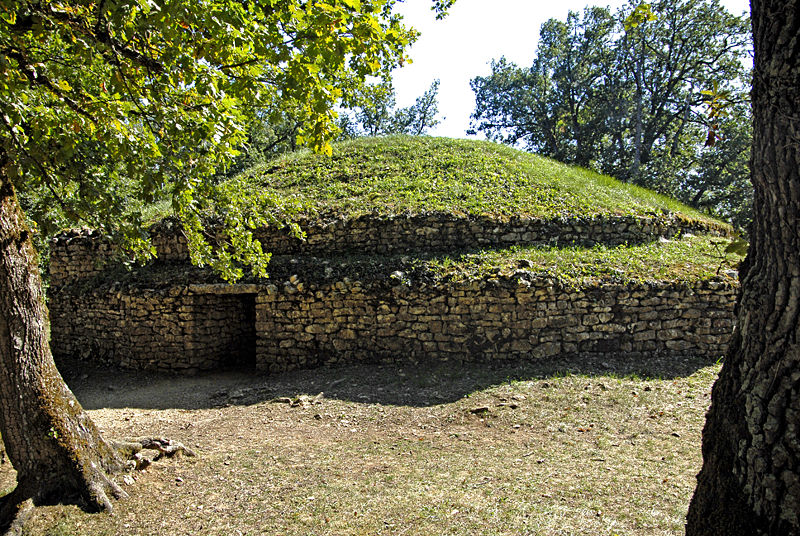
| Tumulus of Bougon |
To give a prelude we must understand what came before this period. The retreating of the glaciers from the last glacial maximum was nearly complete at this point. Most of Europe was inhabited by humans, with the exception of some far off islands such as Iceland. In the previous millennia farming had spread by a process of either migration or cultural diffusion from the Middle East and by this period had reached all of Europe. This period, where agriculture is the main source of food but before the advent of writing or widespread working of non-precious metals, is known as the Neolithic and it lasts in Europe for about the next two millennia. The transition from hunter-gathering to farming (Mesolithic to Neolithic) was gradual but had nearly universally happened across Europe by 4000BC.
The Neolithic farmers not only farmed grains, but also had access to domesticated animals such as dogs, sheep, goats, oxen and others. Cats and horses were probably not domesticated as yet by humans but were known to them in their wild forms. Much of the land would still have been the primeval forests that had grown across Europe after the last Ice Age, but the Neolithic peoples were engaged in clearing this with axes and fire to make farmland. They also had access to boats that were able to navigate rivers and short distances at sea.
 |
| Varna Necropolis Treasure |
Previously, while the glaciers had covered much of the land, there had been land bridges across many short straits, such as across the English Channel. But with the rising sea levels these had been flooded. The rising sea levels also covered over many pre-existing Mesolithic settlements that would have been along the coast lands of Europe. It has been hypothesised that there was a population crash in Europe around 4500BC, but I am somewhat sceptical about how significant this was, despite the fact that the overall methodology seems sound. Fascinatingly there seems to have been a culture in the far north of Europe, called the Pit-comb culture that has similarities with the cultures across all of northern Eurasia. If so this would suggest some very early migrations in either direction across the Siberian taiga but it’s possible that the similarities are illusory. Perhaps comb patterned pottery is just an easy design to make and thus emerges, almost like convergent evolution?
With the rise of agriculture and Neolithic culture Europe seems to have developed relatively complex societies quite quickly. Their sites are less ancient than Jericho or Catal Huyuk, but there are signs of quasi-urbanisation in the Transylvanian region from about the mid-5000’s to the mid 4000’s. This is known as the Vinca culture. They had some small villages that could be classed as towns or proto-cities, as well as some of the earliest usage of copper. Most mysteriously they also created small amulets covered in symbols that look suspiciously like writing. There is no evidence that they are anything more than shamanic symbols, but there is the possibility that these were the first attempts at writing. They probably weren’t, but it does remain a possibility. For those who wish to know more about these, check out the Vinca Symbols and Tartaria Tablets for further details.
 |
| Broken Menhir of Er Grah |
Slightly further south from the mid-4000’s to the late 4000’s were the Varna culture, who buried their dead in elaborate tombs. They were possibly the first people to work with gold and their chieftains must have been rich indeed. The south-eastern Europeans also were familiar with the working of copper and this knowledge spread slowly across the continent during this millennium. But copper should not be viewed as a primary working material. It was too soft to be of much use in day to day life and the primary material was still stone. Trade networks facilitated the spread of high-status items like jadeite axes, which were imported from the Alps as far as Ireland. But these would only have been for very valuable items and trade was presumably still quite limited.
Further north and west in Europe the religion of the inhabitants seems to have at least partially focused on sun-worship and the creation of large arrangements of giant stones. These giant stone arrangements are known to us today as megaliths, from the Greek words for “large stone”. While the main building of megaliths would be later, apparently there were early examples of it from the early 4000’s. The Iberian Peninsula saw the building of the Almendres Cromlech in what is now Portugal. Western France in particular saw much activity at this early stage with the Cairn of Barnanez, Tumulus of Bougon and the Menhir of Er Grah dating from this period. The Menhir of Er Grah is particularly astounding as it is the largest stone known to have been moved by Neolithic man, weighing over 300 tons and originally standing over 20m tall before it toppled. I am somewhat sceptical about these dates, as it would be unusual for the most difficult type of construction to be completed first, but if it is correct it points to advanced engineering capabilities in the Neolithic.
 |
Computer reconstruction of Talianki,
a massive temporary settlement of the
Cucuteni-Trypillia culture |
Finally it is worth pointing out that the languages of Europe were different. There is considerable debate about the origins of Proto-Indo-European, but practically all scholars are in agreement that Proto-Indo-European (or PIE) was not spoken in Europe at the time and that the European languages were of a different and probably unknown language family. It has been speculated that the Basque language is a tiny linguistic remnant from this time, but this is unproven. The Proto-Indo-European speakers were probably living north of the Black Sea at this point in time.
Around 4000BC the great Menhir of Er Grah in Brittany was broken, probably by an earthquake. As mentioned previously, I am wary of the dates for this item, but this is the conventional dating. On Sardinia, Monte d’Accoddi was begun to be occupied around this time by the Ozieri culture. This was a small step pyramid but the site was extended over the next millennium so it is hard to tell what the original structure was like.
Around this time the Cuceteni-Trypillia culture (or Cucuteni-Tripolye culture) was flourishing in the area roughly around in Romania, Moldova and Ukraine. Their settlements were very large, but perhaps not cities as we would think of them. They seem to be composed of about twenty thousand inhabitants (which would be extremely large for the time) living in a temporary fortified encampments. These encampments were burned and abandoned after about two generations and the process would start afresh, with the population either rebuilding or moving to another area. The settlements were always burned, but perhaps not accidentally or in warfare. Like other cultures living in the region before them the peoples of these cities/proto-cities, seem to have deliberately covered their houses with flammable material to create a gigantic pyre that would vitrify the mud walls of the houses, leaving them cracked and destroyed.
 |
| Reconstruction of the Sweet Track |
Around 3900BC there was the 5.9 Kiloyear Event. I dislike this naming convention, as it will be out of date and very misleading in around fifty years. However, it caused cooling over Europe at the same time as it contributed to desertification in the Sahara. It may have caused some migration into the Iberian Peninsula from Africa, but apart from this it is likely that it simply made Europe a harsher and more difficult place to live in than it had previously been.
Around this time, the Ertebølle culture in Denmark, which was quasi-Mesolithic, seems to have come to an end, as better agricultural practices moved northwards. Up until this point, this culture appears to have known about farming but to have primarily used sea-fishing as its main source of food.
Around 3800 work began on the Windmill Hill complex structure around Avebury in what is now England. Malta was re-inhabited around this time as well. The previous population had over-farmed the land and had apparently abandoned the island, although this is an unproven hypothesis.
 |
| Tomb from Carrowmore |
Also around this time we can give what to my knowledge is one of the first fixed dates in human history. Normally we can say that something happened in a particular millennium or century. But in exactly 3838BC some Neolithic farmers in Somerset England decided to build a wooden causeway across some marshy ground. This is known as the Post Track. In 3807BC the posts were reused and incorporated into an expanded causeway known as the Sweet Track. The remains of this event were covered up by peat bogs and only consisted of a single plank walkway at the top. But thanks to the wonders of dendrochronology, it is more securely dated than any of the early deeds of the great monarchs of Egypt or Mesopotamia.
Around 3700BC the Carrowmore complex was begun in the west of Ireland. This marked the first of the passage grave complexes in Ireland.
In the Caucasus area the Maykop culture began to flourish. This group used large mounds to bury their dead, which are sometimes referred to as kurgans. Some have identified these people are early Indo-European language speakers but this is speculative.The Maykop culture does seem to have been related to the steppe cultures further north however.
 |
| Ggantija Temple in Malta |
Around 3600BC Malta entered a phase of megalithic temple building known as the Ggantija Phase. This was typified by the building of large stone buildings, presumably for religious purposes. These stone buildings are some of the oldest enclosed structures in the world, but what exactly counts as a structure is debateable (e.g. should Carrowmore be treated as an enclosed structure?). Shortly after this the Ħaġar Qim complex on Malta was also built, presumably by the same culture and for similar reasons.
Around this time the Baden culture in central Europe arose and has been treated by some as being an Indo-European culture. But this is speculative and I am unsure as to whether the members of this culture were primarily Proto-Indo-European speakers.
 |
| Ceide Fields in Ireland |
Circa 3500 the wheel seems to have been invented, possibly independently by the Sumerians in the Near East, by the Maykop culture of the Caucasus and by the Cucuteni-Trypillia culture in what is present-day Romania or the Funnel-Beaker culture of what is now Poland. This would have far-reaching consequences for humanity, but it would take time for wheels to attain their full utility. The earliest known representation of what may be a wheel can be seen in the Bronocice Pot that has what may possibly be proto-writing, as well as what appears to be a picture of a wheeled cart drawn upon it.
In Ireland, the Neolithic farmers continued their land clearance and created farmlands in the west of the country. These fields have been preserved and were rediscovered in the last century. We know these as the Céide Fields. It is quite common for us to find ancient megalithic monuments or the complex settlements of the Neolithic peoples. But we seldom actually see the fields where they practiced the agriculture that was the foundation of their culture.
 |
| Passage Grave in Carrowkeel |
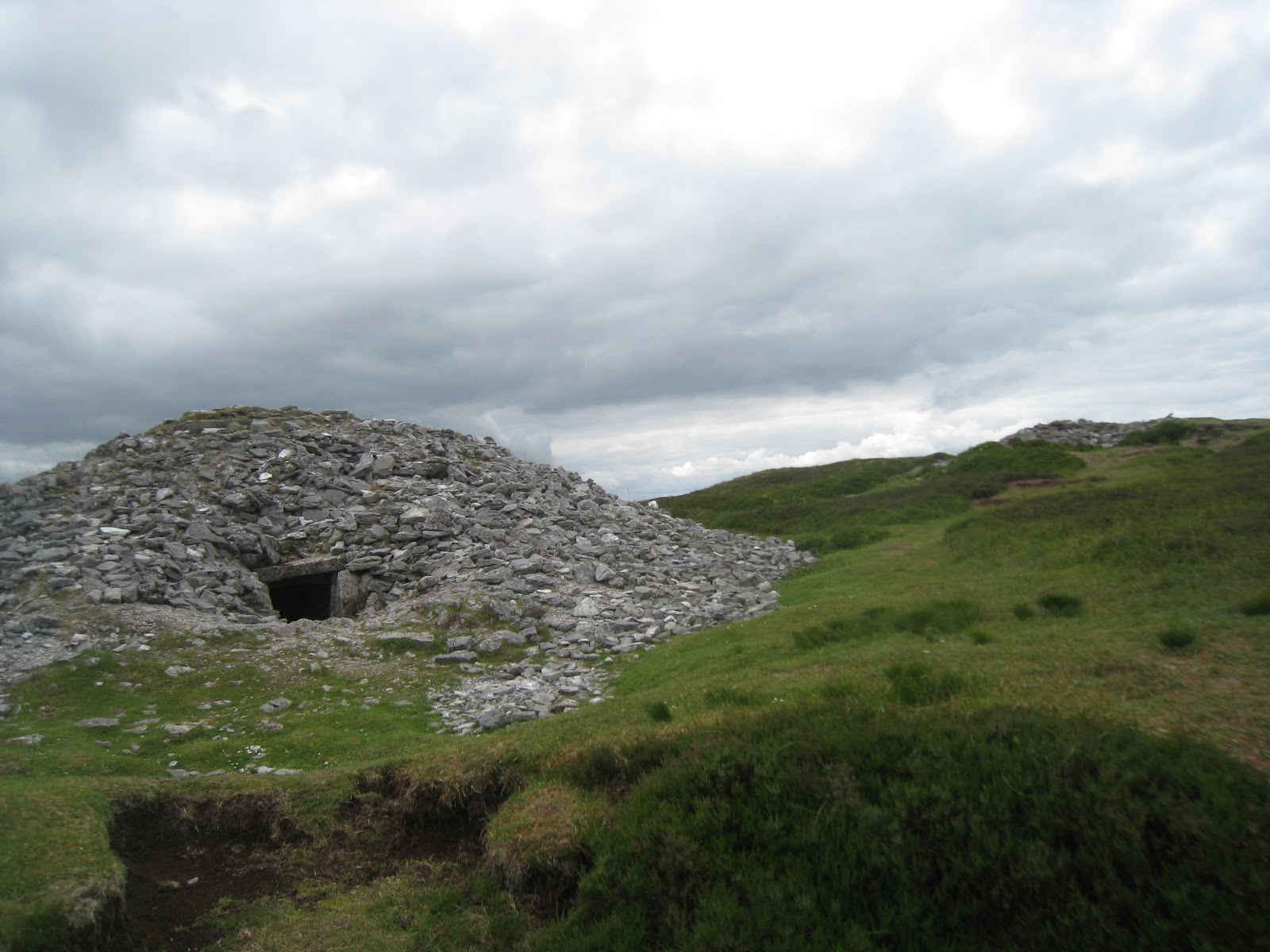
Around 3400 the passage grave complex of Carrowkeel was built upon a low ridge of mountains in the west of Ireland. This was the first complex to feature roof-boxes that would allow the sun to enter the chambers of the tombs if the tomb was aligned to the solstice.
In what is now Ukraine, the Sredny Stog culture began to come to an end and seems to have been replaced by the Yamna culture. The Yamna culture buried their dead in large mounds, known as kurgans, and may have been Indo-European. In what is probably not a coincidence, the horse appears to have been domesticated in Central Asia around this time, although these were possibly not the ancestors of modern horses. We should not imagine cavalry being used by these cultures. Early horses probably did not have the size to carry a human on their backs. But with the twinning of the wheel and the horse, crude carts could have been made that would allow the cultures using these carts much greater mobility than their contemporaries and would have given them a substantial advantage in competing for resources.
 |
| Stone alignment in Carnac |
The Globular Amphora culture stretching across what is now Poland, may have been related to the Yamna culture, or to have taken some of their burial practices from them. These too begin to appear in the archaeological record from about this point onwards. It took over from the older Lengyel culture in the region, who had been some of the first to use copper in Europe.
Around 3300 the main stage of development on the huge Neolithic site of Carnac, in present-day Brittany, took place. Carnac is one of the largest Neolithic sites anywhere in Europe and consists of vast arrays of standing stones in lines across the landscape, as well as a variety of tombs. This type of stone alignments seems to be rather unusual for Europe at the time and the purpose of the stones is unclear.
 |
| Hypogeum of Ħal-Saflieni |
In Malta, the Ggantija phase ended and the Saflieni archaeological phase began. This merely marked a change in building styles and does not indicate any form of invasion or population change on the island. Here the temples became even more elaborate and unlike the huge tomb/temple complexes in Brittany and Ireland, the Maltese temples comprised of worked stone and carved underground rock and they look surprisingly modern considering they are from the Neolithic. Their main tomb is the Hypogeum of Ħal-Saflieni, which is an underground tomb with over seven thousand human remains having been found there.
Further south of Europe the desertification of the Sahara was continuing and Europe must have become rather similar climactically to what it is today. Possibly as a result of this climate change the Yamna culture, now equipped with wheeled vehicles and small, recently-domesticated horses, began to expand westwards into what is now Ukraine. There does seem to have been some conflict between the pastoral peoples living at the western edge of the Yamna culture and the large cities of the Cucuteni-Tripyllia culture.
 |
| Reconstruction of Ötzi the Iceman's clothes |
In Ireland the passage-grave complex at Loughcrew was begun at this time, atop a series of hills in the centre of the country. Near this area, the earliest occupation of the site now known as Tara began, with a small grave mound being built. This mound is later known to history as the Mound of the Hostages, but this name has nothing to do with the original purpose of the tomb.
While all this is taking place; giant constructions in Malta, Ireland and France, changing climates and wanderings of peoples in the east, we have a personal drama taking place. High in the Alps a tattooed figure, clad in furs, wearing boots cleverly adapted for the snow and bearing copper weapons was struggling in the snow. He was wounded, with a deep cut on his hand that he had sustained a few days earlier. His breathing was laboured and his movements slow. He kept moving his hands to his left armpit, from which he had removed an arrow a few hours earlier. But the wet blood flowed constantly and without ceasing. Finally the man fell into the snow and died.
We will never know who the man was, or who his enemies were. But his death has shed new light on the period. His body was preserved in the ice of the high Alps, where he may have fled to escape his pursuers. His partially preserved body was discovered in the twentieth century by climbers and the archaeologists have been puzzling over his remains ever since. The body was given the name Ötzi the Iceman, named after the region where his body was discovered but no one knows his name. The discovery has allowed scientists to find the earliest known evidence of tattoos on humanity and the possibility that he underwent a type of acupuncture on the lower spine. His stomach contents were analysed to show that he had eaten meat recently, probably earlier that day.
 |
| Passage at Knowth |
Around 3200BC the vast tomb complex of Brú na Bóinne in Ireland was begun, with a major passage-grave being constructed at Knowth. This tomb was probably aligned to the solstices but the entrance to the tomb was changed during later eras so the exact alignment is unclear. The tomb is intricately decorated with spiral and lozenge patterns and contains more decoration than any other Neolithic site in Europe. Unlike previous complexes such as Carrowmore, Carrowkeel and Loughcrew, this site was built along a river valley and was far larger than the previous complexes. It is unclear exactly why this was so, but it perhaps speaks to growing settlement sizes among the Neolithic peoples of Ireland.
There was considerable Neolithic complexity all around the edges of Europe, with the Neolithic village of Skara Brae on the Orkney Islands beginning roughly around this time. The Orkney Islands are sparsely populated today but seem to have been quite important in the Neolithic period. Or perhaps the lower population has led to better preservation of the monuments. It is hard to know why the edges of Europe sometimes seem to have more items from this time period.
 |
| Wheel at Ljubljana |
In the marshes of Ljubljana, in present day Slovenia, the oldest wooden wheel in the world was discovered, dating roughly from this time. This would suggest that the knowledge of the wheel was spreading throughout much of Europe at this time, although it may not have been known in the west. It is unclear if the builders of Knowth would have had access to this technology.
In what is now southern Spain, the site of Los Millares was founded roughly around this time. This settlement would grow later, but was not really more than a village at this point. However, it is proof that there was a trend towards urbanisation in Europe as well as in the river valley cultures of Mesopotamia, Egypt and the Indus Valley. Unlike the temporary cities of the Cucuteni-Trypillia culture, the site of Los Millares was occupied for centuries.
Around 3100BC the Saflieni culture ended in Malta and the Tarxien period began. This was the final stage of the great temple-building culture of Malta. This is best exemplified by the Tarxien Temples, which the period is named for. Here, shaped stones of great weight are fitted together and carved with animals. There is a possibility that they worshipped a Mother Goddess, as there have been figurines found of corpulent ladies, which may have been cult figurines. But this is unclear. The temple itself and the carvings on the temple are some of the most striking works of art from the Neolithic and form a contrast in their realism between other Neolithic artwork, such as at Knowth.
 |
| Carvings at Tarxien |
While Tarxien was being built in Malta, in Ireland the construction of Newgrange was beginning. This was a monumental effort that took decades, moving gigantic stones by boats along coasts and the River Boyne to reach the site. Once the stones were in place a long tunnel was laid down with a central chamber that formed a cruciform shape at the centre of the mound.
The tunnel was aligned to the rising of the sun on the Winter Solstice and once a year, on the shortest day, the sun was enter the roofbox and strike the far wall of the innermost chamber, illuminating the room. In the side chambers there would be the remains of cremated bodies in stone depressions. It would appear that there were never many remains at any one time and it is possible that after the rituals surrounding the solstice were complete, that the remains were removed again. The inner chamber was corbelled into a primitive small dome, but done in such a way that it would bear the weight of the large earthen mound placed above it. The front level of the mound was covered with white quartz that would have gleamed in the sun.
 |
| Carvings at Newgrange |
Newgrange has been reconstructed in the 1970’s AD, but its reconstruction is very controversial. The façade is too steep and is currently held in place by concrete. It is more likely that the façade was shallower and covered over the great stone edges of the mound. But the interior is entirely ancient and is certainly worth a visit if people have an opportunity.
Around last century of the millennium, around 3000BC, the Maykop culture in the Caucasus and the Cucuteni-Trypillia culture in Romania, came to an end. These may have been affected by the expanding Yamna culture. The step pyramid site in Sardinia, Monte d’Accoddi, was also burned or destroyed around this time, but this is highly unlikely to have been related to the demise of the afore-mentioned cultures.
In England, the large megalithic complex of Avebury was begun around this period but would not have reached its present form until later. Later generations would add more stone circles and alignments and banks of earth to the site until it reached the impressive proportions that it has today.
 |
Monument at the finding place of
Ötzi the Iceman |
Before I finish up I should leave a warning, or a caveat over what has been said. In many works about Europe at this time, one will see the phrase “Old Europe” crop up again and again. This is from the work of Marija Gimbutas, who postulated that there was an Old Europe, comprised of the Neolithic farmer/monument builders who were overrun by Indo-Europeans from the east. These Indo-European invaders brought increased warfare, a patriarchal system, the horse and proto-chariot, and the European languages that we know today.
I’ve previously written in other posts about bad theories, about how aliens certainly did not build ancient stone circles in South Africa, or the pyramids in Egypt. The theory of Old Europe is not a theory such as this one. In many ways it’s a really good theory and I don’t want to dismiss it out of hand. Certainly, at some point, the Indo-European languages came into Europe and that this probably was part of an overall cultural shift, and a certain amount of population movement.
What concerns me most with the theories of Old Europe are the assumptions of uniformity. We know that the Neolithic world had trade connections all over Europe and that there were certain similarities in how the built their megalithic monuments. But the variety of pottery styles and most importantly, burial styles all over Europe, suggests that Old Europe was never a single entity. Other ideas, such as Old Europe worshipping a mother goddess, are far less certain. Some cultures have figurines that may represent a mother goddess, others do not. The obsession with astronomical alignments in the megalithic monuments gives at least as much credence to the idea that at least some Neolithic peoples primarily worshipped the sun. The idea of a matriarchal Old Europe, even restricting "Old Europe" to the Balkans, is also problematic, considering the elaborate male burials in the Varna Necropolis (before this time period, but still considered “Old Europe” by adherents of the theory). Lastly the idea of a peaceful Neolithic world cannot be well sustained with the body of Otzi the Iceman having such terrible wounds inflicted in rapid succession.
I like the idea of Old Europe. In fact, as a theory it probably is right in many aspects. But to generalise across a whole continent for several thousand years is problematic. The behaviour of peoples change over time and considering the complexity of the Late Neolithic, I would be shocked if European culture could be summed up so easily. Future historians will doubtless refine the idea to make it watertight but for now, be wary of any dichotomies between egalitarian Old Europe and hyper-patriarchal kurgan cultures. History is never so simple.
 |
Reconstruction of Ötzi the Iceman's
axe |
So, to sum up, from 4000-3000BC we see complex village societies, all across Europe. These societies practice agriculture and use their surpluses to build large megalithic monuments. We see rising capabilities, as the tombs become more sophisticated. There are technological advances, such as the wheel and the domestication of the horse, and changing pottery styles, as fashions and cultures change. Lastly we can move our gaze from the very large to the very small and wonder at the building of the Post Track/Sweet Track and the last days of the maimed Otzi the Iceman in the Alps. Europe was still in the Stone Age, but the later civilisations of Europe would be built on a very well-developed Neolithic foundations.
Related Blog Posts:
Some European history from 4000-3000BC
Some European history from 3000-2000BC
Some European History from 2000-1500BC
Some European History from 1500-1000BC
Some European History from 1000-750BC
Some European History from 750-500BC