 |
| Achaemenid Persian drinking cup |
This blog post will be looking at the years 525-500BC in the Near East, which for the purposes of this blog will include Kush and Lydia in the south and west, far over to the easternmost reaches of the newly founded Persian Empire and to the Caucasus in the north. Occasionally there may be references to other regions, but the Greek world in particular will be dealt with in a separate post.
The sources for this blog will include as many primary sources as possible, but primary documents for this period are very scant, with the exception of the exceptionally detailed Behistun Inscription. Babylonian chronicles, Egyptian inscriptions and Kushite inscriptions are almost non-existent at this point unfortunately.
The Hebrew Tanakh or Old Testament, particularly the book of Ezra and the prophetic works of Haggai and Zechariah will be used where possible, but these have a very narrow focus and are not always contemporary with the events described. Also, the writers of the Biblical books at this period are not writing history as such, and their writings have their own specific conventions that can be difficult to interpret. The majority of Hebrew writings are silent during this period anyway.
The most prevalent source materials for this period are later Greek writings, particularly the Histories of Herodotus. This is a great book but quite problematic as a source. For better or for worse, shortly after the fall of Assyria we begin to have fewer and fewer writings directly from the Mesopotamians. This means that, like it or not, we must rely heavily on Herodotus.
As always I feel it is important to note that I am not a professional historian. The facts and dates in this post should be treated with due caution and everything should be checked. There are certainly mistakes and errors in the sources and I may make mistakes in my interpretations of these sources. Mistakes are particularly likely to occur when dealing with years, as the Babylonian and Jewish years do not correspond exactly to our own. So, there is the possibility that I may have, for example, interpreted an event as happening in late 522 when it may in fact have been early 521. If the reader spots any errors such as this, please let me know in the comments and I will research it and correct it as soon as possible. Even professional historians have differing opinions on the exact ordering of events at this time, so exact precision is not likely here.
 |
| Persian drinking cup |
It can be useful to give context to the period by describing what is happening elsewhere in the world at this time. In China, the Zhou Dynasty was continuing its long slow decline, while the feudal states such as Qi and Chu grew ever more important and waged wars for influence. The Spring and Autumn Period was ending, as the wars between the little kingdoms became ever more violent. This flux of warfare would also stimulate the thinkers of China and much of Chinese philosophy is developed at this time.
In India, there were a number of powerful kingdoms, particular in the north along the Gangetic Plain. These kingdoms were known as the Mahajanapadas and included states such as Kuru, Panchala, Kosala, Videha and Magadha. The kingdom of Magadha became the strongest of these states and may have been ruled by a king called Bimbisara at this time. In India at this time a number of sects began to spring up, which in certain cases had unusual interpretations of the accepted beliefs of the time and region, but this is a topic for another blog. The religions of Jainism and Buddhism emerged from this intellectual ferment and may have been already formed at this time, depending on the dates given. To the west, in Greece, poets and tyrants flourished, along with the beginnings of Greek science and philosophy. These will all be spoken of in later blogs, but this should give a rough idea of the state of the world at this point.
In the previous decades Cyrus the Great of Persia had conquered the kingdoms of Lydia and Babylon, as well as most of the Iranian tribes that had not already been subject to the Medes. He probably died in battle against the Scythian Massagetae tribe to the north and his son Cambyses II became ruler of the Persian Empire and began the conquest of Egypt.
In the year 525BC the Persians crossed the desert to reach the Egyptian fortress city of Pelusium. Herodotus, who is always good for a tale, recounts stories that the ruler of that region of Arabia diverted rivers into the desert using artificial pipelines made of animal skins. Even Herodotus felt that this was a little too much and tells a more sensible tale of water supplies being stored up for years previously to allow the army of the Persians to make a passage.
When, then, the Arabian had made the pledge to the messengers who had come from Cambyses, he devised the following expedient: he filled camel-skins with water and loaded all his camels with these; then he drove them into the waterless land and there awaited Cambyses' army. This is the most credible of the stories told;
Herodotus Histories 3:9, written around 440BC
 |
A fantastically over the top painting of the Battle of
Pelusium, showing the story of the Persians
using cats. Paul-Marie Lenoir AD1872 |
The armies clashed outside Pelusium and there was a hard-fought battle. The Persians were victorious and Psammetichus III fled to Memphis. Herodotus tells stories of how the Greek mercenaries murdered Phanes’ children in the space between the two armies before battle joined. He also mentions how he himself had seen the site of the battle and could see the differences in the skulls between the Egyptians and the Persians (how could he tell which were Egyptian?) But the most spectacular story of the battle of Pelusium was told by an even later Greek writer, who wrote that the Persians knew the Egyptians held cats to be sacred, so they placed cats in the front line to stop the Egyptians from shooting. Thus the Battle of Pelusium is sometimes known as the Battle of the Cats.
When Cambyses attacked Pelusium, which guarded the entrance into Egypt, the Egyptians defended it with great resolution. They advanced formidable engines against the besiegers, and hurled missiles, stones, and fire at them from their catapults. To counter this destructive barrage, Cambyses ranged before his front line dogs, sheep, cats, ibises, and whatever other animals the Egyptians hold sacred. The Egyptians immediately stopped their operations, out of fear of hurting the animals, which they hold in great veneration. Cambyses captured Pelusium, and thereby opened up for himself the route into Egypt.
Polyaenus Stratagems 7:9, written around AD163
The Egyptians had fled to Memphis. An offer to surrender was rebuffed by the Egyptians, who may have slain the heralds, and so Memphis was taken by storm. Psammetichus III was captured, but not executed immediately. However, later he was accused of stirring up rebellion against the Persians and was executed by them.
 |
Anknesneferibre
God's Wife of Amun |
The God’s Wife of Amun, Ankhnesneferibre, daughter of Psammetichus II, and the Divine Adoratrice of Amun, Nitocris II, daughter of Amasis, both seem to disappear from history at this point. The vast estates and treasuries of the temple of Amun were too important to be left in the hands of those who were loyal to the previous dynasties. Thus these women, who were among the wealthiest women in the world, were deposed and possibly executed, although their fate is unclear.
Another Egyptian who fared rather better under the new rule was Udjahorresnet (or Udjahorresne). He had been a commander of the Egyptian fleet under the Saite Dynasty and put his services at the disposal of the new Persian rulers. He had a variety of other titles and may have also been a physician. He now acted as a collaborator for the new regime and even devised proper Egyptian royal titles for Cambyses II.
…Commander of the royal navy under the King of Upper and Lower Egypt, Khenemibre, (Amasis)…
When the great King of all lands, Cambyses, came to Egypt, the people of all (foreign) lands were with him. He exercised sovereignty in the land in its entire extent; they settled down in it, he being the great King of Egypt, the mighty sovereign of this country. His Majesty conferred upon me the dignity of Chief San, and granted that I should be by him as Smer and Provost of the temple.
Inscription of Udjahorresnet (written perhaps around 510BC?)
The Libyan tribes and the Greek city kingdom of Cyrene, on the north coast of Africa, seem to have sent tribute to Cambyses II as a sign of submission. No one wished to be the next target of the seemingly invincible Persians.
So the Egyptians were besieged, and after a long while surrendered; but the neighboring Libyans, frightened by what had happened in Egypt, surrendered without a fight, laying tribute on themselves and sending gifts; and so too did the people of Cyrene and Barca, frightened like the Libyans.
Herodotus Histories 3:13, written around 440BC
 |
| Kushite pyramids at Jebel Barkal |
Around this time, while the work on the Temple in Jerusalem was stalled or stopped, the Hebrew book of Kings may have been written. It may have undergone some editorial work later and it almost certainly drew from earlier sources, but the book itself probably reached a recognisable form around this time.
In the thirty-seventh year of the exile of Jehoiachin king of Judah, in the year Amel-Marduk became king of Babylon, he released Jehoiachin king of Judah from prison. He did this on the twenty-seventh day of the twelfth month. He spoke kindly to him and gave him a seat of honor higher than those of the other kings who were with him in Babylon. So Jehoiachin put aside his prison clothes and for the rest of his life ate regularly at the king’s table. Day by day the king gave Jehoiachin a regular allowance as long as he lived.
2 Kings 25:27-30 (probably written around 525BC, as the final sections are a recollection of how Jehoiachin/Jeconiah was restored to favour by Amel-Marduk. Jeconiah was a direct ancestor of Zerubbabel)
 |
Mountain at Jebel Barkal, possibly the location for what
Herodotus describes as the Table of the Sun in Kush |
In the year 524 Cambyses was engaged in stabilising the control of Egypt and eyeing up even further conquests. The kingdom of Kush lay to the south, probably ruled by Amaninatakilebte at this time. The royal city of Napata had been abandoned as a capital city by the Kushites, although they still controlled it and buried their rulers there. The new capital had been moved to Meroe, further to the south along the Nile, making it harder to invade. The Persian king is said by Herodotus to have sent gifts to the Kushite ruler, who believed the gifts were the prelude to an invasion. The Kushite ruler sent back in return an immensely powerful bow that was difficult to draw. This bow could supposedly only be drawn by Bardiya (Smerdis in Greek), the brother of Cambyses. Fearing that Bardiya would usurp the throne, Cambyses ordered his secret murder. This story of royal murder comes from Herodotus. The Behistun Inscription of Darius records that Bardiya was secretly murdered before the Egyptian campaign. Herodotus records that the Persians then invaded Kush, but were forced to retreat from lack of supplies after being reduced to cannibalism on their march south. Despite Herodotus' account it is likely that at least some parts of northern Kush were added to the empire.
 |
Rams at the ruined Temple of Amun at the foot of
Jebel Barkal |
Having seen everything, the spies departed again. When they reported all this, Cambyses was angry, and marched at once against the Ethiopians, neither giving directions for any provision of food nor considering that he was about to lead his army to the ends of the earth; being not in his right mind but mad, however, he marched at once on hearing from the Fish-eaters, ordering the Greeks who were with him to await him where they were, and taking with him all his land army. When he came in his march to Thebes, he detached about fifty thousand men from his army, and directed them to enslave the Ammonians and burn the oracle of Zeus; and he himself went on towards Ethiopia with the rest of his host. But before his army had accomplished the fifth part of their journey they had come to an end of all there was in the way of provision, and after the food was gone, they ate the beasts of burden until there was none of these left either. Now had Cambyses, when he perceived this, changed his mind and led his army back again, he would have been a wise man at last after his first fault; but as it was, he went ever forward, taking account of nothing. While his soldiers could get anything from the earth, they kept themselves alive by eating grass; but when they came to the sandy desert, some did a terrible thing, taking by lot one man out of ten and eating him. Hearing this, Cambyses feared their becoming cannibals, and so gave up his expedition against the Ethiopians and marched back to Thebes , with the loss of many of his army; from Thebes he came down to Memphis, and sent the Greeks to sail away.
Herodotus Histories 3:25, written around 440BC
While at Thebes Cambyses is said to have detached a component of his force and sent it into the deserts of the west to conquer the temple of Ammon at the oasis at Siwa. This force marched into the unknown before being overwhelmed by sandstorms and buried in the desert sands. This has been the basis for many legends and tall tales about the Lost Army of Cambyses.
 |
| Later drawing showing the Lost Army of Cambyses |
Thus far, it is said, the army came; after that, except for the Ammonians themselves and those who heard from them, no man can say anything of them; for they neither reached the Ammonians nor returned back. But this is what the Ammonians themselves say: when the Persians were crossing the sand from Oasis to attack them, and were about midway between their country and Oasis, while they were breakfasting a great and violent south wind arose, which buried them in the masses of sand which it bore; and so they disappeared from sight. Such is the Ammonian tale about this army.
Herodotus Histories 3:26, written around 440BC
When Cambyses returned from his failed conquest of Kush (or Ethiopia as the Greeks called it), Herodotus records that he found the Egyptians celebrating the festival of the Apis Bull. Interpreting the Egyptian celebrations as a sign that they rejoiced in his misfortunes, Cambyses is said to have proceeded to murder the Apis Bull, a type of bull with unusual markings that was worshipped by the Egyptians as a god. This sacrilege shocked the Egyptians and the king proceeded to show that he was mad by executing many Egyptians and Persians and behaving in a deranged and violent manner, including killing marrying his sisters before subsequently killing at least one of them and murdering his courtiers.
Cambyses was fully persuaded that these signs of joy were for his misfortunes, and summoned the rulers of Memphis; when they came before him, he asked them why the Egyptians behaved so at the moment he returned with so many of his army lost, though they had done nothing like it when he was before at Memphis. The rulers told him that a god, wont to appear after long intervals of time, had now appeared to them; and that all Egypt rejoiced and made holiday whenever he so appeared. At this Cambyses said that they lied, and he punished them with death for their lie.
Herodotus Histories 3:27, written around 440BC
 |
Door lintel showing outline
of Petubastis III/IV |
There are problems with the account of Herodotus. Firstly, Herodotus is taking his account of the reign of Cambyses from the Egyptian priests, who apparently hated the memory of Cambyses. They had reason to do so, as Cambyses had effectively stripped the temples, which had been some of the wealthiest landowner corporations in the world, of much of their financial power. So, Herodotus, who relies on the Egyptian priests as sources, must be treated as a hostile witness. Secondly, we have inscriptions that show an old Apis bull dying naturally in this year, buried normally. This might be a later cover for the murder of the bull, but it does cast doubt on Herodotus’ story.
What is most likely to have happened is that Cambyses was staying in Egypt because Egypt was not yet fully conquered. A shadowy, little-known prince called Petubastis III or Petubastis IV depending on what text you read, seems to have still been ruling in one of the oases. The expedition into the south of Egypt may not have been an invasion of Kush, but was more likely an expedition to cement Persian power in the south of the land. The attack on Siwa may have been an expedition against the rebel prince, who was probably based in the Dakhla Oasis. Perhaps the expedition was destroyed by sandstorms, but it may also have been defeated by the Egyptian rebels. It is hard to know exactly what happened, but it is clear that Cambyses stayed in Egypt for the next few years and that this was probably because Egypt was not fully conquered.
The struggles in Egypt were history on a vast scale, but I would like to take time to mention a smaller story from this time. Around this year, in the city of Kish, a slave called Ishunnatu was given a loan to start an inn. Ishunnatu was owned by the Egibi family, the powerful landholding, loan-giving family. To allow them to make more money, the Egibi would often allow their most enterprising slaves to set up businesses. The Egibi family would provide the capital on loan, to be repaid by the slave with interest. The Egibi would also reap profits from the enterprise, but the slave would keep some of the proceeds.
 |
Ruined mound at Kish, near where Ishunnatu had her
tavern |
In 524 or 523 a woman called Ishunnatu was just such an entrepreneur. Her inn served beer, with the patrons sitting around tables. There were beds as well, which has led some to categorise it as a brothel, but it was probably just an inn. Perhaps I might be reading too much into it, but I like to think of Ishunnatu’s tavern as a bar and find it a little comforting to know that we know of drinking establishments so long ago. Her bar survived the turmoil of the years to come and flourished into the time of the reign of Darius.
1 mina of silver, price of 50 vats of fine beer...; 40 shekels of silver, price of 10 800 liters of dates, 22 shekels of silver, ... a total of 2 minas and 2 shekels belonging to Itti-Marduk-balaṭu, son of Nabu-ahhe-iddin, descendant of Egibi, are at the disposal of Isḫunnatu, slave woman of Itti-Marduk-balaṭu. Until the end of the month Tebētu, she will pay an interest. Not including : 5 beds, 10 chairs, 1 kettle , 1 vat, 1 stand lamp, 3 knives, 1 iron hoe, 1 axe, 2 fermenting vats, 1 stand for fermenting vat, 1 vat of decantation,... Witnesses: Remut, son of Aplaia, descendant of Arad-Nergal ; Bel-apla-iddin, son of Remut, descendant of Paharu ; Tukulti-Marduk, son of Iddin-Nabu, descendant of Šangu-Parakki and the scribe : Kalbaia, son of Ṣillaia, descendant of Nabaia Hursagkalamma, 11th day of Kislīmu (ix), year 6th of Cambyses, king of Babylon, king of Lands.
Contract for Ishunnatu’s bar loan, written around 524-523
In the year 523 I cannot tell what happened. It seems that Cambyses spent more time in Egypt trying to suppress unrest against Persian rule. While he was in Egypt, the rest of the empire appears to have been growing restless under the demands for taxation. With an absent emperor and restive populations, the empire was becoming unstable.
 |
Gold Croesid coin, minted by the Persians until
the currency reform of Darius around 510BC |
In the year 522 things came to a head. On the 11th of March, Bardiya (or Smerdis in the Greek texts, which is effectively the same name), the son of Cyrus and brother of Cambyses, declared himself king of the Medes and Persians. This may have been a surprise to Cambyses, who had ordered the death of Bardiya some months or years earlier. According to the sources (the Behistun Inscription and Herodotus), there was an imposter called Gaumata, a Mede from the tribe of the Magi, who had impersonated the slain prince and seized power for himself.
King Darius says: Afterwards, there was a certain man, a Magian, Gaumâta by name, who raised a rebellion in Paishiyauvada, in a mountain called Arakadriš. On the fourteenth day of the month Viyaxana (11 March 522 BCE) did he rebel. He lied to the people, saying: 'I am Bardiya, the son of Cyrus, the brother of Cambyses.' Then were all the people in revolt, and from Cambyses they went over unto him, both Persia and Media, and the other provinces.
Behistun Inscription, written no earlier than 520BC
Cambyses was isolated from his empire as he was detained in Egypt, where he was fighting a protracted war against the Egyptian resistance and Bardiya, or more strictly, the imposter, declared a tax relief for three years for the whole empire. Grateful at their relief from taxation the entire empire declared in favour of Bardiya.
 |
| Persian seal |
In this time he benefitted all his subjects to such an extent that after his death all the Asiatics except the Persians wished him back; for he sent to every nation he ruled and proclaimed an exemption for three years from military service and from tribute.
Herodotus, Histories, 3:67, written around 440BC
Cambyses mustered his troops and began to march back from Egypt in a fury, hoping to use the battle-hardened royal army to crush the imposter. But by the 1st of July of 522 the usurper Bardiya had cemented his control of the empire. Cambyses’ army was beginning its march through the Levant, towards Mesopotamia and Iran when it became obvious that the empire was lost. Sometime after that and in rather unspecified circumstances, Cambyses II, son of Cyrus and conqueror of Egypt, died. Herodotus records that he died by accidentally being stabbed with his own sword in the thigh, as punishment for stabbing the Apis bull of the Egyptians in the thigh. Herodotus should probably not be taken too seriously here. The Behistun Inscription records simply that he died naturally, but I am suspicious. The death of Cambyses ended the civil war before it began and he was not a popular king. Many people had reason to wish Cambyses’ untimely death.
As he sprang upon his horse, the cap fell off the sheath of his sword, and the naked blade pierced his thigh, wounding him in the same place where he had once wounded the Egyptian god Apis
Herodotus, Histories, 3:64, written around 440BC
 |
| Persian seal |
The royal army marched back to Iran, now under the command of the generals and nobles who had commanded it under Cambyses. Bardiya seemed to be favouring the Medes rather than the Persians and was spending time in Media. A number of high-ranking Persian nobles were displeased with the new king, who seemed to be executing nobles for specious purposes, particularly those who had been close to Bardiya at one time. The nobles who lived suspected that the king was an imposter. According to Herodotus they sent a message to one of the wives of the king to see if the king was missing ears, as the person they suspected to be impersonating Bardiya had had their ears mutilated in the time of Cyrus. Their suspicions were confirmed, but even though whispers were sounded about that the king was not who he said he was, none dared to act upon it.
"I thought that I alone knew that it was the Magus who was king and that Smerdis son of Cyrus was dead; and it was for this reason that I made haste to come, that I might effect the Magus' death; but since it turns out that you know too and not only I, I think that we should act at once and not put it off."
Herodotus, Histories, 3:71, written around 440BC
 |
| Persian artwork |
A conspiracy was formed of some of the most powerful nobles of the empire. Otanes, Intaphrenes, Gobryas, Hydarnes, Megabyzus and Aspathines (or Ardumanis) joined with Darius to plan the assassination of the usurper. These were all high aristocrats, most of them were related to the royal family through marriage and Darius was related to the royal line through a distant relative. Darius’ father Hystaspes was still alive and was a kind of sub-king who ruled a section of the Persians under the auspices of the Great King. Darius’ family had held this position of sub-kings because they were related to the main royal family. It must have been agreed that the assassins would put Darius on the throne, but that he would reward them greatly. Herodotus records a fanciful account of Darius gaining the empire by winning a bet, using a trick involving a clever slave and a lustful horse. He also records that the conspirators debated making the empire a democracy. This is later Greek imagination. Intending to slay the imposter and to make Darius king, the conspirators approached the fortress of Sikayauvati on the 29th of September.
When they came to the gate, it turned out as Darius had expected; the guards, out of respect for the leading men in Persia and never suspecting that there would be trouble from them, allowed them to pass, who enjoyed divine guidance, and no one asked any questions. And when they came to the court, they met the eunuchs that carry messages, who asked the seven why they had come; and while they were questioning these, they were threatening the watchmen for letting them pass, and restraining the seven who wanted to go on. These gave each other the word, drew their knives, and stabbing the eunuchs who barred their way, went forward at a run
Herodotus, Histories, 3:77, written around 440BC
There were guards on duty at the entrance of the fortress, but they were too afraid to stop and question seven of the most powerful men in the empire. The nobles approached the inner rooms of the palace before being called to halt by the eunuchs of the palace. The nobles were armed and began to cut down those in their way before bursting in upon the imposter and his brother. The two Magi armed themselves and fought back, but after a desperate struggle in which the nobles were wounded, the two brothers lay dead and Darius was proclaimed king of the empire.
 |
| Darius I (or his son Xerxes) enthroned |
One rushed to take down a bow, the other went for a spear. Then the fighting started. The one that had caught up the bow found it was no use to him, as the antagonists were close and jostling one another; but the other defended himself with his spear, wounding Aspathines in the thigh and Intaphrenes in the eye; Intaphrenes lost his eye from the wound but was not killed.
Herodotus, Histories, 3:78, written around 440BC
On the tenth day of the month Bâgayâdiš (29 September 522 BCE) I, with a few men, slew that Gaumâta, the Magian, and the chief men who were his followers. At the stronghold called Sikayauvatiš, in the district called Nisaia in Media, I slew him; I dispossessed him of the kingdom.
Behistun Inscription, written no earlier than 520BC
As part of the assassination of the imposter and his brothers, who were both Magi, the conspirators seem to have given an edict that all Magi were to be killed. The Persians in the city rallied to the conspirators and the Magi were slaughtered until nightfall. Later Persian kings would celebrate this as a festival.
 |
| Relief of guards at Darius' Palace Susa |
When they had killed the Magi and cut off their heads, they left their wounded there because of their infirmity and for the sake of guarding the acropolis, while five of them carrying the Magi's heads ran outside with much shouting and commotion, calling all Persians to aid, telling what they had done and showing the heads; at the same time they killed every Magus that came in their way. The Persians, when they learned what had been done by the seven and how the Magi had tricked them, resolved to follow the example set, and drew their daggers and killed all the Magi they could find; and if nightfall had not stopped them they would not have left one Magus alive. This day is the greatest holy day that all Persians alike keep; they celebrate a great festival on it, which they call the Massacre of the Magi; while the festival lasts no Magus may go outdoors, but during this day the Magi remain in their houses.
Herodotus, Histories, 3:79, written around 440BC
The news spread like wildfire. Darius must have been hoping that the empire would rally to him, but he was gravely mistaken. Only a few days later, on the 3rd of October, the city of Babylon rose in revolt against the new king. Herodotus does not describe many of the rebellions against Darius but the Behistun Inscription records that a Babylonian Nidintu-Bel pretended to be a son of Nabonidus and crowned himself in Babylon, taking the throne name Nebuchadnezzar III. This perhaps shows that Nabonidus was not as unpopular a king as the propaganda of Cyrus would have said.
And a certain Babylonian named Nidintu-Bêl, the son of Kîn-Zêr, raised a rebellion in Babylon: he lied to the people, saying: 'I am Nebuchadnezzar, the son of Nabonidus.' Then did all the province of Babylonia go over to Nidintu-Bêl, and Babylonia rose in rebellion.
Behistun Inscription, written no earlier than 520BC
 |
Wall decoration from Darius'
palace at Susa |
Almost immediately the Elamites, under a ruler called Asshina rose in revolt. At the same time, a Persian called Vahyazdata revolted in Persia and declared himself to be king of Persia. Vahyazdata may in fact have had some legitimate claims to the throne himself, as Darius was far from the only person to have royal ancestors. The Behistun Inscription records instead that Vahyazdata was in fact yet another person pretending to be Bardiya.
A certain man named ššina, the son of Upadarma, raised a rebellion in Elam, and he spoke thus unto the people of Elam: 'I am king in Elam.' Thereupon the people of Elam became rebellious, and they went over unto that ššina: he became king in Elam.
Behistun Inscription, written no earlier than 520BC
To try and cement his rule Darius married Atossa, the daughter of Cyrus. He also married Artystone, another daughter of Cyrus, who had been married to Bardiya. He also married Parmys, Phratagone, Ardabama and possibly some other noble ladies. These marriages were intended to link Darius to the noble houses of the other conspirators, binding them together in their attempt to take and retain the empire. The first week or two Darius’ reign must have been composed of hurried wedding ceremonies.
The royal army that had been with Cambyses in Egypt, had been loyal to Darius, who had been one of the leading officers after Cambyses’ death. This army was dispatched southwest towards Babylonia. The Babylonians attempted to hold the Tigris at Upu (Opis), but their armies must have been hurriedly gathered and ill-equipped. Darius had no loyalty from his subjects, but he had the best equipped and most powerful army in the region. The Babylonians were defeated and Upu on the 13th of December.
 |
Wall decoration from Darius'
palace at Susa |
Then I marched against that Nidintu-Bêl, who called himself Nebuchadnezzar. The army of Nidintu-Bêl held the Tigris; there it took its stand, and on account of the waters (the river) was unfordable. Thereupon I supported my army on (inflated) skins, others I made dromedary-borne, for the rest I brought horses. Ahuramazda brought me help; by the grace of Ahuramazda we crossed the Tigris. Then did I utterly overthrow that host of Nidintu-Bêl. On the twenty-sixth day of the month Âçiyâdiya (13 December 522 BCE) we joined battle.
Behistun Inscription, written no earlier than 520BC
The Elamites had close relations with the Persians, who had been their near neighbours for a number of generations and they cannot have trusted Asshina in his revolt against the mighty Persians. The rebel Asshina was captured by his fellow Elamites and handed over to Darius.
Then I sent (an envoy?) to Elam. That ššina was brought unto me in fetters, and I killed him.
Behistun Inscription, written no earlier than 520BC
Meanwhile, main Persian army was moving at speed and encountered the remainder of the Babylonian rebels near the Euphrates River, on the 18th of December 522. The rebel Nidintu-Bel (Nebuchadnezzar III) was slain shortly after the battle and the rebellion of Babylon was over before it had had a chance to really begin. Darius himself was now in Babylon.
Then did Nidintu-Bêl flee with a few horsemen into Babylon. Thereupon I marched to Babylon. By the grace of Ahuramazda I took Babylon, and captured Nidintu-Bêl. Then I slew that Nidintu-Bêl in Babylon.
Behistun Inscription, written no earlier than 520BC
Meanwhile there was further unrest in Elam, with another Elamite rebel called Martiya rising in rebellion. As with the previous rebel Asshina, the Elamites were sceptical of this rebel and Martiya was killed by the Elamites themselves.
 |
Wall decoration from Darius' palace
at Susa |
A certain man named Martiya, the son of Zinzakriš, dwelt in a city in Persia called Kuganakâ. This man revolted in Elam, and he said to the people: 'I am Ummaniš, king in Elam.' At that time, I was friendly with Elam. Then there were Elamites afraid of me, and that Martiya, who was their leader, they seized and slew.
Behistun Inscription, written no earlier than 520BC
The usurper Bardiya had favoured the Medes and his murder at the hands of Darius must have provoked the Medes. Until the time of Cyrus they had been the dominant power on the Iranian Plateau and there must have been considerable resentment against the Persians. The Medes were also well-armed and well-organised. So, when Darius moved his main army against the Babylonians a very serious rebellion flared up in the heartlands of the Medes. A king arose who called himself Khshathrita of the house of Cyaxares, but whom the Behistun Inscription refers to as Phraortes. This was the most serious rebellion that Darius had to face, particularly as many of his troops were Medes and could not necessarily be trusted to fight their brethren. While many of the other rebellions of the empire were scattered and local affairs, the rebel kings Phraortes and Vahyazdata, of the Medes and the Persians respectively, might reasonably work together. Darius thus needed to prevent these two kings from joining their forces against him.
A certain Mede named Phraortes [Fravartiš] revolted in Media, and he said to the people: 'I am Khshathrita, of the family of Cyaxares.' Then did the Medes who were in the palace revolt from me and go over to Phraortes. He became king in Media.
Behistun Inscription, written no earlier than 520BC
 |
Bull capital of a column from the Apadana
in Susa |
Darius now split his armies. Vaumisa was sent north to the mountains of Armenia to deal with rebellions there and to threaten the Median rebels on their western flank. Hydarnes was sent into the mountains of Iran in the depths of winter to try and secure the passes of the mountains and stop the Medes from moving south to join the Persian rebels.
The Persian and Median army, which was with me, was small. Yet I sent forth another army. A Persian named Hydarnes, my servant, I made their leader, and I said unto him: 'Go, smite that Median host which does not acknowledge me.' Then Hydarnes marched forth with the army.
Behistun Inscription, written no earlier than 520BC
The rebel Persian king, Vahyazdata, had sent troops eastwards to Arachosia to try and seize the eastern provinces. But the eastern provinces had largely stayed loyal to Darius, possibly because his father Hystaspes was a ruler of one of the eastern provinces. On the 29th of December Vivana, one of the eastern satraps who had stayed loyal to Darius, defeated the armies of Vahyazdata in Arachosia.
On the 31st of December 522 Vaumisa, a Persian general, defeated a number of rebels at a place called Izala in Assyria, while en route to Armenia. It is unclear if these rebels were Assyrians, Armenians or Medes loyal to the rebel king Phraortes, but the Behistun Inscription records that Vaumisa won the victory.
Then Vaumisa went forth. When he had come to Armenia, the rebels assembled and advanced against Vaumisa to give him battle. At a place in Assyria called Izalâ they joined battle.
Behistun Inscription, written no earlier than 520BC
 |
Bull column from the Apadana Palace
in Susa |
It should be clear that the Behistun Inscription only records victories for the armies of Darius. It presents the year as an unbroken string of victories. But it is likely that Darius’ provincial governors were being defeated, even if his main armies were still winning victories. Darius must have been preparing his armies in Babylonia during the winter months, sending off reinforcements whenever he could.
In Egypt, the satrap Aryandes, who had been left in charge of the province when Cambyses left to deal with the rebellion, was forced to flee and the rebel prince Pedubastis III/IV came to Memphis and was crowned as a Pharaoh. It’s not clear exactly when this happened, but it is probable that Pedubastis only made his move when it was clear that the rest of the Persian Empire was in turmoil, so it is likely to be later in the year.
Also in the west that year, the Persian satrap of Lydia, Oroetes, had been showing signs of independence. It seemed as if he was toying with the idea of either joining the rebellions of Phraortes or Vahyazdata or possibly of setting himself up as a king in Lydia himself. He certainly undertook military campaigns on his own accord, capturing Polycrates of Samos through treachery. Polycrates was an influential and powerful Greek ruler and Oroetes’ capture of this man and his retinue was a strange reversal of fortune and a terrible crime by Oroetes. But it also suggests that Oroetes did not send troops to help Darius during the period of the civil war, despite being asked, and Herodotus writes that Darius was displeased with him afterwards.
 |
| Drawing of the crucifixion of Polycrates from AD1662 |
But Polycrates would listen to no advice. He sailed to meet Oroetes, with a great retinue of followers, … Having killed him in some way not fit to be told, Oroetes then crucified him; as for those who had accompanied him, he let the Samians go, telling them to thank him that they were free; those who were not Samians, or were servants of Polycrates' followers, he kept for slaves. And Polycrates hanging in the air fulfilled his daughter's vision in every detail; for he was washed by Zeus when it rained, and he was anointed by Helios as he exuded sweat from his body.
Herodotus, Histories, 3:125, written around 440BC
On the 12th of January 521 the rebel Medes attacked the Persian forces of Hydarnes, whom Darius had sent into the mountains to block the passes. Hydarnes beat back the attack, but it was far from a total victory.
On the 21st of February Vivana, the satrap of Bactria loyal to Darius, beat back another army of rebel Persians sent by Vahyazdata. However, more eastern provinces now rose in rebellion and on the 8th of March, Hystaspes, Darius’ father, was attacked by rebel Parthian tribes, but fought them off.
Around April another army was sent to Armenia on the flanks of the Medes. This was commanded by a Persian general named Dadarsi, who probably joined forces with the army of Vaumisa that had already been sent to the region. A mixed contingent of Medes and Persians, under the command of a Persian nobleman called Artavardiya was sent to deal with the rebellion in Persia. This meant that the Medes would be sent to fight against Persian rebels rather than their kinsmen. Meanwhile Darius’ main army, comprising primarily of Persians, under the command of the king himself, marched against the Medes.
 |
| Lion decorations Persepolis |
The main battle was fought between Phraortes and Darius at Kundurus, on the 8th of May, and Darius had the victory. Phraortes fled to Rhagae and was captured. Darius captured Ecbatana, the capital of the Medes, and tortured and executed the defeated Phraortes and his chief supporters.
Then I went forth from Babylon and came into Media. When I had come to Media, that Phraortes, who called himself king in Media, came against me unto a city in Media called Kunduruš to offer battle. Then we joined battle. Ahuramazda brought me help; by the grace of Ahuramazda did my army utterly overthrow that rebel host. On the twenty-fifth day of the month Adukanaiša(8 May 521 BCE) we fought the battle. Thereupon that Phraortes fled thence with a few horseman to a district in Media called Rhagae. Then I sent an army in pursuit. Phraortes was taken and brought unto me. I cut off his nose, his ears, and his tongue, and I put out one eye, and he was kept in fetters at my palace entrance, and all the people beheld him. Then did I crucify him in Ecbatana; and the men who were his foremost followers, those at Ecbatana within the fortress, I flayed and hung out their hides, stuffed with straw.
Behistun Inscription, written no earlier than 520BC
 |
| Wall decorations Persepolis |
This was the turning point in the civil wars. Another rebellion promptly broke out among the Medes as soon as Phraortes was captured, possibly led by one of Phraortes’ generals called Tritantaechmes. This was deemed a minor affair and a Persian general was dispatched to deal with this new rebel while Darius moved to Ecbatana to crush the noble families of the Medes.
On the 20th of May Dadarsi won a victory for Darius in Armenia. This may have been with the help of Vaumisa’s army, but the Behistun Inscription does not specify.
On the 24th of May Artavardiya attacked the Persian rebel king at Rakha. Many of the Persian rebel troops had been sent to the east in an attempt to take the eastern provinces and Artavardiya’s army won a great victory for Darius’ cause. Vahyazdata fled with his supporters into the mountains to the east to try and gather his armies again but by now the word of Darius’ victories over the Medes and Armenians would have been known.
 |
| Ruined remains of the palaces of Persepolis |
Then did I send out the Persian and the Median army which was with me. A Persian named Artavardiya, my servant, I made their leader. The rest of the Persian army came unto me in Media. Then went Artavardiya with the army unto Persia. When he came to Persia, at a city in Persia called Rakhâ, that Vahyazdâta, who called himself Smerdis, advanced with the army against Artavardiya to give him battle.
Behistun Inscription, written no earlier than 520BC
On the 30th of May Dadarsi won another victory in Armenia. The victories for Darius’ armies were now coming thick and fast. On the 11th of June Vaumisa won another victory in Armenia, while slightly over a week later, on the 20th of June, Dadarsi won another victory in Armenia.
The Median rebel Tritantaechmes was defeated and captured by Darius’ general Takhmaspada and he was tortured and crucified in Arbela. But this victory for Darius was offset by the fact that there was another Babylonian rebellion. This rebellion, according to the Behistun Inscription of Darius, was by an Armenian named Arakha, but the rebel claimed to be a son of Nabonidus and was crowned Nebuchadnezzar IV. Intaphrenes, one of the conspirators in Darius’ assassination of the fake Bardiya, was dispatched to deal with the rebellion. Herodotus reports that Gobryas may have also assisted.
 |
Arakha, shown on the
Behistun Inscription |
A certain man named Arakha, an Armenian, son of Haldita, rebelled in Babylon. At a place called Dubâla, he lied unto the people, saying: 'I am Nabû-kudurrī-Aṣur (Nebuchadnezzar), the son of Nabonidus.' Then did the Babylonian people revolt from me and they went over to that Arakha. He seized Babylon, he became king in Babylon.
Behistun Inscription, written no earlier than 520BC
On the 11th of July Hystaspes, Darius’ father, received reinforcements and was able to win a victory in the east. Meanwhile, on the 15th of July the general Artavardiya brought the Persian rebel Vahyazdata to battle, defeated and captured him. This was the last of the serious rebellions dealt with.
However, the fighting still continued. The rebellions in the eastern provinces continued. The city of Babylon was still being besieged by Intaphrenes. Egypt was still in revolt, being held by Pedubastis III/IV. Elam revolted for the third time and this time Gobryas, one of the seven conspirators, and now the lance carrier of Darius (an important ceremonial role), was sent to quell the rebellion.
The second Babylonian rebellion was crushed by Intaphrenes. He had been besieging the city of Babylon, but it seems that through some ploy or persuasion the Babylonians were persuaded to hand over their king Nebuchadnezzar IV and his chief advisors. For this the city was spared, but the captives, like all the captive kings taken by Darius, were tortured and executed. Herodotus records a stratagem that Gobryas used to gain the trust of the Babylonians before betraying them, but Herodotus may be getting confused with Gobryas’ campaign against Elam at the same time, or with the previous Persian governor at the time of Cyrus (also called Gubaru/Gobryas).
 |
| Persepolis |
By the grace of Ahuramazda Intaphrenes overthrew the Babylonians and brought over the people unto me. On the twenty-second day of the month Markâsanaš (27 November) they seized that Arakha who called himself Nebuchadnezzar, and the men who were his chief followers. Then I made a decree, saying: 'Let that Arakha and the men who were his chief followers be crucified in Babylon!'
Behistun Inscription, written no earlier than 520BC
The final blows of the war were fought when the eastern satrap Dadarsi of Bactria defeated the last pretender king, Frada of Margiana, in a battle fought on the 28th of December 521. There were still uncertain satraps and Egypt was still in revolt but the main empire was now stabilised under the reign of Darius.
A certain Margian named Frâda they made their leader. Then sent I against him a Persian named Dâdarši, my servant, who was satrap of Bactria [Bâxtriya], and I said unto him: 'Go, smite that host which does not acknowledge me.' Then Dâdarši went forth with the army, and gave battle to the Margians.
Behistun Inscription, written no earlier than 520BC
 |
| Inscription at Persepolis |
I should like to take a little time to discuss the tumultuous events of the previous two years. Darius claimed that Bardiya was an imposter, a Magian named Gaumata who was a lookalike of the dead Bardiya. If this is true then it is surely the most ambitious coup in human history, where a person realises that they look like a dead prince that no one knows is dead and through scheming takes their place. It is a mystery that has no solution, but many scholars think that the reason Darius faced so many rebellions is because Bardiya was not in fact an imposter and that Darius had killed the real Bardiya. This means that Darius, with the full backing of the aristocracy, murdered the real king and then told the story of the imposter to justify his takeover. This is astonishingly brazen; almost as brazen as the coup of Gaumata was. While we will never know the true story we do know that Darius accuses Vahyazdata of pretending to be Bardiya. This would mean that there was yet another person willing to try and impersonate and take over the largest empire on earth.
So they believed that it was Cyrus' son Smerdis who had been made king. For Prexaspes stoutly denied that he had killed Smerdis, since now that Cambyses was dead, it was not safe for him to say that he had slain the son of Cyrus with his own hands. Cambyses being dead, the Magus, pretending to be the Smerdis of like name, Cyrus' son, reigned without fear for the seven months by which Cambyses had fallen short of reigning eight years.
Herodotus, Histories, 3:67, written around 440BC
Some say that because the Behistun Inscription of Darius was written too high for human readers that it was addressed to God and therefore must be trusted. I am not sure I agree. Darius would not be the first human to try to lie to his God. We will probably never solve this problem of who was the real king and who were the imposters. We cannot solve this ancient murder mystery with true certainty. But I am surprised that no one has yet made this into a film.
 |
Skunkha, shown on the
Behistun Inscription |
In the year 520 there was an attack by Darius against the Scythian tribes to the north. Darius writes that he slew one of their chieftains and captured another by the name of Skunkha. It is not exactly clear, but it seems that troops were sent to Egypt and the Persians reclaimed most of the land for their satrap Aryandes. Pedubastis III/IV went into hiding once more, although low-level fighting continued.
Because Oroetes had not helped Darius in his civil war, and in fact may have murdered some of the messengers sent by Darius, Oroetes was removed from power by Darius and executed by his own personal guard on orders sent by Darius.
Bagaeus gave the letters to test the spearmen, whether they would consent to revolt against Oroetes. Seeing that they were greatly affected by the rolls and yet more by what was written in them, he gave another, in which were these words: “Persians! King Darius forbids you to be Oroetes' guard.” Hearing this, they lowered their spears for him. When Bagaeus saw that they obeyed the letter so far, he was encouraged and gave the last roll to the scribe, in which was written: “King Darius instructs the Persians in Sardis to kill Oroetes.” Hearing this the spearmen drew their scimitars and killed him at once.
Herodotus, Histories, 3:128, written around 440BC
Darius sent Otanes to conquer Samos, which had been ruled by Maeandrius after Oroetes had killed Polycrates. Samos was conquered, with some bloodshed after Maeandrius’ brother led mercenaries to attack the Persians. Once conquered, Otanes made Syloson ruler of the island. Syloson was a Greek who had been a benefactor of King Darius, and he was to rule in Samos as a Persian vassal.
As for Samos, the Persians swept it clear and turned it over uninhabited to Syloson.
Herodotus, Histories, 3.139, written around 440BC,
 |
| Bull from Persepolis |
In the context of these times it seems that there was a letter sent to Darius by his officials for the Trans-Euphrates province concerning the Jews of Jerusalem. They had begun to rebuild their Temple and this was concerning to the Persian officials, who knew that Cambyses and Bardiya had both refused it to be built. But in the troubled times, and obeying their prophets, the returned Jews appeared to be disregarding the Persians. However the Jews were claiming that they had been given permission by Cyrus to build the Temple. A search was made of the archives in Babylon and Darius gave the order that the Jews could continue to build their temple.
This is a copy of the letter that Tattenai, governor of Trans-Euphrates, and Shethar-Bozenai and their associates, the officials of Trans-Euphrates, sent to King Darius. The report they sent him read as follows:
To King Darius: Cordial greetings. The king should know that we went to the district of Judah, to the temple of the great God. The people are building it with large stones and placing the timbers in the walls. The work is being carried on with diligence and is making rapid progress under their direction. We questioned the elders and asked them, "Who authorized you to rebuild this temple and to finish it?" We also asked them their names, so that we could write down the names of their leaders for your information. This is the answer they gave us: "We are the servants of the God of heaven and earth, and we are rebuilding the temple that was built many years ago, one that a great king of Israel built and finished. But because our ancestors angered the God of heaven, he gave them into the hands of Nebuchadnezzar the Chaldean, king of Babylon, who destroyed this temple and deported the people to Babylon."
Ezra 4:6-12, probably written no earlier than 420BC
 |
| Griffin and the ruins of the palaces of Persepolis |
Some have written that Darius (a Zoroastrian) saw the monotheism of the Jews as similar to his own beliefs. This is possible, but I think that it is more likely that the Persian officials were worried about a rebellion in the region and saw the activities of the Jewish governor Zerubbabel and the prophets as the prelude to an uprising. Reading some of the prophecies from Zechariah and Haggai about the governor Zerubbabel it is easy to see why the Persian authorities might become suspicious.
The word of the Lord came to Haggai a second time on the twenty-fourth day of the month: “Tell Zerubbabel governor of Judah that I am going to shake the heavens and the earth. I will overturn royal thrones and shatter the power of the foreign kingdoms. I will overthrow chariots and their drivers; horses and their riders will fall, each by the sword of his brother. “‘On that day,’ declares the Lord Almighty, ‘I will take you, my servant Zerubbabel son of Shealtiel,’ declares the Lord, ‘and I will make you like my signet ring, for I have chosen you,’ declares the Lord Almighty.”
Haggai 2:20-23, probably written around 520BC
 |
| Tribute peoples bringing gifts, Persepolis |
As Darius had recently fighting in every direction he had no wish to make any more enemies, so he probably just authorised the building of the Temple to keep the region quiet. The connection to a decree of Cyrus would also help to legitimise Darius as well, as Darius was keen to emphasise all links between himself and Cyrus, to whom he was not in fact directly related. Perhaps Darius was interested in monotheism, but I doubt he had time to examine the theology of the small group in Jerusalem. It is most likely to have been merely an expedient policy.
May God, who has caused his Name to dwell there, overthrow any king or people who lifts a hand to change this decree or to destroy this temple in Jerusalem. I, Darius have decreed it. Let it be carried out with diligence.
Ezra 6:12, probably written no earlier than 420BC
 |
| Ruins at Persepolis |
In Jerusalem the Temple rebuilding continued, but there is no further mention of Zerubbabel to my knowledge. It is possible that he was removed as governor due to the suspicions of the other officials in the region that the Temple rebuilding was a preliminary to declaring Zerubbabel king. But this is speculation. The prophets Haggai and Zechariah had been active during this period and it is possible, in fact, likely, that their pronouncements were committed to writing around this time and over the next few years.
On the twenty-fourth day of the eleventh month, the month of Shebat, in the second year of Darius, the word of the Lord came to the prophet Zechariah son of Berekiah, the son of Iddo. During the night I had a vision, and there before me was a man mounted on a red horse. He was standing among the myrtle trees in a ravine. Behind him were red, brown and white horses. I asked, "What are these, my lord?" The angel who was talking with me answered, "I will show you what they are." Then the man standing among the myrtle trees explained, "They are the ones the Lord has sent to go throughout the earth." And they reported to the angel of the Lord who was standing among the myrtle trees, "We have gone throughout the earth and found the whole world at rest and in peace."
Zechariah 1:7-11, probably written around 516BC
 |
| Ruins at Persepolis |
Darius took advantage of the peace that had now begun to settle on the kingdom to reorganise the empire. The entire empire was re-divided into satrapies. A satrap was like a governor, but also rather like a king. They would hold office for as long as the king wished it and in many cases, satrapies were for life and sons could inherit their father’s satrapies. They were like kings and were more powerful than many neighbouring kingdoms. They could wage war on other nations in the name of the king and could occasionally even go to war against each other. But because even the most powerful satrapy was tiny in comparison to the whole empire, rebellion was discouraged. There were also garrison commanders and secretaries whose loyalties were directly to the king rather than the satrap. As a further check, there were officials called the Eyes and Ears of the King, who would be sent to inspect the satrapies and report on any signs of disloyalty. It was a loose system, but one that would prove successful.
 |
| Wall decoration from Persepolis |
As a minor aside I would like to mention that this is the last that we hear of the strange thieving auditor of southern Babylonia, Gimillu. Peace and improved administration did not agree with Gimillu, who disappeared from his post and from history.
Also in the year 520, Darius probably ordered construction to begin on a royal palace in Susa. This was a work done on a massive scale, dwarfing the previous constructions of Cyrus at Pasargadae. The entire old Elamite city would be built over to create this new administrative centre of the Persian world.
Darius may also have ordered inscriptions to be written in Cyrus' name to say that Cyrus was an Achaemenid. The Persian Empire is sometimes called the Achaemenid Empire but there is no solid evidence that Cyrus ever called himself an Achaemenid. The reason that this term is used is that Achaemenes was the common ancestor of both Cyrus and Darius. The fiction of an Achaemenid Dynasty is a convenient one that masks the fact that the ruling family of the Persian Empire had been supplanted by another branch of the family.
 |
| The Behistun Inscription |
To commemorate his triumph in the civil wars, Darius commissioned a monument to remember this. A rockface on Mt Behistun was chosen on which to write the tale. It was a hundred metres above an ancient pass, through which the royal road ran. It is a strange place for an inscription, as none could read it here. There were figures carved into the rock, representing Darius, two loyal Persians, nine captive kings and a figure of the slain Magi Gaumata lying beneath the foot of Darius.
I am Darius [Dâryavuš], the great king, king of kings, the king of Persia [Pârsa], the king of countries, the son of Hystaspes, the grandson of Arsames, the Achaemenid.
Behistun Inscription, written no earlier than 520BC
The Behistun Inscription is an incredible thing for a number of reasons. Firstly because it gives us such a detailed picture into the civil war that led to Darius’ accession. Even though it is one sided, this is one of the most detailed pictures of a year in history that we have yet seen in any culture.
 |
| The Behistun Inscription |
Secondly because the Behistun Inscription is the oldest known inscription in the Old Persian language. It is probable that the Old Persian Cuneiform script was invented for the purpose of writing this inscription.
King Darius says: By the grace of Ahuramazda this is the inscription which I have made. Besides, it was in Aryan script, and it was composed on clay tablets and on parchment. Besides, a sculptured figure of myself I made. Besides, I made my lineage. And it was inscribed and was read off before me. Afterwards this inscription I sent off everywhere among the provinces. The people unitedly worked upon it.
Behistun Inscription, written no earlier than 520BC
Thirdly, because the Old Persian Cuneiform was a new script and relatively easy to decipher (once the guess was made that it was a type of Persian) this meant that the Behistun Inscription now functioned as a Rosetta Stone for the other two languages written there (Elamite and Akkadian respectively). Thus the Behistun Inscription opened the way for the decipherment of these ancient scripts and opened the proper historical study of the Near East.
 |
| Wall decoration from Persepolis |
Fourthly because the Behistun Inscription is actually the earliest definitive mention of Zoroastrianism, or at least the God Ahura Mazda of Zoroastrianism. As mentioned in previous blogs, it is very likely that Zoroastrianism is quite ancient, but it is hard to know exactly when. The Behistun Inscription provides the first definite reference to this.
King Darius says: Whoso shall worship Ahuramazda, divine blessing will be upon him, both while living and when dead.
Behistun Inscription, written no earlier than 520BC
In the year 519 Darius probably was still staying in Persia, Elam and Media, handling administration and planning future wars and building projects. Also in this year, Amaninatakilebte of Kush died and was succeeded by Karkamani of Kush, although the dates of the Kushite monarchs are sometimes unclear.
In the year 518 Darius went to Egypt. The war against Pedubastis III/IV was still ongoing but Herodotus records that a sacred Apis Bull died (inscriptions confirm that this happened in the 31st of August of that year) and that Darius offered an enormous sum of money to anyone who would find the next one. This reverence for Egyptian customs (and the overwhelming force that Darius had with him) endeared him to the Egyptians and Pedubastis III/IV disappears from history. The old Egyptian admiral Udjahorresnet was with Darius in Egypt and doubtless assisted him with dealing with local customs. Darius restored a number of temples, which meant that the priesthood (Herodotus’ later sources) were favourably disposed towards Darius. While Darius was in Egypt he may have ordered construction to begin again on the canals from the Red Sea to the Nile, which had been begun by Necho II around a century earlier.
 |
| Wall decoration from Persepolis |
In the year 517 Darius returned to Persia and was probably planning for a major campaign to the east in the following years. Not much else can be said about this year.
Around the year 516 Darius moved eastwards to Bactria and his armies probably began the conquest of the Indus Valley region of India. Darius’ armies would have faced the Kamboja tribe, which seems to have followed a council rather than a king, and the Gandhara kingdom, centred on the large city of Takshashila (Taxila). Both of these were subdued and the Persian armies penetrated down to the shores of the sea. They do not appear to have crossed the Indus in any great strength and their province was organised more to the west. While this campaign must have been of great interest we have nothing but the fables of Herodotus to go on for this time period I fear.
This year 516, also saw the Temple in Jerusalem finished. The Temple had been destroyed in 586, so the seventy years between the First Temple and the Second Temple would have seemed like a clear and final fulfilment of the prophecy of Jeremiah.
 |
| Stamped silver from the Achaemenid period found in India |
In the year 515 the conquest of western India was formalised and the Satrapy, or province, of Hindush was organised. The Persian administration probably centred on Taxila but the city now known as Kabul was probably significant as well. It is probably around this time that the anecdote of the Callatiae and the Greeks should be placed. Herodotus was interested in different cultures and customs and according to Herodotus, Darius found that there was a tribe in India which ate their dead as a matter of ritual burial. Darius apparently summoned the Greeks who cremated their dead, and the Indian tribe, the Callatiae, and asked them what they thought of each other’s customs. The Greeks averred with horror that nothing would induce them to eat their dead parents, while the Callatiae were shocked at the idea of destroying the bodies of their dead parents with fire instead of eating them as was right and proper. It is an amusing anecdote but may be entirely made up.
When Darius was king, he summoned the Greeks who were with him and asked them for what price they would eat their fathers' dead bodies. They answered that there was no price for which they would do it. Then Darius summoned those Indians who are called Callatiae, who eat their parents, and asked them (the Greeks being present and understanding through interpreters what was said) what would make them willing to burn their fathers at death. The Indians cried aloud, that he should not speak of so horrid an act.
Herodotus, Histories, 3.38, written around 440BC
 |
| Later ruins from the city of Taxila |
Herodotus had very confused notions on India. For instance, Herodotus correctly noted that the Persian satrapy of Hindush (India) was very wealthy in gold. To explain this Herodotus told a tale of gold-digging ants that the Indians would steal from. This tale has been ridiculed by nearly everyone who has ever read it, including myself. But there may actually be a grain of truth to it. There are some claims by an ethnologist Michael Peissel that he has discovered the truth of the matter, although this is disputed.
The link here contains a rather fuller detailed description by Monique Cardell of the gold-digging giant ants of Herodotus. It’s worth a read.
In this sandy desert are ants, not as big as dogs but bigger than foxes; the Persian king has some of these, which have been caught there. These ants live underground, digging out the sand in the same way as the ants in Greece, to which they are very similar in shape, and the sand which they carry from the holes is full of gold.
Herodotus, Histories, 3.102, written around 440BC
One of Herodotus’ sources for India was Scylax of Caryanda. Here was yet another explorer. Darius had sent an expedition to sail down the Indus and return via the sea. This expedition included observers such as an Ionian Greek called Scylax of Caryanda. He may not have actually led the expedition, but he did write an account of it and his report was apparently useful to Darius in his conquest of the region. I am rather more of the opinion that the voyage happened after the conquest (of at least the northern regions of the Indus Valley) but I cannot say for sure. It is from this voyage that the word India comes from. The Sanskrit word for rivers is “Sindhu”, and the modern region is still referred to as Sindh. In Persian the “S” sound in Sanskrit is changed to a “H” sound, so they would have spoken of the region as “Hindhu”. However, Scylax was Ionian, and his dialect did not reflect initial “H” sounds, so he would have referred to the region as “Indos” or “Indike”. This word entered Greek and Latin and eventually to English.
But as to Asia, most of it was discovered by Darius. There is a river, Indus, second of all rivers in the production of crocodiles. Darius, desiring to know where this Indus empties into the sea, sent ships manned by Scylax, a man of Caryanda, and others whose word he trusted; these set out from the city of Caspatyrus and the Pactyic country, and sailed down the river toward the east and the sunrise until they came to the sea; and voyaging over the sea west, they came in the thirtieth month to that place from which the Egyptian king sent the above-mentioned Phoenicians to sail around Libya. After this circumnavigation, Darius subjugated the Indians and made use of this sea.
Herodotus, Histories, 4.44, written around 440BC
Scylax’s work is the first known description of India by an outsider, but sadly it is lost and only exists in small quotations by other writers. What little remains suggests that Scylax had listened to some tall tales told by the locals and reported them as fact. Many of the fabulous creatures of the Middles Ages such as the Troglodytes, and Monopthalmi, seem to have come from the pen of Scylax.
 |
| Wall decoration from Persepolis |
India inspired Scylax to write his Periplus, but the external influences of the Persians were also causing the Indians to write. Since the Indus Valley Civilisation had disappeared there had been no known writing in India for over a thousand years. When the Persians arrived they brought their languages, including their main language of administration, Aramaic, with its convenient alphabetic writing system. This was swiftly adapted by the Indian people to make a new alphabet, called Kharosthi, which was partially modelled on Aramaic. A different alphabet, called Brahmi would be invented by them slightly later. Kharosthi was popular for hundreds of years, but eventually died out. However, Brahmi is the ancestor of many South Asian and Southeast Asian scripts which are still used to this day and owe their history to Persian influence and inspiration.
In Jerusalem, on the 1st of April in 515, the newly rebuilt Temple was dedicated in a grand ceremony. This coincided with the Passover and the Festival of Unleavened Bread.
On the fourteenth day of the first month, the exiles celebrated the Passover. The priests and Levites had purified themselves and were all ceremonially clean. The Levites slaughtered the Passover lamb for all the exiles, for their relatives the priests and for themselves. So the Israelites who had returned from the exile ate it, together with all who had separated themselves from the unclean practices of their Gentile neighbours in order to seek the Lord, the God of Israel. For seven days they celebrated with joy the Festival of Unleavened Bread, because the Lord had filled them with joy by changing the attitude of the king of Assyria (Persia) so that he assisted them in the work on the house of God, the God of Israel.
Ezra 6:19-22, probably written no earlier than 420BC
Finally around this time Darius began work on a grand ceremonial capital called Parsa, but more commonly known by its Greek name, Persepolis. This would now become the ceremonial capital of the empire, although in practice the Persian kings would often stay at Susa, or sometimes Babylon or Ecbatana. Its ruins survive today and are astonishing. A foundation deposit was found from the Apadana Palace at Persepolis, containing tablets describing the foundation and a number of Lydian and Greek coins, known as the Apadana Hoard. These were probably included as good luck symbols.
Herodotus mentions the career of the Greek doctor Democedes. Originally from the Greek city of Croton in Sicily, he was a famed doctor who had gone to Samos to serve under Polycrates. When Polycrates was captured and slain by the Persian satrap Oroetes, the doctor was held as a prisoner of war. When Oroetes was executed on Darius’ orders, these prisoners were sent inland to the Great King. When Darius sustained a leg injury Democedes was supposedly able to assist and restore the king to full health.
 |
| Bust of Atossa, daughter of Cyrus and wife of Darius |
In the year 514 the Persian queen Atossa, daughter of Cyrus the Great, became ill with what appears to be the first recorded case of breast cancer, and possibly the earliest record of cancer. Democedes was able to cure her, presumably by excising the growth, although this is not recorded. Democedes was probably a surgeon rather than a doctor as we would know it. As a result of these services Democedes was granted leave to visit his homeland. He participated in a Phoenician scouting mission to spy out the Greek lands for future conquest (similar to the voyage of Scylax of Caryanda along the Indus) and used the opportunity to escape from his Persian minders.
A short time after this, something else occurred; there was a swelling on the breast of Atossa, the daughter of Cyrus and wife of Darius, which broke and spread further. As long as it was small, she hid it out of shame and told no one; but when it got bad, she sent for Democedes and showed it to him. He said he would cure her, but made her swear that she would repay him by granting whatever he asked of her, and said that he would ask nothing shameful.
Herodotus, Histories 3.133, written around 440BC
Around the year 513, Aryandes, the Persian satrap of Egypt, conquered Libya. The people of Barca had killed the previous king of Cyrene, Arcesilaus III, and his queen, Pheretime, had requested assistance from Aryandes, as the kings of Cyrene were nominally tributary to the Persians. The armies of Aryandes had been sent to punish the murderers and place her son Battus IV on the throne. This was done, but only after Barca had been subjected to a long siege, with the city finally falling to treachery. Battus IV was then installed as a client king, but with closer ties to Persia.
At this time, Aryandes took pity on Pheretime and gave her all the Egyptian land and sea forces, appointing Amasis, a Maraphian, as general of the army, and Badres of the tribe of the Pasargadae, admiral of the fleet. But before despatching the troops, Aryandes sent a herald to Barce to ask who it was who had killed Arcesilaus. The Barcaeans answered that it was the deed of the whole city, for the many wrongs that Arcesilaus had done them; when he heard this, Aryandes sent his troops with Pheretime. This was the pretext; but I myself think that the troops were sent to subjugate Libya.
Herodotus, Histories, 4.167, written around 440BC
 |
| Bull column from Persepolis |
Also in the year 513 in Egypt is the strange case of the Petition of Pediese. The document is a rather complicated one, and it may not even be a real case. It is possible that this was drawn up as a literary exercise showing how justice could be perverted. It begins with an official apprehending a priest called Pediese and interrogating him about what has happened in the city of Teudjoi, which is apparently unable to pay what the official was demanding. Pediese was tortured and eventually told a tale of how his great-great-grandfather had been a wealthy man under the previous dynasties, but whose patrimony had been lost over the generations to other priests of the region. Eventually Pediese brought a case against the priests, but it was dismissed with the guilty parties only making partial amends. Pediese rebuilt his house, but sections of it remained destroyed when he wrote his petition. Then the priests refused to actually give the petitioner his dues. The Petition of Pediese ends with hymns celebrating the justice of Amun, which may be hopeful or darkly ironic. It’s hard to know if this is a true tale or a literary imagining but it is a vivid, if somewhat confusing, read.
I shall force him to give you the remainder of the sum which the priests have given you. I myself shall show you my favour. (By) the life of Re! I have heard of the damage they have caused you. I have not had these priests brought before the supervisor of the anteroom so that Kherkhonsu could not dismiss your case and your cause be lost."
Petition of Pediese, written around 513BC
 |
Mouth of the Bosphorus onto the Black Sea,
near where Darius' army crossed via a pontoon bridge |
The main event of the year 513 was Darius’ great invasion of Scythia. The Scythian tribes were spread along the Pontic Steppe, on the northern coasts of the Black Sea. It is not clear why Darius ordered the invasion. Perhaps he wanted to subdue Thrace and was concerned that the Scythian raiders threatened this promised acquisition. The great army of the Persian Empire was assembled, with a core of Persian and Median troops, bolstered by huge forces of levied soldiers from all the regions of the empire. A fleet was assembled, primarily composed of Ionian ships and Phoenician ships. The land army and fleet rendezvoused at Chalcedon, on the Asian shores of the Bosphorus. Darius ordered a bridge to be constructed over the Bosphorus. This was to be made by lashing the some of the ships together so as to form a pontoon bridge that stretched over a kilometre in length. Mandrocles of Samos was the engineer who had designed this and oversaw the construction. Darius erected monuments to commemorate his expedition and crossed into Europe.
After having viewed the Pontus, Darius sailed back to the bridge, whose architect was Mandrocles of Samos; and when he had viewed the Bosporus also, he set up two pillars of white marble by it, engraving on the one in Assyrian and on the other in Greek characters the names of all the nations that were in his army: all the nations subject to him.
Herodotus, Histories, 4:87, written around 440BC
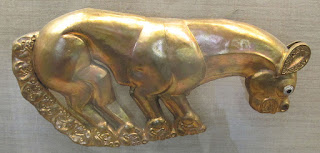 |
| Scythian gold artwork |
Darius marched northwards, seeking to subdue the Thracians and Getai tribes. These tribes were promptly dealt with and the huge army of Darius continued northwards to the Danube. Once here they crossed the wide river by means of another pontoon bridge. The Ionians were said to have been left here to guard the bridge against Scythian attacks. Meanwhile the main Persian army marched into Scythia attempting to bring the horse raiders to battle.
The Scythians were a very loose confederation of nomadic tribes, who specialised in raiding and whose cavalry and archers were some of the finest in the world. They decided not to engage the Persian army, but to retreat before the Persians, burning the lands before them to scorch the earth and deny the invader anything. Darius’ army followed in hot pursuit, but were unable to catch the fleeting Scythians. The lands of the Budini and Geloni, tribes subject to the Scythians, were burned and the villages destroyed. It is a little difficult to determine the geography from Herodotus, but it seems that Darius had chased the Scythians into what is now present day Ukraine and had eventually reached the banks of the Volga. It is not clear how the Persian or Scythian armies managed to cross the broad rivers of the Dnieper and the Don. Despite this rapid advance, the Persians had still not managed to bring the Scythians to battle. Forts were built to try and act as a frontier, but these were abandoned when it became clear that the Scythian army had not crossed the river but had instead circled to the north and west and were now in the rear of the army. In frustration, Darius is said to have sent a message to Idanthyrsus, the king of the Scythians, to taunt him into either fighting or submitting. The message was of no avail.
 |
| Scythian gold artwork |
As this went on for a long time and did not stop, Darius sent a horseman to Idanthyrsus the Scythian king, with this message: “You crazy man, why do you always run, when you can do otherwise? If you believe yourself strong enough to withstand my power, stand and fight and stop running; but if you know you are the weaker, then stop running like this and come to terms with your master, bringing gifts of earth and water.”
Herodotus, Histories, 4.126, written around 440BC
The Scythians never did fight Darius, instead focusing on continuing their harassment and scorched earth policy. Both sides had suffered greatly in the campaigns. The Persians were running short on supplies in the steppes, while the vassals of the Scythians had seen their lands destroyed. Representatives from the Scythians pleaded with the Ionians manning the bridge on the Danube to abandon it and return, leaving Darius and his army trapped north of the river. But the Ionian tyrants stayed loyal, mainly on the reasoning of the tyrant of Miletus, Histiaeus. The Ionians partly dismantled the bridge, but left enough that when Darius’ army returned to the Danube the pontoon bridge could be re-established easily.
When these (the Ionians) accepted Histiaeus' view, they decided to act upon it in the following way: to break as much of the bridge on the Scythian side as a bowshot from there carried, so that they seem to be doing something when in fact they were doing nothing, and that the Scythians not try to force their way across the bridge over the Ister (Danube); and to say while they were breaking the portion of the bridge on the Scythian side, that they would do all that the Scythians desired.
Herodotus, Histories, 4.139, written around 440BC
The Persian army returned to the bridge and crossed back to the southern shore of the Danube. Herodotus records the expedition as a defeat for the Persians but it was more like a tactical and strategic stalemate. The Persians could not conquer the Scythians, but the Scythians could not protect their lands against the Persians. Megabazus, a Persian general, was left in charge of solidifying the conquest of Thrace and the lands south of the Danube. Darius himself returned to Persia with most of his army. The expedition against the Scythians may not have been a complete success, but his campaign had seen monumental feats of logistics and engineering. He was also the first king of Asia that we know of to extend his empire into Europe.
There was an Egyptian with Darius whose voice was the loudest in the world; Darius had this man stand on the bank of the Ister (Danube) and call to Histiaeus the Milesian. This the Egyptian did; Histiaeus heard and answered the first shout, and sent all the ships to ferry the army over, and repaired the bridge.
Herodotus, Histories, 4.141, written around 440BC
Around the year 512, Megabazus continued the campaigns in Europe. He sent a delegation to Amyntas I of Macedonia to force him to accept Persian overlordship. He also oversaw the conquest and deportation to Anatolia of the Paeonian people, although both of these events may have occurred over the next decade.
The Paeonians, learning that their towns had been taken, straightway disbanded, each going his own way, and surrendered themselves to the Persians. Thus of the Paeonians the Siriopaeones and Paeoplae and all who lived as far as the Prasiad lake were taken away from their homes and led into Asia.
Herodotus, Histories, 5.15, written around 440BC
I am not aware of anything that happened in the year 511.
 |
| Gold daric |
Around the year 510, although it may have been slightly later, Darius introduced the daric currency. The Persian Empire now included most of the major gold producing regions of the ancient world, such as Egypt and India and the great commercial centres such as Phoenicia, Ionia and Babylonia. To standardise taxation and currency exchange throughout this vast empire a new currency was required. The coin was possibly named after the king, Darius, but may also stem from the Persian word for gold, “dari”. Prior to this the Persians had mostly continued the minting of Lydian type coins, following the types used by Croesus. A silver coin, using a similar design was minted, called the siglos. The siglos probably predates the daric, possibly being minted in the 520’s. Minting was done primarily in Sardis, the old capital of Lydia, but because of taxation, many of the coins accumulated in bullion stored in Susa, Babylon or Persepolis. The coins, both siglos and darics, had an obverse design showing the king as an archer. Later types show the king, still as an archer, but sometimes holding a lance or dagger. Thus the coins were colloquially known by the Greeks as Archers. While Persian satraps were not allowed to mint their own coins, the coins, weights and measures still continued to circulate throughout the empire. Later satraps would mint coins in their own names however. However, the daric was the only major gold coin in use, and was thus highly prized.
 |
Statue of Udjahorresnet in the
Vatican Museum |
Also around the year 510, Karkamani of Kush may have died. He buried in the royal cemetery at Nuri and succeeded by Amaniastabarqa. Neither Karkamani nor Amaniastabarqa are well known to scholarship. Udjahorresnet, the renegade Egyptian admiral whose treachery helped Cambyses conquer Egypt and who had been a friend of Darius in his campaigns, seems to have died around this time. His monuments remain, as an Egyptian who fought against his country, but who seems to have tried to teach the conquerors he served to respect the customs of Egypt.
Among all of the wars and building projects, there were also scientific advances. Naburimannu, a Babylonian astronomer and mathematician, who also was an almost certainly an astrologer as well, seems to have flourished around this time. He may have developed the Babylonian System A for calculating ephemerides of the Solar System. Not much more can be said of Naburimannu, save that he lived, but it is important to remember the progress of human knowledge continued.
The year 509 is the date of the oldest tablet in the Persepolis Fortification Archives. These were administrative records that were kept in the libraries of Persepolis and which shed some light on the day to day administration of the empire. These have yet to be fully deciphered however, as many of them are in Elamite and this language is poorly understood even now. Sadly, these archives are mostly held in the United States currently, where they are involved in a legal case that threatens to see the texts confiscated and sold at some point in the future. Hopefully, for the sake of preserving the history of the world, this does not happen.
 |
Tablets from the Persepolis Fortification
Archive |
Not much can be said for the years 508, 507 or 506. Around the year 505 Histiaeus, the tyrant of Miletus who had rendered such service to Darius at the pontoon bridge on the Danube, was summoned to Susa to live as the guest-friend of Darius. This was doubtless a great honour but also a terrible blow to Histiaeus, who rightly saw that he would be kept there forever and that this honour would mean that he would never see his homeland again. When Histiaeus departed for Susa he left Aristagoras as a deputy tyrant of Miletus in his stead. Darius may have summoned Histiaeus because Megabazus, the Persian general in charge of subduing Thrace, did not trust him.
Histiaeus the Milesian was by this time fortifying the place which he had asked of Darius as his reward for guarding the bridge, a place called Myrcinus by the river Strymon. Megabazus discovered what he was doing, and upon his arrival at Sardis with the Paeonians, he said to Darius, “Sire, what is this that you have done? You have permitted a clever and cunning Greek to build a city in Thrace, where there are abundant forests for ship-building, much wood for oars, mines of silver, and many people both Greek and foreign dwelling around, who, when they have a champion to lead them, will carry out all his orders by day or by night. Stop this man, then, from doing these things so that you will not be entangled in a war with your own subjects, but use gentle means to do so. When you have him in your grasp, see to it that he never returns to the Greek lands.”
Herodotus, Histories, 5.23, written around 440BC
Not much can be said for the years 504, 503, 502 or 501. Around the year 500, although this is of course an approximate date, a number of reforms were put in place by the Persian Empire. A new calendar was introduced by Darius, which effectively used the Babylonian lunar calendar as the basis for timekeeping. This was adopted by many of the peoples of the empire and is still used today, in a rather modified form, in the Hebrew calendar. In a similar vein, Aramaic was proclaimed as the official language of administration of the empire. Other languages were used of course, such as Old Persian, Akkadian and Egyptian but the lingua franca of the empire was now Aramaic.
 |
| Silver siglos coin |
Finally, the old administrative roads of the empire, some dating from Assyrian times, were linked into something approximating a coherent series of highways. The greatest of these was the Royal Road, which linked Susa in the east to Sardis in the west. Along this road rode the famed Persian messengers. There were stops that would allow the messengers to change horses and to pass messages on to fresh riders. Herodotus writes that these messengers are the fastest humans on earth and his glowing description of them ultimately became the motto of the US Postal Service.
Now there is nothing mortal that accomplishes a course more swiftly than do these messengers, by the Persians' skilful contrivance. It is said that as many days as there are in the whole journey, so many are the men and horses that stand along the road, each horse and man at the interval of a day's journey. These are stopped neither by snow nor rain nor heat nor darkness from accomplishing their appointed course with all speed.
Herodotus, Histories, 8.98, written around 440BC
It seems that around this time the Carthaginians began expanding their trading in southern Spain, perhaps setting up trading emporia along the coastlines. Carthaginian influence would certainly have been felt here, but there was probably no outright colonisation, at least of the interior.
It was possibly around this time that the Palace of Darius in Susa was partially completed. This had been started around the year 520 and had been worked on by peoples from all over the empire. An inscription celebrating its creation was written and has been preserved to this day.
 |
| Gold daric |
This palace which I built at Susa, from afar its ornamentation was brought. Downward the earth was dug, until I reached rock in the earth. When the excavation had been made, then rubble was packed down, some 40 cubits in depth, another (part) 20 cubits in depth. On that rubble the palace was constructed. And that the earth was dug downward, and that the rubble was packed down, and that the sun-dried brick was molded, the Babylonian people - it did (these tasks). The cedar timber, this - a mountain named Lebanon - from there was brought. The Assyrian people, it brought it to Babylon; from Babylon the Carians and the Ionians brought it to Susa. The yakâ-timber was brought from Gandara and from Carmania. The gold was brought from Sardis and from Bactria, which here was wrought. The precious stone lapis lazuli and carnelian which was wrought here, this was brought from Sogdiana. The precious stone turquois, this was brought from Chorasmia, which was wrought here. The silver and the ebony were brought from Egypt. The ornamentation with which the wall was adorned, that from Ionia was brought. The ivory which was wrought here, was brought from Nubia and from Sind and from Arachosia. The stone columns which were here wrought, a village named Abiradu, in Elam - from there were brought. The stone-cutters who wrought the stone, those were Ionians and Sardians. The goldsmiths who wrought the gold, those were Medes and Egyptians. The men who wrought the wood, those were Sardians and Egyptians. The men who wrought the baked brick, those were Babylonians. The men who adorned the wall, those were Medes and Egyptians. Darius the King says: At Susa a very excellent (work) was ordered, a very excellent (work) was (brought to completion). May Ahuramazda protect me, and Hystaspes my father, and my country.
Dedicatory inscription of the Palace of Darius at Susa, written around 510-500BC
Lastly, in the year 500 certain exiles from the island of Naxos approached Aristagoras, the deputy tyrant of Miletus, for help in restoring them to their homelands. In return they would promise that they would bring Naxos into the Persian Empire. Aristagoras agreed and from these minor matters great changes in world history would follow.
This brings the period to a close. We have seen the Persian conquests in Egypt, the most audacious coup (either by Gaumata or Darius) in the history of the world, a year and a half of frenetic civil war, explorations of new lands and seas, the Persian expeditions against India and Scythia and the growing cohesion of the most powerful empire that the world had yet seen at the very height of its power.
 |
| Griffin design from Persepolis |
Primary Sources:
2 Kings (probably written around 525BC)
Contract for Ishunnatu’s bar loan, written around 524-523
Full translation of the Behistun Inscription, written no earlier than 520BC
Haggai, probably written around 520BC
Zechariah, probably written around 516BC
Petition of Pediese, written around 513BC
Inscription of Udjahorresnet (written perhaps around 510BC?)
Herodotus Histories, written around 440BC
Ezra, probably written no earlier than 420BC
Polyaenus Stratagems, written around AD163
Secondary Sources:
Article on the Babylonian Auditor/Thief Gimillu by Michael Kozuh
An Essay on the Gold-Digging Ants of Herodotus by Monique Cardell
Related Blog Posts:
550-525BC in the Near East
525-500BC in Greece
499-480BC in the Near East


