|
| Dragon brickwork from the Ishtar Gate of Babylon |
This blog post will be looking at the years 600-575BC in the Near East, which for the purposes of this blog will include Kush and Lydia in the south and west, far over to the easternmost reaches of the Median Empire and to the Caucasus in the north. Occasionally there may be references to other regions, but the Greek world in particular will be dealt with in a separate post.
The sources for this blog will include as much primary sources as possible, particularly Neo-Babylonian chronicles and other cuneiform writings. Lydian and Median sources are so scant as to be almost non-existent, and those that do exist may in fact be forgeries. Egyptian and Kushite inscriptions will be used where possible, but there are not as many of these as we would like. The Hebrew Tanakh or Old Testament will be used where possible, but this has a very narrow focus and is not contemporary with the events that it describes. Also, the writers of the books of Kings, Chronicles, Jeremiah, etc. are not writing history as such and their writings have their own specific conventions. The source material that we shall see becoming ever more prevalent during this period, is the later writings of the Greeks. For better or for worse, shortly after the fall of Assyria, we begin to have fewer and fewer writings directly from the Mesopotamians.
 |
Inscription of Nebuchadnezzar
detailing the rebuilding of the Ebabbar
temple in Sippar |
As always I feel it is important to note that I am not a professional historian. The facts and dates in this post should be treated with due caution and everything should be checked. There are certainly mistakes and errors in the sources and I may make mistakes in my interpretations of these sources. Mistakes are particularly likely to occur when dealing with years, as the Babylonian and Jewish years do not correspond exactly to our own. So, there is the possibility that I may have, for example, interpreted an event as happening in late 609 when it may in fact have been early 608. If the reader spots any errors such as this, please let me know in the comments and I will research it and correct it as soon as possible. Also, another thing that will affect dating for this period is whether the king counts the first year of their reign as the 1st year or the 0th year (counting from accession or from first full year). Even professional historians have differing opinions on the exact ordering of events at this time, so exact precision is not likely here.
It can be useful to give context to the period by describing what is happening elsewhere in the world at this time. In China, the Zhou Dynasty was continuing its long slow decline, while the feudal states such as Jin and Chu grew ever more important and waged wars between them for influence. In India, there were a number of powerful kingdoms, particular in the north along the Gangetic Plain. These kingdoms were known as the Mahajanapadas and included states such as Kuru, Panchala, Kosala, Videha and Magadha. In India at this time a number of sects began to spring up that in certain cases had unusual interpretations of the accepted beliefs of the time and region, but this is a topic for another blog. To the west, in Greece, poets and tyrants flourished along with the beginnings of Greek science and philosophy. These will all be spoken of in later blogs, but this should give a rough idea of the state of the world at this point.
 |
| Gold coin of the Mermnad Dynasty of Lydia |
When we begin our time period, we can see that the fall of the Assyrian Empire had left three powers, Media, Babylon and Lydia in its place and that these three, in combination with Egypt, now dominated the region. Each of these large kingdoms had strong rulers: Alyattes II in Lydia, Nebuchadnezzar II in Babylon, Cyaxares in Media and Necho II in Egypt. Smaller kingdoms were dotted around the region, but were relatively insignificant in comparison to these three.
In the year 600 the Babylonians were rebuilding their army after suffering a defeat while attempting an invasion of Egypt the previous year. Their western client kingdom of Judah was in revolt and Babylonian rule west of the Euphrates was jeopardised. Necho II of Egypt seems to have tried to support the rebellion of the kingdom of Judah by attacking and capturing the city of Gaza, which was also an important trading post.
In Judah the prophet Habbakuk was probably active around this time and the book that bears his name may have been written around this time, however dates are not explicitly given in this work and it may be later. In Kush, to the south of Egypt, the king Anlamani died and was succeeded by his brother Aspelta.
 |
Outlined tablet showing silhouette of
the Etemenanki |
As for the Etemenanki — the ziggurat of Babylon, which had become very weak and had been allowed to collapse before my time — the god Marduk — my lord — commanded me to firmly secure its foundation on the surface of the netherworld and to have its summit rival the heavens.
Nabopolassar 5, i 19
Around this time, the Etemenanki, the huge ziggurat in Babylon, was rebuilt. The reconstruction of this had begun under the Assyrian kings, but the revolt of Shamash-shuma-ukin had probably put a stop to it. Nabopolassar had begun to rebuild, it but the work was only completed under his son, Nebuchadnezzar II. The tower reached 91 metres and was one of the tallest structures on earth at the time. Some have speculated that this gigantic tower was the inspiration for the story of the Tower of Babel, but ziggurat towers were well known in the Near East. It is possible as well that its ruins were the inspiration for the Hanging Gardens of Babylon, but again, this is highly speculative.
In the sixth year [599/598] in the month of Kislimu the king of Akkad (Nebuchadnezzar) mustered his army and marched to the Hatti-land (west of the Euphrates River). From the Hatti-land he sent out his companies, and scouring the desert they took much plunder from the Arabs, their possessions, animals and gods. In the month of Addaru the king returned to his own land.
Babylonian Chronicles ABC5 (Jerusalem Chronicle)
Around the year 599 the Babylonian army had been reorganised after the defeat near Egypt and was campaigning once more. The army marched west and probably quelled rebellions among the nomad tribes near the Jordan River. The tribes in question were probably the Kedarite Arabs, who had desert cities in Dumatha and Tayma. This campaign probably served to strengthen the kings of Moab and Edom who had acted as allies of Babylon against the rebellious kingdom of Judah.
 |
| Babylonian World Map from Sippar |
Around this time the Ebabbar Temple, dedicated to the Sun God Shamash, in the sacred city of Sippar, was restored by Nebuchadnezzar. He left inscriptions describing his rebuilding of the temple and the city seems to have prospered under his rule. This is as good a place as any to mention the Babylonian map of the world that was discovered in Sippar and may come from this time period. Dates cannot be exact of course, but the map does date from this century. It appears to show a conceptual picture of a circular world, surrounded by mountains. The furthest places that it shows are Urartu and Susa, meaning that it shows a very limited picture of the world. But despite the fact that we are not sure of its exact use (the tablet itself is broken), we can be sure that this is the oldest map currently possessed by humanity. There are Greek maps that were supposedly made in this century as well, but they are not preserved in their original form.
Also made around this time are the Ketef Hinnom scrolls. These were little silver scrolls that were made in Jerusalem that were probably used as amulets. They are interesting in that they are the earliest known quotations from the Hebrew Bible and contain versions of the Priestly Blessing from the Book of Numbers. Similarly to the Babylonian map, the exact dating of these is unclear, but it is believed to be around this time, so I thought that I would mention them here.
 |
| One of the Ketef Hinnom scrolls |
YHWH, keep you. Make shine, YHWH, His face upon you and grant you peace.
Ketef Hinnom KH2 Apotropaic Amulet text
In 598 the Babylonian army continued the campaign in the Levant and probably began to besiege Jerusalem, which was in revolt under the leadership of Jehoiakim. Jehoiakim died however and was buried in the tombs of the kings while the siege was ongoing. Jehoiachin succeeded his father, but only reigned for a few months.
And Jehoiachin the king of Judah went out to the king of Babylon, he, and his mother, and his servants, and his princes, and his officers: and the king of Babylon took him in the eighth year of his reign. And he carried away all Jerusalem, and all the princes, and all the mighty men of valour, even ten thousand captives, and all the craftsmen and smiths: none remained, save the poorest sort of the people of the land. And he carried away Jehoiachin to Babylon, and the king's mother, and the king's wives, and his officers, and the mighty of the land, those carried he into captivity from Jerusalem to Babylon.
2 Kings 24:12,14-15
In 597 the city was surrendered to the Babylonians, but this did not save the king. Jehoiachin was dethroned and sent away to Babylon, along with many high-ranking prisoners who were also deported. The city was plundered and the loot sent eastwards to Babylon with the train of captives. The corpse of the rebel king Jehoiakim was taken from its tomb and thrown outside the city to be eaten by the wild beasts. After all this Mattaniah, a son of Josiah, was placed on the throne and his name changed to Zedekiah. It was expected that Zedekiah would prove loyal, as Babylonian patience with Judah must have been wearing thin. One of those deported to Babylon was a young man from a priestly family known as Ezekiel.
 |
| Inscription of Nebuchadnezzar II |
In the seventh year, the month of Kislîmu (February or March 597), the king of Akkad (Nebuchadnezzar) mustered his troops, marched to the Hatti-land, and besieged the city of Judah and on the second day of the month of Addaru he seized the city and captured the king. He appointed there a king of his own choice, received its heavy tribute and sent to Babylon.
Jerusalem Chronicle ABC 5
In the year 596 Babylonian sources record that Elam, which had somehow managed to recover from the wars of the previous century, made some form of attack against Babylonia. The armies of Babylon returned from the west and fought a campaign against the Elamites that seems to have ended in an Elamite withdrawal. It is not clear if Nebuchadnezzar pursued the Elamites or invaded Elam himself, but some form of punitive action probably took place.
 |
| Partiall reconstructed ruins of Babylon |
While there was still a distance of one day's march between them, the king of Elam was afraid and, panic falling on him, he returned to his own land.
Jerusalem Chronicle ABC5
In 595 it seems that Sarduri IV of Urartu died and was succeeded by his brother Rusa IV. Urartu at this point seems to have been ruined; a shadow of its former self and this once mighty kingdom would fade out with barely a whimper in historical sources.
In this year there seems to have been a rebellion against Nebuchadnezzar in Babylon. This civil war was dealt with quite quickly and the rebellion was crushed. We know very little about who exactly was rebelling or what their motivations were.
 |
| Inscription of Nebuchadnezzar II |
In the tenth year the king of Akkad (Nebuchadnezzar) was in his own land; from the month of Kislîmu to the month of Tebetu there was rebellion in Akkad. With arms he slew many of his own army. His own hand captured his enemy.
Jerusalem Chronicle ABC5
Also in this year Necho II died and was succeeded by his son Psamtik II in Egypt. This is as good a time as any to remember the achievements of Necho II. He was the son of Psamtik, who was remembered by Herodotus as trying to discover the first language of man, in what may have been the first experiment recorded in history. Necho continued this tradition of boldness, both in his daring campaign that expanded Egyptian power briefly to the Euphrates and in the exploration and building projects he completed.
Necho II is supposed to have attempted to link the Red Sea to the Nile in the earliest version of the Suez Canal to have been attempted. This was a gigantic work and was truly a work of vision, but there were problems with it, namely that there is a considerable difference in water levels between the two bodies of water. There are no Egyptian inscriptions for this, but we know the story from Herodotus, who says that Necho II stopped construction after receiving an unfavourable oracle.
Necho II then appears to have commissioned an even more intriguing expedition. He hired Phoenician sailors, the greatest sailors of the ancient world, to set sail from the Red Sea and to attempt to circumnavigate Africa. According to Herodotus, who again, is our sole source for the story, the sailors did not return for a long time but did eventually arrive back in Egypt having sailed around the continent and coming back through the Straits of Gibraltar. This was an unprecedented feat and one that was not to be repeated to our knowledge until the Age of Exploration. The sailors told tales of the sun being in the wrong position, which led the Greeks, and perhaps the Egyptians, to discount the story. This however makes it much more plausible, as it suggests that the Phoenicians did in fact reach the southern hemisphere.
 |
Earlier Assyrian relief of Phoenician sailors
on riverboats |
For Libya shows clearly that it is bounded by the sea, except where it borders on Asia. Necos king of Egypt first discovered this and made it known. When he had finished digging the canal which leads from the Nile to the Arabian Gulf, he sent Phoenicians in ships, instructing them to sail on their return voyage past the Pillars of Heracles until they came into the northern sea and so to Egypt. So the Phoenicians set out from the Red Sea and sailed the southern sea; whenever autumn came they would put in and plant the land in whatever part of Libya they had reached, and there await the harvest; then, having gathered the crop, they sailed on, so that after two years had passed, it was in the third that they rounded the pillars of Heracles and came to Egypt. There they said (what some may believe, though I do not) that in sailing around Libya they had the sun on their right hand.
Herodotus, Histories: 4:42
Sadly for Necho II while he was a king of vision and energy, his projects nearly all failed. His armies lost to the Babylonians, the canal was not completed and the route around Africa was too long to be of practical use. He was a genius before his time perhaps.
 |
| Ankhnesneferibre |
When Psamtik II took the throne he instated his daughter Ankhnesneferibre as Divine Adoratrice of Amun in Thebes. This was in the year 595 or 594 depending on what is counted as the first year. This was an important position, in certain ways perhaps the second most important position in Egypt after the Pharaoh himself, so it was important to ensure that this post was held by someone loyal to the dynasty. Nitocris I adopted the princess to ensure that she would become God’s Wife on the death of Nitocris. Thus the Saite Dynasty further strengthened its hold on the southern part of Egypt.
Year 1, third month of the third season, day 29, under the majesty of Horus: Favourite of the Two Goddesses: Mighty of Arm; Golden Horus: Beautifying the Two Lands; King of Upper and Lower Egypt: Psamtik II, given life. On this day the king's-daughter, Ankhnesneferibre, arrived at Thebes. Her mother, the Divine Consort, Nitocris, who liveth, came forth to behold her beauty, and they went together to the House of Amon.
Stela of Ankhnesneferibre
In 594, after the rebellion was crushed in Babylon, the Babylonian army seems to have moved back to the western part of the empire to continue campaigning. There were continued tensions with the Egyptians who had raised a fleet of Phoenicians and Greeks and were attacking the Mediterranean coasts. The loyalty of Tyre and Sidon and other Phoenician cities to Babylon was very suspect as well. There are references to the Babylonians besieging Tyre around this time, but I have found that the dates are highly inconsistent, possibly because there was more than one siege.
Possibly as part of this western campaign Zedekiah king of Judah was summoned to Babylon and made the trip with several high ranking officers of his court. Presumably this was to show that he was still loyal to Nebuchadnezzar and that he was able to give the tribute that was required of him.
 |
| Inscription of Nebuchadnezzar II |
This is the message Jeremiah the prophet gave to the staff officer Seraiah son of Neriah, the son of Mahseiah, when he went to Babylon with Zedekiah king of Judah in the fourth year of his reign.
Jeremiah 51:59
In 593 the Babylonians continued their campaigns in the Levant, but it is not clear against whom exactly. In this year the so-called Jerusalem Chronicle (because it refers to the capture of Jerusalem in 598/597) comes to an end and our main sources of Babylonian history grow silent. We have been spoiled by the Assyrian and Babylonian records from the reigns of Tiglath-Pileser III onwards, but from here the contemporary records become more fragmentary unfortunately.
Perhaps around this time, the passage simply says early in Zedekiah’s reign, there was a confrontation between Jeremiah and Hananiah, the prophets who were prominent in the pro-Babylonian and pro-Egyptian groups in Jerusalem. At this point there were a number of envoys from the surrounding kingdoms in Jerusalem; from Edom, Moab, Ammon, Tyre and Sidon. Why they were here is not exactly clear, but the most likely answer is that the kings of the region were plotting an uprising. Jeremiah made a yoke that he wore and proclaimed that everyone who wore the yoke of Babylon would live. Hananiah seized the yoke and broke it, saying that within two years the exiles would return. This was a blatant challenge to Jeremiah, as Jeremiah had previously proclaimed that the exile would last seventy years. Jeremiah then proclaimed that, in exchange for the yoke of wood that had been broken, the Babylonians would rule with a yoke of iron and prophesied Hananiah’s death.
 |
| Psamtik II |
In 592 Psamtik II became worried about the power of Kush and launched an attack against the Kushite king Aspelta. His army moved downstream with boatloads of soldiers and mercenaries, including large contingents of Greeks and Carians as bronze-clad soldiers of fortune looking to make money in distant lands. The Greeks gazed in awe at the statues of Ramesses II at Abu Simbel and proceeded to do what tourists always do, and carve their names all over the ancient site. Some of their graffiti still survives, as they record who they are and who led them for all time.
When King Psammetichus came to Elephantine, this was written by those who sailed with Psammetichus the son of Theocles, and they came beyond Kerkis as far as the river permits. Those who spoke foreign tongues (the Greeks and Carians) were led by Potasimto, the Egyptians by Amasis.
Graffito at Abu Simbel written in Greek
The campaign against the Kushites was at least a partial success and Napata may have been ransacked forcing the Kushite capital to move south to Meroe. Psamtik II set up a victory stela but it is extremely formulaic and not overly detailed as to what exactly happened. It is clear that even after the capital was moved that the Kushites still controlled Napata and were generally buried nearby in the cemetery of Nuri.
 |
| Kushite royal tombs at Nuri, near Napata |
The Nubians of every hill-country rose up against him, their hearts full of rage against him. His attack took place, and it was misery for the rebels. His majesty has done a fighter’s work. When the battle was joined the rebels turned their backs. The arrows did not stray from piercing them. The hand did not let loose. One waded in their blood as in water. Not one bound pair escaped of the 4,200 captives. A successful deed has been done!”
Psamtik II Victory Stela
After the successful attack on Kush Psamtik II seems to have campaigned in the Levant as well to try and stir up revolt against the Babylonians, either in late 592 or in 591. Judah seems to have been in turmoil, with a pro-Egyptian party and a pro-Babylonian party. Jeremiah the prophet seems to have either led, or been important in, the pro-Babylonian party. The pro-Egyptian party was possibly led by a prophet called Hananiah, who may have died at this point.
The situation was complicated by the fact that there were probably supporters of the deposed king Jehoiachin who were keen to topple Zedekiah. The situation was complicated further still by the fact that many of the exiles in Babylon seem to have stayed in contact with the people in Jerusalem and the exiles had their own factions as well. It was into this maelstrom of politics and prophecy that Psamtik II entered with the Egyptian army. In either 592 or 591, Zedekiah of Judah succumbed to the pressure of the pro-Egyptian faction and Judah rose in rebellion against Babylon.
 |
| Ruins of the Temple of Amun in Meroe |
Exiled faraway in Babylon, Ezekiel, who had been exiled along with those taken with Jehoiachin, began to prophesy. Ezekiel was of the group that could roughly be called pro-Babylonian. This is not to imply that they liked the Babylonians. Jeremiah and Ezekiel certainly did not like their conquerors, but they did counsel patience for those who had been taken into exile and submission for those who remained.
On the fifth of the month—it was the fifth year of the exile of King Jehoiachin— the word of the Lord came to Ezekiel the priest, the son of Buzi, by the Kebar River in the land of the Babylonians. There the hand of the Lord was on him. I looked, and I saw a windstorm coming out of the north—an immense cloud with flashing lightning and surrounded by brilliant light. The centre of the fire looked like glowing metal, and in the fire was what looked like four living creatures. In appearance their form was human, but each of them had four faces and four wings.
Ezekiel 1:2-6
 |
| Lydian brooch decoration |
Finally, around this time there is a strange tradition in later Judaism that suggests that Jeremiah hid the fire from the temple somewhere on Temple Mount and then separately hid the Ark of the Covenant somewhere on Mount Sinai. These are later traditions and almost certainly ahistorical but I found them interesting so I thought that I would make a mention of them. They are certainly intriguingly mysterious even if almost certainly untrue.
These same records also tell us that Jeremiah, acting under divine guidance, commanded the Tent of the Lord's Presence and the Covenant Box to follow him to the mountain where Moses had looked down on the land which God had promised our people. When Jeremiah got to the mountain, he found a huge cave and there he hid the Tent of the Lord's Presence, the Covenant Box, and the altar of incense. Then he sealed up the entrance.
2 Maccabees 2:4-5
In 591 some sources that I have come across suggest that Sadyattes of Lydia dies at this time and that Alyattes II succeeds. This might be true, but honestly the chronology of the Mermnad Dynasty of the Lydian kingdom is not well known. Not knowing which, if either, date is correct I have mentioned both: 619 and 591. The important thing is of course that Alyattes II follows Sadyattes on the throne of Lydia.
 |
| Ruins of city of Teishebaini |
In 590 the city of Teishebaini in Urartu is sacked, probably by the Medes. War broke out between the Medes and the Lydians, presumably over the remnants of the Urartian kingdom, which at this point was probably no more than a few cities, if even that. At stake in the war between the mighty powers of Media and Lydia was where the border between them should lie. However, Herodotus records that the war was fought because Alyattes refused to give up refugees that had fled from Media. This is quite possible as well, as extraditions were quite important for ancient states.
Also around this time a prophet in Jerusalem named Obadiah spoke a short prophecy against Edom, a nearby kingdom to the south that was related to the kingdom of Judah and had previously been allied or tributary to the larger kingdom. When Nebuchadnezzar had attacked Jerusalem the Edomites had assisted in the loot and Obadiah prophesied the destruction of their kingdom as a result. It is not clear if this was the exact time of the vision and the writing, but the context certainly fits.
 |
| Psamtik II temple at Hibis |
On the day you stood aloof while strangers carried off his wealth and foreigners entered his gates and cast lots for Jerusalem, you were like one of them. You should not gloat over your brother in the day of his misfortune, nor rejoice over the people of Judah in the day of their destruction
Obadiah 11-12
In the year 589 Psamtik II of Egypt died. He had been an energetic Pharaoh who had campaigned to the south and east. He had done major building works in Egypt, including the monumental temple at Hibis that still stands to this day. He was succeeded by Wahibre, better known by his Greek name Apries, but referred to by the Hebrews as Hophra.
 |
The remains of an Assyrian siege ramp at Lachish
This may have been reused by the Babylonians |
The Babylonian armies returned to the west of their empire to crush the revolt of Zedekiah. The army of Judah was nowhere near strong enough to meet the Babylonians in open battle, so they resorted to other tactics. Much of their army was set to defend the three main cities remaining in Judah: Jerusalem, Lachish and Azekah. Other contingents would be sent out to the hills to act as raiders and to send fire signals between the besieged cities. Other contingents would be sent out to the neighbouring kingdoms to assist in other revolts and a large contingent was probably sent to Egypt to join the forces of the Egyptians who would come to their aid. It is possible that the siege of Jerusalem was begun by the Babylonian forces in 589, although Nebuchadnezzar himself seems to have stayed near Riblah where he could conduct other operations against other cities simultaneously.
The commander of the army (of Judah) Konyahu son of Elnatan, has gone down to go to Egypt and he sent to commandeer Hodawyahu son of Ahiyahu and his men from here.
Lachish Letter 3
As a side note, it is possible that the book of Judith is meant to be set in this period, as it refers to a king called Nebuchadnezzar who invades Judah, but the references are hopelessly confused and do not really fit any actual historical period.
 |
Painting of Judith and Holofernes
by Vincenzo Catena |
Now in the twelfth year of his reign, Nabuchodonosor king of the Assyrians, who reigned in Ninive the great city, fought against Arphaxad and overcame him
Judith 1:5
In 588 the Babylonians continued the attack on the three cities, presumably after having first attacked and destroyed the remaining less well-fortified cities in the land of Judah. Through an accident of history we have a primary source for the siege of Lachish. A broken pot was used to write down messages that were received by the garrison of Lachish. The messages were probably sent by fire-signals from the hills, allowing the commanders to talk to each other despite being under siege, and then transcribed for reading before being discarded near the gates, where they were found in the 20th century by archaeologists. The messages talk about confidential documents, army contingents being sent to Egypt, prophets and discouraging news in Jerusalem, and a host of other interesting information.
The sieges do not seem to have lasted long, as almost immediately the Babylonians received word that Apries, king of Egypt, had sent his armies from Egypt to fight them. Possibly Apries had landed troops further north in Phoenicia rather than sending his army out across the northern coast of the Sinai. Whatever route was taken, the Babylonians withdrew their armies from Judah to meet this new threat.
When the Babylonian armies withdrew to face the Egyptians, Jeremiah, a prophet who had been vocal in counselling submission to Babylon, attempted to leave the city and was arrested as a likely defector to the enemy. The prophet was imprisoned, but not executed, as King Zedekiah still respected him.
Pharaoh’s army had marched out of Egypt, and when the Babylonians who were besieging Jerusalem heard the report about them, they withdrew from Jerusalem. … But when he reached the Benjamin Gate, the captain of the guard, whose name was Irijah son of Shelemiah, the son of Hananiah, arrested him and said, “You are deserting to the Babylonians!”
Jeremiah 37:5,13
 |
| Seal of Gedaliah son of Passhur |
The Babylonian army soon returned, having dealt with the Egyptian army, and now Jeremiah’s continued prophecies about the city falling could not be stood any longer by the pro-Egyptian party who demanded his death. Even his enemies could not stand to put a prophet to death however and he was placed in a dry well to starve to death until he was rescued by Ebed-Melek the Kushite Considering the recent war between Egypt and Kush, Ebed-Melek is unlikely to have been pro-Egyptian. One of those who had thrown Jeremiah into the well was Gedaliah, the son of Passhur, whose seal was discovered in Jerusalem in 2008.
Jeremiah spent the remainder of the siege under arrest, but not in threat of death, which shows the respect that prophets were given, even if their actual words were not followed. The pro-Egyptian and pro-Babylonian were not even the only factions and sub-groups in the besieged city, as there were followers of a conservative sect of Judaism, known as Recabites that had also fled for shelter there as well. It is a good reminder that just as there were profusions of sects in later stages of Judaism, that there were likely to have been a number of sects at this time as well.
Then Jeremiah the prophet told all this to Zedekiah king of Judah, in Jerusalem, while the army of the king of Babylon was fighting against Jerusalem and the other cities of Judah that were still holding out—Lachish and Azekah. These were the only fortified cities left in Judah.
Jeremiah 34:6-7
When the Babylonians returned to the attack they launched simultaneous sieges against Azekah, Lachish and Jerusalem. It seems that first Azekah fell and then Lachish. Even with the strengthening of the cities and the fire-signal communications from the hills, there was no resisting the Babylonian armies.
 |
| Replica of one of the Lachish Letters |
And may (my lord) be apprised that we are watching for the fire signals of Lachish according to all the signs which my lord has given, because we cannot see Azekah.
Lachish Letters No 4.
While Lachish and Azekah may have fallen quickly, Jerusalem seems to have held out for eighteen months, during which time the Babylonians built siege ramps and battered at the walls while inside the walls the people starved. Partway through the siege the people of Jerusalem decided to curry favour with their God by freeing their slaves, but seeing that the siege continued regardless, they re-enslaved them again. They were castigated for this by Jeremiah from his imprisonment. It’s not exactly clear when this happened, but if the siege was resumed in 588, then it is likely that the freeing and re-enslaving took place in 587. This is one of the few noted attempts at emancipation in the ancient world, despite the fact that it did not last.
So all the officials and people who entered into this covenant agreed that they would free their male and female slaves and no longer hold them in bondage. They agreed, and set them free. But afterward they changed their minds and took back the slaves they had freed and enslaved them again.
Jeremiah 34:10-11
In 586 Jerusalem fell to the Babylonians. Possibly it was 587, as the sources have some ambiguity in them, but it was either one year or the other. The city wall was breached and the Babylonians entered the city, where the people by all accounts were starving. Zedekiah and his officials fled the city and made it as far as Jericho before being captured. Zedekiah was taken to face Nebuchadnezzar at his command centre in Riblah. Here the sons of Zedekiah and the nobles of Judah were executed, while Zedekiah was blinded and brought to Babylon. Most people who had survived the sieges of the cities were deported to Babylon, although country dwellers were allowed to stay. Jeremiah was allowed to stay, as the Babylonians had heard that he had counselled against the siege.
A new governor, Gedaliah, a minor member of the royal house, was appointed, but there were to be no more kings. The city walls, damaged from the siege, were now torn down. The palaces of the rebel kings of Judah were put to the torch and the great temple of YHWH in Jerusalem was burned. This act meant that Babylon would never be forgiven by the survivors of the siege and that the very name of Babylon would become synonymous with oppression and evil to this day. The temple, built by Solomon, was the most important temple in the religion of Judah and was the focal point of the reforms of Hezekiah and Josiah. The destruction of this temple and the loss of the kings of the House of David would force a shift in the very nature of Judaism.
 |
Computer generated reconstruction of the
Temple in Jerusalem |
On the seventh day of the fifth month, in the nineteenth year of Nebuchadnezzar king of Babylon, Nebuzaradan commander of the imperial guard, an official of the king of Babylon, came to Jerusalem. He set fire to the temple of the Lord, the royal palace and all the houses of Jerusalem. Every important building he burned down. The whole Babylonian army under the commander of the imperial guard broke down the walls around Jerusalem. Nebuzaradan the commander of the guard carried into exile the people who remained in the city, along with the rest of the populace and those who had deserted to the king of Babylon. But the commander left behind some of the poorest people of the land to work the vineyards and fields.
2 Kings 24:8-12
 |
| Victory Stela of Psamtik II |
I must apologise if readers of this blog have no interest in the history of Judaism. It is certainly very possible to have an interest in Egyptian or Babylonian history without being particularly interested in the fate of one small kingdom at the periphery of both empires. But I have found that, even though the sources are seldom contemporary, the sheer amount of sources about the history of Judah make it an interesting case. The description of the fall of Jerusalem given in Jeremiah is probably the best non-Greek account of a siege anywhere in the ancient world and gives us far more detail than the Babylonian sources. It is certainly fair to question that detail critically, but it is also important to note that it is there. Please also note that there are other interpretations of this data than the one that I have given, as the sources are full of detail, but not exhaustive enough to prevent interpretation.
While it might seem that the fall of Jerusalem is enough detail for one year, for the sake of completeness, it is worth noting that this year saw the death of Nitocris I, God’s Wife of Amun in Thebes. Her adopted daughter, the Divine Adoratrice Ankhnesneferibre, daughter of Psamtik II, became God’s Wife in her stead. It is worth remembering these powerful ladies, whose incomes and power were the equal of many kings and cities in the world at this time, even if they were technically priestesses rather than rulers.
In Year 4, fourth month of the third season, 8 day 4, of this king; went forth the Divine Votress, Nitocris, triumphant, to heaven. She joined the sun, the divine limbs mingling with him who made her.
The Stela of Ankhenesneferibe
 |
Halys River, where the border was fixed between
the Medes and Lydians |
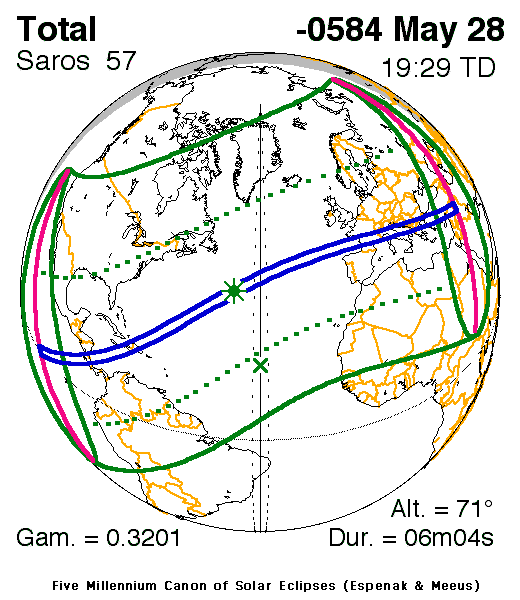
In the year 585, on the 28th of May, the war between Lydia and Media came to a head. According to Herodotus they had been fighting for five years and had even fought a night battle. Night battles were very rare in the ancient world. It was possible for them to be done, but the difficulties of commanding an army in the darkness and certain religious scruples generally meant that armies only clashed during the day. The general reluctance to fight in darkness may have influenced the end of the war.
On that day, the 28th of May 585BC, the armies of the Lydians and Medes were fighting at the Halys River when the sky darkened and a total eclipse of the sun occurred. The two sides took this as an omen and made peace, fixing the border between them at the Halys River. The date is one of the very few absolutely fixed dates in this period of history, because of course this event can be correlated with the eclipse times. Supposedly the event was predicted by Thales of Miletus, making this date as good a date as any other for the birth of science in the West, but we’ll discuss this more in the Greek blog for this period.
 |
NASA image showing the path of the eclipse
Source |
After this, since Alyattes would not give up the Scythians to Cyaxares at his demand, there was war between the Lydians and the Medes for five years; each won many victories over the other, and once they fought a battle by night. They were still warring with equal success, when it happened, at an encounter which occurred in the sixth year, that during the battle the day was suddenly turned to night. Thales of Miletus had foretold this loss of daylight to the Ionians, fixing it within the year in which the change did indeed happen. So when the Lydians and Medes saw the day turned to night, they stopped fighting, and both were the more eager to make peace.
Herodotus Histories 1:74:1-3
Around this time Cyaxares, the king of the Medes who had destroyed Nineveh and transformed his tribe into one of the most powerful kingdoms of the world, probably died. The dates are a little unclear but whatever the exact date, after the battle of the Halys River and the peace with Lydia, Cyaxares dies and his son Astyages succeeded him.
The Medes occupied Erebuni, present-day Yerevan, and the peace with Lydia allowed them to take over fully the lands of Urartu. The last king of Urartu, Rusa IV, disappears completely from history. He is poorly attested anyway, with only a few seals and almost no inscriptions. He may not have died fighting a last stand, but may have been a vassal king of the Medes. Perhaps Rusa’s death was similar to Zedekiah’s, as the empires consolidated their peripheral holdings.
 |
| Seal of Rusa IV, last king of Urartu |
Finally, despite the fact that Jerusalem was destroyed, the Egyptian fleet was still a threat along the coast and the Phoenician city-states were restless against the Babylonians. It seems that Nebuchadnezzar began a siege against Tyre at some point around this time but the exact times are not clear. The city of Tyre was almost impossible to besiege by land, as half of it was set on an island, which could be resupplied with ease by the Tyrian ships, making it almost impossible to starve and impossible to assault with battering rams, etc. It’s not clear how exactly the Babylonians attacked the city but for thirteen years, according to Josephus, they were encamped around it and at war with it.
In the years 584 no political events happened to my knowledge. However, the Vision of the Valley of Dry Bones was recorded by Ezekiel in Babylon around this time. This was a dramatic vision that spoke of the prophet seeing a valley full of bones that were eventually raised to life in a striking metaphor for the rebuilding of the nation.
 |
| Ezekiel's Vision of the Valley of Dry Bones |
The hand of the LORD was on me, and he brought me out by the Spirit of the LORD and set me in the middle of a valley; it was full of bones. He led me back and forth among them, and I saw a great many bones on the floor of the valley, bones that were very dry. He asked me, “Son of man, can these bones live?” I said, “Sovereign LORD, you alone know.”
Ezekiel 37:1-3
In 583 there is nothing that I can be certain happened in this year. It was however around this time that the Book of Lamentations in the Hebrew Old Testament was written. This was a lament over the fall of Jerusalem. It is written in a highly stylised manner, but conveying great emotion. Tradition has ascribed it to Jeremiah and this is possible but uncertain. As there is no fixed date for it I thought I would mention it here.
Remember, Lord, what has happened to us; look, and see our disgrace. Our inheritance has been turned over to strangers, our homes to foreigners. We have become fatherless; our mothers are widows. We must buy the water we drink; our wood can be had only at a price. Those who pursue us are at our heels; we are weary and find no rest. We submitted to Egypt and Assyria to get enough bread. Our ancestors sinned and are no more, and we bear their punishment.
Lamentations 5: 1-7
Meanwhile, in Judah, which was now a Babylonian province, the Jewish governor Gedaliah had been trying to have the people return and to cultivate the land. The Babylonians appeared to rule with a fairly light hand and allowed those who had been scattered by the sieges and wars to return and farm the land, although rebuilding the Temple or the walls of Jerusalem would have been stopped immediately.
 |
| Stela of Apries of Egypt |
When all the Jews in Moab, Ammon, Edom and all the other countries heard that the king of Babylon had left a remnant in Judah and had appointed Gedaliah son of Ahikam, the son of Shaphan, as governor over them, they all came back to the land of Judah, to Gedaliah at Mizpah, from all the countries where they had been scattered. And they harvested an abundance of wine and summer fruit.
Jeremiah 40:11-12
Some of the contingents of soldiers that had been sent to other kingdoms seem to have wanted to continue the war, or possibly were jealous of the new governor. One of these, an army commander distantly related to the House of David, called Ishmael, had a meeting with Gedaliah and assassinated him before fleeing in fear of retribution. Ishmael seems to have been acting on behalf of the king of Ammon, with whom he was seeking refuge. Not only had Ishmael killed Gedaliah, but he had slaughtered the Babylonians who were with him and killed a great number of others as well. The remainder were taken captive and taken with Ishmael to the Ammonites.
In the seventh month Ishmael son of Nethaniah, the son of Elishama, who was of royal blood and had been one of the king’s officers, came with ten men to Gedaliah son of Ahikam at Mizpah. While they were eating together there, Ishmael son of Nethaniah and the ten men who were with him got up and struck down Gedaliah son of Ahikam, the son of Shaphan, with the sword, killing the one whom the king of Babylon had appointed as governor over the land. Ishmael also killed all the men of Judah who were with Gedaliah at Mizpah, as well as the Babylonian soldiers who were there.
Jeremiah 41:1-3
This had to have been an act of rebellion by the Ammonite King Ba’alis. While Ishmael and his soldiers might have viewed themselves as freedom fighters striking against collaborators it is hard not to see it as senseless violence years after a war was finished. The murder of Gedaliah is still remembered in Judaism and there is a Fast in his honour.
It’s hard to know what Ba’alis’ motivations were. It is hard to imagine that he thought he could defeat Babylon, but perhaps he hoped that the murder would be secret and could be blamed on the Jews. Little is known of him or of the fate of Ammon. Josephus suggests that Moab and Ammon was subsequently conquered by the Babylonians but they were already subject to Babylon. Perhaps Ba’alis was simply removed and another client king put in his place. As a historical aside, we are fortunate enough to have the seal of Ba’alis that was used to sign royal documents.
 |
| Seal of Ba'alis |
Belonging to Ba'alis, King of Bnei Ammon
Seal of Ba’alis
The killing threw the remainder of the people of Judah into a panic. They assumed that they would be blamed for the murder and that they would be caught up in a war between Babylon and Ammon. This was not entirely groundless, as empires do not take kindly to their officials being assassinated. To escape from any Babylonian vengeance and against the strong opposition of Jeremiah, many of the remaining people fled from Judah down into Egypt, bringing Jeremiah with them.
So Johanan son of Kareah and all the army officers and all the people disobeyed the LORD’s command to stay in the land of Judah. Instead, Johanan son of Kareah and all the army officers led away all the remnant of Judah who had come back to live in the land of Judah from all the nations where they had been scattered. They also led away all those whom Nebuzaradan commander of the imperial guard had left with Gedaliah son of Ahikam, the son of Shaphan—the men, the women, the children and the king’s daughters. And they took Jeremiah the prophet and Baruch son of Neriah along with them. So they entered Egypt in disobedience to the LORD and went as far as Tahpanhes.
Jeremiah 43:4-7
 |
| Colossal statue of Aspelta of Kush |
The Babylonians might have not retaliated against the remnant in the land, but fleeing to Egypt seemed to confirm their guilt so there may have been further deportations from the land in 581. The land of Judah by now must have been nearly depopulated.
In the year 580 Aspelta of Kush died and was succeeded by Aramatle-qo. Aspelta had been a strong ruler and while Psamtik II had forced him to move the capital to Meroe, he was still buried at Nuri, near the old capital of Napata. Kush was still a power to be reckoned with, even if it was no longer able to influence events in Egypt. There is however some slight evidence that Kush was embroiled in a power struggle between two lines of the royal family, which had been split with the takeover of Taharqa over a century before. The succession in Kush appears to have gone through the matrilineal line and there are a number of stelas of Aspelta that have been vandalised to excise not his name, but the names of his female ancestors. Aspelta himself may in fact have usurped the throne. He records that the people had searched for a new king, that the gods had been asked to confirm a new king and that the gods and people had approved of the choice. This may have been common practice but may also have been a usurper trying to legitimise his reign. Whatever the case, Aramatle-qo was the new king of Kush.
 |
| Seal of Cyrus I of Anshan |
Also around this time, Cyrus I, the ruler of Persia and king of Anshan, died. The Persians at this point were a tribal people who were tributary to the Medes and controlled a small amount of territory to the east of Elam. Cyrus I probably had a brother called Ariaramnes who was a lesser chieftain among the people but subordinate to the main regnal line. Cambyses I, son of the deceased Cyrus, became the new king of the Persians.
There is not much that can be said for the years 579-575 so I will mention a few things that were prominent around that time but cannot be exactly dated. Firstly, the house of Egibi. These were a family in Babylonia who became extremely wealthy from commercial activities. They bought land and slaves and financed certain aspects of the Neo-Babylonian military. They gave loans for people to buy and sell and facilitated trade. They gave their slaves considerable leeway to carry out their own businesses and were the dominant force in commercial activities at this time. They are sometimes referred to as bankers but this is an overstatement. While they did give loans at 20% interest they were not primarily a banking establishment, although they were the closest thing to it at that time. Some older scholarly literature refers to them as Jewish, but it is almost certain that the Egibi family were Babylonian rather than Jewish. They would dominate trade for over a century, from about 600-480 and now seemed as good a time as any to mention them.
Another thing that is worth talking about is the literature that was being created by the exiled Jews in Babylonia. Lament songs were created that kept alive Jewish culture and have inspired works up until the present day. While many of the Psalms predate this and many postdate it I thought that 137th Psalm was a good example of them and thought that I would mention it here.
 |
By the Waters of Babylon
Painting by Arthur Hacker |
By the rivers of Babylon we sat and wept when we remembered Zion. There on the poplars we hung our harps, for there our captors asked us for songs, our tormentors demanded songs of joy; they said, “Sing us one of the songs of Zion!” How can we sing the songs of the Lord while in a foreign land? If I forget you, Jerusalem, may my right hand forget its skill.
Psalm 137:1-5
Lastly, around this time Nebuchadnezzar was doubtless expanding his empire and strengthening the frontiers, but we have no documentation of this. The Egyptian, Hebrew, Greek and Babylonian sources are all silent for these years, insofar as I can tell. However, we do know that Nebuchadnezzar embarked on a huge building program to make Babylon the strongest and most beautiful city in the world. To this end he surrounded Babylon with a vast system of walls, possibly the largest that had yet been built on earth and great ceremonial gates. The walls were listed in the first list of the wonders of the world. The greatest of the gates was the Ishtar Gate, which was connected to the processional way that the kings and statues of the gods would follow on state occasions.
The gate itself was a huge affair of blue glazed bricks, adorned with lions, bulls and dragons. Nebuchadnezzar had an inscription carved to highlight his great creation and this is the quintessential artefact of the Neo-Babylonian Empire. The gate survived relatively intact throughout the millennia and sections of it can be seen in the Louvre and in Istanbul. The majority of it however was shipped over to Berlin and a nearly full reconstruction can be seen in the Pergamon Museum in Berlin.
 |
| Ishtar Gate in the Pergamon Museum |
Nebuchadnezzar, King of Babylon, the faithful prince appointed by the will of Marduk, the highest of princely princes, beloved of Nabu, of prudent counsel, who has learned to embrace wisdom, who fathomed their divine being and reveres their majesty, the untiring governor, who always takes to heart the care of the cult of Esagila and Ezida and is constantly concerned with the well-being of Babylon and Borsippa, the wise, the humble, the caretaker of Esagila and Ezida, the firstborn son of Nabopolassar, the King of Babylon. Both gate entrances of Imgur-Ellil and Nemetti-Ellil —following the filling of the street from Babylon—had become increasingly lower. Therefore, I pulled down these gates and laid their foundations at the water-table with asphalt and bricks and had them made of bricks with blue stone on which wonderful bulls and dragons were depicted. I covered their roofs by laying majestic cedars length-wise over them. I hung doors of cedar adorned with bronze at all the gate openings. I placed wild bulls and ferocious dragons in the gateways and thus adorned them with luxurious splendor so that people might gaze on them in wonder.
Ishtar Gate dedication
This brings the period to close. The kingdoms of Urartu and Judah are no more. Lydia, Media, Babylon and Egypt are still the strongest powers in the region. The twenty-five year period has seen exploration, great building projects, the rise of commercial entreprises, competing prophets, great literature, murders, fire signals codes, and eclipses. This is an interesting time in history.
 |
Myself standing in front of the
reconstructed Ishtar Gate |
Primary Sources:
Sardis Expedition
Jerusalem Chronicle ABC5
Neo-Babylonian Royal Inscriptions
Egyptians Texts
2 Kings
Jeremiah
Ezekiel
2 Chronicles
Secondary Sources:
The Enemy Within: Internecine Conflict in the Second Kingdom of Kush
Related Blog Posts:
625-600BC in the Near East
600-575BC in Greece
575-550BC in the Near East