Sunday, 8 July 2018

Some European history from 4000-3000BC

Cromlech of Almendres
This is a post about European history, or more strictly prehistory, from the years 4000-3000BC. The time period is a little arbitrary, but a millennia will certainly give enough to talk about. I am no expert on this time period and everything I say should be treated critically and examined. This is as much for my own learning and discovery as it is for the readers.

Naturally we are in a prehistoric era. This period in Europe sees no writing and the beginning of the period sees no readable writing on Earth. Also, the time period is so long ago that stories, legends and oral traditions are of little use to us.

There are real difficulties in dating. Most of what remains is stone, either in the form of monuments or tools, but stone itself cannot be generally be dated, thus all dates must be inferred by some form of carbon dating, thermo-luminescence or dendrochronology on organic remains near the stones. Carbon dating can have significant inaccuracies and dendrochronology is seldom available to the archaeologist. There are other issues in dating. Because many ancient sites were discovered by early archaeologists in different European countries, there was almost a spirit of national rivalry over who had the earliest artefacts. This happens all over the world, but it is particularly awkward in Europe. Nearly every major Neolithic site in Europe uses the phrase “older than Stonehenge” to market itself. This is because Stonehenge was a very well-known ancient monument and the temptation to say that your site was older than the prototype seems to be compelling.

General map of pottery cultures in Europe c. 4500BC
Europe was also where archaeology and the study of the Stone Age was first developed. This, along with the fact that many areas of Europe had cultural traditions that preserved Stone Age sites, meant that there has been a great deal of study into the Neolithic period in Europe. I suspect that other parts of the world will become better known as human knowledge advances.

There is another difficulty in dating as well. Many sites are occupied for centuries. This means that a site could be occupied in 4000, have a ceremonial centre in 3800, expand the ceremonial centre in 3500 to its current form and finally abandon it in 3200. Is the site, 6000, 5800, 5500 or 5200 years old? There’s no neat answer. So whenever someone talks about the exact age of a site, it’s useful to check whether they are talking about its first occupation or the building of a notable structure on the site. Again, this is common to all prehistory, but I found this issue particularly prevalent while researching the European Stone Age. I think it should be taken as a given that exact dates in this context are very rare and caution should be used with nearly all the dates given here.

Cairn of Barnenez
Yet another issue of trying to understand Neolithic Europe is that often archaeologists will attach a culture name to a group of pottery. For example books will often speak of the Beaker People, referring to the Beaker type pottery and the graves where these pots were buried. But much in the same way as vastly different people groups will wear similar clothing or write with a similar script, it should not be taken to mean that there were homogenous people groups. The naming conventions are attached as a way of covering our own ignorance and should be treated as such.

There are also the conceptions that European culture at this time was less advanced than others. And this is to a certain extent true. The people of the river valleys of the Nile, Euphrates, Tigris and Indus were all making steps towards building cities and developing writing during this time. On certain levels Europe was behind and this should be acknowledged, but we should be wary to being too derogatory about Neolithic Europe. The temptation to do reverse-colonial history is a temptation we must resist. Any culture that was able to create Newgrange should probably be viewed as a proto-civilisation. The question of exactly what constitutes civilisation is a loaded one with little agreement, but we must remember that these societies were well-organised and complex.
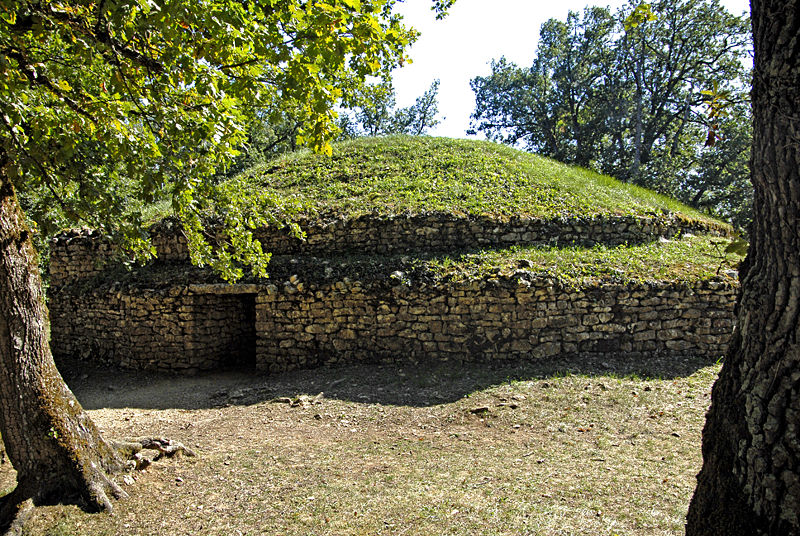
Tumulus of Bougon
To give a prelude we must understand what came before this period. The retreating of the glaciers from the last glacial maximum was nearly complete at this point. Most of Europe was inhabited by humans, with the exception of some far off islands such as Iceland. In the previous millennia farming had spread by a process of either migration or cultural diffusion from the Middle East and by this period had reached all of Europe. This period, where agriculture is the main source of food but before the advent of writing or widespread working of non-precious metals, is known as the Neolithic and it lasts in Europe for about the next two millennia. The transition from hunter-gathering to farming (Mesolithic to Neolithic) was gradual but had nearly universally happened across Europe by 4000BC.

The Neolithic farmers not only farmed grains, but also had access to domesticated animals such as dogs, sheep, goats, oxen and others. Cats and horses were probably not domesticated as yet by humans but were known to them in their wild forms. Much of the land would still have been the primeval forests that had grown across Europe after the last Ice Age, but the Neolithic peoples were engaged in clearing this with axes and fire to make farmland. They also had access to boats that were able to navigate rivers and short distances at sea.

Varna Necropolis Treasure
Previously, while the glaciers had covered much of the land, there had been land bridges across many short straits, such as across the English Channel.  But with the rising sea levels these had been flooded. The rising sea levels also covered over many pre-existing Mesolithic settlements that would have been along the coast lands of Europe. It has been hypothesised that there was a population crash in Europe around 4500BC, but I am somewhat sceptical about how significant this was, despite the fact that the overall methodology seems sound. Fascinatingly there seems to have been a culture in the far north of Europe, called the Pit-comb culture that has similarities with the cultures across all of northern Eurasia. If so this would suggest some very early migrations in either direction across the Siberian taiga but it’s possible that the similarities are illusory. Perhaps comb patterned pottery is just an easy design to make and thus emerges, almost like convergent evolution?

With the rise of agriculture and Neolithic culture Europe seems to have developed relatively complex societies quite quickly. Their sites are less ancient than Jericho or Catal Huyuk, but there are signs of quasi-urbanisation in the Transylvanian region from about the mid-5000’s to the mid 4000’s. This is known as the Vinca culture. They had some small villages that could be classed as towns or proto-cities, as well as some of the earliest usage of copper. Most mysteriously they also created small amulets covered in symbols that look suspiciously like writing. There is no evidence that they are anything more than shamanic symbols, but there is the possibility that these were the first attempts at writing. They probably weren’t, but it does remain a possibility. For those who wish to know more about these, check out the Vinca Symbols and Tartaria Tablets for further details.

Broken Menhir of Er Grah
Slightly further south from the mid-4000’s to the late 4000’s were the Varna culture, who buried their dead in elaborate tombs. They were possibly the first people to work with gold and their chieftains must have been rich indeed. The south-eastern Europeans also were familiar with the working of copper and this knowledge spread slowly across the continent during this millennium. But copper should not be viewed as a primary working material. It was too soft to be of much use in day to day life and the primary material was still stone. Trade networks facilitated the spread of high-status items like jadeite axes, which were imported from the Alps as far as Ireland. But these would only have been for very valuable items and trade was presumably still quite limited.

Further north and west in Europe the religion of the inhabitants seems to have at least partially focused on sun-worship and the creation of large arrangements of giant stones. These giant stone arrangements are known to us today as megaliths, from the Greek words for “large stone”. While the main building of megaliths would be later, apparently there were early examples of it from the early 4000’s. The Iberian Peninsula saw the building of the Almendres Cromlech in what is now Portugal. Western France in particular saw much activity at this early stage with the Cairn of Barnanez, Tumulus of Bougon and the Menhir of Er Grah dating from this period. The Menhir of Er Grah is particularly astounding as it is the largest stone known to have been moved by Neolithic man, weighing over 300 tons and originally standing over 20m tall before it toppled. I am somewhat sceptical about these dates, as it would be unusual for the most difficult type of construction to be completed first, but if it is correct it points to advanced engineering capabilities in the Neolithic.

Computer reconstruction of Talianki,
a massive temporary settlement of the
Cucuteni-Trypillia culture
Finally it is worth pointing out that the languages of Europe were different. There is considerable debate about the origins of Proto-Indo-European, but practically all scholars are in agreement that Proto-Indo-European (or PIE) was not spoken in Europe at the time and that the European languages were of a different and probably unknown language family. It has been speculated that the Basque language is a tiny linguistic remnant from this time, but this is unproven. The Proto-Indo-European speakers were probably living north of the Black Sea at this point in time.

Around 4000BC the great Menhir of Er Grah in Brittany was broken, probably by an earthquake. As mentioned previously, I am wary of the dates for this item, but this is the conventional dating. On Sardinia, Monte d’Accoddi was begun to be occupied around this time by the Ozieri culture. This was a small step pyramid but the site was extended over the next millennium so it is hard to tell what the original structure was like.

Around this time the Cuceteni-Trypillia culture (or Cucuteni-Tripolye culture) was flourishing in the area roughly around in Romania, Moldova and Ukraine. Their settlements were very large, but perhaps not cities as we would think of them. They seem to be composed of about twenty thousand inhabitants (which would be extremely large for the time) living in a temporary fortified encampments. These encampments were burned and abandoned after about two generations and the process would start afresh, with the population either rebuilding or moving to another area. The settlements were always burned, but perhaps not accidentally or in warfare. Like other cultures living in the region before them the peoples of these cities/proto-cities, seem to have deliberately covered their houses with flammable material to create a gigantic pyre that would vitrify the mud walls of the houses, leaving them cracked and destroyed.

Reconstruction of the Sweet Track
Around 3900BC there was the 5.9 Kiloyear Event. I dislike this naming convention, as it will be out of date and very misleading in around fifty years. However, it caused cooling over Europe at the same time as it contributed to desertification in the Sahara. It may have caused some migration into the Iberian Peninsula from Africa, but apart from this it is likely that it simply made Europe a harsher and more difficult place to live in than it had previously been.

Around this time, the Ertebølle culture in Denmark, which was quasi-Mesolithic, seems to have come to an end, as better agricultural practices moved northwards. Up until this point, this culture appears to have known about farming but to have primarily used sea-fishing as its main source of food.

Around 3800 work began on the Windmill Hill complex structure around Avebury in what is now England. Malta was re-inhabited around this time as well. The previous population had over-farmed the land and had apparently abandoned the island, although this is an unproven hypothesis.

Tomb from Carrowmore
Also around this time we can give what to my knowledge is one of the first fixed dates in human history. Normally we can say that something happened in a particular millennium or century. But in exactly 3838BC some Neolithic farmers in Somerset England decided to build a wooden causeway across some marshy ground. This is known as the Post Track. In 3807BC the posts were reused and incorporated into an expanded causeway known as the Sweet Track. The remains of this event were covered up by peat bogs and only consisted of a single plank walkway at the top. But thanks to the wonders of dendrochronology, it is more securely dated than any of the early deeds of the great monarchs of Egypt or Mesopotamia.

Around 3700BC the Carrowmore complex was begun in the west of Ireland. This marked the first of the passage grave complexes in Ireland.

In the Caucasus area the Maykop culture began to flourish. This group used large mounds to bury their dead, which are sometimes referred to as kurgans. Some have identified these people are early Indo-European language speakers but this is speculative.The Maykop culture does seem to have been related to the steppe cultures further north however.

Ggantija Temple in Malta
Around 3600BC Malta entered a phase of megalithic temple building known as the Ggantija Phase. This was typified by the building of large stone buildings, presumably for religious purposes. These stone buildings are some of the oldest enclosed structures in the world, but what exactly counts as a structure is debateable (e.g. should Carrowmore be treated as an enclosed structure?). Shortly after this the Ħaġar Qim complex on Malta was also built, presumably by the same culture and for similar reasons.

Around this time the Baden culture in central Europe arose and has been treated by some as being an Indo-European culture. But this is speculative and I am unsure as to whether the members of this culture were primarily Proto-Indo-European speakers.

Ceide Fields in Ireland
Circa 3500 the wheel seems to have been invented, possibly independently by the Sumerians in the Near East, by the Maykop culture of the Caucasus and by the Cucuteni-Trypillia culture in what is present-day Romania or the Funnel-Beaker culture of what is now Poland. This would have far-reaching consequences for humanity, but it would take time for wheels to attain their full utility. The earliest known representation of what may be a wheel can be seen in the Bronocice Pot that has what may possibly be proto-writing, as well as what appears to be a picture of a wheeled cart drawn upon it.

In Ireland, the Neolithic farmers continued their land clearance and created farmlands in the west of the country. These fields have been preserved and were rediscovered in the last century. We know these as the Céide Fields. It is quite common for us to find ancient megalithic monuments or the complex settlements of the Neolithic peoples. But we seldom actually see the fields where they practiced the agriculture that was the foundation of their culture.

Passage Grave in Carrowkeel
Around 3400 the passage grave complex of Carrowkeel was built upon a low ridge of mountains in the west of Ireland. This was the first complex to feature roof-boxes that would allow the sun to enter the chambers of the tombs if the tomb was aligned to the solstice.

In what is now Ukraine, the Sredny Stog culture began to come to an end and seems to have been replaced by the Yamna culture. The Yamna culture buried their dead in large mounds, known as kurgans, and may have been Indo-European. In what is probably not a coincidence, the horse appears to have been domesticated in Central Asia around this time, although these were possibly not the ancestors of modern horses. We should not imagine cavalry being used by these cultures. Early horses probably did not have the size to carry a human on their backs. But with the twinning of the wheel and the horse, crude carts could have been made that would allow the cultures using these carts much greater mobility than their contemporaries and would have given them a substantial advantage in competing for resources.

Stone alignment in Carnac
The Globular Amphora culture stretching across what is now Poland, may have been related to the Yamna culture, or to have taken some of their burial practices from them. These too begin to appear in the archaeological record from about this point onwards. It took over from the older Lengyel culture in the region, who had been some of the first to use copper in Europe.

Around 3300 the main stage of development on the huge Neolithic site of Carnac, in present-day Brittany, took place. Carnac is one of the largest Neolithic sites anywhere in Europe and consists of vast arrays of standing stones in lines across the landscape, as well as a variety of tombs. This type of stone alignments seems to be rather unusual for Europe at the time and the purpose of the stones is unclear.

Hypogeum of Ħal-Saflieni
In Malta, the Ggantija phase ended and the Saflieni archaeological phase began. This merely marked a change in building styles and does not indicate any form of invasion or population change on the island. Here the temples became even more elaborate and unlike the huge tomb/temple complexes in Brittany and Ireland, the Maltese temples comprised of worked stone and carved underground rock and they look surprisingly modern considering they are from the Neolithic. Their main tomb is the Hypogeum of Ħal-Saflieni, which is an underground tomb with over seven thousand human remains having been found there.

Further south of Europe the desertification of the Sahara was continuing and Europe must have become rather similar climactically to what it is today. Possibly as a result of this climate change the Yamna culture, now equipped with wheeled vehicles and small, recently-domesticated horses, began to expand westwards into what is now Ukraine. There does seem to have been some conflict between the pastoral peoples living at the western edge of the Yamna culture and the large cities of the Cucuteni-Tripyllia culture.

Reconstruction of Ötzi the Iceman's clothes
In Ireland the passage-grave complex at Loughcrew was begun at this time, atop a series of hills in the centre of the country. Near this area, the earliest occupation of the site now known as Tara began, with a small grave mound being built. This mound is later known to history as the Mound of the Hostages, but this name has nothing to do with the original purpose of the tomb.

While all this is taking place; giant constructions in Malta, Ireland and France, changing climates and wanderings of peoples in the east, we have a personal drama taking place. High in the Alps a tattooed figure, clad in furs, wearing boots cleverly adapted for the snow and bearing copper weapons was struggling in the snow. He was wounded, with a deep cut on his hand that he had sustained a few days earlier. His breathing was laboured and his movements slow. He kept moving his hands to his left armpit, from which he had removed an arrow a few hours earlier. But the wet blood flowed constantly and without ceasing. Finally the man fell into the snow and died.

We will never know who the man was, or who his enemies were. But his death has shed new light on the period. His body was preserved in the ice of the high Alps, where he may have fled to escape his pursuers. His partially preserved body was discovered in the twentieth century by climbers and the archaeologists have been puzzling over his remains ever since. The body was given the name Ötzi the Iceman, named after the region where his body was discovered but no one knows his name. The discovery has allowed scientists to find the earliest known evidence of tattoos on humanity and the possibility that he underwent a type of acupuncture on the lower spine. His stomach contents were analysed to show that he had eaten meat recently, probably earlier that day.

Passage at Knowth
Around 3200BC the vast tomb complex of Brú na Bóinne in Ireland was begun, with a major passage-grave being constructed at Knowth. This tomb was probably aligned to the solstices but the entrance to the tomb was changed during later eras so the exact alignment is unclear. The tomb is intricately decorated with spiral and lozenge patterns and contains more decoration than any other Neolithic site in Europe. Unlike previous complexes such as Carrowmore, Carrowkeel and Loughcrew, this site was built along a river valley and was far larger than the previous complexes. It is unclear exactly why this was so, but it perhaps speaks to growing settlement sizes among the Neolithic peoples of Ireland.

There was considerable Neolithic complexity all around the edges of Europe, with the Neolithic village of Skara Brae on the Orkney Islands beginning roughly around this time. The Orkney Islands are sparsely populated today but seem to have been quite important in the Neolithic period. Or perhaps the lower population has led to better preservation of the monuments. It is hard to know why the edges of Europe sometimes seem to have more items from this time period.

Wheel at Ljubljana
In the marshes of Ljubljana, in present day Slovenia, the oldest wooden wheel in the world was discovered, dating roughly from this time. This would suggest that the knowledge of the wheel was spreading throughout much of Europe at this time, although it may not have been known in the west. It is unclear if the builders of Knowth would have had access to this technology.

In what is now southern Spain, the site of Los Millares was founded roughly around this time. This settlement would grow later, but was not really more than a village at this point. However, it is proof that there was a trend towards urbanisation in Europe as well as in the river valley cultures of Mesopotamia, Egypt and the Indus Valley. Unlike the temporary cities of the Cucuteni-Trypillia culture, the site of Los Millares was occupied for centuries.

Around 3100BC the Saflieni culture ended in Malta and the Tarxien period began. This was the final stage of the great temple-building culture of Malta. This is best exemplified by the Tarxien Temples, which the period is named for. Here, shaped stones of great weight are fitted together and carved with animals. There is a possibility that they worshipped a Mother Goddess, as there have been figurines found of corpulent ladies, which may have been cult figurines. But this is unclear. The temple itself and the carvings on the temple are some of the most striking works of art from the Neolithic and form a contrast in their realism between other Neolithic artwork, such as at Knowth.

Carvings at Tarxien
While Tarxien was being built in Malta, in Ireland the construction of Newgrange was beginning. This was a monumental effort that took decades, moving gigantic stones by boats along coasts and the River Boyne to reach the site. Once the stones were in place a long tunnel was laid down with a central chamber that formed a cruciform shape at the centre of the mound.

The tunnel was aligned to the rising of the sun on the Winter Solstice and once a year, on the shortest day, the sun was enter the roofbox and strike the far wall of the innermost chamber, illuminating the room. In the side chambers there would be the remains of cremated bodies in stone depressions. It would appear that there were never many remains at any one time and it is possible that after the rituals surrounding the solstice were complete, that the remains were removed again. The inner chamber was corbelled into a primitive small dome, but done in such a way that it would bear the weight of the large earthen mound placed above it. The front level of the mound was covered with white quartz that would have gleamed in the sun.

Carvings at Newgrange
Newgrange has been reconstructed in the 1970’s AD, but its reconstruction is very controversial. The façade is too steep and is currently held in place by concrete. It is more likely that the façade was shallower and covered over the great stone edges of the mound. But the interior is entirely ancient and is certainly worth a visit if people have an opportunity.

Around last century of the millennium, around 3000BC, the Maykop culture in the Caucasus and the Cucuteni-Trypillia culture in Romania, came to an end. These may have been affected by the expanding Yamna culture. The step pyramid site in Sardinia, Monte d’Accoddi, was also burned or destroyed around this time, but this is highly unlikely to have been related to the demise of the afore-mentioned cultures.

In England, the large megalithic complex of Avebury was begun around this period but would not have reached its present form until later. Later generations would add more stone circles and alignments and banks of earth to the site until it reached the impressive proportions that it has today.

Monument at the finding place of
Ötzi the Iceman
Before I finish up I should leave a warning, or a caveat over what has been said. In many works about Europe at this time, one will see the phrase “Old Europe” crop up again and again. This is from the work of Marija Gimbutas, who postulated that there was an Old Europe, comprised of the Neolithic farmer/monument builders who were overrun by Indo-Europeans from the east. These Indo-European invaders brought increased warfare, a patriarchal system, the horse and proto-chariot, and the European languages that we know today.

I’ve previously written in other posts about bad theories, about how aliens certainly did not build ancient stone circles in South Africa, or the pyramids in Egypt. The theory of Old Europe is not a theory such as this one. In many ways it’s a really good theory and I don’t want to dismiss it out of hand. Certainly, at some point, the Indo-European languages came into Europe and that this probably was part of an overall cultural shift, and a certain amount of population movement.

What concerns me most with the theories of Old Europe are the assumptions of uniformity. We know that the Neolithic world had trade connections all over Europe and that there were certain similarities in how the built their megalithic monuments. But the variety of pottery styles and most importantly, burial styles all over Europe, suggests that Old Europe was never a single entity. Other ideas, such as Old Europe worshipping a mother goddess, are far less certain. Some cultures have figurines that may represent a mother goddess, others do not. The obsession with astronomical alignments in the megalithic monuments gives at least as much credence to the idea that at least some Neolithic peoples primarily worshipped the sun. The idea of a matriarchal Old Europe, even restricting "Old Europe" to the Balkans, is also problematic, considering the elaborate male burials in the Varna Necropolis (before this time period, but still considered “Old Europe” by adherents of the theory). Lastly the idea of a peaceful Neolithic world cannot be well sustained with the body of Otzi the Iceman having such terrible wounds inflicted in rapid succession.

I like the idea of Old Europe. In fact, as a theory it probably is right in many aspects. But to generalise across a whole continent for several thousand years is problematic. The behaviour of peoples change over time and considering the complexity of the Late Neolithic, I would be shocked if European culture could be summed up so easily. Future historians will doubtless refine the idea to make it watertight but for now, be wary of any dichotomies between egalitarian Old Europe and hyper-patriarchal kurgan cultures. History is never so simple.

Reconstruction of Ötzi the Iceman's
axe
So, to sum up, from 4000-3000BC we see complex village societies, all across Europe. These societies practice agriculture and use their surpluses to build large megalithic monuments. We see rising capabilities, as the tombs become more sophisticated. There are technological advances, such as the wheel and the domestication of the horse, and changing pottery styles, as fashions and cultures change. Lastly we can move our gaze from the very large to the very small and wonder at the building of the Post Track/Sweet Track and the last days of the maimed Otzi the Iceman in the Alps. Europe was still in the Stone Age, but the later civilisations of Europe would be built on a very well-developed Neolithic foundations.

Related Blog Posts:
Some European history from 4000-3000BC
Some European history from 3000-2000BC
Some European History from 2000-1500BC
Some European History from 1500-1000BC
Some European History from 1000-750BC
Some European History from 750-500BC

Saturday, 30 June 2018

Some African History from 3000-2000BC

Late Period statue of Imhotep
Around the year 3000BC the desertification of the Sahara continued and only a few tiny oases remained of what had previously been a relatively lush savannah. The First Dynasty ruled in Egypt, having previously united the land over the previous centuries. The king Djet was the ruler of Egypt at this time, holding sway over the river down as far as the First Cataract and possibly slightly further south. Egyptian writing at this point was not as developed as it would later become, but at this point it was probably the most advanced writing system in the world, having surpassed cuneiform in terms of complexity. The first queen in history, Menteith, reigned after Djet and goes down in history as the first named powerful woman to lead a state.

Further south along the Nile was a settlement known as Qustul. This was inhabited by members of the A group culture from what is now Sudan. Qustul seems to have been a royal settlement contemporary with the First Dynasty kings and culturally was very similar to the Egyptian material culture of the time. This would suggest that there was state formation further south along the Nile and not just in Egypt.

Around the year 2890 the First Dynasty ended and was replaced by the Second Dynasty, which supposedly ruled from the old capital of Thinis until 2686. Almost nothing is known about the Second Dynasty and even the names of the kings are obscure. There are some things we suspect about this Dynasty. but there are a lot of elements that I suspect are incorrect. For one things the length of the reigns of the kings are improbably long, which is usually a good indicator that something is wrong with the historical record. There is a suspicion that there may have been religious strife towards the latter end of this period between the followers of the Horus and Seth, with the kings occasionally taking sides. This is of course debated, as is the possibility that Egypt was actually divided and had multiple simultaneous rulers. The truth is that at the moment we simply do not know much about the Second Dynasty.

Step Pyramid of Djoser
Around 2686 the Third Dynasty of Egypt came to power. This marks the beginning of what is referred to as the Old Kingdom in Egypt. Djoser was the first monarch of this dynasty and had a famed vizier named Imhotep. The capital was moved from Thinis to Memphis, which was now probably the largest city in the world. The kings of Egypt had been buried in elaborate tombs with grave goods (and in the case of the First Dynasty, human sacrifices), but Djoser’s tomb would be the most spectacular building in the world so far. The previous burials had been brick or stone mounds, known as mastabas. Imhotep, the vizier of Djoser, was probably the architect who decided to place these on top of each other to form the first Egyptian pyramid, now known as the step pyramid of Djoser and, standing at 62 metres, probably the tallest building of its day. Imhotep’s fame would grow until he was eventually deified centuries later as a god of wisdom and healing, and he is remembered today as possibly the first architect whose name is known to us.

Bent Pyramid of Sneferu in Dahshur
Djoser’s successors also tried to build pyramids, although most of them have been ruined over the course of the years. After Djoser the rulers of the Third Dynasty are not well attested but we know at least more than we do about the Second Dynasty. Around 2613 the Fourth Dynasty begins with King Sneferu ruling from Memphis. Sneferu was an extraordinary figure who was not content with simply building a pyramid, but decided to construct three pyramids. The first of these, the Meidum Pyramid, probably partially collapsed during construction. The second, the Bent Pyramid of Dahshur, changed angles mid-construction, probably to avert a similar collapse. The third, the Red Pyramid of Dahshur, is in some ways the first true pyramid and it paved the way for the true pyramids of the successors.

Sneferu was succeeded by Khufu. Sneferu had built three of the largest buildings in the world, but would be outdone by Khufu. Under Khufu’s reign the Great Pyramid of Giza was constructed. This would be later classed as one of the ancient wonders of the world and is the only one of these wonders to survive. It was the tallest man-made building in the world from the time of its completion (around 2560BC) until 1300AD. It is hard not to wax too lyrical about the Great Pyramid. It is truly one of the most spectacular buildings ever built. Many people today have some strange ideas that it was built by aliens or other nonsense. But this is clearly refuted by the fact that archaeologists have discovered, not just the village occupied by the Egyptians who built it, but that we have their records, including a document called the Diary of Merer, which gives some of the details of how this was built.

Great Pyramid of Giza with sphinx
After passing of Khufu, Khafre his son succeeded (though not directly) and also built a pyramid; but on a slightly smaller scale to his father. The Great Sphinx dates from around this time. Menkaure also completed a much smaller pyramid completing the triad of the pyramids now seen at Giza.

Around 2500 the city of Kerma was established in present-day Sudan. Presumably Qustul was too close to the powerful Egyptian Old Kingdom and the cultural centres of the Kushites moved south. In between the Kerma culture and the Egyptians were a group known as the C-Group (as no writings survive giving their demonym). These were pastoralists and cattle-herders who traded with and occasionally allied with both of the two civilisations on the Nile. These tribal chieftains formed a buffer zone between the kingdoms of Memphis and Kerma.

Around the year 2498 Userkaf founded the Fifth Dynasty of Egypt, continuing the pyramid building traditions of his predecessors. He was succeeded by Sahure who championed expeditions to the Levant and to what became known as the Land of Punt. Punt was an area probably around the Horn of Africa, perhaps in contemporary Eritrea or Somalia. From here exotic trade goods were brought back to Egypt in great ceremony. It is not known exactly where this land was or how organised it was, but it was at least advanced enough to trade with the Egyptians, suggesting that there were at least three distinct civilisations in Africa at this time, Egypt, Kush and Punt.

Pyramid of Neferirkare
Sahure’s successor Neferirkare continued trade relations with the Levant and also with Nubia/Kush. He is remembered as being a kind ruler who relaxed some of the restrictions surrounding the royal person. There is an inscription from the tomb of an official called Rawer where Rawer records that the king pardoned him from death after an accidental infraction (he had accidentally touched the royal mace during a religious ceremony). This is a very minor incident, but I thought that records of human kindness should be remembered as well as achievements in building, trade and war.

A later Fifth Dynasty ruler known as Djedkare continued the traditions of empire building and trade, sending more expeditions to Punt, Nubia and the Levant. His reign is most notable however for his vizier Ptahhotep, who became known as a byword for wisdom. Later wisdom texts supposedly record his wisdom, the most notable being the Maxims of Ptahhotep. But these texts date from much later and are probably not contemporary with the sage himself.

Around 2345 Teti founded the Sixth Dynasty. The tradition of pyramid building continued but these pyramids were much smaller than the giant edifices of the Fourth Dynasty and have not survived well. One of the later Sixth Dynasty monarchs, Pepi II, is credited with having the longest reign in the history of the world, with a possible reign of 94 years, but this is rather unlikely. He was a long-lived Pharaoh, but the reign is more likely to have been around 60 years. During the reign of Pepi II the Old Kingdom began to split and collapse, with two viziers being appointed to govern Upper and Lower Egypt. In the early stages of his rule Pepi II had tried to mount expeditions to Nubia. The governor of Aswan, Harkhuf, sent an expedition that brought back trade items and a pygmy to the royal court. Harkhuf recorded the expedition on the walls of his tomb and this has been referred to as the world’s first travelogue. Harkhuf is sometimes recorded as the world’s first named explorer, which is possible but it’s not clear if Harkhuf went on the expedition himself. Following Pepi II were a number of short-lived rulers, at least one of which seems to have murdered his predecessor. Here the Old Kingdom ends and Egyptian history enters what is known as the First Intermediate Period.

Tomb image of Harhuf and his son
Come northward to the court immediately; [...] thou shalt bring this dwarf with thee, which thou bringest living, prosperous and healthy from the land of spirits, for the dances of the god, to rejoice and [gladden] the heart of the king of Upper and Lower Egypt, (Pepi II) Neferkare, who lives forever. When he goes down with thee into the vessel, appoint excellent people, who shall be beside him on each side of the vessel; take care lest he fall into the water. When he sleeps at night appoint excellent people, who shall sleep beside him in his tent, inspect ten times a night. My majesty desires to see this dwarf more than the gifts of Sinai and of Punt. If thou arrivest at court this dwarf being with thee alive, prosperous and healthy, my majesty will do for thee a greater thing than that which was done for the treasurer of the god Burded in the time of Isesi, according to the heart's desire of my majesty to see the dwarf. 
Inscription from the Tomb of Harkhuf describing the king’s excitement to see the dwarf who had been found on a southern expedition. 

The Seventh Dynasty supposedly reigned at this time, around 2181BC, but this dynasty is probably mythical and no firm evidence has ever been found of it. The Eighth Dynasty was a similarly weak dynasty and their kings reigned for about 20 years before the Ninth Dynasty succeeded it around 2160. Even the names of the kings of the Ninth Dynasty are not fully known and the local rulers or nomarchs of the regions of Egypt must have been mostly independent.

This confusion may or may not be tied into a century of climate change known as the 4.2 kiloyear event, meaning that it took place about 2200BC. This may have led to lower Nile floods and to pressures from Libyan nomads. It’s unclear what exactly happened in the First Intermediate Period. It seems that the power of the central state simply broke down and was replaced by local rulers, some of whom claimed kingship. The changed rainfall patterns do seem to have affected the civilisation across the Near East, but I am unsure if the collapse of the Old Kingdom can be attributed to this alone. By the year 2130 however the Ninth Dynasty collapsed and what is known as the Tenth Dynasty took their place.

The Tenth Dynasty has a bad reputation in later times, but this could simply be a reflection of the troubled times that they lived in. They were based in Herakleopolis and overthrew the Ninth Dynasty in Memphis. Around the same time Intef the Elder, a local official in Thebes, became effectively independent and is viewed as the founder of the Eleventh Dynasty. But he would not have seen himself as a king.

Mentuhotep II who reunited Egypt
and founded the Middle Kingdom
Around the year 2050, a member of the Eleventh Dynasty, known as Mentuhotep II came to power in Thebes and following a war with the kings of Herakleopolis, managed to reunite Egypt. This event brought the First Intermediate Period to an end and is referred to as the beginning of the Middle Kingdom. The reunited kingdom began sending expeditions to Nubia and Punt as had been done in the Old Kingdom and the renewed prosperity and stability would allow the flourishing of Egyptian literature.

This overview of African history has unfortunately been heavily centred on Egypt. This is unfortunate, but somewhat inevitable, as Egypt is the best documented place in the world for this millennium. Outside of Egypt there were sophisticated cultures in Nubia and Punt. The lower edge of the Sahara had seen the development of agriculture although there is no record of extensive bronze metalworking from this period. This is to be expected as tin was very scarce in the ancient world and there were no easy trade routes past the Sahara at this time.

Further south of the equator humans still lived as hunter-gatherers, as their distant ancestors had done for millennia. This was more to do with the sophistication of their hunting techniques than anything else. Unlike other parts of the world they had not had the need to develop agriculture and their culture was perfectly adapted to its surroundings. However, should farming groups arrive in the area from outside, this would change the balance of the environment and tip the scales in favour of the agricultural groups. Near the Niger Delta agriculture was being developed by speakers of what are now known as Proto-Bantu languages. This group would change the face of the continent when it began to expand.

Even while we have very limited information about Africa during this millennium it is fair to say that there are still a remarkable series of firsts and records, with the Egyptians repeatedly setting the records for the tallest construction in the world and attempting to explore and trade with other groups in Africa and beyond.

Related Blog Posts:
Some African History from 4000-3000BC
Some African History from 3000-2000BC
Some African History from 2000-1500BC
Some African History from 1500-1000BC
Some African History from 1000-750BC
Some African History from 750-500BC

Wednesday, 20 June 2018

Some African History from 4000-3000BC

The Battlefield Palette
from Naqada III Period in Egypt, c3200BC
showing defeated soldiers being eaten by beasts
This post is the first in the new series trying to describe the less-studied time periods in history. For this blog we will look at the history of the African continent from the year 4000-3000BC. In some ways this is a very difficult endeavour, as the history of one part of the continent often has almost nothing to do with other parts, but the same could be said for Europe, Asia or the Americas. Africa is more split than most though, with the Sahara creating a large natural barrier that sometimes cut the Mediterranean coast off from the lands south of the desert. But despite these difficulties we shall try our best.

African history is sometimes dismissed as being less interesting than that of other areas and it is true that it is understudied and sometimes suffers from lack of source materials. But Africa is also the birthplace of Egypt, possibly the world’s second oldest civilisation (if not the oldest) and cannot thus be treated as unimportant. The origins of Egyptian culture are distinctly African and considering that Africa is held to be the original birthplace of humanity and contains not only Egypt, but so much more, this continent is fully deserving of historical study. My hope is that the next decades will see great strides in our understanding of African history.

Africa is long held, by the majority of historians, to be the original cradle of the human race, so by the year 4000BC humans had been in Africa since time immemorial. Exact dates are not expected at this point in prehistory, but by 4000BC agriculture was in the Nile Valley and had spread across much of the northern belt of the rainforests in the centre of the continent.

Skull of a megatherium. These large beasts once roamed
the Saharan lands before going extinct
Around the year 3900BC a major climactic shift occurred in Northern Africa. The Neolithic Subpluvial began to end. The Neolithic Subpluvial was an epoch where nearly all of North Africa was fertile (or more strictly speaking, semi-arid) rather than desert. The lakes were vastly larger than they currently are.

Megafauna roamed across the savannahs and were prey to the Neolithic hunters of the region. The Nile and other rivers in the region all carried much more water and were probably higher than they now are today.

The Last Glacial Maximum began to recede, but was interrupted by the Younger Dryas period (which saw the warming planet temporarily cooled again) about 10,000BC according to current climate estimates. But the glaciers had now begun to disappear to their current proportions and this caused a change in climate that saw heavy rainfall across Africa, as the currents of the North Atlantic shifted with the changing climate.

This wet Sahara period was ended by what is known to us as the 5.9 Kiloyear Event (as in it happened roughly 5900 years before the present date). This saw the fertile and semi-arid lands of what was then the North African savannah begin to turn to desert. This desertification did not happen overnight, but did seem to happen more rapidly than could be entirely attributed to climate. It is a theoretical possibility that human hunting, gathering and subsistence agriculture in the region may have contributed in a small fashion to the creation of a climate loop that created the largest desert known today.

Rock art from Wadi Mathendous in Libya
showing meerkats
The change did not happen overnight, or even over the course of century, but from this time onwards the Sahara would begin to expand. The people in the area would have to migrate outwards, towards the coastlands, to the shrinking grasslands around Lake Chad, to oases such as Nabta Playa, southwards towards the rain belts of central Africa or towards the Nile Valley, which was now the only major river remaining in the region. The inhabitants of the Sahara have left few remnants, save for their artworks that were left in caves throughout the region. Here we can see humans interacting with extinct species and animals of the savannah, a memory of a lost landscape in the midst of desolation.

Naqada I sculpture
with lapis lazuli eyes,
evidence of trade
In Egypt, along the Nile Valley, Neolithic settlements had been in place for a long period. In Lower Egypt the Maadi culture flourished around this time. They traded with the Levant and seem to have imported some goods from that region. Even though they had copper workings, their primary tools remained stone. Their culture is not well known as many of their settlements throughout the Nile Delta have been covered by the Nile silt.

In Upper Egypt (higher along the Nile, hence in the south of the country) the Naqada I culture, also known as the Amratian culture, flourished. They traded obsidian, a hard volcanic rock used for tools, and gold, with the Nubian region further to the south. They also began to build in mud-brick, although nothing more than small settlements.

Reconstruction of a stone circle from Nabta Playa
Around this time as well, there seems to have been a civilisation building megalithic structures in Nabta Playa, an oasis in what is now the southern part of Egypt. A stone circle has been interpreted as a potential archeo-astronomical calendar that was possibly able to predict the seasons. Deep wells had also been dug here to access water during dryer periods and there is evidence of a sacrificial cult sacrificing bovines (although these may not have been domesticated). There are a number of relatively complex structures that seem in certain ways more advanced than their contemporaries on the Nile. But the drying of the land forced the abandonment of Nabta Playa over the next centuries.

Postage stamp commemorating
Bouar megaliths
In Central Africa, near Bouar in what is now the Central African Republic, there are a number of megalithic monuments that still stand today. They are clustered in this part of the region and not seen elsewhere, suggesting that the culture that built them was not widely diffused. The dates for the construction of the megaliths are somewhat confused, suggesting that they may be built around 5000-4500, and they were later reused about two millennia before our time, which confuses the dating somewhat. Nevertheless, for the millennia between 4-3000BC we can say with certainty that there was a megalithic culture, contemporary with the Neolithic and presumably having some form of agriculture. This culture has disappeared and left no other traces.

In Egypt, from c.3300BC onwards the Naqada III culture was predominant in both Upper and Lower Egypt. This period is also sometimes referred to as the Protodynastic period, as we know that there were attempts to unify the land of Egypt. This is also the point where Egypt, and by extension, Africa, enters history, as the hieroglyphic writing system was invented around this time.

Gebel-el-arak knife from Naqada III
Egypt. The designs on the hilt are
Mesopotamian c3200BC
It is unclear if the writing was independently invented. There were earlier scripts in use in Mesopotamia at the time, but these were quite different from what Egyptian hieroglyphics would become. We know that the Mesopotamians had trade contacts with the Egyptians but it was probably not direct contact. My own theory is that the Egyptian writing was invented by the Egyptians themselves, but only after becoming aware of the existence of the Mesopotamian system. This enabled their script to bypass many of the stages of development that cuneiform had to undergo to become a full-fledged writing system. We will probably never know for sure, but considering how seldom writing is invented as a concept (possibly only occurring three or four times in human history) it would be strange that it would be invented nearly simultaneously and independently by two cultures already in contact with each other.

The Proto-Dynastic period, or Dynasty 0 as it is sometimes known, saw kingdoms form in Upper and Lower Egypt. In Lower Egypt kings bearing names such as Crocodile and Double Falcon reigned. In Upper Egypt there were three smaller kingdoms, Thinis, Naqada and Nekhen. Thinis was possibly ruled over by an early king called Scorpion. We’re not sure exactly how his name would have soundedm but it used the same sound as the early Egyptian word for Scorpion, so he is known to history as Scorpion. It is possible that Scorpion is the first named person known to history, although there are some other contenders from Mesopotamia.

Macehead showing King Scorpion, c.3150BC
The role of kings would grow, as their already elaborate tombs would be expanded. Warfare was a feature of life. While weapons could in theory be made of copper, it is probable that at this stage the warriors probably used stone weapons. Around the year 3100BC a king or tribal chieftain in Thinis would conquer Naqada in Upper Egypt before conquering Lower Egypt. Nekhen would later join the kingdom by either conquest or peaceful assimilation. This king was Narmer and he founded what can be justifiably said to be the first kingdom or state in the world.

Later Egyptian writers would credit the unification of Egypt to a king they called Menes, but this was probably just another name for Narmer, or one of the other Proto-Dynastic kings who was involved in the unification of Egypt. One interesting remnant of this time was the crowns that would be worn by the later Pharaohs. Upper Egyptian rulers wore a tall white crown, while Lower Egyptian rulers wore a low red crown. These were united by Narmer and his descendants into a single crown known as the Double Crown of Egypt.

Palette of Narmer, showing the
king wearing the white crown of
Upper Egypt and smiting a foe
c.3100BC
Narmer’s descendants would form what is known as the First Dynasty of Egypt. They continued solidifying the kingdom and were probably worshipped as gods by their subjects. Two generations after Narmer the Egyptian kings were already trying to expand their empire with expeditions into the Sinai. They were buried with great state in a cemetery near Abydos. When they died large numbers of their subjects were sacrificed and placed in their tombs to accompany the dead ruler to the afterlife. This practice was discontinued by the Second Dynasty and those who followed after. Instead of human sacrifices they would leave little statues of human workers, known as ushabtis to follow their master to the afterlife. This connection between early rulers and human sacrifices seems to have also occurred in Mesopotamia and China, as well as in the Americas and the fact that so many of these early cultures practiced human sacrifice should sober us when praising the birth of civilisation.

While Egypt was being unified under Narmer, the civilisation of Egypt was being paralleled in Nubia. This was a region to the south of Egypt, further upstream along the River Nile. From about 3800-3100BC the region had what was known as the A Group culture. While it does not appear that a fully-fledged kingdom emerged here at this point, their grave goods and the artefacts that remain seem to have been culturally very similar to the Egyptian developments and we know that the two regions traded with one another.

Rock art of Laas Geel
Around the Horn of Africa region we have some beautiful cave paintings from around 3000BC in the Laas Geel caves near the present-day city of Hargeisa in Somaliland. Later writings would refer to a wealthy kingdom in this region, but this was probably only developed in the following centuries.

I have not mentioned anything so far from the southern part of the vast continent of Africa. The reason for this is that there is not much to say. We know that the area was inhabited with hunter-gatherers who possibly resembled the San peoples in South Africa today and almost certainly spoke different languages to the ones spoken today. These hunter-gatherers, living either in rainforests or arid lands, lacked the resources to erect substantial monuments or leave many material remains. There are cave paintings from the region, but they are hard to date, as many of them are much more recent. As agriculture became more significant in the north and west of Africa the pastoralists and farmers would expand southwards, but around 3000BC hunter-gathering was probably the most sensible method of survival in these regions. So, while acknowledging that the area was inhabited, there is sadly not much that we can say with certainty about it at this time.

King Den of Egypt striking an Asian foe, c.3000BC
There is one thing that I have omitted that I would like to clarify before continuing. If one checks online about South African early history there will be a lot of articles about stone circles, which are supposedly aeons old. However, if you research these further you find that these theories and dates are almost all from a single source, a non-archaeologist by the name of Michael Tellinger, who claims that these circles are archeo-astronomical in nature and that they are hundreds of thousands years old. This is almost certainly false. These circles certainly exist but they are probably built within the last millennia by the peoples in the region. Michael Tellinger speaks of aliens and all sorts of other nonsense mostly lifted from the works of Erich von Daniken. It is sad that he is taken so seriously, while there are so many other parts of African history that are worth exploring and learning more about.

So, after traversing the thousand years between 4000-3000BC in Africa we have seen the rebirth of the world’s largest desert and the mass migrations and extinctions of those who fled from this devouring wasteland. We have looked at what is possibly the world’s oldest ancient astronomical megalithic site, as well as the foundation of the world’s first real state known to history, the invention of the world’s second-oldest script and possibly the first names known to history.

Related Blog Posts:
Some African History from 4000-3000BC
Some African History from 3000-2000BC
Some African History from 2000-1500BC
Some African History from 1500-1000BC
Some African History from 1000-750BC
Some African History from 750-500BC

Sunday, 17 June 2018

A new type of blog post coming soon

Poulnabrone Dolmen
We’ve covered a lot of history over the years. In particular we’ve looked at the civilisations of the ancient Middle East and Greece in great detail. The blog posts on these will continue next year in full detail and I have already began to prepare for these. But there is something that has been weighing on my mind.

To some extent this blog is beginning to constitute a minor history of the world. It definitely has errors and flaws, but I have enjoyed writing it. Chinese and Indian civilisations have been mentioned in earlier blog posts, as have the South American and Mesoamerican civilisations. The earlier blog posts are considerably less detailed than perhaps they should be. Possibly I may revise them at some stage, but I am more worried about other omissions.

Slieve Gullion Passage Tomb
I love writing about ancient history, but there is a tendency for historians to focus on their pet areas. I personally love Mesopotamian history so I often gravitate to writing about that. But in writing about the so-called Greek Dark Ages I have noticed how few resources there are. Writers will speak of the fall of the Mycenaean civilisation, mention a few facts about Archaic Pottery and a dark age and then boom, we’ve skipped straight to Homer. A few more sentences, or maybe even a page, mentioning Hesiod, Sparta, tyrants and maybe Sappho and Thales and boom, we’ve reached the Battle of Marathon, happily skipping over centuries of development. This is troubling. All of history is important, not just the few centuries that historians like writing about.

To properly understand a historical civilisation we need to know something about why they arose and who came before them, in the same way we study those civilisations to understand ourselves. So, I will spend some time over the next few years interrupting my normal blogs to give context to what is happening all over the world from the years 4000-500BC.

I will break these up into sections for better understanding. So, the first blog will probably be about what is happening in Africa or Europe for the years 4000-3000BC. This will hopefully keep things manageable.

Silbury Hill
I make no claims to be an expert on these areas or anything even close to it. I have never studied history as a discipline properly at a college level, but I do have a degree in Greek and Roman Civilisation and have studied Biblical and Mesopotamian history as an amateur since I was a small child. So, while not an expert, I can at least talk with some confidence about these time periods. But Stone Age Japan or Central Asia in the Bronze Age are just not things that I know. There is honestly no one in the world qualified as a full expert in the prehistory of the entire world, so this is a humbling and daunting task. It will be a challenging experiment. But it will be an interesting challenge and hopefully a fun one.

So, if you’re a follower of this blog and you notice that the series on Near Eastern history is discontinued for a while, don’t worry, it will return. But we’ll try and explore some new times and places first. I hope that you will enjoy this dive into lesser known history as much as I will!