Showing posts with label Artaxerxes. Show all posts

Sunday, 1 September 2019

439-420BC in the Near East

Probable tomb of Artaxerxes I from Naqsh-i-Rustam
This blog will try and look at the Near East for the years 439-420BC, which during this period was mainly included in the Persian Empire. From the Persian period onwards, the historical sources become quite scant and we are quite heavily reliant on the writings of the Greeks, such as Thucydides, Plutarch and Diodorus Siculus.

Occasional snippets of information may come from the Hebrew biblical writings, or sacred traditions, but these will generally only concern affairs in Judea or those pertaining specifically to Jewish history. It is not that there is nothing to say for this period, but the history is now mainly written by the Greeks. So if most of what I have to say concerns the Greeks, we should remember it is because they are writing the history, not because nothing else was happening in the Persian Empire. For any events that deal with the Greeks, I will only write of them briefly as they are dealt with in greater detail in previous blogs, which will be listed at the end.

During this period Artaxerxes I was ruling as Great King of Persia. A peace had been negotiated between the Athenians and the Persians, which was possibly formalised in a treaty known as the Peace of Callias. Persia was still the largest empire in the world, stretching from the Indus River in the east, to the lands of Cyrene in the west and containing the ancient lands of Babylonia and Egypt. It was incredibly wealthy and could put larger armies in the field than any other kingdom. However, the increasing professionalism of armies in Greece, China and India meant that these vast armies may not have been the most effective in the world at that time. Still, Persia was the single most important empire in the world at this time.

In the year 439, the Samian rebellion against Athens failed. In the previous year, a Persian satrap in Asia Minor had given support to the islanders of Samos in their revolt against the Athenian Empire. Technically the Persian Empire was at peace with the Athenian Empire, but the satraps of Persia had a great deal of flexibility in their foreign affairs and the Persians could always claim that the satrap Pissuthnes was acting independently. Perhaps he was acting in his own capacity. Regardless of whether he acted on his own, or on the commands of Artaxerxes I, the revolt failed in this year. The Athenians were too preoccupied with the danger from Sparta to be interested in pursuing a quarrel with the Great King and thus peace reigned between Athens and Persia once more.

Not much can be said, to my knowledge, for the years 438, 437 and 436. Presumably things happened, but sadly I am not aware of them.

Cylinder of Talakhamani from Kush
Around the year 435 Malewiebamani the King of Kush who ruled in Meroe, died. He was succeeded by Talakhamani who was possibly his son, or perhaps a younger brother. Little is known about either of these kings save their names and places of burial. It is a sad fact that for now, the kings of Kush are little known, despite their known wealth. Malewiebamani was buried in the royal cemetery at Nuri.

Not much can be said, to my knowledge, for the year 434. Presumably things happened, but sadly I am not aware of them.

In the year 433 Nehemiah returned to Susa to serve King Artaxerxes I again. He was the personal cupbearer to the king, a position of considerable influence. However, he had been allowed to go to his homeland and served as governor of the small Persian province of Yehud Medinata, containing the city of Jerusalem and the rebuilt Temple of the Jews. His going was contingent on his returning at some point in the future, so in this year Nehemiah returned to resume his duties as cupbearer to the King.

It is possibly around this time that the book of Malachi is to be dated. This was a book containing prophecies. It called upon the returned exiles in Yehud to be more faithful in the fulfilment of their religious duties and noted the poverty that was creeping over the land as the result of the neglect of these duties. It is perhaps the last of the books of prophecy in the writings referred to as the Old Testament.

"I the LORD do not change. So you, the descendants of Jacob, are not destroyed. Ever since the time of your ancestors you have turned away from my decrees and have not kept them. Return to me, and I will return to you," says the LORD Almighty.
Malachi 3:6-7, written perhaps circa 433BC

Not much can be said, to my knowledge, for the year 432. Presumably things happened, but sadly I am not aware of them.

Kushite pyramids at Nuri
In the year 431 Talakhamani, the King of Kush who ruled in Meroe, died and was buried in Tomb 16 in the Kushite royal cemetery at Nuri. He was succeeded by his brother, or possibly nephew, Amanineteyerike.

Also in this year, the Great Peloponnesian War broke out between Athens and Sparta. This did not immediately affect the Persian Empire in the short term, but it meant that the two strongest Greek states no longer had an interest in fighting the Persians and gave the Persian Empire a measure of security.

Around the year 430, although the dates are open to interpretation, Nehemiah returned to Jerusalem from the court of the King of Persia. He was probably sent out to become governor again. It is not clear who was the governor in Jerusalem for the province of Yehud in his absence. The High Priest Eliashib probably had had some important role in the administration. The High Priest Eliashib had family ties with Tobiah the Ammonite, who together with Sanballat the Horonite, was an enemy of Nehemiah. Sanballat, Tobiah and possibly Geshem the Arabian, were governors of the small regional units bordering the province of Yehud. In the Persian Empire governors were afforded considerable freedom, which could extend to fighting wars among themselves, as long they took care to not harm the interests of the king.

Upon Nehemiah's return he found that Tobiah had been granted store rooms on the grounds of the temple. Nehemiah ordered these rooms emptied and purified, before reassigning them to their proper purpose. He also prohibited the traders from entering Jerusalem on the Sabbath day, as well as once more prohibiting the intermarriage of the Jews and their surrounding neighbours. This brought him once more into conflict with the high priestly family, which had marriage ties with Sanballat the Horonite. The account of the book of Nehemiah ends here.

Detail from the Lycian sarcophagus
Sometime later I asked his permission and came back to Jerusalem. Here I learned about the evil thing Eliashib had done in providing Tobiah a room in the courts of the house of God. I was greatly displeased and threw all Tobiah's household goods out of the room. I gave orders to purify the rooms, and then I put back into them the equipment of the house of God, with the grain offerings and the incense.
Nehemiah 13:6-7, probably written no earlier than 420BC

Not much can be said, to my knowledge, for the years 429, 428, 427 and 426. Presumably things happened, but sadly I am not aware of them.

In the year 425 the Spartans, who were faring badly in the Peloponnesian War, were sending emissaries to Persia, some of whom requested aid in various forms, but none of whom agreed with each other. Artaxerxes I sent an emissary to Sparta requesting that Sparta send one group of ambassadors who could speak for Sparta, as the current situation was too confusing. This Persian emissary was captured by the Athenians at Eion and detained. He was taken to Athens, where his cuneiform dispatches were translated and read by the Athenians. This would have let the Athenians know that the power of Persia might soon be ranged against them. Not wanting to allow the emissary to reach Sparta, but not wanting to arouse the anger of the King, the Athenians put the emissary on a ship and sent him to Ephesus, from which he could easily reach Persian territory.

The incident is a fascinating one, as it gives an insight into ancient diplomacy, but also shows that there were at least some people in Athens who were able to read cuneiform (which was probably written in the Akkadian language, but possibly Old Persian). This means that it would have been possible for Babylonian mathematical and astronomical documents to be read and understood by at least some people in Athens, and this may help explain the diffusion of knowledge in these matters that had been happening in the Greek world.

Lycian sarcophagus
During the winter ensuing, Aristides, son of Archippus, one of the commanders of the Athenian ships sent to collect money from the allies, arrested at Eion, on the Strymon, Artaphernes, a Persian, on his way from the King to Lacedaemon. He was conducted to Athens, where the Athenians got his dispatches translated from the Assyrian character and read them. With numerous references to other subjects, they in substance told the Lacedaemonians that the King did not know what they wanted, as of the many ambassadors they had sent him no two ever told the same story; if however they were prepared to speak plainly they might send him some envoys with this Persian. The Athenians afterwards sent back Artaphernes in a galley to Ephesus, and ambassadors with him, who heard there of the death of King Artaxerxes, son of Xerxes, which took place about that time, and so returned home. 
Thucydides, History of the Peloponnesian War, Book 4, written circa 400BC

Around this time, in Sidon, a beautiful sarcophagus, carved in the Greek style by Ionian artists was made. It is known as the Lycian sarcophagus of Sidon, as the style of the tomb is done in such a way that it matches the Lycian tombs in Asia Minor. The Phoenician kings seem to have developed an interest in elaborate sarcophagi, with each king wanting a more elaborate tomb than the previous. The Lycian sarcophagus is decorated with Greek mythological motifs, such as the battle between the Lapiths and Centaurs, however more generic scenes such as lion-hunting are also shown. Whereas previous Sidonian kings had taken Egyptian sarcophagi, the new generation were quite interested in copying Greek culture.

Probable tomb of Artaxerxes I at
Naqsh-i-Rustam
In the year 424 Artaxerxes I, known as Artaxerxes the Long-Handed, died, probably in or around the months of November or December. According to Ctesias, his wife Damaspia also died the same day, although he does not say why. Ctesias then says that his son took the throne under the name of Xerxes II. Xerxes II ruled for 45 days and then was murdered by his half-brother Sogdianus while Xerxes II lay in a drunken stupor. Ctesias then reports that Sogdianus took over the empire and ruled for about a year, before he was killed by his brother, who reigned as Darius II.

Now, Ctesias is well-known for being an unreliable narrator and his confounded history is one of the most infuriating pieces of historical writing to emerge from the classical world. Worse, he was supposedly a physician at the court of the king of Persia, not that long after these events took place, so he absolutely should have known the correct story. Yet, the story that is given here appears to be incorrect. There are Babylonian tablets that mention Darius II reigning within about a month after the death of Artaxerxes I, which does not leave enough time for the two kings that Ctesias mentions.

What is most likely to have happened is that there was a civil war upon the death of Artaxerxes I and that Xerxes I took over the palace, before being killed by his rival Sogdianus who was based nearby in Elam. Finally Sogdianus was defeated and killed by Darius II who probably had his powerbase in Babylonia. Thus this would explain the three kings of Ctesias and the Babylonian documents. This is speculation of course. It is entirely possible that Ctesias is just wrong.

It is likely that Amestris died in or around this time, although it is not clear that it had anything to do with the civil war. Artaxerxes I was probably buried in a rock-cut tomb in the Achaemenid cemetery at Naqsh-i-Rustam. His name is not inscribed upon the tomb, so the identification is uncertain, but probable. The tomb is decorated with a relief of the king, holding a bow and saluting Ahura Mazda, while the subject peoples of the empire are arranged below, upholding the platform.

Relief from Tomb of Artaxerxes I showing the
nations of the empire
In the year 423 Sogdianus was killed and Darius II became the undisputed king of Persia. It is possible either that Darius II revolted against Sogdianus, or, more likely, that the two half-brothers had been at war from the year before, following the death of their father Artaxerxes I.

Secydianus, then summoned Ochus to court, who promised to present himself but failed to do so. After he had been summoned several times, he collected a large force with the obvious intention of seizing the throne. He was joined by Arbarius, commander of the cavalry, and Arxanes, satrap of Egypt. The eunuch Artoxares also came from Armenia and placed the crown on the head of Ochus against his will. Thus Ochus became king and changed his name to Dariaeus. At the suggestion of Parysatis, he endeavoured by trickery and solemn promises to win over Secydianus. Menostanes did all he could to prevent Secydianus from putting faith in these promises or coming to terms with those who were trying to deceive him. In spite of this Secydianus allowed himself to be persuaded, was arrested, thrown into the ashes, and died, after a reign of six months and fifteen days. 
Ctesias, Persica, written circa 398BC

Not much can be said, to my knowledge, for the years 422 and 421. Presumably things happened, but sadly I am not aware of them.

A much later (medieval) scroll of the book of Esther
Around the year 420, although the dates are very inexact, the sacred writings of the Jews began to be collected and others were written. It is likely that the books of Esther, Ezra, Nehemiah and Chronicles were written in something resembling their current form at around this time.

There may have been a few additional decades of rearrangement of materials. For example Nehemiah 12:10-11 seems to have been a later interpolation giving the family tree of the High Priests down to around the year 350. But the majority of the book of Nehemiah itself almost certainly predates this and was probably written in or around this time period. Esther would later have Greek interpolations added to it, perhaps as late as the 2nd or 1st century BC, but these are clearly late additions and done in a completely separate language. I would not get too concerned over the exact dating of these books, but it is important to note that this is the probable time of their composition.

One of the sons of Joiada son of Eliashib the high priest was son-in-law to Sanballat the Horonite. And I drove him away from me. Remember them, my God, because they defiled the priestly office and the covenant of the priesthood and of the Levites. So I purified the priests and the Levites of everything foreign, and assigned duties to them, each to his own task. I also made provision for contributions of wood at designated times, and for the first fruits. Remember me with favour, my God.
Nehemiah 13:28-31, probably written no earlier than 420BC

It seems strange to have so little to write about the largest empire in the world for a span of two decades. Aside from the deaths and wars of kings and states on their borders, or tombs of their subject kings, or the affairs of the tiny province of Yehud, there is almost nothing to report, save that at the beginning of the period Artaxerxes I was ruling and that at the end of the period, Darius II was ruling. It is a terrible thing that there are such gaps in our knowledge, but this is the state of affairs. I will continue the story in the next blog.

Detail from the Lycian Sarcophagus
Primary Sources
Elephantine Papyri, written between circa 459-402BC
Book of Malachi, written perhaps circa 433BC
Book of Esther, written possibly as early as 420BC
Ezra, probably written no earlier than 420BC
Nehemiah, probably written no earlier than 420BC
Thucydides, History of the Peloponnesian War, written circa 400BC
Ctesias, Persica, written circa 398BC
The Parian Chronicle, written circa 216BC
Apocrypha 1 Esdras (2 Esdras in Slavonic, 3 Esdras in Appendix to Vulgate), written circa 170BC
2 Esdras (3 Esdras in Slavonic, 4 Esdras in Appendix to Vulgate: Composite work comprising 5 Ezra [chs 1-2], 4 Ezra [3-14], 6 Ezra [chs 15-16]). All three works were composed by circa AD250, but may only have been combined as late as AD800
Diodorus Siculus, Library of History, written circa 40BC
Josephus, Antiquities of the Jews, written circa AD93
Sukkah, written perhaps circa AD230

Secondary Sources
Clarification page on books called Ezra/Esdras

Related Blog Posts:
459-440BC in the Near East
439-430BC in Greece
429-420BC in Greece
439-420BC in Rome
419-400BC in the Near East


Sunday, 14 July 2019

459-440BC in the Near East

Achaemenid golden cup from the 5th century BC
This blog will try and look at the Near East for the years 459-440BC, which during this period was mainly included in the Persian Empire. I will occasionally mention the affairs of Carthage as well. From the Persian period onwards, the historical sources become quite scant and we are quite heavily reliant on the writings of the Greeks, particularly Herodotus. This period sees the ending of Herodotus’ history and the sources become even sparser.

Other important sources will be Thucydides, Plutarch and Diodorus Siculus. Occasional snippets of information may come from the Hebrew biblical writings, or sacred traditions, but these will generally only concern affairs in Judea or those pertaining specifically to Jewish history. The story of Esther is an exception of sorts but even this event would not have been of major concern to other peoples of the empire. It is not that there is nothing to say for this period, but the history is now mainly written by the Greeks. So if most of what I have to say concerns the Greeks, we should remember it is because they are writing the history, not because nothing else was happening in the Persian Empire. For any events that deal with the Greeks, I will only write of them briefly as they are dealt with in greater detail in previous blogs, which will be listed at the end.

Palace in on platform in Persepolis
In the year 459 Persia ruled most of the world known to the people of the Near East. From Ionia to India, from the edges of Scythia to the borders of Egypt, the Persian Empire held sway, under the monarchy of Artaxerxes I. In the previous year the Athenians had joined the Egyptian rebels under Inaros II and Amyrtaeus and had won a major victory against the Persians. A large Greek force comprised of the Athenians and their allies were besieging the defeated Persians in a section of the city of Memphis. The siege was to drag on for years.

Around the year 459 BC, Archeptolis, son of Themistocles, was granted the right to rule the province of Magnesia after his father’s death. The Persian Empire would be quite a welcoming place for Greek exiles and many Greeks made the fame and fortune serving the Persian king. Archeptolis would go on to mint coins in his own name. Some of these had what may well be his portrait upon them. This practice, inherited from his father, eventually became influential and other satraps would begin to mint their own coins in the years to come.

Probably in this year, Ezra the priest set out from Babylon to return to Jerusalem. Some Jews had previously returned to Jerusalem under the reign of Cyrus, however the majority of the Jews in Babylon had stayed in Babylonia, where they had settled and achieved some measure of prosperity. Gathering together gifts from this community and a number of those who wished to return. They gathered at the Ahava Canal in Babylonia before making the journey.

Gustave Dore drawing of Artaxerxes sending
Ezra to Jerusalem
This second, smaller group of exiles seem to have carried letters from Artaxerxes, King of Persia, and it is likely that Ezra was sent out to act as governor of the small sub-province Yehud Medinata, which was the area centred on Jerusalem. It is nowhere stated in the book of Ezra, but it is possible that the Persians were concerned about the danger of the revolt in Egypt and wanted to ensure the loyalty of the surrounding regions. Dispatching Ezra with gifts and royal blessing might have been a means to this end, but this is speculation.

On the twelfth day of the first month we set out from the Ahava Canal to go to Jerusalem. The hand of our God was on us, and he protected us from enemies and bandits along the way. So we arrived in Jerusalem, where we rested three days.
Ezra 8:31-32, probably written no earlier than 420BC

There is some uncertainty around the date of Ezra’s expedition. The book of Ezra gives the date of the arrival in Jerusalem as the 7th year of Artaxerxes, but does not specify which Artaxerxes. It was most likely Artaxerxes I, but there were three Persian named Artaxerxes and it is theoretically possible that it was one of the others. However, it is most probable that the journey of Ezra happened at this time.

A slightly papyrus from
Elephantine, documenting
a property transfer
Also around this time the Elephantine Papyri begin. These are a number of papyrus documents from a Jewish community in Upper Egypt. They seem to have been a semi-polytheistic community, probably descended from Jewish refugees who fled to Egypt before or shortly after the destruction of Jerusalem by Nebuchadnezzar over a century previously.

The Jews at Elephantine had a small temple to YHWH at Elephantine, similar to the small temples of the late divided kingdom era of Israelite history. The papyri record the administration of their lives; the selling of houses, the manumission from slavery, marriage and other matters. There are some letters sent to the Jewish community in Judah, but they also had contact with the Samaritan community centred around their temple on Mount Gerizim, which seems to have had some tension with the returned exiles in Jerusalem.

On the 21st of Chislev, that is the 1st of Mesore, year 6 of King Artaxerxes, Mahseiah son of Yedoniah, a Jew of Elephantine, of the detachment of Haumadata, said to Jezaniah son of Uriah of the said detachment as follows: There is the site of a house belonging to me, west of the house belonging to you, which I have given to your wife, my daughter Mibtahiah, and in respect of which I have written her a deed.
Elephantine Papyri, written between circa 459-402BC

In the year 458 it seems that Ezra arrived in Jerusalem. Here he handed over the gifts that he had brought with him from Babylonia to the keepers of the Temple. He also sent letters to the local governors of the larger provinces (the sub-province of Yehud seems to have been under the overall jurisdiction of the governors of the Trans-Euphrates province).

After this Ezra called the leaders of the people together and told them that they had been unfaithful and guilty of intermarriage with the people surrounding them. This would seem fairly trivial in our eyes, but the returned exiles believed firmly that the old Kingdom of Judah had been destroyed for its failure to worship YHWH alone. Thus to marry people who were not committed to this ideal risked corrupting their beliefs and for judgement to once again come upon them.

On the basis of these beliefs, the exiles decided to wait for a certain time and then to divorce their wives who were not of the same faith. This move probably strengthened the cohesion of the community surrounding Jerusalem, but also probably antagonised their neighbours. After this reform Ezra seems to have been the governor of Yehud for some time.

Persepolis Fortification Archive cuneiform
tablets
Around the year 457 the Persepolis Fortification Archives come to an end. These are a large collection of cuneiform texts from Persepolis, mostly written in Elamite but with a large number of Aramaic records and some scattered records in other languages. They provide an insight into the administration of the Persian Empire, but they are perhaps underused because their primary language (Elamite) is not as well understood as some other languages of the ancient Near East.

Not much can be said to my knowledge for the year 456. Presumably things happened, but sadly I am not aware of them.

In the year 455 the long siege of Memphis in Egypt had been broken. The Athenians and rebel Egyptians under Inaros II and Amyrtaeus, had been besieging the Persians and loyalist Egyptians in a fortified area of Memphis known as White Castle. The siege had dragged on for years, and the Athenians had probably been unable to fully capture the Nile waterway and stop the resupply of the Persian garrison. While the siege had dragged on, the Persians had been mustering a counterattack.

The Persian general Megabyzus had been put in charge of the campaign by Artaxerxes I. He had spent time retraining his army and preparing it for the campaign. He attacked the Egyptians and Greeks and raised the siege of Memphis. The Egyptians were defeated and possibly their armies were broken at this point. The Athenians retreated in good order to the island of Prosopitis in the Nile where their ships were moored. However they were unable or unwilling to abandon the campaign and reach the sea. Megabyzus then began to besiege the island and began drainage works to drain that section of the Nile itself.

Statue of the goddess Neith from the
city of Sais, one of the centres of
the rebellion
In the year 454 in Egypt, the Athenian forces had been under siege on an island in the Nile. They had been defeated by the Persians in the previous year and their Egyptian allies were scattered. However, secure on their island, the Athenians were able to fend off the attacking Persians. However, the Persian commander Megabyzus had ordered the Nile to be diverted away from that area. Once the river drained away, the Persians could march over and attack the Greek forces by land. Also, the two hundred ships of the Athenians were now useless. Some Athenians tried to escape and some made it out, eventually marching along the coast and making it to Cyrene. Most did not. The Persians inflicted a terrible defeat on the Athenians, capturing or destroying the entire expeditionary navy and killing or capturing nearly all of the rowers and marines.

To further compound the disaster, the relief force that the Athenians had sent approached Egypt, unaware of the disaster. They had 50 ships with them; a sizeable force but not a huge one. They Persian navy caught the Athenian reinforcements and utterly defeated them. The Athenians and their Greek allies had grown used to easily defeating the Persians and their overconfidence made them pay a terrible price. The defeat of the Egyptian expedition was nearly as serious as the defeat of the Persians at the Eurymedon River. The Athenians and their allies lost 250 ships and perhaps 50,000 men.

The Egyptians were similarly impacted. Their rebellion against Persia was nearly ended by the defeat. The Libyan chieftain, Inaros II, who had been the main leader of the revolt, was captured by the Persians, having fled to a place called Byblos (presumably a place near Memphis rather than the more famous Byblos in Phoenicia). He was afterwards crucified or impaled on the orders of Artaxerxes I, possibly the urging of his mother Amestris. Another leader of the rebellion, Amyrtaeus of Sais, who was an Egyptian, seems to have had more success and carried out a low-level guerrilla war against the triumphant Persians. Amyrtaeus and his remaining troops escaped the Persian retaliations by hiding in the marshes of the Nile Delta.

Cartouche of Artaxerxes I from Egypt
Arriving by land he defeated the Egyptians and their allies in a battle, and drove the Hellenes out of Memphis, and at length shut them up in the island of Prosopitis, where he besieged them for a year and six months. At last, draining the canal of its waters, which he diverted into another channel, he left their ships high and dry and joined most of the island to the mainland, and then marched over on foot and captured it. Thus the enterprise of the Hellenes came to ruin after six years of war. Of all that large host a few travelling through Libya reached Cyrene in safety, but most of them perished. And thus Egypt returned to its subjection to the King, except Amyrtaeus, the king in the marshes, whom they were unable to capture from the extent of the marsh;
Thucydides, History of the Peloponnesian War, Book I, written circa 400BC

Not much can be said to my knowledge for the years 453, 452 and 451. Presumably things happened, but sadly I am not aware of them.

In the year 450 Cimon had raised a great fleet of 200 triremes to send against the Persians. He attacked Cyprus with his main force, but split off a fleet of 60 triremes to sail southwards to Egypt to support the faltering revolt of Amyrtaeus. The Athenians and their allies laid siege to Kition, but were unable to take the city, as siege warfare was not well developed in those days. The Persians were mustering a response to Cimon's attack and were preparing their own navy and land army, under the command of Megabyzus, who had defeated the Athenians in Egypt.

While the siege of Kition dragged on, Cimon died, either of a wound or sickness, or just old age, as he cannot have been a young man. A large Persian army and navy arrived on Cyprus and the Greeks abandoned the siege of Kition, retreating towards Salamis. This was not the more famous Salamis where Persia had been defeated under Xerxes, but a city named Salamis-in-Cyprus.

The Athenians were not informed of Cimon's death and were told that he was still in command and drawing up the plans of battle. The Athenian general Anaxicrates was actually in command however. The Athenians defeated the Persians on land and sea at Salamis-in-Cyprus, giving Cimon the honour of being one of the few generals to win a posthumous victory. However, the victory was a hollow one, as the Athenians had not enough men or ships to exploit their victory. Taking the body of Cimon, the expeditionary force returned to Athens, joined by the ships that had been sent to Egypt, which had also achieved very little.

Also around this time, a large fire devoured much of the Persian city of Susa. The city was of course rebuilt, as it was an important centre of Persian administration, but many records must have been lost at this time.

Excavated houses and ziggurat at Ur
Another city that suffered in and around this time was the ancient city of Ur. This was one of the oldest centres of Mesopotamian civilisation. But by now the coastlines had changed so much and the land had become so ravaged with salt damage from over-irrigation that it could no longer sustain a population. Ur was abandoned and its tombs, houses and ziggurat were left to be covered with the dust of ages until it was rediscovered and excavated in the 19th and 20th centuries. Excavations are still ongoing there in the nearby site of Abu Tbeirah and I have included their recent archaeological report in the secondary literature section of the blog.

In the year 449 it was said that there was a peace treaty signed between the Athenians and the Persians, often called the Peace of Callias, named after one of the Athenian negotiators. The terms of the peace were said to be that the Athenians would cease to support the enemies of Persia, particularly in Egypt and Cyprus. In return the Persians would acknowledge the liberation of the Ionian cities and would not allow them to be interfered with. The Persian navy would also be bound not to sail into the Aegean Sea.

Relief decoration from Susa,
currently in Louvre
There is some academic debate as to whether or not this treaty actually existed and, if it did exist, exactly what its terms were. However, it does seem to be the case that the Persians and Athenians ceased fighting for some time, and that the Athenians ceased their support for Amyrtaeus’ continuing small-scale revolt in Egypt.

It is possible that Inaros II and some captured Greeks had been executed in or around this time, but this detail comes from Ctesias, who is generally quite an unreliable source. It would be unusual to execute the Athenian prisoners at the same time as signing a treaty with them, but as I have mentioned, any detail from Ctesias should probably be treated with some level of suspicion.

Not much can be said to my knowledge for the years 448, 447 and 446. Presumably things happened, but sadly I am not aware of them.

In the year 445 it seems that the prominent Persian noble Megabyzus, who had crushed the Egyptian rebellion and been prominent in both the murder of Xerxes and the accession of Artaxerxes I, rebelled against the king. His base appears to have been Syria and he is said by Ctesias to have defeated two armies sent against him by the king. However, the Queen Mother Amestris and Megabyzus’ wife Amytis appealed to Artaxerxes and Megabyzus was pardoned and the revolt ended.

Sogdian tribute bearers relief in Persepolis
Ctesias relates that Megabyzus later violated court protocol while on a hunting expedition and was sentenced to death. He was once more pardoned but was banished, before returning in disguise dressed as a leper and being pardoned fully once more. If this sounds like a fairy tale it is because it probably is. Ctesias is a most untrustworthy source.

In or around this year, Nehemiah seems to have made his journey to Jerusalem. The same chronological issues surrounding the date of Ezra also surround the dating of Nehemiah. It seems likely that the two were contemporaries, thus if Artaxerxes I is the king that they both serve, then Nehemiah’s journey must be dated to around this year. If not, then the journey of Nehemiah should probably be dated to around 384.

Nehemiah was the cupbearer of Artaxerxes and after requesting permission to return to his ancestral homeland, he was sent back as governor to Yehud, possibly replacing Ezra. He was sent with a contingent of Persian soldiers for protection, possibly because the revolt of Megabyzus was ongoing at the time. However, the dating of this revolt is very speculative, so it is possible that the soldiers were simply provided because the roads were dangerous. Nehemiah seems to have only travelled with a small party, rather than the group of returnees who had travelled with Ezra over a decade earlier.

Gustave Dore drawing of Nehemiah inspecting
the broken walls of Jerusalem by night
In the year 444 Nehemiah surveyed the broken down wall of Jerusalem, which had never been restored when the exiles returned, due to opposition from their neighbours; who feared Jerusalem becoming a prominent city in the region again. Nehemiah organised the people into groups, each responsible for a particular area of the wall and the work began swiftly.

By night I went out through the Valley Gate toward the Jackal Well and the Dung Gate, examining the walls of Jerusalem, which had been broken down, and its gates, which had been destroyed by fire. Then I moved on toward the Fountain Gate and the King’s Pool, but there was not enough room for my mount to get through; so I went up the valley by night, examining the wall.
Nehemiah 2:13-15, probably written no earlier than 420BC

There was opposition from the neighbouring areas and Sanballat the Horonite, Tobiah the Ammonite and Geshem the Arab seem to have led the opposition to the wall. Sanballat was based at Samaria and seems to have been the local governor of that area. It was not uncommon for satraps and governors to actively quarrel with each other and the central government in Persia tended not to care as long as neither side rebelled against the king.

The builders in Jerusalem feared attack while rebuilding the walls and thus worked while armed, while others who were not working were stationed as additional guards. Once these precautions were put in place, Sanballat and Tobiah attempted to lure Nehemiah outside the city so that he could be attacked, but Nehemiah refused to meet them. Sanballat and/or his descendants, also named Sanballat, are known from the Elephantine Papyri.

Babylonian tribute bearers relief in Persepolis
While the building was ongoing the common people accused certain wealthy individuals of charging interest (presumably excessive interest) on loans. The people were going into debt, unable to meet the interest repayments and then being sold into slavery to pay the debt. This outcry reached Nehemiah and the practice seems to have been stopped by his intervention. His government also tried to purchase freedom for those Jews who had already been sold into slavery. While Nehemiah’s reforms may have provided some relief, it does seem that the province of Yehud was quite impoverished throughout the Persian period, probably as a result of Persian tax policies.

The wall surrounding the city of Jerusalem was completed that year, after only 52 days in the building. The city was now surrounded by a wall, but up until that point the people had been living in the nearby villages. Nehemiah made it so that one in every ten people from the villages would now live in Jerusalem instead, to help build up the population and make it a proper urban centre once more.

After the completion of the wall, Nehemiah and Ezra supervised a gathering of the people. Ezra read aloud from the Hebrew sacred writings, some of which would have been familiar to the people and some of which may have been forgotten. After this festival of reading, which went on for some days, the people swore to renew the covenant of the law contained in these writings.

Gustave Dore drawing of Ezra reading the
book of the Law in Jerusalem
Ezra ascended from Babylonia and re-established the forgotten laws.
Sukkah 20a, written perhaps circa AD230

It is sometimes hypothesised that Ezra wrote the majority of what is now referred to as the Old Testament. This is unlikely, as there are historical details contained in these books that would be unlikely to be remembered in the Persian era. It is I think certain that at least some portions of the Pentateuch and other parts of the Old Testament are much older than the time of Ezra. But it also seems to be the case that much of these writings were not compiled into a single text. It is possible that the arrangement of the material may have taken place at this time, whether this was done by Ezra or by others.

The wall was then dedicated by the priests and Levites. The people of Jerusalem were also sworn once more to not mingle with the people of the neighbouring lands. The tensions between Sanballat and Nehemiah must have been quite high. Certain sections of the book of Nehemiah may be the personal memoirs of Nehemiah and there are a number of times when Nehemiah calls upon God to witness the persecution he has undergone from the neighbouring governors.

Not much can be said to my knowledge for the years 443, 442 and 441. Presumably things happened, but sadly I am not aware of them.

Gateway in Persepolis
In the year 440BC in Cyrene in North Africa, the people had finally had enough of the tyrannical rule of their king Arcesilaus IV. He had exiled many of the nobles and had kept himself in power by hiring mercenaries. He and his son fled the city to go to what is now the Benghazi region in Libya. Here he was caught and killed and his corpse desecrated. His son was beheaded and his head cast into the sea. The land of Cyrene was subsequently made into a republic, while remaining under Persian rule.

In the Aegean Sea, the island of Samos revolted from the Athenian Empire with the aid of the nearby Persian governor Pissuthnes. The Athenian garrison on the island was captured and sent inland to Sardis. Meanwhile the Persians seem to have mustered a fleet to perhaps try and challenge the Athenians once more along the Ionian coast of Asia Minor. Or perhaps they did not, but it does seem that the Athenians thought that a fleet was dispatched against them.

It seems that the Persian general Megabyzus died around this time. He would have been quite old at this point, having been present during Xerxes’ invasion. He had had an eventful life and was survived by his wife Amytis. One of his sons, Zopyrus II, is said by Ctesias to have defected from Persia and to have joined Athens. He eventually died fighting on the side of the Athenians while in Caria. It is interesting that both Greeks and Persians would occasionally defect quite happily from one camp to the other.

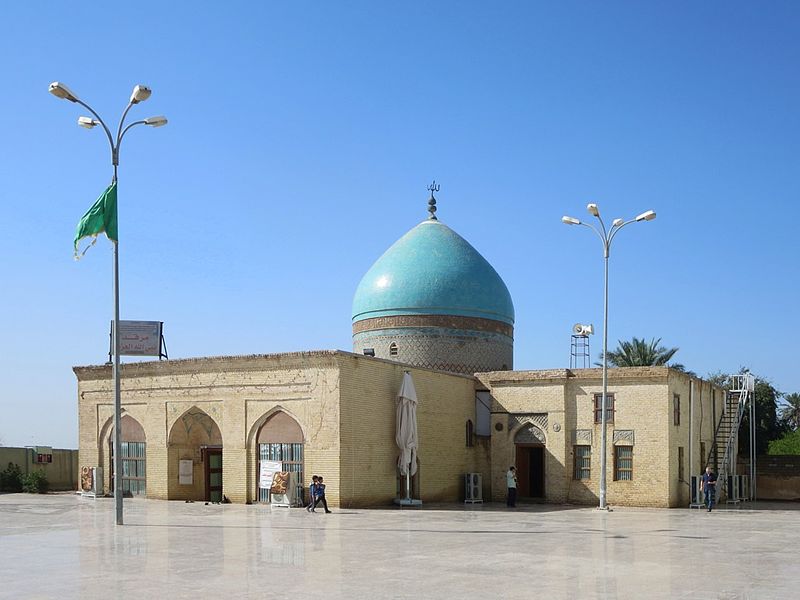
Mosque at the site of Al-'Uzair near Basra in Iraq, where
Ezra is said to be buried
Ezra, also known as Ezra the Scribe, or Ezra the Priest, probably died around this time as well. There is no later tradition of his dying in Jerusalem and he may have died elsewhere. There are traditions of his being buried near Tedef, in present-day Syria, and in Al-‘Uzair near Basra in present-day Iraq.

He is remembered as one of the restorers of Judaism, one who gave new spirit to the returned exiles. There are a lot of books named after him. There is the book known as Ezra, which is a Hebrew and Aramaic text and is accepted by all sects of Judaism and Christianity. This is sometimes called Ezra 1 (or alternatively Esdras 1, Esdras is just another word for Ezra). There is the book of Nehemiah, which was treated as part of the same scroll for many centuries. This is sometimes called Esdras 2. There is a Greek text that is sometimes referred to as Esdras 1 or 3. This text is nearly identical to the standard book of Ezra, but contains an additional, probably later, episode about Zerubbabel answering a riddle of Darius.

Bowl bearing the name of Artaxerxes I
Finally, there is a text called Esdras 2 or 4, which is a combination of three different texts, some of them written up to six hundred years after Ezra. I have included a link to an explanation page of all the books called Ezra/Esdras to hopefully shed some light on the matter. Suffice it to say that Ezra was influential enough that many books bear his name, whether he had anything to do with them or not.

Thus the period draws to a close. Artaxerxes I had reigned throughout the entire period, which saw the Egyptian rebellion and the Athenians defeated, further setbacks on Cyprus for the Persians, before the establishment of a fragile peace. The remarkable career of Megabyzus came to an end, after triumph and rebellion. Probably the most influential happenings, from the context of later history, were the events happening in the small and insignificant sub-province of Yehud. Here the return of Ezra and Nehemiah, the rebuilding of the wall and the reading of the Torah, galvanise the small community and help preserve the unique identity which survives and has had such influence to this very day.

Bull column from Persepolis
Primary Sources
Elephantine Papyri, written between circa 459-402BC
Book of Esther, written possibly as early as 420BC
Ezra, probably written no earlier than 420BC
Nehemiah, probably written no earlier than 420BC
Thucydides, History of the Peloponnesian War, written circa 400BC
Ctesias, Persica, written circa 398BC
The Parian Chronicle, written circa 216BC
Apocrypha 1 Esdras (2 Esdras in Slavonic, 3 Esdras in Appendix to Vulgate), written circa 170BC
2 Esdras (3 Esdras in Slavonic, 4 Esdras in Appendix to Vulgate: Composite work comprising 5 Ezra [chs 1-2], 4 Ezra [3-14], 6 Ezra [chs 15-16]). All three works were composed by circa AD250, but may only have been combined as late as AD800
Diodorus Siculus, Library of History, written circa 40BC
Josephus, Antiquities of the Jews, written circa AD93
Plutarch, Themistocles, written circa AD100
Sukkah, written perhaps circa AD230

Secondary Sources:
Persepolis Fortification Archives:
Abu Tbeirah Excavations Volume I
Clarification page on books called Ezra/Esdras

Related Blog Posts:
479-460BC in the Near East
459-450BC in Greece
449-440BC in Greece
459-440BC in Rome
439-420BC in the Near East

Friday, 28 June 2019

479-460BC in the Near East

Bull Column at Persepolis
This blog will try and look at the Near East for the years 479-460BC, which during this period was mainly included in the Persian Empire. I will occasionally mention the affairs of Carthage as well. From the Persian period onwards, the historical sources become quite scant and we are quite heavily reliant on the writings of the Greeks, particularly Herodotus. This period sees the ending of Herodotus’ history and the sources become even sparser.

Other important sources will be Thucydides, Plutarch and Diodorus Siculus. Occasional snippets of information may come from the Hebrew biblical writings, or sacred traditions, but these will generally only concern affairs in Judea or those pertaining specifically to Jewish history. The story of Esther is an exception of sorts, but even this event would not have been of major concern to other peoples of the empire. It is not that there is nothing to say for this period, but the history is now mainly written by the Greeks. So if most of what I have to say concerns the Greeks, we should remember it is because they are writing the history, not because nothing else was happening in the Persian Empire. For any events that deal with the Greeks, I will only write of them briefly as they are dealt with in greater detail in previous blogs, which will be listed at the end.

In the year 479 Persia ruled most of the world known to the people of the Near East. From Ionia to India, from the edges of Scythia to the edges of Kush, the Persian Empire held sway, under the monarchy of Xerxes I. In the previous year Xerxes had launched an unsuccessful invasion of Greece and had suffered a major naval defeat at the Battle of Salamis. Faced with an enemy that now had a naval advantage, Xerxes retreated from Europe and went to Sardis in Lydia, there to wait to hear the outcome of the war. He had left a high-ranking general by the name of Mardonius in Greece who would carry on the struggle against the Athenians and Spartans. Mardonius had a large army and there were good reasons to suspect that he would achieve his goals. The Persian navy had fallen back and was anchored near the Aegean island of Samos, quite close to the mainland of Asia Minor.

Relief of Persian soldiers from Susa
Mardonius attempted to negotiate with the Greek cities, particularly the Athenians, to try and detach them from their alliances. This was a good tactic, albeit unsuccessful, and led to serious dissensions among the Greek alliance. Trying to pressure his enemies, Mardonius moved his armies towards Attica and tried once more to negotiate.

Meanwhile a city in the north of Greece had already rebelled against Persia, thinking Persia already defeated in the wars. This could not be allowed to stand and Mardonius had sent a force to subdue the city of Potidaea before the rebellion could spread. The siege was proceeding against the coastal city when the sea suddenly retreated away from the shore, exposing weakened areas of the walls of Potidaea. The Persians could not pass up such a heaven-sent opportunity and they ran across the exposed shallows towards the wall. While their columns were rushing along the sand the Persians were caught as the sea returned in a greater tide than had ever been seen in that region. The attackers were swept away in the surf and the Persian commander abandoned the siege. This may possibly be the first description of a tsunami in the historical record.

Meanwhile Mardonius occupied Athens and, upon hearing that the Athenians were flatly refusing any further negotiations, he burned it to the ground as thoroughly as he could accomplish. The Athenians appealed to the Spartans to actually do something instead of waiting behind fortifications at the Corinthian Isthmus and finally the Spartans did march out.

Relief from the palace at Susa
The Spartans and their allies, combined with the Athenians and other troops, made up an army perhaps 80,000-100,000 strong, which was also probably the largest Greek army (not counting later Macedonian armies) ever fielded in the classical era. I could be mistaken on this however. Mardonius had a slightly larger army, probably numbering around 100,000-120,000. The Persians were much less lightly armoured, but had the advantage of Greek allies such as the Thebans, who were armed much like the Spartans. The Persians also had the advantage of having a much stronger cavalry component to their army.

The two armies met on a plain in Boeotia near the city of Plataea. The Greeks won some initially skirmishes, beating back Persian cavalry attacks and killing a Persian cavalry commander. Wishing to capitalise on these successes, the Greeks, under the leadership of a Spartan general called Pausanias, moved closer to the Persian camp. But this proved to be a mistake on the part of the Greeks, as their food and water supplies were now threatened by the more mobile Persian units. The Greeks decided to pull back to a more defensible position, covering themselves from Persian attack by retreating at night.

Their retreat was uncoordinated and Mardonius mistook this for a full-scale withdrawal. He ordered a Persian attack, but while his army was readying itself, the Greeks managed to get into some form of order and prepared for the Persian assault. Mardonius had thus committed himself to fighting an uphill infantry battle against more heavily armoured troops. But his army was already engaged by the time the mistake would have been realised and there would have been no choice but to carry on with the battle and hope that Persian courage would carry the day. The balance of the battle hung in doubt until Mardonius was killed in the thick of the fray. The Persian army collapsed after the death of Mardonius and probably only around half the Persian army was able to escape. The Persian land invasion of Greece had failed.

Bull column from the palace at Susa
The Greek fleet had sailed eastwards to engage the Persian fleet. The Persians had moved from Samos to the nearby mainland at a place called Mycale, where they had beached their ships and built a stockade to protect themselves from attack. Seeing that the Persians did not offer battle on the sea, the Greeks landed their marines and sailors and moved to the attack. The Persians left their camp so as not to be surrounded by the Greeks. It seems as if the Persian morale was poor or that perhaps they were not expecting an engagement. The Greek hoplite armour would have been much heavier than the Persian armour (which was often simply a light shield) and in close-quarters combat the Greeks defeated the Persians, sacked their camp and burned their ships. This ended the last chance that the Persians had to offer any resistance to the Greeks in the Aegean. Both the battles of Plataea and Mycale are described in more detail in previous blogs.

Xerxes had been in Sardis while these events were ongoing and it must have been extremely demoralising to hear the news of catastrophic defeat after catastrophic defeat. I wonder why the Persians did not bring up more troops to attack the Greeks or to fight back. But there are some indications to suggest that the province of Babylon was in revolt at this time and any troops that could be spared would have had to be sent to quell this. However, this is far from proved. It is not certain that the Babylonians drew away troops from the western satrapies of the Persian Empire, but it is a possibility and the Greek victories may have been easier, or less contested than they would otherwise have been. But this is speculation.

Coins of the
Ghazzat Hoard
At least some Persians (or Phoenicians) returned from the wars. A coin hoard was found underwater near Gaza in Palestine, now known as the Ghazzat hoard. These coins were all from the northern areas of Greece and parts of Thrace, and all of these coins are from the decades immediately previous to Xerxes invasion of Greece. I wonder if this was the part of the pay or plunder of a Phoenician captain who managed to escape the storms and battles of Artemision and Salamis only to return to the Levant and perish within sight of their native land. I’m being very melodramatic here, but it is interesting to see that there is such physical evidence of the invasion found in various parts of the Near East.

In the year 478 Xerxes seems to have left Sardis and returned to the centre of his empire, probably to Susa or Persepolis. It is not known if he left the heartland of his realm again and we know of no further military campaigns undertaken by the king.

The Greeks attacked Cyprus and continued their attacks on Persian holdings around the Aegean Sea. It is likely that there were still some areas that acknowledged the Persian king in northern Greece or in Ionia. But they would have acknowledged the king in name only and the Greek alliance, now led by the Athenians, would be continually attacking any place that had any illusions of remaining loyal to the Persian invaders.

One of the last events recorded by Herodotus is a strange affair whereby Xerxes falls in love with a lady called Artaynte. She was the daughter of his brother Masistes and Xerxes ordered her to be married to his son and heir, the Crown Prince Darius. Xerxes seems to have been in love with both Artaynte and her mother. Herodotus records that Xerxes swore to give Artaynte a gift: Any gift that was in his power to give. She asked for a shawl that had been a gift from Amestris, one of the wives of Xerxes. Xerxes feared to give this to her, as it would mean his angry wife would hear of it, but he had promised and the word of the King could not be rescinded.

Treasury at Persepolis
Artaynte is said to have worn the shawl and Amestris inevitably heard of this. Suspecting that the mother of Artaynte was behind the entire affair, Amestris went to Xerxes and asked a gift of Xerxes: Any gift that was in his power to give. Amestris then asked for the mother of Artaynte to be handed over to her. Xerxes tried to save his brother’s wife, but once again, he had given his word. The wife of Masistes was handed over to Amestris who tortured, humiliated and mutilated her before sending her back to her brother.

Masistes was a son of a king and the brother of a king and must have felt the insult keenly, as well as fearing for his life. He fled to the east of the empire, towards Bactria, looking to raise a rebellion against Xerxes. However he and his sons were caught and killed and the rebellion, such as it was, was swiftly quelled.

Our main source for this is Herodotus and it is likely that this story has some factual basis, but I would be surprised if this was the exact reason for the rebellion and death of Masistes. There are too many elements in it that seem to mirror earlier or later stories. It might be entirely true, but I feel it would be good to show some caution on this tale. This is the last piece of information given to us by Herodotus about the Persian Empire.

Persepolis in the evening
According to the most common way of interpreting the book of Esther, Esther was selected and crowned queen around this time. After Vashti had been dismissed by Xerxes he eventually selected another woman to be his queen, in this case the Jewish lady called Esther, or Hadassah in Hebrew. She is unlikely to be referred to by this name, as Esther may have been a Babylonian name derived from the goddess Ishtar (it might also have derived from a Persian word however). Her uncle was known as Mordecai, which is certainly derived from the name of the Babylonian god Marduk, so the Babylonian form is more likely.

Scholars have not been sure how to correlate the crowning of Esther with the tale of Herodotus about Amestris, who clearly seems to be the main wife of Xerxes. Some have identified Amestris with Vashti or even with Esther. The identification of Esther with Amestris is probably wrong, as Amestris has full-grown children in 478 at the time of the Masistes affair. But if Amestris is Vashti, then she should have been in seclusion and out of favour with the king at this time. The solution is probably not a simple one, but we must remember that Herodotus is writing some decades later, is liable to confuse details, and is to a certain extent a hostile witness to the deeds of Xerxes and his family. The Book of Esther is also written perhaps a generation later and seems to use different names to those used by the Greeks (or the Persians). So some major confusion is really only to be expected here.

While not losing battles or engaging in silly love affairs Xerxes carried on the building programs of his father. The cities of Susa and Persepolis were adorned with vast buildings. This period, though not necessarily this exact year, saw the completion of the Imperial Treasury at Persepolis. This is sometimes referred to as the Harem (as it has many identical rooms), but is more likely to be the treasury of the empire, or even more likely, one of the treasuries of the empire.

Gate of All Nations at Persepolis
Another colossal building work completed in or around this time was the Gate of All Nations. This was a great gateway to the terrace containing the main palaces of Persepolis. The gates themselves are flanked with Assyrian style lamassu and the stairs leading to the gates are engraved with reliefs of the peoples of the empire.

As impressive as the building works at Persepolis and Susa are, they also exemplify a problem with how the Persian Empire was run. Fundamentally the Persians requested large payments in tribute every year. They were perhaps not as draconian in their tribute demands as the Assyrians or Babylonians, but they were drawing from a much larger area. Thus every year the Persians would take in precious metals, which would be melted down for bullion and stored in Susa, Persepolis and Ecbatana and a few other regional centres of Persian power. The money would never be spent and the provinces were perpetually drained of their resources. Because much of the wealth of the Persians was simply locked in ever accumulating vaults it never even benefitted the people in the heartland of the realm. Thus it seems that the nations of Asia began to suffer from a slow economic malaise during the 5th century BC.

The problem probably did not surface under Cyrus and Cambyses, who did not mint coinage and whose taxation policies were much looser. The seeds of the problem were sown with the more efficient bureaucracy of Darius, but probably only became noticeable during the reign of Xerxes. This economic stagnation and impoverishment of the provinces would continue for as long as the Persian Empire lasted. It seems to have led to the decline of Ionia at a later time period, and explains some of the economic issues seen in the literature from Judah, Babylon and Egypt.

Al-Yahudu Tablets
In the year 477 the Al-Yahudu Tablets, a cache of cuneiform documents from Babylonia, that shed light on the life of the Jewish exiles living there, comes to an end. It is not clear if the Jewish community was badly affected by the turmoil in Babylonia or why the archive comes to an end at this time.

Around this time, King Eshmunazar II of Sidon died. He was buried in a sarcophagus that had been looted from Sais in Egypt, as his father Tabnit had been. The sarcophagus has a Phoenician inscription on it however, where Eshmunazar tells of his lifetime and asks the reader not to open his tomb and to leave it undisturbed.

In the month of Bul, in the fourteenth year of the royalty of King Eshmunazzar, King of the two Sidons, son of King Tabnit, King of the two Sidons, King Eshmunazzar, King of the two Sidons, said as follows: I am carried away, the time of my non-existence has come, my spirit has disappeared, like the day, from whence I am silent, since which I became mute. And I am lying in this coffin, and in this tomb, in the place which I have built. O thou reader remember this: "May no royal race and no man open my funeral couch, and may they not seek after treasures, for no one has hidden treasures here, nor move the coffin out of my funeral couch, nor molest me in this funeral bed, by putting another tomb over it.”
Sarcophagus of Eshmunazar II, written circa 477BC

Eshmunazzar Sarcophagus in the Louvre
In this year the last vestiges of Persian power in Europe seem to have been finished. The Spartans campaigned against the Thessalians and the Athenians were in full control of the Hellespont. This meant that even if any Greek, Macedonian or Thracian peoples had wished to acknowledge the rule of Xerxes, the Athenians and Spartans would actively make war upon them to prevent this. The Spartans appear to have left the main continuation of the war to the Athenians at this point however.

In the year 476 the Greek alliance, now primarily led by the Athenians, continued their war against the Persian Empire. This year they seem to have focused on freeing any remaining Ionian cities from the Persians and in offensive operations against Persian targets within easy reach of the coast.

In 475 the Greeks seem to have focused their attacks on the island of Scyros in the Aegean. It is not clear if the Dolopian inhabitants of Scyros had any attachment to Persia, or if they were simply pirates, but this operation seems to have occupied the Greek alliance and left the Persian holdings on the mainland in peace for the time at least.

Around this time Atossa died. She had been the daughter of Cyrus the Great, the wife of Darius and the mother of Xerxes. She was the primary link of legitimacy that connected the family of Darius to the older branch of the Persian royal family. She had possibly been the reason Xerxes had been given the throne by Darius. Xerxes was not the eldest son of Darius, but he was the eldest son of Darius through Atossa, after Darius had ascended to the throne. She was a formidable figure but respected by all. Even the Greek playwright Aeschylus gives her a role in his play The Persians, which was written shortly after this time.

Griffins at Persepolis
It may have been around this time that Sataspes returned. Sataspes was a cousin of Xerxes who had been convicted of raping the daughter of Megabyzus. Megabyzus was one of the most powerful nobles in the empire. He was descended from one of the seven conspirators who had helped put Darius on the throne. He had commanded the Persians who crushed the rebellion in Babylon in the previous decade and he had been a prominent commander during the invasion of Greece. Even a cousin of the king would have to be punished for such a crime, particularly when the father of the victim was a powerful man in his own right.

Sataspes was initially condemned to death, but at the urging of Atossa he had been allowed to take a different course. He was told to take ships and sail around the coastline of Africa, to circumnavigate it from the west, passing the Pillars of Heracles, and sailing southwards along the western coast, through the Atlantic Ocean until he had reached the Red Sea.

Herodotus records that he had attempted it (although Herodotus does not give an exact date). He had an Egyptian ship with Egyptians as crew and sailed far to the south. He reported that the people he saw were very small and that his ship simply stopped and went no further. Xerxes must have believed that these were tall tales and ordered Sataspes to be executed by impalement. I have recorded the expedition here, but again, there is great uncertainty on the date.

Map showing the Benguela Current in the south Atlantic
that Sataspes' ship would have struggled to make
headway against
It must be noted that there are peoples of shorter stature in central Africa, particularly along the Congo Basin, known as pygmies. There are also strong currents flowing northwards around the mouth of the Congo. Later Portuguese explorers avoided these by sailing westwards, towards Brazil and following the Atlantic currents around towards the Cape of Good Hope. So Sataspes may have been telling the truth. It seems as if this was the last serious attempt to circumnavigate Africa in this direction until the Age of Exploration.

Sataspes went to Egypt where he received a ship and a crew from the Egyptians, and sailed past the Pillars of Heracles. Having sailed out beyond them, and rounded the Libyan promontory called Solois (possibly Cape Cantin), he sailed south; but when he had been many months sailing over the sea, and always more before him, he turned back and made sail for Egypt. Coming to King Xerxes from there, he related in his narrative that, when he was farthest distant, he sailed by a country of little men, who wore palm-leaf clothing; these, whenever he and his men put in to land with their ship, left their towns and fled to the hills; he and his men did no harm when they landed, and took nothing from the people except cattle. As to his not sailing completely around Libya, the reason he said was that the ship could move no farther, but was stopped.
Herodotus, Histories, 4.43, written circa 440BC

An 1869AD painting of Esther, by Portaels
Around the year 474 the Haman Affair occurred. Dates are very far from certain on this so a certain chronological leeway should be allowed. Haman was a courtier in the retinue of King Xerxes and was highly honoured by the king. He had a feud with a less important courtier named Mordecai, who was also Jewish and the uncle of Queen Esther. Mordecai was not nobody however, and was known to the king. Mordecai had also helped the king by reporting a palace plot some time previously.

Haman, who may have had an ancestral grudge against the Jews decided to revenge himself on Mordecai by asking the king to hang Mordecai, but also to allow the Jews to be hunted and murdered with impunity on a certain day.

There was a twisted precedent for this, as Darius seems to have allowed people to hunt and kill the Magi on a particular day, as the “imposter” impersonating Bardiya was said to have been from the tribe of the Magi. It is said that Xerxes agreed to this. However, Esther, who seems to have fallen out of favour with the king by this time, approached the king unannounced, in a breach of court protocol that could have led to her execution to ask the king and Haman to a banquet.

After diplomatically getting the sympathy of the king at a later time, Esther revealed that Haman was seeking the destruction of Xerxes’ queen and all her people. Xerxes ordered the execution of Haman.

However, the king’s word was law and the destruction of the Jews could not be countermanded, however, the king sent another edict allowing the Jews to defend themselves. After this Mordecai, the uncle of Esther, was promoted to a high rank and the Jews later came to celebrate their deliverance in what is now known as the Feast of Purim. The story was commemorated in the book of Esther, which may have been written as early as sixty or so years after the events it describes.

Monumental ruins at Persepolis
This has been a very brief paraphrase of the book of Esther. It is a short book and worth reading in its own right. The dates, names and overall veracity of the book are hard to verify. It is written for a Jewish audience but is dealing primarily with a non-Jewish subject matter. This means that some details are obscured and it makes it more difficult to discover the truth of the matter.

But, some of the details, such as the immutability of the word of the king and the picking of a certain day for the murder of an entire ethnic group do sound familiar from the words of Herodotus. If the story of Amestris and Artaynte is true, then it shows that there were vicious harem feuds at play at the Persian court; feuds that could trigger coups and rebellions. This too rings true to the account of Esther. It is hard to definitively say more.

There is little that can be said for the years 473, 472 or 471. I’m sure that many things happened in these year, possibly even things that I have described as happening at different times, but I cannot say for sure.

Idalion Tablet from Cyprus
Around this time in Cyprus, which was now a disputed territory between the Persians and the Aegean Greeks, the Idalion Tablet was made. This was a bronze tablet from the city of Idalion that records the Greek language but written with an ancient script known as the Cypriot Syllabary.

This recorded a contract made by King Stasicyprus of Idalion and some physicians who had cared for the soldiers and people of the city during a long siege. It is unclear when this siege actually was. It may have begun in 478, but may also have taken place during the time of the Ionian Revolt, or been an entirely unrelated war.

The king had asked the physicians to treat the people without charge and in gratitude the king gifted a plot of land to the physicians forever. This is sometimes referred to as the first public health plan, but considering that it was an emergency action during wartime, this may be overstating the case.

When the Medes (Persians) and Kitians had the city of Idalion under siege, in the year of Philokypros, son of Onasagoras, King Stasikypros and the city – the Idalians – called physician Onasilos, son of Onasikypros, and his brothers, to treat people who were wounded in battle, without payment.
Idalion Tablet, written circa 470BC

Griffins at Persepolis
Not much can be said to my knowledge for the year 469. Presumably things happened, but sadly I am not aware of them.

In or around the year 468 King Siaspiqa of Kush died. Nasakhma, presumably his son, succeeded him as King of Kush. Both monarchs are attested by some small artefacts and lists from Nuri and Meroe, but as with all of the monarchs of Kush from this era, very little is known about them.

Not much can be said to my knowledge for the year 467. Presumably things happened, but sadly I am not aware of them.

In the year 466 the Persians were potentially trying to retake the cities of Ionia that they had lost after the failed invasion of Xerxes. However the Persian army and navy were attacked by the Athenians at the Eurymedon River and the Persians suffered a heavy defeat. The Athenians, led by their general Cimon, inflicted a near total defeat on the Persian navy and what seems to have been a very conclusive defeat upon their land army as well. Although Xerxes had not led this debacle, it was the last major Persian defeat to have occurred during his reign.

Probable tomb of Xerxes at Naqsh-i-Rustam
In the year 465 Xerxes I, King of Persia, was murdered in a palace coup. It is unclear why he was murdered. His subjects may not have been happy with the continual defeats and losses after the failed invasion of Greece. They may not have been happy with the heavy taxation needed to fund the extravagant building projects of the king and his court. The conspirators may have had purely personal reasons for wishing Xerxes dead. But, whatever the cause, Xerxes was murdered.

The Persian sources, such as they are, do not seem to mention this and no Jewish text records these events. We are reliant on an offhand comment in a later work by Aristotle, written perhaps a century later, and a very unreliable account written by a Greek doctor called Ctesias, who wrote perhaps six decades after the event and is a very dubious witness. Ctesias wrote two works, Indica and Persica, neither of which survive in their original form and both of which have some very serious problems. Sadly, for Persian history, we are partially reliant on the Persica of Ctesias.

Ctesias records that a courtier who had risen to favour named Artabanus, (a different nobleman from both the Artabanus’ and the Artabazus’ mentioned in Herodotus’ work) was scheming to attain the throne. He planned a complex coup, where he enlisted the help of Megabyzus, a powerful Persian noble and one of the most powerful men in the empire, and a palace eunuch named Aspamitres.

Artabanus killed Xerxes with the help of Aspamitres and then told one of the younger princes, named Artaxerxes, that the Crown Prince Darius had murdered their father Xerxes. Artaxerxes reacted swiftly and Prince Darius, the supposed murderer, was quickly slain.

Detail from the (probable) Tomb of Xerxes
Artaxerxes became king, but Artabanus seems to have planned to murder Artaxerxes as well. After acting as regent for some time, Artabanus made some form of pact with Megabyzus to slay the young Artaxerxes. However, Megabyzus had no interest in serving some lowborn character and told Artaxerxes of the plot. Artabanus and his sons were killed and Artaxerxes I was now the undisputed king of Persia. Some rebellions were fought in the east, as Bactria rose up against the king of Persia, but Ctesias does not go into great detail.

Certain later classical sources, such as Justin and Diodorus Siculus, refer to this tale, but they seem to be either drawing directly from Ctesias, or embellishing his account. If Ctesias was a better source generally, I would have much more faith in this account. But as it stands, I am not convinced the episode took place at all.

There is something similar alluded to in the book of Esther, where there is a palace intrigue, an upstart courtier (Haman in Esther, Artabanus in Ctesias, both of whom seem to have sons involved in the plots) and a plot involving eunuchs (Bigthana and Teresh in Esther, Aspamitres in Ctesias). However in the account of Esther the plot/s fail and Xerxes survives. Without saying that the book of Esther is correct in this instance, it is quite possible that Ctesias has misheard an incident from the Persian court tales and garbled the entire account of Xerxes death. In case anyone thinks I am being too tough on Ctesias, note that he somehow manages to garble the account of Xerxes’ invasion of Greece, which was common knowledge during his lifetime.

Where Xerxes was buried is not known for sure, but there is a rock hewn tomb at Naqsh-i-Rustam that is very similar to the tomb of his father. There is no inscription remaining. It is nevertheless assumed that this is the tomb of Xerxes.

It is recorded that Inaros II and Amyrtaeus of Sais rose up against Artaxerxes and Persian rule shortly after Artaxerxes took the throne. If that is the case then it would appear that the uprising may have taken place in the year 464, but it is quite likely that the revolt actually took place some years later.

Coin of Themistocles, possibly showing a portrait on it
(or possibly not)
In or around this time, at some point around the year 463, although it may have been some years previously, during the regency of Artabanus or even the reign of Xerxes, it seems that Themistocles arrived at the court of the king of Persia. He had been instrumental in the defeat of the Persian invasion, but the Persian kings were generally not vindictive to their foes. Themistocles was treated well and was even given a small province in the region of Magnesia to rule in the name of the Persian Empire. Themistocles ruled here for some years and even minted his own coins. The coins with portraits are perhaps some of the earliest portrait coins that are known to history, but whether or not Themistocles was the first to put his portrait on a coin is still rather debateable.

Around this time Nasakhma, King of Kush, died. He was probably succeeded by Malewiebamani, who was probably his son. Various artefacts of Nasakhma and Malewiebamani survive, but very little is known of their reigns. It is unfortunate that the kingdom of Kush is not better known and understood.

Not much can be said to my knowledge for the year 462. Presumably things happened, but sadly I am not aware of them.

In the year 461 it seems that the Athenians sent the wealthy nobleman Callias (known as Callias II to differentiate him from others of the same name) to Persia. He was sent as an ambassador, but it is not clear what his mission was. As Athens was on the brink of war with Sparta it is possible that Callias was sent to Persia to investigate whether or not the ceaseless war between Athens and Persia could end. It seems that his mission did not succeed however.

Fallen lion head at Persepolis
In Egypt, the revolt of Inaros II, a Libyan chieftain who ruled some portion of the Nile Delta region, was still ongoing (or just beginning at this time, the chronology is unclear). Achaemenes, who was the Persian satrap of Egypt and a brother of Xerxes I, had gathered a large army to fight it. The Athenians sent a large force of 200 ships to aid the rebellion. The Athenians made contact with the Egyptians and together they set out to confront the Persian garrison. The two armies clashed in what is known as the Battle of Pampremis and, after a sharp struggle, the Persians were routed. Achaemenes was slain in the rout.

However the victory of the Greeks was not fully complete. A section of the Persian garrison fled to a fortified section of Memphis called the White Castle and they could not be removed from this position. They had ample supplies and enough troops to disrupt the whole region of Lower Egypt. So the Athenians and their Egyptian allies settled down for a siege of this fortress.

Meanwhile Inaros, son of Psammetichus, a Libyan king of the Libyans on the Egyptian border, having his headquarters at Marea, the town above Pharos, caused a revolt of almost the whole of Egypt from King Artaxerxes and, placing himself at its head, invited the Athenians to his assistance. Abandoning a Cyprian expedition upon which they happened to be engaged with two hundred ships of their own and their allies, they arrived in Egypt and sailed from the sea into the Nile, and making themselves masters of the river and two-thirds of Memphis, addressed themselves to the attack of the remaining third, which is called White Castle. Within it were Persians and Medes who had taken refuge there, and Egyptians who had not joined the rebellion.
Thucydides, History of the Peloponnesian War, written circa 400BC

In the heartlands of the Persia, the Apadana palace complex in Persepolis was probably finished around this time. Artaxerxes I was a builder but he undertook no gigantic building projects on the scale of the buildings of Xerxes, but the projects that had been ongoing when he had taken the throne were brought to completion.

Historical image of Mount Gerizim seen from nearby
Mount Ebal
In the region of Samaria, a very minor province of the Persian Empire, the religious group that later became known as the Samaritans probably began building a temple atop Mount Gerizim. This group held beliefs that derived from the Judaism, as it had been practiced before the destruction of Jerusalem by Nebuchadnezzar. They were based primarily in what had been the older northern kingdom of Israel, rather than the southern kingdom of Judah. They had perhaps mixed with the deportees from Mesopotamia who had been planted there by the Assyrian kings after the destruction of Samaria.

There was tension between the Samaritans and the groups who had returned from exile in Babylonia. Both sides claimed to represent the continued tradition of Judaism. The Jewish exiles in Jerusalem had rebuilt (albeit on a much reduced scale) a temple in Jerusalem. It seems that at some point in the mid-5th century BC that the Samaritans built their own rival temple atop Mount Gerizim. While the disputes between the two communities are remembered to a certain extent today, because of their religious writings that survive, we must remember that both the Samaritans and the Jews were very tiny minorities within the Persian Empire at the time.

Thus the period draws to a close, beginning with the defeat of Xerxes’ invasion and ending with the Greeks aiding the Egyptian revolt against Artaxerxes I. The period saw great buildings and the Persian Empire at near the height of its splendour, but also saw the beginnings of its decline, with the growing penury of the outer provinces and the serious military weaknesses of the empire exposed by its wars with the Greeks.

Relief from the (probable) Tomb of Xerxes
Primary Sources:
Sarcophagus of Eshmunazar II, written circa 477BC
Idalion Tablet, written circa 470BC
Herodotus, Histories, written circa 440BC
Book of Esther, written possibly as early as 420BC
Thucydides, History of the Peloponnesian War, written circa 400BC
Ctesias, Persica, written circa 398BC
The Parian Chronicle, written circa 216BC
Diodorus Siculus, Library of History, written circa 40BC
Plutarch, Themistocles, written circa AD100

Secondary sources:
The Sale of the Ghazzat Hoard:

Related Blog Posts:
499-480BC in the Near East
489-480BC in Greece
479-470BC in Greece
469-460BC in Greece
479-460BC in Rome
459-440BC in the Near East