Sunday, 27 November 2011

Sumer

"Standard" of Ur showing scenes of battle
This will be the last post that I shall do for a while. The assignment that I have been doing will be completed this week. I shall continue the blog (I have grown to enjoy it) but time constraints mean that I shall probably put it on hold for a few weeks before resuming posting at some point after Christmas. I would like to thank everyone who took the time to read or comment on the blog. I hope that you enjoyed it as much as I enjoyed writing it.

This final post will be about my favourite ancient civilisation, Sumer. When I was in my early teens I wanted to study Sumerian (or Mesopotamian) history for a living and I occasionally still wish that I had gone down that route. I have alluded to this civilisation in earlier posts, such as The Gardener Who Became King and Hearing History but I never gave them a proper introduction to the reader.

A map of some of the cities of Sumer
Sumer is special because in many ways it is the first civilisation. There are Neolithic settlements around the world that are far older than any Sumerian sites and other areas could claim to have been roughly contemporary with Sumer but it is uncontested that Sumer is the oldest civilisation yet discovered that we can say anything about with certainty. They are indisputably the earliest culture to leave behind records that can still be read by scholars today.

Sumer is located in the south of Iraq, from the Persian Gulf in the south to roughly around Baghdad in the north and bounded by the Arabian Desert and Iranian Plateau to the west and east respectively. It is generally a flat floodplain for the two rivers, the Tigris and the Euphrates that give Mesopotamia its name (Mesopotamia literally means "the land between the rivers" in Greek). It lacks natural resources, including stone and wood and the deltas of the rivers have extensive marshland around the mouths.

King Gudea of Lagash
In or around 3500 BC (by most conventional dating) the inhabitants of the land banded together to create irrigation systems. These systems allowed the inhabitants to control the floodwaters of the two unpredictable rivers, drain the marshlands and irrigate the deserts. The new farmland was exploited to allow the Sumerians to produce multiple harvests per year. Their population expanded but not in a haphazard fashion. They needed to cooperate in order to maintain these complex irrigation systems. This led to communities living together in the world’s first cities.

The plain of Sumer lacked stone so to build their houses and monuments the Sumerians used mud bricks. This was a poor building material so they would periodically destroy their buildings and build new ones on top of them. This led to their cities (occupied for hundreds and, in some cases, thousands of years) to eventually rise above the plains on artificial hills. These mounds survive today across the Middle East and are referred to as "tells".

There are possible writing systems that may predate the Sumerian one, but many scholars are convinced that these systems are just collections of pictures and are not actually writing. The Sumerian script is the oldest decipherable script. It originally seems to have been a method for recording transactions but evolved into a medium for writing advanced mathematics and literature. They wrote on clay tablets. The scribes would use a wedge shaped stick to make impressions on the clay, which led scholars to name the script cuneiform ("cuneus" is Latin for "wedge"). The Sumerians kept a huge amount of records and thousands upon thousands of tablets and tablet fragments have been found documenting everything from their musical scales, to epic poetry, to humour (they liked situational comedy) to the price of sheep. Many civilisations leave behind a few enigmatic fragments. The Sumerians left behind libraries.

Cuneiform text of the Epic of Gilgamesh
The language that they wrote in is a language isolate. There is no language on earth today that is related to it. There are wild theories about extraterrestrial contact and stuff, but language isolates are not all that uncommon (Basque is one) and there were doubtless many languages spoken thousands of years ago that have died out without a trace. Fortunately for scholars, for thousands of years scribes would write parallel texts in Sumerian and Akkadian. Akkadian is a Semitic language that can be understood so the Sumerian texts could be read by measuring them against the parallel texts. Nevertheless the unique formation of the language leads to occasional difficulties in translation.

As fascinating as the price of sheep might be to an agricultural historian the rest of us can be glad that they left behind somewhat more interesting texts. They were deeply interested in astronomy, or more strictly speaking, astronomy mixed with astrology. They believed that there was a correlation between celestial events and earthly ones, plus they needed to keep a close track of the seasons to maximise their agriculture so they used their recording skills to develop a sophisticated astronomy and mathematics. Many of their ideas were subsequently transmitted to the Greeks and survive today. Did you ever wonder why, when we have a decimal system (with ten as a base) we have 24 hours in a day? The 24-hour day, twelve-signed zodiac and 360-degree circle are (possibly, as there is some debate about this) legacies of Sumerian astronomy and mathematics.

They also created some of the most poignant literary works the world has ever seen. The Sumerian worldview is generally held to have been a gloomy one. The gods ruled in heaven and the underworld and humanity lived a life of toil for a brief period before descending to the underworld for an uncomfortable life as an insubstantial ghost. The Sumerians were very concerned with the meaning of life and the greatest of their works (perfected by the successors of their civilisation but created originally by the Sumerians) is the Epic of Gilgamesh. This epic tells of a king who rules harshly until he finds a real friend. When his friend dies Gilgamesh falls into despair and goes on a quest to try and find eternal life and give meaning to his existence. Storytelling has changed greatly over the last four thousand years but the basic storyline is still gripping. The first known author (there are literary texts that predate her, but she is the first named author) was a priestess called Enheduanna writing in the Sumerian city of Ur.

The partially restored Ziggurat of Ur
Sumerian architecture is often overlooked for two reasons. Firstly because their buildings were built of mud-brick, which degenerates over time and made it difficult to truly build large structures and secondly because the near-contemporaneous Egyptian civilisation produced lasting architecture on a truly colossal scale. The Sumerian cities were ornamented with at least one ziggurat apiece. A ziggurat was a series of brick platforms built on top of each other with a temple at the top. The temples were the symbolic home of the gods of the city and may have doubled as astronomical observation platforms for the priests.

The Sumerians lived in city-states with rulers (who seem to have had advisory councils). These city-states rose or declined in prominence over the years and the latter part of the third millennium BC the cities were involved in direct warfare with each other. The Sumerians were either the first, or among the first, to invent the wheel and used chariots in battle. The horse was not yet domesticated in that area of the world so their chariots were massive, slow platforms for warriors to fight from, drawn by onagers (wild donkeys), that would lumber into battle. Their warriors had helmets, body armour, spears and bows. It is theorised, based on certain reliefs, that their armies may have used the phalanx formation but this is unclear and I suspect that it may have more to do with artistic conventions than actual military formations.

Over the years the Sumerian culture had imitators and similar cultures arose in what is now Iran and in northern Iraq. Around the year 2270 BC (according to certain dating systems) the Sumerian city-states were conquered by the Akkadian king Sargon and ruled from Akkad for several generations. The empire eventually broke down when Gutian invaders from the Iranian Plateau conquered the Akkadians. There was a revival in Sumerian culture (there were several major revolts by the Sumerian cities during the Akkadian Empire) after the Gutian invasion and a city called Ur (which is possibly the city identified by the Bible as the birthplace of Abraham) became the centre of an empire in the south of Iraq. But this empire only lasted a few generations and by the year 1800 BC Sumerian cities had declining populations, reduced farmland and were ruled from Babylonia. The Akkadian language gradually replaced Sumerian and Sumerian culture as a distinct entity effectively came to an end.

The Stele of Vultures: Lagash victory stele
Sumer had an impressive legacy however. Their language remained as a language of learning (rather like Latin used to be in Europe) and the last Sumerian texts were written around the first century AD. The Akkadians, Elamites and later Assyrian and Babylonian cultures were deeply influenced by them and in many ways Sumerian culture didn’t die so much as change into a broader Mesopotamian culture. While the later Persian Empire drew primarily on Iranian culture it was also influenced by the Mesopotamian empires it replaced, thus extending the range of Sumerian influence. The Greek philosophers borrowed concepts such as certain mythic cycles and mathematical and astronomical ideas from the Mesopotamians thus drawing on Sumerian cultural achievements in a way that perpetuates their influence to this day.

So, hopefully this has sparked some interest in this most ancient of civilisations, whose ultimate legacy to us is more than mathematics, the wheel, writing, irrigation etc. The real legacy of the Sumerians to us is, well, civilisation itself. 

Related Blog Posts:
Sumerian History: 3500-1940BC
The Time of the Amorites: Part I
The Time of the Amorites: Part II

Friday, 25 November 2011

Indus Valley Links

Figure from Mohenjo-Daro
Over the last few weeks there has been some interest in the blog post written about the Indus Valley Civilisation. If anyone is interested I am posting a link to a site that contains a number of theories and scholarly opinions about the civilisation and its script. While I am to a certain extent detached from the controversies surrounding this area and it is definitely not my field of study, I found it to be a generally well-worded and careful site. Here is the link to the main site.

Wednesday, 16 November 2011

Johannes Scottus Eriugena

Interior of Charlemagne's chapel at Aachen
Scholars think that the whole concept of the Dark Ages in Europe is overrated, that things weren’t as bad as they are sometimes portrayed. But it seems fair enough to say that between the years of around 450-1000 AD that original thought and culture in Western Europe suffered. In the Roman Empire the language of learning had been Greek, but after the Empire had split and the Western Empire had collapsed, libraries were destroyed, travel became difficult and these factors, combined with indifference, meant that by around 700 AD there was almost no one in Western Europe who could speak Greek, meaning that there was no one who could act as an ambassador between the western states and the surviving Eastern Roman (Byzantine) Empire. Worse still, it meant that the surviving manuscripts of ancient learning were unable to be read or replaced once the original manuscripts degenerated.

Image from illustrated Bible of Charles the Bald
After the Western Empire collapsed the migrating tribes set up a bewildering mixture of states. By around 800 AD these states had largely been united into a new empire of sorts by Charlemagne and his descendants with a power base based upon their Frankish tribe, centred roughly around northern France. Charlemagne was illiterate but understood the importance of culture and tried to foster a revival of Roman culture and learning. Among other projects he founded a new school at his court where the best thinkers of Europe could teach under the auspices of the emperor.

This cultural project was hampered by politics. Unfortunately in the Frankish kingdom inheritance was divided between heirs and personal loyalty was a far higher consideration than loyalty to a state, meaning the Frankish Empire was split up and reunited based upon how many princes there happened to be at the time. One of these descendants of Charlemagne, a king by the unfortunate name of Charles the Bald, required a new teacher for the school, preferably anyone who could speak Greek so that Charles could establish better diplomatic relations with the Byzantines.

Gold coin of Michael III, Byzantine Emperor of the time
Charles asked Johannes Scotus Eriugena to lead his school. I should explain his name first. In the early Middle Ages Irish people were sometimes referred to as Scots. Probably due to the high number of migrants from Ireland to what is now Scotland, Ireland was referred to as Scotia Majora and the word Scotland derives from the Latin term Scotia Minora (little Scotland). Eventually Scotia Majora was no longer used but the Scotus in the Eriugena’s name merely means "Irish" or possibly "Gael". Similarly, "Eriu" was a name of Ireland, so Eriugena is simply a way of saying from Ireland. Names at that time had a certain bluntness about them, so we can say that around the year 845 AD "Charles the Bald" asked "Irish John from Ireland" to be head of his school.

Eriugena could speak Greek; in fact he was fluent in it. Because Ireland had never been part of the Roman Empire and was fairly isolated on the edge of Europe it had escaped much of the chaos that followed the fall of the Western Empire. The newly Christianised island had a number of monasteries that preserved learning and the texts preserved there presumably allowed Eriugena to learn the language.

Coin of Alfred the Great. The word "Aelfredre" is visible
Eriugena was a somewhat colourful character in subtle ways. He was a friend of Charles the Bald and the two often dined. Now even back in the Dark Ages the Irish had a reputation for being somewhat over fond of alcohol. The king asked (in Latin, but the rhyme is the same) what separated a Scot (an Irishman) from a sot (a drunkard). Eriugena, sitting opposite the king at dinner, heard the joke and turned it back on the king (who was noted for his own alcohol consumption) with the wry quote "Mensa tantum" meaning "Only a table".

The table joke is not particularly well attested, coming from a much later source that may well be unreliable. But the confidence of Eriugena can be definitely seen in the title of his major work, the "Periphyseon". This may not sound all that defiant or confident but one has to remember that Eriugena was writing his book for the educated classes of the Frankish Empire, who could speak Latin but who could not speak Greek. "Periphyseon" is a Greek title and a reminder of his own superiority compared to the scholars of the realm.

The ruins of the much later abbey at Malmesbury
Eriugena’s work was heavily influenced by Plato, whose works he could read in the original Greek. He was very concerned with the nature of existence and tried to draw up a logical scheme to divide the entire universe into objects with different attributes based upon some simple first principles. It was an elegant theory and one that attracted a lot of positive attention at the time but after Eriugena’s death his ideas were condemned at Church councils and his writings were banned. However it says a fair bit about the lazy medieval tolerant intolerance that we know his works still circulated. It is proven that figures as orthodox as St Thomas Aquinas (whose philosophy is still the official philosophy of the Catholic Church) read and quoted Eriugena (omitting only the name) while writing their own ideas.

Apart from his own original work Eriugena also restarted the tradition of translation. The last great translator had been Boethius in the early 500’s. Eriugena translated and wrote commentaries on an important philosophical work at the request of the Byzantine emperor and in doing so, helped to revive the idea of translation and prove its utility. The translation and textual preservation efforts of the Europeans and the Islamic world have preserved the vast majority of ancient texts available to us today.

Eriugena commemorated on an Irish five pound note
Sources are scarce for the final sections of Eriugena’s life but there is some evidence to suggest that he was asked to come to the newly united England by Alfred the Great and teach at the abbey of Malmesbury. The story goes that he was stabbed to death in Malmesbury by some disgruntled students with their sharpened pens. This story sounds a little too metaphorical to be true and some scholars allow that there may have been such a bizarre murder but that it happened to another John from Ireland (there was probably more than one). Be that as it may, we know that around 877 AD this innovative thinker in a staunchly traditionalist age passed away. Philosophy has changed and we now no longer see the ability to speak Greek as something almost impossible but we can still admire the abilities and audacity of this diplomat, translator, courtier, teacher and philosopher. 

Tuesday, 15 November 2011

The Plain of Jars

I recently wrote a post dealing mainly with megalithic sites in Ireland. While writing this I was reminded of a site that has always fascinated me on the other side of the world. As megalithic monuments go, they don’t get too much more enigmatic than the Plain of Jars.
         
Located near Phonsavan, in the mountains of Laos, are megalithic (literally “big stone”) monuments. But, almost uniquely insofar as I can tell, these objects are shaped as giant stone jars. Thousands of them have been identified and they are dispersed over a number of sites, but all within a relatively small area. These jars range in size, but the largest of them are very impressive. They become even more impressive to the viewer when it becomes evident on inspection that they are carved from solid rock.

It is unclear what date should be assigned to them. Scholarly estimates range from 500 BC to 1100 AD. As they are carved into stone it is impossible to use standard radio-carbon testing on them and the continuous occupation of the site means that artefacts from a variety of eras may be found.

The main theories are that either the jars were the burial places of important people or it was a place for traders to stop and use the rainwater collected in the jars. The fact that these theories are so completely different highlights the difficulties in understanding this site.

There is however, a more immediate obstacle to understanding the site. During the Vietnam War the US Air Force carried out bombing raids on the surrounding countries of Cambodia and Laos to try to stop North Vietnamese supplies reaching the Viet Cong by different routes. The Plain of Jars was heavily bombed with some destruction of the artefacts. Due to the remote nature of the site and lack of resources allocated, the site is still quite dangerous decades after the bombing ended. Unexploded bombs and rusted shrapnel are a hazard for those who stray off the beaten track. There are ongoing projects to attempt to clear the site in its entirety and develop it into a major attraction and possibly a UNESCO World Heritage site.
       
I have to apologise to the reader for an ongoing theme over the last few posts, where I have spoken at length about the difficulty of getting real information about a particularly interesting place or event. I have decided to write some background articles about earlier history to provide perspective for those who are not comfortable with ancient history. If you enjoy the mystical fog of unknowing and have enjoyed the last few posts, I am delighted. If you are more comfortable with firm facts and such like, then rest assured that I shall return to the realms of the well-documented shortly. 

Monday, 14 November 2011

The Pyramids of Kush

Pyramids at Meroe seen from the ai
The pyramids of Giza are probably the most famous pyramids in the world and there is no doubt that the public perception of pyramids is inextricably linked with Egypt. However, by number, the single largest concentration of pyramids isn’t even in Egypt but in Sudan.

Since the time of the Middle Kingdom it is clear that the Egyptians had difficulties dealing with organised political entities on their southern border. These eventually coalesced into the state generally referred to as Kush. Around the year 760 BC the Kushites actually conquered all of Egypt and held it for around a hundred years until they were expelled by the invading Assyrians. Due to its isolation, the kingdom of Kush is less well-known to history than their northern neighbour Egypt, but the two kingdoms shared a great deal of cultural similarities. It is clear that the Kushites were impressed with the Egyptian pyramids and they buried the majority of their kings in similar constructions, but added a distinctive look to them by elongating the height.

A Kushite crown
Over 53 pyramids have been identified in Meroe (a city that was the capital of Kush for a significant part of its history). Many of them have been extensively damaged and ongoing instability in Sudan has led to a lack of significant restoration but many of the pyramids survive and some idea of the grandeur of the site can be grasped. As well as their pyramids they also left behind writings, sculptures and a variety of other artefacts that all help to shed light on this ancient kingdom.

After being expelled from Egypt the kingdom of Kush survived in relative isolation until the first century, although it appeared that they may have had to move their capital from Napata to city of Meroe further to the south. They went to war with the Roman Empire, achieving some successes but also suffering defeats. The Kushites raided Egypt but the Romans burned Napata. Kush and Rome came to a treaty arrangement that was suitable to both sides and fostered trade agreements between the two kingdoms. Raiding occasionally still took place however and excavations in Meroe found broken off head of a statue of Augustus that had been buried in Meroe as a war trophy. It is currently on display in the British Museum.

Pyramids at Meroe
By about the year 300 AD the kingdom of Kush had fallen into decline for unknown reasons and they were conquered by the rising kingdom of Axum. Axum has its own fascinating history and surviving architecture and it eventually became the start of what is effectively the start of the Ethiopian state. 

Sunday, 13 November 2011

Southern Sligo


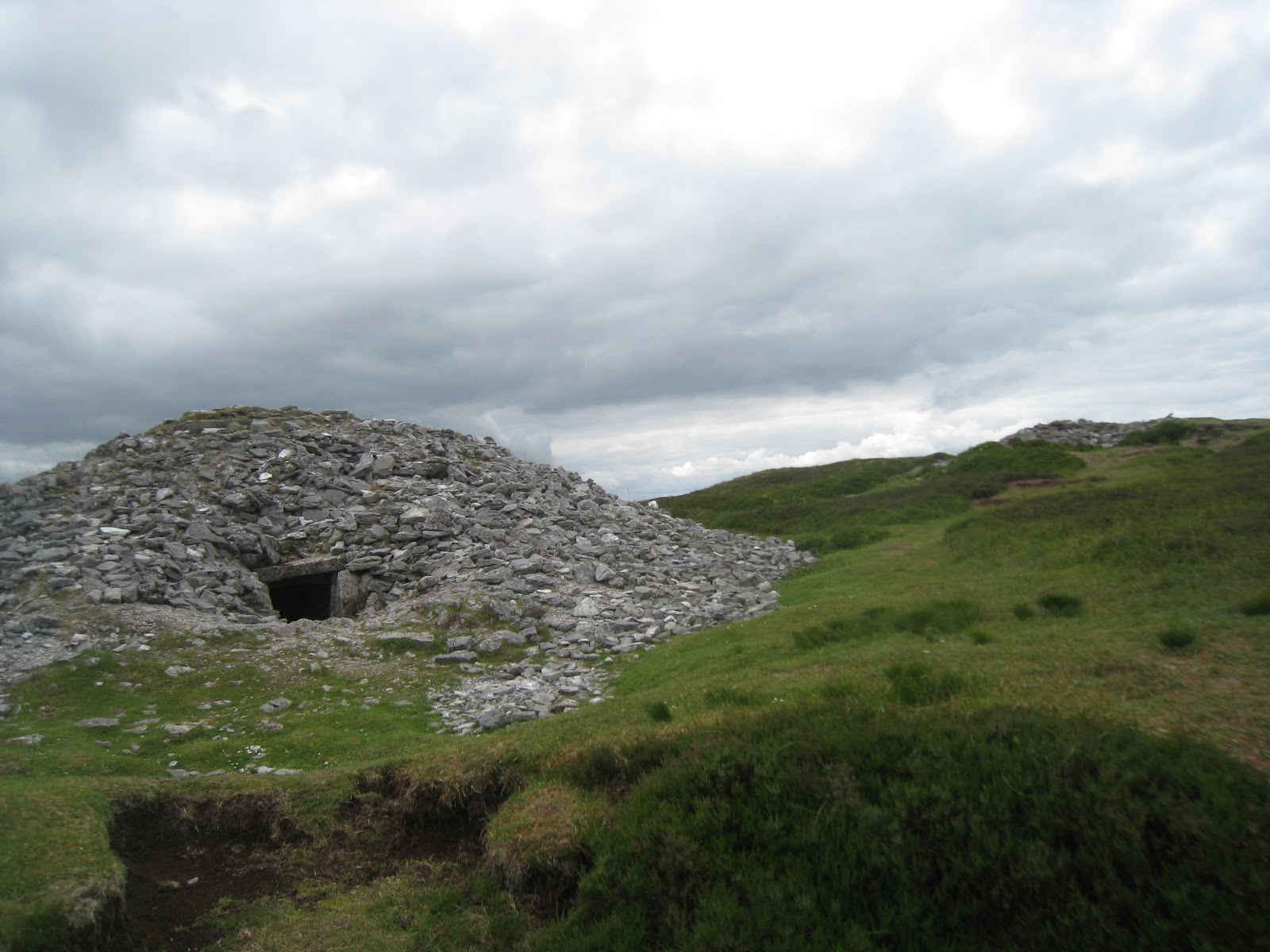
Tomb at Carrowkeel
This blog post is about some interesting archaeological and historical sites in the south of County Sligo in the Republic of Ireland. Ireland has many well-known historical sites such as Tara and Newgrange but sometimes the lesser-known sites are more rewarding to visit.

If one is driving north from the town of Boyle towards Sligo you will see the Bricklieve Mountains on your left. These are not particularly high or remarkable looking mountains and the unwary visitor could easily pass them by without a second thought, but on top of these mountains is the Carrowkeel megalithic tomb complex. 

There are thousands of prehistoric tombs and monuments in Ireland but there are only four complexes of these tombs, where the tombs are grouped together. The most famous complex is in the Boyne Valley, comprised of Newgrange, Knowth, Dowth and a host of other tombs. The Boyne Valley complex is elaborate and by far the largest complex in Ireland but it is not the most ancient as the other complexes, Carrowmore, Carrowkeel and Loughcrew are assumed to predate it. Based on radiocarbon dating, these Neolithic sites are generally given dates ranging from 3500 BC to 3000 BC with Carrowmore as the most ancient and the Boyne Valley as the most recent. It should be remembered that not all the tombs are dated and that these complexes were built over time and used for hundreds of years so there is doubtless considerable overlap.

Tomb G: Note the Roof Box above the entrance.
Despite being more recent than the more ancient site of Carrowmore in the north of Sligo, Carrowkeel bears the distinction of having what appears to be the oldest “roof box” in Ireland. Many of these tombs appear to have been oriented towards particular directions based on astronomical calculations but the roof box allowed the builders to harness this alignment for effect. The roof box was a small window above the main entrance, too small for anyone to enter through. However, if you are lucky enough to be allowed into Newgrange on the morning of the winter solstice (and if the unpredictable Irish weather co-operates) you will see the rays of the rising sun enter the passage and briefly, but brilliantly, illuminate the total darkness of the tomb. Click here for images. The astronomical alignment at Carrowkeel is different; with the roof box aligned to catch the setting sun of the summer solstice but the principle is the same. 

The tombs are signposted from the village of Castlebaldwin along the N4 and can be accessed on foot by paths and on a clear day the views are impressive, however the visitor should be aware that the Bricklieve Mountains have a number of cliffs and sheer drops and wanderings from the path should be done with caution. Tombs that appear deceptively close may in fact lie across a hidden valley. There are over sixteen tombs in the complex. They generally comprise of a single room, entered by a north-facing entrance and covered with a mound of locally quarried quartz. Some have been damaged by amateurish investigation so visitors should be aware not to compound the damage done. The tombs are labelled alphabetically. Tomb G is probably the best preserved and is the tomb that contains the first roof box.

Interior of Tomb G
From this tomb one can see Sligo spread out below, with Knocknarea to the north. Click here for a site containing panoramas from the site. The tombs of Carrowmore are located to the north but I was unable to see them from Carrowkeel. It was however possible to see the prominent cairn of “Queen Maeve’s Grave” on Knocknarea to the north so it is possible that the two Sligo complexes are aligned to each other. To the west can be seen Kesh, another low mountain with tombs atop it. The other side of Kesh, invisible from Carrowkeel, is riddled with caves, which may have had some ritual significance. To the east lies Lough Arrow and the plain, which according to mythology was the site of the Battle of Moytura.

Interior of St Mary's Priory
If you are touring the area it may be worth a trip to the other side of Lough Arrow, where one can find the ruins of St. Mary’s Priory, founded in 1547 AD under the patronage of the McDonagh clan. It was closed down by Henry VIII in his Dissolution of the Monasteries, but the friars continued to live in and around the site until around 1785. The priory is relatively well preserved compared to other similar structures.

Labby Rock
Nearby is the Labby Rock, a large dolmen, the capstone of which is estimated to weigh 65 tonnes. The name “Labby” is transliterated into English from the Irish word “Leaba” meaning “bed”. According to one legend, Diarmaid and Grainne used the capstone as a bed while on their legendary flight around Ireland being pursued by Fionn mac Cumhaill (“Cumhaill” is generally pronounced “cool”). An older legend, based upon the Book of Invasions says that the tomb was of the king of the Tuatha De Danann, Nuada of the Silver Arm. 

View from Carrowkeel over Lough Arrow and Moytura
The area to the west of Lough Arrow is the site of the legendary Second Battle of Moytura. In the legend the Tuatha De Danann were oppressed by a king, Bres. They overthrew Bres and replaced him with their previous king, Nuada. Nuada had previously lost the kingship after losing an arm in single combat and the Tuatha De Danann were not permitted to be ruled by someone with a physical defect. To remedy this Nuada was given an arm of silver to replace the one lost. Bres fled to his kinsfolk across the sea, the Fomorians, who gathered to invade Ireland. The Fomorians were led by their king, Balor of the Evil Eye, whose eye was said to be so huge that it required several warriors averting their gaze and using spears to open it and which caused death to anyone who saw it. Against this awful weapon the Tuatha De Danann had the warrior Lugh of the Spear.

The battle raged for days, with Balor wrecking havoc and Nuada dying on the field until Lugh came within range of Balor and hurled his spear just as the great eye was being opened. The spear slew Balor and knocked him backwards so that the Evil Eye faced backwards into the Fomorian hosts before burning a hole straight into the earth. Decimated by their own weapon, their king dead and attacked by the triumphant Lugh, the Fomorians fled back across the sea. The story is unusual and entertaining as Irish legend usually is. As a student of mythology, Tolkien was doubtless aware of the tale and I have always wondered if the Eye of Sauron had any basis in the person of Balor of the Evil Eye.
Tomb H at Carrowkeel heavily damaged by poor excavation

The Labby Rock is dated to around 2500 BC and so predates all the tales of Moytura but it is interesting that there are so many Stone Age remains in the Sligo area. According to archaeological consensus the first settlement of Ireland was in the south with settlers from northern Spain. While the settlement of Ireland happened long before the Neolithic era, any new technologies from Europe would be most likely to arrive in the south or east of the island, meaning that Sligo, up towards the northwest of the island is an unlikely place for the first concentration of ancient monuments. Why the Neolithic farmers chose this place to first dabble in monumental architecture is something we shall probably never know.

Wednesday, 9 November 2011

Home of the Minotaur?

Fresco in Palace of Knossos
I've spent the last few posts describing extremely ancient civilisations so I'll stick with the theme and describe the Minoans. The Minoans were the first major civilisation in what is now Europe. Their culture was based primarily on and around the island of Crete around the years 1900-1400 BC. Like the Indus Valley Civilisation, they left behind an undecipherable script, but unlike the Indus Valley their cities and palaces have been extensively excavated and we know a fair amount about them.

Their culture is named after a mythical Cretan king from Greek mythology called Minos. Minos is said to have had a large fleet and to have demanded human sacrifice from the mainland Greeks, who were sacrificed by being fed to a monster (the Minotaur, the progeny of Minos' wife and a bull) in a labyrinth underneath Minos' palace. This continued until a hero from ancient Athens slew the Minotaur. The classical Greek myth is unclear, but there may be the slightest elements of history lurking around in them. There may be the occasional reference to their culture in Egyptian texts and possibly the Old Testament, but apart from these snatches of myth and minimal reference we have only archaeology to go on.

Fresco from Akrotiri showing a Minoan port
Archaeology shows the Minoans to have been great palace builders. The main palace was at a site called Knossos but there were other palaces at sites such as Phaistos that were significant. These palaces were very large, haphazardly planned, decorated with magnificent frescoes and supplied with luxuries like flushing toilets. The palaces could contain up to a thousand rooms and palace is probably the wrong word to describe them. They were more like miniature cities (but palace is the usual archaeological description). The site at Knossos has been extensively restored and visitors can get a vague idea of what the original sites must have been like.

Minoan Fresco of Bull Leaping
Upon discovery of this remarkable civilisation people were originally struck by how peaceful these people seemed to be. Compared to other cultures of the time, the Minoans did not depict warfare in their art, their cities were unfortified and very few weapons were found. This initial reaction is being revisited and evidence of weaponry has been discovered. The lack of city walls isn't all that significant either. If the later Greek legend has any basis of fact in its description of Cretan sea power, the Minoans may simply have relied upon destroying enemies at sea and not bothered to fortify. As regards the lack of battle scenes in their art, most of the surviving artwork comes from ground floor walls of the palaces. The upper stories do not survive and so to draw a conclusion from a fraction of the material seems unwise.

'Throne Room' in Knossos
The Cretan religion is usually considered to be centred on goddess worship but the bull was very important in their artwork as well. Some of the most famous frescoes and statues show what appear to be ritual games where young athletes would compete to leap and vault over the backs of charging bulls. Perhaps it was their sport, perhaps it was an artistic motif, but it was significant. In other Near-Eastern cultures around that date the horns of a bull were a symbol of power. It even appears that the roofs of all the Cretan palaces were ringed with stylised horns of bulls.

Perhaps the Classical Greeks, who would have seen the collapsed, maze-like remnants of the Cretan palaces and seen the ever-present frescoes of bulls may have used this to come up with the legend of the Minotaur: Or possibly not. The legends of human sacrifice may have had some bearing in reality as well, as some skeletons have been found that bear the signs of possible sacrifice.

If the Minoans (an island civilisation) had control of the sea why did their civilisation disappear? We move from one legend to another.

The bay in the middle of the island is actually a crater
The tale of Atlantis (told by Plato in the early 300's BC) is of an ancient highly developed city whose inhabitants were the favoured people of the sea god. Their city flourished until they behaved wickedly and brought the anger of the gods upon them. The gods allowed them to be defeated by the Athenians and the sea god, after the defeat allowed their island city to sink into the sea.

An island not far north of Crete, called Thera, was one of the most active volcanoes in the Mediterranean. Some time around 1600 BC the inhabitants must have realised something terrible was going to happen because they abandoned the city built on the edge of the island and presumably took to the sea. The volcanic eruption that followed was one of the largest in human history, launching huge amounts of ash into the atmosphere, darkening the sky. Major tsunamis followed that seem to have done serious damage to the Minoan coastal settlements and, if their fleet was at anchor on the north of the island, could have destroyed their fleet and merchant shipping. If any visitors from later times went to see the once powerful city on Thera, they would have seen the island as it now is (see picture). If there is a historical basis for the legend of Atlantis, this is probably it.

Mycenaean Weapons: The Mycenaeans were not peaceful
It seems that the Minoan civilisation survived the catastrophe of the Theran eruption but their civilisation was presumably weakened by the loss of their coastal settlements and fleet. The atmospheric ash after the eruption would have damaged their agriculture for years to come so with reduced farmland and reduced fishing abilities their culture must have tried to weather the continuing crisis. Their culture survives for less than a hundred years after the eruption before there is a change in the archaeological data. The palaces remain but now the artefacts are the same as artefacts from mainland Greece. It is probable that the Minoan civilisation had been conquered by the rising Bronze Age Greeks, better known as the Mycenaean culture. Perhaps the Atlantean reference to conquering Athenians and the Greek legend of Theseus' slaying of the Minotaur are a very confused memory of the mainland Greeks overthrowing their weakened neighbours and overlords. Bear in mind however, that this theory depends upon the dating of the eruption of Thera, which is still debated by scholars.

Linear A writing of the Minoan Culture
It is frustrating that we cannot read the Minoan writing (known as Linear A). If they could speak to us directly we could know them better. But through the selective reading of myth and through the much more reliable method of archaeology we can get perhaps a glimpse of who the people who comprised this first European civilisation were.