Sunday, 13 November 2011

Southern Sligo


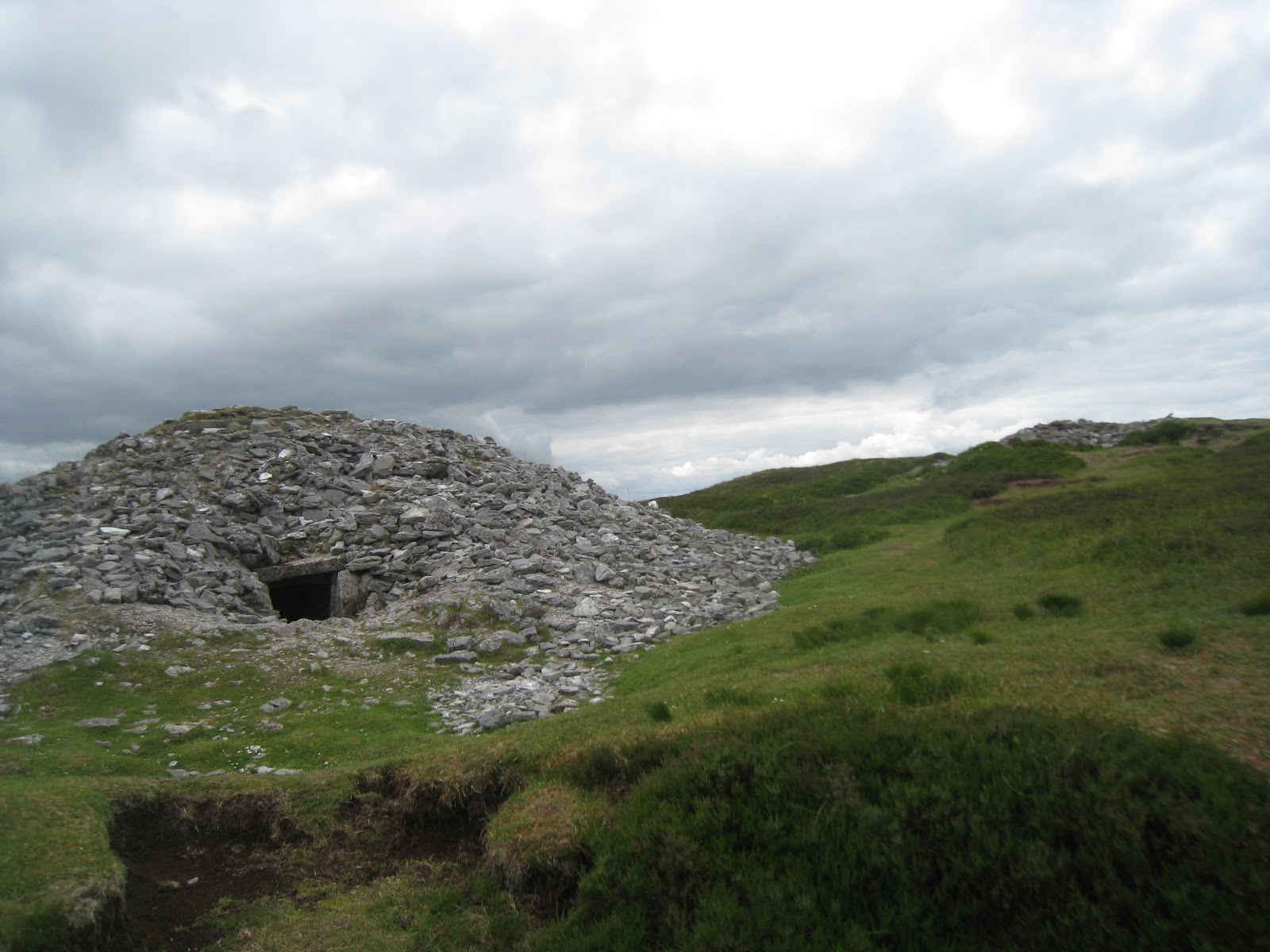
Tomb at Carrowkeel
This blog post is about some interesting archaeological and historical sites in the south of County Sligo in the Republic of Ireland. Ireland has many well-known historical sites such as Tara and Newgrange but sometimes the lesser-known sites are more rewarding to visit.

If one is driving north from the town of Boyle towards Sligo you will see the Bricklieve Mountains on your left. These are not particularly high or remarkable looking mountains and the unwary visitor could easily pass them by without a second thought, but on top of these mountains is the Carrowkeel megalithic tomb complex. 

There are thousands of prehistoric tombs and monuments in Ireland but there are only four complexes of these tombs, where the tombs are grouped together. The most famous complex is in the Boyne Valley, comprised of Newgrange, Knowth, Dowth and a host of other tombs. The Boyne Valley complex is elaborate and by far the largest complex in Ireland but it is not the most ancient as the other complexes, Carrowmore, Carrowkeel and Loughcrew are assumed to predate it. Based on radiocarbon dating, these Neolithic sites are generally given dates ranging from 3500 BC to 3000 BC with Carrowmore as the most ancient and the Boyne Valley as the most recent. It should be remembered that not all the tombs are dated and that these complexes were built over time and used for hundreds of years so there is doubtless considerable overlap.

Tomb G: Note the Roof Box above the entrance.
Despite being more recent than the more ancient site of Carrowmore in the north of Sligo, Carrowkeel bears the distinction of having what appears to be the oldest “roof box” in Ireland. Many of these tombs appear to have been oriented towards particular directions based on astronomical calculations but the roof box allowed the builders to harness this alignment for effect. The roof box was a small window above the main entrance, too small for anyone to enter through. However, if you are lucky enough to be allowed into Newgrange on the morning of the winter solstice (and if the unpredictable Irish weather co-operates) you will see the rays of the rising sun enter the passage and briefly, but brilliantly, illuminate the total darkness of the tomb. Click here for images. The astronomical alignment at Carrowkeel is different; with the roof box aligned to catch the setting sun of the summer solstice but the principle is the same. 

The tombs are signposted from the village of Castlebaldwin along the N4 and can be accessed on foot by paths and on a clear day the views are impressive, however the visitor should be aware that the Bricklieve Mountains have a number of cliffs and sheer drops and wanderings from the path should be done with caution. Tombs that appear deceptively close may in fact lie across a hidden valley. There are over sixteen tombs in the complex. They generally comprise of a single room, entered by a north-facing entrance and covered with a mound of locally quarried quartz. Some have been damaged by amateurish investigation so visitors should be aware not to compound the damage done. The tombs are labelled alphabetically. Tomb G is probably the best preserved and is the tomb that contains the first roof box.

Interior of Tomb G
From this tomb one can see Sligo spread out below, with Knocknarea to the north. Click here for a site containing panoramas from the site. The tombs of Carrowmore are located to the north but I was unable to see them from Carrowkeel. It was however possible to see the prominent cairn of “Queen Maeve’s Grave” on Knocknarea to the north so it is possible that the two Sligo complexes are aligned to each other. To the west can be seen Kesh, another low mountain with tombs atop it. The other side of Kesh, invisible from Carrowkeel, is riddled with caves, which may have had some ritual significance. To the east lies Lough Arrow and the plain, which according to mythology was the site of the Battle of Moytura.

Interior of St Mary's Priory
If you are touring the area it may be worth a trip to the other side of Lough Arrow, where one can find the ruins of St. Mary’s Priory, founded in 1547 AD under the patronage of the McDonagh clan. It was closed down by Henry VIII in his Dissolution of the Monasteries, but the friars continued to live in and around the site until around 1785. The priory is relatively well preserved compared to other similar structures.

Labby Rock
Nearby is the Labby Rock, a large dolmen, the capstone of which is estimated to weigh 65 tonnes. The name “Labby” is transliterated into English from the Irish word “Leaba” meaning “bed”. According to one legend, Diarmaid and Grainne used the capstone as a bed while on their legendary flight around Ireland being pursued by Fionn mac Cumhaill (“Cumhaill” is generally pronounced “cool”). An older legend, based upon the Book of Invasions says that the tomb was of the king of the Tuatha De Danann, Nuada of the Silver Arm. 

View from Carrowkeel over Lough Arrow and Moytura
The area to the west of Lough Arrow is the site of the legendary Second Battle of Moytura. In the legend the Tuatha De Danann were oppressed by a king, Bres. They overthrew Bres and replaced him with their previous king, Nuada. Nuada had previously lost the kingship after losing an arm in single combat and the Tuatha De Danann were not permitted to be ruled by someone with a physical defect. To remedy this Nuada was given an arm of silver to replace the one lost. Bres fled to his kinsfolk across the sea, the Fomorians, who gathered to invade Ireland. The Fomorians were led by their king, Balor of the Evil Eye, whose eye was said to be so huge that it required several warriors averting their gaze and using spears to open it and which caused death to anyone who saw it. Against this awful weapon the Tuatha De Danann had the warrior Lugh of the Spear.

The battle raged for days, with Balor wrecking havoc and Nuada dying on the field until Lugh came within range of Balor and hurled his spear just as the great eye was being opened. The spear slew Balor and knocked him backwards so that the Evil Eye faced backwards into the Fomorian hosts before burning a hole straight into the earth. Decimated by their own weapon, their king dead and attacked by the triumphant Lugh, the Fomorians fled back across the sea. The story is unusual and entertaining as Irish legend usually is. As a student of mythology, Tolkien was doubtless aware of the tale and I have always wondered if the Eye of Sauron had any basis in the person of Balor of the Evil Eye.
Tomb H at Carrowkeel heavily damaged by poor excavation

The Labby Rock is dated to around 2500 BC and so predates all the tales of Moytura but it is interesting that there are so many Stone Age remains in the Sligo area. According to archaeological consensus the first settlement of Ireland was in the south with settlers from northern Spain. While the settlement of Ireland happened long before the Neolithic era, any new technologies from Europe would be most likely to arrive in the south or east of the island, meaning that Sligo, up towards the northwest of the island is an unlikely place for the first concentration of ancient monuments. Why the Neolithic farmers chose this place to first dabble in monumental architecture is something we shall probably never know.

Wednesday, 9 November 2011

Home of the Minotaur?

Fresco in Palace of Knossos
I've spent the last few posts describing extremely ancient civilisations so I'll stick with the theme and describe the Minoans. The Minoans were the first major civilisation in what is now Europe. Their culture was based primarily on and around the island of Crete around the years 1900-1400 BC. Like the Indus Valley Civilisation, they left behind an undecipherable script, but unlike the Indus Valley their cities and palaces have been extensively excavated and we know a fair amount about them.

Their culture is named after a mythical Cretan king from Greek mythology called Minos. Minos is said to have had a large fleet and to have demanded human sacrifice from the mainland Greeks, who were sacrificed by being fed to a monster (the Minotaur, the progeny of Minos' wife and a bull) in a labyrinth underneath Minos' palace. This continued until a hero from ancient Athens slew the Minotaur. The classical Greek myth is unclear, but there may be the slightest elements of history lurking around in them. There may be the occasional reference to their culture in Egyptian texts and possibly the Old Testament, but apart from these snatches of myth and minimal reference we have only archaeology to go on.

Fresco from Akrotiri showing a Minoan port
Archaeology shows the Minoans to have been great palace builders. The main palace was at a site called Knossos but there were other palaces at sites such as Phaistos that were significant. These palaces were very large, haphazardly planned, decorated with magnificent frescoes and supplied with luxuries like flushing toilets. The palaces could contain up to a thousand rooms and palace is probably the wrong word to describe them. They were more like miniature cities (but palace is the usual archaeological description). The site at Knossos has been extensively restored and visitors can get a vague idea of what the original sites must have been like.

Minoan Fresco of Bull Leaping
Upon discovery of this remarkable civilisation people were originally struck by how peaceful these people seemed to be. Compared to other cultures of the time, the Minoans did not depict warfare in their art, their cities were unfortified and very few weapons were found. This initial reaction is being revisited and evidence of weaponry has been discovered. The lack of city walls isn't all that significant either. If the later Greek legend has any basis of fact in its description of Cretan sea power, the Minoans may simply have relied upon destroying enemies at sea and not bothered to fortify. As regards the lack of battle scenes in their art, most of the surviving artwork comes from ground floor walls of the palaces. The upper stories do not survive and so to draw a conclusion from a fraction of the material seems unwise.

'Throne Room' in Knossos
The Cretan religion is usually considered to be centred on goddess worship but the bull was very important in their artwork as well. Some of the most famous frescoes and statues show what appear to be ritual games where young athletes would compete to leap and vault over the backs of charging bulls. Perhaps it was their sport, perhaps it was an artistic motif, but it was significant. In other Near-Eastern cultures around that date the horns of a bull were a symbol of power. It even appears that the roofs of all the Cretan palaces were ringed with stylised horns of bulls.

Perhaps the Classical Greeks, who would have seen the collapsed, maze-like remnants of the Cretan palaces and seen the ever-present frescoes of bulls may have used this to come up with the legend of the Minotaur: Or possibly not. The legends of human sacrifice may have had some bearing in reality as well, as some skeletons have been found that bear the signs of possible sacrifice.

If the Minoans (an island civilisation) had control of the sea why did their civilisation disappear? We move from one legend to another.

The bay in the middle of the island is actually a crater
The tale of Atlantis (told by Plato in the early 300's BC) is of an ancient highly developed city whose inhabitants were the favoured people of the sea god. Their city flourished until they behaved wickedly and brought the anger of the gods upon them. The gods allowed them to be defeated by the Athenians and the sea god, after the defeat allowed their island city to sink into the sea.

An island not far north of Crete, called Thera, was one of the most active volcanoes in the Mediterranean. Some time around 1600 BC the inhabitants must have realised something terrible was going to happen because they abandoned the city built on the edge of the island and presumably took to the sea. The volcanic eruption that followed was one of the largest in human history, launching huge amounts of ash into the atmosphere, darkening the sky. Major tsunamis followed that seem to have done serious damage to the Minoan coastal settlements and, if their fleet was at anchor on the north of the island, could have destroyed their fleet and merchant shipping. If any visitors from later times went to see the once powerful city on Thera, they would have seen the island as it now is (see picture). If there is a historical basis for the legend of Atlantis, this is probably it.

Mycenaean Weapons: The Mycenaeans were not peaceful
It seems that the Minoan civilisation survived the catastrophe of the Theran eruption but their civilisation was presumably weakened by the loss of their coastal settlements and fleet. The atmospheric ash after the eruption would have damaged their agriculture for years to come so with reduced farmland and reduced fishing abilities their culture must have tried to weather the continuing crisis. Their culture survives for less than a hundred years after the eruption before there is a change in the archaeological data. The palaces remain but now the artefacts are the same as artefacts from mainland Greece. It is probable that the Minoan civilisation had been conquered by the rising Bronze Age Greeks, better known as the Mycenaean culture. Perhaps the Atlantean reference to conquering Athenians and the Greek legend of Theseus' slaying of the Minotaur are a very confused memory of the mainland Greeks overthrowing their weakened neighbours and overlords. Bear in mind however, that this theory depends upon the dating of the eruption of Thera, which is still debated by scholars.

Linear A writing of the Minoan Culture
It is frustrating that we cannot read the Minoan writing (known as Linear A). If they could speak to us directly we could know them better. But through the selective reading of myth and through the much more reliable method of archaeology we can get perhaps a glimpse of who the people who comprised this first European civilisation were. 

Monday, 7 November 2011

Indus Valley Civilisation

Map of the Indus Valley Civilisation
Indian history was a bit of an enigma to archaeologists for many years and, to a great extent, it remains so. Alexander’s invasion of north-west India in 326 BC was an early fixed date, but it was evident that Alexander had entered a land that already had an ancient culture. Scholars were aware that there were ancient religious texts called the Vedas, the oldest of which was dated to the centuries in or around 1200 BC, but these were religious texts that dealt only obliquely with historical events. The Vedas did not necessarily shed much light on what was happening in India when these texts were composed. Scholars worked on the assumption that India was a relatively late civilisation, one that was predated by Sumer and Egypt by thousands of years. Around the turn of the last century there were striking discoveries along the Indus River that proved this assumption completely wrong.

A site called Harappa, in what is present day Pakistan was excavated, showing the remains of a city. The locals believed it to be the city of a medieval king but once dated, it was discovered to be around five thousand years old. Other discoveries were made in the region and soon it became apparent that there had been an advanced civilisation in the area. There were a series of cities all along the river all built along a vaguely similar pattern.

Mohenjo-Daro: Note Possible public bath in foreground
The cities showed some signs of urban planning. Drainage was attended to and streets were laid out in an orderly fashion. There were walls but it was unclear if these were for defence or for flood control (or both), as nearly all the cities were built very near rivers. There were raised areas in the cities that were identified as citadels but it is impossible to properly describe their function. Early investigations noted the absence of monumental architecture. There were no gigantic pyramids or ziggurats to mark these cities, their skyline was comparatively quite boring. But if you were an inhabitant of one of these cities, such as Mohenjo-Daro, you might have been consoled about the lack of public temples by the fact that the cities appear to have public baths. Public baths might seem unhygienic to us now but they were light years in advance of bathing facilities available to the ancient Egyptians or Mesopotamians.

Statue from Mohenjo-Daro
They weren’t quite as egalitarian as once thought. All of the houses had access to public drainage but, well, some got neat cisterns and covered drains, others had open sewers. But they do not appear to have had kings in our sense of the word. No single dwelling in the cities was vastly larger than the others. Archaeologists speculate that the cities may have been controlled by trading elites.

They certainly were interested in trade. Once the artefacts of the Indus Valley Civilisation were recognised for what they were, they began turning up in archaeological digs in what is now Iraq. Clearly there were trade links between the two cultures but the Sumerians do not seem to have sold any of their artefacts in return. This is odd because the Sumerians lacked real commodities to trade. The strength of their civilisation lay in their ability to use irrigation to produce multiple harvests. This leads to the fascinating possibility that perhaps the Indus Valley traded luxury goods for grain, building ships to transport grain over thousands of miles of open sea to feed their population five thousand years ago. While the Indus Valley did not have irrigation complexes on the scale of Mesopotamia or Egypt they nevertheless were a major agricultural society so this idea is of course, highly speculative (and given the nature of boats in those times, rather unlikely). There are remains of what could be ports but their uses are debated.

Cylinder seals from Indus: Note the writing above the pictures
We have some of their artwork but it is impossible to understand much of their culture or history because their writing is currently undecipherable. Like many ancient cultures they signed their documents using cylinder seals that would be rolled in wet clay to leave a distinctive mark on a trade document. Most of the writing recovered from the Indus Valley has been on these seals and these terse statements in an unknown tongue and isolated script, have sadly proved undecipherable so the enigmatic builders of the cities must remain silent for now.

This unassuming, well organised civilisation existed for hundreds of years before going into decline around 1700 BC. Possibly the causes were invasion, cultural changes or climate change but the cities were gradually abandoned. To this day only a few of the many known sites have been excavated and less is known of this culture than of any major civilisation that existed around that period.

Indra: Accused?
Partly this is because of the difficulties in understanding their writing but mainly this is because of politics. Different political ideologies have, over the years, really messed up any attempt to properly understand things. Firstly the British archaeologists (remember at the time the cities were discovered all of the Indian subcontinent was under British rule) assumed that the cities had been built by Dravidians (peoples who spoke a type of language most commonly spoken in southern India) and that the ancestors of the current inhabitants of northern India had arrived as nomads from Iran and Afghanistan, worshipping Iranian gods and destroying the civilisation that stood in their path. When a prominent British archaeologist was asked what had destroyed these cities he famously stated, "Indra (an early Hindu god who may have been known as the destroyer of cities) stands accused." This belief in nomadic invaders from the north is known as the Aryan Invasion Theory.

Quite frankly there is very little evidence for any violent invasion. There is a strong suspicion that, by portraying Hindu culture as basically a foreign imposition, the British were trying to justify their own foreign rule. Be that as it may, some Hindu fundamentalists see the cities of the Indus River as being part of an ancient Hindu culture. They explain cultural and linguistic similarities between their culture and Iran by saying that the culture spread from India to Iran rather than vice versa. There is a much stronger version of the theory that states that all civilisation and the Indo-European language family originally came from the Indus Valley. This is known as the Out of India theory and there is almost no evidence to support the strong version of it.

Bullock Cart Statue from the Indus Valley
To compound the religious and cultural issues involved in "claiming" the Indus Valley, some people from the south of India believe (following elements of the Aryan Invasion Theory) that the language (and by extension the people and culture) of the Indus was Dravidian rather than Indo-European. Due to the unfortunate tension that exists between India and Pakistan and the fact that some Indian political parties claim the Indus Valley as the birthplace of distinctively Hindu civilisation, there have been issues in conducting large scale excavations.

So, do check out the Indus Valley Civilisation online but be aware that we know very little about it. Also be aware that, sadly, there are people who have very definite agendas, or political and religious points to make so be wary in your research.This is one area where political interest in history has unfortunately obscured the search for truth.

Related Blog Posts:
India from 1800-500BC: Part One
India from 1800-500BC: Part Two

Sunday, 6 November 2011

Maps

A picture is worth a thousand words, but a good map is surely worth much more than that. To understand the broad ebbs and flows of world history I find that it is very useful to be able to look at a map that shows what state controlled what territory at any given time. I have included some links to sites showing historical maps of the world. Both of them have issues (neither of them are particularly fast when it comes to loading times) and they are ultimately works of interpretation so, with a different interpretation of the source material the boundaries would often be slightly different. But insofar as I can tell, they are generally quite accurate.

The first link is to an interactive site. This site excludes the Western Hemisphere and focuses on Eurasia. It comes with a description of world history at the time, which is useful for understanding why the maps change as they do. Unfortunately the site is not properly maintained and there are occasional technical issues with maps not displaying properly. The link to the site is here.

The second site is more universal in scope but does not contain associated text to explain what is going on. Nevertheless, it should give you an excellent idea of what the world looked like at a particular date. The link to the site is here. (Update: As of late 2019 this site no longer appears to be maintained. But I have relinked it to the Internet Archive's version of the page, which may allow users to still reach this).

These sites are brilliant for inquisitive minds. If you have a broad knowledge of history and a fair idea of what is going on you will not be too surprised at the general picture but quite often the maps will show kingdoms on the peripheries, small states that are often passed over when history is told. Once one is aware of the existence of these forgotten empires you can start to research them and discover their stories. Enjoy. 

Friday, 4 November 2011

Hearing History

Victory Stele of Naram-Sin, king of the Akkad
It is fascinating to read about history, but it can sometimes be difficult to really visualise it. Texts read on a screen or on the pages of a book can sometimes seem dead and lifeless as our imaginations fail to really capture the spirit of times past. Sometimes we require aids to spur the imagination.

Last year I discovered a site where academics attempted to recreate how ancient languages sounded. This site deals with the Akkadian language. Akkadian is a Semitic language, related to Hebrew and Arabic but thousands of years older than either and spoken mainly in what is now Iraq. It first makes an appearance around the early centuries of the second millennium BC and became the official language of the Akkadian Empire (the first empire the world has ever seen). Our best copies of the Epic of Gilgamesh, which is the world’s oldest epic and still a fantastic tale despite the passing of centuries, are written in Akkadian.

In the Bronze Age, when the kings and emperors of the Near East would communicate with each other they would use this language. It was at different times the language of commerce, of science, of sacred texts and of diplomacy. It was spoken as a proper language for millennia but, like Latin in the European Middle Ages, eventually became a dead language, preserved merely among the intellectuals. After Alexander’s conquests the old temples and centres of learning were gradually abandoned and the language died out around two thousand years ago. The tablets upon which it was written were lost and buried in Iraq to be discovered and deciphered in the late nineteenth century AD.

Ancient Akkadian clay tablet from the Epic of Gilgamesh
Working backwards from Semitic languages spoken today and using all the texts available to us, scholars have recorded themselves speaking in this language. I am not a linguist but I can only imagine the amount of work (and/or guesswork) that went into this project. It is one thing to translate a text but quite a different thing to try and understand how it was pronounced. I will leave you with a link to the site, which can be found here. I found it slightly eerie but intriguing to listen to our civilisations attempts to vocalise the works of the world’s first great literate civilisation. Enjoy. 

Thursday, 3 November 2011

Ancient Egyptian History

Cleopatra (left)
When people think of ancient civilisations one of the first that springs to mind is the Egyptian civilisation. It left behind some of the worlds' most impressive monuments and has very distinctive culture and art. Television history channels love to show documentaries about periods of Egyptian history and most of us have a vague knowledge of the names of some of the pharaohs. However, ancient Egyptian culture lasts for over three thousand years and it can be very easy to think of the entire civilisation as one static unity. This was not the case and in this blog I shall try and give some rough outlines on Egyptian history that will hopefully allow you to make more sense of it overall and enable you to find your place the next time you see a documentary on the Egyptians on TV.

Firstly, Egyptian artwork is a bad thing to go on. I have shown pictures of the first Pharaoh (Narmer) and the last one (Cleopatra VII). As you can see, the artwork, while not identical, is very similar indeed, despite the fact that the two monarchs are separated by nearly three thousand years.

Narmer
Roughly around 3000 BC Egypt was comprised of two kingdoms. The first king to unite the two kingdoms and form Egypt, as we know it was a king known as Narmer. Egyptian history was relatively uneventful for the next few hundred years. The period between 2700 BC and 2200 BC is known as the Old Kingdom. The Old Kingdom is most notable for the way it buried it's kings. They invented and perfected the art of pyramid building and the great pyramids at Giza and elsewhere were built almost entirely during the Old Kingdom. It's unclear why they stopped building them thereafter, but if you see a documentary dealing with pyramid building in Egypt you can be almost sure that it is dealing with the Old Kingdom.

Old Kingdom pyramids at Giza
In the period 2200-2000 BC it seems that social order broke down. Kings still reigned but they had little power and there are few great buildings or writings from this time. This is referred to as the First Intermediate Period, a sort of Dark Ages. Of course, this is based on our source material. If more source material comes to light it may emerge that conditions were not as bad as was said.

From around 2000-1600 BC the Middle Kingdom reigned. The Middle Kingdom was a period of order but they were not great builders like the rulers of the Old Kingdom and their kings have not been known in popular culture. Their greatest contribution to world heritage is the creation of a book known as the Tale of Sinuhe, which is probably the finest work of ancient Egyptian literature, despite being difficult to read because of cultural differences.

An Egyptian Scribe
In the 1600's BC the Middle Kingdom broke down and invaders from Syria migrated to Egypt and ruled the land for around one hundred years. These invaders were known as the Hyksos and the technology they brought allowed them to conquer Egypt. The most significant technological advantage they brought to Egypt was the chariot. If you see an Egyptian temple with a picture of a chariot you can be almost sure that it is not older than the time of the Hyksos. Many commentators have tied the tale of the Hyksos to the narratives in Genesis about the tale of Joseph but the connection is as yet unproven. This period is also referred to as the Second Intermediate Period.

The Hyksos never fully conquered the land and a king from the southern city of Thebes was able to eventually throw out the invaders. The newly unified Egypt was now strengthened by the technology the Hyksos had brought and the next three hundred years saw Egypt reach the height of its power and influence. Notable pharaohs were Hatshepsut (the brilliant woman pharaoh), Tuthmosis III (the conqueror), Rameses II (the greatest temple builder of the pharaohs), Akhenaten (the heretic), Tutankhamun (whose tomb later became famous) and Rameses III who saved Egypt from invasion.

A Picture of an Egyptian Chariot
Egypt created a large empire stretching down into what is now Sudan and comprising what is now Israel, Palestine, Lebanon and parts of Syria. Many of the famous monuments in Luxor and Karnak were built at this time, as the New Kingdom pharaohs embellished their southern capital. They did not however bury their pharaohs in pyramids. Instead, to prevent robbery they made tombs in the western desert, in what is now known as the Valley of the Kings.

The one great exception to Egyptian art occurred at this time, when the heretic Pharaoh Akhenaten moved the capital and changed the royal artwork. Instead of the idealised identical faces and bodies of traditional art, Akhenaten chose to have himself portrayed with a drawn face and distended stomach. The brief time of Akhenaten's reign (1353-1336 BC: worth a post in its own right) is referred to as the Amarna Period because he moved his capital to what is now Amarna so if you come across this you know when it is from.

Valley of the Kings
Around 1200 BC the great Bronze Age civilisations began to break down all across the Near East. The last notable Pharaoh of the New Kingdom, Rameses III spent most of his reign fighting constant invasions of migrating peoples. In the 1100's BC the New Kingdom broke down.

From this point onwards Egypt goes into decline. At various points the kingdom was ruled by pharaohs from what is present day Libya and Sudan. These kings were often very successful but Egypt was no longer able to control the newly independent kingdoms in Syria and the Levant or compete with the rising empires of Assyria or Babylon. This is known as the Third Intermediate Period.

Akhenaten
Around 671 BC the fearsome Assyrian Empire conquered Egypt but could not hold it for long. The Egyptians left in charge of the province became independent almost immediately and ruled successfully until 525 BC when the Persian Empire conquered Egypt. This period of independence is referred to as the Late Period.

Persian rule was deeply unpopular and Egyptian princes revolted against the Persians with the aid of Greek mercenaries and the city of Athens. Some of the rebellions were successful, but eventually the Persians regained control. Alexander the Great passed through Egypt in 332 BC while conquering the Persian Empire and added it to his own empire.

After Alexander's death his Macedonian generals seized portions of the empire and Egypt was taken by an enterprising general called Ptolemy. His descendants ruled Egypt for the next 300 years and are referred to as the Ptolemaic Dynasty (partly because all of their kings were unimaginatively named Ptolemy). They portrayed themselves as Egyptian pharaohs to the Egyptians, building traditional temples and writing in hieroglyphics. But they also facilitated Greek culture and built the famed Library of Alexandria and the Lighthouse of Alexandria, one of the ancient Wonders of the World. The dynasty went into decline and survived by playing a dangerous diplomatic game with the Roman Republic. The last Ptolemaic ruler, Cleopatra VII (the only Ptolemaic Pharaoh who bothered to learn Egyptian) was defeated along with her Roman allies by Caesar Augustus at the Battle of Actium (31 BC). Antony (the Roman general) and Cleopatra committed suicide shortly afterwards and Egypt was absorbed as a province in the Roman Empire.

A much later picture of the Battle of Actium
This has been a very long blog post but it has been a summary of over three thousand years of history so it is difficult to keep it short. I hope that this is of some help to people in understanding the broad trends of Egyptian history.
Tuesday, 1 November 2011

The Gardener Who Became King

Map of Mesopotamia around 1800 BC
In the year 1861 BC, in the small city of Isin, in what is now southern Iraq, the astronomers and priests were worried. They lived in an independent city, which was ruled by a king upon whom the government relied. The educated classes were priests and scribes who built great towering temples from which they could study the stars and use their starry measurements to try to predict the future. There was one particular celestial event that worried them. We don’t know exactly what it was, but they believed that this heavenly sign meant that the king would die.

If the king died, the priests feared chaos would break out on earth. There must always be a king. Kingship descended from heaven and must be preserved at all costs. So, the contingency plan was set in motion. In the past the priests had attempted to alter destiny to preserve their kings. They would ritually strip the king of his kingship, send him into hiding, crown a new king chosen from the commoners, wait until the heavenly sign had passed and then kill the substitute king. This would fulfill the prophecy but keep the real king, who was subsequently re-crowned, alive.

A Mesopotamian King
The priests searched for a suitable commoner and finally settled on a gardener by the name of Enlil-Bani. The astronomical conjunction did not happen frequently so it is unknown if he would have been aware of his fate, but even if he did not know the specifics, he surely must have been aware that something very unusual was going on when he was plucked from obscurity and inducted into the kingship. But he was powerless to resist.

The days passed and Enlil-Bani’s fate approached, until a very prosaic event provided an extraordinary rescue. The king (a man known to us as Erra-Imitti, who was then in hiding) apparently and improbably choked to death while eating (according to the tale it was a bowl of porridge, which would be quite difficult to choke on). The ruling classes were in a quandary but the gardener seized the moment and refused to step down from the kingship. He had been crowned and he presumably argued that the events had been ordained by the gods. The prophecy had been fulfilled and the king was dead. Long live the king.

Cuneiform writing used for records
The old dynasty passed away and Enlil-Bani founded a new dynasty, restored the temples of Isin and was generally remembered as a good king in the chronicles of clay kept by the scribes and priests. I have always loved the story, as it was a moment where a member of the downtrodden who was doomed to death instead became the head of state who ruled justly over those who would have killed him.

Now that I am older and more cynical I sometimes view the tale differently. The city of Isin was in trouble at the time. Neighbouring cities had been threatening their water supply and the old dynasty had been unable to preserve Isin’s power. The old dynasty itself was failing. The previous kings had had very short reigns and Erra-Imitti himself may not have been from the direct regal line. Perhaps the priests used the opportunity presented to them to murder the previous king. Perhaps Enlil-Bani realised the situation and persuaded them to murder Erra-Imitti instead of himself. Possibly, in what must surely count as one of the most audacious coups in history he had been in contact with the astronomers and planned it all from the beginning!

There is also the possibility that the entire tale is much later. An Assyrian king from the 7th century BC named Esarhaddon, had a tendency to use this ritual quite frequently and it is possible that the story of Enlil-bani and the death of the original king was a way of protesting the practices of Esarhaddon. I am quite sceptical of this interpretation, but I have heard it mentioned.

A Ziggurat: A temple that was also used for astronomy
We will never know the true story. It is a three thousand, eight hundred year old (possibly murder) mystery. Take whichever version of events you feel is most plausible but remember that, unless we discover more detailed records in the ancient sites of Iraq, that the other versions are equally valid.