Tuesday, 4 December 2018

600-575BC in Greece

Vase by the Pholoe Painter, active around 580BC
This post will look at Greece and the wider Greek world from the years 600BC to 575BC. Firstly a word as to our sources. By and large, the closer we move to the present, the better the sources become. Archaeology will shed some light on the period, but not much. Archaeology can give information on settlement patterns and occasional destruction levels, but it cannot tell the stories of the people who lived at this time. For this we are reliant on later writings from the classical world. Unlike the Mesopotamian and Egyptian sources, at least some of which are near contemporary with the events they describe, we have almost no manuscripts from this era, so most of what we hear will be mediated through the words of later writers. This is not necessarily an issue but it should be remembered.

Chalice from Chios
I will also be dealing with elements of Roman history as these arise. I will shortly give Rome its own posts, but for now there is too little that can be said with certainty about it, so I will mention it along with the events of the Greek world. Roman history will probably also be mentioned in the context of European history in later blogs as well.

I must reiterate that I am not a professional historian, or any other type of historian for that matter. There are certainly mistakes and errors in the sources and I may make mistakes in my interpretations of these sources. Mistakes are particularly likely to occur when dealing with years, as the years in the ancient world do not necessarily correspond exactly to our own. Even professional historians have differing opinions on the exact ordering of events at this time, so exact precision is not likely here. Also, a lot of events have only approximate dating anyway, so some historians will place an event in 590 while another might say 580 and the truth is that no one knows for sure, although some opinions are more founded than others.

Modern statue of Cleobulus at Lindos
Also, a lot of writers and poets of the time are active for various periods of time. Thus I might mention Cleobulus as being active in the year 601-600 but he was doubtless also active and writing poetry in the years around this time as well.

I will now recap the events that happened in or around the years 601-600BC. The poets Arion and Cleobulus supposedly flourished in or around this time, although I am not entirely convinced that Arion even existed.

Cleobulus was a citizen of the city of Lindus in Rhodes and may well have been the tyrant of that city. But this is not certain by any means. He was a poet and a traveller, who may have travelled to Egypt and spent time among the wise men of the Egyptians (this is probably a later myth). He educated his daughter Cleobulina well and she would go on to become a renowned writer herself. Not much is known of Cleobulus save that he wrote epitaphs and riddles. But despite the fact that later sources do not speak much of him, we do know that he was accounted among the Seven Sages of Greece. He flourished around the latter end of the 7th century BC so it is sufficient to make mention of him here.

Periander of Corinth:
Later Roman era bust in
Vatican Museum
The father is one, the sons twelve, and each of these has twice thirty daughters of features twain; some are white and others are black, and though they be immortal they all perish.
A riddle of Cleobulus preserved in Diogenes Laertius’ Lives of the Philosophers, written perhaps around 200AD? The answer is "a year"

The poet Arion also is supposed to have flourished around this time and was provided for by Periander the tyrant of Corinth. He may have been from the island of Lesbos and he was said to have been a great lyre-player and to have been instrumental in making dithyrambs, which were hymns to Dionysus the god of wine. None of his works survive to my knowledge but there is a striking legend that sees the poet being taken prisoner while at sea, playing his lyre before being thrown into the deep and then being saved from drowning by dolphins. The dolphins had gathered to hear his song and carried him to safety.

At first glance, this seems like an entirely frivolous legend but dolphins are notoriously friendly and have been known to save people in contemporary times. So, it is unlikely but it is at the very edge of possibility that the story is true. However, a second glance makes it even more unlikely, as there are legends of Dionysus being captured by pirates and turning the pirates into dolphins. So if a poet who glorified a god was saved by the creatures of that god? Well, it certainly sounds like an almost certain myth, but with the very faintest outer possibility that there might be a grain of truth to the story.

Amphora of Massalia
Periander was despot of Corinth. During his lifetime, according to the Corinthians – and indeed the Lesbians – a very marvellous thing took place, namely the rescue of Arion of Methymna from the sea at Taenarum by a dolphin. This Arion was the finest singer to the lyre then known, and is the first recorded composer of dithyrambs, which he named and trained Corinthian choirs to perform. It seems that he spent most of his life at the court of Periander; but one day conceiving a desire to visit Italy and Sicily, he did so, and some time afterwards, having made large sums of money there, determined to return to Corinth. Accordingly he set sail from Tarentum, chartering a vessel manned by Corinthians, a people whom he thought, of all men, he could trust. But when they reached the open sea the crew conspired to secure his money by throwing him overboard . . . Putting on all his harper’s dress and grasping his lyre, he took his stand in the stern-sheets, and went through the Orthian or High-pitched Nome from beginning to end. Then he threw himself just as he was, dress and all, into the sea. The crew continued their voyage to Corinth; but meanwhile a dolphin, it seems, took Arion upon his back and carried him ashore at Taenarum . . . There is a small bronze votive-offering of Arion on the promontory of Taenarum, consisting of a man upon a dolphin’s back.
Herodotus Histories 1. 23, written around 440’s BC

In 600, Smyrna fell to the Lydians. The King of Lydia, Alyattes II, had attacked it and Smyrna was left in ruins for many years after this. The poet Mimnermus may have died in this battle.

Also, although the exact year is uncertain, it seems that around this time an assassination attempt was launched against Myrsilus of Mytilene. Previous tyrants had been assassinated by the noble groups and Pittacus was again involved. But this time Pittacus may have betrayed the conspiracy and a number of the aristocrats, including Alcaeus and possibly Sappho, were banished. This may have occurred around 593 however. The dates here are quite inexact.

The Olympic Games were held this year and Anticrates of Epidaurus won the Stadion race. The other winners are not recorded by history.

Drawing of the ruins of Paestum, drawn in the 19th century
Elsewhere the process of colonisation went on apace. The city of Massalia was founded by Greeks from the Ionian city of Phocaea. This was the first Greek settlement in what is now France and would go on to become one of the most significant western colonies. Supposedly the founding was opposed by the Carthaginians but their fleet was defeated and the Greeks founded their city in alliance with the local Ligurian tribe. Massalia would later become the main trading emporium for the Greeks in their trade with the Celts.

The city of Poseidonia was also founded around this time on the west coast of southern Italy. This name was later changed to Paestum and later to Pesto. Sadly this is not the etymology of the food “pesto”. It was not an important city in antiquity but is known today for some of the best preserved Greek temples of the ancient world. These however would be built much later.

Not in hewn stones, nor in well-fashioned beams,
Not in the noblest of the builder's dreams,
But in courageous men of purpose great,
There is the fortress, there the living State.
The Bulwark of the State, Poem by Alcaeus

Sappho and Alcaeus: 1881 painting by Lawrence Alma-Tadema
Alcaeus of Mytilene also flourished around this time. He was a contemporary of Pittacus and was quite antagonistic to him, because of Pittacus' betrayal of the conspiracy to murder Myrsilus. He was a lyric poet and famed in later antiquity. He was a soldier of fortune and his brother was a mercenary for the Babylonians (possibly taking part in the siege of Askelon. Strangely, if his brother Antimenides was fighting against the Philistines, Alcaeus boasts in a poem of his slaying a giant slightly over 15 feet tall (or over 4.5 metres). Allowing for no problems in the translation and allowing for a considerable amount of poetic exaggeration, it might suggest that the Philistines had a tradition of fielding large warriors in battle. Alcaeus actively participated in the political intrigue of Mytilene at the time and fell afoul of Pittacus, who apparently pardoned him. He would later be a poetic contemporary of Sappho, who was also from Mytilene.

From the end of the world thou hast just returned,
And an ivory-hilted sword hast thou earned,
A sword which is all overlaid with gold,
A magnificent prize for thy labours bold,
Which by Babylon's men was given to thee;
For thou from their troubles thine allies didst free.
Thou slew a royal warrior, a man,
To be five ells tall lacking only a span.
To Antimenides, Poem by Alcaeus

Later mural of the abduction of Persephone by Hades
Also around this approximate date the Eleusinian Mysteries began to be formally brought into Athenian life. These were an ancient set of rituals involving processions to nearby Eleusis. There those who were to be initiated into the secrets would fast and be shown secrets that would supposedly change their lives. In exchange they would be sworn to secrecy about what exactly the rituals involved. To this day we are not sure exactly what was done, said or shown at these mysteries. But we have a fair idea, mostly because later Christian writers had no such scruples about revealing the secrets. The rites were connected to Demeter and Persephone, goddesses who were associated with both the harvest and the underworld. There were dances and libations to the dead and possibly hallucinogenic drugs involved. These rites predated this period, but only seem to have been formalised in this era. They would continue until 392AD when the Arian Christian Goths destroyed the sanctuary. But the secrecy that was enjoined on the initiates means that the full details of the Mysteries will always remain a mystery.

It is possibly around this time that the Terrace of Lions on the sacred island of Delos was made. These were marble lions that may have been set up in imitation of Egyptian terraces. The island of Delos was said to be the birthplace of Apollo and Artemis.

Not much can be said about the next three years 599, 598 and 597 for either the Greeks or Romans. In the year 596 the Olympic Games were held. Chrysamaxos of Sparta won the main race, the stadion. Polymestor of Miletus won the boys’ stadion race while Hetoimokles of Sparta won the wrestling competition again, making this his second Olympic crown.

Castalian Spring, sacred spring in Delphi,
where pilgrims would wash before
consulting the oracle
Around this time the First Sacred War broke out between the port city of Cirrha (sometimes spelled Kirrha) near the shrine of Delphi and an alliance of Greeks sometimes referred to as the Amphictyonic League. This league was a loose religious association of Greek city-states. It seems that Cirrha, and possibly its sister-city Crissa, had been levying a tax on pilgrims seeking guidance from the oracle. The war was led by the tyrant Cleisthenes (or Kleisthenes) of Sicyon. Sicyon was a city on the north of the Peloponnese and had a long lasting tyranny. Cleisthenes was a particularly energetic tyrant and waged war on the city of Argos as well at some point during his tyranny. The navy of Sicyon blockaded the port and the city was placed under siege. However the amateur nature of Greek warfare was not suited to sieges so the city was able to hold out against the League for years.

It should be noted that the Greek city-states were involved in almost continuous low-level warfare with each other and that at any given point there might be about twenty small wars/disputes being fought among the many cities. Around this time Athens and Megara were fighting over the small island of Salamis. Considering that Salamis is visible from the Acropolis of Athens it shows just how small the hinterlands of these states were. The Athenians seem to have had success in the war, led by a general famed for his wisdom known as Solon. However the dispute was eventually sent to arbitration to Sparta, who ruled that Salamis should be Athenian. Athens was also involved in the First Sacred War with their troops probably being led by Alcmaeon ,with Solon possibly acting as an aide. Plutarch in fact reports that Solon had persuaded the League to attack Cirrha but this is not certain.

Roman era bust of Solon
Notwithstanding all this, the Megarians persisted in their opposition, and both sides inflicted and suffered many injuries in the war, so that finally they made the Lacedaemonians arbiters and judges of the strife. Accordingly, most writers say that the fame of Homer favoured the contention of Solon; for after himself inserting a verse into the Catalogue of Ships, he read the passage at the trial thus:— 
Ajax from Salamis brought twelve ships,
And bringing, stationed them near the Athenian hosts.
Plutarch, Life of Solon 10, written circa 110AD

Around the year 594 Solon was the Archon for Athens. He had had success in the war against Megara and Athens was in danger of falling into severe turmoil. The farmland of Attica was not rich and was best for the growing of olives rather than grain. Because olives take a long time to mature many poor farmers were forced to switch to olive cultivation and to take out large loans from aristocrats in the hope of a favourable harvest in the future. If they were unlucky they would find themselves reduced to slavery. The common people were terrified of the possibility of being reduced to a status similar to that of the helots in Laconia. The aristocrats feared the unbridled wrath of the poor. The laws laid down by Draco in 621 do not seem to have helped the problem. This was made worse by the fact that some clans wanted to keep power in their own families and there was regional distrust between the different parts of Attica.

Solon was asked to write new laws for the city. He was a noble, but one who had the trust of the people. The law code was quite a large one for the time, but the main point was that the debts were all cancelled and any Athenian who had been enslaved by the nobles would be set free. This was seen as a liberation of the people and Solon was careful to ensure that he also cancelled the substantial amounts of money he was owed by his friends, so that none could accuse him of profiting (although his friends certainly did profit).

Modern statue of Solon showing him as lawmaker
To compensate the nobles, new laws were made forbidding the export of any foodstuff except olives and olive oil. In practice this would have favoured the nobles who had large estates and could export olives. Solon also split the people up into four classes based on how much they could produce. The wealthiest class could run for offices and be generals. The next class were expected to be the cavalry force for the city, as they could afford horses. The next class were expected to be the hoplite infantry, as they could afford armour. Finally the mass of the people, who owned only a little property were expected to serve as light infantry or in any naval combat.

Soon, however, they perceived the advantages of his measure, ceased from their private fault-finding, and offered a public sacrifice, which they called Seisactheia, or Disburdenment. They also appointed Solon to reform the constitution and make new laws, laying no restrictions whatever upon him, but putting everything into his hands, magistracies, assemblies, courts-of-law, and councils. He was to fix the property qualification for each of these, their numbers, and their times of meeting, abrogating and maintaining existing institutions at his pleasure
Plutarch, Life of Solon 16, written circa 100AD

Relief of Solon in the Capitol Building in
Washington DC, commemorating him
as a lawmaker
The reforms of Solon seem to have eased the tension in the city and the Athenians swore to keep his laws untouched for ten years. While Solon did not create a democracy, the rise of the fourth class, as the navy became more important, paved the way for later Athenian democracy. Having become a byword for wisdom, Solon supposedly left Athens for ten years to travel the Mediterranean seeking wisdom. He is said to have visited Egypt and Lydia, however the dates do not quite match. He is supposed to have spoken with Croesus of Lydia, but Croesus did not come to the throne of Lydia until around 560. The dates are unclear for the Lydian kings, but if Solon did in fact meet Croesus it probably happened at a much later date. Even Plutarch notes that some in antiquity thought this meeting never occurred.

In the year 594 Solon supposedly began his travels, voluntarily leaving behind the city of Athens that he had just reformed, to prevent the Athenians from pressuring him into the changing the laws he had written. Plato later writes that it was on these journeys that Solon came to the temple of Neith in Egypt where he heard the tale of the lost city of Atlantis. This is probably not true, but it is a beautiful tale.

“In the Delta of Egypt,” said Critias, “where, at its head, the stream of the Nile parts in two, there is a certain district called the Saitic. The chief city in this district is Sais—the home of King Amasis,—the founder of which, they say, is a goddess whose Egyptian name is Neith, and in Greek, as they assert, Athena. These people profess to be great lovers of Athens and in a measure akin to our people here. And Solon said that when he travelled there he was held in great esteem amongst them; moreover, when he was questioning such of their priests as were most versed in ancient lore about their early history, he discovered that neither he himself nor any other Greek knew anything at all, one might say, about such matters.
Plato, Timaeus 21-22, written circa 360BC

Later red-figure vase showing the contemporary poets
Alcaeus and Sappho
On the island of Lesbos, in the city of Mitylene, the tyrant Myrsilus reigned. There seems to have been an attempt by the nobles to murder the tyrant. To do this they enlisted the help of the wise man Pittacus, who had helped overthrow the previous tyrant Melanchron, probably around 609. However Pittacus betrayed the plot and a large number of the aristocrats were exiled, including the poet Alcaeus and possibly also the poet Sappho and her family. This made Alcaeus a fervent enemy of Pittacus who he condemned in his poetry, as he bided his time and waited for his revenge. This event may have happened in the year 600 and I have mentioned it there as well.

At every drinking-bout does he carouse,
And silly triflers feasting fill his house.
Well, let him boast in his exultant pride,
That he from Atreus' lineage won his bride.
As he devoured the state with Myrsilus,
So let him now, until success to us
By Ares be restored, and we again
Relax our wrath and soul-consuming pain,
And our intestine strife, stirred up amongst us
By some Olympian god: to Pittacus
He gave the glory he to see did lust,
But on our people mournful ruin thrust.
Alcaeus, Pittacus in power

In the year 592 the Olympic Games were held. Eurycles from Sparta won the stadion race. Alcmaeon of Athens, one of their most powerful generals and leader of the Alcmaeonid clan, entered a chariot team in the chariot race and won the prize. Hetoimokles of Sparta won the wrestling again, for the third time in a row. While weightlifting was not an Olympic sport, the athletes of Greece would attend the Olympic Games and it may have been at this Games that Bybon, a weightlifter, is said to have lifted a block of sandstone weighing 143.5kg above his head with one hand. The stone was inscribed with the achievement and was rediscovered in modern times in Olympia where it is now on display.

Roman era bust of Pittacus
In 591 the metalworker Glaucus of Chios flourished, who was supposed by the ancient Greeks to have made contributions to the craft of welding. Around the year 591 or 590 the tyrant Myrsilus of Mytilene probably died. Pittacus of Mytilene, one of the Seven Sages of Greece, was made tyrant in his stead and Pittacus allowed the exiled nobility to return to the island of Lesbos, which was generous, considering that Alcaeus of Mytilene, one of the exiles, had been slandering him in his poetry.

Around the year 590 King Eurycratides of Sparta died and was succeeded by Leon. Sparta had two kings from two different lines, the Eurypontid and the Agiad. Eurycratides and Leon were of the Agiad line.

Supposedly around this time, Alcmaeon of Athens, an Olympic victor and general, was banished from the city. This was because his father Megacles had instigated the summary execution of the rebels after the Cylonian conspiracy. In 632 the starving rebels had been lured from their sanctuary under promises of peace and then executed. This was a breach of religious piety and the family of Megacles were said to be under a curse. Alcmaeon left the city and went to Lydia where supposedly he was given a great deal of wealth by Croesus. Again the timelines do not add up here, as Croesus was probably not king for another thirty years, but the dates at this time are rather imprecise.

After Alcmaeon was banished the Athenians supposedly called in the Cretan seer Epimenides to help them to purify the city with rites and sacrifices. Epimenides was a strange character who is closer to myth than reality. Supposedly he had lived for nearly three hundred years when he finally died and he had slept for fifty-seven of these in a cave in Crete, sacred to Zeus, before waking up as a prophet. Again there are chronological issues with Epimenedes' visit to Athens, as this is said to have been while Solon was in Athens, however, Solon was probably abroad at the time. Epimenides is closer to Arion, more of a creature of myth than history, and any story about him should be taken very cautiously. What is likely is that he had some connection with the pre-Greek religions of Crete and the half-remembered tales of this religion became associated with him.

Later bust of Bias of Priene
Some fragments of his writing have come down to us and he is actually quoted twice in the New Testament. One of the quotes is also a logical paradox. He writes of the “Cretans, always liars”. However Epimenides was himself from Crete, so was he lying when he wrote this? The poet himself was speaking of something quite different, referring to the Cretan belief that Zeus was a mortal man and believing that this was a lie. However the logicians of later ages turned this fragment of poetry into a logical puzzle. And thus, through these quotes, the faint memory of this semi-legendary sage lives on.

They fashioned a tomb for you, holy and high one,
Cretans, always liars, evil beasts, idle bellies.
But you are not dead: you live and abide forever,
For in you we live and move and have our being.
Epimenides Cretica, quoted by Isho’dad of Merv in the commentary on the Acts of the Apostles, written circa 850AD

Around the year 590 Bias of Priene was a statesman and advocate in the law courts of Ionia. He was supposedly the greatest orator of his age and apparently used this power to foster justice. He became known for his wisdom and was accounted one of the Seven Sages of Greece.

Ruins of the Temple of Hera in Olympia
Also around the year 590 the Temple of Hera in Olympia was built, making it one of the oldest temples in Greece. It was later reconstructed however, as much of the original building had been made of wood. It is not the oldest temple in Greece, with that honour probably going to the now lost Temple of Isthmia in Corinth, but it is certainly an important instance of early Greek architecture.

In the year 589 nothing much happens that I can tell, save that the siege of Cirrha, in the First Sacred War, was probably still ongoing. In the year 588 the Olympics were held, with Glaukias of Croton winning the stadion race. Pythagoras of Samos won the boxing event. Supposedly he was ridiculed for looking too effeminate and was not allowed to enter the boy’s boxing event, but appealed to the judges to let him compete in the men’s event, which he then won. Considering that there were no weight categories in ancient boxing, Pythagoras of Samos must have been brave indeed if the story is true. Hetoimokles of Sparta won the wrestling competition for the fourth time. It would be his last victory in the Olympics.

In the year 587 I do not know of any events that happened. In the year 586 I cannot say if anything happened with the exception being that the Pythian Games may have started then, but I will speak of these later.

Hellebore. Or what I think
is hellebore. I am not a botanist
In 585 the First Sacred War probably ended. We cannot be sure of the dates, but we can be sure that the city of Cirrha was depopulated and that the plain of Cirrha became an empty plain, sacred to the god Apollo where no cultivation was permitted. The siege may have ended through starvation but some ancient sources suggest that the water supply of Cirrha was poisoned. This may well be a later legend. The plant hellebore, which can be both a purgative and a poison, grows freely nearby. Some suggest that it was Solon who suggested this ruse, others that it was an Asclepiad, a type of priest of the god of healing, called Nebros who gave the idea to poison the water pipe that supplied the city. I’m sceptical, as the amount of poison needed would have made it very obvious that the water was tampered with. But if the story is true, then this is the oldest known instance of biological warfare in history.

In Corinth the tyrant Periander died. As a tyrant in an age of tyrants he had garnered a reputation for wisdom and had left his city great. He was succeeded by his nephew Psammetichus (an Egyptian name) who ruled for a few years before the city reverted to an oligarchy. Periander had built the Diolkos, a pathway for ships, allowing ships to be transferred from one side of the Isthmus to the other. Small sections of it still remain to this day and it was a very clever solution to a major problem for a trading and naval power. Periander also had a reputation for wisdom and was accounted as one of the Seven Sages of Greece, but some lists of the Seven Sages exclude him, as later ages viewed tyrants poorly.
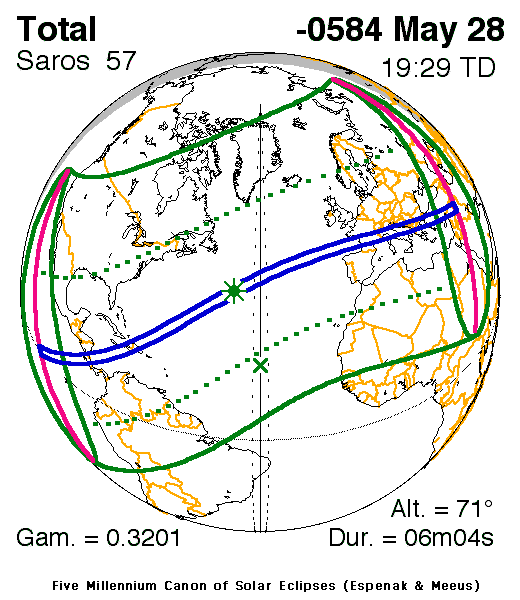
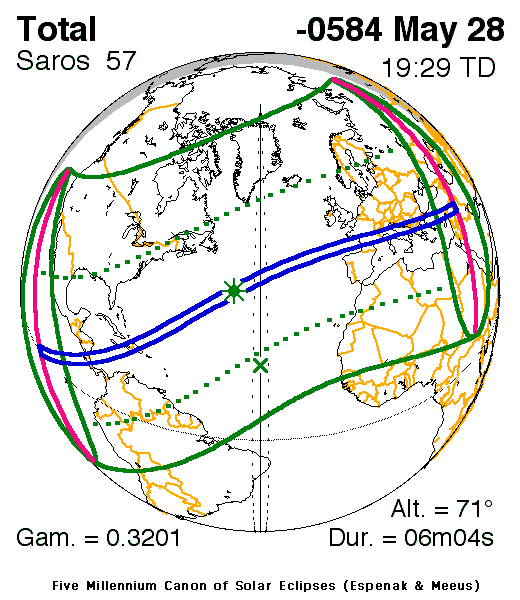
Map from NASA showing the path of the eclipse
seen by Thales. Source
The year 585 is particularly noteworthy though, not just for the end of wars or the death of tyrants, but as the birth of science in the Western world. In the year 585 a total eclipse of the sun was observed in Lydia. This eclipse caused the Lydian and Median empires to make peace with each other, but had in fact been predicted by Thales. Thales was a Greek thinker from Miletus and is the first known Greek philosopher.

Philosopher at this point meant merely lover of knowledge and Thales studied the stars and the earth. It is impossible for one person to accumulate enough data in a lifetime to predict an eclipse, so Thales must have been familiar with the works of previous civilisations, probably the Babylonians or Egyptians. This is the first mention that we have of Greek astronomy, but Greek astronomy at this point was quite crude compared to that of the ancient civilisations around them. Even the Babylonians were not entirely able to predict eclipses. They knew when they might occur but because not all eclipses are visible all over the world, they often saw no confirmation. So Thales probably used the same data that they did, guessed that this time it would be visible, and got lucky.

And this change of the day Thales the Milesian had foretold to the Ionians laying down as a limit this very year in which the change took place.
Herodotus, Histories, 1:74, written circa 440BC

Thales had a great reputation for wisdom and was another of the Seven Sages of Greece. He was a citizen of Miletus, but he had seen the weakness of the Ionian cities compared to the might of the Lydians and urged the Ionians to unite into a single country. History might have been different if they had, but the cities were too independent.

Drawing of a later bust of Thales
Thales also is possibly the first named mathematician. There were mathematicians before him, in Egypt, Babylonia, China and possibly India, but none to my knowledge whose names are preserved. Thales made some observations about the height of pyramids and formulated axioms about right angles. It was not particularly advanced mathematics, but it was definitely mathematics.

Hence, as the certain knowledge of numbers received its origin among the Phoenicians, on account of merchandise and commerce, so geometry was found out among the Egyptians from the distribution of land. When Thales, therefore, first went into Egypt, he transferred this knowledge from thence into Greece: and he invented many things himself, and communicated to his successors the principles of many. Some of which were, indeed, more universal, but others extended to sensibles.
Proclus, Commentary on Euclid Chapter IV, written circa 450AD

But what made Thales truly special was that he was the first person we know of to try and explain the world using purely natural means, without relying on divine intervention to explain away difficulties. He also probed the ultimate nature of reality, believing that at the root of being, all things are water. This was of course incorrect but his reasoning shows the beginning of the speculations that lead to science. He seems to have thought that water can take different forms, such as ice and steam, and that water was necessary for life, therefore if one substance must lie at the root of reality, it must be water.

Thales, the founder of this school of philosophy, says the permanent entity is water (which is why he also propounded that the earth floats on water). Presumably he derived this assumption from seeing that the nutriment of everything is moist, and that heat itself is generated from moisture and depends upon it for its existence (and that from which a thing is generated is always its first principle). He derived his assumption, then, from this; and also from the fact that the seeds of everything have a moist nature, whereas water is the first principle of the nature of moist things.
Aristotle, Metaphysics 1.983b, written circa 340BC

He wasn’t entirely free of metaphysical speculation. He seems to have thought that magnets were connected to gods somehow. But, in the west at least, Thales has good claim to be the first philosopher, the first mathematician and the first scientist, as well as an engineer and diplomat. He was a lover of knowledge indeed.

A cup showing the people of Cyrene loading silphium onto
a ship. The seated figure to the left is Arcesilaus,
although this may be Arcesilaus II 
In 584 the Olympic Games were held. Lykinos of Croton won the stadion race that year. In 583 King Arcesilaus I of Cyrene, in North Africa, died. He was succeeded by his son Battus II, because the kings of Cyrene were always unoriginally called either Battus or Arcesilaus in alternating order. Around this time a plant was discovered that had medicinal, possibly aphrodisiacal and possibly prophylactic properties. It was hailed as a wonder and exported by the people of Cyrene, whose economy came to depend on it. However, it could not be grown elsewhere and all attempts to cultivate it failed. So it had to be harvested with care. Eventually the ancient world would over-harvest the plant and silphium was extinct by the time of Nero, but for now, the wealth of the Greek North African colony depended on the wonder plant silphium.

Stadium at Delphi where the Pythian Games were held.
The stone seats are later additions from the Roman era
In the year 582, in celebration of the victory over Cirrha in the First Sacred War, the Pythian Games were organised. It is possible that these were held in 586 but it depends on when the Siege of Cirrha ended. These games were supposedly the restoration of a more ancient set of games but this is probably a myth. The games were held in Delphi, near the sanctuary of the god Apollo to whom they were dedicated. They were held every four years, in the middle period between the more prestigious Olympic Games and included many of the same sporting events as the Olympics. These games did attract visitors from all over Greece however, and the Pythian Games gave visitors an opportunity to conduct business and to consult the Oracle. It must have brought great prosperity and soon after, other games would be organised around Greece. The Pythian Games never became as prestigious as the Olympic Games however and not as many victors are recorded. Sakadas of Argos was a winner in the first Pythian Games, winning a competition for music.

In the year 581 the Isthmian Games were organised. These were similar to the Pythian Games, but held every two years (in the first and third years of the Olympiad). The winners would be crowned with celery. Like the Pythian Games, these were given suitably heroic origins, supposedly dating back to the time of Theseus, but were most likely organised when the Corinthians saw the success of the Pythian Games.

Vase painted by the Cavalcade Painter
In 580, the city of Agrigentum was founded on the southern coast of Sicily by Greek settlers from Gela. The city was originally named Akragas, but it was later known as Agrigentum. It would rapidly expand to become one of the largest and most powerful cities in Sicily. Around this time two other cities in Sicily, Segesta and Selinus, were at war with each other. These two cities were at the eastern end of the island and the rise of the Greek cities on the south and eastern parts of Sicily must have been a concern to the Carthaginians, whose city lay across the sea in Africa.The Carthaginians are said to have interfered in the war, siding with Segesta against Selinus. Some of the defeated Dorians who had been fighting on the side of Selinus occupied Lipera, which became a hub of piracy in the region.

In this year of 580 the Olympic Games were held and Epitelidas of Sparta won the stadion race. This event almost certainly happened in 580, however many of the other things that will be mentioned happened in or around this time, rather than directly in this year.

In the arts, a number of vase painters were active at this time. In many cases their names have not come down to us but we know them by their work and refer to them this way. The Cavalcade Painter flourished around this time, and probably was based in Corinth, producing black-figure vases. Also active at this time was the Gorgon Painter, another painter of black-figure vases whose work included a number of representations of Gorgons, including the vase showing the myth of Perseus and the Gorgon. The Pholoe Painter also flourished at this time, again as part of the Corinthian school of black-figure vase painting. In some ways these vase paintings are still somewhat crude compared to later Greek art but they are still impressive. The kouroi statues known as Cleobis and Biton at Delphi were made around this time. These are named after two brothers in Argos who had died pious deaths and were honoured by the Greeks, however this is a modern appellation and it is more likely that these represented the Dioscuri, the Hero-Twins of the Greeks.

Pediment of the Temple of Artemis in Corcyra
Supposedly around this time Susarion brought Megarian Comedy to Attica. This Comedy was slapstick and buffoonery that would be performed for the festivals of Dionysus in Icaria (a region of Attica) and would later inform the development of the comedy performed at the festivals of Dionysus in Athens itself. However almost nothing survives of Susarion’s work and none of his comedies may have been written down. They may instead have been nearly extempore jests performed by a chorus, and almost certainly did not involve actors.

Also around this time, the earliest aqueducts bringing water into Athens were probably constructed. We know that other cities at this time had pipes bringing in water into the city, as it was supposedly by poisoning these that city of Cirrha was taken by siege some years earlier. We should not imagine Roman aqueducts here however, but rather a series of pipes that brought water in from local sources.

Gorgon from the pediment of the
Temple of Artemis in Corcyra
In Corcyra, the present-day island of Corfu, what was probably the first Doric temple made entirely of stone was constructed. It was dedicated to Artemis and had pediments decorated with elaborate sculptures of a gorgon and other scenes from mythology. Little remains of it but the pediments have been largely reconstructed and can be viewed in museums.

In a strange twist of history the excavations were partially overseen by none other than Kaiser Wilhelm II who had become somewhat obsessed with the site and the artworks found. Compared to later Greek temples this seems very strange but the pediments do have a compelling beauty of their own.

Around the year 580 we see some of the first real exploration efforts from the Greeks. In 640 a Greek called Colaeus of Samos had been swept by accident through the Straits of Gibraltar and had reached the land of Tartessos in what is now southern Spain or Portugal, Thus Colaeus may be counted as the first explorer. But his mission was more of a trading one and seems to have been mainly accidental.

Around 580 Euthymenes, of the newly founded city Massalia, set out on a voyage through the Pillars of Heracles, as the Straits of Gibraltar were then known, and sailed southwards along the western coast of Africa until he reached a large river that he thought looked like the Nile. He reported that the seawater was pushed out by the great flows of freshwater from the river. His report that the Nile was to be seen in West Africa was confusing, and speaks to the lack of geographical knowledge of the time, but he may have been describing the Senegal River instead. His voyage is rather tame compared to the supposed exploits of the Phoenicians, but is worth remembering nonetheless.

Modern bust of Euthymenes in Marseilles
"Euthymenes of Massilia says by way of testimony, 'I have navigated' says he, 'the Atlantic sea. Now, the Nile flows, greatly, as long as the Etesian Winds endure; for the sea is constantly thrown back by the constant winds; as soon as they have abated and the sea becomes calm, the Nile descends with less force. For the rest, the seawater is fresh to the taste and has wildlife similar to that of the Nile”
Seneca the Younger quoting Euthymenes in Naturales quaestiones IV.2.22, written circa 40AD

In poetry, the poet Cleobulina flourished around this time. She was a daughter of Cleobulus, who was a famed poet and sage in his own right. She came from Lindos in Rhodes and was active in Ionia. Some traditions associate her with Thales, with Diogenes Laertius asserting that she was his mother, but these traditions are much later. She primarily wrote riddles, as did her father, and three of these survive. It is interesting to see that in some ways the Archaic Period of Greece saw a higher percentage of women writers than the Classical Period, though this may be due to the fragmentary nature of the sources.

I saw one man welding bronze to another man with fire, so tightly as to make them common blood.
Athenaeus, Doctors at Dinner, written circa 180AD, quoting Cleobulina’s riddle. The answer is “applying a cupping glass”

Later Roman bust of Sappho
Cleobulina was remembered in the ancient world but her contemporary Sappho was famous. Sappho lived in the city of Mitylene on the island of Lesbos in the north-eastern Aegean. She was possibly the greatest of the Lyric poets but also wrote elegiac and iambic poetry. She was a contemporary with Alcaeus and some have said that they were lovers. But this is probably false and an example of later biographers pairing up anyone or connecting anyone who was vaguely contemporary. Alcaeus and Sappho would certainly have known each other though, as they were both from noble families on Lesbos and may have both been banished after the assassination attempt on Myrsilus.

Sappho seems to have been part of a community or association of women, probably related to poetry and music. Some refer to this as a school, but this is an anachronism. The nobility of Lesbos formed communal fraternal groups aimed at fostering brotherhood and loyalty among the wealthy and Sappho’s group was probably the female equivalent of such a group.

Some say that the most beautiful sight upon earth’s dark soil is a company of soldiers on horse. Others think that this honour belongs to a line of soldiers on foot. And still others to a fleet of ships. Ah, but for me this honour belongs to whoever one loves. 
It’s easy to see why. Look! The most gorgeous woman on earth, Helen, abandoned her man, most excellent of all men! And made sails for Troy! 
Not a thought for her daughter nor her dear parents. 
That was Cypris’ fault! Aphrodite! It was this goddess who had led her so far astray. So suddenly. So easily. So gently. 
Ah! This reminds me of Anactoria who is very far away. How I’d much rather look upon her charming step, and upon the dazzling beauty of her face than upon all the glittering chariots of Lydia and all of her foot soldiers, clad in their weighty armour! 
Sappho, A company of Soldiers

1887 painting of Sappho
by Charles Mengin
As part of this Sappho formed strong bonds with the ladies in her group and wrote numerous poems alluding to the love she felt for these women. It should be noted that these are not explicitly sexual in nature, but almost certainly are sexual in intent. Thus Sappho was not only admired for the quality of her poetry but also eventually lent her name to female homosexuality. In English, the epithet Sapphic bears this meaning, but the most common word used stems from her island of origin; Lesbian.

And again when the moon casts her brilliance all over the earth, the stars soften the blaze of their beauty
Sappho, The stars around the moon

While there is no evidence of explicit disapproval of this, there are indications that the ancient world found female heterosexuality disturbing. So there were efforts made by later biographers to prove that she also loved men. There are the suppositions that because she and Alcaeus were contemporary that they were lovers. There are also cruder stories where Sappho falls passionately in love with an ugly boatman named Phaon and when he dies or rejects her, she hurls herself over the Leucadian cliffs to her death, in the hope that the leap would either cure her love or kill her. There is an even cruder tradition that holds that she was married to a man called Kerkylas of Andros (which translates in modern idiom as “Dick from the Isle of Man”). The name Kerkylas is extremely unusual and seems to have been invented as a slang for penis, so this is probably a joke story. There is a possibility that Sappho had a daughter Cleis, but this is disputed. Regardless of the fact that her probable homosexuality made the Greeks uncomfortable, we must remember that the Greeks did not think of sexuality as a matter of fixed orientation, as we do today, and thought of sexuality more in terms of individual acts. But this is a longer discussion for another time.

Cliffs near Leucadia
present-day island of Lefkada
Because if you forget, I’ll remind you of the good things we lived through together. 
Remember the many garlands of violets and roses I placed next to you and the many flower necklaces I weaved around your soft skin 
Sappho, Abandoned

In the year 579 Lucius Tarquinius Priscus, the quasi-usurper king of Rome, was slain by the sons of Ancus Marcius, a previous king. Lucius Tarquinius Priscus had begun work on making wooden stands in the valley between the Palatine and Aventine Hills in Rome, in what would later become the Circus Maximus. He had also begun work on the Cloaca Maxima, the main drain for Rome that still stands to this day. In this time it was probably an open sewer rather than the closed work that it is today. The temple of Jupiter on the Capitoline Hill was probably begun around under his reign as well. It should be noted that many scholars feel that the dates of the early kings are inaccurate and that all of this work might in fact have been done sixty years later, but I will mention the traditional dates for now.

Model of an Etruscan period temple, built around 500BC
It would have closely resembled the Temple of Jupiter
on the Capitoline Hill in Rome
They appeared in the vestibule of the palace, each with his usual implement, and by pretending to have a violent and outrageous quarrel, they attracted the attention of all the royal guards. Then, as they both began to appeal to the king, and their clamour had penetrated within the palace, they were summoned before the king. At first they tried, by shouting each against the other, to see who could make the most noise, until, after being repressed by the lictor and ordered to speak in turn, they became quiet, and one of the two began to state his case. Whilst the king's attention was absorbed in listening to him, the other swung aloft his axe and drove it into the king's head, and leaving the weapon in the wound both dashed out of the palace.
Titus Livius, Ab Urbe Condita, 1.40, written circa 15BC

Not much can be said for the years 578 and 577. In 576 Alcetas I of Macedonia probably began his rule. Macedonia was a kingdom to the north of Greece. It saw itself as Greek but the Greeks further south sometimes treated them as barbarians. Macedonia was certainly linked to Greek culture and would later become extremely important in Greek history, but it always stood slightly apart, with its own identity. Needless to say the early dates for the kingdom, like nearly all the dates mentioned in this blog, should be treated with caution.

Vase by the Anagyrus Painter
We can be rather more certain about the Olympic Games of this year, with Eratosthenes of Croton, a city in Sicily, winning the stadion race. I always find it strange that there is in some ways more knowledge about ancient sport than about ancient kings in this period.

Treating the Spartan dates with similar caution, Agasicles, the Eurypontid king of Sparta probably began his rule around the year 585. The Greek city of Massalia in southern Gaul, which is now Marseilles in contemporary France, founded a colony named Emporion, meaning “Trading Place”, on the north-western coast of what is now Catalonia in Spain around this time. The Greek cities were still sending colonies to settle new lands, but the great age of colonisation seems to have nearly ended. There was now too much competition between the Greeks and the Phoenicians for new lands and trade and as cities became better at feeding their populations there was less need to send excess people to settle new lands.

The Anagyrus Painter flourished around this time. The Anagyrus Painter was probably based in Attica and painted in the black-figure style, similar to the Corinthian vase painters of the same time.

The Sounion Kouros in the National
 Archaeological Museum in Athens.
The legs have been almost entirely reconstructed
In art, over the previous decades, a new type of statue was being made in Greece. Previous Greek statuary was rather crude, but increased contacts with the other cultures in the Mediterranean seem to have inspired the Greeks to create statues that were the equal of the Egyptian statues. These statues were known as kouroi and were almost universally of nude men, clean-shaven with long hair. They all had the same pose, standing straight upright with one foot slightly forward so that the weight of the statue would have to be distributed. Each statue would have long hair and an enigmatic smile, similar to the Egyptian statues, that is known as the Archaic Smile, as all the statuary of the time seems to have this expression. There were female statues that were also made of a similar type, but almost always clothed rather than nude. These physical remains show that Greece had reached a high level of cultural expression and even if their civilisation had disappeared at this point, we would know and appreciate some of what they had achieved.

In Rome, according to the traditional dates, the king Servius Tullius came to power around this time. The dates are of course unclear here. Servius’ name designates that he came from humble origins, originally being a slave in the household of the previous king, before marrying the daughter of Tarquinius and Tanaquil, and showing great competency in everything he was entrusted with. Supposedly, when Tarquinius was assassinated, Servius and other members of the royal family hid the death from the people before eventually taking over power themselves and forcing the assassins to flee. It should of course be remembered that all of this information is taken from much later sources. At the time, Rome was a minor and insignificant city, which barely controlled more than the seven hills upon which it stood.

Wall of the Temple of Capitolin Jupiter
preserved in the Capitoline Museum
She bade them hope for the best; the king had been stunned by a sudden blow, but the weapon had not penetrated to any depth, he had already recovered consciousness, the blood had been washed off and the wound examined, all the symptoms were favourable, she was sure they would soon see him again, meantime it was his order that the people should recognise the authority of Servius Tullius, who would administer justice and discharge the other functions of royalty.
Titus Livius, Ab Urbe Condita, 1.41, written circa 15BC

Thus the period that we are looking at draws to a close. The dates are problematic for this time of course. Apart from the eclipse of 585 nearly every other date that is mentioned is up for interpretation. But even if we cannot say with certainty exactly what year we can have growing confidence that these events did in fact happen, with the exception of the doings of semi-legendary characters such as Epimenides.

This period has the flourishing of vase painting, continued Olympic valour and the founding of games in emulation of the Olympics. We see wars between the Greek states, including possibly the first use of biological weapons in history, the rising importance of the Oracle of Delphi, the semi-legendary Seven Sages of Greece, continued expansion of colonies and the beginning of purposeful exploration. Poetry and song are represented by poets such as Sappho and Alcaeus. Statuary, engineering and architecture are becoming ever more impressive. And lastly and perhaps most importantly, we see the rise of Greek science, mathematics and philosophy in the person of Thales of Miletus.

Remains of the Diolkos on the Corinthian Isthmus
A causeway that allowed ships to be dragged across the Isthmus
instead of having to sail around the Peloponnese
Primary Sources:
Poems of Cleobulus
Herodotus’ Histories
Poems of Alcaeus
Plutarch’s Life of Solon
Titus Livius, Ab Urbe Condita
Poems of Sappho

Related Blog Posts:
Greece from 625-600BC
600-575BC in the Near East
575-550BC in Greece

Wednesday, 28 November 2018

575-550BC in the Near East

Lion Statue from Babylon
This blog post will be looking at the years 575-550BC in the Near East, which for the purposes of this blog will include Kush and Lydia in the south and west, far over to the easternmost reaches of the Median Empire and to the Caucasus in the north. Occasionally there may be references to other regions, but the Greek world in particular will be dealt with in a separate post.

The sources for this blog will include as much primary sources as possible, particularly Neo-Babylonian chronicles and other cuneiform writings. The writings of the later Babylonian priest Berossus (contemporary with Alexander) have been lost to us, but survive in quotations from other authors such as Josephus, so these will be used where possible. Lydian, Median and Persian sources are so scant as to be almost non-existent, and those that do exist may in fact be forgeries. Ancient Persian religious writings are interesting, but provide no context and are difficult to date. Egyptian and Kushite inscriptions will be used where possible but there are not as many of these as we would like and not many are translated and available to the layman.

The Hebrew Tanakh or Old Testament will be used where possible, but this has a very narrow focus and is not contemporary with the events that it describes. Also, the writers of the Biblical books at this period are not writing history as such, and their writings have their own specific conventions that can be difficult to interpret. The majority of Hebrew writings are silent during this period anyway. The most prevalent source material for this period is later Greek writing, particularly the Histories of Herodotus. This is a great book, but quite problematic as a source. For better or for worse, shortly after the fall of Assyria we begin to have fewer and fewer writings directly from the Mesopotamians. This means that, like it or not, we must rely heavily on Herodotus.

Object inscribed with the cartouche
of Aramtle-qo
As always I feel it is important to note that I am not a professional historian. The facts and dates in this post should be treated with due caution and everything should be checked. There are certainly mistakes and errors in the sources and I may make mistakes in my interpretations of these sources. Mistakes are particularly likely to occur when dealing with years, as the Babylonian and Jewish years do not correspond exactly to our own. So, there is the possibility that I may have, for example, interpreted an event as happening in late 609 when it may in fact have been early 608. If the reader spots any errors such as this, please let me know in the comments and I will research it and correct it as soon as possible. Also, another thing that will affect dating for this period is whether the king counts the first year of their reign as the 1st year or the 0th year (counting from accession or from first full year). Even professional historians have differing opinions on the exact ordering of events at this time, so exact precision is not likely here.

It can be useful to give context to the period by describing what is happening elsewhere in the world at this time. In China, the Zhou Dynasty was continuing its long slow decline while the feudal states such as Jin and Chu grew ever more important and waged wars between them for influence. In India, there were a number of powerful kingdoms, particular in the north along the Gangetic Plain. These kingdoms were known as the Mahajanapadas and included states such as Kuru, Panchala, Kosala, Videha and Magadha. In India at this time a number of sects began to spring up that in certain cases had unusual interpretations of the accepted beliefs of the time and region, but this is a topic for another blog. To the west, in Greece, poets and tyrants flourished along with the beginnings of Greek science and philosophy. These will all be spoken of in later blogs but this should give a rough idea of the state of the world at this point.

Pyramids of the royal family of Kush in Nuri
At the beginning of this time period the region was dominated by four mighty kingdoms. Egypt was ruled by the Pharaoh Apries, Lydia was ruled by Alyattes II, Babylon was ruled by Nebuchadnezzar II and Media by Astyages. Some smaller kingdoms, such as Ammon, Elam, or Persia, existed at the peripheries of these states, but were not truly independent. Kush existed to the south of Egypt, but is less well known in this time period than in the earlier centuries. To the west the Phoenicians and Greeks traded in the Mediterranean Sea. To the north lay the Scythian tribes, to the south the Arabian Desert with the kingdom of Saba flourishing in present-day Yemen. To the east of the Kingdom of the Medes lay other Iranian tribes and the exact extent of the Median power is not known to historians.

In  the last post I said that there was not much that could be said exactly for the year 575, or for that matter for the years between 579-575, or for 574-573 either, so I will mention a few of the things that were mentioned in the last blog. Firstly, the house of Egibi. These were a family in Babylonia who became extremely wealthy from commercial activities. They bought land and slaves and financed certain aspects of the Neo-Babylonian military. They gave loans for people to buy and sell and facilitated trade. They gave their slaves considerable leeway to carry out their own businesses and were the dominant force in commercial activities at this time. They are sometimes referred to as bankers but this is an overstatement. While they did give loans at 20% interest they were not primarily a banking establishment, although they were the closest thing to it at that time. Some older scholarly literature refers to them as Jewish but it is almost certain that the Egibi family were Babylonian rather than Jewish. They would dominate trade for over a century, from about 600-480 and now seemed as good a time as any to mention them.

Painting "By the waters of Babylon"
by Arthur Hacker
Another thing that is worth talking about is the literature that was being created by the exiled Jews in Babylonia. Lament songs were created that kept alive Jewish culture and have inspired works up until the present day. While many of the Psalms predate this and many postdate it I thought that 137th Psalm was a good example of them and thought that I would mention it here.

By the rivers of Babylon we sat and wept when we remembered Zion. There on the poplars we hung our harps, for there our captors asked us for songs, our tormentors demanded songs of joy; they said,
“Sing us one of the songs of Zion!” How can we sing the songs of the Lord while in a foreign land? If I forget you, Jerusalem, may my right hand forget its skill. 
Psalm 137:1-5 

Lastly, around this time Nebuchadnezzar was doubtless expanding his empire and strengthening the frontiers, but we have no documentation of this. The Egyptian, Hebrew, Greek and Babylonian sources are all silent for these years, insofar as I can tell. However, we do know that Nebuchadnezzar embarked on a huge building program to make Babylon the strongest and most beautiful city in the world. To this end he surrounded Babylon with a vast system of walls, possibly the largest that had yet been built on earth and great ceremonial gates. The walls were listed in the first list of the wonders of the world. The greatest of the gates was the Ishtar Gate, which was connected to the processional way that the kings and statues of the gods would follow on state occasions.

The author by the gates of Babylon
The gate itself was a huge affair of blue glazed bricks, adorned with lions, bulls and dragons. Nebuchadnezzar had an inscription carved to highlight his great creation and the gate is the quintessential artefact of the Neo-Babylonian Empire. The gate survived relatively intact throughout the millennia and sections of it can be seen in the Louvre and in Istanbul. The majority of it however was shipped over to Berlin and a nearly full reconstruction can be seen in the Pergamon Museum in Berlin.

Nebuchadnezzar, King of Babylon, the faithful prince appointed by the will of Marduk, the highest of princely princes, beloved of Nabu, of prudent counsel, who has learned to embrace wisdom, who fathomed their divine being and reveres their majesty, the untiring governor, who always takes to heart the care of the cult of Esagila and Ezida and is constantly concerned with the well-being of Babylon and Borsippa, the wise, the humble, the caretaker of Esagila and Ezida, the firstborn son of Nabopolassar, the King of Babylon. Both gate entrances of Imgur-Ellil and Nemetti-Ellil —following the filling of the street from Babylon—had become increasingly lower. Therefore, I pulled down these gates and laid their foundations at the water-table with asphalt and bricks and had them made of bricks with blue stone on which wonderful bulls and dragons were depicted. I covered their roofs by laying majestic cedars length-wise over them. I hung doors of cedar adorned with bronze at all the gate openings. I placed wild bulls and ferocious dragons in the gateways and thus adorned them with luxurious splendor so that people might gaze on them in wonder. 
Ishtar Gate dedication 

Sphinx of Apries
There is not much that can be said for the year 574. During the year 573 I have come across some sources saying that the siege of Tyre ended. This is a confused episode that shows the state of the sources. It is clear that the Phoenicians had been involved with the revolts and wars in the region and that the Babylonians would try and curb this. A number of Greek authors recount that there was a thirteen year siege of Tyre by the Babylonians. This probably happened, but it’s unclear when and if the siege was continuous. As Tyre was at least partly on an island besieging it would seem very pointless, but this is what the sources say. The Babylonian chronicles might have shed light on it if there were any for this period, but there aren’t, so we have to rely on the Greek texts. I believe that the siege may have ended around this date ,but a lot of other dates are plausible. The siege ended with a negotiated surrender that saw the Tyrians submit to Nebuchadnezzar, but their city was not looted nor their king slain.

Diocles also, in the second book of his Accounts of Persia, mentions this king; as does Philostrates in his Accounts both of India and of Phoenicia, say, that this king besieged Tyre thirteen years, while at the same time Ethbaal reigned at Tyre. 
Josephus, Antiquities of the Jews, 11.1 

In the year 572 there is not much that can be said, bar the final prophecies of Ezekiel according to Ezekiel’s own internal dating system. I may have mistaken the year and it may be 573, but it is around this time. The final vision is a vision of an idealised temple in Jerusalem and a land restored to the people of Judah (in a somewhat geometrical fashion). This means that, if this dating is correct, that there is no Hebrew record of the years of exile. There are some stories within the book of Daniel, but these are not historically verifiable with our current knowledge and do not affect the diaspora as a whole, but are more to do with the protagonists of the book of Daniel.

Medieval illustration of Ezekiel
In the twenty-fifth year of our exile, at the beginning of the year, on the tenth of the month, in the fourteenth year after the fall of the city—on that very day the hand of the Lord was on me and he took me there. In visions of God he took me to the land of Israel and set me on a very high mountain, on whose south side were some buildings that looked like a city. He took me there, and I saw a man whose appearance was like bronze; he was standing in the gateway with a linen cord and a measuring rod in his hand. The man said to me, “Son of man, look carefully and listen closely and pay attention to everything I am going to show you, for that is why you have been brought here. Tell the people of Israel everything you see.” 
Ezekiel 40:1-4

According to later Armenian legends the king Orontes Sakavakyats began to rule in Armenia around the year 570. This legend should be treated with considerable scepticism as the region was under the dominance of the Medes at the time but it is quite possible that a local ruler was allowed to act as a subordinate ruler of the province, particularly one so mountainous as the Armenian region. Whether or not Orontes Sakavakyats truly existed or was in fact a king, it is fair to say that there was a later dynasty, the Orontids, who ruled the region as governors over the next few centuries.

Stele of Apries mounted on
Bernini's elephant
Also around 570, Apries, the Pharaoh of Egypt, sent a large invasion force to try and crush the Greek kingdom of Cyrene, in present-day Libya. The invasion was a failure and seems to have failed badly. Perhaps the soldiers felt that they had been led into the desert to die at the hands of their foes or perhaps they feared punishment on returning to Egypt. Either way, they rose in rebellion against the Pharaoh.

The armies of the Pharaoh were composed of two sections. The native Egyptian forces, which was by far the larger part of the army, and some elite, heavy-armed mercenary forces, composed mainly of Greeks and Carians. Each section of the army had its own commander, so Apries sent the commander of the Egyptian forces, a general named Ahmose, to quell the rebellion. Ahmose went to the troops who promptly proclaimed him the new king. Ahmose returned to Memphis and a battle was fought against the mercenary troops who remained loyal to Apries. Apries possibly survived the battle and probably fled across the Sinai, where he tried to enlist Babylonian help in regaining his kingdom.

This entire episode is almost entirely taken from the writings of Herodotus. It is in some ways extremely annoying just how reliant we are on Herodotus. If we did not have his Histories we would lose a huge amount of information about this century.

Apries sent a great expedition against Cyrene which suffered a great defeat. The Egyptians blamed him for this and rebelled against him; for they thought that Apries had knowingly sent his men to their doom, so that after their death his rule over the rest of the Egyptians would be strengthened. Bitterly angered by this, those who returned home and the friends of the slain rose against him. Apries sent Amasis to dissuade them, when he heard of this. Amasis met the Egyptians and he exhorted them to desist; but as he spoke an Egyptian put a helmet on his head from behind, saying it was the token of royalty. 
Herodotus Histories 2,161 ff 

Salvador Dali painting showing the Stele of
Apries mounted on Bernini's elephant
There is a strange little postscript to the reign of Apries. During his reign he had commissioned a small obelisk, which I believe was placed in Sais. This obelisk was later taken to Rome and eventually abandoned as Rome fell into disrepair. The obelisk was recovered during excavations in the 1600’s and was incorporated into a sculpture by Bernini called Elephant and Obelisk, where a Renaissance statue of an elephant acts as a base for the obelisk, which seems to grow from its back. It is exhibited in Rome to this day, sitting near the Pantheon, and has been featured in a number of Salvador Dali’s artworks. I have always found this combination of history, sculpture and art to be quite fascinating and any travellers to Rome should take a little time to see it if they can.

For the year 569 not much happened to my knowledge. In the year 568 or 567 it seems that the Babylonians attacked Egypt. Possibly this was done at the behest of the ousted Pharaoh Apries. The invasion probably reached the edges of Egypt, but probably did not get much further and Apries seems to have been captured and probably killed.

Broken head of a statue of Amasis
The sources for this are very confused. The Babylonian sources are not extant for this time. The Greek sources are much later and are dependent on the Egyptian priests who may have not wished to speak of defeats. The Hebrew sources themselves are silent. However, there are Hebrew prophecies from Jeremiah and Ezekiel that speak of Nebuchadnezzar conquering Egypt. It is not clear when these were written, but if these prophecies were entirely inaccurate it is likely that the Hebrews would have abandoned the books of Jeremiah and Ezekiel.  So, the existence of these prophecies is not a proof that the Babylonians conquered Egypt, but it should make us suspect that something happened which was viewed as fulfilling this. However, the language used by Ezekiel in particular should not be viewed as being exactly literal. Ezekiel refers to the land of Egypt lying desolate for 40 years. This did not happen and is just poetic imagery for a great destruction. But the sources are too scant to really tell us much here. Babylon could have invaded Egypt ten times and we would have no real data on it.

Then say to them, ‘This is what the LORD Almighty, the God of Israel, says: I will send for my servant Nebuchadnezzar king of Babylon, and I will set his throne over these stones I have buried here (in the city of Tahpanhes); he will spread his royal canopy above them. He will come and attack Egypt, bringing death to those destined for death, captivity to those destined for captivity, and the sword to those destined for the sword. He will set fire to the temples of the gods of Egypt; he will burn their temples and take their gods captive.
Jeremiah 43:10-12

I suspect there is a solution to the problem. Our main source for the period is Herodotus, whose main sources were the Egyptian priests. Herodotus records a later invasion by Cambyses, a Persian monarch, whose reason for invading was because he had married a daughter of Apries. Now the explanation that Herodotus gives for the marriage alliance is a rather silly one, so a marriage alliance with the Babylonians under Nebuchadnezzar makes more sense. Herodotus also refers to Cambyses slaying the Apis bull, (a bull that was sacred to the Egyptians). However, inscriptions from this time show that Herodotus is wrong about this. I suspect that Herodotus is confusing parts of the accounts of an earlier invasion by Nebuchadnezzar with the later invasion of Cambyses. But this is all speculation on my part.

Sculpture of the goddess Neith
Also around this time, Aramatle-qo of Kush may have come to the throne. The dates are confused here, as I have also seen dates suggesting that Aramatle-qo came to the throne in 580, but these are the dates that I have seen. Not enough research has been done on the kingdom of Kush I fear.

For the years 566-563 it is hard to find sources of anything that happened. So I will mention some general developments around this time. Firstly, in Egypt, in the city of Sais that was the capital of the Twenty-Sixth Dynasty, there had been a revival in the cult of the goddess Neith. She was a creator goddess who also was a sky goddess of battle, hunting and wisdom. She also was associated with many of the Egyptian rites of the dead. She was an ancient goddess, whose cult had been very important in the early dynastic periods in Lower Egypt but whose worship had been obscured by the primacy of the cult of Amun based in Thebes. The Saite rulers were based in Lower Egypt and promoted her worship, building large temples in Sais. This was partly a revival of ancient traditions, but also shows that religion in the ancient world was not static. The Greek travellers and mercenaries associated Neith with Athena.

First in Sais he (Amasis) built and completed for Athene a temple-gateway which is a great marvel, and he far surpassed herein all who had done the like before, both in regard to height and greatness, so large are the stones and of such quality.
Herodotus, Histories 2,176

Also around this time the outer walls of Babylon were completed. Not content with building giant fortifications for his capital city, which was the largest city in the world at the time, Nebuchadnezzar had constructed a series of fortifications that encircled his kingdom to the north and east. The northern wall stretched from Opis to Sippar, from the Tigris to the Euphrates. Later Greek writers spoke of these as being 20 feet wide and 100 feet high.

The modern restoration of the Processional Way
in Babylon
After travelling three stages they reached the so called wall of Media, and passed within it. It was built of baked bricks, laid in asphalt, and was twenty feet wide and a hundred feet high; its length was said to be twenty parasangs (slightly over 100km), and it is not far distant from Babylon.
Xenophon Anabasis 2.4.12

There are some indications from the Babylonian inscriptions of Nebuchadnezzar that these walls were built, but the sheer scale of the walls meant that these were probably not completed until very late in the reign of the king. It is these walls, as well of the walls of the city of Babylon itself, which were viewed as wonders of the world by the later Greeks. The reason for building the walls must have been fear of invasion by the Medes. There is no evidence for the Babylonians and the Medes going to war at this time, but the fragmentary nature of the sources means that there could have been hostility and even war between the two empires around this time and we would be unaware of it.

I made a strong earth dam over a distance of 5 beru above Upu as far as Sippar, from the bank of the Tigris to the bank of the Euphrates, and I surrounded the city with mighty waters for a distance of 20 beru like the expanse of the sea. In order that the strong earth dam should not be carried away by the battering of a flood of furious waters, I constructed its banks with bitumen and baked brick. I built on their neck a strong wall as high as a mountain. I turned Babylon into a life-preserving mountain refuge for the people…
Brisa Inscriptions of Nebuchadnezzar II

Illustration by William Blake of the madness
of Nebuchadnezzar
Around the year 562 Nebuchadnezzar II of Babylon died. He was in many ways the most powerful king of his age. His father had helped destroy Assyria and he himself had beaten the Egyptian armies and established his kingdom as the wealthiest and possibly the most powerful in the world at the time. His building works have nearly all crumbled into dust, but the few that remain are wondrous. I myself have seen the Ishtar Gate that was transported to Berlin and it is a magnificent piece. But his most lasting cultural legacy is as the stereotypically evil monarch who destroyed Jerusalem and deported the Jews to Babylon. It is for this that Babylon is referred to in Judeo-Christian writings and songs as the embodiment of all of the evil in the world. He is referenced in the Biblical writings of Kings, Chronicles, Jeremiah, Ezekiel and Daniel.

In the book of Daniel, Nebuchadnezzar is portrayed as a benevolent tyrant, whose whimsy would turn to anger without warning, and who was much given to the interpretation of dreams. The last reference to Nebuchadnezzar in this book is of an episode of seven years madness, where the king refused to honour the God of Heaven and was driven out to live as a beast in the wilderness for seven years. Now, some have interpreted this as a reference to the later king Nabonidus. This is quite plausible as there were other writings about a seven year period of madness of Nabonidus in the Jewish tradition. However, some have interpreted a cuneiform document that opens with the fragmentary words that Nebuchadnezzar “considered his life appeared of no value to him” to refer to a period of madness where his son Amel-Marduk became a temporary regent. Without more and better sources it is impossible to know if this tradition is reliable.

Medieval illustration of
the dream of Nebuchadnezzar
Apart from the Biblical cultural legacy of Nebuchadnezzar, he is best remembered for building the Hanging Gardens of Babylon. No traces of these have ever been found, nor are they mentioned by any extant Babylonian inscription, nor are they mentioned by Herodotus. It is possible that they were a misplaced memory of the gardens of Nineveh that had been built by Sennacherib. But all of this is not well known.

Now in this palace he erected very high walks, supported by stone pillars: and by planting what was called a pensile paradise; and replenishing it with all sorts of trees, he rendered the prospect an exact resemblance of a mountainous country. This he did to please his Queen: because she had been brought up in Media, and was fond of a mountainous situation.
Berossus’ Babyloniaca, quoted by Josephus in Contra Apion, Book I

With the mighty Nebuchadnezzar dead, his son Amel-Marduk took the throne. We have some small inscriptions from his reign, but we know very little about this king. We do know that he seems to have considered restoring the exiles of Judah, or at least changing their status. He restored the exiled king Jehoachin to favour and allowed him to sit at the royal table and receive allowances. This is mentioned in the Biblical books of Jeremiah and Kings and in both cases is thought to be so important that it is the last note in both books. Interestingly we have found Babylonian rations tablets that confirm that this detail and speak of the King of Judah being given rations.

One of the Jehoiachin Tablets
In the thirty-seventh year of the exile of Jehoiachin king of Judah, in the year Amel-Marduk became king of Babylon, on the twenty-fifth day of the twelfth month, he released Jehoiachin king of Judah and freed him from prison. He spoke kindly to him and gave him a seat of honour higher than those of the other kings who were with him in Babylon. So Jehoiachin put aside his prison clothes and for the rest of his life ate regularly at the king’s table. Day by day the king of Babylon gave Jehoiachin a regular allowance as long as he lived, till the day of his death.
Jeremiah 52:31-34

1.5 sila (oil) for three carpenters from Arvad, 1/2 apiece,
11.5 sila for eight woodworkers from Byblos, . . .
3.5 sila for seven Greek craftsman, 1/2 sila apiece,
0.5 sila to the carpenter, Nabuetir,
10 sila to Ia-ku-u-ki-nu (Jehoachin), the king of Judah’s son,
2.5 sila for the five sons of the Judean king.
One of the Ration Tablets of Jehoiachin

Around the year 561, but possibly considerably earlier, the Egyptian Pharaoh Amasis conquered Cyprus, which was an important source of copper for the entire region. If Amasis was able to project power across the sea, he must have had a considerable navy, either of his own or through mercenaries or allies.

The vast remains of the tomb of Alyattes
Around the year 560 Alyattes of Lydia died. He had made Lydia stronger than ever before and his armies and wealth were famous. Like Nebuchadnezzar however we know far less than we would like about him and apart from a few Greek tales preserved in Herodotus, we can say very little about him.
One thing that can be said however, is that Alyattes built one of the largest tombs in history for himself. The Lydian kings and nobility were buried in tumuli outside their capital city of Sardis. Even today these mounds can be seen like little hills dotting the plain, silhouetted against the sky and distant mountains. Alyattes’ funeral mound is by far the largest.

Its base was originally 360 metres in diameter and 61 metres in height. By comparison the sides of the Great Pyramid are 230 metres and it is 147 metres in height. Thus the tomb of Alyattes was not the largest building in the world, but it was certainly one of the largest buildings. It has since been excavated but it had been looted in antiquity. The wealth of the Lydian monarchs, the possible inventors of currency, was legendary and it is hard to imagine what his tomb furnishings must have been. The tomb was topped with stone phalli, which may have had a religious significance. Herodotus characteristically tells a tale that says that the tomb was built mainly by prostitutes and that they left their sign atop it as a marker. This is unlikely. If one is in western Turkey it might be interesting to visit the forgotten marvel; the greatest tomb of a half-remembered kingdom.

Coin of Alyattes of Lydia
In Lydia is the tomb of Alyattes, the father of Croesus, the base of which is made of great stones and the rest of it of mounded earth. It was built by the men of the market and the craftsmen and the prostitutes. There survived until my time five corner-stones set on the top of the tomb, and in these was cut the record of the work done by each group: and measurement showed that the prostitutes' share of the work was the greatest.
Herodotus, Histories 1:93

Coin of Croesus of Lydia

Alyattes’ son Croesus succeeded him and seems to have gone to war with Ephesus and with the Greek cities of Ionia. Croesus would become famous for his vast wealth and in English the phrase “Rich as Croesus” was used to describe those who had huge fortunes.

In the year 560 Amel-Marduk, son of Nebuchadnezzar and king of Babylon, was killed by Nergal-Sharezer, who was a high-ranking official who had married into the royal family. Berossus records that Amel-Marduk was unpopular. If Amel-Marduk had ever truly planned to restore the Jews to Judah, he did not reign long enough to accomplish this, or much of anything else for that matter.

His son Eveilmaradouchos (Amel-Marduk) became master of the kingdom. Because he managed affairs in a lawless and outrageous fashion he was plotted against and killed by Neriglisaros (Nergal-Sharezer), his sister's husband. He was king for two years.
Berossus’ Babyloniaca, 

Possible tomb of Cambyses I (possibly not)
Probably around the year 559 Cambyses I, a minor king who ruled the Persian tribes, died. The Persian tribes were culturally and politically linked to the more powerful Medes and the daughter of the Median King, Mandane, daughter of Astyages, had been married to Cambyses I. Their son, Cyrus II became king of Persia. There are some sources however that suggest that Cambyses I died later, around 551.

I have no sources for any events happening in 558. In 557 however the sources very briefly flare to life. The Babylonian chronicles have been silent since 593. This is not because they are not recording anything, but merely because we have found no documents. A fragment of a much larger chronicle was found that spoke of a military campaign by Neriglissar (Nergal-Sharezer) King of Babylon. This chronicle is referred to as the Chronicle of Neriglissar and is much more detailed than Babylonian chronicles normally are. This chronicle speaks of a campaign by the Babylonian king against Appuashu, a king of Cilicia. Appuashu is possibly the same king Synennesis mentioned by Herodotus, who had helped negotiate peace between the Lydians and Medes in 585, but it is more likely to have been a descendent. This shows that the Babylonians were still powerful and that their kings were engaging in campaigns at the outer reaches of their empire.

The third year (557/556): on the Nth day of the month [...], Appuashu, the king of Pirindu, mustered a large army and set out to plunder and sack Syria. Neriglissar mustered his army and marched to Hume [Cilicia] to oppose him. Before his arrival Appuashu placed the army and cavalry which he had organized in a mountain valley ambush. When Neriglissar reached them he inflicted a defeat upon them and conquered the large army. The army and numerous horses he captured.
Neriglissar Chronicle (ABC6) 

It is probable that around the year 557 the Ionian Greek cities, on the west coast of what is now Turkey, became subject to the Lydian King Croesus. Croesus in turn became a great patron of Greek culture and regularly enquired of, and sent gifts to, the Oracle at Delphi, as his father Alyattes had done before him. The Greek city states were still mostly independent and still continued to flourish at this time.

In 556 Nergal-Sharezer, King of Babylon, died. He had been a high official of the Babylonian court for many years, partaking in the siege of Jerusalem and marrying the daughter of Nebuchadnezzar before he usurped the throne from Amel-Marduk. He had campaigned in Cilicia the year before and had undertaken great building projects, in emulation of Nebuchadnezzar. He left behind a young son, Labashi-Marduk who reigned for only nine months (perhaps less) before being assassinated in a palace conspiracy. The conspirators placed one of their number, Nabonidus, on the throne of Babylon. The entire episode sounds strangely like Herodotus’ account of the accession of Darius, which again leads me to suspect that some details of the Neo-Babylonian and the Persian empires have got mixed up in Herodotus’ work.

Stele of Nabonidus
Laborosoarchodos (Labashi-Marduk), the son of Neriglisaros (Neriglissar), who was only a child, was master of the kingdom for nine months. Because his wickedness became apparent in many ways he was plotted against and brutally killed by his friends. After he had been killed, the plotters met and jointly conferred the kingdom on Nabonnedos (Nabonidus), a Babylonian and a member of the conspiracy
Berossus, Babyloniaca 

Nabonidus was not from an important family and may not even have been Babylonian. His mother was from Harran, the city sacred to the moon god Sin in northern Syria. His mother, Adad-Guppi, was probably connected with the temple establishment and thus may have been Assyrian. Nabonidus writes in a later inscription that he was insignificant and not of royal blood. His accession to the throne must have seemed like divine destiny. Thus he came to believe that the Moon-God Sin had chosen him.

Sin, lord of the gods and goddesses, dwellers of the heavens, came from the heavens in front of me, Nabonidus king of Babylon. I, Nabonidus, the lonely one, who have not the honour of being somebody, and kingship is not within me, but the gods and goddesses prayed for me, and Sin called me to the kingship.
The Harran Inscription of Nabonidus

Pillar inscribed with
Nabonidus' proclamations
In the year 556 another Babylonian chronicle, referred to as the Nabonidus Chronicle, begins and gives some fragmentary details about the doings of the king and country over the next 17-18 years. The chronicle suggests that there was a military campaign fought that year, but the tablet is damaged and it is not clear against whom the campaign was fought.

In 555 Nabonidus announced his intention to rebuild the sanctuaries of the land. This was phrased as a holy duty endorsed by Marduk. Numerous temples had been ruined when the Assyrian Empire was destroyed, such as the temple at Uruk, but Nabonidus was primarily interested in the Ehulhul Temple of Sin in Harran. It is possible that the Babylonians may not have controlled Harran at this time, but if they did not, Nabonidus certainly reconquered that region for them. In that year the king and the army campaigned against Cilicia and the route to Cilicia would have taken the Babylonian troops near to Harran.

Around this time Aramatle-qo, king of Kush, died and was succeeded by Malonaqen. Not much is known about the doings of the kings of Kush at this period.

I am unsure what was happening in the world in the year 554, save that the Babylonian army may have been near Hamath in Syria. Now is as good a time as any to speak of the unusual inscriptions of Nabonidus about archaeology. I had said that Nabonidus had wished to restore the temples of the gods. As these temples were being restored, artefacts were brought to light from previous kings. These artefacts were evaluated by the new king and restored to their supposed original position. Nabonidus has sometimes been referred to as the first archaeologist because of this. But it’s more likely that this was part of a Mesopotamian royal tradition of restoring items to their original places; that Nabonidus was establishing his connections to previous kings, despite being a usurper. There are parallels to Nabonidus’ inscriptions in the writings of Ashurbanipal. But it is certainly an interesting window into how the people of this time viewed their past.

Nabonidus was helped in the study of antiquity by his daughter, Bel-Shalti-Nanna, also known as Ennigaldi-Nanna. His daughter had been placed in charge of a school for priestesses, but also assisted with the creation of a museum in Ur. Later, around the year 547, she was made High Priestess in Ur. This paralleled in certain ways the career of the famed priestess Enheduanna, the daughter of Sargon of Akkad. Nabonidus must have been aware of this and may have placed his daughter in this position for this reason.

I removed (the debris of) that temple, sought out its original foundation, and dug down eighteen cubits deep, and the foundation of Narām-Sîn, the son of Sargon (of Akkad), which for 3,200 years no king who came before me had seen
Inscription of Nabonidus

In the year 553 Nabonidus seems to have made an expedition to attack Cilicia. Later in the year he set off on an expedition from Babylon to attack the kingdom of Edom and then to visit or attack the city of Tayma in northern Arabia. It is really unclear why. There seems to have been some form of suffering in Babylonia at the time, probably a plague. There is a section from the Nabonidus chronicle that refers to fruit being brought to Babylon from the Amanus Mountains and someone being ill, but recovering. Perhaps Nabonidus had caught, but recovered from, a plague, took it as an omen and left the city?

Inscription of Nabonidus
Nabonidus was also a usurper, so he may have feared a palace conspiracy or an uprising. But he was also obsessed with dreams and with the fact that the Moon-God Sin had raised him to the kingship. Perhaps there was a religious imperative to visit the oasis city of Tayma? Previously Assyrian kings had fought campaigns against the Arab tribes who lived in the deserts between the Babylon and the Levant. Perhaps Nabonidus wanted to expand his power into these deserts and control the trade routes that went from Saba (present-day Yemen) into Syria? It is impossible to know what all motivations Nabonidus had.

The Babylonian elites must have been furious. Not only was their new king proclaiming himself the champion of a different god than Marduk, he was abandoning the royal city for an expedition into the remote wastes. With the king gone, the New Year Akitu Festival could not be celebrated. The largest city in the world had been spurned in favour of an oasis in the desert. The priests must have thought that he was insane or impious or both. A later Hebrew tradition preserved in the Dead Sea Scrolls tells that Nabonidus went insane and was in Tayma for seven years and some have supposed that that the madness of Nebuchadnezzar in Daniel is telling of the same tale. We have so few documents from this period that it is possible but with a decision this strange, almost any hypothesis might be true.

Well at Tayma, supposedly originally dug by Nabonidus
Words of the prayer, said by Nabonidus, king of Babylonia, [the great] king, [when afflicted] with an ulcer on command of the most high God in Tayma: ["I, Nabonidus,] was afflicted [with an evil ulcer] for seven years, and far from [men] I [was driven, until I prayed to the most high God.] And an exorcist pardoned my sins. He was a Jew from [among the children of the exile of Judah, and said:] "Recount this in writing to glorify and exalt the name of [the most high God."Then I wrote this:] "When I was afflicted for seven years [by the most high God] with an evil ulcer during my stay at Tayma,...
Opening lines of the Prayer of Nabonidus, from the writings in the Dead Sea Scrolls

Nabonidus stayed in Tayma for the next ten years. Tayma was a relatively large city anyway and Nabonidus may have tried to extend it. It is not proven however that he was trying to build a rival city to Babylon, as is sometimes stated. He also visited a number of cities in the region, including Dedan and going as far as Yatribu, (later known as Yathrib, the name of which would eventually be changed to Medina). If this was a military conquest, Nabonidus had pushed further to the southwest than any recorded Mesopotamian monarch before him, but the land he was conquering was all desert.
If this was a pilgrimage it is hard to know what he was searching for.

There was a temple in Tayma to an obscure Aramean god called Salm and it seems that this was patronised by Nabonidus. Interestingly this temple had hereditary priests who seem to have had connections to Egypt, but it is hard to know what, if anything, this had to do with the religious beliefs of Nabonidus. A large well and some palace buildings may date from this time or may have been made by later rulers of the region.

Stela of Salmshezub
from Tayma
Neither gods nor men shall remove Ṣalmšēzeb, the son of Petosiris, from this house nor his descendants or his name as priests in this house forever
Slightly later inscription of Salmshezeb, priest of Salm in Tayma

While Nabonidus pursued his goals in the desert lands, his son Belshazzar ruled Babylon as his regent. All the while the hatred and resentment of the priests of Marduk grew against him.

But the sons of Babylon, Borsippa, Nippur, Ur, Uruk, Larsa, the administrators and inhabitants of the Babylonian cities, acted wickedly and offended his divinity, they knew not the terrible wrath of the Moon-god, king of the gods. They disregarded his rituals and dedicated themselves to impious and disloyal discourses. Like dogs, they devoured one another, they brought fever and famine in the midst of them. He (Sin) decimated the people in the land, he made me leave my city of Babylon, and led me to Tayma, Dadanu, Padakku, Hibra, Yadihu, as far as Yatribu. Ten years I went about amongst them, and did not enter my city Babylon.
Harran Inscription of Nabonidus

Nabonidus
The exact dates are not clear but around 553/552 the Persians under their king Cyrus II, revolted against the Median Empire. King Astyages of the Medes sent a force, probably under his general Harpagus, to quell the rebellion. Astyages was unpopular with his nobility and troops and the army of the Medes defected to join the rebellion of Cyrus. Cyrus of course was not a foreign foe of the Medes. He was directly related to the royal family, as his mother had been a princess of the Medes, making Cyrus a grandson of Astyages, and giving him a claim to the throne.

The Persians had long been discontent that the Medes ruled them, and now having got a champion they were glad to win their freedom. But when Astyages heard that Cyrus was about this business, he sent a messenger to summon him; Cyrus told the messenger to take back word that Astyages would see him sooner than he liked. Hearing this, Astyages armed all his Medes, and was distracted by Providence so that he forgot what he had done to Harpagus, and appointed him to command the army. So when the Medes marched out and engaged with the Persians, those who were not in on the plan fought, while others deserted to the enemy, and most were deliberate cowards and ran.
Herodotus, Histories, 1:128

Renaissance painting depicting Astyages
decreeing that the infant Cyrus should be slain
It is worth mentioning some of the legends about the birth of Cyrus. Supposedly the princess Mandane was given in marriage to a minor king of an allied tribe because Astyages had two dreams about his daughter. Firstly that a she urinated until all of Asia flooded and secondly that a plant grew from her womb to cover his empire. This was supposedly interpreted that Mandane would bear a child who would dominate the known world, so when she gave birth, her child, Cyrus, was given to a trusted minister called Harpagus who was to kill him. Harpagus instead gave the child to some shepherds. Eventually the child was found and recognised and Astyages accepted him, but then killed the children of Harpagus and secretly fed them to Harpagus. Harpagus then, understandably, bore Astyages a grudge and when Cyrus eventually revolted Harpagus joined him and orchestrated the downfall of Astyages.

Harpagus told the story straight, while Astyages, hiding the anger that he felt against him for what had been done, first repeated the story again to Harpagus exactly as he had heard it from the cowherd, then, after repeating it, ended by saying that the boy was alive and that the matter had turned out well.
Herodotus, Histories, 1:119

Sphinx with the head of Amasis
This story is all very nice and rather interesting but it is probably not true. It is too close to the stories of the childhood of other remarkable leaders, such as Sargon of Akkad or Moses. It was probably felt that Cyrus’ career was so extraordinary that his early life should have been extraordinary as well. There were other stories that Cyrus had been raised by dogs, similar to the legendary suckling of Romulus and Remus by a wolf. The truth of the matter is that we do not know, but we do not have to accept the stories of Herodotus or Xenophon uncritically. Even Herodotus is keen to note that he had heard other versions of this story.

I mean then to be guided in what I write by some of the Persians who desire not to magnify the story of Cyrus but to tell the truth, though there are no less than three other accounts of Cyrus which I could give.
Herodotus, Histories, 1:95

In the year 551 there were probably further battles between the Medes and Persians. One such battle is what is referred to as the Battle of the Persian Border, referring to a battle where the Medes won a somewhat Pyrrhic victory against the Persians and forced them to retreat to their capital. Supposedly during this battle, Cyrus’ father was captured by the Medes and died almost immediately from his wounds. I am somewhat sceptical of this, as this entire battle is only known from the writings of Nicolaus of Damascus, who was writing over five centuries later. It’s quite probable that some battles occurred, but they probably didn’t resemble Nicolaus’ account.

Apis bull pendant from the time of Amasis
In the year 550 Astyages had invaded Persian territory hoping to crush the rebellion of Cyrus once and for all. Herodotus had earlier recounted that the Median general Harpagus had gone over to the Persians and now recounts that the Persians defeated the Medes. However the Babylonian chronicle of Nabonidus recounts that the Medes deserted Astyages and handed over their unpopular king to Cyrus. It’s unclear if Herodotus and the Babylonian writers are referring to the same event, but it would be better to trust the Babylonians here, as their account is written much closer to the events, although not without its own issues. The chronicle then recounts that Cyrus marched on the Median capital Ecbatana and looted it.

The sixth year: Astyages mustered his army and marched against Cyrus, king of Anshan, for conquest … The army rebelled against Astyages and he was taken prisoner. They handed him over to Cyrus. … Cyrus marched to Ecbatana, the royal city.
Nabonidus Chronicle (ABC7)

Despite the looting of Ecbatana the defeated Medes seem to have been treated well. Many Median aristocrats must have deserted to him, on the evidence of both Herodotus and the Babylonians, and these must have been rewarded. Cyrus had taken control of a much larger empire than his previous kingdom and had done so because he had been more popular than the previous monarch. To maintain his rule he would have to tread lightly and carefully. Cyrus goes down in history as a tolerant and just monarch who allowed his subjects every possible advantage and freedom. This was probably why he was so popular with the nobility of his enemies, but also was a wise policy considering the circumstances of his rule. Perhaps I am too cynical, but I cannot help but feel that Cyrus had no choice but to be tolerant.

There is a matter that I have wanted to write about for some time but have never found the right place for it. It must however be written about now, as this is the last period where it might be. This is the matter of the religion of the Persians. The Persian religion as it is known to us from antiquity is Zoroastrianism. However Zoroastrianism, like Christianity, Buddhism, or Judaism, has looked different at different times. Much of what we know of Zoroastrianism comes from the Sassanid Persian period, over seven centuries later and their sacred book, the Avesta, was compiled in Sassanid times.

Much later depiction of Zoroaster
Thus spake Ahura Mazda):
"The one who alone has hearkened to my precepts 
        is known as Zarathushtra Spitama; 
For his Creator and for Truth he wishes to announce 
        the Holy Message, 
Wherefore shall I bestow on him the gift of eloquent speech."
Avesta: Ahunuvaiti Gatha: Yasna 29

Even the date of their prophet Zoroaster is in great doubt. The Greeks believed that he lived at an absurdly early date, perhaps about 6000BC. This is definitely incorrect. Zoroaster is supposed to have composed some religious writings, called the Gathas. The language of the Gathas is similar to that of the Rig Veda, but linguistic analysis would suggest that it is slightly later. So, if the assumption that the Rig Veda is mostly composed before 1200BC is correct and the assumption that Zoroaster wrote the Gathas is correct, it would seem likely that Zoroaster would have lived around maybe 1000BC. Later Zoroastrian sources give a date in the mid 500’s BC, which is the latest possible date that it could be.

Ruins of Babylon
The issue is complicated by the fact that there is no concrete evidence of definite Zoroastrian practices evident before around the 520’s BC. Nor are there historical figures mentioned in the Zoroastrian texts who can be linked to known personages. The patron of Zoroaster is Vishtaspa, a tribal chieftain or king, who adopts the new religion. Some people have associated this person with a relative of Cyrus, who was better known in Greek as Hystaspes. Hystaspes was a close relative of Cyrus and, before Cyrus’ revolt, seems to have been an independent ruler of a small state under the suzerainty of the Medes. We know that the son of Hystaspes was a Zoroastrian, but we cannot tell if this Hystaspes is indeed the Vishtaspa of Zoroastrian belief.

Let them advance in thought, word, and deed 
Toward the satisfaction of Mazda with reverential worship, 
King Vishtaspa, Frashaoshtra, and the successors of 
        Zarathushtra Spitama.
May they teach all to keep to the established straight path, 
Announced by the spiritual preceptors, and ordained by Ahura,
Avesta: Vahishto-Ishti Gatha: Yasna 53

Ruins of Babylon
What we can say is that Zoroaster was born into an Iranian tribal world, one that had not been transformed into a large empire under the Persians. He probably lived to the east, possibly in Bactria or Sogdia (perhaps in present-day Tajikstan, Uzbekistan or Afghanistan). The religious beliefs of his contemporaries were probably similar to the beliefs described in the Vedas and probably with similar gods, although we cannot be entirely sure of this. The god Mithra and Mitra were pretty much the same god in both Iranian and Indian religions, but we cannot speak with certainty for the others.

Zoroaster came to believe that there was a single good god, who was called Ahura Mazda, meaning Wise Spirit. This god was opposed by an evil spirit, Angra Mainyu (Hostile Spirit). Ahura Mazda symbolised Truth and Angra Mainyu symbolised the Lie. This has sometimes been referred to as the first monotheism or the first dualism, but the actual system is not really either monotheist or dualist.

The Ishtar Gate in the Pergamon Museum Berlin
There were a great many other actions that Zoroaster approved of, such as being kind to dogs, or slaying certain animals, like snakes, that were said to be followers of the Lie. There was a belief in an afterlife, where a follower of Ahura Mazda would cross the Chinvat Bridge (the rainbow, or possibly the Milky Way) and reach Paradise (which is itself a Persian word meaning “garden”).

There are many other beliefs that the Zoroastrians have, such as the towers of silence and the purity of fire. But these beliefs are not immediately evidence in the earliest Zoroastrian texts, so they will be dealt with at a later time.

So, in summary, Zoroaster probably founded the Zoroastrian religion at some point between 1000-550BC but there is no definite material evidence for it. Either he or someone else composed the oldest hymns in the Avesta, known as the Gathas. By linguistic evidence, another set of hymns, known as the Yashts, were composed between 600-500BC, so I am fairly sure that Zoroaster probably predates this period. But because I am not sure of any of this, I am giving the reader all of my uncertainty.

Dragon detail from the Ishtar Gate in the
Pergamon Museum Berlin
May Ahura Mazda be rejoiced! May Angra Mainyu be destroyed by those who do truly what is the foremost wish (of God).
I praise well-thought, well-spoken, and well-done thoughts, words, and deeds. I embrace all good thoughts, good words, and good deeds; I reject all evil thoughts, evil words, and evil deeds.
Avesta: Ohrmazd Yasht

And so the period draws to a close. In Egypt the Pharaoh Amasis has conquered Cyprus and is engaged in building projects in Sais. In Lydia King Croesus is famed for his wealth and has subdued the Greek states on the western coast of Asia Minor. In Babylon King Nabonidus has abandoned his capital to pursue religious reform and campaign in the south-western deserts. And in the largest change, Cyrus the king of the Persians has taken over the kingdom of the Medes. I will continue the story in the next few blogs.


Later illustration of the
Hanging Gardens of Babylon
Primary SourcesNeo-Babylonian Royal Inscriptions
Egyptians Texts
Ezekiel
Berossus’ Babyloniaca
Neriglissar Chronicle
The Harran Inscription of Nabonidus
Herodotus: The Histories
Prayer of Nabonidus
Verse Account of Nabonidus
Zoroastrian Texts
Avesta

Secondary Sources
Sardis Expedition
The Enemy Within: Internecine Conflict in the Second Kingdom of Kush
The Babylonian Walls
Nabonidus the Archaeologist?
The Pantheon of Tayma
Aramaic in Tayma

Related Blog Posts:
600-575BC in the Near East
575-550BC in Greece
550-525BC in the Near East