This is a post about Southeast Asian history from 4000-2000BC. The reason I am covering two millennia rather than one is that the history of this area, while still interesting, has comparatively less happening than in Africa or Europe for example. I am not an expert on this time period at all and there is much that is still unknown and being discovered by archaeologists, but the broad outlines of what I will describe here will hopefully be mostly correct. The dates presented here will be very broad estimates and may well be wildly off. This is a time before writing in this part of the world so the main sources will be entirely archaeological, but I may make some references to later myths and legends.
For the purposes of this blog, Southeast Asia will be held to comprise the lands of Myanmar, Thailand, Laos, Vietnam, Cambodia, the Philippines, Malaysia, Singapore, Brunei, the archipelago of Indonesia and East Timor. There are strong reasons for including Taiwan and southern China within the remit of this piece, but these will be covered elsewhere I think.
Prior to the year 4000BC nearly all of Southeast Asia was inhabited by modern humans, with the possible exception of some small islands in the archipelago. It is thus likely that the inhabitants of these regions were quite comfortable with seafaring. The inhabitants may have been the ancestors of the groups such as the Ati and Aeta peoples of the Philippines, who appear to have been in the region before the later waves of migration occurred. While the entire area was inhabited there is less evidence for this habitation. The reason for this would seem to be that the climate is hot, damp and humid and would quickly consume any evidence of wooden structures. The actual footprint of these structures was also reduced, as in many cases the buildings would have been raised on stilts, meaning that that a large settlement might only leave a few hundred post holes, which could easily be missed by archaeologists and would leave no mark on the landscape to indicate where to dig.
Sunset on the coast of Sulawesi
Before 4000 rice and millet agriculture had begun to be adopted in southern China, from where they would eventually spread across the mountains of what is now Yunnan province and into southeast-Asia. In Vietnam red slip pottery was being produced near the Red River Delta, but it does not appear that the inhabitants were fully using agriculture at this point. In Thailand there is a long history of occupation at a cave referred to as Spirit Cave, which shows occupation levels around this time. The primary artefacts found in Southeast Asia at this time are known as Hoabinhian, which refers to a type of flaked stone implements that were used by the peoples of the region. It is named after a type site called Hoa Binh in Vietnam. It was used for so long and over so wide an area that it was probably not a culture per se, but rather it was a very persistent tool-making method that was retained by many cultures over a long time.
From a linguistic perspective, the mainland of Southeast Asia was probably populated by speakers of Proto-Austroasiatic languages, which would later diverge to form language groups such as the Khmer and Vietic languages. The speakers of Austronesia languages were situated in the island of Taiwan at this point in history and had not yet begun their epic migrations that would see their language family stretch from Madagascar to Easter Island. Other languages such as Tai languages group or the Lolo-Burmese portion of Sino-Tibetan were not yet much spoken in the region, as the speakers of these languages came in later migrations to the region.
At some point after the year 4000BC some speakers of Austronesia languages began to migrate from Taiwan to the island of Luzon and from there to the rest of the Philippines. The migration is unlikely to have started much before 4000, but was probably not later than 2000, so now is as good a time as any to mention it.
While much may well have been happening in the region there is little that can be said with certainty for the next thousand years. The nature of the region simply does not permit much to be said. There are forest clearances in Java around 3000BC that would suggest that agriculture or proto-agriculture was beginning to spread through the region but it is hard to pinpoint this for definite. The supposedly very early dates for agriculture given by some archaeologists working in Thailand is almost certainly incorrect.
Red River Delta in northern Vietnam
Later Vietnamese writers of history identified a legendary dynasty beginning around 2800BC. This is extremely ancient and there is no real evidence to support this. The dynasty was referred to as the Hồng Bàng dynasty and was supposed to have ruled in what is now northern Vietnam, near the Red River Delta. This dynasty reigned over a kingdom that was supposedly called Văn Lang. It should be noted that the history of Vietnam, while undoubtedly ancient, was also affected by a number of destructive wars fought with the Chinese, which seems to have destroyed a certain amount of records. As this dynasty is only really referred to by later writers from the 15th Century AD and there is no archaeological evidence for it, we should probably relegate this kingdom to the realms of legend. However, it would be correct to state that the Red River Delta would be important to the later history of the region.
Around the year 2500BC pigs were introduced to Timor, suggesting that farming practices were beginning to spread through the region. By this time the speakers of Austronesian languages seem to have spread throughout most of the Philippine archipelago. They did not wipe out the original inhabitants of the land but they did occupy most of the coastal areas and the peoples such as the Ati moved inland to become forest dwellers. These forest dwellers eventually abandoned their own languages and spoke Austronesian languages as well.
Around this time the speakers of Austronesian languages seem to have reached the coastlands of Borneo, Sulawesi, and possibly Timor. If this is the case then they were bringing agriculture with them. Interestingly, the Austronesia peoples had no success in spreading to the island of New Guinea, as the inhabitants there had already developed their own indigenous form of agriculture and had a sufficient population density to absorb the newcomers instead of being absorbed by them.
Around the year 2100 the site of Ban Chiang in Thailand was occupied, although this date is contested and it might be some centuries later. This site would later produce some spectacular pottery and impressive bronze works, but the earliest layers of the site were still Neolithic. The people who lived here buried their dead near to their homes and had established a permanent settlement. This either meant that they had reached a fully agricultural phase or had managed to attain a stable hunter-gathering state such as the Jomon of Japan had reached around this time.
Nephrite Jade such as that traded between
Taiwan and the Philippine islands
Around the year 2000, as the period which we are examining draws to a close, regular trade contacts begin to appear between Taiwan and the Philippines. Both island groups spoke mostly Austronesian languages at this point and may have shared vaguely similar cultures. The mainland cultures in China prized jade highly and the Taiwanese islanders also became enamoured of the beautiful stone. Jade items began to be traded between the islands of the Philippines and Taiwan. In some ways this high status good had similarities to the lapis lazuli trade in the Middle East at that time. It is one of the earliest well-defined trade routes in the region.
By the closing of the period we are certain that wet-rice agriculture and millet farming had been introduced to areas such as Laos and northern Thailand. Around this time, the Hoabinhian methods of making stone tools seem to be gradually phased out across southeast Asia, as the inhabitants of the region shifted their tool production to match their increased use of agriculture.
In northern Vietnam the Phung Nguyen culture began to flourish. Here as well, we begin to see definite evidence of farming in a recognisable fashion. In southern Thailand the Khok Phanom Di site began to be occupied. It comprises a series of burials near habitations from the late Neolithic to the Early Bronze Age. The inhabitants of Khok Phanom Di may not have been full agriculturalists at the beginning of the settlement however, as they seem to have eaten a great deal of fish, suggesting a more hunter-gatherer lifestyle.
Reconstruction of hunter-gatherers in Ban Chiang
Thus the period draws to a close. Sadly we can say far less than we would wish to say. I suspect that much of the history of the region has simply been swallowed by the region’s environment but I also hope that the years to come will shed much light on what the patterns of growth and change in Southeast Asia.
Before ending the blog I would like to address a few historical inaccuracies that I have seen while researching this blog. I have noted that a number of countries tend to extend their history further back than is justified. I suspect that there are nationalist reasons for this but for whatever reason, it is inimical to history and should be avoided.
The site of Gunung Padang
A rather more specific flaw is Gunung Padang. Gunung Padang is an archaeological site in Indonesia near an extinct volcano. It is believed to be a pyramid of huge size and extraordinarily ancient date. While I don’t want to be too sceptical I am deeply unconvinced by this site. The entire area looks like it is natural. Sure, there are orderly and regular formations but volcanic rocks like basalt are often regular. The local inhabitants have shaped some of the stones into something resembling temples and such like but this does not change the fact that the rocks and structure are almost certainly a natural phenomenon. Perhaps I am wrong but I have seen nothing to suggest that this is anything more than a natural site. I don’t think that the archaeologists are deliberately lying but I do think that they are badly mistaken. Perhaps I am wrong. Time will tell.
This is a post about Japanese and Korean history from 4000-2000BC. The reason I am covering two millennia rather than one is that the history of these places, while still interesting, has comparatively less happening than in Africa or Europe for example. I am not an expert on this time period at all and there is much that is still unknown and being discovered by archaeologists, but the broad outlines of what I will describe here should be mostly correct. This is a time before writing in this part of the world so the main sources will be entirely archaeological, but I may make some references to later myths and legends.
Jeulmun Pottery Vessel
In 4000BC in Korea the period known as Early Jeulmun was in place. This is named after the Korean word for the comb-patterned pottery vessels that were used by the hunter-gatherers in the region. While farming does not seem to have been used, the early inhabitants of Korea were nevertheless fairly sedentary, building pit houses that were roofed with a type of thatch. The reason that they were able to remain sedentary was because they seem to have relied heavily on fishing in the sea, allowing them to stay in one location without developing traditional agriculture. The Bangudae Petroglyphs, a series of rock carvings in southern Korea
show evidence of whaling, perhaps the first whaling in the world, but
it’s unclear exactly what date this should be ascribed to. Their pottery allowed them to store food and to keep it safe, while also allowing the weaker members of their society to eat soups that had been simmered slowly over fires, making digestion easier for those with weaker teeth and stomachs.
In Japan, the situation was very similar. Here the early Jomon culture, also named after the comb-patterned pots used by its people, was flourishing. Here again we see fairly sedentary hunter-gatherers who had used bows and arrows (possibly tipped with poison) to hunt deer while also spending much of their time fishing and gathering nuts and berries.
Jomon Pottery Vessel
In Sakhalin and the Kuril Islands, to the north of Japan, there is evidence of hunter-gatherers at this time as well. It is presumed that they were related to the Jomon peoples but the harsher climates faced by these more northerly peoples limited their numbers. To the south, in the Ryukyu Islands, similar conditions prevailed, with the islands being inhabited by hunter-gatherers who relied primarily on gathering fish, especially shellfish, from the sea. The remains of the shellfish were deposited in large shell-middens that are very useful to archaeologists.
Around 3900 the site of Sannai-Maruyama on the northern end of the island of Honshu in Japan was occupied. The inhabitants of this site may have used it as a seasonal residence, spending time foraging for food through the summer and autumn months and bringing back the bounty of the seas and forests to be stored in underground storage pits while their families lived in permanent dwellings throughout the harsh Japanese winter.
Jeulmun era jade ornaments
Around 3500 the Middle Jeulmun period began in Korea. This period seems to have seen the development of low intensity agriculture. There are a number of sites that seem to show carbonized grains. To try and preserve grains many early cultures would subject them to high heat. If this was done wrongly it would burn the grains entirely and when these discarded grains are found, they can prove useful to later archaeologists as signs of possible cultivation. However, it’s not clear if these seeds were from agriculture or if the charred remains that have been found were from plants that had been gathered from the wild. The archaeology of Korea is also hampered by the fact that the peninsula is divided between North and South Korea and that the two countries conduct their archaeology in very different ways.
Insofar as I can tell not much happens for nearly the next thousand years. The ways of life of the Jeulmun and Jomon peoples were quite stable. There seems to have been little warfare, although if they used poisoned weapons the usual signs of warfare might not be as apparent to archaeologists. The only real difficulty that they faced was the possibility that their populations would outgrow the carrying capacity of their environment. This seems to have happened eventually but it is nevertheless a credit to these people and their cultures that they managed to maintain their way of life for so long.
Site of Sannai-Maruyama, reconstructed
Around the year 2600 the Jomon site of Sannai-Maruyama sees a major expansion, including a strange building that seems to have been comprised of six giant poles set into the ground. All that remains to us are the postholes so it’s unknown what the upper stories looked like but it may have been a temple, a watchtower or a place to store food above the ground. The expansion of this site shows that the population of Japan was probably rising considerably.
Around the year 2500 the Early Jomon Period is held to have come to an end and the Middle Jomon Period began. This period saw the pit-houses become larger and the pottery become ever more elaborate. Some unusual looking clay figurines were also created and may have functioned as ritual objects. I’m always a little wary of the word “ritual”. It is an uncontested fact that our ancestors were extremely religious and even superstitious compared to our modern beliefs today. But there is a tendency to use the phrase “ritual” or “religious” whenever archaeologists come across an item that they do not understand. Because there is no real way of disproving it, we should be careful when using it. But use it we do. These figurines, known as Dogu, seem to be covered with patterns, which may indicate tattooing among the Jomon peoples.
Reconstructed site of Sannai-Maruyama
Around 2300 the site of Sannai-Maruyama in northern Honshu seems to have been abandoned. Perhaps the land around it had been exhausted. The population expansion of the Middle Jomon must have placed pressure on the local ecosystems, but it is unclear why the site was abandoned.
Korean legends place the first emperor of Korea, Dangun Wanggeom, during this period. Supposedly he was the grandson of a bear who was born on Paektu Mountain in the north of Korea. This was held to be a sacred mountain and even today is held in reverence by the people in the region. North Korean official history suggests that Kim Jong-il was born there. Kim Jong-il also believed that Dangun was a historical figure and set his archaeologists to find his tomb. A tomb was duly found, but it is unlikely to be the tomb of Dangun. While the legends about Dangun are very interesting and shed much light on later Korean history, there is no direct evidence from this period for any state being founded. Perhaps this will change and I wanted to mention it here, but also to stress that for now, this is an entirely mythical episode.
Jomon Pottery Vessel
Around the year 2000 the Middle Jeulman Period ends in Korea and the Late Jeulmun period begins. The population seems to have reduced its reliance on gathering shellfish and begun low-level subsistence agriculture.
In Japan, in what is now the Akita Prefecture of northern Japan, the Ōyu Stone Circles began to be used. These were a number of circles of small stones (rather than megaliths such as those of Stonehenge). The two largest circles were 46 and 42 metres in diameter. Around the edges, there were a number of wooden buildings and further out, some rubbish heaps, which would suggest that large numbers of people gathered here. The stone circles are aligned so that certain larger standing stones mark the position of the sunset on the summer solstice, making this an ancient astronomical monument. The monument seems to have been in use for several centuries at least.
This brings our very cursory view of the history of Japan and Korea to a close. There is indeed less to speak about here than in other regions. But we can see that both areas have formed stable pre-agricultural societies that would be well-placed for the eventual transition to full agriculture.
One final note when discussing Japanese archaeology. Sometimes when viewing older literature on the Paleolithic in Asia one will see Japanese artefacts that are vastly older than anything else in that region of Asia. This is because an amateur archaeologist, Shinichi Fujimura, was systematically faking ancient finds from the 1970’s all the way until the year 2000. This was caught and exposed by a brilliant piece of investigative journalism by a Japanese newspaper and the dates were revised substantially. Most of this affects the older pre-Jomon period in Japan, but it has some bearing on the dates of the Jomon, particularly the earlier phases, before the time span of this blog. So, if you come across older articles on Japanese archaeology bear in mind that they may be affected by this fraud.
Model of a Bactrian Camel from
the Bactria-Margiana Archaeological Complex
This post will look at the years 3000-2000BC for the region of Central Asia. Central Asia is a little tricky to describe and for the purposes of this post it will include the Pontic Steppes (referred to in previous European posts), the boreal lands north of Siberia and all the steppe lands from the black soil of the Ukraine, the highlands of the Tibetan Plateau, to the northern steppes on the borders of China. I will also include the history of the Iranian Plateau here. It is not Central Asian, but it does link the northern steppes with the regions of Mesopotamia and the Indus Valley.
The same caveats that I have mentioned before must be mentioned again. I am not a professional historian, merely someone who finds history interesting. So, all of my data should be questioned heavily.
This period predates most writing, so much of what we learn will come from archaeology, with some additional input from linguistics, genetics, biology and geology. Dendrochronology is of less use here than in Europe but we have the great fortune to be close enough to written history to be able to use folklore and legend here in a way that we have not been able to do in the posts about prehistoric Europe. There will however be some writings, mainly from nearby Mesopotamia, which shed some light on the kingdoms of what is now Iran.
Carved item from Konar Sandal
Possibly a forgery
To speak of the history of the regions of the centre of the Eurasian landmass, we must speak of what this world looked like in the year 3000BC. North of the Caucasus Mountains the Maykop culture was possibly ending. Further north than this, in the Pontic Steppes, the Yamna culture, a possible homeland of the Proto-Indo-European speaking peoples, was flourishing. Possibly the Yamna culture was in conflict with the Cucuteni-Trypillia culture in what are now the lands of Ukraine. Further east in the Altaic region, the Afasanevo culture, which seems to have had a similar material culture to the Yamna culture, was also flourishing. At the southern edges of the Ural Mountains, the speakers of the Uralic languages seem to have been active around this time, with the dialect of Proto-Finno-Ugric possibly branching off around this date. The Tibetan Plateau was populated by Sino-Tibetan speakers from the northern Chinese Plains around this date.
South of the Caucasus, the Kura-Araxes culture flourished, with settlements such as Shengavit being strongly fortified. The Kura-Araxes culture may have been in the ascendant at this time, with the settlement of Arslantepe in Anatolia burned at this time, possibly by the Kura-Araxes peoples.
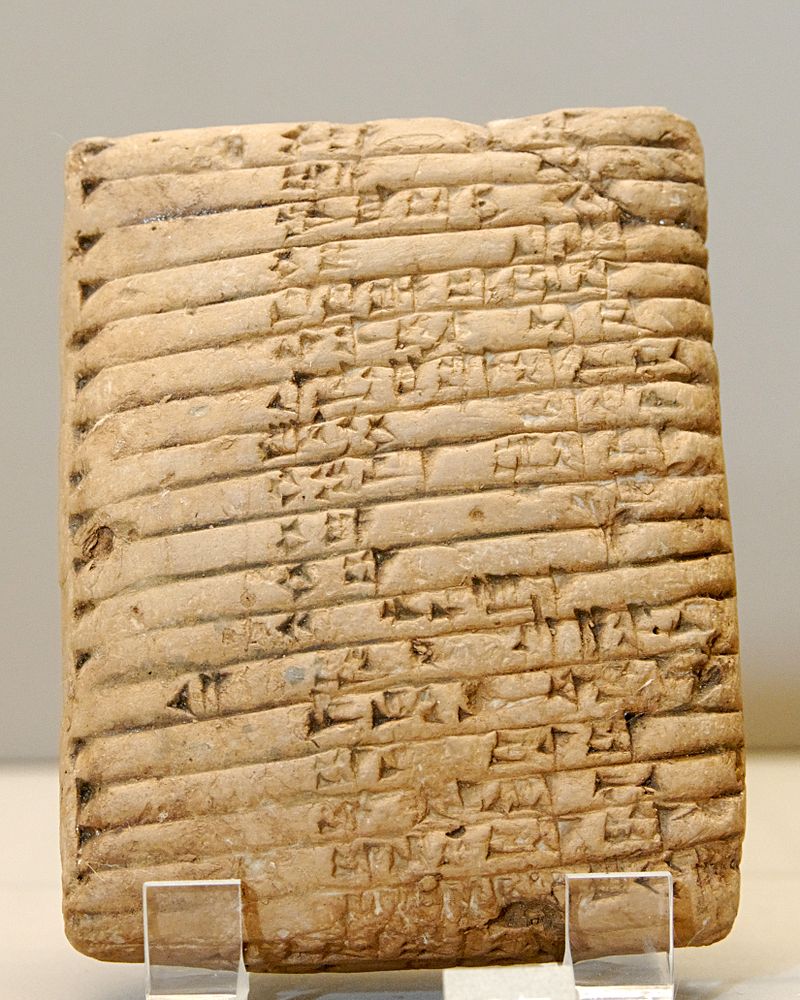
In Iran itself, Proto-Elamite script was in use. It is hard to pinpoint exactly the time that this region moves from history to prehistory, as the scripts are mostly indecipherable. It is however fair to say that peoples of south-western Iran had become at least partly literate at this point. Large urban settlements that can with justification be called cities exist in Susa, Godin Tepe and Tepe Sialk. A possible settlement existed at this time at Konar Sandal, but the Jiroft culture, of which Konar Sandal is part, is poorly studied (having only been discovered in 2001).
Possible ziggurat at Tepe Sialk
Around 2900 a huge mudbrick structure that may have been intended as a ziggurat was constructed in Tepe Sialk, in what is currently north-western Iran. This may be the oldest existing ziggurat in the world, if this is indeed the case. Around this time vessels have been found in nearby Godin Tepe that show signs of fermentation, which was probably intentional. This is perhaps the oldest indication of humans using alcohol, although it is likely that this long predates this find.
Around 2800 Shahr-e-Sukhteh seems to have been burned (thus ending the period known as Shahr-e-Sukhteh I). This was a city that was in eastern Iran, near the present-day border with Afghanistan. This was the largest city of the Helmand culture, which seems to have had contact with the Indus Valley Civilisation and to have formed a bridge between the Indus Valley culture and the cities and cultures to the west, like Susa and Tepe Sialk. "Shahr-e-Sukhteh" means "The Burnt City" and it lives up to its name, being burned down four separate times over the millennia. But it was also a vibrant cultural hub and was a very large settlement for its time.
Buildings at Shahr-e-Sukhteh
Around 2700 Elamite culture evolved from Proto-Elamite culture. It influenced, and was heavily influenced by, the nearby Sumerian culture of Lower Mesopotamia, but the Elamites certainly spoke their own language and had their own gods and political organisations. The writing script Linear Elamite, which is yet another untranslated Elamite script, dates from around this time. The interaction between Susa and Sumer seems to have been quite hostile at times, with Mesopotamian texts indication a possible war between the city of Kish and Susa during this era.
Also around this time, the Indo-Iranian languages may have begun to split off from Proto-Indo-European as a dialect. Of course this is very conjectural, but it is a plausible date.
Around the time of 2600 the Yamna culture, that had inhabited the steppes north of the Black Sea, seems to have evolved into what is known as the Poltavka culture, which might possibly be identified as the culture or homeland of the Indo-Iranian branch of Proto-Indo-European. This might suggest that other branches, such as Proto-Hittite, Proto-Tocharian, Proto-Germanic etc., had speakers that had migrated away from that particular area of the steppes, but caution is always needed in applying such broad brushes to complex language shifts.
Animation on pot from
Shahr-e-Sukhteh
Around this time Shahr-i-Sukhteh was flourishing and reaching perhaps the high point of its culture. One of the most fascinating artefacts to emerge from this period was a jar with four similar images on it, which when spun on a wheel would produce an image of a goat leaping up to a tree. This is the world’s earliest known attempt at animation. The Burned City was effectively producing the Photoshop or After Effects of the ancient world.
There were a number of other wonderful things that were being done here at this time though, with evidence that the inhabitants practiced a form of brain surgery (or cranial surgery to be more accurate). Much survives of the city because of a large graveyard outside the city, which may contain up to 40,000 burials. The remains of the city are now a UNESCO World Heritage Site.
Around the year 2500 a great many things seem to have been happening. This is probably an illusion, as archaeologists will, in the absence of fixed dates, round their dates to the nearest half millennium. So if something happened between 2700 and 2300 and you were unsure, you might just say it happened in 2500. So with that caveat in mind, let’s see what things archaeologists’ record happening for these years.
In the eastern steppes, the Afanasevo culture seems to have come to an end around this time and the Okunev culture seems to have come to prominence. The people of the Okunev culture may have come from further east, from the region near Lake Baikal. They raised sheep and cattle and buried their dead in slab tombs; buried face upwards towards the sky and with their earthly goods surrounding them.
Yamna Arrowheads
After the gradual decline of the Yamna culture, the Potapovka culture and the Abashevo cultures began to flourish to the north of where the Yamna culture had been before. These cultures resembled the Yamna cultures to some extent and used a similar pottery type, although again, it must be remembered that “pots are not people”. The Potapovka cultures in particular began to show horse remains in their kurgans, which were impressive and occasionally had wheeled vehicles as well.
Tepe Sialk appears to have been burned around this time, although the nearby Kura-Araxes culture may not have been at fault, as the settlement of Shengavit appears to be abandoned around this period as well.
In Elam, the semi-mythical Dynasty of Awan seems to have come to power around 2500. Awan may have been the city of Godin Tepe and the names of their kings survive from a king list. But like many king lists of the ancient world, even if the names are right, the order may be confused. It’s unclear if the kings of Awan controlled all of Elam and also not clear if they actually controlled Susa, which was a semi-independent city-state in its own right. The writing system known as “Elamite cuneiform”, as opposed to other systems such as Linear Elamite, or Proto-Elamite, was probably in use around this time, although no texts are extant from that exact era. Around this time the city of Lagash seems to have been dominant in southern Mesopotamia and the ruler, Eannatum, claims laconically to have conquered Susa.
Around this time the Kulli culture in Baluchistan began to flourish. This had some similarities with the other cultures such as the Jiroft and the Helmand cultures to the west and north but was most influenced by the Indus Valley Civilisation to its east. Numerous Indus Valley seals have been found and the art styles are very similar to each other. The main cultural difference is that the main Kulli site of Nindowari seems to have had a monumental mound, like a proto-ziggurat, that rose to 25 metres. This is in contrast to the Indus Valley sites, which do not seem have monumental architecture.
The city of Konar Sandal, in the Jiroft culture, seems to have reached the peak of its cultural output around this time, as does the nearby Helmand civilisation. However, true to its name of “The Burnt City”, Shahr-e-Sukhteh appears to have been burned down again around this time.
Around the year 2400, far away from Elam, or the steppes, or even the Tibetan Plateau, in the Arctic Ocean north of the Bering Straits, the last woolly mammoth on earth died. I find it astonishing that this last remnant of megafauna could have coexisted with the building of Stonehenge and the pyramids. It has nothing really to do with the rest of this blog, but I felt it was worth mentioning somewhere and it might as well be here.
Clay goddess figurines from Helmand Culture
Object on left from Mundigak
In what is present-day Afghanistan, the city of Mundigak flourished around this time, having close trade relations with the Indus Valley, but differing from them in having large mounds (possibly for temples or palaces) prominent in their city. Around this time, the cities of Tepe Yahya and Bampur (in present day south-eastern Iran) became prominent. It appears that not only did they trade with each other, but that they also traded across the straits with the civilisations on the Arabian Peninsula. This, along with evidence from Mesopotamia, is yet more evidence of a strong trade network connecting the Indus and the Tigris/Euphrates.
Stele of Naram-Sin,
an Akkadian conqueror
Around the year 2300, Susa moves very definitely into the realms of history, as the conqueror Sargon of Akkad conquered the city and its hinterland. The descendants of Sargon would have further campaigns in this area. Shahr-i-Sukhteh was once again burned, marking the end of the Shahr-i-Sukhteh III period, but this is unlikely to have been by the Akkadians, as it is very far from Mesopotamia.
This time period is also a possible date for the Maikop kurgan, north of the Caucasus. This was described in the last blog post in detail and the fact that the dates assigned to it are up to a thousand years apart means we must be very cautious with dating in this era.
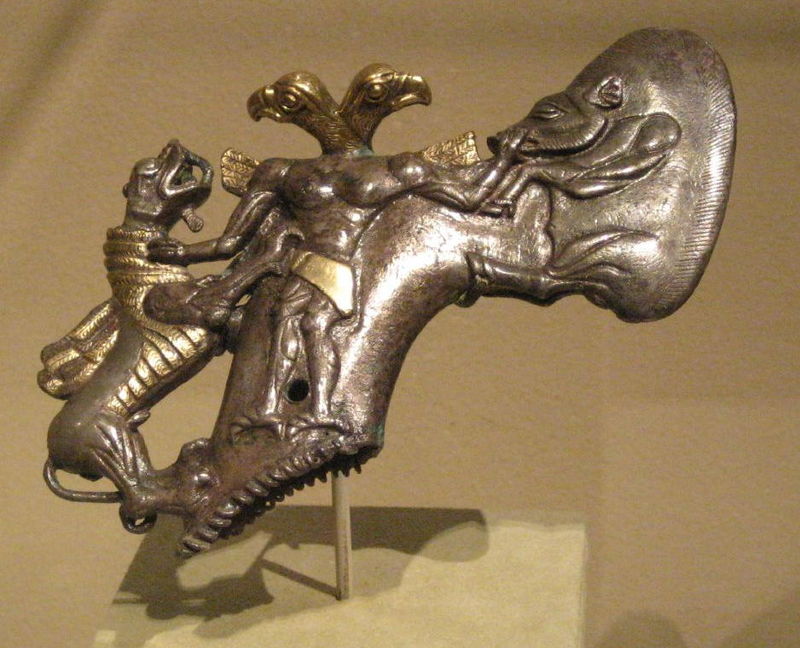
Also around this time the Bactria-Margiana Archaeological Complex emerges. This is often shortened to the BMAC for convenience. This was a culture in present-day Turkmenistan and northern Afghanistan. It was an urban civilisation, possibly a blending of Neolithic farmers from the region and migrants from what is now Iran. This area had been urbanised previously but around this time the cities, particularly the large city of Gonur Tepe, become very prominent. They had trading relationships with the cultures of Iran and the Indus Valley civilisation. They were possibly the first people to domesticate the Bactrian camel.
Most intriguingly a small seal has been found that was incised with hitherto unknown characters that vaguely resemble later Chinese characters. Some people extrapolate that the BMAC was a literate culture and that it was through them that the idea of writing passed eastwards towards the Chinese plains. This is extremely conjectural and should be treated with extreme scepticism. But the level of culture displayed by the BMAC, particularly at their “capital” Gonur Tepe, would certainly allow one to believe that they were literate.
Around the year 2200 the Helmand culture and the cities of Shahr-i-Sukhteh and Mundigak began to go into a decline. It is possible that the monsoon cycle was changing and that rains no longer reached as far north as they previously had. This is interesting as the Indus Valley Civilisation begins to experience some difficulties around this time. The rain-fed Ghaggar-Hakra River (sometimes referred to conjecturally as the Sarasvati River) seems to have begun drying at this time.
Susa Kinglist describing Awan Dynasty
The first definite texts of Elamite cuneiform date from this time, although as mentioned earlier, it was probably in use significantly earlier. The first texts seem to be treaties between the Akkadian kings and unknown vassals in the Elamite heartlands.
Around the year 2100 the Poltavka culture in seems to have come to an end and evolved into the Sintashta culture north of the Caspian Sea. Again, the Sintashta did not differ greatly from the Poltavka, nor the Poltavka from the Yamna. The main difference is that the Poltavka had substantially greater grave goods in their tombs. The Sintashta by contrast also had large amounts of grave goods in their tombs, but also chariots. The Lake of Krivoye Ozero was a place of burial for the Sintashta culture and the first true chariot burial in the world is there. The chariot was the first indisputable example of the horse as a weapon. Prior to the development of the chariot we have no way of knowing if horses were rode and it seems likely that they were more of a draught animal. But with the chariot, individuals could fight from a stable platform and move at great speeds in battle. A new age of warfare had begun.
Statue of goddess
dedicated by Kutik-Inshushinak
Further south, in Susa, the last king of the Awan Dynasty according to the Susa Kinglist, Kutik-Inshushinak, shook off the yoke of the fading Akkadian Empire and made Susa independent. He conquered Anshan, a city somewhere to the east of Susa, but whose location is not securely known. He then embarked on a building program and fostered the use of Linear Elamite. However, after the death of Kutik-Inshushinak the use of Linear Elamite would fade away, leaving Elamite cuneiform as the main writing method of the Elamites. After his death the Shimashki Dynasty, which may not have been a dynasty in any real sense of the word, ruled Elam. However, as is so often the case with Elam, we know very little about them.
As our period comes to a close, around the year 2000BC, we see the Kulli culture of Baluchistan coming to an end. This probably signals that the Indus Valley Civilisation, upon which the Kulli culture appears to have been based, was entering a period of difficulty and any influence on the hinterlands appears to have ending. It is around this time that the trade from Meluhha to Mesopotamia stops and the two civilisations drift apart, leaving each other as only a memory.
The Kura-Araxes culture south of the Caucasus comes to an end around this time and the Trialeti culture, based in what is now Georgia, come to prominence. The Trialeti are known for their spectacular kurgan burials and might possibly be counted as a steppe culture.
Gold goblet from Trialeti culture
Much further to the north and east, in Siberia, the Okunev culture comes to an end and the sprawling Andronovo culture. The Andronovo culture was in many ways an extension of the Sintashta culture. It covered a vast swathe of territory. The Andronovo region stretched from the north of the Caspian Sea past Lake Balkhash to the east and stretching into what is now Xinjiang in China. To the south it stretched down as far south as the BMAC, where it seems to have influenced the culture.
The Andronovo culture should in no way be thought of as a single group and definitely not as an empire but it is rather a cultural expansion, probably driven by the now perfected methods of chariot warfare. Every group on the steppe now adopted this new method or faced absorption by those that did. The transient nature of steppe life depended on the herds of livestock that could be kept. This means that any group that specialised in mobile warfare could steal the herds of those that did not with impunity. This gave a strong impetus for all groups to adopt a mobile form of warfare, in this case, the chariot.
Graveyard from Shahr-i-Sukhteh
In Elam, the city of Susa was conquered by the Ur III Dynasty in their expansion under their king Shulgi, but it won independence around the turn of the millennium under a Shimashki king known as Kindattu.
Ornament from Bactria-Margiana Archaeoligical Complex
Thus the period comes to a close, with Elam locked in a perpetual conflict with their Mesopotamian neighbours. The steppe cultures have mastered the two-wheel chariot and used it to expand greatly. The Indo-European languages have broken up into their main constituents, with the gradual eastwards movements of the Indo-Iranian speakers, possibly tied in with the Andronovo culture. A new and vibrant civilisation has arisen in the Bactria-Margiana Archaeological Complex, but is threatened by the chariot cultures to the north and changing climate patterns. The changing climate and trade patterns also threaten the Helmand and Jiroft cultures of south-eastern Iran. While there is a very great deal that can be written about the central area of the Eurasian landmass at this time, it must be remembered that what we write is nearly all taken from archaeology and linguistics and only a tiny fraction of the area, Elam and its hinterlands, are able to provide us texts for history proper. Hopefully this has shed some light however.
This post will look at the years 4000-3000BC for the region of Central Asia. Central Asia is a little tricky to describe and for the purposes of this post it will include the Pontic Steppes (referred to in previous European posts), the boreal lands north of Siberia and all the steppe lands from the black soil of the Ukraine, the highlands of the Tibetan Plateau, to the northern steppes on the borders of China. I will also include the history of the Iranian Plateau here. It is not Central Asian, but it does link the northern steppes with the regions of Mesopotamia and the Indus Valley. I have not spoken in great detail about Iran before and it is certainly worth including so I shall include it here.
The same caveats that I have mentioned before must be mentioned again. I am not a professional historian, merely someone who finds history interesting. So, everything presented here should be questioned heavily.
This period predates most writing, so much of what we learn will come from archaeology, with some additional input from linguistics, genetics, biology and geology. Dendrochronology is of less use here than in Europe, but we have the great fortune to be close enough to written history to be able to use folklore and legend here in a way that we have not been able to do in the posts about prehistoric Europe.
Goblet and cup of the Susa I type
To speak of the history of the regions of the centre of the Eurasian landmass, we must speak of what this world looked like in the year 4000BC. On the Iranian Plateau and north into the steppes west of the Urals, agriculture had been adopted and farming villages had developed into towns. Urbanisation was beginning in what is now Iran, spurred on by similar developments in the neighbouring Indus and Mesopotamian river valleys. The greatest of these cities, or proto-cities, was probably Susa, which was in the phase known as Susa I, where the two nearby settlements had merged to form a single walled settlement, with geometric style pottery abundantly placed in the graves of the inhabitants.
Further to the north was the city/proto-city of Tepe Sialk, which was at this time in the cultural period known as Tepe Sialk III. Somewhat surprisingly the climate of Iran seems to have been wildly different to what we think of today. What is now the vast desert of Dasht-e-Kavir, the Great Salt Desert, seems to have been a huge inland lake that could be sailed on as if a sea, and the monsoons of the Indian Ocean seem to have stretched up into the Iranian Plateau to water this paradise.
Lapis lazuli
Nearby Godin Tepe was established on an extremely early trading route where the beautiful blue stone of lapis lazuli was imported from Badakhshan (in what is now Afghanistan) to Mesopotamia. The Mesopotamians prized lapis lazuli highly and its brilliant hues illuminate many of their artworks. It might be compared to how our culture values diamonds, with the exception that lapis lazuli was perhaps rarer. To the ancient world, the only source of lapis lazuli were the mines of Badakhshan and any occurrence of lapis lazuli in archaeology is a sign of interconnections with this trading network.
To the east of Susa was the small settlements of Tall-i-Bakun and Rahmatabad Tepe, which, like the other settlements in what is now Iran, seems to have been involved in trade with the surrounding world and the burgeoning proto-urban centres of southern Mesopotamia. Doubtless the Iranian Plateau holds many such centres that are as yet under-studied. These are the ones that we will mention for now to give an idea of a landscape that was moving towards urbanisation and civilisation but, like its neighbours, was not quite there yet.
In the Pontic Steppes, north of the Black Sea, the speakers of Proto-Indo-European languages had begun to split up. The speakers of Proto-Anatolian, the parent language of Hittite, and the oldest branch of Indo-European, had probably already split at this point. As of this point however, the Indo-European speakers were probably just minor pastoralist tribes roaming on the grasslands with no inkling of the future of the languages they spoke or the mythologies they believed.
Further to the east through the vast steppes of Central Asia, through the deserts of the Gobi, we know less of the peoples who lived on this land. It is probable that the taiga was nearly uninhabited.
Around the year 3900 Susa seems to have come more heavily under the influence of nearby Mesopotamia and this period is usually referred to as Susa II. Many of the trappings of the Uruk period culture of Mesopotamia would be evident in Susa over the following centuries. While there were always substantial differences between Mesopotamia and the Iranian Plateau, in some ways it makes sense to think of them, or at least the periphery regions like Susa, as a single cultural area.
Figurines from the Kura-Araxes culture
Around this time as well the Kura-Araxes culture began to form. This was a mountain culture that flourished in the highlands of what is now Azerbaijan and Armenia. This culture seems to have had dealings with the steppe dwellers to the north but also trade links with the agricultural centres to the south. The culture also seems to spread quite rapidly throughout the mountain regions, and there is a strong possibility that the Kura-Araxes culture was spread through violence. It’s not clear what language these peoples spoke but it is a possibility that they spoke some version of Hurro-Urartian, or Proto-Kartvelian, as the speakers of these languages later inhabited these lands. But this is merely a hypothesis.
Around the century of 3700 the Botai culture began in what is now northern Kazakhstan. These people built small houses of wood and earth and had enclosures of fence poles. But their actual settlements were quite small. We shall speak more of this culture later.
Cromlech of the Maykop culture
Around this time, the Maykop Culture (also referred to as the Maikop Culture) began to flourish in the Kuban River basin, a territory that roughly corresponds to the area just north and west of modern Georgia, between the Black Sea and the Caspian. Here the burial practices were rather similar to the later Indo-European burial practices, with the prominent members of society being buried in holes that were later covered with large mounds. The grave goods of the Maykop culture were quite elaborate, including many beautifully carved items that are honestly some of the most beautiful pieces of art anywhere in the world from this time. The Maykop culture would exist between the later Yamna culture to the north and the Kura-Araxes culture in the Armenian Highlands to the south and may have served as a cultural bridge between the two.
Around the year 3500 it seems likely that the wheels were in use among the Maykop culture and other cultures in the area. The Mesopotamians also had developed the wheel, as had the Balkans cultures in Europe. Perhaps these inventions were independent or perhaps there was a common source. At this stage we don't know for sure. Some have assumed that this means that horses were domesticated around this time, but we know that the Sumerians at least did not have domesticated horses. It is likely that the first wheeled vehicles were pulled by oxen (donkeys were probably only domesticated some centuries after the wheel had already been invented).
Around this time, the Tocharian languages, a branch of Indo-European probably broke off from the main language family. The speakers of these languages were probably moving eastwards, towards the towards and around the lands of the Botai culture. Eventually they would settle in the Tarim Basin in what is now present-day China. Their languages have gone extinct but are known through (much, much later) manuscripts. Their existence is a reminder that much language data has simply been lost to us. Had the manuscripts of the Tocharians not come down to us we might never have known that their language had ever even existed.
The settlements of the Bakun culture, such as its type site of Tall-i-Bakun (near the later Persian capital of Persepolis) seem to have fallen into decline and disuse around this time, as cultures overlapped, grew, struggled and merged over the centuries in a ceaseless whirl that we can only glimpse at by examining their pottery sherds.
Circa 3400 the Botai culture, in what is now Kazakhstan seem to have given us the first real evidence of the domestication of the horse. Horses could be used for meat, for their hides and for their milk (depending on whether the people of this culture were lactose tolerant). Cultures that had mastered the use of the wheel for human or oxen driven transport could also turn their captive horses to pulling carts. It is unlikely however that the earliest domesticated horses were ever ridden. The horses would have been quite small and may have been unable to bear the weight of riders. So, it would be a mistake to picture the Botai culture as a society of nomadic cavalry warriors. But it did lay the foundations for further developments.
Przewalski’s Horse on the Mongolian steppe
Now, it’s not exactly clear when and where the horse was first domesticated, but it would seem that the horses domesticated by the Botai culture were actually a rare breed of horse known as Przewalski’s Horse, or the Dzungarian horse. After the disappearance of the Botai culture these horses became feral and became effectively a wild species. So, we’re still not sure exactly where modern horses were domesticated, but it cannot have been too long after the Botai culture had domesticated the Przewalksi’s horses.
We should not picture the Botai as cavalry warriors. but we do know that they took great pride in the appearance of their horses and that they apparently bred horses for their colours. The pattern that they seem to have selected for was a white coat with small black spots on it. So, we can picture the Botai as effectively trying to domesticate their horses to look like Dalmatian dogs, which is an interesting mental image.
Around the year 3300 the Yamna culture began to thrive on the Pontic Steppes, north of the Maykop culture in the Caucasus. This is usually seen as the homeland for the Indo-European speakers and the place where they were able to either domesticate, or obtain domesticated, horses. These horses would allow the tribes to become highly mobile, as their hardy creatures would provide them with milk, hides and food while also pulling along goods and supplies behind them on carts. As these horses became more useful, the people of the Yamna culture would have tried to refrain from killing them (at least immediately), turning them into almost sacred creatures, but also relying more on oxen for their meat. These two animals, the horse and the cow, would become extremely important for the Indo-Europeans.
Pot from Yamna culture
It’s not totally clear that the Yamna were Indo-European speakers, but there are a number of clues that strongly suggest it, such as the fact that their land is near the centre of the Indo-European speaking lands, and thus would be a plausible homeland for them. There are certain genetic arguments as well, but as I am even less of a geneticist than a historian, I will simply say that there are some genetic reasons to believe that the Yamna are probably the original Indo-European speakers. However, it is important to remember that peoples are not languages and languages are not cultures, so identifying the Yamna as the "homeland" of speakers of Proto-Indo-European must be done with caution.
If these were the Indo-European speakers then we can speak a little about their religion. They worshipped a sky god who was king of the gods, whose name meant “Sky Father”. They also worshipped the sun or the moon, but not as their most important gods, as sometimes the gender of the he-god or she-god of the sun would differ from culture to culture. There were hero twins associated with horses, some myths of dragons and a world tree, a vague idea of a dark underworld where humans went after they died and other myths and legends. We can guess at a lot more, based on the mythologies of the later peoples who followed after but I feel that we cannot know much more than I have stated for certain. And that whereof we cannot speak, thereof we must be silent.
We can hear and read reconstructions of what some linguists believe this language to have sounded like. Here is a Youtube video of someone reading a fable in Proto-Indo-European. The fable was written by a linguist called August Schleicher in 1868 and is not ancient. But the constituent words are ancient and it is a fascinating window into a reconstructed ancient world. The translation is below:
The Sheep and the Horses A sheep that had no wool saw horses, one of them pulling a heavy wagon, one carrying a big load, and one carrying a man quickly. The sheep said to the horses: "My heart pains me, seeing a man driving horses." The horses said: "Listen, sheep, our hearts pain us when we see this: a man, the master, makes the wool of the sheep into a warm garment for himself. And the sheep has no wool." Having heard this, the sheep fled into the plain.
Around the same period as the Yamna Culture was beginning to thrive, the Afanasevo Culture (or Afanasievo Culture) began to flourish in southern Siberia, farther to the east than the Botai Culture. These may have been the first farmers in the region, bringing with them oxen and shortly afterwards, horses. Possibly these are to be associated with the Proto-Tocharian speakers whose language has been previously mentioned as separating off from the main Proto-Indo-European language group some centuries earlier. If this is the case then this would be a sign of rapid expansion by the speakers of the Indo-European languages.
Settlement at Shengavit, near Yerevan
Around the year 3200 the settlement of Shengavit was founded near present-day Yerevan by the Kura-Araxes culture. This was a small urban settlement, surrounded by a wall. It is possibly the most important settlement of the Kura-Araxes culture and contains a number of graves. Some believe that horses were found at this site, but these are probably from later burials that were sank into the ground through the archaeological strata, thus possibly appearing earlier than they in fact are. The fact that the walls were so large would suggest that they were for more than demarcation or keeping in livestock. It would suggest that the Kura-Araxes culture was a warlike one and that the builders of the proto-city believed that they would possibly face some form of attack.
Proto-Elamite writing
Around the year 3100 the Botai culture seems to come to an end, although it is not clear why this is the case. Far to the south, the city or proto-city of Susa enters the Susa III period, which is also the beginning of the Proto-Elamite Period. Most importantly, the Proto-Elamite script came into use in Susa around this time. This is a largely untranslated script but we can know that it was influenced by the cuneiform writing of the Mesopotamians, as it used a number of their number symbols. The exact language is unknown but is likely to have been the Elamite, or Proto-Elamite, language, which is not well known in any case. There is a possibility of an earlier script originating from Jiroft, but this is marred by the possibility of forgery and its archaeological context is not clear.
It has been believed that the Maikop Kurgan, a large ceremonial burial centre, in the Kuban River Basin, and the type site for the Maykop culture, was built around this time. The grave goods here are spectacular. There is also the more sinister addition of two women skeletons, who may have been sacrificed at the funeral of the dead ruler. If this date is correct then it may mean that this was the most elaborate burial from that time that has been discovered. The Hermitage Museum in Russia preserves some of their golden statues and clothing decorations. The man who was buried here must have been a chieftain or a king of great wealth. I will quote from the book “The Horse, the Wheel and Language” where the author, David W. Anthony, describes the contents of the kurgan.
With him were eight red-burnished, globular pottery vessels, the type collection for Early Maikop; a polished stone cup with a sheet-gold cover; two arsenical bronze, sheet-metal cauldrons; two small cups of sheet gold; and fourteen sheet-silver cups, two of which were decorated with impressed scenes of animal processions including a Caucasian spotted panther, a southern lion, bulls, a horse, birds, and a shaggy animal (bear? goat?) mounting a tree. His tunic had sixty-eight golden lions and nineteen golden bulls applied to its surface. … Around his neck and shoulders were 60 beads of turquoise, 1,272 beads of carnelian, and 122 golden beads. Under his skull was a diadem with five golden rosettes of five petals each on a band of gold pierced at the ends. … The turquoise almost certainly came from north-eastern Iran near Nishapur or from the Amu Darya near the trade settlement of Sarazm in modern Tajikistan, two regions famous in antiquity for their turquoise. The red carnelian came from western Pakistan and the lapis lazuli from eastern Afghanistan. Description of the Maykop Kurgan from "The Horse, the Wheel and Language"
The author correctly points out that these items almost certainly came from the south, in that the lion was a Mesopotamian symbol of power and that the lands of the Maykop culture lay beyond the original range and habitat of the Asiatic lion. So, this ruler dressed himself in beads acquired through trade and bedecked himself with the symbols of royal power from another culture. We will almost certainly never know who they were, but the resplendence of the burial is worth remembering. It should be noted however that this date is far from certain for the Maikop kurgan and it may date from a later period, perhaps as late as 2300BC. This would still be impressive, but would certainly give a different context to the kurgan.
Around the end of the fourth millennium, around 3000BC, some believe that the Maykop culture drew to a close. This is obviously debateable. Clearly if the Maikop kurgan is from 2300BC then the culture continues for far longer, but all of the dates given here are by their nature speculative.
To the north of this region the language group Proto-Finno-Ugric may have branched off from Uralic. There is no real agreement as to exactly where these people lived (and languages do not correspond exactly with ethnic groups, and certainly not with genetics). But it is important to remember that all of the language groups that would come to be spread across Eurasia were in existence and spreading and splitting and changing, as language groups always have and always will.
Mountains in the Tibetan Plateau
In the Tibetan region there seems to have been an influx of migrants to the Tibetan Plateau around this time. These people seem to have come from what is now the northern Chinese Plains. However they also may have brought with them a unique adaptation for the mountains. There is a gene, which may be inherited from the Denisovans; that helps control red blood cell production and allows humans to function better at high altitudes without developing oxygen sickness. This gene allowed the inhabitants of the plateau to function and thrive where others would have surely perished. The original inhabitants of the mountains may possibly have had this gene, EPAS1, as well (remember that I am not a geneticist), but certainly the newcomers thrived with its help.
Finally, in Anatolia, the city of Arslantepe was burned around this time. This city was probably a trading colony, or possibly even an actual colony, of the Uruk culture from Mesopotamia. Later on the site would be rebuilt and would once again feature in the story of mankind but for now it was thoroughly destroyed. The culprits would appear to be the warriors of the Kura-Araxes culture, whose pottery now begins to appear in Anatolia and then to spread down into the Levant. The direct Mesopotamian influence on the region would fade around this time.
Before bringing the blog to a close I think it would be useful to discuss some historical issues that sometimes come up from looking at this period of history. Firstly, the question as to what is the oldest civilisation. A lot of countries currently lay claim to having the original civilisation, or the origins of civilisation, within their borders. A lot of these claims are quite legitimate. Iraq, Egypt, Iran, Turkey, Syria, Jordan, India and others have quite legitimate claims in this regard. Even European countries like Malta, Bulgaria, Romania, Moldova or Ukraine could make similar claims: The difficulty lies in deciding what makes a civilisation.
Iraq is home to ancient cities and is probably the origin of writing. Syria, Iran and India all have urban centres that unquestionably are earlier than the southern Mesopotamian cities (although Mesopotamia also has towns from this era). Many cultures have symbols that could potentially be interpreted as proto-writing. The Egyptian kingdom founded by Narmer/Menes is the world’s first unquestioned state. The site of Gobekli Tepe in Turkey is the oldest known temple or sacred site in the world and Turkey/Iran is the probable home of agriculture in Eurasia.
The splendour of the burials in the Varna Necropolis of Bulgaria would give Bulgaria a good claim to the crown of civilisation, while the Cucuteni-Trypilia culture in present day Romania/Moldova/Ukraine had probably the largest urban settlements in the world in the year 3200BC, although they were abandoned shortly thereafter. Malta, with its ancient temples of the Stone Age, long before the Pharaohs ruled, could claim that this was civilisation and that it was the first. And surely the great megalithic constructions of Western Europe, with giant works like Knowth or Avebury could be considered the works of a civilisation?
So we can see that the question has many possible answers and that, while there are definite wrong answers (anyone who claims that civilisation started in Antarctica or the Azores would be wrong), there is no single right answer. What we should do instead is to question what we mean by civilisation, break it down into its constituent parts, and figure out where the constituent parts started. Questions like “Where was the wheel first used?” have an answer, even if we may not know it for certain right now. Questions like “Where did civilisation start?” do not really have a well-defined answer.
Later artwork of the Jiroft culture, c2500BC
It should be noted that I have not discussed the Jiroft culture in south-eastern Iran in this blog. This is because it has only recently been discovered and there is much work to be done on it. Unfortunately I was unable to find much solid information on this culture, as it was apparently discovered by a looter, who was afterwards caught, which spurred excavation of the site. However, there are few major papers on this that I could find, and those that I could find seemed to require confirmation. It has been speculated that Jiroft is as important a civilisation as the Indus Valley or Mesopotamia, but extraordinary claims require extraordinary evidence and at this moment, that is lacking. Hopefully more information will be available soon.
While discussing the Maykop culture I mentioned the book, The Horse, the Wheel and Language, which is an interesting book but, while I would recommend reading it, I would give some notes of caution about it. Firstly, I am wary of the idea that the steppe tribes such as the Botai actually rode their horses. Horses that we know today have been shaped by the selective breeding from domestication and their physical shapes have changed. Because no wild horses exist today, we do not know what the original horses looked like, but it is a plausible guess that they were unable to support a fully grown man on their backs. Evidence of bit-wear on teeth is not good evidence here. Horses may have had bits to help them in drawing sleighs, ploughs or later wagons.
Proto-Elamite Pottery found near Susa
exhibited in the Louvre
We know that when horses came to the Middle East around 1600BC that the people of the Middle East used them for chariots and that cavalry was only introduced much later. Similarly, we know that later steppe cultures used chariots, suggesting that cultures like the Botai could not ride their horses (or at least could not ride them into battle). The author suggests that rather than developing into cavalry the steppe tribes used the horses to raid in a more disorganised fashion. But it is still interesting that the cultures of the Middle East never developed this behaviour. The domestication of the horse was probably more as a source of meat/milk/skins/draught animal and only later as a weapon of war. On this point I could of course be proved wrong.
So this sums up some of the crucial developments in the history of the world that occurred between 4000-3000BC in the vast stretches of Central Asia. For the next blog we will be looking at the same region but for the millennium that follows it.