Showing posts with label Austronesian. Show all posts

Saturday, 15 September 2018

Some history of New Guinea and the Pacific Islands from 4000-1BC

Aerial Photo of Kuk Region where the inhabitants of
New Guinea developed agriculture independently
This is a post about the history of New Guinea and the Pacific Islands from 4000-1BC. The reason that I am covering a period of 4000 years, which is a long time, is because the history of these regions is interesting, but for large swathes of it there is simply not much that can be said at the moment. Archaeology, historical linguistics, paleo-biology and genetic studies will almost certainly change this picture over the years. As always, I am not an expert in this subject matter. I have some knowledge of the history of Assyria and Greece and other such culture, but for these type of blogs I am at least partly writing about these regions to give myself an excuse to learn some new history. So, in short, I am very far from an expert and these blogs should be treated with great caution before using as a source.

Unlike nearly every other region we have looked at so far, the Pacific islands (of Polynesia, Micronesia and Melanesia) are probably uninhabited when we gaze out upon the world of 4000BC. However, the island of New Guinea was very definitely inhabited and has been estimated to have been inhabited from about 40,000BC.

Around the year 7000BC the people of New Guinea had independently developed agriculture. This makes it one of the few places in the world to have unequivocally developed agriculture in isolation. Their type of agriculture was a very different one to the grain and pulse based agricultural revolution in the Near East. This type of agriculture is known as swamp garden agriculture and involved controlling water flows out of a natural basin to create a large swamp. This was then extensively farmed for crops such as taro and bananas.

This is not only a huge achievement, effectively replicating the Neolithic revolution independently, but it also made the island of New Guinea quite densely populated relative to other parts of Southeast Asia, which were still reliant on hunting and gathering for survival. This will become important in the history of the Pacific. Sadly, despite developing agriculture so early, the subsequent history of the island of New Guinea is less well-known, at least by me, and there is not much more that can be said about it by myself.
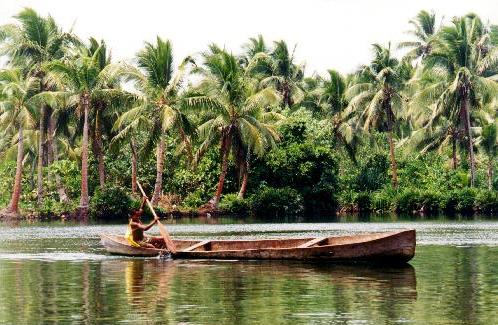
Dugout canoe in the Solomon Islands
Around the year 4000BC, as mentioned in the previous blog about the history of Southeast Asia, the Austronesian speakers possibly began to migrate from the island of Taiwan to the Philippines. There is not much more that can be said about this time, save that over the next fifteen hundred years the speakers of certain Austronesian languages had made their way southwards through the islands of the Philippines and had migrated to the island of Sulawesi. This island is to the south of Mindanao in the Philippines. From here certain groups moved west, but the ones that concern us, moved east to the island of North Maluku. By about the year 2000BC there were Austronesian speakers along the coasts of New Guinea, with population clusters near Cenderawasih Bay on the north-western coast of the island of New Guinea.

However, here the Austronesian speakers had some difficulties expanding. Unlike previous areas, where they arrived from the sea bearing knowledge of sailing, fishing and agriculture and had been able to at least partially displace the hunter-gatherer populations, the peoples of New Guinea were not displaceable. Having already developed their own form of agriculture and having achieved a relatively high population density the peoples of New Guinea were not absorbed by the newcomers. By this time the Austonesian arrivals, whose cultural ancestors had travelled all the way from Taiwan, were certainly familiar with the sea, sailing and voyages into the near unknown. Moving by short hops along the shore of New Guinea they expanded eastwards along the coast without moving substantially inwards, eventually coming to the Vitiaz Straits.

Probably around 1500BC these speakers of Austronesian languages, whose language families had now diverged enough from Austronesian to be referred to as Polynesian, made the jump across the Vitiaz Straits to the shores of the island now known as New Britain and from there across the small St George’s Channel to what is now known as New Ireland and from there to the other islands of the Bismarck Archipelago. These islands were already inhabited by hunter-gatherers whose ancestors had previously sailed from New Guinea or crossed via land bridges during the fallen sea levels during the times of the previous glaciations.

The Polynesian navigators, who must now have become quite confident and skilful and crossing from island to island now began to expand to the Solomon Islands to the east and south of the islands of New Britain and New Ireland. Here again there were original inhabitants who mixed with and interacted with the new Polynesian culture, but it is unclear whether or not the local populations of these islands survived the contact with the Polynesian navigators.

Lapita culture pottery
From around 1300BC we see a distinct pottery culture that is now known as the Lapita culture. While the usual cautions of “Pots are not people” still apply, it is quite probable that the original pottery culture that spread across the islands of the south Pacific at this time was the work of a single culture.

Around 1300BC the Polynesian navigators, by now adept at crossing distant seas, reached Santa Cruz at the end of the Solomons Chain and the islands of Vanuatu, which lay to the south and west of the Solomon Islands. These were uninhabited lands and it is here that the Polynesian expansion can be truly said to have fully begun.

There are a few different accounts of the history of the settlement of the Pacific Islands. They normally differ in how long the ancestors of the Polynesians spent in the area around New Guinea. Some models see the migration has happening almost directly from Taiwan, bypassing the Philippines and the Indonesian islands. This is certainly possible I guess, but the version of the story that I have given above is plausible. Regardless of which theory turns out to be the truest one, it is known that the Lapita pottery horizon occurs around 1300BC and that this was very definitely associated with the Polynesian expansion. So, all the models converge around the Bismarck Islands around 1300BC.

The Lapita culture began to expand its frontiers around this time. The reasons for this expansion are simply not known. Perhaps those who had organised the initial migration to the Bismarck Islands had consolidated power among themselves and their families. When questioned about these arrangements they justified their power in the concept that they had organised the sea trip and that if other families wished to rule, that they should find a new land to rule in. This is of course speculation but the islanders seem to have gone on a flurry of new settling and colonisation expeditions.

Aerial view of Mango Island in Tonga
By the year 1000BC the Polynesians had settled New Caledonia, Fiji, Western Samoa and Tonga. These were all new territories and even though they were small, they were able to support decent population sizes. As resources became scarce on one island, the incentives to jump to a new island would increase, but those that remained would be able to switch to different food-gathering methods and sustain their lifestyle on these islands. As each island was colonised in rapid succession, there was no reason to forget the sea routes that had taken them there, so the islands seem to have traded items with each other, particularly obsidian. This could be used for weapons, as technically these advanced mariners were still in the Stone Age, but obsidian was not available everywhere. The Lapita cultures kept up their trade contacts. An experienced group of high-status navigators must have arisen to carry out this high-risk trade and to occasionally engage in the even more dangerous business of exploration for new lands.

Some of the people from the time of the Lapita culture have been preserved in the cemetery of Teouma, on Efate Island in Vanuatu. The cemetery is around three thousand years old and is well preserved. The remains show that the people of Vanuatu were genetically quite close to certain people groups currently in the Philippines, suggesting that the Polynesian populations did not mix much with the groups in the Solomon Islands. But this is hard to know for sure, as there were only a few genetic samples taken. The genetic samples were all from women as well, and if there was a matrilineal culture this might affect the sampling. Another important Lapita site from this era is Mulifunua in Samoa. This was not a cemetery, but a living area, which yielded a large amount of pottery and some tools and is useful in showing not only the Lapita lifestyle, but also how far they had reached at that time.

Samoan outrigger
Over the next few centuries the expansion continued further west and north. The Mariana Islands far to the north were settled. These dates are a little odd to me, as it would seem that the navigators bypassed a large number of other island chains to reach the Marianas. Perhaps the dates are wrong or the sequences of colonisation are wrong. Nevertheless it is extremely likely that Saipan, Guam and the other Mariana Islands were reached by the Polynesians by at least 500BC and possibly a great deal earlier. It is entirely possible that the Marianas were populated by a separate expansion from the Philippines, possibly as early as 1500BC. This honestly makes more sense than tying it in to the other Polynesian expansions further east.

Less controversially, Nauru, Niue and the South Cook Islands were also discovered and inhabited, probably before 500BC. Now however the distances were becoming vast. The Lapita culture was spread over such a territory that it simply ceased to exist as a unified entity. The Lapita peoples traded with the Papuan islanders who probably began to migrate from New Guinea and the Solomon Islands, into the islands inhabited by the Lapita cultures. The melding of the Papuan and Lapita groups led to the groups that we now know as the Melanesians. The Melanesians spread as far as Fiji, which stands at the crossroads between Polynesia and Melanesia.

The Lapita culture itself simply ceases to exist after 500BC. The distances needed to maintain trade and contact simply cause the trading network to break down. The Polynesians to the east seem to have stopped making pottery altogether over the next centuries. This period is poorly known, as there is little archaeological evidence but it is too early to rely on the oral traditions of the later Polynesians.

Model of an outrigger canoe that could be used
to cross the oceans
Over the next centuries the Polynesian seafarers may have reached the islands of Micronesia, such as Tuvalu, the Caroline Islands and Kiribati. They may even have reached outer islands of Eastern Polynesia, such as the Tuamotus and Tahiti. But in the absence of any real archaeological evidence it is hard to pin down anything even close to exact dates. It is also possible that islands were settled several times. Pitcairn Island was later inhabited by Polynesians before the colony either evacuated or died out. It is possible that certain expeditions achieved initial success before ultimately failing.

The important thing to remember is that by the time Augustus in Rome, the Polynesian navigators had explored and settled a gigantic region in the southern Pacific and were reaching out to expand their settlements on to other regions. By about 1300AD nearly every island in the Pacific would be settled by either Polynesians or Melanesians or by both groups together.

Before genetic and linguistic evidence was combined with archaeology and the finds of the Lapita culture it was a mystery as to where the Polynesian peoples had come from. When the Europeans met these people, they found Stone Age societies that had nevertheless managed to sail to the most remote regions of the earth. The Europeans were baffled as to how this had occurred and this bafflement continued into the 20th century.

An adventurer by the name of Thor Heyerdahl thought there was a possibility the explorers had come from the South American continent. His ideas were crazy, but at least parts of them sounded like they might be plausible. To prove that his theory was at least possible, Thor Heyerdahl and a band of like-minded adventurers, (including some veterans of the Norwegian resistance against the Nazis) set out on an expedition to sail across the Pacific using a raft called the Kon-Tiki, sailing from South America towards the setting sun and the South Seas.

The expedition was successful and has triggered a wave of similar attempts to recreate ancient voyages (such as Tim Severin’s crossing of the Atlantic in a boat like the Irish monks used). Thor Heyerdahl wrote about the experience in a book called “The Kon-Tiki Expedition: By Raft Across the South Sea”. I remember reading it as a child and being enthralled by the book and by the idea of a noble adventure to push the limits of science and history.

The Kon-Tiki raft in a museum in Norway
However, as inspiring as the expedition was, genetics and linguistics have very firmly placed the Polynesian ancestors as migrants from East Asia, and the Melanesians as migrants from the New Guinea region. There is a possibility that later Polynesian navigators reached South America and returned with certain plants, such as the sweet potato. These claims are yet not as of yet substantiated and would fall outside the timeframe of this blog post even if they had definitely occurred. So, if while researching the settlement of the Pacific islands you come across the works and theories of Thor Heyerdahl, by all means read them with pleasure but just be wary of accepting them uncritically, as much new evidence has since come to light that contradicts his theory of settlement from South America: an interesting idea, nobly pursued, but ultimately incorrect.

Tuesday, 11 September 2018

Some Southeast Asian history from 4000-2000BC

Mountains in Yunnan Province in southern China
This is a post about Southeast Asian history from 4000-2000BC. The reason I am covering two millennia rather than one is that the history of this area, while still interesting, has comparatively less happening than in Africa or Europe for example. I am not an expert on this time period at all and there is much that is still unknown and being discovered by archaeologists, but the broad outlines of what I will describe here will hopefully be mostly correct. The dates presented here will be very broad estimates and may well be wildly off. This is a time before writing in this part of the world so the main sources will be entirely archaeological, but I may make some references to later myths and legends.

For the purposes of this blog, Southeast Asia will be held to comprise the lands of Myanmar, Thailand, Laos, Vietnam, Cambodia, the Philippines, Malaysia, Singapore, Brunei, the archipelago of Indonesia and East Timor. There are strong reasons for including Taiwan and southern China within the remit of this piece, but these will be covered elsewhere I think.

Prior to the year 4000BC nearly all of Southeast Asia was inhabited by modern humans, with the possible exception of some small islands in the archipelago. It is thus likely that the inhabitants of these regions were quite comfortable with seafaring. The inhabitants may have been the ancestors of the groups such as the Ati and Aeta peoples of the Philippines, who appear to have been in the region before the later waves of migration occurred. While the entire area was inhabited there is less evidence for this habitation. The reason for this would seem to be that the climate is hot, damp and humid and would quickly consume any evidence of wooden structures. The actual footprint of these structures was also reduced, as in many cases the buildings would have been raised on stilts, meaning that that a large settlement might only leave a few hundred post holes, which could easily be missed by archaeologists and would leave no mark on the landscape to indicate where to dig.

Sunset on the coast of Sulawesi
Before 4000 rice and millet agriculture had begun to be adopted in southern China, from where they would eventually spread across the mountains of what is now Yunnan province and into southeast-Asia. In Vietnam red slip pottery was being produced near the Red River Delta, but it does not appear that the inhabitants were fully using agriculture at this point. In Thailand there is a long history of occupation at a cave referred to as Spirit Cave, which shows occupation levels around this time. The primary artefacts found in Southeast Asia at this time are known as Hoabinhian, which refers to a type of flaked stone implements that were used by the peoples of the region. It is named after a type site called Hoa Binh in Vietnam. It was used for so long and over so wide an area that it was probably not a culture per se, but rather it was a very persistent tool-making method that was retained by many cultures over a long time.

From a linguistic perspective, the mainland of Southeast Asia was probably populated by speakers of Proto-Austroasiatic languages, which would later diverge to form language groups such as the Khmer and Vietic languages. The speakers of Austronesia languages were situated in the island of Taiwan at this point in history and had not yet begun their epic migrations that would see their language family stretch from Madagascar to Easter Island. Other languages such as Tai languages group or the Lolo-Burmese portion of Sino-Tibetan were not yet much spoken in the region, as the speakers of these languages came in later migrations to the region.

At some point after the year 4000BC some speakers of Austronesia languages began to migrate from Taiwan to the island of Luzon and from there to the rest of the Philippines. The migration is unlikely to have started much before 4000, but was probably not later than 2000, so now is as good a time as any to mention it.

While much may well have been happening in the region there is little that can be said with certainty for the next thousand years. The nature of the region simply does not permit much to be said. There are forest clearances in Java around 3000BC that would suggest that agriculture or proto-agriculture was beginning to spread through the region but it is hard to pinpoint this for definite. The supposedly very early dates for agriculture given by some archaeologists working in Thailand is almost certainly incorrect.

Red River Delta in northern Vietnam
Later Vietnamese writers of history identified a legendary dynasty beginning around 2800BC. This is extremely ancient and there is no real evidence to support this. The dynasty was referred to as the Hồng Bàng dynasty and was supposed to have ruled in what is now northern Vietnam, near the Red River Delta. This dynasty reigned over a kingdom that was supposedly called Văn Lang. It should be noted that the history of Vietnam, while undoubtedly ancient, was also affected by a number of destructive wars fought with the Chinese, which seems to have destroyed a certain amount of records. As this dynasty is only really referred to by later writers from the 15th Century AD and there is no archaeological evidence for it, we should probably relegate this kingdom to the realms of legend. However, it would be correct to state that the Red River Delta would be important to the later history of the region.

Around the year 2500BC pigs were introduced to Timor, suggesting that farming practices were beginning to spread through the region. By this time the speakers of Austronesian languages seem to have spread throughout most of the Philippine archipelago. They did not wipe out the original inhabitants of the land but they did occupy most of the coastal areas and the peoples such as the Ati moved inland to become forest dwellers. These forest dwellers eventually abandoned their own languages and spoke Austronesian languages as well.

Around this time the speakers of Austronesian languages seem to have reached the coastlands of Borneo, Sulawesi, and possibly Timor. If this is the case then they were bringing agriculture with them. Interestingly, the Austronesia peoples had no success in spreading to the island of New Guinea, as the inhabitants there had already developed their own indigenous form of agriculture and had a sufficient population density to absorb the newcomers instead of being absorbed by them.

Around the year 2100 the site of Ban Chiang in Thailand was occupied, although this date is contested and it might be some centuries later. This site would later produce some spectacular pottery and impressive bronze works, but the earliest layers of the site were still Neolithic. The people who lived here buried their dead near to their homes and had established a permanent settlement. This either meant that they had reached a fully agricultural phase or had managed to attain a stable hunter-gathering state such as the Jomon of Japan had reached around this time.

Nephrite Jade such as that traded between
Taiwan and the Philippine islands
Around the year 2000, as the period which we are examining draws to a close, regular trade contacts begin to appear between Taiwan and the Philippines. Both island groups spoke mostly Austronesian languages at this point and may have shared vaguely similar cultures. The mainland cultures in China prized jade highly and the Taiwanese islanders also became enamoured of the beautiful stone. Jade items began to be traded between the islands of the Philippines and Taiwan. In some ways this high status good had similarities to the lapis lazuli trade in the Middle East at that time. It is one of the earliest well-defined trade routes in the region.

By the closing of the period we are certain that wet-rice agriculture and millet farming had been introduced to areas such as Laos and northern Thailand. Around this time, the Hoabinhian methods of making stone tools seem to be gradually phased out across southeast Asia, as the inhabitants of the region shifted their tool production to match their increased use of agriculture.

In northern Vietnam the Phung Nguyen culture began to flourish. Here as well, we begin to see definite evidence of farming in a recognisable fashion. In southern Thailand the Khok Phanom Di site began to be occupied. It comprises a series of burials near habitations from the late Neolithic to the Early Bronze Age. The inhabitants of Khok Phanom Di may not have been full agriculturalists at the beginning of the settlement however, as they seem to have eaten a great deal of fish, suggesting a more hunter-gatherer lifestyle.

Reconstruction of hunter-gatherers in Ban Chiang
Thus the period draws to a close. Sadly we can say far less than we would wish to say. I suspect that much of the history of the region has simply been swallowed by the region’s environment but I also hope that the years to come will shed much light on what the patterns of growth and change in Southeast Asia.

Before ending the blog I would like to address a few historical inaccuracies that I have seen while researching this blog. I have noted that a number of countries tend to extend their history further back than is justified. I suspect that there are nationalist reasons for this but for whatever reason, it is inimical to history and should be avoided.

The site of Gunung Padang
A rather more specific flaw is Gunung Padang. Gunung Padang is an archaeological site in Indonesia near an extinct volcano. It is believed to be a pyramid of huge size and extraordinarily ancient date. While I don’t want to be too sceptical I am deeply unconvinced by this site. The entire area looks like it is natural. Sure, there are orderly and regular formations but volcanic rocks like basalt are often regular. The local inhabitants have shaped some of the stones into something resembling temples and such like but this does not change the fact that the rocks and structure are almost certainly a natural phenomenon. Perhaps I am wrong but I have seen nothing to suggest that this is anything more than a natural site. I don’t think that the archaeologists are deliberately lying but I do think that they are badly mistaken. Perhaps I am wrong. Time will tell.

Related Blog Posts:
Some Southeast Asian history from 4000-2000BC
Some Southeast Asia history from 2000-1000BC
Some Southeast Asian history from 1000-500BC