Showing posts with label long count. Show all posts

Tuesday, 18 September 2018

Some North American history from 4000-2000BC

Clovis flint spear heads
This is a post about North American history from 4000-2000BC. The reason I am covering two millennia rather than one is that the history of this area, while still interesting, has comparatively less happening than in Africa or Europe for example. I am not an expert on this time period at all and there is much that is still unknown and being discovered by archaeologists but the broad outlines of what I will describe here will hopefully be mostly correct. The dates presented here will be very broad estimates and may well be wildly off. This is a time before writing in this part of the world so the main sources will be entirely archaeological but I may make some references to the beliefs of later cultures.

For the purposes of this blog, North America will comprise of Alaska, Canada, the continental USA, Mexico, all the Central American countries as far as Panama, the Caribbean Islands and, for good measure and because there was nowhere else to really put it, Greenland.

Prior to the year 4000BC the majority of North America was inhabited. Certain areas of the extreme north in Canada and Greenland were not yet fully populated due to the extreme conditions but nearly everywhere else was populated. Even the islands of the Caribbean were inhabited by a hunter-gatherer population known to archaeologists as the creators of Casimiroid tools.

The exact date for the arrival of humans in the Americas is a mystery, but most agree that there was an arrival around 10,000BC where the most recent glacial maximum had lowered the sea levels to allow a land bridge to emerge in the Bering Strait. This connected North America and Asia and allowed for small groups of foragers to cross. There may have been earlier settlements, but it is unclear. The group that arrived around 10,000BC was referred to as the Clovis culture (named after their flint weapons that were first found in the city of Clovis in the state of New Mexico). Within around a millennia humanity had spread all the way down to the southern tip of South America. The large mammals that had lived in North America disappeared, possibly because the humans hunted them but possibly due to the pressure of climate change, combined with food competition from humans.

Teosinte, a related plant to the wild maize that was
domesticated in Mexico
The original inhabitants of the Americas were hunter-gatherers, but as the populations expanded and the larger animals disappeared it would seem that the dwellers in the warmer climates began to rely more on gathering food. These gatherers began to manage and maintain the squash plants that they were reliant on, gradually segueing into agriculture as they added maize and beans to their array of domesticated plants. The plants were originally much smaller than their modern counterparts. The importance of these foods, particularly maize, was that they could be dried and stored for later consumption.

The domestication of these plants happened mostly in what is now Mexico. Other plants were being domesticated in South America as well however. Chili plants were used, but were less important for calories. A number of other plants that are familiar to us today were eventually domesticated by the inhabitants of Mexico, such as tomatoes, vanilla and chocolate. But these would come later.

So, Mesoamerica had begun to move into an agricultural phase, but was still lacking ceramics. Instead of using pottery the inhabitants were able to use dried gourds, such as the bottle gourd, as water carriers. If heated stones were dropped into the gourds they could even be used to cook soups.

The first cultivation of crops seems to have come, not just from Mexico, but from a specific region in Mexico; the highlands of the Pacific coast, near Soconusco and Oaxaca. In particular, the cave of Guilá Naquitz and the Chantuto Archaeological Site seem to show a society that was beginning to transition from hunter-gathering to a sedentary agricultural lifestyle. A small site that may shed light on the period is Gheo-Shih, which seems to have been a meeting place for small groups. The site contains a great many stone artefacts and possibly some dwelling places. Most tantalisingly of all, there is the remains of what might be a marked off area for dancing/playing/doing ceremonies. It is possible that this might be a ball court and might point to an early origin of the Mesoamerican ball game, which would prove so popular in later Mesoamerican civilisations.

So this gives a picture of North America around 4000BC, at the outset of the time period. Nearly the entire region is inhabited by hunter-gatherers. But the beginnings of an agricultural system is flourishing on the southern Pacific coast of Mexico and these techniques would soon spread outwards.

Map showing Watson Brake archaeological site
Despite having talked so much about the developments in Mexico, the next milestone that must be mentioned is further north, in the US state of Louisiana. Around 3500BC work began on the Watson Brake earthworks. These were a circular series of earthworks with a number of large mounds around the edges of the circle. They were built by a hunter-gatherer society and the site was a ceremonial space rather than a living space. In some ways it reminds me of the site of Gobekli Tepe. It was a work of considerable size and sophistication, but done before the advent of agriculture. The nearby river bank and swamps provided a fertile area to hunt and fish in and the middens show that the diet of the builders was mainly fish and shellfish. The area had been inhabited by people for centuries before. but it was only around this period that they began to build.

It’s not clear why mounds were built here. The river nearby currently does not flood the land much and there is no evidence of defensive earthworks. Perhaps they were platforms for religious ceremonies, with different platforms for different deities. But this is speculation. Later cultures building along the Mississippi would build spectacular mounds, so perhaps the inhabitants of Watson Brake created a cultural trend.

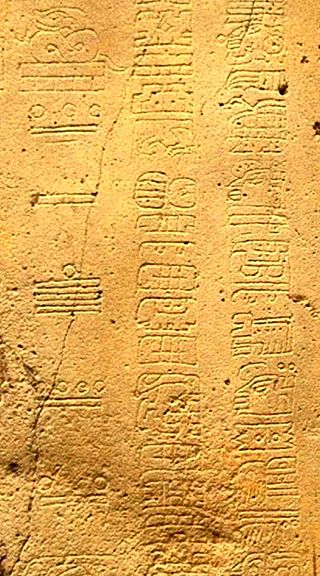
A much later stela showing
Mayan symbols for the
Long Count Calendar
We move now from the mysterious mound-builders of the Lower Mississippi to consider a date that may have no significance at all. On the 11th of August in the year 3114BC, the Long Count calendar used by Mesoamerican peoples, most particularly the Mayans, began. It was believed by the later Mayan peoples that the world had been created on this day. But it is hard to know exactly why. The first clear uses of the Long Count calendar are much later, nearly three millennia later. The Mayan civilisation used two other calendars in addition to the Long Count (Haab’ and Tzolk’in). All three calendars were extensively used by the Mayans but were probably not invented by them. Thus the true significance of why the Long Count date was chosen may never be known.

Around the year 3000BC the Paleo-Eskimo settlement of the Arctic regions began. Not that there is anything special about the year 3000. I’m sure communities were on the move during that year, but I’m also sure that the communities were moving into the frozen Canadian tundra in 3001/3002/3003 etc. It’s just that historians have a tendency to round things they’re not very sure of into neat round numbers: The greater the uncertainty, the rounder the number. The settlement of the tundra and the arctic lands beyond it are one of the great achievements of humanity. It ranks with the exploration of the Pacific islands or the climbing of Everest. The hunting bands who learned to catch seals and walruses and to carve ivory in lands where there was no more wood or stone for spears have pushed forward the boundaries of the human species.

Around 2800BC the hunter-gatherer earthworks at Watson Brake were abandoned. Perhaps the region could no longer support the population or perhaps the people migrated to new lands. Perhaps disease broke out among the people or they had a political or religious revolution. Whatever the cause, the first known mound building civilisation in North America, contemporary with ancient cities such as Uruk in Mesopotamia or Memphis in Egypt, were abandoned to the embrace of nature and the trowels of future archaeologists.

Around 2500 culture changes could be seen in the far north. In Alaska, near the Bering Strait, the Arctic Small Tool tradition developed. This is a blanket term for a number of cultures that spread across the north of the western hemisphere using bows and arrows. They would have capitalised on the developments made by the Paleo-Eskimo cultures and most of the people using the Arctic Small Tool tradition would have been from those Paleo-Eskimo cultures. Using this new technology the arctic hunters spread across the land and sea reaching Greenland. In the south of Greenland the Saqqaq culture began, while in the north the Independence I culture began shortly thereafter.

Clay objects from Poverty Point Culture that were
used for cooking
Around 2200 the Poverty Point culture begins in what is now Louisiana, not far from now empty site of Watson Brake. This was a culture that predated the adoption of mass agriculture. The people of this culture traded all along the Mississippi Valley and as far away as the Ozarks and the Ohio and Tennessee River regions. They were probably able to use the vast fisheries of the river and the swamps to sustain a permanent population in the region. They began to use ceramics and made some small pots but they were more interested in making small clay objects that could be heated up and used to cook food in non-pottery vessels. Later they would make spectacular mounds, but at this point their culture was only beginning.

Around 2000BC many archaeologists refer to the Mesoamerican Archaic Period ending and to the Pre-Classic period beginning. This is more a matter of definition than of any real change. Nothing really changed for the inhabitants of the region. But it is an acknowledgement that in Mesoamerica all of the major crops had been domesticated and that villages were now forming that would eventually grow into cities.

Greenland
To the far north, in Greenland, a young man died. His body was discovered four thousand years later and his genome sequenced. He is known now as Inuk, from the current Greenlandic language word for “man”. The cold climate and the fortunate preservation of some of his hair allowed for the DNA sequencing to take place and points to Inuk being closely related to the current tribes on the Russian side of the Bering Strait.

So, the period that we are looking at comes to an end. The two millennia examined saw the continuous development of the Mesoamerican agricultural communities, the expansion of humans across the frozen northlands and the development of the first monumental architecture in the Mississippi floodplains. While North America in this period still does not have any culture that can be unequivocally called a civilisation it nevertheless has all the ingredients for several to develop.

Related Blog Posts:
Some North American history from 4000-2000BC
Some North American history from 2000-1000BC
Some North American history from 1000-500BC

Tuesday, 1 September 2015

Mesoamerica: The Olmecs


Olmec artwork showing a were-jaguar baby
being held
I will take a quick break from my description of the history of the Middle East, which is extremely well documented, to speak of an area of the world that I have neglected. I have described the rise of civilisation in Mesopotamia, Egypt, India, China, Crete and in South America. However, up to this point I have not mentioned the civilisations of Mesoamerica. These civilisations would see a great flowering of culture during the European Dark Ages and would continue to flourish until the European trans-oceanic contact. In particular I will be focusing on the Olmec civilisation, but I will try to cover some of the other cultures that arose in the region.

When exactly a civilisation can be said to have started is a tricky question. No civilisation springs up entirely from nothing; there are always precursors. There were extensive Neolithic settlements in the Indus Valley, Mesopotamia, Egypt and China, and even the Peruvian Norte Chico civilisations all had precursors of Neolithic farming villages, which eventually developed into full urbanisation. The Olmec were unusual in that they seem to have developed an urban civilisation in what were effectively jungles rather than open river plains but their civilisation did nevertheless centre heavily on cereal agriculture, unlike the Norte Chico civilisation in South America. Maize had been domesticated thousands of years earlier, allowing for agricultural surpluses to be built up, providing the basis for later urbanisation in the region.

Olmec Colossal Head from La Venta
Like the Sumerians in Mesopotamia, the Olmec appear to have been the “mother culture” for later Mesoamerican civilisations. Many features that are seen in later cultures in the region, such as the Mayan culture, can be said to have originated with the Olmec; probably the most important cultural legacy that they left was the “ballgame”, which was to be played until the arrival of Europeans in the region. Unlike the Sumerians however, the Olmec have left no deciphered writing so their civilisation remains mute (for now at least). Even the name Olmec, simply means “rubber people” (meaning those who extract rubber from trees rather than Michelin Man type entities). This word “Olmec” was simply the Aztec word for the people who lived in this region over a thousand years after the Olmec civilisation had passed. Despite the apparent lack of writing or even of a true name, the Olmec did leave impressive legacies behind.

The Olmec civilisation began around 1500BC near the city of San Lorenzo in the present Mexican state of Veracruz. This formed a collection of sites (San Lorenzo, Tenochtitlan, which is not the same as the later Aztec Tenochtitlan, and Potrero Nuevo). Here the basic elements of Olmec culture were seen for the first time, art, monumental architecture, high population density, social demarcation etc. The city was un-walled and may have featured as a ceremonial site. We do not know how Olmec society was ruled or if they functioned as a state, although most archaeologists assume that there were kings who ruled the society. The city included causeways, a palace type structure and a type of drainage system. The population had a variety of food sources, but relied heavily on maize cultivation as a staple. This city area was inhabited continuously for around five hundred years, until around 900BC.

Olmec Monument from La Venta
Around 900BC the city of San Lorenzo was abandoned by most of the populace. Another Olmec site, La Venta, appears to have taken absorbed most of the population. It is unclear what caused the move away from San Lorenzo. San Lorenzo was in lush agricultural land near the Coatzalcoalcos River. La Venta was on a different river system and appears to have been in quite marshy terrain. The city was built from mud-brick rather than stone (due to the alluvial nature of the area), meaning that little has survived except for the Great Pyramid that must have been the largest building in Mesoamerica at the time. Currently the Great Pyramid of La Venta looks like an irregular cone however it was once a four sided structure, before the centuries caused the brick to erode. Like San Lorenzo, it was probably a ceremonial site, with the populace scattered in small outlying settlements around the main urban centre. La Venta is estimated to have had a population of at least eighteen thousand people and in terms of the complexity and scale of the site, it probably represents the apogee of Olmec culture.

Great Pyramid of La Venta
While the Olmec city of La Venta flourished, other urban areas began to appear in different parts of Mesoamerica. Teopantecuanitlan was a site to the northwest, in the current Mexican state of Guerrero, which appears to have been connected with the Olmec cities. Some believe that the Olmec originated here and that this was the seat of their culture. However, the Olmec heartlands are much more suitable for the development of agricultural surpluses, making it likely that the site in Guerrero is a colony rather than the original homeland. Regardless, it nevertheless was a significant Olmec site that was very far from the rest of their cities. Another site, Cuetlajuchitlán, in the Guerrero region dates from this period as well. The Mezcala culture in Guerrero possibly was a local adaptation of Olmec culture. However, not enough is known of the Mezcala to say for sure. The Mezcala were influenced by the Olmecs and later were to influence the Teotihuacanos.

Zapotec stele showing possible sacrificial victim.
At the bottom of the slab (to the right of the picture)
are glyphs that may be the name of the person shown
The Zapotec civilisation arose in the Oaxaca Valley, to the southwest of the Olmec cities, and would have been close to the trade routes between the Olmecs and Guerrero. The earliest stages of the city of San Jose Mogote are nearly contemporary with the Olmec site of San Lorenzo. This site had a main pyramid, ceremonial sites and defensive structures.

Trade was conducted with the Olmec civilisation to the east but the Oaxaca Valley does not seem to have had the same population density as the Olmec heartlands. Around 500-400BC San Jose Mogote was supplanted by another site, Monte Alban.

Map showing the Olmec cities and other urban centres
Around 500BC another Olmec site, Tres Zapotes, became prominent. Around 300BC the Olmec site of La Venta was almost abandoned. However, Tres Zapotes survived and continued to thrive in what is known as the Epi-Olmec or Post-Olmec phase.

Ultimately, the Olmec were not destroyed or wiped out. Their culture was absorbed by their neighbours, whose descendants ultimately absorbed the Olmec culture in a broader Mesoamerican culture, most particularly the Classic Veracruz culture that was roughly contemporary with the Classic Maya culture.

Cascajal Block
Like some other ancient civilisations, the Olmec cannot speak to us directly, so that many of their sites are named after the Spanish pronunciations of Christian saints rather than the original Olmec names. There is the tantalising possibility that this might one day change. It is known that the Mesoamerica was one of the few places in the world to independently invent writing, however it is unclear exactly which civilisation should be given the credit for this invention. The Olmec may have had writing, as there are what appear to be glyphs on some of their monuments. The picture is complicated by the discovery of the Cascajal Block, which shows a rather different set of glyphs, organised in what appears to be a horizontal writing system (other Mesoamerican writing systems are vertical).

It is unclear if the Cascajal Block is genuine. Considering that the Epi-Olmec culture of Tres Zapotes has continuity with earlier Olmec culture and that they have a writing system completely different from the Cascajal Block makes me suspect that there is much here that we do not understand.

The Zapotecs had their own script, but it is as yet not fully deciphered and the dating of the script is problematic. The Mayans may in fact have been the earliest to have fully developed writing in the region. There is a great deal of work to be done in this field of history.

Were-jaguar
The Olmec religion has usually been interpreted as shamanistic (which is not a useful term, as it is very broad). Their statues often represent were-jaguars; stylised creatures that appear in mid-transformation from human to jaguar. Some researchers think that the were-jaguar is also the rain-god. A maize god appears to have been worshipped, which is unsurprising considering their reliance on maize for agriculture. They also appear to have worshipped a feathered serpent. The worship of a feathered serpent would appear again in many other Mesoamerican societies and it is probable that this was originally an Olmec god.

One of the achievements of later Mesoamerican civilisations (mainly the Maya) was the creation of a highly accurate calendar for following the movements of the stars. This was based on a modified base 20 number system that included a zero, albeit not a zero with the full spectrum of uses that is possible using the Indian numbering system.

The earliest instances of this are dated to around the 30’s BC and come from sites that were shared with Olmec and Maya civilisations (an ancient Long Count date has also come from Tres Zapotes). Many suspect that the Olmecs invented this counting method, however, the lack of evidence for it at La Venta and earlier sites suggests that it may have been a late invention.

Stele from Takalik Abaj showing the
possible oldest Long Count date
The Mesoamerican ballgame was an enduring legacy of the Olmec culture. This game was adopted by nearly all the Mesoamerican civilisations (Aztecs, Toltecs, Mayans, etc.) These games were so important that the great stone heads that the Olmecs were famous for are garbed as ball players. Versions of the game are still played today.

The main feature of the game was that a rubber ball would be manoeuvred by the players without using their head, feet or hands to pass through a loop or marker on the other side of the court. There were two teams and the game was endowed with great ritual significance. The ball game is mentioned in the great Mayan text, the Popol Vuh, and after some games the losers would be sacrificed (this would be rare). Viewing modern versions of it online, it does look quite demanding and intense, but rather a lot of fun (although modern versions eschew any sacrificing at all).

Olmec art has been justly praised as being some of the finest in Pre-Columbian America, but the art that they are best remembered for is the gigantic stone heads that have been found at some of their sites (mainly San Lorenzo, La Venta and Tres Zapotes, but with some of the heads in smaller sites). At least seventeen of these have been found to date. These sculptures weigh between 6-40 tons and were transported by unknown methods over 150km to the final sites. Each head was sculpted differently, with different facial features and wearing the headgear of ballplayers. The sheer scale of these heads are actually what alerted the archaeological community to the existence of the Olmec civilisation.

Olmec Colossal Head from Tres Zapotes
If you are researching the Olmec culture online you are likely to have the misfortune to come across the alternative origin theories for the Olmec civilisation. These theories postulate that the Olmec civilisation was brought to Mesoamerica from elsewhere. There is nothing intrinsically wrong with this speculation but discussions about this online tend to become very heated and unscholarly. The two main ones that I have come across are basically either that the Olmec civilisation came from China or that it came from Africa. In both cases the main argument is that certain Olmec sculptures resemble people from either of these places. Most mainstream scholars would reject these theories so they are fringe theories but I would hesitate to discount them simply because of this.

The Chinese origin theory suggests that perhaps refugees from the collapse of the Shang Dynasty fled on ships and landed in Central America before founding the Olmec civilisation. There are a number of problems with this idea. Firstly, the dates do not work. It would seem that the Olmecs were already advanced before the collapse of the Shang. There is no evidence of such shipbuilding capabilities in China at that period to allow refugees to traverse the span of the Pacific Ocean. Also, the Olmec culture as a whole does not resemble Shang culture in its specifics. There are no elaborate bronze works, no oracle bone writings, etc. The Shang did not make the gigantic stone heads in China so it is unclear why they would begin in Mesoamerica. Insofar as there are supposedly sculptural similarities I have to say I have never been able to see these (although my eye for art is admittedly poor).

Olmec King/Priest?
The other, more common, alternative origin theory is that the Olmec culture came from Africa. This suffers from many of the same problems as the Shang origin theory. The timelines do not match civilisations on the west coast of Africa at this time. Even the Egyptians, who were active in this period, did not have extensive fleets that were able to sail outside of the Mediterranean. No African civilisation of this time period was similar to the Olmec civilisation in detail (the Mesoamerican ballgame and Long Count calendar are not attested in Africa) and no African civilisation is known to have created the colossal heads that the Olmec are famous for. The facial features similarity is probably due to the fact that the heads, while carved individually with features, were very large and mainly made of basalt, which is a hard rock in comparison to limestone. This means that it is more difficult to carve features deeply, which would make the faces somewhat flatter than in other Olmec art. Once this is accounted for the facial similarity largely disappears.

I do not think that either of these origins theories are a priori wrong, however, the simplest explanation for the Olmec civilisation is that it was indigenously developed rather than transplanted from outside. Unless there is substantial evidence to the contrary I think that historians and archaeologists are correct to discount other theories. Unfortunately debates about these online often degenerate into accusations of racism, with some accusing people of minimising African culture and others accusing people of minimising indigenous American people’s cultural achievements. If people research the Olmec civilisation online it is likely that these debates will be encountered so please remain respectful while also retaining due respect for the current evidence.

Example of Epi-Olmec writing with a Long Count date to the left
This has been a very brief summary of the beginnings of Mesoamerican civilisation. I love to quote sources but sadly the writing systems have not been fully deciphered sufficiently to give proper quotations. Much of what I have written is speculative, as archaeology is incomplete, however the great strides made in recent decades gives me hope that this region will be much better known in the future. I will write further posts on later civilisations in the region at some point in the future.

Related Blog Posts:
Some North American history: 4000-2000BC
Some North American history: 2000-1000BC
Some North American history: 1000-500BC

Monday, 10 October 2011

2012 and the Mayans?

A double-headed jade serpent
"And such was the instruction they gave when all the Under-worlders had been finally defeated. And then the two boys ascended this way, here into the middle of the light, and they ascended straight on into the sky, and the sun belongs to one and the moon to the other. When it became light within the sky on the face of the earth, they were there in the sky. And then the Four Hundred Boys climbed up, the ones who were killed by Zipacna. And so they came to accompany the two of them, they became the sky's own stars."
From the end of the Third Part of the Popol Vuh, describing the destiny of the Hero Twins.

There are theories floating around presently about the end of the world that will supposedly happen in the year 2012, specifically, in or around the 20th of December of 2012. Is there anything to this or is it a misunderstanding? I should firstly say that the scientific community has been fairly sceptical of these claims. However, my vague interest in matters scientific do not qualify me to talk about this from a strong scientific perspective, but if I come across any good online resources I will post links to them. I can however deal briefly with some historical aspects of this prediction.

The Classic Mayan city of Tikal
The prediction is based on the Mayan Long Count Calendar. The Mayans were a people (politically organised in loose groupings of opposing city-states) whose civilisation flourished in Southern Mexico and Guatemala from around 200 AD to 1000 AD. After this date the major cities were abandoned for unknown reasons and new cities emerged. But the new cities were on a smaller scale. From the early 1500's onwards these remaining states were attacked by the newly arrived Spanish conquistadors and the last Mayan city was finally conquered in 1697.

The Mayans did not merely leave monumental architecture, but they also left writings. Many of their books were destroyed in the Spanish conquest, but some Spanish monks and friars preserved the books they could find. From these books we can see that the Mayan literate class were very concerned with the timing of events and had created multiple calendars to mark the passage of events.

One of these calendars (there were several others) involved having a 360-day year that would be counted in cycles of 20. These cycles were then also counted in cycles of 20 (usually 20, but sometimes 18 according to some scholars). This was known as a Bak'tun. When 13 Bak'tun's had passed the cycle would repeat and the calendar would revert back to the first Bak'tun. If there are any astronomers reading they'll be quite angry about the 360-day year, but what the Mayans did was to refer to each day using a number of terms, which would cycle over and allow them to keep track of deviations from the solar calendar until the cycle was complete. It was not the first system I would have devised but it was complex enough to use "zero" as a number (i.e. better than Greek or Roman maths in certain respects) and was of use in the keeping track of constellation movements as well, so it's an impressive enough piece of work.

The reader may wonder what this has to do with the end of the world. The date given in the theory for the day the world ends is simply the date that the 13th Bak'tun ends on. According to most theories the 1st cycle begins on the 11th of August, 3114 BC so we are approaching the date where the calendar rolls over so to speak. So did the Mayans feel that this was the date that the world ended on?

Well, the date picked for the beginning of the cycle appears somewhat arbitrary. It predates their civilisation and there are no known inscriptions for the first three thousand years of the system. It might have been borrowed from an earlier civilisation like the Olmecs, but this is speculative. So, if we have no idea why they chose to start their calendar at one point, it makes understanding the end point difficult. Some scholars believe that there are inscriptions that deal with orders higher than the Bak'tun or even thirteen Baktun's, which, if true, suggests that the Mayans did not view time as being contained within the cycle.

Scholars also speak of Long Calendar dates being spoken of after the turning of the cycle, suggesting that the Mayans didn't believe the world would end in 2012. It should be noted that the Mayans had no telescopes that we know of to predict anything about "galactic shifts" or discover hidden planets or anything. If they had some method of predicting the future it did not help their civilisation. Their civilisation went into chronic decline around 900 AD, suffered definite attacks from the Mexican city of Teotihuacan and a possible invasion from Tula before having their cities taken over completely by the Spanish. If the Mayan priests could really see the future then they were spectacularly bad at acting on their knowledge. This is a bit of a cheap shot at a culture that I greatly respect, but I am sick to death of hearing New-Age stuff about mystical Mayan knowledge.

Having a nice long calendar allowed them to place events in a framework that remained constant for centuries and allowed them to neatly predict both agricultural seasons and astronomical events. There are very few prophecies recorded from Classic Mayan sites.

Mayan culture does become rather prophetic later on, but I believe this to be a result of European influence. The Popol Vuh, the most famous of the Mayan books, was at least partially written after the Spanish had arrived. It gives a Mayan creation account that has a number of incomplete creations, each destroyed before a new creation, with the last destruction being by a great flood.

Now this could be seen as a series of catastrophes marking the completion of a separate Long Count cycle, meaning that the Mayans saw a catastrophe for the year 2012 even if the world didn't end. But by the time the Popol Vuh is written, the Long Count is no longer used and an equally sophisticated but different way of marking time is given. No dates are given for the creations or the catastrophes and, although far from unparalleled in world mythology, the universal flood wiping out an initial creation sounds suspiciously like the Popol Vuh has been influenced by Catholicism.

There are late Mayan texts called the Books of Chilam Balam specifically dedicated to prophecy. These are books ascribed to a legendary sage who prophesies the coming of the Spanish. But they are all written in the Colonial era and back-prophecies if you will, where a community deals with a catastrophe by inventing a text to cope with it and view it as part of a greater plan (see the prophecies of Myrddin Wyllt, even conspiracy theories could be viewed as community attempts to rationalise the irrational).

The idea that the world will end is notably absent even in these most prophetic of all Mayan texts (although there are quite a lot of them and I haven't read them all so I may be wrong on this). So will the world end in 2012? Possibly, as we can never predict the future with total accuracy, but I'm betting that it won't (and giving good odds if anyone's interested). I'm also betting that the Mayans had less than no intention of predicting the end of the world when some of their priests decided to use a particular method of counting that started at an arbitrary date. Roll on 2013!

Edit: I am updating this blog in late 2019 and I can confidently confirm to readers that the world did not in fact end in 2012.