Friday, 14 December 2018

550-525BC in the Near East

Lions from the Processional Way in Babylon
This blog post will be looking at the years 550-525BC in the Near East, which for the purposes of this blog will include Kush and Lydia in the south and west, far over to the easternmost reaches of the newly founded Persian Empire and to the Caucasus in the north. Occasionally there may be references to other regions, but the Greek world in particular will be dealt with in a separate post.

The sources for this blog will include as much primary sources as possible, particularly Neo-Babylonian chronicles and other cuneiform writings. The writings of the later Babylonian priest Berossus (contemporary with Alexander) have been lost to us, but survive in quotations from other authors such as Josephus, so these will be used where possible. Lydian, Median and Persian sources are so scant as to be almost non-existent, and those that do exist may in fact be forgeries. Ancient Persian religious writings are interesting but provide no context and are difficult to date. Egyptian and Kushite inscriptions will be used where possible, but there are not as many of these as we would like and not many are translated and available to the layman.

The Hebrew Tanakh or Old Testament will be used where possible, but this has a very narrow focus and is not contemporary with the events that it describes. Also, the writers of the Biblical books at this period are not writing history as such, and their writings have their own specific conventions that can be difficult to interpret. The majority of Hebrew writings are silent during this period anyway.

The most prevalent source materials for this period are later Greek writings, particularly the Histories of Herodotus. This is a great book but quite problematic as a source. For better or for worse, shortly after the fall of Assyria we begin to have fewer and fewer writings directly from the Mesopotamians. This means that, like it or not, we must rely heavily on Herodotus.

Modern replica of a possible likeness
of Cyrus II from Pasargadae
(he probably didn't have wings though)
As always I feel it is important to note that I am not a professional historian. The facts and dates in this post should be treated with due caution and everything should be checked. There are certainly mistakes and errors in the sources and I may make mistakes in my interpretations of these sources.

Mistakes are particularly likely to occur when dealing with years, as the Babylonian and Jewish years do not correspond exactly to our own. So, there is the possibility that I may have, for example, interpreted an event as happening in late 539 when it may in fact have been early 538. If the reader spots any errors such as this, please let me know in the comments and I will research it and correct it as soon as possible. Also, another thing that will affect dating for this period is whether the king counts the first year of their reign as the 1st year or the 0th year (counting from accession or from first full year). Even professional historians have differing opinions on the exact ordering of events at this time, so exact precision is not likely here.

It can be useful to give context to the period by describing what is happening elsewhere in the world at this time. In China, the Zhou Dynasty was continuing its long slow decline while the feudal states such as Qi and Chu grew ever more important and waged wars between them for influence. The Spring and Autumn Period was ending, as the wars between the little kingdoms became ever more violent. This flux of warfare would also stimulate the thinkers of China and much of Chinese philosophy is developed at this time.

In India, there were a number of powerful kingdoms, particular in the north along the Gangetic Plain. These kingdoms were known as the Mahajanapadas and included states such as Kuru, Panchala, Kosala, Videha and Magadha. The kingdom of Magadha became the strongest of these states and may have been ruled by a king called Bimbisara at this time. In India at this time a number of sects began to spring up that in certain cases had unusual interpretations of the accepted beliefs of the time and region, but this is a topic for another blog. The religions of Jainism and Buddhism emerged from this intellectual ferment and may have been already formed at this time, depending on the dates given. To the west, in Greece, poets and tyrants flourished, along with the beginnings of Greek science and philosophy. These will all be spoken of in later blogs, but this should give a rough idea of the state of the world at this point.

Sphinx of Amasis in the
Captoline Museum
At the beginning of this time period, in the year 550BC the international order had been disturbed. Astyages had invaded Persian territory hoping to crush the rebellion of his vassal Cyrus once and for all. Herodotus had earlier recounted that the Median general Harpagus had gone over to the Persians and now recounts that the Persians defeated the Medes. However the Babylonian chronicle of Nabonidus recounts that the Medes deserted Astyages and handed over their unpopular king to Cyrus. It’s unclear if Herodotus and the Babylonian writers are referring to the same event, but it would be better to trust the Babylonians here, as their account is written much closer to the events, although not without its own issues. The chronicle then recounts that Cyrus marched on the Median capital Ecbatana and looted it.

The sixth year: Astyages mustered his army and marched against Cyrus, king of Anshan, for conquest … The army rebelled against Astyages and he was taken prisoner. They handed him over to Cyrus. … Cyrus marched to Ecbatana, the royal city.
Nabonidus Chronicle (ABC7) written sometime after 538BC

Despite the looting of Ecbatana the Medes seem to have been treated well. Many Median aristocrats must have deserted to him, on the evidence of both Herodotus and the Babylonians, and these must have been rewarded. Cyrus had taken control of a much larger empire than his previous kingdom and had done so because he had been more popular than the previous monarch. To maintain his rule he would have to tread lightly and carefully. Cyrus goes down in history as a tolerant and just monarch who allowed his subjects every possible advantage and freedom. This was probably why he was so popular with the nobility of his enemies, but also was a wise policy considering the circumstances of his rule. Perhaps I am too cynical, but I cannot help but feel that Cyrus had no choice but to be tolerant.

The four kingdoms of Babylon, Media, Lydia and Egypt had coexisted for nearly half a century in relative peace and with some alliances between them. However, now the king of Media, Astyages, had been overthrown by a vassal named Cyrus II. As the other monarchs were personally linked through alliances to Astyages, this would have been a threat. In Egypt, the Pharaoh Amasis had conquered Cyprus and was engaged in building projects in Sais. In Lydia, King Croesus was famed for his wealth and had subdued the Greek states on the western coast of Asia Minor. In Babylon, King Nabonidus has abandoned his capital to pursue religious reform and campaign in the south-western deserts.

Tayma Stela
dating to slightly after this
period but mentioning
Nabonidus' stay there
It is not possible to say much of the year 549, save that the chronicle of the Babylonians known as the Nabonidus Chronicle records that Nabonidus was still in Tayma. While the king was in Tayma the prince and the army were in Akkad, meaning Babylonia. The prince referred to here is almost certainly the crown prince, Bel-shar-usur, better known to us today as Belshazzar, from the later writings of the Jews.

The year 548 probably saw the Lydian kingdom led by Croesus attacking the new empire of Persia. The Lydians and Medes had previously fought in 585 and as Astyages kingdom had been taken over, Croesus of Lydia may have decided to try and annex some of the lands between the two kingdoms. The Lydian king, who was the conqueror of Ionia, but who still respected Greek culture, sent an embassy to the Oracle at Delphi to enquire if he would be successful. The Oracle answered that if he attacked Persia a great empire would fall. Croesus took this for a good omen and made war upon the Persians.

Now, this story is in fact suspicious. There is good reason to think that such an ambiguous oracle would not be acted upon. So, did the Oracle in fact promise victory to Croesus and did this failure of the prophecy have to be explained away by later Greek writers, who paint Croesus as missing such an obvious clue? I’m not sure as to its truth, but this may be the most famous story of the Oracle of Delphi and I find it quite implausible.

When the Lydians came to the places where they were sent, they presented the offerings, and inquired of the oracles, in these words: “Croesus, king of Lydia and other nations, believing that here are the only true places of divination among men, endows you with such gifts as your wisdom deserves. And now he asks you whether he is to send an army against the Persians, and whether he is to add an army of allies.” Such was their inquiry; and the judgment given to Croesus by each of the two oracles was the same: namely, that if he should send an army against the Persians he would destroy a great empire.
Herodotus Histories 1:53, written around 440BC

Gold coin of Croesus
In the year 547 the Lydian armies crossed the Halys River that had formed the border between the Median and Lydian kingdoms and attempted to defeat the Persians. The Lydian army attacked the city of Pteria and ravaged the territory near it. Cyrus had anticipated the threat and had his army nearby to counterattack. A fierce battle was fought between the two armies. Neither side gained the advantage, but the Lydians withdrew the following day, as the army of Cyrus was larger and had no supply line problems. Clearly the conquest of Persia was more difficult than Croesus had anticipated, so he determined to withdraw and gather larger forces to continue the conflict the next year. Messengers were sent to the Babylonian and Egyptian kingdoms, as well as to the allies of Croesus in the Greek world, particularly Sparta. Supposedly Croesus believed the campaigning season was over, that the battle honours had been equal and that Cyrus would never dare to attack him, so he retreated to his capital at Sardis and discharged his mercenaries.

The fighting was fierce, many on both sides fell, and at nightfall they disengaged with neither side victorious. The two sides contended thus.
Herodotus Histories 1:76, written around 440BC

Inscription of Nabonidus
Also in the year 547 Adadgoppe (sometimes written as Adad-Guppi) of Harran died. She was the Queen Mother of Nabonidus, king of Babylon. She had been born around 549 and had supposedly seen 104 years of life (the overlapping of years may have led to some confusion in the count, her real age may have been 102 or 103). She was a remarkable woman, born during the Assyrian Empire she had served the god Sin in his temple at Harran and may have been taken to Babylon when Harran was destroyed by the Babylonians during the fall of the Assyrian Empire and the cult statue of Sin was taken to Babylon. Although she had probably arrived as a captive in Babylon, she had lived to see her child become an important functionary in the Babylonian court and eventually to become king. When her child became king she had the satisfaction of seeing the god that she had served restored to his temple in Harran and the temple itself rebuilt. The rebuilding of the temple was probably done before the year 546. She is often said to have written an autobiography, which was preserved in Harran on a stela, but it also refers to her death, meaning that it was in fact a piece of royal propaganda written after her death. It may well have reflected her views however.

From the time of Ashurbanipal, king of Assyria, until the ninth year of Nabonidus, king of Babylon, my son, my offspring, Sin, king of the gods, made me live one hundred and four good years in the awe which he set in my heart. I myself, the sight of my two eyes is sharp and my comprehension is excellent, my hands and feet are health and my words are well, chosen, food and drink agree with me, I am in good health and my heart is full. My descendants to the fourth generation, I have witnessed their existence and I am replete with extreme old age. Sin, king of the gods, you looked upon me with favour and you have made my days long, therefore let me entrust to you Nabonidus, king of Babylon, my son. 
The “autobiography” of Adad-Guppi, probably written around 546BC

Later battle standard of the Persians
It may have been adopted by Cyrus
In the year 546 Cyrus showed his initiative and made a sudden attack into Lydia. The Lydian armies were mostly dispersed and Herodotus reports that only the core of Croesus’ army was available to face the Persian invasion. The Lydian cavalry was feared and apparently the Persians countered the charge of the Lydian cavalry by deploying camels, whose unfamiliar scent and appearance apparently disrupted the cavalry. After a hard-fought battle on the plains of Thymbra, before the city of Sardis, the Lydians were defeated and Croesus and his bodyguard were reduced to defending the high citadel of Sardis.

Such was his command. The reason for his posting the camels to face the cavalry was this: horses fear camels and can endure neither the sight nor the smell of them; this then was the intention of his manoeuver, that Croesus' cavalry, on which the Lydian relied to distinguish himself, might be of no use. So when battle was joined, as soon as the horses smelled and saw the camels they turned to flight, and all Croesus' hope was lost. Nevertheless the Lydians were no cowards; when they saw what was happening, they leaped from their horses and fought the Persians on foot. Many of both armies fell; at length the Lydians were routed and driven within their city wall, where they were besieged by the Persians.
Herodotus Histories 1:80, written around 440BC

Croesus’ situation was desperate but not hopeless, for the citadel of Sardis was strong and his allies many. If his allies could muster their troops and come to his aid, Croesus and his kingdom might yet be saved. However, apparently one section of the citadel was left almost unguarded due to the steep nature of the rock face. A Persian soldier saw a Lydian soldier drop his helmet and climb down what had been thought to have been an impregnable rock face. Later Persian soldiers climbed the rock face and took the citadel by surprise and by storm. According to Herodotus the siege had only last fourteen days, which was far too soon for any of his allies to have reached Croesus. It is not clear that they would have come anyway.
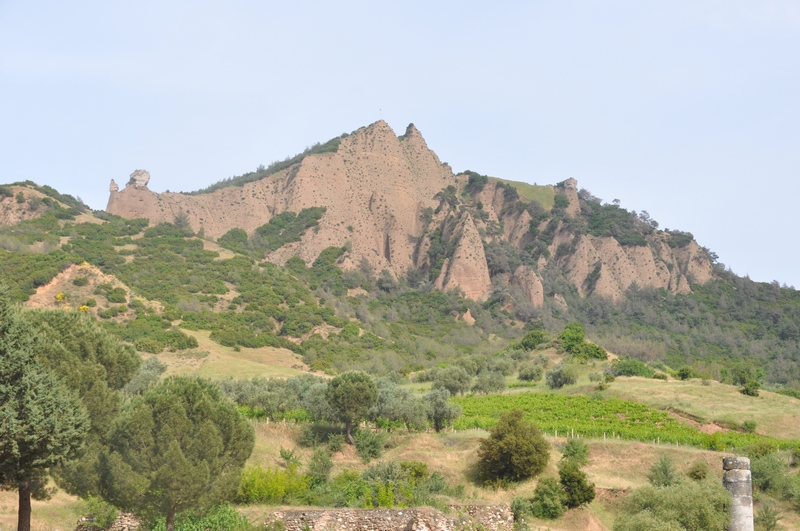
The rock of the citadel of Sardis
Then, when all the others were stopped, a certain Mardian called Hyroeades attempted to mount by a part of the acropolis where no guard had been set, since no one feared that it could be taken by an attack made here. For here the height on which the acropolis stood is sheer and unlikely to be assaulted; … The height was sheer and defied attack. It is on the side of the city which faces towards Tmolus. The day before, then, Hyroeades, this Mardian, had seen one of the Lydians come down by this part of the acropolis after a helmet that had fallen down, and fetch it; he took note of this and considered it. And now he climbed up himself, and other Persians after him. Many ascended, and thus Sardis was taken and all the city sacked.
Herodotus Histories 1:84, written around 440BC

Now Herodotus records that Croesus was captured by Cyrus’ army and was placed on a huge pyre to be burned alive. Herodotus records that Croesus was saved from the burning because Croesus wailed aloud about how Solon was right and that no man could be called happy until his life had been lived to its end. Cyrus then pardoned the defeated king and kept him as an advisor. But Herodotus is writing around the year 440BC, around a hundred years after the fall of Sardis. However Bacchylides, writing perhaps about 470BC, refers to Croesus as having tried to burn himself to death but the flames were extinguished by rain sent by Zeus. Croesus was then rescued and taken away to live in a mythical land to the far north by Apollo in recognition for his piety and devotion to the oracle at Delphi. The Greeks must have felt misgivings about the death of a king that was obviously pious. Perhaps they mitigated the downfall of the king by giving him a rescue from his fate? Herodotus in particular seems to have spent time at Delphi and received much of his knowledge from the priests of Delphi, who would have wished to exonerate their god and his Oracle. But it is hard to escape the conclusion that the Oracle of Delphi and the god Apollo had betrayed the king of Lydia.

Greek vase showing the pyre of Croesus
Croesus had no intention of waiting any longer for the tears of slavery. He had a pyre built before his bronze-walled courtyard, and he mounted the pyre with his dear wife and his daughters with beautiful hair; … His daughters cried out, and threw their arms out towards their mother; for death is most hateful to mortals when it is right before their eyes. But when the flashing force of terrible fire began to shoot through the wood, Zeus set a dark rain-cloud over it, and began to quench the golden flame. Nothing is unbelievable which is brought about by the gods' ambition. Then Apollo, born on Delos, brought the old man to live among the Hyperboreans, along with his slender-ankled daughters, because of his piety, since of all mortals he sent the greatest gifts to holy Pytho.
Bacchylides Ode 3, written shortly after 468BC

In Assyrian and Babylonian history we hear of kings such as Shamash-shuma-ukin and Sinsharishkun who had probably burned themselves to death with their possessions when their cities fell. To fall captive into the hands of another king was a dreadful fate and one who had wielded supreme power would often prefer to taste death at their own hand than to face it from another. The Babylonian chronicle of Nabonidus has a tantalising entry for this year. It refers to the Persians crossing the Tigris in the land of Assyria and marching west to attack an unknown land and its king.

This is almost certainly the kingdom of Lydia but the document is damaged so we cannot know the name of the land. If this is not Lydia then perhaps it may mean that the fall of Lydia may have taken place later, perhaps a decade later. This lacuna has generated a scholarly debate, which is summarised here. It is good to remember that, even for the major events of the world, our understanding may be entirely mistaken and that we are reliant on the most fragmentary of sources. But for the purposes of this blog, it is probable that in 546 Sardis and the kingdom of Lydia had fallen and the last king of Lydia was probably dead. Also in the year 546 we should note that the Persians may have taken over the island of Cyprus. The fact that they were able to cross the Tigris below Arbela means that the Persians were able to march through what had once been Babylonian territory with near impunity.

In the month Nisanu, Cyrus, king of Parsu, mustered his army and crossed the Tigris below Arbela. In the month Ajaru, he marched to the land of [...] He killed its king, took his possessions, and stationed his own garrison there …
Nabonidus Chronicle ABC7, written sometime after 538BC

In the year 546, as soon as Cyrus had left Tabalus as governor of Sardis and returned to his kingdom. Here Cyrus probably ordered the construction of a new capital city at Pasargadae. The vast wealth of the Lydian treasury doubtless helped to finance the construction, which was done on a lavish scale in a hybrid style.

Inscription of Nabonidus
In 546 a revolt among the Lydians broke out led by a Lydian named Pactyes, who may have been from the royal house but who controlled gold collection. His revolt managed to besiege Sardis itself before the Persians beat it back. Pactyes then fled to the Greek city states on the coast, who refused to surrender the rebel. The cities of Cyme, Mytilene and Chios each held the suppliant for some time before the Persian commander Mazares bribed the Chians to hand over the prisoner for execution.

Aside from the city of Miletus, which had made a treaty with Cyrus, the Ionian cities had taken part in the Lydian War and now were forced to submit to Persian rule as a consequence. The Persians first attacked Priene, Magnesia and then Phocaea. Phocaea was fortified with a large wall that had been paid for by their trade with Tartessos in Spain. However they dared not to face the Persian assault, but instead abandoned the city and set sail for the western Mediterranean where they had a variety of adventures that mainly involved piracy. The nearby city of Teos was also abandoned by the inhabitants, who fled to Abdera in Thrace.

The Chians, then, surrendered Pactyes, and afterwards Mazares led his army against those who had helped to besiege Tabalus, and he enslaved the people of Priene, and overran the plain of the Maeandrus, giving it to his army to pillage and Magnesia likewise. Immediately after this he died of an illness.
Herodotus Histories 1:161, written around 440BC

Pillar of Nabonidus
Meanwhile Harpagus had taken over command from Mazares and vigorously attacked the coastal Greek city-states. The city-state of Cnidus was at the end of the long peninsula, which the inhabitants attempted to cut through while Harpagus was attacking other cities. The Delphic Oracle apparently told them that they should cease the attempt and that “If Zeus had wanted an island, he would have made an island”. Considering that the some other priests of Apollo had counselled that the Lydian rebel Pactyes should be handed over to the Persians and that this advice to the people of Cnidus would doom their city, it seems almost as if the oracles were cooperating with the Persian conquest. But this is later speculation and paranoia.

Many of them were at this work; and seeing that the workers were injured when breaking stones more often and less naturally than usual, some in other ways, but most in the eyes, the Cnidians sent envoys to Delphi to inquire what it was that opposed them. Then, as they themselves say, the priestess gave them this answer in iambic verse: ““Do not wall or trench the isthmus: Zeus would have given you an island, if he had wanted to.” At this answer from the priestess, the Cnidians stopped their digging, and when Harpagus came against them with his army they surrendered to him without resistance.
Herodotus Histories 1:174, written around 440BC

According to Herodotus, during the Persian conquest of Lydia the Spartans had sent a penteconter (fifty-oared) ship to Cyrus to tell him that he should not harm any Greek states, “because the Spartans would not tolerate it”. This embassy prompted Cyrus to ask in return “Who are the Spartans?” While the story is an interesting one I doubt that the story happened.

Inscription of Nabonidus
But the Lacedaemonians, though they had rejected their envoys, did nevertheless send men in a ship of fifty oars to see (as I suppose) the situation with Cyrus and Ionia. These, after coming to Phocaea, sent Lacrines, who was the most esteemed among them, to Sardis, to repeat there to Cyrus a proclamation of the Lacedaemonians, that he was to harm no city on Greek territory, or else the Lacedaemonians would punish him. When the herald had proclaimed this, Cyrus is said to have asked the Greeks who were present who and how many in number these Lacedaemonians were who made this declaration.
Herodotus Histories 1:152-153, written around 440BC

The conquest of Ionia probably continued over a number of year, but from around 545 onwards the Greek city-states on the western coast of Asia Minor were to be subject to the Persians, with many of the island states near the coast also submitting before the Persian power. However, while these cities were the most cultured and wealthy cities in the Greek world, they were not the main focus of Cyrus. His kingdom had now grown immensely and he set about curbing the Iranian tribes to the east. The next three or four years probably saw campaigns in the east with the possible founding of the city of Cyropolis (the City of Cyrus, as it was known in Greek), as early as 544. The site of Cyropolis is probably what is now the city of Khujand in northern Tajikistan, on the Jaxartes (Syr Darya) River.

In the year 543 Nabonidus probably returned from Tayma to Babylon. The Persian Empire had now conquered his allies, the Lydians, and his own nobility and priesthood seem to have been angry at him for neglecting the city and omitting its rituals. War with Persia must have been inevitable and perhaps he planned to coordinate the war from Babylon.

Pyramids at Nuri in the royal burial grounds of Kush
In the year 542 Malonaqen of Kush probably died and was buried at the royal cemetery at Nuri. Analmaye succeeded, but there is little that I know of the kings of the Kushites at this time, which is sad. There is probably much history to be learned, but sadly there are not many resources online for it. For the year 541 I cannot find any record of events for that year, save that the Persian Empire under Cyrus was probably finishing the conquest of the Iranian tribes to the east.

In the year 540 war was declared between Persia and Babylon, if indeed the two states had not already been at war for some years previous. In the west, around this time, Harpagus the Mede, one of the generals of Cyrus, was fighting the Lycians, on the southwest coast of what is now Turkey. He had already brought the Ionians and Carians under Persian rule and expected an easy victory against the Lycians. But the Lycians of the city of Xanthos rallied out of their city to attack the Persians, and when they were beaten, they destroyed their city and committed mass suicide rather than submit to conquest. With this tragic victory the western seaboard of Asia Minor was brought nearly entirely under Persian rule.

Nabonidus
The Pedaseans were at length taken, and when Harpagus led his army into the plain of Xanthus, the Lycians came out to meet him, and showed themselves courageous fighting few against many; but being beaten and driven into the city, they gathered their wives and children and goods and servants into the acropolis, and then set the whole acropolis on fire.
Herodotus Histories 1:176, written around 440BC

Around this time the Carthaginians allied with the Etruscans to fight the exiled Phocean Greeks near Alalia. The result was a Pyrrhic victory for the Greeks, but a strategic victory for Carthage and her allies, as the Greeks retreated shortly after and Carthage's hold on Sardinia was secured.

In 539 Nabonidus prepared for the coming invasion by gathering the cult-statues of most of the gods of Babylonia to the city of Babylon itself. This may have been intended as a protective measure, to stop the Persians from capturing the statues and bringing them away as booty. Alternatively it may have just been as part of a festival that he wanted to celebrate. However, it may have showed defeatism, in that it assumed that the Persians would capture the outer cities of the empire and the priesthood seems to have interpreted this as yet another act of impiety.

An account known as the Verse Account of Nabonidus recounts tales of a king who was nearly mad, inscribing stelas with imaginary victories over Cyrus, with fawning courtiers such as Zeriya and Rimut crouching around Nabonidus and confirming his every word, as the illiterate king misunderstood oracles and signs. According to this account the impious king even attempted to turn the shrine of Marduk into a shrine for the god Sin. But this is a piece of pro-Persian propaganda written after Nabonidus was defeated.

The author by the Ishtar Gate in the
Pergamon Museum Berlin
It was he who once stood up in the assembly to praise himself, saying: "I am wise, I know, I have seen what is hidden. Even if I do not know how to write with the stylus, yet I have seen secret things…” When he saw the moon symbol of Esagila (the temple of Marduk), he makes an insulting gesture. He assembled the priestly scholars, he expounded to them as follows: "Is not this the sign of ownership indicating for whom the temple was built? If it belongs really to Marduk, it would have been marked with the spade (symbol of Marduk). Therefore the Moon himself has marked already his own temple with the moon-symbol!" And Zeriya, the Å¡atammu (chairman of the temple council) who used to crouch as his secretary in front of him, and Rimut, the bookkeeper who used to have his court position near to him, do confirm the royal dictum, stand by his words, they even bare their heads to pronounce under oath: "Now only we understand this situation, after the king has explained about it!"
Verse Account of Nabonidus, written sometime after 538BC

The invasion came from the direction of Media, from the north and east. The Babylonian armies, possibly under the command of Belshazzar, son of King Nabonidus, met the Persians and Medes at the city of Upu (Opis) on the River Tigris. It was here that the great Median Wall had been built by Nebuchadnezzar against the Medes. The huge defensive work failed in its intent, possibly because the Persians changed the watercourses to allow them to bypass the wall. While Cyrus may have conquered Lydia later, I believe the more usual interpretation that Lydia fell first. This would have meant that Cyrus would have been able to use the treasury of Croesus to fund his war and could have afforded to field a vast army. Outnumbered the Babylonian army was slaughtered in a great battle and the Persians passed the Median Wall. A governor named Ugbaru, who controlled the region bordering the Medes, may have defected to the Persian cause and thus the victorious Persian army may now have included a large Babylonian contingent.

Ruins of Babylon
The Babylonian forces would have fallen back to Babylon after such a cataclysmic defeat. Having lost faith in the ruling family, the huge city of Sippar, sacred to the sun-god Shamash, surrendered to the Persians without a siege. With his empire collapsing around him and not trusting the people of Babylon, Nabonidus may have fled to the neighbouring city of Borsippa, which was strongly fortified and which contained the temple of the god Nabu, after whom Nabonidus was named.

When Cyrus did battle at Opis on the bank of the Tigris against the army of Akkad, the people of Akkad retreated. He carried off the plunder and slaughtered the people. On the fourteenth day Sippar was captured without a battle. Nabonidus fled. 
Nabonidus Chronicle ABC7, written sometime after 538BC

The Persian army proceeded to Babylon and laid siege to the city, the largest in the world. The walls that had been built by Nebuchadnezzar were nearly impregnable and the city had been stocked with food supplies enough to last for years. The city should have been invincible. However, Herodotus reports that the Persians diverted the River Euphrates and made it so that the water levels flowing into the city dropped low enough for their troops to march along the river bed and into the city.

Partially reconstructed walls of Babylon
Herodotus reports that there were river walls along the banks of the river and that the forces of Babylon could have manned these and shot the Persians with arrows like fish in a trap. But the Persians were instead able to march into the city almost unscathed. There may have been reasons for this, such as the fact that Babylon was so large that the garrison may not have realised that the river walls were under attack. Another reason was that the city of Babylon was celebrating a festival that day and the guards may have not been at full strength. It is also possible, considering the level of hatred against Nabonidus and his son, that there was an element of treachery and the Babylonian garrison, or parts of it, simply allowed the Persians to enter once the river levels lowered.

Cyrus dealt with it and with the river just as had the Babylonian queen: drawing off the river by a canal into the lake, which was a marsh, he made the stream sink until its former channel could be forded. When this happened, the Persians who were posted with this objective made their way into Babylon by the channel of the Euphrates, which had now sunk to a depth of about the middle of a man's thigh. Now if the Babylonians had known beforehand or learned what Cyrus was up to, they would have let the Persians enter the city and have destroyed them utterly; for then they would have shut all the gates that opened on the river and mounted the walls that ran along the river banks, and so caught their enemies in a trap. But as it was, the Persians took them unawares, and because of the great size of the city (those who dwell there say) those in the outer parts of it were overcome, but the inhabitants of the middle part knew nothing of it; all this time they were dancing and celebrating a holiday which happened to fall then, until they learned the truth only too well.
Herodotus Histories 1:176, written around 440BC

Feast of Belshazzar by John Martin AD1820
Later Hebrew tradition records that Belshazzar, who was once again acting as king, with Nabonidus out of the city and in nearby Borsippa, was feasting on the night the city fell. As they were feasting a hand appeared and began to write the following words on the wall of the palace, Mene, mene, tekel, upharsin. The king was perturbed by the portent and asked the Hebrew courtier Daniel what these words meant. Daniel replied that this meant that Belshazzar had been weighed in the balance and found wanting, that his kingdom would be divided and given to the Persians. The interpretation Daniel gives is based on Hebrew wordplay that would not be obvious to those who did not speak Hebrew. Later that night the Persians stormed the palace and the prophecy came true. Thus, even to this day, the phrase “The writing is on the wall” is a way of describing an imminent event. The account of Daniel is probably written later, but is one of the few documents that remain that mention the Crown Prince Belshazzar.

Suddenly the fingers of a human hand appeared and wrote on the plaster of the wall, near the lampstand in the royal palace. The king watched the hand as it wrote. His face turned pale and he was so frightened that his legs became weak and his knees were knocking. “This is the inscription that was written: Mene, mene, tekel, parsin “Here is what these words mean: 
Mene: God has numbered the days of your reign and brought it to an end.
Tekel: You have been weighed on the scales and found wanting.
Peres: Your kingdom is divided and given to the Medes and Persians.”
Then at Belshazzar’s command, Daniel was clothed in purple, a gold chain was placed around his neck, and he was proclaimed the third highest ruler in the kingdom. That very night Belshazzar, king of the Babylonians, was slain, and Darius the Mede took over the kingdom, at the age of sixty-two.
Daniel 5:5-6, 25-30, written later, at some point between 500-150BC

Feast of Belshazzar by Gustave Dore AD1866
Babylon had fallen with barely a struggle and now the broken king Nabonidus, who had thought himself the chosen one of the god Sin, who had seen himself raised to supreme power and brought low again, was now captured by the Persians either in Borsippa or in returning to Babylon. Cyrus himself was not present at the capture of Babylon and the campaign and immediate fate of Babylon seems to have been organised by a Persian general called Gubaru, who may or may not be the same person as the governor Ugbaru, who had possibly switched sides earlier in the campaign. There is a great deal that we do not know of the fall of Babylon, despite the Babylonian, Greek and Hebrew sources describing the event. The remainder of the Babylonian Empire surrendered to the Persians without any known resistance. The fall of the Babylonian Empire was even swifter than that of the Assyrian Empire seventy years previous.

On the sixteenth day, Ugbaru, governor of Gutium, and the army of Cyrus, without battle, they entered Babylon. Afterwards, after Nabonidus retreated, he was captured in Babylon.
Nabonidus Chronicle ABC7, written sometime after 538BC

Cyrus entered the city in triumph, presumably through the great Ishtar Gate and was welcomed by the people and the priests. Cyrus carefully listened to the grievances of the elites and took great care to restore rites and rituals to what they had been before Nabonidus. Assiduous propaganda was begun to ruin the reputation of the fallen king and to paint Cyrus as the generous liberator. To his credit Cyrus does seem to have prevented his troops from looting and the conquest was an easier one than previous conquests. The fallen monarch Nabonidus may even have been allowed to live out his life in exile in the far eastern province of Carmania, but I suspect that he was probably executed. Regardless he was an old and broken man, and his (possible) son and heir Belshazzar was certainly dead.

Feast of Belshazzar, still from Arthur Griffith's
film Intolerance AD1916 (the details here are
rather fanciful, though the scale of the set would
have appealed to the ancient Babylonians
On learning of the invasion Nabonnedos met him with an army and opposed him in battle. After being defeated, he fled with a small retinue and took refuge within the city of the Borsippians. Cyrus meanwhile seized Babylon and ordered that the outer walls of the city be thrown down because the city seemed to him to be very formidable and hard to capture. Cyrus then marched on Borsippa to lay siege to Nabonnedos. Nabonnedos, however, did not await the siege but surrendered himself first. Dealing with him in a gracious manner, Cyrus granted him Carmania as his residence and sent him out of Babylonia. King Darius, however, took away a part of his province for himself. Nabonnedos, therefore, died after spending the remainder of his life in this country.
Berossus, Babyloniaca, written around 280BC, quoted by Josephus, writing around AD90 (hence the possible mention of Darius here)

The wife of Cyrus, Cassandane, died shortly after the fall of Babylon and the newly conquered city mourned her for six days in an act that must have greatly helped relations between the conquered and the conquerors. To further cement the conquest Cyrus’ son Cambyses was tasked with fulfilling some of the rituals of the priesthood of Marduk, although there was some consternation when the young prince accidentally committed sacrilege by allowing his guards to come armed and by approaching the Babylonian temple in Elamite dress. But this was soon rectified and the rites restored.

Remains of the ziggurat in Borsippa
On the third day of the month Arahsamna, Cyrus entered Babylon. ... There was peace in the city while Cyrus, his greeting to Babylon in its entirety spoke. Gubaru, his district officer, appointed the district officers in Babylon.
Nabonidus Chronicle ABC7, written sometime after 538BC

Cyrus himself does not appear to have stayed in the city and it is not clear if Cambyses stayed either. This leads to some rather confused reporting. The Hebrew book of Daniel, possibly written rather later, records that Darius the Mede became king of Babylon, at an advanced age of 62. Some suspect this is another name for Cambyses, prince of Persia, but he is unlikely to have been 62 at this time. A Greek writer Xenophon, writing in the mid-300’s BC records a king of Media called Cyaxares II who seems to have existed as a co-king of the Persian Empire before disappearing from history. Others suspect that Gubaru (Gobryas in Greek), who had organised the city upon its immediate capture, was appointed “king” of Babylon. Gubaru may have been the same as Ugbaru, the defecting governor. So we have a prince, two kings and two governors, two of which may never have existed and two of which may have been the same person.

In the course of time Astyages died in Media, and Cyaxares, the son of Astyages and brother of Cyrus's mother, succeeded to the Median throne.
Xenophon, Cyropaedia, written around 370BC (Xenophon is known as a sometimes unreliable historian)

Kings often changed their names upon taking the throne so either Cyaxares or Gubaru might have changed their names. Also sub-kings were often placed on the throne of Babylon by the Assyrians, as the Babylonians would often rebel otherwise. Kandalanu was sub-king under Ashurbanipal and Bel-ibni was sub-king under Sennacherib. There is no good contemporary source to clear up the confusion. The Babylonian documents are not helpful here either. These would date their transactions by the year of the king, but seeing as there was a later king Darius, whose reign lasted a long time, an earlier king Darius might go unnoticed.

Upper sections of the ruined ziggurat of Borsippa
That very night Belshazzar, king of the Babylonians, was slain, and Darius the Mede took over the kingdom, at the age of sixty-two.
Daniel 6:30, written considerably later, at some point between 500-150BC

The writer Aeschylus, who writes around the 470’s BC, slightly earlier than Herodotus, paints a different picture of the Persian Empire. Rather than conquering the Medes, the Persians formed a partnership with them, that may have seen the royal families of Media and Persia coexist until the Median royal line died out and the Persians became more dominant. There are indications that the behaviour of Medes and Persians was somewhat of a partnership and that this continued until about the year 521. The Hebrew writings lend some credence to this view. But even about such a crucial matter we do not have enough sources to say for sure. For Darius the Mede, there is no certain evidence that he existed, but there are some indications that he, or someone like him, did sit on the Babylonian throne after Cyrus had taken the city.

For Medus was first to be the leader of its host; and another, his son, completed his work since wisdom ruled his spirit. Third, after him, Cyrus, blessed in good fortune, came to the throne and established peace for all his people.
Aeschylus, Persians, 765-770, written 472BC, seeming to suggest a peaceful transfer of power between Medes and Persians

The fall of Babylon seems to have been mostly peaceful and the inhabitants of Babylonia were probably content with their change of ruler. But this masked a far deeper change. Mesopotamia would never again dominate the ancient world. The culture of the Mesopotamians would continue and still be influential for centuries to come, but their political power would never return. Around this time the Elamites also begin to fade from history. Even the name of their last king is barely known and I am unsure of who actually should be said to hold this title. The kingdom of the Persians was now the largest kingdom on earth; the largest kingdom that had ever existed to that date. While it might suit the Persians to temporarily leave a ritual king in Babylon at this time, they probably began to take away all power from the sub-kings of Elam, Babylon and their other tributary states and to replace these with governors.

Nabonidus Chronicle
Nabonidus' deeds Cyrus effaced and everything Nabonidus constructed, all the sanctuaries of his royal rule Cyrus has eradicated, the ashes of the burned buildings the wind carried away. Nabonidus' picture he effaced, in all the sanctuaries the inscriptions of that name are erased. Whatever Nabonidus had created, Cyrus fed to the flames! To the inhabitants of Babylon a joyful heart is now given. They are like prisoners when the prisons are opened. Liberty is restored to those who were surrounded by oppression. All rejoice to look upon him as king!
Verse Account of Nabonidus, written sometime after 538BC

Immediately after the fall of Nabonidus and his son, the restive priesthood began writing documents to discredit the fallen ruler. The Nabonidus Chronicle and the Verse Account of Nabonidus are works of propaganda against the previous king. Some of the Hebrew writings later, canonical and non-canonical, may reflect some of these works. The most significant of these propaganda efforts is a proclamation by the new king Cyrus, known today as the Cyrus Cylinder. Here Cyrus proclaims that he is a righteous monarch, similar to previous great monarchs, and that he had been chosen by the great god Marduk to rule Babylon instead of the impious Nabonidus. Cyrus then confirmed that he would respect previous arrangements and concludes with typical formulae similar to other Mesopotamian inscriptions, about how the king restored and increased sacrifices and reconstruction of temples.

Cyrus Cylinder
Marduk, the great lord, rejoiced over my good deeds and in peace, before him, we moved around in friendship. By his exalted word all the kings who sit upon thrones throughout the world, from the Upper Sea to the Lower Sea, who live in the districts far off the kings of the West, who dwell in tents, all of them, brought their heavy tribute before me and in Babylon they kissed my feet. From Babylon to Asshur and from Susa, Akkad, Eshnunna, Zamban, Me-Turnu, Der, as far as the region of Gutium, the sacred centres on the other side of the Tigris, whose sanctuaries had been abandoned for a long time, I returned the images of the gods, who had resided there, to their places and I let them dwell in eternal abodes. I gathered all their inhabitants and returned to them their dwellings. In addition, at the command of Marduk, the great lord, I settled in their habitations, in pleasing abodes, the gods of Sumer and Akkad, whom Nabonidus, to the anger of the lord of the gods, had brought into Babylon.
Cyrus Cylinder, written sometime around 538BC

A modern, forged translation of the Cyrus Cylinder has been propagated, primarily by the deposed 20th century Pahlavi Dynasty in Iran. This mistranslation completely diverges from the original and has almost nothing in common with the actual text. It supposedly tells how Cyrus abolished slavery and only ruled over those who wished it. The real inscription references the Babylonian god Marduk. The false translation usually refers to the Persian god Ahura Mazda, so that is a good way of spotting it. This travesty was referred to as the First Charter of Human Rights and a bronze reproduction of the cylinder, complete with false translation was gifted to the UN headquarters, where it sits to this day. It is an abject forgery and is completely false but I have seen this misinformation scattered around the Internet so I wanted to mention it here, as it is false and should be called out as false.

Model of the Cyrus Cylinder
with false translation beneath it
Now that I put the crown of kingdom of Persia, Babylon, and the nations of the four directions on the head with the help of Ahura Mazda,, I announce that I will respect the traditions, customs and religions of the nations of my empire and never let any of my governors and subordinates look down on or insult them until I am alive. From now on, till God grants me the kingdom favour, I will impose my monarchy on no nation. Each is free to accept it, and if any one of them rejects it, I never resolve on war to reign. Until I am the king of Persia, Babylon, and the nations of the four directions, I never let anyone oppress any others, and if it occurs, I will take his or her right back and penalize the oppressor. And until I am the monarch, I will never let anyone take possession of movable and landed properties of the others by force or without compensation. Until I am alive, I prevent unpaid, forced labour. Today, I announce that everyone is free to choose a religion. People are free to live in all regions and take up a job provided that they never violate other’s rights. No one could be penalized for his or her relatives’ faults. I prevent slavery and my governors and subordinates are obliged to prohibit exchanging men and women as slaves within their own ruling domains. Such a traditions should be exterminated the world over.
False translation of the Cyrus Cylinder that is sometimes promulgated throughout the Internet, written sometime in the 1950’s AD. I cannot stress enough how false this translation is

Cyrus did generally govern kindly. His conquests were still conquests and many died in his battles, but we read of no peoples being deported and no accounts of state-sponsored torture and terror exist from his reign. It is quite possible that both of these occurred but, like the Neo-Babylonian kings, he did not boast of this. There are no accounts of rebellions against his rule either. But the main reason he is remembered so fondly is that he allowed the exiles to return. Many peoples had been conquered and deported by the Assyrians and Babylonians. These people were generally treated well but they were transplanted hundreds of miles from their homelands and were forced to live in new lands. Many adapted to the new life, but others longed to return. Cyrus seems to have allowed this. This was probably practical, as such a vast empire as Cyrus now ruled could not afford to fight constant rebellions. Regardless of the motives, the exiled peoples of the Near East could now return to their homes.

Partially reconstructed ruins of Babylon
The most famous example of this is the Jews, who had been transplanted from the kingdom of Judah, by the Babylonians, to the south of Mesopotamia. Here they had made new lives for themselves and even created, or been located in, small cities that were named after them, such as Al-Yahudu. A number of the documents from these settlements survive and give an idea of life under captivity.

This whole country will become a desolate wasteland, and these nations will serve the king of Babylon seventy years. “But when the seventy years are fulfilled, I will punish the king of Babylon and his nation, the land of the Babylonians, for their guilt,” declares the Lord, “and will make it desolate forever. I will bring on that land all the things I have spoken against it, all that are written in this book and prophesied by Jeremiah against all the nations. They themselves will be enslaved by many nations and great kings; I will repay them according to their deeds and the work of their hands.”
Jeremiah 25:11-14, dates unclear but committed to writing perhaps as early as 560BC, possibly significantly later

When Cyrus allowed the exiles to return it is probable that not many did, certainly not immediately. But those who had been taken were able to now take hope that they, or their children would be able to return to Zion. They remembered the words of the prophets, such as Jeremiah, that the rule of Babylon would only last seventy years. It is hard to match the seventy years exactly to the exile. The proclamation of return was probably made in 539 or 538, shortly after the fall of Babylon. But the city of Jerusalem had fallen in around 587/586. This is not seventy years but the Hebrew writers seem to have used 70 as a shorthand for “around the span of a lifetime”. Possibly it refers to the length of time that Babylon ruled, which was around seventy years depending on how this is counted. The idea of a god’s anger lasting for seventy years is also known elsewhere in ancient literature, from Esarhaddon’s restoration of Babylon, where he mentioned that the god Marduk had originally been angry with his people for seventy years.

Cyrus restores the vessels of the Temple
Gustave Dore AD1866
He carried into exile to Babylon the remnant, who escaped from the sword, and they became servants to him and his successors until the kingdom of Persia came to power. The land enjoyed its Sabbath rests; all the time of its desolation it rested, until the seventy years were completed in fulfilment of the word of the Lord spoken by Jeremiah. In the first year of Cyrus king of Persia, in order to fulfil the word of the Lord spoken by Jeremiah, the Lord moved the heart of Cyrus king of Persia to make a proclamation throughout his realm and also to put it in writing: “This is what Cyrus king of Persia says: “‘The Lord, the God of heaven, has given me all the kingdoms of the earth and he has appointed me to build a temple for him at Jerusalem in Judah. Any of his people among you may go up, and may the Lord their God be with them.’”
2 Chronicles 36:20-23, written probably around 400BC

Regardless of the exact accuracy of the times, the Jews viewed this as a divine deliverance and saw Cyrus as a saviour sent by God. Babylon was remembered as the city of destruction and in later Jewish, and subsequent Christian literature, Babylon became known as the embodiment of all the evil in the world.

A second angel followed and said, “‘Fallen! Fallen is Babylon the Great,’ which made all the nations drink the maddening wine of her adulteries.”
Revelation 14:8, written around 100AD

Ruins of Pasargadae
Around the year 538, while the propaganda and the proclamations and preparations of return were being made in Babylon, King Analmaye of Kush probably died in the city of Meroe. He was buried in the royal cemetery of the Kushite kings in Nuri and was probably succeeded by Amaninatkilebte. Sadly almost nothing is known of these kings or of the history of Kush at this time. It is possible that the Persians established some form of control on the Arabian shore of the Persian gulf around what is now the territory of the United Arab Emirates.

Around the year 537 any king who ruled Babylon as a ceremonial king under Cyrus, was probably dead. This might have been the mysterious Darius the Mede mentioned by the Hebrew book of Daniel or the mysterious Cyaxares II the Mede mentioned by Xenophon. The book of Daniel records that Darius issued an edict that none save he should be worshipped for the space of a month, that the courtier Daniel broke this edict, was thrown in the lions’ den and survived. It has been noted that the religious behaviour ascribed to Darius in this passage does not accord with the known behaviour of Zoroastrianism. But it is also fair to note that there is as of yet no notice that Zoroastrianism was widespread among the Medes or Persians. Cyrus leaves no real proof that he was a follower of Zoroaster. Whatever the case, if there was a sub-king of Babylon, they fade from history in or around this point, leaving the real power in the hands of Gubaru (or Gobryas) as satrap of Babylonia and the Trans-Euphrates.

Daniel in the Lion's Den, by Gustave Dore
AD1866
So these administrators and satraps went as a group to the king and said: “May King Darius live forever! The royal administrators, prefects, satraps, advisers and governors have all agreed that the king should issue an edict and enforce the decree that anyone who prays to any god or human being during the next thirty days, except to you, Your Majesty, shall be thrown into the lions’ den. Now, Your Majesty, issue the decree and put it in writing so that it cannot be altered—in accordance with the law of the Medes and Persians, which cannot be repealed.” So King Darius put the decree in writing.
Daniel 6:6-9, written later, at some point between 500-150BC

Around this time a number of the exiled Jews were gathered under the leadership of Sheshbazzar and Zerubbabel (who were possibly the same person). They returned to the city of Jerusalem, which was abandoned, although the land around it was not. The book of Ezra records that over forty thousand people returned but this may have been over a number of years and not necessarily all at once. The people moved into settlements in an area probably around 30 km around Jerusalem and within their first year of moving back they created an altar that they could use to sacrifice on.

The rebuilding of the temple
Gustave Dore AD1866
When the seventh month came and the Israelites had settled in their towns, the people assembled together as one in Jerusalem. Then Joshua son of Jozadak and his fellow priests and Zerubbabel son of Shealtiel and his associates began to build the altar of the God of Israel to sacrifice burnt offerings on it, in accordance with what is written in the Law of Moses the man of God.
Ezra 3:1-2, probably written no earlier than 420BC

Around the year 536, the dates are approximate because we do not know exactly when the exiles returned from Babylon, the Jewish exiles went further than building an altar and attempted to rebuild the temple itself. Under the auspices of Zerubbabel, the leader of the returned people and related to the previous royal line of David, and the High Priest Jeshua, they began the work with great ceremony. Those who had been born in Babylon were joyful to see the symbol of their belief rising from the foundations once more. But those who were old enough to remember the great temple that had been destroyed and compare it to the paltry rebuilding effort were moved to tears.

And all the people gave a great shout of praise to the Lord, because the foundation of the house of the Lord was laid. But many of the older priests and Levites and family heads, who had seen the former temple, wept aloud when they saw the foundation of this temple being laid, while many others shouted for joy. No one could distinguish the sound of the shouts of joy from the sound of weeping, because the people made so much noise. And the sound was heard far away.
Ezra 3:11-13, probably written no earlier than 420BC

Ruins of Pasargadae
The peoples who were living in the land, who were descendants of the original Israelites and the peoples of the Middle East who had been deported by the Assyrians and Babylonians over the years, also worshipped the national god of Israel and requested to join the rebuilding effort. This offer was rebuffed by the leadership of the returned exiles. It was felt that the religious beliefs of those who were not returned exiles were the same as had led to the exile in the first place and that their involvement would corrupt the purpose of the temple. Thus there was great tension between the returnees and the people dwelling about.

But Zerubbabel, Joshua and the rest of the heads of the families of Israel answered, “You have no part with us in building a temple to our God. We alone will build it for the LORD, the God of Israel, as King Cyrus, the king of Persia, commanded us.”
Ezra 4:3, probably written no earlier than 420BC

Figure from a facade of a temple in Uruk
For the years 535-531 not much can really be said, to my knowledge. So I will pass the time with describing the character of Gimillu. Gimillu appears in history shortly after Cyrus’ capture of Babylon. The Babylonian empire had been wealthy, not so much in gold, but wealthy in agricultural produce. With the possible exceptions of Egypt or certain sections of the Ganges or the Yangtze, Babylonia was the most fertile place on earth at the time. The temples of the gods were not just focal points of belief but focal points of agriculture. The temple complex of Ishtar in Uruk, known as the Eanna Temple had between 70,000 to 90,000 sheep at this time. When the Persians took over Babylonia they may have arrived as tolerant rulers but they were interested in the wealth of the elites for taxation purposes.

To this end, they sent Gimillu to act as a kind of auditor of the Eanna Temple in Uruk, particularly in monitoring their flocks. The priests seem to have resented this and blocked handing over any information to officials as much as they could. Soon a series of feuds seem to have developed between Gimillu and the temple officials. Gimillu was accused by the temple officials of stealing sheep, which to be fair the temple officials, even Gimillu admitted. When I first came across the story I thought of Gimillu as a charming rogue, but instead came across this excellent article which suggests that Gimillu wanted to preserve his own position and kept his stealing to a minimum.

When the temple officials realised that it was a choice between being audited and keeping Gimillu around, they handed over all the records to Gimillu to give to the Persian rulers in Babylon. Gimillu however refused to hand over the records to his superiors. So there is the ludicrous situation of the temple officials handing over all their documents for audit to the auditor and the auditor refusing to do anything with them and in fact hiding from those he is meant to be auditing. Gimillu was also convicted of stealing sheep from the sacred herds, after copious testimony and a few confessions from Gimillu and his brother, and financed his appeal by stealing some more. It really is a bizarre tale, but also serves as an excellent object lesson in the wealth of Babylon and the very real interest that the Persians were beginning to take in taxing the wealthy provinces.

Ruins of Uruk
Cyrus II, king of the world, king of the land Anshan, the son of Cambyses I: The great gods placed in my hands all of the lands and I allowed the land to live undisturbed.
Inscription of Cyrus in Babylon

Around the year 530 Cyrus II, Cyrus the Great, who had created the largest kingdom the world had yet seen, died. It is not clear exactly how he died. Xenophon, the later unreliable Greek historian who writes in the mid-300’s BC records that he died peacefully, whereas Herodotus records that he was engaged in a war with a Scythian tribe called the Massagetae far to the north. Here he fought the armies of a queen known in Greek as Tomyris. His armies defeated hers, partly using an ambush after falsely retreating from their camp. Her son was killed in the defeat and the Massagetae counterattacked and defeated the Persians, slaying their king in the process. Herodotus says that the queen of the Massagetae put the decapitated head of Cyrus into a container of blood, so that in death his thirst for shed blood could finally be quenched. This shows us just how reliant we are on the Greek historians for this period. No Hebrew sacred text, no Persian inscription, no Babylonian cuneiform, tells us how Cyrus the Great died and the truth is that we just do not know.

Later European painting of Tomyris
dipping the head of Cyrus in blood
Mattia Preti AD1670
The greater part of the Persian army was destroyed there on the spot, and Cyrus himself fell there, after having reigned for one year short of thirty years. Tomyris filled a skin with human blood, and searched among the Persian dead for Cyrus' body; and when she found it, she pushed his head into the skin, and insulted the dead man in these words: “Though I am alive and have defeated you in battle, you have destroyed me, taking my son by guile; but just as I threatened, I give you your fill of blood.” Many stories are told of Cyrus' death; this, that I have told, is the most credible.
Herodotus Histories 1:214, written around 440BC

His son Cambyses II succeeded him as king of the Persian Empire. Cyrus was buried in an imposing yet simple tomb. Interestingly, current Zoroastrian belief does not allow for tombs, lest the earth be polluted, but while Cyrus may have been a follower of Zoroaster, it is likely that his beliefs were different than the Zoroastrianism that we know. His tomb was described by later Greek writers such as Arrian and Strabo and it is from their description that we believe we can know his tomb near Pasargadae.

There was an inscription on the tomb in Persian which read, “Mortal! I am Cyrus son of Cambyses, who founded the Persian Empire, and was ruled over Asia. Do not grudge me my monument.”
Arrian, Anabasis 6:29

Tomb of Cyrus II near Pasargadae
Around this time the inhabitants of Judea who were not part of the group of returned exiles seem to have forced the exiles to stop building their temple. It is possible that the rebuilding was seen as a potentially rebellious step. It is also possible that the inhabitants of the land were simply aggravated with the strangers who had returned and were now competing with the original inhabitants for land and resources. Certainly there were religious tensions between the two groups. Strangely in this episode in the book of Ezra, Cambyses II is referred to as Ahasuerus or Xerxes and Bardiya is referred to as Artaxerxes. Either these were alternative names of Persian kings or they are scribal errors here.

As soon as the copy of the letter of King Artaxerxes (probably meaning Cambyses II) was read to Rehum and Shimshai the secretary and their associates, they went immediately to the Jews in Jerusalem and compelled them by force to stop.
Ezra 4:23, probably written no earlier than 420BC

For the year 529 I cannot tell for certain what occurred this year, nor for the year 528 or 527. However I can make some guesses that Cambyses II of Persia was looking for an excuse to attack the kingdom of Egypt. The Egyptians were the last major kingdom in the Near East not under Persian control and conflict between the two was inevitable.

Persian Empire at the death of Cyrus
Herodotus gives an account of Cambyses demanding a daughter of Amasis as a bride. But Amasis, fearing that his daughter would be mistreated, gave him a daughter of Apries, called Nitetis, as a bride instead, hoping that she would stay silent about the fact that her father had been overthrown and slain by Amasis. Predictably, this did not happen and Cambyses heard the story of how Amasis was a usurper.

But after a time, as he embraced her addressing her as the daughter of Amasis, the girl said to him, “O King, you do not understand how you have been made a fool of by Amasis, who dressed me in finery and sent me to you as his own daughter, when I am in fact the daughter of Apries, the ruler Amasis revolted from with the Egyptians and killed.” This speech and this crime that occurred turned Cyrus' son Cambyses, furiously angry, against Egypt.
Herodotus Histories 3:1, written around 440BC

This is a weird story and one that is unbelievable for a number of reasons. Surely it is a bad idea to send the child of a slain foe to be your emissary in the court of a powerful enemy? Apries had been dead since 567, perhaps earlier, meaning that any daughter of Apries would have been around forty at the youngest. It is strange, but it is possible that Herodotus has confused this with an earlier episode that may have seen a daughter of Apries already married to Nebuchadnezzar, who invades Egypt as a result. The timelines fit better with a Babylonian king rather than a Persian one.

Statue of Amasis
Another tale Herodotus tells is of Phanes of Halicarnassus, a Greek mercenary captain who was deep in the councils of the Pharaoh but who defected and fled to Asia Minor. The Egyptians had had dealings with the tyrant of Samos, called Polycrates, so he may have defected while on a mission. The Egyptians dispatched a ship to catch him and Phanes was supposedly captured in Lycia, but escaped his captors by getting them drunk, before he made his way to Cambyses where he advised the Persians. One must be cautious of this story as Phanes supposedly goes on to give Cambyses advice that allows him to win the campaign (according to Herodotus). Greek historical writings tend to ascribe all tactical and strategic skill to themselves and none to the non-Greeks. If a barbarian army wins, it must be because they had a Greek mercenary captain advising them.

This Phanes had some grudge against Amasis, and fled from Egypt aboard ship, hoping to talk to Cambyses. Since he was a man much admired among the mercenaries and had an exact knowledge of all Egyptian matters, Amasis was anxious to catch him, and sent a trireme with his most trusted eunuch to pursue him. This eunuch caught him in Lycia but never brought him back to Egypt, for Phanes was too clever for him. He made his guards drunk and so escaped to Persia. There he found Cambyses prepared to set out against Egypt, but in doubt as to his march, how he should cross the waterless desert; so Phanes showed him
Herodotus Histories 3:4, written around 440BC

So, at the beginning of 526 the stage was set for war between the Persian Empire and kingdom of Egypt, possibly because of marriage alliances gone wrong, or because of defecting Greeks, but probably simply because the Egyptian kingdom was the last major threat to the Persian Empire and Cambyses wanted to take it.

Statue of
Ankhnesneferibre
God's Wife of Amun
in Thebes
As the preparations for the Persian invasion were nearly complete the Pharaoh Amasis died. He had been a usurper but also a strong and successful monarch. He would go on to be remembered as a funny, trickster-like king whose memory would live on in Egyptian folk-tales, which were later immortalised by Herodotus.

While Amasis was now dead, there was another royal death that may or may not have happened around this time. Another son of Cyrus, named Bardiya but sometimes referred to by the Greeks as Smerdis, may have been killed on the orders of King Cambyses around this point. If the murder did happen it would have been secret but whether or not this murder did happen would affect the next decade of history dramatically.

Amasis’ son, Psammetichus III took the throne in his stead. He mustered the armies of Egypt in the north, where the invasion would surely come. However his preparations were overshadowed by what was seen to be an omen; rain in the city of Thebes. The city almost never saw rain and this unusual phenomenon was seen as an evil omen.

While his son Psammenitus was king of Egypt, the people saw an extraordinary thing, namely, rain at Thebes of Egypt, where, as the Thebans themselves say, there had never been rain before, nor since to my lifetime; for indeed there is no rain at all in the upper parts of Egypt; but at that time a drizzle of rain fell at Thebes
Herodotus Histories 3:10, written around 440BC

Relief of Psammetichus III from Karnak
In the year 525 BC the Persians crossed the desert to reach the Egyptian fortress city of Pelusium. Herodotus, who is always good for a tale, recounts stories that the ruler of that region of Arabia diverted rivers into the desert using artificial pipelines made of animal skins. Even Herodotus felt that this was a little too much and tells a more sensible tale of water supplies being stored up for years previously to allow the army of the Persians to make a passage.

When, then, the Arabian had made the pledge to the messengers who had come from Cambyses, he devised the following expedient: he filled camel-skins with water and loaded all his camels with these; then he drove them into the waterless land and there awaited Cambyses' army. This is the most credible of the stories told;
Herodotus Histories 3:9, written around 440BC

The armies clashed outside Pelusium and there was a hard-fought battle. The Persians were victorious and Psammetichus III fled to Memphis. Herodotus tells stories of how the Greek mercenaries murdered Phanes’ children in the space between the two armies before battle joined. He also mentions how he himself had seen the site of the battle and could see the differences in the skulls between the Egyptians and the Persians (how could he tell which were Egyptian?) But the most spectacular story of the battle of Pelusium was told by an ever later Greek writer, who wrote that the Persians knew the Egyptians held cats to be sacred, so they placed cats in the front line to stop the Egyptians from shooting. Thus the Battle of Pelusium is sometimes known as the Battle of the Cats.

A fantastically over the top painting of the Battle of
Pelusium, showing the story of the Persians
using cats. Paul-Marie Lenoir AD1872
When Cambyses attacked Pelusium, which guarded the entrance into Egypt, the Egyptians defended it with great resolution. They advanced formidable engines against the besiegers, and hurled missiles, stones, and fire at them from their catapults. To counter this destructive barrage, Cambyses ranged before his front line dogs, sheep, cats, ibises, and whatever other animals the Egyptians hold sacred. The Egyptians immediately stopped their operations, out of fear of hurting the animals, which they hold in great veneration. Cambyses captured Pelusium, and thereby opened up for himself the route into Egypt.
Polyaenus Stratagems 7:9, written around AD163

The Egyptians had fled to Memphis. An offer to surrender was rebuffed by the Egyptians, who may have slain the heralds, and so Memphis was taken by storm. Psammetichus III was captured but not executed immediately. However, later he was accused of stirring up rebellion against the Persians and was executed by them.

Statue of Udjahorresnet
The God’s Wife of Amun, Ankhnesneferibre, daughter of Psammetichus II, and the Divine Adoratrice of Amun, Nitocris II, daughter of Amasis, both seem to disappear from history at this point. The vast estates and treasuries of the temple of Amun were too important to be left in the hands of those who were loyal to the previous dynasties. Thus these women, who were among the wealthiest women in the world, were deposed and possibly executed, although their fate is unclear.

Another Egyptian who fared rather better under the new rule was Udjahorresne. He had been a commander of the Egyptian fleet under the Saite Dynasty and put his services at the disposal of the new Persian rulers. He had a variety of other titles and may have also been a physician. He now acted as a collaborator for the new regime and even devised proper Egyptian royal titles for Cambyses II.

…Commander of the royal navy under the King of Upper and Lower Egypt, Khenemibre, (Amasis)… 
When the great King of all lands, Cambyses, came to Egypt, the people of all (foreign) lands were with him. He exercised sovereignty in the land in its entire extent; they settled down in it, he being the great King of Egypt, the mighty sovereign of this country. His Majesty conferred upon me the dignity of Chief San, and granted that I should be by him as Smer and Provost of the temple.
Inscription of Udjahorresnet (written perhaps around 519BC?)

The Libyan tribes and the Greek city kingdom of Cyrene, on the north coast of Africa, seem to have sent tribute to Cambyses II as a sign of submission. No one wished to be the next target of the seemingly invincible Persians.

Rather fanciful interpretation by a modern painter of the
aftermath of the Battle of Pelusium: 
So the Egyptians were besieged, and after a long while surrendered; but the neighboring Libyans, frightened by what had happened in Egypt, surrendered without a fight, laying tribute on themselves and sending gifts; and so too did the people of Cyrene and Barca, frightened like the Libyans.
Herodotus Histories 3:13, written around 440BC

Around this time, while the work on the Temple in Jerusalem was stalled or stopped, the Hebrew book of Kings may have been written. It may have undergone some editorial work later and it almost certainly drew from earlier sources but the book itself probably reached a recognisable form around this time.

Chapel of the Divine Adoratrice Nitocris II
in Karnak
In the thirty-seventh year of the exile of Jehoiachin king of Judah, in the year Amel-Marduk became king of Babylon, he released Jehoiachin king of Judah from prison. He did this on the twenty-seventh day of the twelfth month. He spoke kindly to him and gave him a seat of honor higher than those of the other kings who were with him in Babylon. So Jehoiachin put aside his prison clothes and for the rest of his life ate regularly at the king’s table. Day by day the king gave Jehoiachin a regular allowance as long as he lived.
2 Kings 25:27-30 (probably written around 525BC, as the final sections are a recollection of how Jehoiachin/Jeconiah was restored to favour by Amel-Marduk. Jeconiah was a direct ancestor of Zerubbabel)

Thus the period draws to a close. It began with a disturbed international stage, with a power struggle within the kingdom of the Medes seeing the Persians become dominant. The period closes with the kingdoms of Lydia, Babylon and Egypt all conquered by the Persian Empire. 25 years sees the Persian Empire becoming the largest empire that the world had ever seen. This has been a very long blog and I will let the text speak for itself rather than summarising. I will continue the story in the next blog.

Ruins of Pasargadae
Primary Sources:
Jeremiah, dates unclear but committed to writing perhaps as early as 560BC, possibly significantly later
The “autobiography” of Adad-Guppi, probably written around 546BC
Verse Account of Nabonidus, written sometime after 538BC
Nabonidus Chronicle (ABC7) written sometime after 538BC
Cyrus Cylinder, written sometime around 538BC
Inscription of Cyrus in Babylon, no later than 530
Inscription of Udjahorresnet (written perhaps around 519BC?)
Daniel, written later, at some point between 500-150BC
Aeschylus, Persians, written 472BC, seeming to suggest a peaceful transfer of power between Medes and Persians
Bacchylides Ode 3, written shortly after 468BC
Herodotus Histories, written around 440BC
Xenophon, Cyropaedia, written around 370BC (Xenophon is known as a sometimes unreliable historian)
Berossus, Babyloniaca, written around 280BC, quoted by Josephus, writing around AD90 (hence the possible mention of Darius here)
2 Chronicles, written probably around 400BC
Ezra, probably written no earlier than 420BC
Revelation, written around 100AD
Polyaenus Stratagems, written around AD163

Secondary Sources:
False translation of the Cyrus Cylinder that is sometimes promulgated throughout the Internet, written sometime in the 1950’s AD. I cannot stress enough how false this translation is
Scholarly work on the Babylonian Auditor/Thief Gimillu
Article about the debate on the dating of the fall of Sardis

Related Blog Posts:
575-550BC in the Near East
550-525BC in Greece
525-500BC in the Near East

Thursday, 6 December 2018

575-550BC in Greece

Pentelic Marble Sphinx from Attica, circa 570BC
This post will look at Greece and the wider Greek world from the years 575BC to 550BC. Firstly a word as to our sources. By and large, the closer we move to the present, the better the sources become. Archaeology will shed some light on the period, but not much. Archaeology can give information on settlement patterns and occasional destruction levels, but it cannot tell the stories of the people who lived at this time. For this we are reliant on later writings from the classical world. Unlike the Mesopotamian and Egyptian sources, at least some of which are near contemporary with the events they describe, we have almost no manuscripts from this era, so most of what we hear will be mediated through the words of later writers. This is not necessarily an issue, but it should be remembered.

I will also be dealing with elements of Roman history as these arise. I will shortly give Rome its own posts, probably from the year 500BC onwards, but for now there is too little that can be said with certainty about it, so I will mention it along with the events of the Greek world. Roman history will probably also be mentioned in the context of European history in later blogs as well.

Lion of Miletus, circa 550BC
I must reiterate that I am not a professional historian, or any other type of historian for that matter. There are certainly mistakes and errors in the sources and I may make mistakes in my interpretations of these sources. Mistakes are particularly likely to occur when dealing with years, as the years in the ancient world do not necessarily correspond exactly to our own.

Even professional historians have differing opinions on the exact ordering of events at this time, so exact precision is not likely here. Also, a lot of events have only approximate dating anyway, so some historians will place an event in 570 while another might say 560 and the truth is that no one knows for sure, although some opinions are more founded than others. Also, a lot of writers and poets of the time are active for various periods of time. Thus I might mention Anaximander as being active in the year 560 but he was doubtless also active and engaging in philosophy in the years around this time as well.

Berlin Goddess statue
(probably not of a goddess)
circa 570BC,
Altes Museum Berlin
I will recap the year 575, as recounted in the previous blog. In this year, Agasicles, the Eurypontid king of Sparta probably began his rule. The Greek city of Massalia in southern Gaul, which is now Marseilles in contemporary France, founded a colony named Emporion, meaning “Trading Place”, on the north-western coast of what is now Catalonia in Spain around this time. The Greek cities were still sending colonies to settle new lands, but the great age of colonisation seems to have nearly ended. There was now too much competition between the Greeks and the Phoenicians for new lands and trade and as cities became better at feeding their populations there was less need to send excess people to settle new lands.

The Anagyrus Painter flourished around this time. The Anagyrus Painter was probably based in Attica and painted in the black-figure style, similar to the Corinthian vase painters of the same time.

In art, over the previous decades, a new type of statue was being made in Greece. Previous Greek statuary was rather crude but increased contacts with the other cultures in the Mediterranean seem to have inspired the Greeks to create statues that were the equal of the Egyptian statues. These statues were known as kouroi (singular is kouros) and were almost universally of nude men, clean-shaven with long hair. They all had the same pose, standing straight upright with one foot slightly forward so that the weight of the statue would have to be distributed. Each statue would have long hair and an enigmatic smile, similar to the Egyptian statues, that is known as the Archaic Smile, as all the statuary of the time seems to have this expression. There were female statues that were also made of a similar type but almost always clothed rather than nude. These physical remains show that Greece had reached a high level of cultural expression and even if their civilisation had disappeared at this point, we would know and appreciate some of what they had achieved.

Plate by the Anagyrus Painter
In Rome, according to the traditional dates, the king Servius Tullius came to power around this time. The dates are of course unclear here. Servius’ name designates that he came from humble origins, originally being a slave in the household of the previous king, before marrying the daughter of Tarquinius and Tanaquil, and showing great competency in everything he was entrusted with. Supposedly, when Tarquinius was assassinated, Servius and other members of the royal family hid the death from the people before eventually taking over power themselves and forcing the assassins to flee. It should of course be remembered that all of this information is taken from much later sources. At the time, Rome was a minor and insignificant city, which barely controlled more than the seven hills upon which it stood.

She bade them hope for the best; the king had been stunned by a sudden blow, but the weapon had not penetrated to any depth, he had already recovered consciousness, the blood had been washed off and the wound examined, all the symptoms were favourable, she was sure they would soon see him again, meantime it was his order that the people should recognise the authority of Servius Tullius, who would administer justice and discharge the other functions of royalty.
Titus Livius, Ab Urbe Condita, 1.41, written circa 15BC

Stadium at Nemea
In the year 574 there is not much that can be said for the year. In the year 573 the Nemean Games were begun. These were the fourth of Panhellenic Games in Greece and were held in Nemea. These were also organised by the Corinthians, although the site was actually not that far from Argos either. Like the Olympic, Pythian and Isthmian games, the primary event was the stadion foot race, but there were other races and events, such as wrestling, chariot racing, racing in hoplite armour, boxing, pankration, discuss throwing and other such sporting events. Sometimes, musical or poetic contests would also be included. With the four Games, athletes could now compete in a major international contest every year, rather than waiting every four years for their chance of glory.

In 572 the Olympics were held. Agis of Elis won the stadion race. Tisandros of Sicilian Naxos won the boxing, while Arrhichion of Phigaleia won the pankration. Cleisthenes (or Kleisthenes), the tyrant of Sicyon, won the tethrippon or chariot race.

This is as good a time to mention Cleisthenes of Sicyon. He had been mentioned to some extent in the previous blog in connection to the First Sacred War. He was one of the leaders of the Greek cities allied against Cirrha and his navy supposedly helped to blockade the port. He was a grandson of Orthagoras, one of the first tyrants to seize power in the Greek world, whose dynasty was one of the longest-lasting. The Greek world was divided into various tribes, such as Dorian, Ionian, Aeolian, etc. Quite often these were not significant, but because Sicyon had been under the previous domination of the people of Argos, who were Dorian, Cleisthenes had a hatred of Argos, and went out of his way to sponsor Ionian interests. Supposedly Sicyon went to war with and defeated Argos. Cleisthenes then apparently banned the works of Homer, because they glorified his enemies the Argives.

Birth of Athena Vase
from Cervetari Italy
But Cleisthenes is most remembered for an incident that he had little to do with. He was one of the foremost men in Greece and when his daughter Agariste was of a marriageable age, he held a gathering of all the wealthiest and noblest youths in Sicyon to see who would be a suitable match for his daughter. In the end only two youths remained in the competition, Megacles and Hippocleides, with Hippocleides the clear favourite. Hippocleides became carried away and probably drunk and began dancing. He continued to dance, at one point standing on his head and kicking his legs in the air in time with the music. In exasperation Cleisthenes exclaimed, “Oh son of Teisander, you have danced away your marriage!” To which Hippocleides blithely responded, “Hippocleides doesn’t care”. The saying “Hippocleides doesn’t care” became a joke and a saying in the Greek world and afterwards with T.E. Lawrence later inscribing the words “Don’t care” in Greek above the door of his house in memory of the incident. I remember hearing the story in college and thinking that at some time or another, we have all been Hippocleides.

As they sat late drinking, Hippocleides, now far outdoing the rest, ordered the flute-player to play him a dance-tune; the flute-player obeyed and he began to dance. I suppose he pleased himself with his dancing, but Cleisthenes saw the whole business with much disfavor. Hippocleides then stopped for a while and ordered a table to be brought in; when the table arrived, he danced Laconian figures on it first, and then Attic; last of all he rested his head on the table and made gestures with his legs in the air. Now Cleisthenes at the first and the second bout of dancing could no more bear to think of Hippocleides as his son-in-law, because of his dancing and his shamelessness, but he had held himself in check, not wanting to explode at Hippocleides; but when he saw him making gestures with his legs, he could no longer keep silence and said, “son of Teisander, you have danced away your marriage.” Hippocleides said in answer, “Hippocleides doesn’t care” Since then this is proverbial.
Herodotus, Histories 6:160, written around 440BC

Vase from Cervetari in Italy
In the year 571 there is not much that can be said. However in 570 we know that Egyptian armies attacked the kingdom of Cyrene and were repulsed. After this defeat the Egyptians revolted against their king Apries and placed their general Amasis on the throne. Apries fought back with his Greek and Carian mercenaries, but they were overpowered by the native Egyptian troops.

Apries sent a great expedition against Cyrene which suffered a great defeat. The Egyptians blamed him for this and rebelled against him; for they thought that Apries had knowingly sent his men to their doom, so that after their death his rule over the rest of the Egyptians would be strengthened. Bitterly angered by this, those who returned home and the friends of the slain rose against him. Apries sent Amasis to dissuade them, when he heard of this. Amasis met the Egyptians and he exhorted them to desist; but as he spoke an Egyptian put a helmet on his head from behind, saying it was the token of royalty. 
Herodotus Histories 2,161 ff, written around 440BC

Modern bust of Stesichorus
Around this time Phalaris became tyrant of Acragas (or Agrigentum as it was then known). This was a city on the southern coast of Sicily and though recently founded was soon to be one of the most important cities on the island at that time. Phalaris would become known for his cruelty.

The lyric poet Stesichorus was said by Aristotle to have warned the people of Acragas about the dangers of the tyrant Phalaris. Apparently this was delivered in the form of a fable about the dangers of treating the enemy of one’s enemy as one’s friend.

For Stesichorus, when the people of Himera had chosen Phalaris dictator and were on the point of giving him a body-guard, after many arguments related a fable to them: “A horse was in sole occupation of a meadow. A stag having come and done much damage to the pasture, the horse, wishing to avenge himself on the stag, asked a man whether he could help him to punish the stag. The man consented, on condition that the horse submitted to the bit and allowed him to mount him javelins in hand. The horse agreed to the terms and the man mounted him, but instead of obtaining vengeance on the stag, the horse from that time became the man's slave. So then,” said he, “do you take care lest, in your desire to avenge yourselves on the enemy, you be treated like the horse. You already have the bit, since you have chosen a dictator; if you give him a body-guard and allow him to mount you, you will at once be the slaves of Phalaris.”
Aristotle Rhetoric, 2.20.5, written around 340BC

Manuscript fragment of Sappho's poetry
Around the year 570 the great poet Sappho from the isle of Lesbos probably died. There are later tales that she hurled herself in a lover’s leap from the Leucadian Cliffs, but these are probably later inventions. All we can say for sure was that around the year 570 Sappho passed and that she was one of the greatest poets of the ancient world, despite few fragments of her work remaining.

In the year 569 not much happens to my knowledge. In the year 568 the Olympic Games were held, with Hagnon of Peparethos winning the stadion race, Tisandros of Sicilian Naxos winning a second title in boxing and Arrhichion of Phigaleia winning the pankration.

Around this time Pittacus of Mytilene, one of the Seven Sages of Greece, died. He had been a general and had led his state for some years. He had been a tyrant and friend of tyrants, but he had also quelled social strife in his city and gained a reputation as one of the wisest men in Greece.

Hero-shrine of the poet Musaeus on Philopappou Hill
in Athens
Around the year 567, although this is an extremely approximate date, the poet Eugammon of Cyrene is said to have written an epic poem called Telegony. This was an epic about the Telegon, the son of Odysseus and Circe. This was the last book in the Epic Cycle and recapped all of the myths about the Trojan War and the wandering of heroes that had not been covered in either the works of Homer or of those who had come after. The epic is lost to us, but it may have only been transcribed by Eugammon. The original work may have been composed by Musaeus, a semi-legendary poet from the previous century.

In 566 according to traditional dating, the Panathenaic Games were founded. The Panathenaic Festival was a major festival dedicated to Athena, with a procession to the Parthenon, with women carrying a robe to be given to the statue of Athena on the hilltop. A large sacrifice would be made to Athena. From 566 onwards games became part of the celebrations and victory in these brought large prizes, unlike the Panhellenic Games, which only had a wreath as a trophy. The races were run in a gap between two hills to the east of Athens. Later, in the Roman era, this stadium was given marble seating, but fell into disrepair. It was eventually reconstructed in the late 1800’s and held the first modern Olympic Games.

Modern Panathenaic Stadium in Athens
Around the year 565 the Painter of Acropolis 606 (named after a particular vase discovered on the Acropolis in Athens) flourished. The vases created by this painter were black-figure vases, but were becoming ever more detailed than previous vases, with care being taken to show the horses and warriors as perfectly as the artist was able.

During this year 565 Peisistratos of Athens, an extremely ambitious Athenian, helped to defeat the neighbouring city of Megara and seized the port of Nisaea. The people of Athens were at this point divided between the regions of the plain and the sea coast. Peisistratos of Athens organised a third party, the people of the hills, who were poorer than either of the other two and rather more numerous.

Later red-figure vase showing a foul in a
pankration match
In the year 564 Hippostratos of Croton won the stadion race in the Olympics. Kallias of Athens entered the winning team for the tethrippon, or chariot-race. In an extraordinary display of sporting prowess, Tisandros of Sicilian Naxos won the boxing for the third time in a row, yet even this was not the main story from the Olympic Games of this year.

Eight years earlier Arrhichion of Phigaleia had won his first pankration title and successfully defended it again four years later. Now he faced a skilful opponent in the ring and was pinned, with his opponent catching him in a death grip and suffocating him. Arrhichion refused to submit and while he was losing his life, kicked out and dislocated his opponents toe. The opponent was unable to maintain his grip because of the pain and submitted but Arrhichion was already dead. He was given posthumous honours as the winner, never defeated at Olympia. Statues were erected to his memory at Olympia and his fighting spirit has been remembered ever since.

Apart from Olympic glory 564 probably saw the death of the great teller of fables, Aesop. Like Epimenides, Aesop is a somewhat legendary character. He was probably a slave who became known as a story-teller and whose simple stories became universally famous. Very little is known of him. He may have been from Africa or Lydia, but was probably not Greek. Supposedly he met the Seven Sages of Greece and was honoured by them. He is also supposed to have been an ambassador to the sacred island of Delos in the Aegean for the Lydian king Croesus, because Croesus later became such a legendary figure that every prominent Greek of this century was later connected to him by the biographers of later times. Supposedly the Delians accused him of stealing from a temple and hurled him over a cliff. His death sounds a little too similar to the death of Sappho and both stories are probably fictional.

Later illustration of Aesop's Fables
Aesop’s Fables are still known today and, apart from Homer, are possibly the best known stories from the Greek world. There are lots of traditions about Aesop being hunchbacked or ugly, but I prefer the story that recounts how the most beautiful woman of the age fell in love with him.

Rhodopis, whose real name may have been Doricha, was a Thracian slave in Samos, where she had the same owner as Aesop. Rhodopis became famed as the wealthiest hetaira (meaning “companion”, “prostitute” or “courtesan” depending on the context) of her day. Supposedly Sappho’s brother fell in love with her and paid to free her from slavery. Rhodopis lived in Naucratis in Egypt and sent dedication items to Delphi, which further cemented her fame. There were even stories among the Greeks that she had so much money as to build the third pyramid at Giza, which is of course nonsense. But I find the tale that the most beautiful woman of the age fell in love with an ugly storyteller during their shared captivity to be a rather interesting one. It is almost certainly not true but it is interesting.

…For very many years later than these kings who left the pyramids came Rhodopis, who was Thracian by birth, and a slave of Iadmon son of Hephaestopolis the Samian, and a fellow-slave of Aesop the story-writer. For he was owned by Iadmon, too
Herodotus Histories 2.134, written around 440BC

Vase of the Naucratis Painter
I do not know of any events that occurred in either 563 or 562. In 561 however an Athenian nobleman named Peisistratos seized control of Athens and attempted to set up a tyranny. He did so by wounding himself and then appearing before the people and crying out that he had been attacked and that he needed a bodyguard. Solon apparently was back in the city and denounced Peisistratos, who was in fact a relative of Solon. But Peisistratus was given his bodyguard and seems to have taken over the Acropolis, but was forced out and fled that same year. However the factional strife in Athens remained and Peisistratos’ new party remained also.

Peisistratus, being thought to be an extreme advocate of the people, and having won great fame in the war against Megara, inflicted a wound on himself with his own hand and then gave out that it had been done by the members of the opposite factions, and so persuaded the people to give him a bodyguard, the resolution being proposed by Aristophon. He was given the retainers called Club-bearers, and with their aid he rose against the people and seized the Acropolis, in the thirty-second year after the enactment of his laws, in the archonship of Comeas. It is said that when Peisistratus asked for the guard Solon opposed the request, and said that he was wiser than some men and braver than others—he was wiser than those who did not know that Peisistratus was aiming at tyranny, and braver than those who knew it but held their tongues.
Aristotle, Athenian Constitution 14, written around 340BC

Oil jar depicting marching warriors
In the year 560 there are a lot of approximate dates for the accession of kings. This is really because we’re not sure of the exact dates here so historians tend to round to multiples of 10, e.g. 560 rather than 561. These dates shouldn’t be taken too seriously. In Sparta, King Leon died and was succeeded by Anaxandridas II who became king of the Agiad line. In Cyrene, in North Africa, Battus II died and his son Arcesilaus II succeeded. In the city of Sicyon in the Peloponnese, the tyrant Cleisthenes died and was succeeded by Aeschines. In Lydia, Alyattes II died and his son Croesus succeeded him as king. The Lydian state was the wealthiest and powerful kingdom near to Greece and around this time Croesus began to make war against the Ionian states on the coastlands, starting with Ephesus.

In the Olympics that year Hippostratos of Croton won the stadion. Miltiades of Athens, an Athenian nobleman who may have been associated with Peisistratos, owned the chariot that won the tethrippon. Tisandros of Sicilian Naxos won the boxing for the fourth time; a set of victories spanning twelve years.

Moschophoros Statue
On the island of Samos there had been a temple to Hera dedicated at some point during the previous century. This temple was torn down and a colossal new temple, perhaps the largest in Greece to that point, was built. The building was overseen by the architects and sculptors, Rhoikos and Theodorus, who were father and son. Both of these were supposedly great inventors who improved bronze casting and possibly iron-casting. They were polymaths, Renaissance men two thousand years before the Renaissance, but little survives of their work. Their temple did not last long and probably was destroyed by earthquakes within about a decade of its completion.

A large temple was placed on the Acropolis in Athens, roughly in the area that now contains the Parthenon. This was known as the Hekatompedon. Little of it survives but we have some elements from the pediment decorations. The Moschophoros, or "Calf-Bearer" statue found on the Acropolis from this time may have been associated with the new temple. It shows a wealthy man bearing a calf on his shoulders to sacrifice to the goddess. Like many of the archaic items on the Acropolis, this was destroyed around 480BC. The Sphinx of Naxos, dedicated by the island of Naxos to the shrine at Delphi was also created around this time. This sat atop a tall Ionic column in Delphi.

Sphinx of Naxos
In the last blog we had mentioned Thales and the birth of Greek science. Anaximander was another lover of wisdom from the city of Miletus who lived and flourished around this time. He was certainly a contemporary of Thales and may have been part of something like a school with him. School is a bit of an anachronism here however. Thales of course is the first thinker that we know of, but Anaximander was much more radical in his thought.

Anaximander of Miletus, a pupil of Thales, was the first to try to draw the inhabited world on a tablet; after him, Hecataeus of Miletus, a great traveller, made it more accurate so that the thing was greatly admired. 
Agathemerus, Geography 1.i, written circa 250AD

He is said to have been the first Greek to draw a map of the world, which is unusual but not unprecedented, as the Babylonians had already drawn up maps, such as the map found at Sippar. But he also seems to have realised that the earth did not need to float upon anything, that the earth could sit at the centre of the universe without floating upon anything, or needing support. Around this world rotated the stars, the moon and the sun.

Reconstruction of Anaximander's map of the world,
later improved by Hecataeus
But, moreover, he asserted that there is an eternal motion, by the agency of which it happens that the heavens are generated; but that the earth is poised aloft, upheld by nothing, continuing (so) on account of its equal distance from all (the heavenly bodies); and that the figure of it is curved, circular, similar to a column of stone. And one of the surfaces we tread upon, but the other is opposite. And that the stars are a circle of fire, separated from the fire which is in the vicinity of the world, and encompassed by air. And that certain atmospheric exhalations arise in places where the stars shine; wherefore, also, when these exhalations are obstructed, that eclipses take place. And that the moon sometimes appears full and sometimes waning, according to the obstruction or opening of its (orbital) paths. But that the circle of the sun is twenty-seven times larger than the moon, and that the sun is situated in the highest (quarter of the firmament); whereas the orbs of the fixed stars in the lowest.
Hippolytus, Refutation of All Heresies, 1.5, written around 220AD

Rather than believing that all things came originally of water, as his predecessor Thales did, Anaximander postulated a infinite universal, original substance from which the four primeval elements of the Greeks, Earth, Air, Fire and Water, came. It is hard to know exactly what he meant by this, but it was a reasoned attempt to understand and think about the beginning of the universe. Anaximander also believed that the earth was once very different than it is now and that humans had to gestate inside fish, because the conditions were too watery for life to survive as it does now. This is sometimes referred to as a precursor to the theory of evolution. It probably isn’t really one, as it is unclear if the creatures themselves are changing or the conditions have changed. But it is the type of speculation that was hitherto unknown in the world before the Milesian thinkers.

Schema showing Anaximander's view of the cosmos
This man said that the originating principle of existing things is a certain constitution of the Infinite, out of which the heavens are generated, and the worlds therein; and that this principle is eternal and undecaying, and comprising all the worlds. And he speaks of time as something of limited generation, and subsistence, and destruction. This person declared the Infinite to be an originating principle and element of existing things, being the first to employ such a denomination of the originating principle.
Hippolytus, Refutation of All Heresies, 1.5, written around 220AD

Anaximander also apparently put forward naturalistic explanations for thunder and lightning. As Thales is said to have predicted an eclipse, Anaximander is said to have predicted an earthquake. This almost certainly did not happen and is probably an embellishment of later biographers. Nevertheless, Anaximander is the second known Greek philosopher and thinker. Like Thales, his ideas were almost entirely wrong, but they set the world onto a new path, one that we are still travelling today.

Later Roman mosaic of Anaximander
And that animals are produced (in moisture) by evaporation from the sun. And that man was, originally, similar to a different animal, that is, a fish. And that winds are caused by the separation of rarified exhalations of the atmosphere, and by their motion after they have been condensed. And that rain arises from earth's giving back (the vapours which it receives) from the (clouds) under the sun. And that there are flashes of lightning when the wind coming down severs the clouds. 
Hippolytus, Refutation of All Heresies, 1.5, written around 220AD

In the year 559 I do not know of any events that were happening, save that there was probably war in Ionia between the Ionians and the kingdom of Lydia. In 558 Solon, the lawmaker of Athens died. He is supposed to have visited Croesus in Lydia. Croesus supposedly showed the famed Athenian his treasures and asked Solon who was the happiest man on earth? Solon replied mentioning those who had died peacefully after honourable lives. The lesson that the king was meant to learn was that no one knows what tomorrow will bring and those who are fortunate now may suffer greatly in the future. The story is probably just a legend but if there is any truth to it, it might apply to Solon, who died seeing his city Athens riven with civil strife despite his laws and foreseeing the upcoming tyranny of his relative Peisistratos.

Croesus showing Solon his riches,
painting by Casper Casteleyn 1655AD
When he got there, Croesus entertained him in the palace, and on the third or fourth day Croesus told his attendants to show Solon around his treasures, and they pointed out all those things that were great and blest. After Solon had seen everything and had thought about it, Croesus found the opportunity to say, “My Athenian guest, we have heard a lot about you because of your wisdom and of your wanderings, how as one who loves learning you have travelled much of the world for the sake of seeing it, so now I desire to ask you who is the most fortunate man you have seen.” Croesus asked this question believing that he was the most fortunate of men, but Solon, offering no flattery but keeping to the truth, said, “O King, it is Tellus the Athenian.” Croesus was amazed at what he had said and replied sharply, “In what way do you judge Tellus to be the most fortunate?” Solon said, “Tellus was from a prosperous city, and his children were good and noble. He saw children born to them all, and all of these survived. His life was prosperous by our standards, and his death was most glorious: when the Athenians were fighting their neighbours in Eleusis, he came to help, routed the enemy, and died very finely. The Athenians buried him at public expense on the spot where he fell and gave him much honour.”
Herodotus Histories 1.30, written circa 440BC

Electrum coinage of Miletus in imitation of Lydian
coinage, circa 575BC: Source
Around the year 557 the kingdom of Lydia, under their king Croesus, conquered the Ionian Greek states on the mainland of Asia Minor, on what would be today the west coast of Turkey. These included famous and wealthy cities such as Miletus, but did not include the islands in the Aegean, as the Lydians did not appear to have a large navy.

In 556, Phaidros of Pharsalos won the stadion race in the Olympics. Aeschines, the tyrant of Sicyon, on the north-east of the Peloponnese, was forced to flee his city by the Spartans. The Spartans may have feared a powerful tyranny being established so close to their state., particularly if it was a tyranny that hated the Dorians. To be sure, the enmity of Sicyon was usually against Argos, a traditional enemy of Sparta, but the Dorians believed that they were the better fighters, so to see Dorians losing consistently would be a dangerous precedent for Sparta.

Boeotian siren dish from Tanagra, circa 560BC
One of the driving forces behind the Spartan attack on the tyranny of Sicyon was Chilon of Sparta. He was now an aged man but now sat as an ephor who advised the two kings. Supposedly he laid the foundations for trying to form a lasting alliance of all the states of Peloponnese rather than trying to conquer the entire region and reduce it to slavery as the Spartans had done to the Messenians. Chilon would gain a reputation for wisdom and be accounted among the Seven Sages of Greece.

Chilon, son of Damagetas, was a Lacedaemonian. He wrote a poem in elegiac metre some 200 lines in length; and he declared that the excellence of a man is to divine the future so far as it can be grasped by reason. When his brother grumbled that he was not made ephor as Chilon was, the latter replied, "I know how to submit to injustice and you do not." He was made ephor in the 55th Olympiad; Pamphila, however, says the 56th. He first became ephor, according to Sosicrates, in the archonship of Euthydemus.
Diogenes Laertius, Lives of Eminent Philosophers, 1:68, written around 250AD

However, while the long-lived Sicyonian tyranny was coming to an end, another tyranny was being instated in Athens. Aristotle reports that Peisistratos got a tall, beautiful woman, named Phye, to dress as Athena and be placed in a chariot and pretend to be the goddess. The goddess would then welcome Peisistratos back to her city and proclaim him ruler. Aristotle is probably recording a real story here but it is probably more to do with a religious procession. Peisistratos had been involved in creating the Great Panathenaic Festival, which involved a procession, so the story probably refers to something like this. He had also made an alliance with Megacles, the leader of the people of the coast, combining the parties of hills and coast against the party of the plains. A marriage alliance was established with Peisistratos marrying Megacles' daughter.

Dish by the C Painter
Having first spread a rumor that Athena was bringing Peisistratus back, he found a tall and beautiful woman, according to Herodotus a member of the Paeanian deme, but according to some accounts a Thracian flower-girl from Collytus named Phye, dressed her up to look like the goddess, and brought her to the city with him, and Peisistratus drove in a chariot with the woman standing at his side, while the people in the city marvelled and received them with acts of reverence.
Aristotle, Athenian Constitution 14, written around 340BC

In the year 555 an Athenian nobleman called Miltiades went at this point to the Chersonese, the northern peninsula on the Dardanelles, near present-day Gallipoli. He went at the request of the inhabitants who were fighting wars against other Greek states in the region and were losing. However, he may have also gone at the request of Peisistratos, who wanted to strengthen Athenian influence in the region. Whatever the reason, Miltiades, a previous Olympic victor of the tethrippon went and became a ruler of the region for some time.

Also in this year Peisistratos was forced out of Athens after he fell out with Megacles, the leader of the Coastal party. This was the second time Peisistratos had lost the tyranny of Athens and he determined to become stronger before attempting it once more.

In the year 555 Stesichorus, one of the Lyric poets, died. He had made some innovations in the poetic art and was remembered for his writings about the Trojan War and his opposition to the cruel tyrant Phalaris of Acragas. However, little of his work survives. Pericleitus also flourished around this time as a musician in Lesbos, but even less is known of his work than Stesichorus.

Later drawing of the Perillos being
executed in the Brazen Bull while
Phalaris watches from the throne
In the year 554, Phalaris of Acragas (or Agrigentum) was overthrown and executed by a political rival named Telemachus. Phalaris had become a byword for cruelty and was remembered as the very worst of tyrants. In fact Phalaris may have been partly responsible for the word tyrant gaining the very negative connotations it has today. Supposedly he had constructed a bronze bull that was hollow inside and with tubes connecting the hollow space in the abdomen to the mouth. A fire would then be kindled under the bull and the screams of the victim would sound like the bellowing of a bull. This is a heinous torture, worse than being burned alive, as the victim would not die from smoke inhalation.

Supposedly the creator of the brazen bull, an Athenian sculptor named Perillos, was executed using his own creation by Phalaris. When Phalaris was overthrown by Telemachus the conquered tyrant was placed in his own torture device and executed. It is a grim story, but one that might be true, as it is referred to by writers within a century.

For the years 553, 552 and 551 it is hard to say much. The only fact of note is that Ladromos of Sparta won the stadion race in the Olympics in 552.

Around the year 550 a great deal appears to happen, but this is probably just scholars generalising and rounding their approximations to a convenient number. Many of the dates here should be taken very sceptically.

Around the year 550 the Spartan Eurypontid King Agasicles dies and is succeeded by Ariston as the Eurypontid King of Sparta. Sparta had two lines of kings, the Agiad and the Eurypontid lines.

Cup showingArcesilaus II (or I) overseeing the export of
 silphium from Cyrene
In Cyrene, the Greek colony on the North African coast, in what is now Libya, there was civil strife between King Arcesilaus II and a close advisor (and possibly relative) named Learchus. Supposedly Learchus had been a trusted counsellor and had led to a more tyrannical state of government in Cyrene. But Learchus was ambitious and seemed to be aiming at the throne himself. He was exiled and Learchus and his followers fled to a nearby region called Barca, which they fortified and rallied the Libyans against the Greek colonists.

When Arcesilaus II tried to chase them down the fugitives under Learchus routed the Cyrenaicans and Arcesilaus himself died by poison soon after, possibly by suicide. Learchus then tried to seize the throne of Cyrene, but he was murdered himself and the lame son of the dead king was placed on the throne and reigned as King Battus III. After this the people appealed to the oracle of Delphi and on their advice received an arbitrator from Mantinea called Demonax, who reorganised their city for them.

This Battus had a son Arcesilaus; on his first coming to reign, he quarrelled with his brothers, until they left him and went away to another place in Libya, where they founded a city for themselves, which was then and is now called Barce; and while they were founding it, they persuaded the Libyans to revolt from the Cyrenaeans. Then Arcesilaus led an army into the country of the Libyans who had received his brothers and had also revolted; and they fled in fear of him to the eastern Libyans. Arcesilaus pursued them until he came in his pursuit to Leucon in Libya, where the Libyans resolved to attack him; they engaged, and so wholly overcame the Cyrenaeans that seven thousand Cyrenaean soldiers were killed there. After this disaster, Arcesilaus, being worn down and having taken a drug, was strangled by his brother Learchus; Learchus was deftly killed by Arcesilaus' wife, Eryxo.
Herodotus’ Histories, 4.160, written about 440BC

Electrum coinage of Miletus, circa 550BC: Source
Despite falling under Lydian control, or perhaps because of it, the city of Miletus sent some of its citizens to the northern coast of the Sea of Azov, in present-day Ukraine to found a new city called Olbia. This city would be outside of Lydian control and was yet another colony of Miletus in the Black Sea region.

Sparta was indisputably the strongest state in Greece and was so because it had managed to reduce another large-ish region (Messenia) to a state of serfdom and slavery. The Spartans seem to have considered doing the same to another of the neighbouring regions and to crush the Arcadians, starting with the city of Tegea. They consulted the Oracle at Delphi who gave them a response that they would receive the plain as a dancing ground to measure out, which sounded promising, as the Spartans wanted to measure out the land among themselves. They attacked Tegea, bringing with them chains to shackle their future slaves, but were badly defeated and made slaves themselves, bound with the very chains they had brought. The Spartans were then set to labour in the fields themselves as slaves, which was held to fulfil the prophecy of the Oracle and the chains were hung in a temple in Tegea as a trophy. This battle is known as the Battle of the Fetters, in memory of the chains of the over-confident Spartans.

Greek helmet of Corinthian
style circa 550BC
They were not content to live in peace, but, confident that they were stronger than the Arcadians, asked the oracle at Delphi about gaining all the Arcadian land. She replied in hexameter: 
“You ask me for Arcadia? You ask too much; I grant it not. There are many men in Arcadia, eaters of acorns, who will hinder you. But I grudge you not. I will give you Tegea to beat with your feet in dancing, and its fair plain to measure with a rope.” 
When the Lacedaemonians heard the oracle reported, they left the other Arcadians alone and marched on Tegea carrying chains, relying on the deceptive oracle. They were confident they would enslave the Tegeans, but they were defeated in battle. Those taken alive were bound in the very chains they had brought with them, and they measured the Tegean plain with a rope by working the fields. The chains in which they were bound were still preserved in my day, hanging up at the temple of Athena Alea.
Herodotus Histories 1.66, written circa 440BC

Around this time the epigrammatist Demodocus flourished. He was a poet who wrote brief allusive poetry, which could be seen as containing deeper meaning in its obscurity. Very little survives of his work save a few quotations in the works of other authors.

Thus says Demodocus: The Milesians are not stupid. They just behave as if they were. 
Demodocus quoted in Aristotle’s Nicomachean Ethics, written circa 330BC

In the realm of music Epigonus of Ambracia flourished around this time. He was a musician who introduced a type of harp or psaltery to Greece. It was named in his honour as the epigonion. He lived at Sicyon and was made a citizen of that city in recognition of his musical talent.

Cup by the Phrynos Painter
In art the development of statuary continued apace, with the Orchomenos-Thera and Tenea-Volomandra groups of kouroi being dated to roughly around this time period, among other archaic statuary, such as the statue known as the Berlin Goddess or the Lion of Miletus.

The Lydos Painter was an Athenian vase painter of Lydian origin who painted black-figure pottery. He had a workshop that produced a large quantity of pottery that ultimately became aimed at the poorer section of the market. Another painter active at this time was the Naucratis Painter, who lived and worked in Laconia and who, similarly to the Lydos Painter, was a foreigner in the region. Other black-figure painters were the C Painter and the Phrynos Painter in Attica.

Another character who may have lived around this time was Sostratos of Aegina. Aegina is a rocky island in the Aegean to the south of Athens. At this time Aegina was a major trading hub in the Aegean and they seem to have been some of the earliest adopters of coinage in the Greek world, apart from the Ionian cities on the coast of Lydia, such as Miletus. Sostratos was mentioned as the son of Laodamas and was said to be the richest trader known to Herodotus, who wrote perhaps in 440BC. There have been a few archaeological finds, such as anchors, that seem to suggest that Sostratos was a real person, but it is still open to interpretation.

Later classical copy of
cult statue of Artemis of the
Ephesians: Capitoline Museum
Greek architecture continued to grow as the architects embarked upon ever more ambitious projects. However the temple of Hera on the island of Samos seems to have collapsed in an earthquake around this time. The Samians determined to rebuild it even greater than before. This may have been because, with funding from Croesus of Lydia, the city of Ephesus decided to rebuild their temple to Artemis in a style grander than any before it. It was to be 115m long and 46m wide and may have been the first temple to be built of marble. This temple was not the one that would later become known as a wonder of the world, but it was still probably the largest temple that the Greeks had yet attempted to build. The architect’s name, Chersiphron, is preserved in writings, but we know little else about the building of the temple. The temple itself housed a statue of Artemis, but she was depicted here in an unusual fashion, with many breasts (or bull’s testicles according to some scholars). This may have been following the model of a pre-Greek cult statue. Later copies of the statue survive and can be seen in museums to this day.

Around the year 550, or more strictly, in the mid-6th Century BC, Myson of Chenae lived. He does not appear to have really done anything particularly unusual, except for the fact that despite coming from wealth, he mainly spent his time living on a farm and leading a quiet and inoffensive life. He eventually became a byword for his wisdom and simple way of life and was included by some later writers in the Seven Sages of Greece, normally by those writers who excluded Periander, the tyrant of Corinth from the list of sages.

Bronze leg of a tripod shaped like a
gorgon
Another sage-like character who lived around this time was Anacharsis, a Scythian who travelled in the Greek world and gained the friendship of the Athenians, particularly Solon. He is said to have been treated as an honorary Greek and to have been initiated into the Eleusinian Mysteries of the Athenians, which was a rare privilege for a non-Greek. Some have suspected that he was a philosopher or a travelling mystic but none of his writings survive and it is hard to know exactly what to make of this rather mysterious character. Like Myson of Chenae, he is sometimes accounted among the Seven Sages of Greece.

I have made a number of references, both in this blog and the preceding two blogs, to the Seven Sages. This was a concept that arose later, that the age just preceding the Classical period of the 5th century had seen seven great men, who combined wisdom, courage, statesmanship and skill. The lists changed depending on who reported it. The concept of Seven Sages is not even a Greek concept, as the Mesopotamians had a very similar concept when speaking about their ancient past.

Supposedly there was a tripod that had been discovered in the sea between two cities, both of whom claimed it. Someone had the idea that it should be given to the “wisest of men” and it was given to Thales. Thales however could not accept it and passed it on to another, who passed it on to another and so forth until the tripod returned to Thales, who dedicated it in Delphi. Supposedly the Seven are those to whom the tripod was given, but there are many versions of this story and it is almost certainly a later invention. There was no fixed agreement about who all composed the Seven. Thales of Miletus, Bias of Priene, Pittacus of Mitylene and Solon of Athens were universally recognised as being in the seven. But the remaining three places were contested by Epimenides of Crete, Anacharsis of Scythia, Chilon of Sparta, Myson of Chenae, Periander of Corinth, Cleobulus of Lindus, etc. The list may in fact be as high as 17, so when someone refers to a person as one of the Seven Sages of Greece, just remember that there were more than seven that people gave that name to.

Duenos Inscription (Altes Museum Berlin)
While I’m sure the reader is probably tired of the mid-6th century BC it should be noted that the Forum Inscriptions, such as the one on the Lapis Niger, some of the earliest Latin inscriptions, date from around this time. Also, around this time, but perhaps slightly later is the Duenos Inscription. These are not the earliest artefacts, as the Praeneste Fibula from the preceding century is definitely older and almost certainly not a forgery, but this is just to note that at this time Rome was beginning to become literate.

Finally, a story that I am not sure where to place, so I will put it here. The cities of Carthage and Cyrene both existed along the North African coast. Two trading cities, one Phoenician, one Greek. Neither side had great interest in the desert interior and were both more interested in trading with the rest of the Mediterranean. Thus they decided to draw a border between them. It was decided that two runners would set out from each city and run as fast as they could along the coast until they met the runners from the other city. Supposedly the Carthaginian runners made incredible speed and met the runners from Cyrene well over halfway away from Carthage. The runners from Cyrene understandably were annoyed and accused the Carthaginians, two brothers known as the Philaeni Brother, of cheating. Cheating may in fact have taken place. The Greeks wanted to rerun the race while the Carthaginians wanted the result to stand.

Black-figure crater by the Lydos Painter
Eventually the Greeks agreed to a compromise. They would accept the result, if the Philaeni Brothers were to be slain. If the Philaeni Brothers wanted to live they would rerun the race. The Philaeni chose to die so that their homeland could enjoy the advantage that they had won for it. Solemn sacrifices were made and until the time of late Antiquity the boundary between the two regions was fixed at the Altar of the Philaeni. Later the Roman Empire would be split into east and west at the point where the Philaeni Brothers died. I’m not sure when this story happened and I’m not at all sure if the story is true. It probably is not. But there are no records of Cyrene and Carthage going to war at least.

I will leave the blog here for now. We have seen more philosophers speculating on the nature of the world, ambitious temples, statues and vases being created, wise men of legendary repute, wars, coups, tyrants and torture devices, poetry, song and sporting courage that in the cases of Arrhichion and the Philaeni Brothers defied death itself.

Renaissance painting of
Anaximander from Raphael's
School of Athens, c1510AD
Primary Sources:
Titus Livius, Ab Urbe Condita, written circa 15BC
Herodotus, Historie, written around 440BC
Aristotle Rhetoric, written around 340BC
Aristotle, Athenian Constitution, written around 340BC
Hippolytus, Refutation of All Heresies, written around 220AD
Diogenes Laertius, Lives of Eminent Philosophers, written around 250AD

Secondary Sources:
Coinage of Miletos in Ionia from Wildwinds website

Related Blog Posts:
600-575BC in Greece
575-550BC in the Near East
550-525BC in Greece